




Abstract
This qualitative study explored resident and nonresident fathers’ perspectives about factors that facilitated and inhibited their ability to play a positive and active role in their children’s lives. A total of 30 fathers were recruited from a support/mentoring group and from the general population to complete a semi-structured, audio-taped interview. A content analysis revealed that both groups of fathers were committed to maintaining a relationship with their children, and that by being present, they protected their children, helped them emotionally and financially, helped in their overall development, acted as a role model, and shared parenting responsibilities with their children’s mothers. Factors that facilitated parenting for resident and nonresident fathers included receiving proper guidance about fathering, a positive mother−father relationship, support from family, and church. Inhibiting factors were more prevalent for nonresident fathers that included mothers obstructing the father−child relationship, negative views/remarks about them as fathers, father−child visitation that is contingent upon child support, and fathers’ financial difficulties. The findings suggest a need for coparenting counseling, faith-based interventions, and employment services to address the complex socio-economic challenges that fathers face.
Keywords
Introduction
There are an estimated 70.1 million fathers in the United States (U.S. Census Bureau, 2012b). Yet, according to the U.S. Census Bureau, a third of their children grow up without biological fathers in their lives (U.S. Census Bureau, 2012a). When fathers are absent or uninvolved in their children’s lives, this may have deleterious effects on their children’s psychosocial development (Flouri, 2005). These children are more likely to live in poverty, drop out of school, and engage in risky behaviors like using alcohol, tobacco, and illicit drugs (Nock & Einolf, 2008; Rosenberg & Wilcox, 2006). In addition, they are more likely to enter the juvenile justice system and more likely to be incarcerated later in life (Flouri, 2005; Nock & Einolf, 2008). In contrast, father involvement contributes positively to numerous psychosocial and developmental outcomes in children (Lamb, 2010, Palkovitz, 2002; Pleck, 2010).
Research shows that fathers can be as competent as mothers in their direct (e.g., caretaking) and indirect (e.g., financial support) parenting (Lamb, 2010). However, fathers face a number of barriers with parenting their children, including lack of parenting skills, personal problems, issues with the children’s mothers, and societal impacts such as economic challenges. There is a fair amount of research about barriers to father involvement that often reveal others’ negative views about fathers’ contributions and potential (Malm, Murray, & Geen, 2006; O’Donnell, 1999; O’Donnell, Johnson, D’Aunno, & Thornton, 2005). Typically, these studies consist of data solicited from the children’s mothers, social service workers, or other sources—but not from the fathers. This study explored resident and nonresident fathers’ perspectives about factors that facilitated or inhibited their ability to play a positive and active role in their children’s lives.
Literature Review
Fatherhood Roles
In our society, fathers are often viewed negatively in regard to nurturing and emotional support, because these roles are historically delegated to mothers. Some researchers have found that some fathers do not have a relationship with their children because the children’s mothers limit fathers’ opportunities to engage with their children (Allen & Hawkins, 1999; Fagan & Palkovitz, 2011). Fathers may also struggle with their own beliefs and expectations for relationships with their children. Before men become fathers, they form their ideas about fathering based on the way their own fathers parented them (Coakley, in press; Lamb, 2010; Marsiglio, 2004). Fathers either want to emulate their own fathers’ parenting because they admire their fathers’ way of parenting or they reject their fathers’ way of parenting because it had a negative impact on their childhood. Men thus form their ideas about the type of parent they want to be. They might identify as a father in a good relationship with the children’s mother jointly raising their children. Or they might identify as someone who will have unconventional parenting strategies as a single or nonresident father. If fathers do not have positive examples of successful parenting, they often continue a cycle of absenteeism or poor parental involvement. Their conceptualizations thus help explain differences in the level of involvement fathers have with their children (Marsiglio, 2004, p. 68).
Typically, fathers assume the role of protector and breadwinner. However, they are increasingly supporting their families in a nontraditional caregiving role. Some researchers assert that the distinctiveness of gender-specific roles is important, while others contend that the characteristics of the father as a parent are more important than the characteristics of the father as a man (Lamb, 2010). Once men become fathers, their perspective on fathering and fatherhood is influenced by their personal experiences, which include their relationships with their children and the children’s mothers.
Mother−Father Relationship
A father who has a good relationship with the mother of his children is more likely to be involved, spend time with his children, and have children who are psychosocially and emotionally healthier (Rosenberg & Wilcox, 2006). Similarly, a mother who feels affirmed by her children’s father and is happy with the relationship is more likely to be a good mother. The quality of the mother−father relationship thus affects the parenting behavior of both parents. In good relationships, they are more responsive, affectionate, and confident with their infants; more self-controlled in dealing with defiant toddlers; and better confidants for teenagers seeking advice and emotional support (Rosenberg & Wilcox, 2006). Conversely, research shows that children are more likely to be anxious, withdrawn, or antisocial when their father displays anger toward their mother or refuses to cooperate or communicate with her (Gable, Crnic, & Belsky, 1994; Rosenberg & Wilcox, 2006).
Fathers who treat the mothers of their children with respect and deal appropriately with conflict in the relationship are more likely to have boys who understand how they ought to treat women and are less likely to act aggressively toward females. Girls with involved, respectful fathers see how they should expect men to treat them and are less likely to become involved in violent or unhealthy relationships. In contrast, husbands who display anger or use the silent treatment are more likely to have children who are anxious, withdrawn, or antisocial (Rosenberg & Wilcox, 2006).
It is imperative that fathers interact with mothers amicably because mothers are considered to be the “gatekeepers” in child-rearing (Allen & Hawkins, 1999; Marsiglio, 2004, p. 68; Schoppe-Sullivan, Brown, Cannon, Mangelsdorf, & Sokolowski, 2008). For instance, mothers have the power to control the overall manner in which children are raised, including the amount of contact they have with their fathers. According to the Center for Research on Child Well-Being (2007), mothers’ perceptions of fathers’ trustworthiness influences fathers’ involvement with their children. Fathers whom mothers deem untrustworthy to care for their children are less engaged in activities with their children than fathers who are considered trustworthy. Thus mothers play a crucial role in facilitating the father–child relationship (Arendell, 1996; Marsiglio, 1995).
Economic Challenges
Historically, U.S. social welfare policy and programs, such as public assistance, have provided financial assistance to children and families who live in poverty. Very few Federal programs are specifically targeted to assist fathers. Because of societal expectations for men to assume the role as a financial provider and to be self-sufficient (Harris & Marmer, 1996), the inclusion of men in social welfare policies entails holding them accountable for financially supporting their children. This may be due to the popular opinion in society that mothers are biologically bound to carry out the role of caretaker to their offspring, and thus are more deserving of government assistance to support their children than fathers in similar situations (Coakley, 2013). The emphasis of public policy is mainly on identifying the fathers of children in care to enforce orders for child support payments (Day & Lamb, 2004).
This is unfortunate, because single fathers comprise nearly 1.7 million of the U.S. population of fathers, and many experience problems that are economically based. The recent economic recession had a devastating effect on noncustodial fathers, many of whom had difficulties securing full-time employment during the recession. According to the 2010 U.S. Census report, the number of men working full-time jobs throughout the year was 6.6 million lower than in 2007 (DeNavas-Walt, Proctor, Smith, & U.S. Census Bureau, 2011). This is important to note because employment and income are the strongest predictors of payment of child support (Nelson, 2004): Thus, fathers who are unemployed or who have low incomes are more likely to be penalized for nonpayment of child support.
Previous research has indicated that fathers encounter various barriers to parenting their children. Some barriers are personal or interpersonal, and some are imposed by society, such as economic challenges. We explored resident and nonresident fathers’ perceptions about these factors believed to facilitate or inhibit their ability to play a positive and active role in their children’s lives.
Method
Study Design and Sample
This was a cross-sectional, qualitative study of 30 fathers from two North Carolina counties. The Institutional Review Board from the authors’ university approved all study procedures for the requirements of human participants. Data were collected from January 2012 through June 2012. The sample consisted of resident and nonresident fathers from a fathers’ support/mentoring group and fathers from the general population recruited using convenience and snowball sampling methods. All fathers were at least 18 years old and had at least one child age 18 years or younger.
Recruitment
The Guilford County Fatherhood Coalition assisted with recruitment by distributing study flyers to members in their voluntary fatherhood support/mentoring groups. In addition, participants recommended the study to their acquaintances who also were fathers. Potential participants contacted the researchers by telephone or email, leaving their names and telephone numbers. The researchers contacted the fathers by telephone and read the consent form to them over the phone. The interviewer then sent the informed consent form to them via U.S. mail or email if the fathers wanted to participate in the study. Participation was strictly voluntary.
Data Collection
Prior to their participation, the fathers were read the informed consent form by the researcher again, in person. They were asked to sign it if they still agreed to participate. Next, the fathers were asked 10 questions regarding their socio-demographic background, including race, age, and marital status. Then an audio-taped, semi-structured interview was conducted either on campus in a private conference room, or in the privacy of the participants’ homes, if they preferred. Participants answered the 10 open-ended questions regarding their views on fatherhood and factors in their lives that had helped them as a parent or created barriers to parenting. The interviews lasted, on average, 30 min. Participants were given a US$10 gift card to Walmart on completion of their interview and a father resource guide of helpful community supports for parenting education, counseling, support groups, child support information, and employment information.
Data Analysis
The criteria used to help substantiate the trustworthiness of qualitative findings include credibility, or accurately describing and interpreting participants’ accounts, variability of participants’ accounts, neutrality/unbiased methods, and generalizability of findings (Guba, 1981; Krefting, 1990, p. 215; Sandelowski, 1986). To accurately describe fathers’ perceptions of their experiences, the interview process was designed to make participants feel comfortable talking openly and honestly. Most of the interviews took place in participants’ homes, and participants were further assured that this was a confidential study and their identifiable information would not be shared. In addition, one African American male research assistant interviewed all of the fathers who were mostly African American to encourage their full disclosure about sensitive issues concerning race and culture and fatherhood.
We used an etic approach (Strauss & Corbin, 1988) to conceptualize the study categories. This approach coincided with our objective to ensure that important categories from previous literature about fathers (e.g., barriers to involvement) were included so that themes regarding fathers’ viewpoint about their parenting experience could emerge. A content analysis was conducted by counting all occurrences of each theme across the resident and nonresident household statuses.
All audio-taped interviews were transcribed verbatim. The transcriptions were reviewed a second time by the research assistant to ensure that there were no deviations from the script that would have biased the results. Variability of data was achieved, as all themes that emerged were included.
The data were analyzed using grounded theory (Strauss & Corbin, 1988). We used two levels of coding and categorizing the data, using a computer word processor (Marlow, 2010; Tutty, Rothery, & Grinnell, 1996). In the first level, the first author identified “meaning units,” fitted them into categories where the group had similar meaning, and assigned names to those categories (Marlow, 2010). Codes were then assigned to the categories and refined and reorganized as needed. The second level of coding that helped to interpret the data also was done with a word processor. The second author retrieved meaning units from each of the interviews into categories by copying and pasting the selected text from the transcriptions. Next, the categories were compared and contrasted to integrate them into themes. The themes were saturated once the responses from latter interviews fit easily into our existing categories. Information about the study data can be obtained by contacting the second author.
Results
Sociodemographic Characteristics
This was primarily a low income, young southern African American sample, most of whom were nonresident fathers (60%). More than 93% were the children’s biological fathers; about 6% were adoptive fathers. Among the sample, 27 were African American (90%), 2 were Caucasian (6.7%), and 1 was multiracial (3.3%). Thirteen were married or partnered (43.3%), 12 were single (40%), 4 were divorced (13.3%), and 1 identified as “other” (3.3%). Sixty percent were 30 years old and younger. The majority of fathers did not have a college degree. Approximately a third of resident fathers and a third of nonresident fathers were employed full-time, and more than half earned less than US$20,000 per year. Many fathers (43.3%) identified having a specific religion or belief; most fathers felt that they had a good relationship with their children’s mother. A description of resident and nonresident fathers’ characteristics is in Table 1.
Fathers’ Characteristics.

Note. GED: general educational development.
Interview Findings
Impact of fathers’ presence in their children’s lives
There were six themes that emerged from fathers’ descriptions of their impact: (a) support children emotionally/convey that fathers care, (b) provide for children financially, (c) help children develop into successful adults, (d) share parenting responsibilities with mother, (e) role models for their children, and (f) protect children (see Table 2).
Impact of Fathers’ Presence in Their Children’s Lives.

The vast majority of fathers expressed a desire to be a part of their children’s lives while describing the impact of their presence in their children’s lives. These descriptions were not limited to explaining traditional role activities. Instead, fathers’ viewpoints help us understand the rationale behind their use or application of different roles in response to children’s particular needs. For instance, fathers felt that both parents should be allowed to tap into their own nurturing and gender-neutral qualities when raising their children. One father said,
If my children need to be kissed, I kiss them. If they need money, I will try to give them that. If they need to be held, I will hold them. But, in my household the mother give the soft emotions and I give the hard emotions such as teaching how to defend or take care of themselves.
Similarly, a second father stated, “If a child needs loving, then that’s the responsibility of the father.” Another father explained how a father’s presence helps his children’s development and preparation as an adult:
I mean, to me it means everything. Without my daughter having a father or anybody not having a father they already are in lack. Meaning that whether a father has a daughter that’s to show a daughter how a real man is suppose to be and to make sure she knows what not to look for. And as a son, a father having a son, part of the job is to teach him how to be a man and how to carries himself so I think fatherhood is very important um, and if a child starts off without a father they’re already in lack.
In addition, fathers noted the importance of modeling respectful communication and behavior in front of the children so that they could grow up with a positive view about relationships, as well as develop positive self-worth. One nonresident father described this:
It’s important to keep that [mother–father] relationship intact as far as, a reasonable relationship, not so much as, anything emotional, but just reasonable. “Hey, look I’m here to pick up my child,” or “I’m here to pick up so and so I’ll bring her back at a certain time.” Vice versa and it’s okay and you go about your way. And in a relationship, like I am, it’s important just because I just want to make sure that my daughter is getting a positive scenery of what to do. With her growing up and with what she’s suppose to see and what she’s supposed to see with a mother and father that get along together and so that she can grow and have a healthy relationship as she gets older.
Factors that facilitate good fathering
Seven themes emerged from fathers’ descriptions of factors that facilitated good fathering: (a) early and proper guidance about fatherhood, (b) emotional support, (c) good communication/good relationship with the children’s mother, (d) caretaking help, (e) coparenting/working together on behalf of child, (f) spiritual guidance, and (g) economic assistance (see Table 3).
Factors That Facilitate Good Fathering.
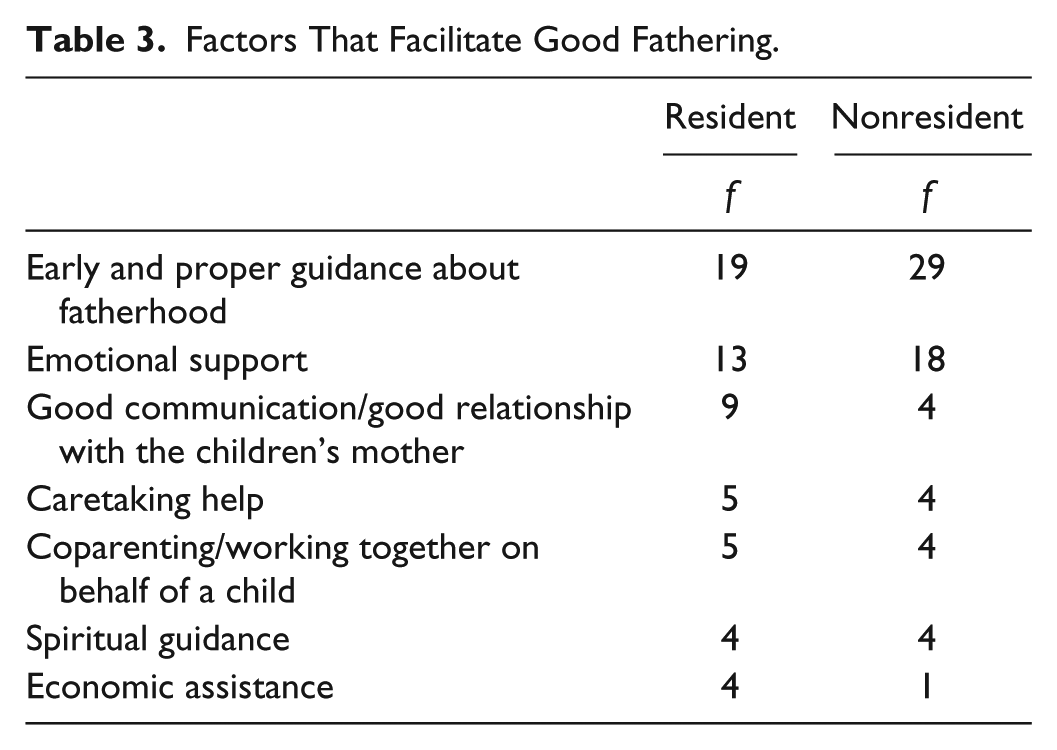
Several resident and nonresident fathers mentioned that a variety of sources such as their family, others, church, and even television shows like the Cosby Show helped shape their role in fatherhood by providing them with these facilitating factors. In regard to what has helped him become a good father, one father stated, “Well, first and foremost, my own father.” Fathers also felt that family support was an important factor that facilitated fathering. In addition to receiving help and encouragement from their parents, these fathers reported that their grandparents, aunts, uncles, brothers, cousins, and their children’s maternal family members were supportive. Below are two fathers’ views:
Yes, I have my family. My mom she’s very supportive and my grandparents . . . my grandmother. Now they’re very supportive of me. So those are my two main supports. I don’t really have my child around a whole lot of people as far as different types of people. My mom and my grandparents . . . grandma are the two main supports that I have. Family, her family is very supportive. My family is very supportive. We actually have a great network of friends and that’s hard to, to have like, between her family, my family, and both of our friends, we have a huge group of people that help raise our kids. So, it’s a blessing.
Resident and nonresident fathers desired to have emotional support from their family and friends, and one father reported needing to receive compassion and understanding from the children’s mothers:
Actually, I had recently been terminated from my previous job . . . She supported me through this little time, even though I was receiving unemployment she was still there to tell me it was okay. Push me to go hard, push me to find something better for myself and it’s not just supporting me financially, but it’s supporting you emotionally and spiritually.
While some fathers felt that support was there, others felt they lacked support to become a good father. One said, Kind of learned it on my own. Like, my dad he wasn’t really there when I was younger so it was just like I know the feelings that I had coming up, so like, why would I want someone else to have those same feelings coming up.
When they did not have a father or father figure in their life growing up, they sought other means for learning their fatherhood role. A second father noted,
I pretty much learned from other people. Just interacting with other parents, you know. I come across people that may have their kids with them in public or you know, going to events that involve a lot of parents with their kids. Ask questions if I’m not sure of something or try to get an understanding on how to handle being a parent in my position.
And a third said,
The best example is probably my neighbor’s father, ’cause I didn’t meet my pops until I turned 13. And I always like, me being a father, I always think back to what would he do in that situation. ’Cause I feel like he was the best example that I’ve had as a father.
The quotes below illustrate fathers’ religious or spiritual support toward good fathering, as well as support from spiritual leaders to shape their parenting. They expressed that the church is a home for many fathers, and church figures play the role of a mentor as well to fathers. Some fathers who did not have a father involved in their lives relied on church figures to teach them how to be a strong support for their children. One said,
Mainly my relationship with Christ. I learned a lot just from him. Love and you know, from a son to father love through Christ. And my love to my daughter, you know that unlimited love that he gives to me, that I feel for my daughter. You know, I understand true love when I have that relationship with Christ. That answers that . . . and my pastor as well, he preaches heavy on being a father being, a real man and a man of Christ.
Another father said,
Church, church, church, church. It’s big in my household. Every Sunday we are in church, rain, sleet, or snow. On Wednesdays, Bible study. Kids are in the choir because you got to have that foundation, you know what I’m saying . . . Social services, they do Medicaid but other than that, the food stamps. I provide for them, but, church is the physical and like a second father to them, you know what I’m saying. I tell them all the time, if I’m not here, go to church. If for some reason you don’t have me in your life, stay in church, you know what I’m saying. Because that’s going to steer you the right way.
Factors that inhibit good fathering
Six themes described the barriers to fathering: (a) economic challenges, (b) mothers preventing father−child contact/custody issues, (c) others’ negative talk and views about fathers’ ability, (d) seeing poor examples of what fatherhood entails, (e) fathers not prepared to care for child/receiving little information about parenting, and (f) mother−father poor relationship/inability to work together (see Table 4).
Factors That Inhibit Good Fathering.
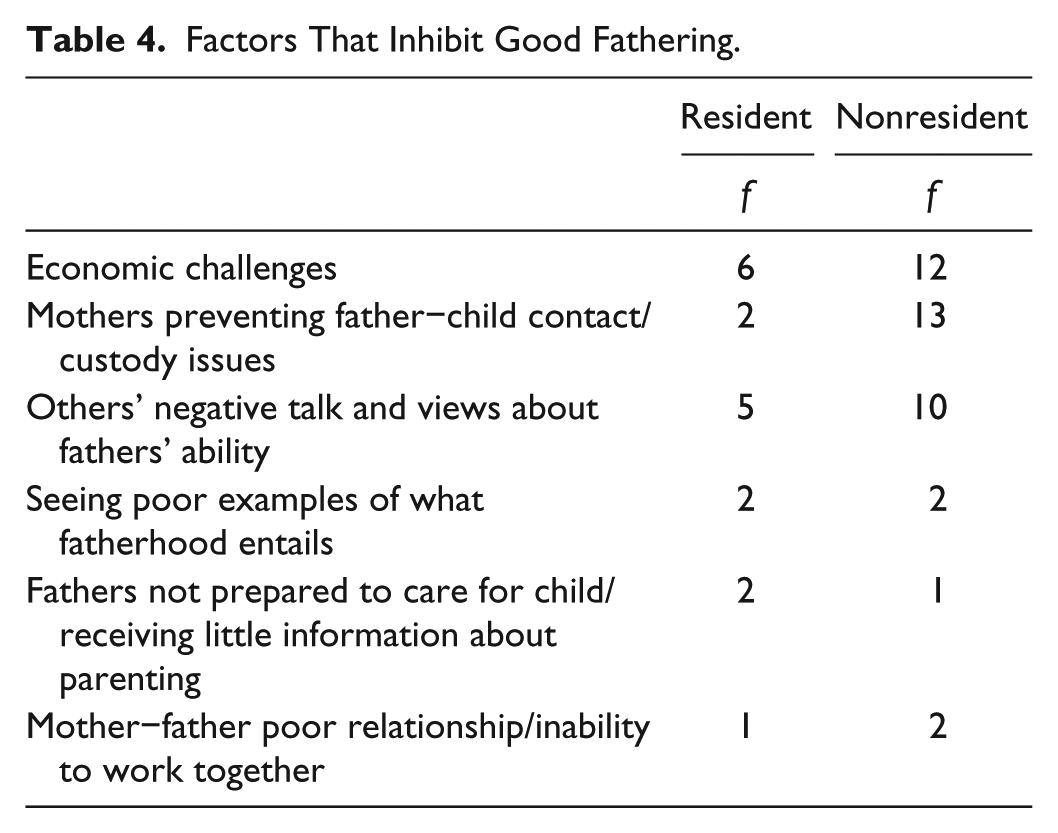
Fathers understood the importance of having a positive relationship with the mother of their children. However, some felt that if they could get along with the mother of their children, it should not affect their relationship with their children. One nonresident father talked about overcoming his possible barrier:
We do not get along, if I don’t do what she says or tells me or request for me to do, I don’t have access to my children. I’m blessed because I’m starting to realize that my children know the truth #1, and #2 it doesn’t matter because they still love daddy because daddy tries. Even though me and mommy are separate, daddy tells you to come over and spend the night, then he picks you up—daddy, and is involved in your life. So the real difficulty is between a mom being angry or upset. Regardless if she still loves daddy or not or loves me or not, it’s just about using her anger to stop me from seeing my children.
Some nonresident fathers discussed being subjected to the mothers’ gatekeeping to see their children. Often, fathers had to endure some kind of unwanted interaction with the mother. They expressed the need to have a relationship with the child even if it did not include the mother. This did not necessarily imply that fathers disliked the children’s mothers. Rather, the fathers yearned for a relationship with their children and preferred to deal with their children only. One said,
When I call or if I do decide to go by the house. Being told you can’t see your kids or “no, your kids can’t visit you,” by the mother. There is only but so much you can do, I mean, you can’t just up and call the police and say, “hey I’m not able to see my kids can you get my kids out the house for me?” Especially, if you don’t have any type of custody arrangements, you know, those type of things . . . You have to go to court for those matters. Also, I can’t physically just go in the house and take them even. You know, there is consequences with that. That’s what’s been or who’s been holding me back from my children.
Another nonresident father reported a similar challenge:
. . . probably about the only obstacle I can think of—for any father— is not being allowed to see your children. When you’re not allowed to see your children that’s a very big obstacle. I mean, you have to be able to speak to them. You have to be able to spend time with them. And I’m not talking about just around the mother or anyone else but you need time with them alone. Personally, that’s my only obstacle is not being allowed to see my kids.
A third nonresident father noted, “. . . I decided to buy my daughter a phone so we could talk to each other whenever because I did not like waiting for her mother to let me call her.”
Some fathers felt they had adequate contact or visitation with their children with support from the children’s mothers—albeit conditional support in some instances for nonresident fathers. That is, they reported that their ability to interact or have a relationship with their children was contingent on whether the children’s mothers were pleased with the fathers’ financial contributions or just happy in general with the relationship between the parents. Fathers stressed that if parents cannot get along with each other, that does not mean they cannot have a relationship with their children. Furthermore, they thought that it was important for fathers to be able to communicate with the mothers about their children, and set aside issues they had with each other. Some nonresident fathers also shared their frustration about unreasonable demands from the children’s mothers regarding child support. One said,
I do take care of my child, you know. I do give her things other than child support. But no, I think that having some conversations with her she expects me to pay more. Even though I live so far away and only work part time and going to school. She expects me to pay more.
Another nonresident father reported a similar experience:
Initially she didn’t [support me] because I told her I couldn’t pay child support because didn’t have a job. And once I got child support and was paying it she started being more receptive to me. And it wasn’t like I didn’t want to see my child because I couldn’t pay. And I don’t feel like I should have to pay to see my child. But, at the same time I know that there is a financial obligation to see my child and that’s my responsibility and I don’t mind that. But, if it was not for me paying my child support, she wouldn’t be so supportive.
Summary of Comparisons Across Household Status
More often, resident fathers reported having a positive view of the children’s mothers in regard to what is needed to facilitate good fathering (see Table 3). They stated that the mothers supported them, and in hypothetical terms, explained how challenges could be worked out between them in order to set a good example for the children. Conversely, nonresident fathers usually referred to specific experiences that had occurred or a current situation that could be exacerbated. Their accounts regarding problematic relationships with the children’s mother about child support also included statements about how it would affect the children or jeopardize the father−child relationship. Furthermore, nonresident fathers reported more frequently than resident fathers that they had experienced financial problems and had challenges with child support payments. Resident fathers, on the contrary, did not see the child support as a relevant issue for them. Though, one resident father spoke about having financial issues as it related to him needing to prioritize spending choices. But, he did not indicate that it had the potential to negatively affect the mother−father or father−child relationship.
Nonresident and resident fathers felt that it was very important to have a good relationship with the children’s mother. However, unlike the nonresident fathers, resident fathers did not speculate about it adversely affecting their father−child relationship or visitation. The tone of nonresident fathers’ interviews was more negative in regard to the mother−father relationship and their financial challenges that they felt ultimately could affect the father−child relationship. Moreover, they felt that if they did not pay child support, then their children’s mothers would talk poorly about them and not allow them to visit their children. Only one married father’s responses reflected those of the nonresident fathers. He reported that one of his babies’ mother created obstacles for him. Mothers preventing father−child contact/custody issues, economic challenges, and others’ negative talk and views about fathers’ ability were the barriers most frequently reported by nonresident fathers compared with resident fathers (see Table 4).
Wanting to spend time with their children to fulfill various fatherhood roles was common for resident and nonresident fathers. However, resident fathers spoke of this phenomenon casually, without having to consider barriers to enjoy the splendor of those roles. Nonresident fathers, however, referred to spending time with their children as a phenomenon that could only be enjoyed if they could overcome obstacles from their children’s mothers.
Discussion and Implications
Nontraditional Father Roles
Our findings indicated that most of the fathers in this study were very engaged in their children’s lives, which is similar to previous studies (e.g., Coakley, 2013; Malm et al., 2006). Resident and nonresident fathers further reported various benefits to their being present in their children’s lives. The frequencies of their reports did not differ much across household status. In addition to the widely accepted roles of provider and protector, fathers also viewed themselves as having qualities of caregivers, role models, mentors, and nurturers. However, they had serious concerns about how their children’s mothers and their family members perceived them as fathers when they did not live up to their role as provider. According to Lamb (2010), when parents assume less sex-stereotyped roles, it leads to children placing less importance on sex-stereotyped roles and children having two involved parents rather than just one—and a high level of involvement from both parents. This creates opportunities for both parents to become fulfilled because they engage in activities that promote closeness with their children. Nevertheless, fathers in the present study acknowledged that their definition of involvement and types and level of support they provided might not be considered sufficient by others’ or society’s standards.
There is a clear need to educate the public, social service agencies, and fathers’ families about the multifaceted fatherhood role. This is particularly important because society has held on to preconceived notions about fathers as primarily breadwinner and protector, making it difficult to accept the idea that they deserve government assistance to raise their children and support their families. Educating the public can bring more realistic views of the fatherhood role and the types of services needed for fathers to support their children and families (Rosenberg & Wilcox, 2006).
Parent Socialization
Nonresident fathers, compared with resident fathers, stated more frequently that early and proper guidance about fatherhood and emotional support facilitated good fathering (see Table 3). Our findings indicated that fathers learned positive ways to parent from a variety of sources and in a number of ways. Some fathers reported learning from their own fathers, who talked to them about becoming a man and the responsibilities of fatherhood. They expressed more often an appreciation for receiving information about manhood or having man-to-man talks with positive male relatives and nonrelatives (e.g., church mentors) than with various females. Although fathers reported that their mothers had been supportive, only two mentioned that they learned about fatherhood from their mothers. This lends some credence to the popular notion that mothers can’t teach a boy how to be a man. Furthermore, this finding is noteworthy as it is estimated that there are 8,365,912 (7.2%) households in the United States headed by single-mothers (U.S. Census Bureau, 2012c).
In regard to other facilitators of good fathering, several fathers said that they were mentored by men in church about fatherhood responsibilities, and spoke extensively about church, God, Christ, the Bible, and spirituality. Given this discovery, faith-based services might thus be an alternative natural resource to men who are leery about seeking outside assistance for their personal problems. Most church services are free or virtually free, which is a huge bonus for young fathers and fathers with low incomes. In addition, because places of worship are usually local and familiar, they can reach out to help fathers who have limited resources.
There was no mention from the fathers in this study about learning about fatherhood from a formal class, books, DVDs, or the internet—methods that are more readily available today than ever. They may have failed to use these methods because they involve costs that many fathers might not be able to afford. Or they might have used these methods and neglected to say so during the interview. In addition, fathers recruited from a father support/mentor group did not state in definitive terms that their present support/mentor group facilitated good fathering. Although some reported that nonrelative males helped them, there is no way of knowing if that included the facilitators or members in their group.
In the present study, only two fathers said that they had a need for parent education or better parenting skills. However, based on their overall disclosures about casually acquiring fragments of information about parenting and seeing poor examples of what fatherhood entails, there may be a need for fathers to learn proper ways to parent their children to promote their healthy development. This is an area for future exploration, as the present study did not solicit that information. Nevertheless, we speculate that parenting education for males could provide them with a more accurate view of fatherhood responsibilities and roles and enhance parenting knowledge and skills (Hook & Chalasani, 2008).
Financial Programs
One of the most critical barriers that emerged from this study involves fathers’ financial challenges. Nonresident fathers reported that when they did not have the finances to pay child support, their right to spend time with their children was jeopardized. This finding is supported by previous research that found that mothers were more likely to refuse visitation if they did not receive financial support from the fathers (Fagan & Barnett, 2003). Social workers should consider a comprehensive socio-ecological approach to address barriers that males face when parenting. For example, to address fathers’ financial challenges, programs in a few states are evaluating the effects of modified child support payment requirements on father involvement and children’s outcomes. However, it is unlikely that this will be an option in the near future for the vast number of men in the United States. Therefore, linking fathers with financial assistance services is a realistic temporary solution, and linking them to employment services that lead to meaningful job placement would be an effective long-term solution: 13.3% of the nonresident fathers in this study were unemployed, much higher than the national unemployment rate for adult men (7.3%; U.S. Bureau of Labor Statistics, 2012).
Coparenting
Similar to previous studies on coparenting and the mother−father relationship, nonresident fathers in this study have also noted the barriers mothers create around child visits (Fagan & Barnett, 2003; Fagan & Palkovitz, 2011). Some fathers expressed feelings of exasperation and little hope about interacting with the children’s mother to be a part of their children’s lives. The majority of fathers wanted to have a special time when they could bond with their children without the mother looking down on them or influencing the children to have negative opinions of them. Fathers said, however, that regardless of barriers created because they had a negative relationship with their children’s mother, they had a desire and obligation to do whatever they could to visit and have a relationship with their children. Social workers can play a role as family counselors by enabling fathers to work with a mediator when things cannot be worked out amicably between the mother and father.
Several of the nonresident fathers in this study reported that they preferred to have little or no dealings with their children’s mothers when they visited their children or made arrangements to pickup or interact with their children. Strained relationships were reported as a potential challenge to fathers’ involvement with their children. Fathers may need to learn how to coparent, an approach that places the mother and father in equal parenting positions, strengthens families, and helps minimize mother−father arguments (Allen & Hawkins, 1999; Fagan & Barnett, 2003; Fagan & Palkovitz, 2011). Fathers can also overcome negative mother−father relationships by gaining an understanding of the situation of their children’s mother. In addition, nonresident fathers who are no longer in a romantic relationship with their children’s mother could benefit from information about dealing with stressful situations that might lead to their walking away when they cannot handle a situation, or reacting inappropriately, which might result in their being incarcerated. Sheppard, Sims-Boykin, Zambrana, and Adams (2004) advocate for interventions with fathers and mothers together, rather than addressing only fathers’ issues, because both parents are important for children’s development.
Limitations
These findings are limited by the use of a convenience sample. Furthermore, some fathers were participating in a fathers’ support/mentoring group at the time of the study or they were friends with someone who was participating in the group. Therefore, it is likely that they were more knowledgeable than many fathers about the supports available to them or parenting strategies. They might therefore be more assertive with advocating for helpful family or financial resources that they feel they needed or minimizing challenges in the mother−father relationship compared with those who were not associated with a fathers’ support/mentoring group.
Also, this sample was comprised mainly of African American fathers; thus, the role of culture likely influenced the findings. As we stated earlier, minority men have been disproportionately affected by unemployment and low income compared with Caucasians (DeNavas-Walt et al., 2011; Harris & Marmer, 1996; Nelson, 2004), which can inhibit their parenting.
In addition, understanding how the composition of the fathers’ childhood household would have influenced their perspectives about their roles went beyond the scope of the data. Future studies should include items about whether they grew up in single-parent households and whether they were male or female headed, as well as their current living and formal custodial arrangements.
Finally, the sample size also adds some limitations. Although it is typical to have a small sample in qualitative studies, it is important to note that all the characteristics of fathers, such as race/ethnicity or income level, were not represented here. Therefore, we cannot state definitively that the findings apply to those fathers whose characteristics were not represented.
Conclusion
Despite these limitations, the study provides useful insights into fathers’ views of their parenting. Resident and nonresident fathers in the study strongly desired to raise their children and contribute positively to their development. However, barriers to fathering are much more complex for nonresident fathers. Therefore, in their efforts to keep fathers engaged in successfully raising their children, social workers must understand the differential effects that household status, as well as other cultural factors, have on parenting supports and barriers.
Footnotes
Acknowledgements
The authors wish to thank William Dudley for supporting this research, and Elizabeth Tornquist for her editorial suggestions.
Declaration of Conflicting Interests
The author(s) declared no potential conflicts of interest with respect to the research, authorship, and/or publication of this article.
Funding
The author(s) disclosed receipt of the following financial support for the research and/or authorship of this article: This study was funded by the University of North Carolina at Greensboro School of Health and Human Sciences Office of Research, and the University of North Carolina at Greensboro Scholars’ Travel Fund.