




Abstract
Deviant workplace behavior violates organizational standards and has the potential to hurt either the entire organization or specific members of the organization. It is a serious and present problem in the workplace. Workplace culture have been linked to deviant workplace behavior however, there has been a scarcity of research and reviews on the impact of workplace culture on deviant workplace behavior. Scopus, Sage, MEDLINE and Web of Science Journals were used to look for terms relating to workplace culture (workplace culture, organizational culture) as well as terms related to deviant workplace behavior (deviant behavior, deviances). Original research, samples, or gendered employee subsamples were considered for this evaluation of workplace culture that have an impact on deviant workplace behavior, and the research must be completed in English. This evaluation has 19 publications that passed the eligibility criteria. This review’s results showed that deviant workplace behavior is significantly influenced by workplace culture with different interpretation of culture and measurement used. These findings are explored in light of existing gaps in the literature and fresh research opportunities.
Plain Language Summary
A systematic literature review on Impact of Workplace Culture on Deviant Workplace Behaviour. Using PRISMA method, 19 publications that passed the eligibility criteria regarding the impact of workplace culture on deviant workplace behaviour has been selected from Scopus, Sage, MEDLINE and Web of Science Journals dated from 2012 to 2022. Original research, samples, or gendered employee subsamples were considered for this evaluation of workplace culture that have an impact on deviant workplace behaviour, and the research must be completed in English. This review's results showed that deviant workplace behaviour is significantly influenced by workplace culture with different interpretation of culture and measurement used. This study has the potential to make a contribution to the body of research that focuses on workplace culture as a possible instigator of employee deviant behaviour in the workplace. The gathering of data on workplace culture and its effect on deviances will be beneficial to both public and private sector organisations because it has been established that workplace culture plays a vital role in preventing the manifestation of deviant workplace behaviour. Future studies could afford to explore other criteria to expand the sample size for systematic review to attain a larger sample in order to advance research on the effect of workplace culture on deviant workplace behaviour.
Keywords
Introduction
A straightforward explanation of workplace culture is “how things are done around here” (Drennan, 1992). The term “workplace culture” refers to the shared values, opinions, or perspectives held by employees within a company or organizational unit (Robbins & Coulter, 2018). Culture is best defined as a set of psychological predispositions, known as basic assumptions, maintained by members of an organization that impact how the members behave (Schein, 1985a). Trevino (1986) in her study on ethical decision making in organizations, stated that environmental and organizational factors have been shown to influence employee behaviors and attitudes. Workplace culture can be a set of written or unwritten rules that must be adhered to by all employees to be accepted in the organization. These organizational norms, or those established by formal and informal organizational policies, rules, and procedures; are defined by social groupings rather than by a set of absolute moral standards. Thus, certain workplace cultures can be construed as an act of deviance and impact an employee’s morale conscience.
A group’s morale is described as a psychological state that all of its members share and consists of feelings of pleasure with the circumstances affecting the group (Wood et al., 2012). It is common knowledge that low morale in the workplace leads to burnout, which in turn can have severe repercussions on an employee’s mental health and overall welfare (Milner et al., 2016; Teo et al., 2021). It is safe to say that workplace culture which is an organizational factor, can affect an employee’s morale and lead to deviances. Sabitova et al. (2020) discovered that a supportive working atmosphere, collaborative teams, and fair, honest, and transparent processes were all positively connected with job morale in a study of healthcare employees. In addition, it has been discovered that working in a learning culture improves clinical services and that assisting clinicians in their work boosts morale and increases worker retention (Blanchard et al., 2020; Sabitova et al., 2020; Senge, 2006).
Generations of sociologists (Blake & Davis, 1964; Etzioni, 1988; Parsons, 1937; Scott, 1971) beginning with Durkheim (1895, 1903), have argued that moral norms and laws are essential to social organization because they prevent individuals from engaging in deviant behavior and promote social solidarity and cooperation among members of society. Morality has been demonstrated to be a strong independent predictor of criminal probabilities and misbehavior, with a strength that appears to outperform self-control as a predictor of criminal probabilities and misbehavior, requiring greater attention as a potent variable in understanding misconduct (Antonaccio & Tittle, 2008).
A prominent white-collar crime theory holds that organizations have diverse cultures that allow legal transgressions for the sake of the company (Apel & Paternoster, 2009). Employees must learn and adopt such culture just as any other organizational practices are learned. Workplace culture can be morally acceptable practices or morally controversial ones that benefits an organization. Some sectors have a system of values or cultural prohibitions that are “friendly to lawbreaking,” and criminal behavior flourishes within these industries and businesses regardless of the characteristics of those who work for them (E. Sutherland, 1983). Thus, E. Sutherland (1983) suggests that a deviant act can be committed regardless of one’s attributes and caused by the culture surrounding oneself.
E. H. Sutherland (1949) also stated that two empirical characteristics had to be accounted for regarding white-collar crimes: (1) workplace conduciveness to criminality; Certain industries appeared to be more conducive to crime over others and (2) engagement in law violations; Some corporations or organizations were more engaged in unlawful activities than others within specific industries. Deviant acts are produced because there is a culture within organization or within sections inside an organization that offer normative support for such illegal behavior as well as a framework of incentives to encourage compliance with such standards and as penalty for noncompliance. As such, it is suffice to say that deviant act may be due to organizational features such as workplace culture and organizational climate. Normative cultural characteristics of organizations is widely cited as a leading factor in encouraging deviant act along with corporate and white-collar criminal activity (Hawkins, 2002; Shover & Hochstetler, 2006).
The impact of workplace culture on deviant workplace behavior might also be framed via the lens of Social Exchange Theory (Blau, 1964). Social Exchange Theory states that workers and their employers have an interdependent relationship in which one party’s behavior effects the other. According to this idea, values, standards, and all other aspects of workplace culture are learned through earlier exchange experiences shared by individuals in the organization (di Stefano et al., 2019). Since exchange of norms normalizes guidelines for conduct around employers and employees, deviant workplace behavior can be construed to have been facilitated by social exchanges between employee and their organization (Liao et al., 2004).
The connection among both workplace culture and deviant behavior in the workplace can also be further explained by Social Information Processing theory. According to this notion, individual attitudes are created through the processing of information about socially relevant behaviors. As a process, individuals “adapt attitudes, behaviour, and beliefs to their social context and to the reality of their own past and present behaviour and situation” (Salancik & Pfeffer, 1978). This idea also indicates that employees look for cues in their work surroundings to characterize their working atmosphere and determine how to behave (Mayer et al., 2010). In other words, workplace culture provides signals and hints for employees regarding acceptable or unacceptable behaviors and behavioural appropriateness in the organizational setting. Workplace culture can also create peer pressure for new employees to conform to organizational norms, so as to be appreciated and accepted among employees and friends. Such tension may include performing deviant behavior, which violates the employee’s morality or beliefs (Zakaria et al., 2022).
Studies have suggested that two sets of variables correlate to deviant behaviors in the workplace: variables at the individual level and other variables at the situational or organizational level (Alias et al., 2013; Appelbaum et al., 2007; di Stefano et al., 2019). Psychopathy, inadequate self-control, and a challenging temperament are significant variables, according to research on the relationship between individual personality traits and criminality (Tharshini et al., 2021). Although research usually supports the major effects of various personality variables on organizational results, effect sizes for their function in predicting deviant workplace behavior are small in general, leaving a lot of variation unexplored (Kish-Gephart et al., 2010). Based on this understanding, this study posits that organizational-related variables could be useful in improving the explanatory power of workplace misbehavior (di Stefano et al., 2019; Mount et al., 2006).
Researchers have also emphasized the significance of workplace culture in terms of affecting deviant workplace behavior (Dunn & Schweitzer, 2005; Goldman et al., 2006; Vardi & Weitz, 2003). This study adopts other scholars’ assertion that workplace culture influences deviant organizational behaviors are clear (Boye & Jones, 1997; Goldman et al., 2006; Kidwell & Martin, 2005; O’Boyle et al., 2011). A more recent study done by di Stefano et al. (2019) noted that workplace culture seemed to influence deviant workplace behavior in the direction of both employees and the organization, which is consistent with the work of Hill and Jones (2001) who observed that shared values, norms, beliefs, and goals impact the dynamics of relationships within employees, between organizations and employees, and even between organizations and external stakeholders (di Stefano et al., 2019).
Furthermore, a study done by Mathieu (2021) found support for the relationship between an individual’s personality and work misbehavior. Specifically, Mathieu (2021) stated that people with negative personality qualities are more prone to conduct fraud, perpetuate leadership behavior that is abusive, engage in acts of harassment and bad manners, and exhibit inadequate quality of work. Our premise is that individuals with dark personality qualities appear to operate in an environment that provides them with freedom and access to resources, while retaining a minimal level of organizational structure and control in order to achieve their self-serving objectives. Such a work environment incorporates employee and management selection processes that are disorganized or politically motivated, has an absence of anti-fraud mechanisms, and has an organizational culture that tolerates negative interpersonal behavior.
The above findings are linked to what represents unethical and ethical work ethos. Based on Victor and Cullen (1987), the agreed viewpoints on what constitutes ethical behavior and how ethical concerns should be addressed inside the organization are referred to as the ethical climate of an organization. On the surface, the notion of organizational climate and its cultural equivalent are different, but from a practical standpoint, they overlap (Ng & Ng, 2014). The current literature is not unanimous on what organizational culture and climate are, or how these concepts should be operationally measured (Shim, 2014).
Nevertheless, it has been proposed that the ethical climate of an organization is not limited to employees’ ethical behavior, but also to a variety of behaviors, including behaviors that are detrimental for example tardiness, absenteeism, and lax performance (Wimbush & Shepard, 1994). Kagaari (2011) had earlier confirmed that organizational culture and climate have a moderating effect on performance management techniques and managed performance. It appears that the ethical climate of an organization will dictate workplace culture, and in turn have an effect on deviant behavior in a workplace. We are of the opinion that ethical climate of an organization which relates to workplace culture may be predictive of both ethical behavior in addition to the frequency of deviant workplace behaviors. This would seem to further provide support for the possibility that workplace culture may have an impact on deviant behavior in the workplace.
Every aspect of human life has changed after the global COVID-19 pandemic breakout in March 2020, and recent studies indicate that criminal and aggressive behavior may also have been impacted (Regalado et al., 2022). The temporary closure of establishments reduced the number of individuals in public settings, hence reducing opportunities for social interaction. This decrease in social interaction therefore affected people’s propensity to commit various deviant behaviors, such as physical altercations or DUI-related car accidents (Calderon-Anyosa & Kaufman, 2021; Gerell et al., 2020). Crime statistic comparisons for 2020 and 2021 showed a marked decrease in violent and property crime incidents. For example a 19.3% decrease for Malaysia (Department of Statistics Malaysia, 2022).
Following the implementation of stringent lockdown measures during the initial wave of the pandemic, the Internet became the default mode of communication and continues to be a major platform for work, classes, consultations, shopping, and socializing (Regalado et al., 2022). Consequently, we have seen what is known as a “transition” from the physical to the digital world (Miró-Llinares & Moneva, 2019; Monteith et al., 2021; Plachkinova, 2021). Organizations’ reactions to this transition often lead to botched cultural change processes (Spicer, 2020).
However the disruption of the work culture presents researchers with a number of key opportunities. The most important set of questions is: How resilient are organizational cultures? What changed in these cultures? How do changes in the symbolic work affect organizational culture? Will there be big changes in the culture of the organization as a whole? What are the actual impact of these changes on culture? (Spicer, 2020). An additional group of inquiries could center on the ways in which alterations to organizational culture can have an effect on individuals, employees, and their behavior, as well as the ways in which it will influence deviations.
There are many interpretations of workplace deviance in academic literature. Most of them agree that workplace deviance is horrendous for organizations. Workplace deviance is defined as voluntary employee behaviors that violate organizational norms and having the ability to hurt either the organization as a whole or individuals inside it. This topic has sparked increased research interest (Gruys & Sackett, 2003; Robinson & Bennett, 1995; Spector et al., 2006). Robinson and Bennett (1995) in their study on typology of deviant workplace behaviors divide workplace deviances into four categories: Production Deviance, Property Deviance, Political Deviance and Personal Aggression. Deviances in the form of personal aggression is not only a type of deviant workplace behavior but it is also a criminogenic feature that is frequently linked to numerous violent crimes (Kamaluddin et al., 2016). Furthermore, physical well-being-threatening behaviors, such as fights and other physically aggressive involving peers, are strongly associated with bullying involvement (Sabramani et al., 2021).
Deviant behavior has negative consequences for people, groups, and organizations. Administrators and human resource managers must therefore describe the predictors of anomalous behaviors inside their organizations (Abbasi & Ismail, 2017). Examples of deviant workplace behaviors include fraud, acceptance of bribes, using one’s power to hurt others in organization, and endangering co-workers. Bennett and Marasi (2015) defend that workplace deviance is a worrying organizational behavior issue. Deviant workplace behaviors are a collection of distinct behaviors that harm or attempt to hurt organizations and their stakeholders. In government organizations, the stakeholder is the general populace.
Plenty of research have been conducted to determine the factors that influence deviant behavior at work (Abbasi et al., 2022; Aryati et al., 2018; Öztürk & Yüksel Poyraz, 2021; Peterson, 2002; Wang et al., 2022). To alleviate deviant behavior in organizations, it is vital to have a comprehensive awareness of the factors that influence an employee’s propensity of engaging in deviant behaviour (Öztürk & Yüksel Poyraz, 2021). When employees experience various sorts of deviance at work, they either reciprocate to co-workers or stray from it, and both action incur costs to the organization (Abbasi et al., 2022). These costs, together with cost associated with excessive breaks, squandered resources, sabotage, and other workplace deviance-related actions, show that workplace deviance is a substantial and critical problem that has to be forcefully handled (Spector & Fox, 2010).
The shortcomings, following an examination of previous evaluations discussing the impact of workplace culture on deviant workplace behavior, is glaring. There are few reviews addressing this relationship, and even fewer empirical research highlighting the importance of situational circumstances such as organizational climate perceptions, ethical climate, injustice perceptions and perceived organizational support. It appears that most empirical research has neglected this macro-level, contextual predictor in favor of more controllable antecedents such as organizational ethical climate or organizational justice (di Stefano et al., 2019). Therefore, to further understand the factors of workplace deviances, the effect of workplace culture on deviant behavior in the workplace merits a systematic and thorough investigation. The objective of the present systematic literature review is to provide a short and systematic evaluation of the research concerning the effects of workplace culture on deviant workplace behavior. It accomplishes this by maintaining explicit inclusion and exclusion criteria, as well as clarity regarding how the quality of the sampled studies was evaluated. In this sense, the results offer a useful synthesis of prior knowledge to guide future behavioural science research directions especially in a workplace environment. The inconsistent results of other studies will be clarified by this study, which examines several factors of workplace culture on deviant workplace behavior in an organization.
Materials and Methods
The PRSIMA flowchart was used to summarize the search process for this systematic review, which adheres to the PRISMA (Preferred Reporting Items for Systematic Reviews and Meta-Analyses) guidelines. The QUAROM guideline, which consists of a checklist and flowchart with 27 components, has been improved into PRISMA (Munusamy et al., 2022). The flow diagram outlines the selection, eligibility, screening, and inclusion standards for reports that fall under the purview of a review (Selçuk, 2019). Sierra-Correa and Cantera Kintz (2015) claim that PRISMA has three key benefits: the ability to define explicit research questions in order to do systematic highlights, the ability to use both inclusive and exclusive criteria, and the ability to quickly analyze a big database. PRISMA was used to identify earlier studies on the impact of workplace culture on deviant workplace behavior in this systematic review.
Regardless of the methodology chosen to do a literature review, whether systematic literature review or other (narrative), there are two essential characteristics that must be present in a good literature review: selection of information sources and gathering of data with sufficient quantity, quality, and dependability (Mangas-Vega et al., 2018). In order to carry out a literature review, it is necessary to pick quality publications based on the journals that are deemed to be of high quality (Wallace & Wray, 2016; Xia et al., 2018). Our search used the following four databases: Scopus, Web of Science, MEDLINE, and SAGE Journals. The fact that these databases provide coverage for a greater number of high-quality journals was a primary factor in our decision to use them.
Scientific databases, whether general or specialized, benefit from the support of major corporations or esteemed publishers who vouch for the accuracy and dependability of the data as well as the selection criteria (Mangas-Vega et al., 2018). However, in contrast to other fields, the vast majority of the scientific literature in the field of Humanities is dispersed across numerous sources of information; consequently, it is fraught with peril to restrict the searching of data to a single source, as is the case with some other investigations (Sivarajah et al., 2017). The use of these four databases from prestigious publishers will both guarantee the high standards of the journal and significantly increase its potential readership. The systematic review process consists of three parts. Identification is the first stage. Screening follows, and the inclusion procedure is the last stage (refer to Figure 1).

Diagram showing the identification, screening, and inclusion of articles.
Finding the keywords to be employed in the search strategy procedure is the first step. Based on prior research, similar phrases and terms relating to the effect of workplace culture on deviant workplace behavior were utilized. The keyword list was examined and improved, for instance, the insertion of various spelling variants. The final form of the keyword search list is presented in Table 1. The primary goal of this research is to identify empirical quantitative studies regarding the association between workplace culture and deviant workplace behavior. Several items were considered as a method for discovering criteria as presented in Table 2. In this study, we looked for articles published between 2012 and 2022 (within the previous eleven years) such that the most recent information synthesis and retrieval research might serve as the foundation for our evaluation of the literature.
Keyword Search List.

Article-Discovery Criteria.

From July 4 through July 9, 2022, the databases Scopus, MEDLINE, Web of Science, and SAGE Journals were searched for studies. Figure 1 depicts the overall number of articles retrieved, the number of surviving articles after deleting duplicates, the number of articles that did not fulfill the inclusion criteria, and the articles chosen for further investigation. There were initially 698 papers. Using the search parameters across all four databases, 271 articles were retained after deleting all the duplicates. In the initial screening phase, 220 titles were eliminated after each paper’s title and abstract were assessed for relevancy. The eligibility of the studies’ full texts was then evaluated in accordance with their methodology and conclusions. After reading the entire article, several manuscripts were rejected for a variety of reasons. Among those that were deleted were manuscripts that did not define the phrase “workplace culture,” manuscripts that were reviews of secondary sources, and papers that just quantified the link. Finally, 19 manuscripts were included and deemed to be eligible for study. Figure 1 depicts the PRISMA flow diagram.
Results
The flow diagram of the identification, screening, and inclusion of articles is shown in Figure 1.
Measurement of Workplace Culture and Deviant Workplace Behavior
Two main measures for workplace culture used in samples that involved employees in public sector and private organization are Organizational Culture Assessment Instrument (OCAI) by Cameron and Quinn (1999) and FOCUS Questionnaire developed by van Mujien et al. (1999). Other scales measured more macro parts of organizational culture such as toxic work culture, abusive supervision, perceived organizational injustice, power distance culture, tightness-looseness, organizational politic, aggressive work culture and hostile organizational climate. A plethora of studies tend to portray organizational climate and perception of leadership or supervision as organizational culture. Most frequent organizational culture measured were abusive supervision (Mawritz et al., 2014; Syed & Azam, 2019; Tiwari & Jha, 2022; Valle et al., 2019), organizational justice (Loi et al., 2020; Nasir & Bashir, 2012), aggressive work culture (Mawritz et al., 2014; Restubog et al., 2012) and organizational politic (Bashir et al., 2019; Rosen et al., 2016).
The workplace deviance scale created by Bennett and Robinson (2000) is the most commonly utilized. Other studies measured specific deviant acts such as incivility via behavioural identification (Rosen et al., 2016), police misconduct (Lim & Sloan, 2016), critical incident technic (Restubog et al., 2012) and police self-protective behaviors (Helfers et al., 2018). Another tool for measuring deviant behavior at work as a whole is a scale developed by Aquino et al. (1999) as described by Nasir and Bashir (2012). Rahmah et al. (2021) study on work ethics at the police corps used unethical behaviour as measurement of deviant workplace behavior.
Synthesized Findings
Nineteen studies in total were chosen for review. Only four manuscripts (Aleksi’c et al., 2019; di Stefano et al., 2019; Načinovi’ et al., 2020; Zoghbi-Manrique-de-Lara & Ting-Ding, 2016) directly measured workplace culture using either Organizational Culture Assessment Instrument (OCAI) by Cameron and Quinn (1999) or FOCUS Questionnaire developed by van Mujien et al. (1999). Other manuscripts used more directly observed antecedents in their study to reflect a specific variable of workplace culture involving employees’ personal circumstances and experiences. This contradict di Stefano et al.’s (2019) argument that instead of focusing on workplace culture at a macro-level and as a contextual predictor, the majority of the research explicitly addressed the link between organizational variables and deviant workplace conduct, emphasizing the relevance of situational variables. However, all the variable that had been previously investigated, can still be subsumed in the four main organizational values according to the computing value framework developed by Cameron and Quinn (1999).
Organizational culture had a significant effect on workplace deviance (di Stefano et al., 2019) although individual sociodemographic factors such as age and gender, in addition to characteristics of personality, are stronger predictors of both individual and organizational deviance (Načinovi’ et al., 2020). Both studies using the same computing value framework developed by Cameron and Quinn (1999) appears to be consistent with Aleksi’c et al.’s (2019) work stating that deviant behavior can be linked to market and hierarchy cultures same as workplace culture that emphasis on “efficiency,” which can raise the level of deviant behavior. Conversely, clan and adhocracy cultures are the only types of culture that considerably reduce relational conflict and boost trust, which are linked to sabotage or customer-oriented behavior, a type of organizational deviance (Zoghbi-Manrique-de-Lara & Ting-Ding, 2016).
The findings stated that narcissism, which contributes to a toxic work environment and abusive supervision have a significant effect and partial mediation effect on organizational deviance (Tiwari & Jha, 2022). For organizations that encourage the culture of volunteerism, high perception of organizational justice reduces the indirect link between employee volunteering and workplace deviances (Loi et al., 2020). On the contrary, low perception of organizational justice shows that employees who believe there’s a power asymmetry inside the organization, may lead to an employee’s engagement in deviant workplace behavior as a means of resisting organizational authority and the perceived powerlessness—this is also echoed in a study by Kelloway et al. (2010) and Lawrence and Robinson (2016). Nasir & Bashir (2012) concluded that one of the most significant contributors responsible for creating workplace deviance are organizational injustice and job dissatisfaction.
In this review, some evidence was found linking the negative influence of organizational and supervisory support to employees’ deviant workplace behavior. Results show how employee perceptions of supervisor support, organizational support, and cultural dimension configurations all have a role in fostering employee deviant workplace behavior (Kalemci et al., 2019). The effect of this on organizational support, expressed as a tightness-looseness ratio culture; demonstrates that perceived cultural tightness at the unit level is significantly and negatively associated to stress and intention to exit at the person level, as well as organizational deviance (di Santo et al., 2021).
The impact of organizational support culture was also revealed in Helfers et al. (2018) study on self-protective behaviors among police officers. Fairness and self-protective behavior are related, but primarily inasmuch as it improves social exchange by raising perceptions of organizational support and lowering perceptions of organizational indifference, both of which have a direct impact on an officer’s use of self-protective behavior. Other surveys that involved police officers as respondents also show that organizational factors influence supervisors’ propensity to report subordinate wrongdoing (Lim & Sloan, 2016). Rahmah et al. (2021) concluded that the work ethics implementation in the police force is strongly influenced by the culture that develops in the organization so that organizational submission toward work ethics that are applied, will depend on whether the organizational culture is conducive or supportive of individuals who implement it.
On the matter of organizational politics and workplace deviance, this review found that while construal level (a stable, personal factor) reduced the association between low self-control and induced incivility, organizational politics (a stable, environmental factor) enhanced the relationship between experienced incivility and low self-control (Rosen et al., 2016), which is a type of deviance in the form of personal aggression. This is in accordance with Bashir et al.’s (2019) study stating that when employees encounter organizational politics, they tend to exhibit interpersonal deviance but not organizational deviance which is two different type of deviances. Deviances in the form of personal aggression also appeared in the results in the form of perceived aggressive culture, abuse and employees’ hostility (Mawritz et al., 2014; Restubog et al., 2012; Syed & Azam, 2019; Valle et al., 2019).
Employees with abusive employers indulged in moral disengagement methods, which led to organizational deviance behaviors (Valle et al., 2019). Employees who worked for supervisors with lower ethical standards were more likely to experience the indirect consequences of a hostile climate through abusive supervision. Furthermore, employees who worked for supervisors with abusive supervision were more likely to engage in organization-directed deviance as a means of coping with the pressure of hostile surroundings (Mawritz et al., 2014). Table 3 provides an overview of these mentioned studies.
Overview of Study.

Discussion
The purpose of this research was to perform a comprehensive review of the literature on the impact of work culture on deviant workplace behavior. Despite having well-established organizational cultural instruments for measuring organizational culture, the related underlying culture variables are very much not known. The broad definition of culture and the overlapping framework and model of organizational culture and its impact on workplace deviant merits a systematic and thorough investigation. Consequently, we analyzed systematically several studies on the influence of workplace culture on deviant workplace behavior. Based on our investigation, we were able to identify 19 publications that qualified, all of which differ in terms of the demographics studied, research designs, and workplace cultures.
For example, in the research done by Kalemci et al. (2019), variables measured included perception of employee that their organization and supervisor take care of their workers and enhance the power distance cultural value. Perception of employees that their organization and supervisor take care of their workers are captured in the computing value framework under clan culture which emphasizes cohesion, participation, empowerment of employees, and teamwork; it is bound together by loyalty and tradition (di Stefano et al., 2019). Additionally, clan culture is linked positively to organizational loyalty, job engagement, and job happiness. (Goodman et al., 2001). According to Hofstede (2005), one way to conceptualize power distance is the degree to which less powerful members of institutions and organizations in a country are prepared for and accept unequal power allocation.
It is mentioned here that personality traits should be measured for the purpose of investigating mediating effect of the cultural values that might impact deviant workplace behavior. This is because personality traits have been demonstrated to be more accurate predictors of both individual and organizational deviance than organizational culture (Načinovi’ et al., 2020). Variables such as toxic work culture (Tiwari & Jha, 2022), perceived abusive supervision (Syed & Azam, 2019; Tiwari & Jha, 2022), perception of organizational support (Helfers et al., 2018; Kalemci et al., 2019), hostile climate perceptions (Mawritz et al., 2014) and organizational politic (Bashir et al., 2019; Rosen et al., 2016) are not directly measured in the Organizational Culture Assessment Instrument (OCAI) (Cameron & Quinn,1999), which was developed from computing value framework, and yet it reflects the culture of an organization. It is important for researchers to firmly differentiate between organizational culture or climate used as variables in order to justify the study of workplace culture on deviant workplace behavior.
Shim (2014) stated that Schein’s conceptual framework of organizational culture, which is founded on presumptions, ideals, norms for behavior, and ways of behaving; is generally congruent with organizational culture developed by Schein (1984, 1985b). Shim (2014) also listed the generally used measures of organizational culture in the literature on organizational culture as follows: Organizational Culture Profile (OCP) by O’Reilly, Chatman and Caldwell (1991); Organizational Social Context (OSC) by Glisson et al. (2007); and Organizational Culture Inventory (OCI) by Cooke and Lafferty (1987). By categorizing organizational culture as helpful or destructive, passive/defensive culture, and aggressive/defensive culture, the OCI assesses twelve sets of behavioral standards (Cooke & Lafferty, 1987).
The OCP evaluates both individual and organizational values, examining the connection between organizational value selection and personal value preferences (O’Reilly et al., 1991). The OCP is more focused on culture defined by assessing person-organization fit. The OSC (Glisson et al., 2007) assesses the norms, values, and expectations of an organization’s members and categorizes organizational culture as competent, inflexible, or resistive. Even while the OCI and the OSC employ different culture types for categorization, there are commonalities between constructive and proficient cultures, passive and rigid cultures, and aggressive and resistant cultures (Shim, 2010). None of the measurements mentioned by Shim (2014) were used in the manuscripts included in this current systematic review. The selection of measurement for culture was dependent on the subject and the variables focused by the researchers.
Conversely, twelve out of 19 identified manuscripts used The Scale of Workplace Deviance created by Bennett and Robinson (2000) to measure deviant workplace behavior. Two manuscripts used FOCUS Questionnaire developed by van Mujien et al. (1999). Another five manuscripts measured specific types of deviant behavior using a specific set of scales. A specific type of deviance in a study usually involved specified respondents such as police officers (Helfers et al., 2018; Lim & Sloan, 2016; Rahmah et al., 2021). This shows that adoption of a typology of deviant workplace behavior is more established and accepted among researchers. Overall, the results indicate that workplace culture has negative and positive impacts on deviant workplace behavior. This has important implications for research, especially in terms of the cultivation of the right workplace culture that has negative relations to workplace deviances or prevention strategies to reduce deviant workplace behavior. Table 4 refers to the findings of studies.
Findings of Studies.
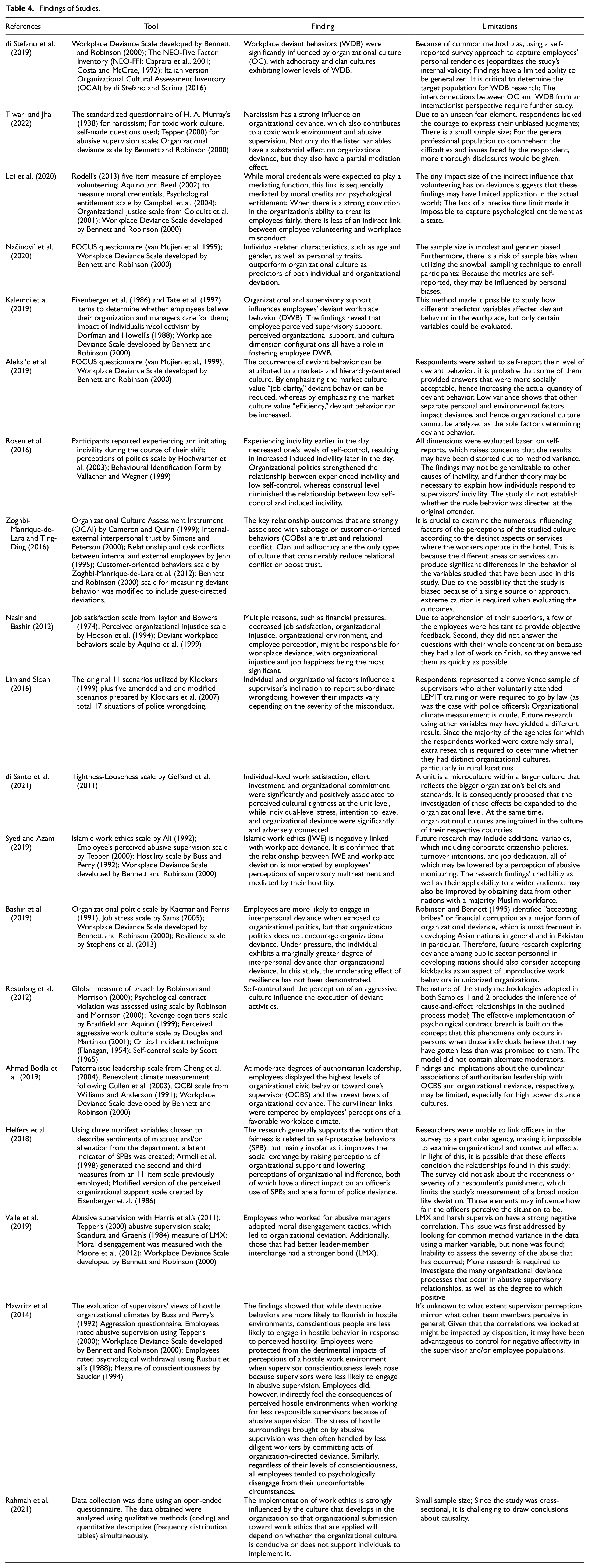
Our study extends and empirically supports the premise that organizational norms and values are implemented through workplace culture, therefore it appears plausible to argue that workplace culture, in addition to employees' personality characteristics, influenced the expression of deviant workplace behavior. Conscientiousness, followed by adjustment, agreeableness, openness to experience, and surgency, have a substantial link with deviances, with conscientiousness being the most commonly observed personality and surgency being the least frequently observed (Abdullah & Marican, 2016). Načinovi’ et al. (2020), di Stefano et al. (2019), and Aleksi’c et al. (2019) explicitly investigated organizational culture as an organization-related component and personality traits as an individual-related factor in their analysis of both individual and organization-related factors as antecedents and instigators of deviant behavior. Whilst di Stefano et al. (2019) and Aleksi’c et al. (2019) found that some types of culture are linked to less deviant behavior, Načinovi’ et al. (2020) research showed that culture has a small effect when personality is considered. Načinovi’ et al. (2020) implication was that an employee's demographic and personality traits are more influential to their deviant behavior than environmental factors of the workplace. Aside from the culture implemented by the organization, workplace culture defined in the findings also included culture that is resulted by personal circumstances and experiences of the employees such as experiencing incivility (Rosen et al., 2016), abusive supervision (Mawritz et al., 2014; Syed & Azam, 2019; Valle et al., 2019), aggressive work culture (Mawritz et al., 2014; Restubog et al., 2012) and toxic work culture (Tiwari & Jha, 2022). The results have shown that workplace culture derive from experiencing negativity and dark personality have a strong influence on deviances. It is worth noting that the definition of workplace culture is not necessarily an antecedent at organizational level but can also be at individual level. Workplace culture define by instruments explained in findings were used to examine workplace culture as organizational or environmental factor meanwhile culture from collective employees’ personality is arguably an individual factors.
Conclusions and Implications for Further Research
According to the findings of our literature review drawn from the following four databases: Scopus, Web of Science, MEDLINE, and SAGE Journals, from the time period beginning in 2012 and continuing through 2022, it was found that deviant workplace behavior is significantly influenced by workplace culture. According to the findings of the empirical research, it is necessary to generate conceptual clarity within a good theoretical framework for the study of organizational culture as an environmental or individual element. Most of the research reported in the evaluation was conducted with a diverse range of respondents, which may result in conclusions that understate or exaggerate the population effect. Hershcovis (2007) argue that the predictors of deviant workplace behavior depend on the participant; therefore, it is necessary to specifically indicate the participant to whom the study was intended, such as a supervisor, senior officer, or general clerk.
Numerous tools have been recognized as being used to assess workplace culture. The majority of measurements used to examine workplace culture are trait-specific, such as toxic or aggressive work cultures, and other measurements were created specifically for a single study. To assess psychometric features and sensitivity of the measures in relation to their application, more instrument validation and specification is required. The cultural validation of these already-in-use tools for usage in a variety of nations would improve awareness and comprehension of the potential universality of culture in the workplace.
The findings of the current investigation serve as a foundation for upcoming research on the effect of organizational characteristics and provide a roadmap for how such research should proceed. More study is needed focusing on a clear definition of culture such as clan culture or hierarchy culture with personal traits, dark personality and employees experience as mediator and moderator to gain deeper understanding on deviant workplace behavior. Future studies could afford to explore other criteria to expand the sample size for systematic review to attain a larger sample in order to advance research on the effect of workplace culture on deviant workplace behavior.
This study has the potential to make a contribution to the body of research that focuses on workplace culture as a possible instigator of employee deviant behavior in the workplace. The gathering of data on workplace culture and its effect on deviances will be beneficial to both public and private sector organizations because it has been established that workplace culture plays a vital role in preventing the manifestation of deviant workplace behavior.
Footnotes
Acknowledgements
We gratefully thank Centre for Research in Psychology and Human Well-Being, Faculty of Social Sciences and Humanities, Universiti Kebangsaan Malaysia.
Declaration of Conflicting Interests
The author(s) declared no potential conflicts of interest with respect to the research, authorship, and/or publication of this article.
Funding
The author(s) disclosed receipt of the following financial support for the research, authorship, and/or publication of this article: The author wishes to acknowledge the Dana Ganjaran Penerbitan (GP-K021070) for providing financial support for this study.
An Ethics Statement
Not applicable

Data Availability Statement
The data described in this article were available for download from the journal website or a data repository.