




Abstract
The exploration of pragmatic competence has been endowed with theoretical and empirical significance for half a century, yet a common framework is still under investigation from different perspectives. First, this article conducts a critical review of the investigation of pragmatic competence in communicative ability theory, the function-discourse model, the componential and meaning-driven model, and the relevance-theoretic model. Based on the merits and demerits of these proposals and their relation with Chomsky’s dichotomy of grammatical and pragmatic competences, an integrated model of pragmatic competence (IMPC) is reformulated for thought and communication, focusing on the interactions among various organism-internal submodules under the current minimalist framework and their interactions with outside sociocultural factors. Finally, a comparison is made between the integrated proposal and the theory and models.
Introduction
Language users, to be linguistically and pragmatically competent, require both competences, which have long been explored from different linguistic perspectives. Different theories or models of pragmatic competence have sprouted out diachronically in language acquisition, teaching, and assessment research (for a comprehensive view, see Culpeper et al., 2018; Mao & Dai, 2017; Timpe et al., 2015), attracting enormous attention from linguistic and cross-linguistic disciplines.
This began with the introduction of the issue of “competence and performance” (Chomsky, 1965/2015) into modern linguistics, which, as is well known, has played a central role in both theoretical and applied linguistics and related fields. Competence refers to the innate knowledge of grammar or other aspects of language, and performance commonly indicates the actual use of language in concrete situations. This is a “methodological distinction” or a “weak claim” as Campbell and Wales (1970, p. 246) term it, but it is generally accepted by most linguists, especially in the applied linguistic field.
In addition, there is a strong claim for the distinction. The strong version of competence denotes “the linguistic system (or grammar) that an ideal native speaker (or listener) of a given language has internalized” (Canale & Swain, 1980, p. 3). Competence is a kind of human capacity, characterized by abstract or decontextualized knowledge of language. In parallel, performance points to “the psychological factors that are involved in the perception and production of speech . . . focusing on the acceptability of sentences in speech perception and production” (Canale & Swain, 1980, p. 3). In other words, it can be understood as a sort of interaction between grammar and the psychological factors involved in language use.
Hymes (1972) argues against the strong claim, stating that what generative grammar outlines in the strong sense “extends only a little way into the realm of the use of language,” and that it is useful to construct “an adequate theory of language users and language use” (p. 281). Such being the case, the first conceptualization of communicative competence comes into existence, because “within the developmental matrix in which knowledge of the sentences of a language is acquired, children also acquire knowledge of a set of ways in which sentences are used (appropriately)” (Hymes, 1972, p. 279). Simply put, sociocultural factors are what really count in language acquisition, and children develop a theory of how to speak properly in a given context when acquiring grammatical competence, even though they might also suffer from a shortage of sufficient input or experience of speech acts in social activities. It is clear that what is proposed for language and its use seems to cover the denotations of competence in generative grammar and the actual use of language in the sense of Austin’s (1962/1975) speech act theory. To wit, linguistic and sociolinguistic competences are necessary for language users, even if Hymes does not point out how the two kinds of competences cooperate in terms of language use.
However, the generative circle regards this criticism as a theory-internal question, because the theoretical priority for generative grammar lies in the exploration of the properties of grammar, and then its use if the first issue is settled properly (cf. Stemmer, 1999). Furthermore, the critique of less attention on language use makes the second dichotomy salient. In detail, Chomsky (1977) points out that “a person attains a system of ‘pragmatic competence’ interacting with his grammatical competence, characterized by the grammar” (p. 3). This could echo Hymes’s motivation for coining the term “communicative competence” for language development in children, although there are differences in the connotations of competence as well as philosophical considerations. In this case, grammatical competence and pragmatic competence are regarded as two components of the attained cognitive state, but whether the latter is also language-specific as a system of basic Universal Grammar (UG) principles or differs from language to language is not clear (cf. Chomsky, 1977). Later on, pragmatic competence was clearly defined as that which “underlies the ability to use such (grammatical) knowledge along with the conceptual system to achieve certain ends or purposes” (Chomsky, 1980, p. 59), including “knowledge of conditions and manner of appropriate use (of language), in conformity with various purpose” (Chomsky, 1980, p. 224). Not so clear about its operation as it may be, pragmatic competence stands in complementarity with grammatical competence, forming a major dichotomy.
The issue of language use under this dichotomy has thus ignited a healthy investigation of the definition, contents, and operations of pragmatic competence in different fields, especially under the framework of communicative competence in applied linguistics and second-language acquisition. A number of theories and models of how to communicate or use languages have come out one after another. Thus, if a thorough understanding of pragmatic competence is desired, it is necessary to review the relevant models to determine the shared properties or idiosyncrasies of different interpretations of pragmatic competence. Of what elements does pragmatic competence constitute? How does pragmatic competence operate in a general linguistic system? What is the relationship between pragmatic competence and other cognitive capacities? Is pragmatic competence a cognitive capacity lurking behind human thought or behind social communication, or both?
To address these important issues, this article is organized as follows: The second section focuses on the basic properties of several influential models or theories of pragmatic competence. The third section presents a newly configured IMPC (an integrated model of pragmatic competence), and the fourth draws a comparison between IMPC and influential proposals to reveal the merits and demerits of the integrated model. The last section concludes the paper.
Critical Assessment of Pragmatic Competence Proposals and Their Relationship With the Classic Dichotomy
Without doubt, pragmatic competence is a significant research topic for both theoretical and applied linguistics as well as neighboring fields. Currently, cognitive science has witnessed flourishing development; for example, generative grammar has renewed its design of grammatical architecture (Chomsky, 1995; Chomsky et al., 2019), but with the classic dichotomy left intact. The new design, along with the achievements of existing theories or models of pragmatic competence, has paved the way for determining its basic properties, operative mechanism, and other relevant aspects. To realize this target, it is necessary to determine what can be learned from existing proposals of pragmatic competence and their relationship with the classic dichotomy of grammatical and pragmatic competences as well as the properties of the performance system.
Communicative Ability as the Core Versus the Dichotomy
The first response to the strong version of the classic dichotomy is Hymes’s (1972) four questions for language and other forms of communication (p. 281): (a) whether (and to what degree) something is formally possible; (b) whether (and to what degree) something is feasible in virtue of the means of implementation available; (c) whether (and to what degree) something is appropriate (adequate, happy, and successful) in relation to a context in which it is used and evaluated; and (d) whether (and to what degree) something is in fact done, actually performed, and what its doing entails.
These questions initiate the exploration of certain components subsuming communicative competence. Pragmatics is thus regarded as “a fundamental constituent of communicative language ability” (Timpe et al., 2015, p. 8). The so-called component model for pragmatic competence takes shape, which identifies several components of relevant knowledge, and emphasizes the function of sociocultural and contextual factors in language use, but putting aside how pragmatic competence operates.
Widdowson (1989) points out, “the first question of the communicative competence was almost equal to Chomsky’s (1977) grammatical competence, and the rest of the three questions corresponded to the status of pragmatic competence defined by Chomsky (1977)” (p. 132). If Widdowson is on the right track, the comparison between Hymes’s analysis of communicative competence with Chomsky’s (1977) dichotomy will definitely point to a feasible method to analyze the cognitive states that human beings have attained for language use, because the subsequent research takes Hymes’s philosophy as a departure. The overlap among various formulations of human cognitive states will positively reveal what a competent interlocutor could possess for language communication. For instance, in language communication, is a comprehensive ability necessary or are some independent knowledge components enough? Or alternatively, is language communication the overall property of language, or is pure thinking the primary property of language?
Canale and Swain (1980) and Canale (1983) explore the first question by innovating the components of communication competence, with Canale’s (1983, p. 6) reanalysis of the components as an improved version, in which four components are planned as grammatical, sociolinguistic, strategic, and discourse competence. In their componential model, grammatical competence refers to the knowledge of lexis and rules pertaining to sentence structure, morphology, syntax, semantics, and phonology. Sociolinguistic competence is a prominent one, including sociocultural rules of use, which defines whether an individual can interpret and produce an utterance appropriately in a given social context. Strategic competence consists of verbal and nonverbal strategies to solve the breakdown in communication, and discourse competence denotes the appropriateness, cohesion, and coherence of utterances in a context (cf. Canale, 1983).
It is obvious that communicative components in innovative design fall within the classic dichotomy and endorse the weak version of performance, even if the new design primarily serves the communicative end and presents no detailed operation of pragmatic competence. This is because the knowledge of rules and form in the new design is separated from that of contextual language use (for the same idea, see Timpe et al., 2015). More clearly, it statically lists relevant knowledge components for idealized interactions between linguistic knowledge and contexts (i.e., without actual delineation of how interactions among components are realized). Furthermore, just as Ifantidou (2014) observes, pragmatics in Canale (1983) is “subsumed under the discourse competence” (p. 125). Taking into consideration these viewpoints, pragmatic competence in the new design can at least cover the domains of sociolinguistic and discourse competence, even including that of strategic competence. This speculation is in accordance with Canale’s (1988, p. 68) subsequent interpretation of pragmatic competence in the communicative framework as “illocutionary plus sociolinguistic competence,” compared with Bachman’s (1990) later assumption of pragmatic competence. 1 Accordingly, the classic dichotomy underlies the new design.
This inference also fits well with the widely referred model—the Communicative Language Ability (CLA) of Bachman (1990) and Bachman and Palmer (2010). With an eye on language assessment, CLA, along with the componential analysis, proposes “language competence, strategic competence and psychophysiological mechanisms” (Bachman, 1990, p. 84) as the cognitive constituents of a competent speaker. Specifically, language competence comprises pragmatic and organizational competences. The former includes illocutionary and sociolinguistic competences; the latter contains grammatical and textual competences. Therefore, pragmatic competence as defined here recalls Canale’s (1988) formulation and the weak version of performance.
Bachman and Palmer (2010) replaced “competence” with “knowledge.” Pragmatic competence thus turns into pragmatic knowledge, including functional and sociolinguistic knowledge. Evidently, the alteration does not change the original idea, but narrows pragmatic competence down to a static state rather than a dynamic operation in communication. Most importantly, the components in the new terminology correspond to the dichotomy of grammatical and pragmatic competences defined by Chomsky (1977, 1980), with irrelevant issues aside. In detail, although Bachman (1990, p. 108) made it clear that he “follow[ed] Hymes’s (1972) broad, rather than Chomsky’s (1965/2015) narrow, concept of linguistic competence,” the organizational competence here actually means Chomsky’s (1977) grammatical one, because both are concerned about the specific grammatical knowledge. In this case, it is a different theoretical purpose (e.g., nature vs. nurture of language 2 ), instead of factual grammatical knowledge, that distinguishes these two constructs. Meanwhile, the rest of the components are all concerned with language use, regardless of thought or public communication, thereby almost exactly corresponding to Chomsky’s (1977, 1980) pragmatic competence.
The first popular working concept of pragmatic competence in interlanguage pragmatics was proposed by Rose (1999). Concretely, pragmatic competence is the ability to “use available linguistic resources to realize the speech act, or doing things with words properly” in social communication (Rose, 1999, pp. 171–172). Therefore, the communication-centered concept, after the traditional exploration of language socialization (communicative ability), is closely related to Leech’s (1983) definition of pragmalinguistics and sociopragmatics, thus subsuming the same logical relation between grammatical and pragmatic competences. More specifically, the relation is mirrored via concentration on “the more linguistic end of pragmatics (pragmalinguistics), i.e., particular resources of a given language provide for conveying particular illocutions” (Leech, 1983, p. 11), and concerns about “the more (culture-) specific ‘local’ conditions on language use (sociopragmatics)” (Leech, 1983, p. 10). In this case, a communicator with pragmalinguistic competence could know how to choose appropriate linguistic forms to perform corresponding speech acts. In Kasper’s (2001) words, “pragmalinguistic knowledge requires mappings of form, meaning, force, and context” (p. 51). A speaker with sociolinguistic competence knows whether a certain speech action is felicitous in action-related social contexts, not necessarily taking into consideration concrete linguistic forms. As is clear, such conceptualization of pragmatic competence echoes the complementary relation between linguistic knowledge and language use, as the dichotomy indicates and underlies the weak version of performance.
Furthermore, Kasper and Rose (2002) and Barron (2003) proceed with this tendency. Pragmatic competence is described by the former as the ability to produce and comprehend utterances or discourse in the sociocultural interaction, and specified by the latter as “the knowledge of the linguistic resources available in a given language for realizing particular illocutions, knowledge of the sequential aspects of speech acts, and knowledge of the appropriate contextual use of the particular language’s linguistic resources” (Barron, 2003, p. 12). Therefore, pragmatic competence in interlanguage pragmatics implies an interactive relation between linguistic knowledge and contextual use because the production and comprehension of utterances heavily relies on grammatical knowledge and contexts, even if it does not specify how the operation proceeds.
Unified Concept as a Norm Versus the Dichotomy
Kecskes (2013, 2015) further explores the issues of pragmatic competence along the line of interlanguage and intercultural pragmatics, concentrating on pragmatic competence rather than communicative competence. This is because of “the difficulty to draw a line between pragmatic competence and intercultural communicative competence” (but distinguish grammatical from pragmatic competence) (Kecskes, 2013, p. 61). This move agrees with the dichotomy because of the uniformity of the performance system (regardless of the strong and weak versions) or the system of language use. In detail, Kecskes (2015, p. 420) argues that there is no separate interlanguage or L2 pragmatic competence from that of L1 (i.e., with only one pragmatic competence system), which is modified dynamically depending on the exposure to different languages, cultures, and individual preferences on the basis of L1. This means bilinguals have already acquired the pragmatic competence of L1, which would be influenced by sociocultural norms or conventions of new languages. Thus, the characteristics of existing pragmatic competence would be integrated with emerging languages, facilitating the formation of new pragmatic competence, even though the developmental pattern, but not the properties of manifestation of pragmatic competence, is different in L1 and L2.
Furthermore, what underlines the dynamic changes of L1-governed pragmatic competence is “primarily conceptual changes rather than linguistic socialization, which is reflected in the functioning of the dual language system” (Kecskes, 2015, p. 426). This is the very variation that accounts for the various developmental patterns between L1 and L2. However, the manifestation of pragmatic competence is the same, such as lexical selection and small talk. In other words, it is the systematic or conceptual changes rather than language socialization that builds up a continuous pragmatic competence system between L1 and L2. Again, this move points to the importance of the uniform system emphasized in the dichotomy and the weak version of performance, even if there is no clear description of how pragmatic competence operates.
Meanwhile, Kecskes (2013, p. 66) notes that interlanguage pragmatics identifies deviations from native speakers’ norms and highlights the dynamism and ever-lasting change of personal pragmatic competence in new sociocultural environments, while intercultural pragmatics conceptually attributes changes in pragmatic competence to pragmatic socialization. However, one thing is certain, that no matter what terminology is adopted in interlanguage or intercultural pragmatics, there is still one system of pragmatic competence, with two types of pragmatics focusing on different aspects during its development.
Form-Function Mapping as the Tenet Versus the Dichotomy
The exploration of pragmatic competence by functionalists adopts the communicative end and probes into how form-function maps in language use. Understanding how pragmatic competence operates based on function-discourse theories represents progress, because interactions of linguistic forms and their function in discourse really reflect the dynamic property of language use, even though the functionalist proposals do not extend the overall picture of how pragmatic competence proceeds.
For example, Halliday (1973) insisted on the function of sociocultural contexts to mediate meanings in language use. The sociocultural context provides a framework in which language is accordingly organized; more specifically, the functional components (ideational, interpersonal, and textual) in the semantic system provide context and decide the function of lexicogrammatical groups. In this way, successful form-function mapping can be regarded as an incarnation of pragmatic competence, and grammatical and pragmatic competences are intertwined in language use. Again, this shows that Chomsky’s (1977) description of grammatical and pragmatic competences as two components of the attained cognitive states of human beings sounds reasonable.
For van Dijk (1977), pragmatic competence is a theory of action in discourse, underlining interactions between utterances and speech acts, and/or between utterances and contextual features (social conventions), facilitating the interpretation of linguistic acts in a given context. This idea clearly demonstrates that pragmatic competence is biased toward pragmalinguistic and sociolinguistic competences, thus linking to the dichotomy and the weak version of performance.
Bialystok (1993) proceeds along the function-discourse tradition (meaning-oriented) and defines communicative competence as a cognitive processing ability that includes knowledge analysis and processing control. Pragmatic competence is thus realized in two aspects—to decode and encode speech intentions at the conceptual, formal, and symbolic levels, and to focus on the relevant information in actual communication. More generally, pragmatic competence refers to the communicator’s ability to create discourse via rules, use language for various purposes, and understand real speech intentions, emphasizing the dynamic and cognitive processing of information during communication. Undoubtedly, this is a big step forward, unveiling the dynamic process of language use and the weak version of performance.
Componential and Meaning-Driven at the Center Versus the Dichotomy
It is the desirable interaction of grammar with pragmatics in function-discourse theories and the componential design of knowledge in the models of CLA that motivate Purpura (2004) and Timpe et al. (2015) to set up a comprehensive and hybridized view of pragmatic competence. This move seems to be on the right track because it could be more reliable to delineate dynamic interactions among several necessary factors in the reexamination of pragmatic competence, such as syntactic, semantic, and pragmatic knowledge.
Purpura (2004), with reference to Bachman and Palmer’s (2010) model, argues that the multi-componential model of communicative competence would be more effective if the specific function of grammatical and organizational knowledge is explored in terms of encoding and decoding meanings in contexts. With language knowledge separated into two independent components, namely, grammatical and pragmatic knowledge, these two types of knowledge would interact closely for the main goal of language use—communication—through the three-dimensional meaning system: literal meaning (derived from the words in syntax), intended meaning (derived from speakers’ intention), and pragmatic meaning (derived primarily from context) (Purpura, 2004). As is clear, the first two types of meanings are conveyed by grammatical knowledge, and the third can be decoded and encoded by pragmatic knowledge, such as appropriateness and conventionality. In this sense, the dichotomy is still implied here, and pragmatic competence can be understood as decoding and encoding pragmatic meanings, taking into account the social identity of communicators, such as social rank and power. Thus, this proposal sounds more flexible than the previous ones because it not only realizes the complimentary relation between grammatical and pragmatic knowledge but also specifies how language components interact via meanings, although meanings might not be overall for pragmatic competence, as shown later.
Timpe et al. (2015) regard pragmalinguistic and sociolinguistic components as two basic constituents of pragmatics: the code component and the use component. Without doubt, this proposal coincides with the framework of the dichotomy, theoretical presuppositions aside. Pragmatic competence is then defined as “the creation or interpretation of intended meaning in discourse by an individual, or as the dynamic and interactive negotiation of intended meanings between two or more individuals in a particular situation” (Timpe et al., 2015, p. 14). In this case, pragmatic competence is one part of language ability and underlies the weak version of performance.
Meanwhile, pragmatic knowledge as a component of communicative competence functions as the medium to explicitize communicative competence. In depth, pragmatic knowledge facilitates the operation of pragmatic competence via five separated but interrelated ordered knowledge dimensions (Timpe et al., 2015, p. 16): (a) sociocultural knowledge (as the basis and linking with situational contexts, such as topic and background information), (b) pragmatic-functional knowledge (illocutionary and sociolinguistic knowledge connecting form with function), (c) grammatical knowledge (knowledge of lexis, rules of morphology, syntax, semantics, etc.), (d) discourse knowledge (cohesion and coherence), and (e) strategic knowledge (a supporting system spirally circling all knowledge dimensions to avoid insufficient knowledge and prevent communicative failure). As it reveals, this proposal specifies the roles of pragmatic knowledge in the dynamic process of language use, which is a meaningful change from the static definition of pragmatic competence. However, even if strategic knowledge is the catalyst driving the operation of language use, why different types of knowledge take the above order is unclear. It thus points to the need to seek a more reasonable theoretical framework.
Tripartite Cognitive Ability as a Whole Versus the Dichotomy
In contrast to the communication-centered proposal, Ifantidou (2014) absorbs the relevance-theoretic assumptions (Sperber & Wilson, 1995), regarding pragmatic competence as a way to exercise both thought and communication. This is the first time that pragmatic competence is made to underlie both strong and weak versions of performance and to update pragmatic competence with cognitive assumptions, that is, resorting to relevance in Relevance Theory (Carston, 2002, 2012) to explore pragmatic competence. Doubtless, this move ushers in a new tendency to address the issues of pragmatic competence. It is thus regarded as “cognitive performance that interfaces with other human cognitive systems such as knowledge of logical rules, mind-reading of others’ intentions or beliefs, interpreting of each other’s behavior, and other kinds of background knowledge” (Ifantidou, 2014, p. 1).
Under this move, pragmatic competence subsumes a three-level interactive ability: (a) identifying relevant linguistic indexes (Linguistic Awareness [LA]), (b) retrieving relevant pragmatic effects (Pragmatic Awareness [PA]), and (c) explicating the link between lexical indexes and pragmatic effects retrieved (Metapragmatic Awareness [MA]) (Ifantidou, 2014, p. 130). The itemized assumption of pragmatic competence stipulates that LA helps communicators to seek out the linguistic cues of structure features, and PA establishes which linguistic form properly realizes certain pragmatic effects (pragmalinguistic awareness), such as illocutionary force. And MA facilitates communicators in knowing in which contexts certain linguistic forms are appropriate or felicitous (sociolinguistic awareness). In this nuanced design, pragmatic competence naturally assumes interactions among modular cognitive systems, such as syntax, semantics, and sociopragmatics, and realizes the strong and weak versions of performance. More interestingly, pragmatic competence does not stand in a complementary relation with linguistic (grammatical) competence, but rather subsumes or contains linguistic competence, in contrast to the classic dichotomy.
Interim Summary
Based on a thorough examination of models and theoretical proposals about language use at communicative levels or beyond, several pieces of significant information can be obtained, useful for further construction of a reasonable pragmatic competence framework.
As shown in the communicative ability models initiated by Hymes (1972), the constituents indicated by his four questions and the components of other communicative models by Canale (1983) and Bachman and Palmer (2010) are almost compatible with the classification of grammatical and pragmatic competences. In this regard, Chomsky’s (1977) dichotomy seems to make sense for reconceptualizing pragmatic competence in the current minimalist framework, regardless of theoretical and applied linguistics or other related fields. This is the common framework to propel linguistic inquiry, including the exploration of pragmatic competence.
However, one pending task to address the dynamic nature of language use should be borne in mind firmly. As Timpe et al. (2015) warn, “while acknowledging the interconnectedness of pragmatic, grammatical, and sociocultural components at the communicative levels, how various components of communicative competence interact remains open to speculation” (p. 9). This is an embarrassing issue for most of the communicative competence models when touching upon pragmatic competence, thus holding priority in demanding a solution.
In light of the dual nature of language and language use, thinking and communication should be central in the reconstruction of pragmatic competence. Along this line, the integration of strong and weak versions of performance, covering both thought and sociocultural communication, is an important move. This is because the integrated version of performance is useful to build up a practical theory of language use, entailing the activity of thinking and sociocultural communication. In this respect, Ifantidou (2014) adduces an example in the Relevance Theory, although it is a pity for her special manner of treating grammatical competence as being contained by pragmatic competence contra the dichotomy.
Furthermore, as empirically demonstrated in interlanguage pragmatics, Leech’s (1983) two-branch theorizing of pragmatics seems able to draw people’s attention to PA and MA, and outline the form-function or function-context mappings. This is a workable way to push the realization of a weak version of performance and define the role of the operative mechanism of pragmatic competence.
Equally important, if Kecskes (2015) is on the right track, some lessons should consequently be taken into serious consideration. Specifically, the difference between L1 and L2 pragmatic competences lies in the developmental pattern rather than the properties of manifestation of pragmatic competence, that is, they share a core mechanism. More notably, it is practical to discard the concept of communicative competence, but in favor of pragmatic competence, due to the difficulty in distinguishing the two in Kecskes’s terms. In fact, pragmatic competence could be an integrated concept if the above comments are sensible, specializing in doing things and implementing thinking with words or linguistic representations.
Integrated Model of Pragmatic Competence
At the turn of the new century, Chomsky listed several tasks for linguistic inquiry in the biolinguistic paradigm. One of them is about “how the internal language 3 is put to use,” as the topics of “neo-Gricean pragmatics’ exploring acts of referring to the world, or interchange with others” (Chomsky, 2007, pp. 14–15). The statement has resolidified the theoretical status of pragmatic competence and inspired relevant investigations in the current minimalist framework.
Modular Interactions in Linguistic Performance
Language is a complex system, as has always been expounded in different disciplines. Thus, the complexities and richness of linguistic signals entail a modular approach to grammar in a broad sense, which fits the modular approach to neural representation of cognition (Grodzinsky & Santi, 2008, p. 476). For instance, Friederici (2017) testifies that syntactic merge and semantic computation are realized in Brodmann areas (BA) 44 and 45, respectively. This certifies the anatomical and functional modularity of the mind/brain. Therefore, the assumption of language modularity has been proven with neurobiological evidence.
Chomsky (2017) points out that language is “a module of the central system of the mind/brain, which is accessed in many kinds of use of language, including input analysis (parsing) and externalization in production” (p. 26). Accordingly, the whole of linguistic computation begins with the selection of lexical items and terminates with externalization of linguistic representations for thought and sociocultural communication. This process involves interactions among several subsystems or submodules such as the syntactic, semantic, pragmatic, and phonological-phonetic submodules, as Figure 1 shows (cf. Mao, 2020).
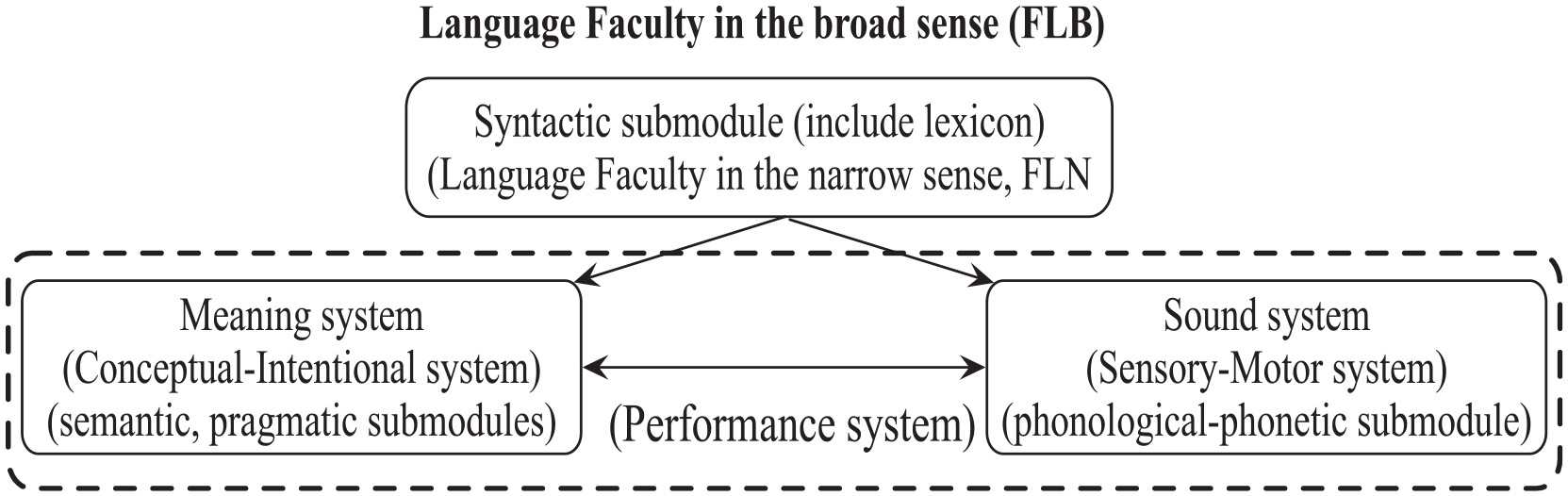
Organism-internal submodules and their interactions.
Stated otherwise, the different types of computational interactions among submodules are conducive to consolidating individual submodules in the mind/brain, which pave the way for the clarification of the process of language use.
In the current minimalist study, language is viewed as “an optimal solution to legibility conditions” (Chomsky, 2005, p. 9). In other words, what is generated by the internal syntactic submodule should be legible for meaning and sound systems, two performance or interpretative systems consisting of different submodules, as shown in Figure 1. This design is due to the fact that language consists of paired meanings and sounds. When using linguistic representations for thinking and communicative activities, all submodules are involved and interact with each other and/or with outside contexts. Just as Chomsky points out, “. . . doubtless in performance all systems are accessed (along with much else outside the language faculty)” (Mao, 2020, p. 613). In this case, pragmatic competence stands in complementary relation with grammatical competence and underlines the strong and weak versions of performance. That is to say, it facilitates interactions between internal syntactic system and external but organism-internal subsystems for thought and communication in an integrated way, whether in real or “imagined sociocultural contexts” (Chomsky, 2011, p. 266).
A Modular Approach to Pragmatic Competence
As evidenced in the previous section, pragmatic competence underlies the strong and weak versions of linguistic performance, which involves all linguistic subsystems in the language faculty in the broad sense (FLB) or other cognitive systems outside FLB. This idea thus points out the direction for delineating the operation of pragmatic competence on the basis of interactions among all the relevant submodules.
Hauser et al. (2002) describe how the internal syntactic submodule (the language faculty in the narrow sense [FLN]) relates to external but organism-internal cognitive submodules in FLB. Along this vein, as displayed in Figure 2, the interactions among submodules within FLB can be fully characterized by interactions either between the internal syntactic submodule (A1) and external but organism-internal cognitive submodules (A2) (i.e., A1 → A2), or among external but organism-internal cognitive submodules themselves (within A2), such as interactions between semantic and pragmatic submodules, and between pragmatic and phonological-phonetic submodules (cf. Mao, 2020). Furthermore, interactions between organism-internal submodules and outside sociocultural contexts cannot be ignored, as shown in Figure 2, given that communication issues can also be considered in our minds in authentic or imagined sociocultural contexts (Chomsky, 2011).

Interactions in FLB and sociocultural contexts.
These types of interactions specify fairly closely how the strong version of performance unfolds when thinking about issues of structural grammaticality or interpretability, sociocultural communications, and prosodic appropriateness of expressions in real or imagined contexts. That is to say, the implementation of pragmatic competence at the level of abstract thinking involves proper handling of pure linguistic parsing and sociocultural communicative issues in authentic or imagined contexts. In this sense, pure thought unfolding during language use is realized by interactions between the internal syntactic submodule (A1) and external but organism-internal submodules (A2) (i.e., A1 → A2), and interactions among all submodules in A2 as well as interactions between all the organism-internal submodules and real/imagined sociocultural contexts, that is, (A1 → A2) ↔ B (see Mao, 2020). The various interactions thereby manifest the detailed operation of human thought, mirroring an internal part of pragmatic competence. Consider the interaction between the syntactic and semantic submodules during the execution of thought as an example.
(1) a. * 贾宝玉 想 结婚 林黛玉.
Jiǎ Bǎoyù xiǎng jiéhūn Lín Dàiyù.
Jiǎ Bǎoyù want marry Lín Dàiyù
“Jiǎ Bǎoyù wants to marry Lín Dàiyù.”
b. * 我 帮忙 他.
Wǒ bāngmáng tā
I help he
“I help him.”
(1a) and (1b) are generated by an internal syntactic submodule and then transferred to the semantic submodule in the Conceptual-Intentional system (CI system) for interpretation. If language users can expertly infer the ungrammaticality of (1a) and (1b) based on the uninterpretability of (1a) and (1b), they are endowed with robust internal pragmatic competence. In detail, 结婚 (jié hūn “marry”) and 帮忙 (bāng máng “help”) in Chinese are intransitive verbs. The semantic types of both are <e, t> (from entity to truth values). In other words, an event denoted by结婚<e, t> or 帮忙<e, t> directly involves one individual rather than two individuals (or two arguments). The extensional meanings of 结婚 and 帮忙are “⟦结婚⟧: λ x. x 结婚” and “⟦帮忙⟧: λ y. y帮忙,” respectively. As a result, the semantic computations of (1a) and (1b) in CI system crash, for each event is shown as involving two individuals. Therefore, the linguistically semantic computations reveal that the previous syntactic computations are off the track. In this case, based on the interaction between syntactic and semantic submodules, language users are able to utilize the uninterpretability of (1a) and (1b) to recognize their syntactic ungrammaticality. Thus, internal pragmatic competence is expressed in the form of “thinking capacity which accounts for the basic property of human language” (Berwick & Chomsky, 2016, p. 11).
Furthermore, when language users are thinking about certain specific pragmatic communicative issues in authentic or imagined contexts, the relevant linguistic and sociocultural pragmatic knowledge needed in the inference of pragmatic meanings is immediately activated from interlocutors’ background knowledge stored in their brains, such as encyclopedic knowledge, and input into the pragmatic submodule for ongoing pragmatic inferences. Therefore, reasoning via interactions between syntactic, semantic, and pragmatic submodules denotes how human thought proceeds during language use. To cite one concise example of how pragmatic competence unrolls in this situation: When an American lady received an email from one of her foreign friends, the salutation puzzled her, because it was “Dear Madman” rather than “Dear Madam.” However, she soon calmed down. Her settlement of the embarrassment would be advanced based on serial interactions among different submodules. First, the semantic submodule interprets phrase structures transferred from syntactic submodule as “vicious greeting” rather than “respectful saluting.” However, given her friend is a non-native speaker with poor English, the real pragmatic intention reasoned out in pragmatic submodule could not be a personal attack but a “beautiful mistake,” because the encyclopedic knowledge selected for pragmatic inference shows that non-native speakers always make typos or other mistakes. In this way, if thought unfolds truly as sketched above among a series of interactions of submodules at the abstract thinking level, the trajectory of internal pragmatic competence could be clearer now.
Meanwhile because of the indispensable role of language in authentic sociocultural communications, any competent language user can use externalized linguistic expressions from the organism-internal linguistic system to perform speech acts in concrete sociocultural situations. Hence, communication involves interactions between all organism-internal submodules and sociocultural contexts. In general, in sociocultural communications, language users exploit linguistic representations derived from the organism-internal submodules and proceed with the sociocultural pragmatic knowledge relevant to specific contexts in the pragmatic submodule. This is the realization of a weak version of performance, exhibiting how external pragmatic competence exercises. To quote Grice’s (1989) well-known example to clarify this point: At a gentle tea party, Person A uttered a surprising remark in front of the public and obtained an unexpected reply from B.
(2) A: Mrs. X is an old bag.
B: (moment of appalled silence) The weather has been quite delightful this summer, hasn’t it?
Why does B respond in that bizarre or uncooperative way? The reason would be that B conducts syntactic and semantic parsing of the sentence uttered by A, obtaining the propositional meaning—“the lady is very old.” Furthermore, B analyzes the plain meaning against the context—a public gathering—and reasons out A’s implied negative attitude to the lady, that is, “the lady is not fashionable.” Yet, further pragmatic knowledge retrieved from the background knowledge informs B that it is “a social gaffe” to negatively comment on a lady in public and that the topic cannot be furthered. In this case, relying on serial interactions among syntactic, semantic, and pragmatic submodules, B acts out properly, that is, changing the topic. If the analysis is reasonable, this is solid evidence for B to be gifted with a smooth external pragmatic competence.
Clearly, the previous criticism of the strong version of performance seems to be solved if the integration of internal and external pragmatic competences, relying on modular interactions and beyond, holds water, which realizes the dual nature of language and/or language use—thinking and communication. Thus, pragmatic competence can be delineated as an internal capacity that is genetically based, facilitating human use of I-languages and much else concerned for thinking, and utilization of linguistic representations, along with relevant pragmatic knowledge, for successful sociocultural communication (cf. Mao, 2020).
Comparison Between IMPC and Other Influential Proposals
Needless to say, research from various perspectives differs in how pragmatic competence is defined and how pragmatic competence operates. This situation makes the relevant inquiry more colorful and provides more possibilities for generalizing the universal properties of pragmatic competence and solving existing problems. For example, whether the static description of pragmatic knowledge equals the exploration of the operative mechanism of pragmatic competence remains unclear. In this case, if IMPC makes sense to some degree, it is worthwhile drawing a comparison between the existing proposals and IMPC, verifying the extent to which IMPC can serve our reconstruction of pragmatic mechanisms and clarify the universal properties of pragmatic competence.
In the framework of communicative ability, Hymes (1972), Canale and Swain (1980), and Bachman and Palmer (2010), among others, conducted a componential analysis of pragmatic competence, that is, pragmatic competence consists of relevant specific knowledge components. As examined in the “Critical Assessment of Pragmatic Competence Proposals and Their Relationship With the Classic Dichotomy” section, the classification of these components could to some degree correspond to Chomsky’s (1977) dichotomy of grammatical and pragmatic competences. The only difference lies in the various definitions of grammatical competence and linguistic performance. Whether to assume linguistic knowledge is internal or not and linguistic performance covers both thought and sociocultural communication are cases in point. In the current minimalist framework, the grammatical architecture is revised and the internal knowledge undergoes tremendous reduction, with most of the rules or principles degraded as general cognitive norms (third factors) and assuming an inventory of universal features and Merge as the only universal principle (Chomsky, 2005; Mao & Dai, 2019). This makes IMPC more flexible, as demonstrated above, to realize both the purpose of the communicative ability theory—language is a tool for communication—and the theoretical target of the minimalist inquiry—language is primarily an instrument for thought. Thus, IMPC firmly abides by the dual nature of language, a common sense seemingly acknowledged by the linguistic circle.
More specifically, on one hand, the design of pragmatic competence in the IMPC, namely, with pragmatic competence in complementary with grammatical competence in the sense of Chomsky (1977), mostly covers linguistic and non-linguistic contents that are summarized componentially in communicative ability theory. For instance, it is congruent with Canale and Bachman’s analysis of linguistic and sociocultural knowledge as syntactic, semantic, morphological, and pragmatic norms. On the other hand, IMPC consists of internal and external parts, satisfying the basic tenet of internalism and the general view of language function, namely, language is designed for both thought and sociocultural communication (i.e., two sides of one coin). The latter is the main target of the communicative ability theory or of all the models of pragmatic competence.
In addition, if Timpe et al.’s (2015) comments on the componential models of pragmatic competence in communicative ability theory are on the right way, it is definitely sensible for IMPC to see the settlement of the problems as a breakthrough when dynamically reformulating how pragmatic competence operates—in other words, not by statically listing pragmatic knowledge closely related to pragmatic competence, but instead by delineating how different knowledge components interact to explicitize the process of language use. As Figure 2 reveals, it is the exact dynamic interactions among various organism-internal submodules and organism-internal submodules with the organism-external sociocultural contexts that define or realize the operation of the two-part IMPC.
The tradition of language socialization is further pursued by interlanguage or intercultural pragmatics in the scrutiny of pragmatic competence. Pragmatic competence for L2 learners is interpreted as producing and comprehending utterances in sociocultural contexts (Culpeper et al., 2018; Kasper & Rose, 2002), yet with Kecskes’s (2015) non-differentiation of L1 and L2 pragmatic competence and non-distinguishing pragmatic competence from communicative competence (Kecskes, 2013). Similarly, IMPC realizes the sociocultural function that the commonly defined pragmatic competence entails, and agrees with Kecskes’s unanimous treatment of pragmatic competence in L1, L2, or Ln, for the grammatical architecture in the biolinguistic paradigm assumes a unified pragmatic mechanism among different languages, no matter in L1, L2, or Ln.
Along with the communication-oriented purpose of communicative ability theory, the function-discourse model stresses the mediation of meaning by the sociocultural contexts in language use. As an illustration, pragmatic competence is basically described in the theory of language use as a cognitive ability (cf. Bialystok, 1993), against the background of the function and meaning of linguistic forms guided by sociocultural conventions, or more. Without doubt, defining pragmatic competence as the cognitive ability to mediate the function and meaning of linguistic forms in contextual language use is not a small step forward, compared with the mere static enumeration of linguistic and pragmatic knowledge. Because it capitulates on the essence of pragmatic competence—concentration on the dynamic mapping of forms with functions, even though the understanding of language function differs to some degree. This move is seemingly achieved in IMPC, with the extension of the domain of language function. Language is not only used for sociocultural communication but is primarily designed for thought. The reason thought is regarded as an indispensable part in the exploration of pragmatic competence is that IMPC takes a comprehensive view of language use. To wit, the propositional meaning provided by the internal submodule—syntax—is used for thinking about the world or communicative issues in the CI system (meaning system); also, in the contextual language use, “the meaning that is created and meditated through the context becomes overt primarily in the coherent flow of discourse and the interlocutor’s interpretation” (Timpe et al., 2015, p. 7). In this sense, thinking and communication as a function of language—two sides of one coin—seems to be revealed completely.
The meaning-based investigation of pragmatic competence is also a fundamental assumption for Purpura (2004) and Timpe et al. (2015). Although their proposals for pragmatic competence constitute different components, both share some key points with IMPC. With Purpura (2004), IMPC also upholds that the pragmatic meaning is derived on the basis of the literal meaning plus the sociocultural contexts, but differing in intensive emphasis on the meaning for pure thought first. With Timpe et al. (2015), IMPC first and foremost adheres to the dynamic interactions among relevant submodules and factors, which characterizes the operative mechanism of pragmatic competence. The major difference lies in the fact that IMPC maintains the complementary relationship between pragmatic competence and grammatical competence, and the former does not contain the latter, that is, pragmatic competence does not subsume grammatical competence. Furthermore, IMPC assumes two functions for pragmatic competence, distinguishing pure thought from sociocultural communication, which is the only purpose of all communicative models.
Aside from the merely sociocultural communicative perspective to address pragmatic competence, Ifantidou (2014) adopts the relevance-theoretic assumption for pragmatic competence. Assuming the cognitive processing of utterance meaning via decoding and inference, pragmatic competence in Ifantidou’s (2014, p. 130) system contains (a) LA, (b) PA, and (c) MA, with (a) seemingly corresponding to decoding and (b), (c) to inference, as shown above. The order of the three criteria is not normative but expository. Most impressively, pragmatic competence includes linguistic competence, as metalinguistic awareness requires LA. It is evident that Ifantidou (2014) proposes form-function mapping via three interrelated criteria; in particular, MA guarantees the interaction between forms and functions. Likewise, IMPC accepts form-function mapping as the basic tenet to redefine pragmatic competence, but IMPC presumes sequential interactions among independent submodules or subsystems and their interactions with sociocultural contexts, not simply listing out three unnormative levels that are relevant to the operation of pragmatic competence during interpretation of utterances in sociocultural contexts. This is mostly attributed to the basic assumption of IMPC about the complementary relationship between grammatical competence and pragmatic competence, rather than the latter containing the former.
Furthermore, even though it is stated that the order of the three criteria is not normative, they seem to work in tandem under the relevance-theoretic framework. As Ifantidou (2014) made it clear, Relevance Theory postulates a pragmatic performance that indirectly relates to linguistic competence; the language faculty interfaces with the pragmatic module, which functions as a decoding process of the language module and delivers a semantic representation (or logical form) to the pragmatic inferential mechanisms that derive the speaker’s meaning. In this sense, the semantic representation surfaces at the joint between linguistic competence (including semantic competence) and pragmatic performance as Carston (2002, 2012) suggests, and there is a pragmatic performance system (a parser) that is responsible for deriving the logical form as an input to the pragmatic system. As it discloses, this type of pragmatic performance is a type of linguistic performance.
Based on this assumption regarding the operation of the pragmatic/linguistic performance system, it is clear that the three-level criteria in Ifantidou’s definition run one after another. 4 If this is the case, it sounds more theoretically optimal and specific for IMPC to conjecture the interactions between the core syntactic submodule and the independent external but organism-internal submodules, and between these organism-internal submodules with outside sociocultural contexts. The major reason is that pragmatic performance or linguistic performance is absolutely the operative “trace” of pragmatic competence in IMPC, as long as the syntactic submodule is the engine to provide linguistic representations for thought and communication, and semantic and the pragmatic submodules subsequently fulfill their interpretative duties in the performance systems (cf. Figure 2). More plainly, pragmatic competence under IMPC is an operative mechanism underlying any kind of performance in language use. That is why IMPC follows the current minimalist assumption by accepting pragmatic competence as complementary with grammatical competence. In this case, it does not make much sense to set up pragmatic performance in parallel with grammatical competence (terminological issues aside). Performance in language use, regardless of whether it is a strong or weak version, is an incarnation of interactions among organism-internal submodules and those interactions between organism-internal submodules with outside sociocultural contexts. These types of interactions among essential submodules in language architecture and their interaction with outside contexts truly embody the dynamic properties of language use and language proper, thus functioning as the solid theoretical foundation for IMPC to redesign pragmatic competence. Along this line, pragmatic competence in IMPC is an automatic cognitive operation.
Conclusion
How language is used for thinking and communication is an important topic in linguistic and philosophical circles. It is referred to as “Descartes’ Problem” in linguistics, triggering different proposals to delineate the basic properties and the operative mechanism.
Based on the examination of several influential models of pragmatic competence, many properties are checked for the sake of universal characteristics. The communicative ability theory initiated by Hymes (1972) is claimed to be the departure for a theory of language users and language use. The subsequent work in this genre, like communicative competence theory, assumes a componential analysis of pragmatic competence, consisting of static knowledge components such as semantics and morphology, but without clarifying how interactions among knowledge components proceed. Along this line, the function-discourse model, when touching upon pragmatic competence, highlights the mediation of meaning between form-function mappings in contexts, merely biasing sociocultural communication. In conjunction with meaning and the role played by knowledge components in language use, the componential and meaning-driven models are established, featuring the mediating function of meaning and dynamic interactions of knowledge components in communication, but without solid theoretical linguistic supports. In parallel, an attractive proposal under the relevance-theoretic framework spotlights the interactions of LA, PA, and MA, taking cognitive processing as the tenet but turning against the classic dichotomy. The knowledge components in these theories and models coincide with the classic dichotomy of grammatical and pragmatic competences in one way or another, realizing both strong and weak versions of performance.
Taking into consideration these two salient features, an integrated two-part proposal (IMPC) is formulated, which is primarily based on the modular interactions in the current minimalist inquiry of the biolinguistic paradigm. More specifically, the internal part serves pure thinking; language is primarily a tool for thought, implemented by interactions among various organism-internal submodules and their interactions with outside sociocultural factors in real or imagined contexts. The external part is to perform speech acts in specific sociocultural contexts. If this hunch is on the right track, IMPC can function as a comprehensive model for the current reconstruction of pragmatic competence, covering both thinking and communicative activities. This will be of importance to the investigation of the acquisition, assessment, and instruction of pragmatic competence. However, more empirical investigation is needed to prove the detailed assumption in the future.
Footnotes
Declaration of Conflicting Interests
The author(s) declared no potential conflicts of interest with respect to the research, authorship, and/or publication of this article.
Funding
The author(s) disclosed receipt of the following financial support for the research, authorship, and/or publication of this article: This research was supported by the research project—The Research on Interlanguage System of TLA Tibetans Based on Micro-Morphological Approach (Grant Numbers 20CYY02 and 20MDX01).
