




Abstract
As a very important plant resource, wood played varied and important roles in the lives of ancient people. In the present study, wood was discovered in the Yanghai cemetery of the Turpan Basin, which belonged to the Subeixi culture (~1300BC–200AD). By using traditional classification techniques of wood anatomy, four taxa of wood, viz. Populus sp., Salix sp., Picea sp., as well as Betula sp., were identified. Woods of Populus, Salix, and Picea were mainly used for tomb construction, with Poplus sp. also used for tub and plate-making. Furthermore, the wood of Betula sp. was selected for dipper-making. Previous studies have shown that the ancient Yanghai people once led an agro-pastoral lifestyle, engaging in both agricultural activities in the local oasis and animal husbandry practices in the Tianshan Mountains. As trees adapted to the cold, wood of Picea sp. and Betula sp. could have been cut in the Tianshan Mountains during transhumance. Conversely, wood of Populus sp. and Salix sp. could have been cut either locally in the oasis of the Turpan Basin or in the river valleys of the northern slopes of the Tianshan Mountains far from Yanghai settlements.
Introduction
The Turpan Basin (Turpan-Tokesun-Shanshan Basin) is a small oval-shaped basin in the middle of the Tianshan Mountains. The Flaming Mountains, foothills of the Tianshan Mountains with a west-east orientation, divide the basin into two parts (Figure 1). Being distant from oceans and having high mountain barriers, the climate in the basin is very dry. The average rainfall is only 15 mm, with an evaporation rate of >2,500 mm. Furthermore, the temperature in summer usually reaches >40°C, which could very well be the highest in China (Jiang et al., 2009). The entire basin consists mainly of stony desert, with several oasis distributed along the base of the Flaming Mountains. Aidingkol Lake, with an altitude of −154 m, is the lowest topography of China. Due to its topographical features, the Turpan Basin is the lowest, driest, and hottest terrain in summer in China.
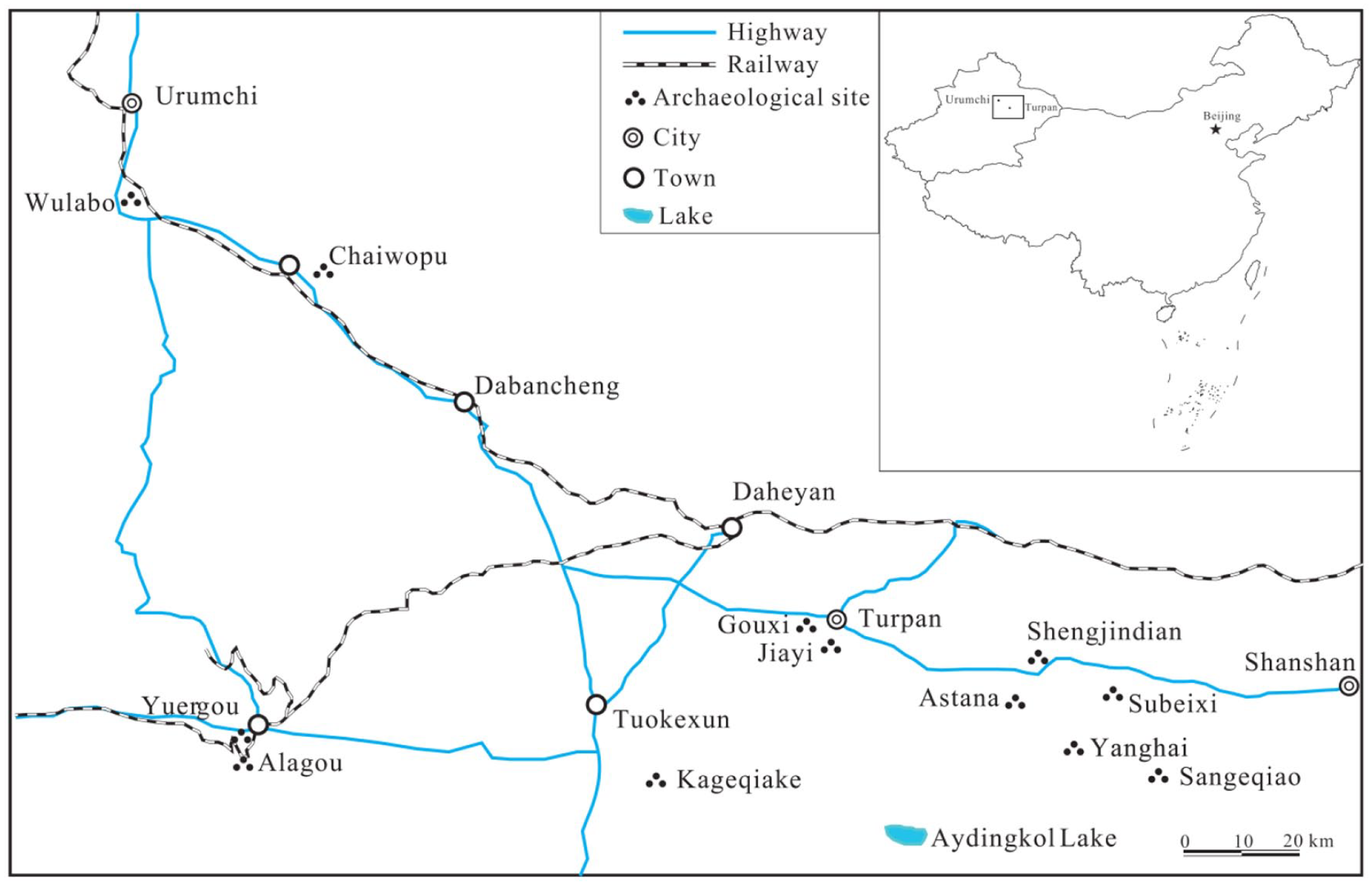
Location of Turpan and the archeological sites.
Research suggests that the existence of human activity in the Turpan Basin dates from approximately 5,000 years ago, as evidenced by stone artifacts discovered in the Gouxi and Astana sites. However, controversy still persists since stone tools were simply collected on the surface of the archeological site, without the support of strata (Wang, 1992). From approximately 3,000 to 2,000 years ago, Turpan was hugely impacted by the Subeixi culture. To date, >30 cemeteries or settlements have been discovered in the Turpan Basin and its surrounding mountains (Guo, 2012). These discoveries reveal that Turpan was once a crossroad of cultural communication between the East and the West. During the historical period, Turpan became an important stop along the ancient Silk Road and played key roles between the interior of ancient China and countries westward, including ancient Persia, India, the Arabic Peninsula, as well as the Roman Empire and Greece (Chen et al., 2012). In the Turpan Basin, some archeological investigations and excavations had been conducted by early explorers, such as Stein (1921) as well as le Coq (1909), le Coq (1928). Detailed studies of the ancient city of Kocho (Gaochang, the third–ninth centuries) in Turpan have also been conducted during recent years (Russell-Smith & Konczak-Nagel, 2016). During the prehistorical period, the Yanghai and Shengjindian cemeteries (Jiang et al., 2009, 2015) as well as the Yuergou and the Subeixi settlements have been the most prominent archeological sites excavated (Gong et al., 2011; Jiang et al., 2013). Due to the dry climate, many organic remains have been well preserved and proved to be a rich resource for the tracing and understanding of the lifestyle of the ancient people of the Subeixi culture. Since 2004, a series of archaeobotanical studies have been conducted at the Subeixi related settlements or cemeteries. Archaeobotanical studies have shown that in the early stages of development of the Subeixi culture, this agro-pastoral people seemed to plant only three types of crops and on a small scale, viz. bread wheat (Triticum aestivum), naked barley (Hordeum vulgare var. coeleste), and common millet (Panicum miliaceum) (Zhao et al., 2019). In the late stages, in addition to these three cereals, which have been excavated in considerable amounts, a small number of foxtail millet (Setaria italica) grains were also discovered in the Shengjindian cemetery and Yuergou site, respectively (Jiang et al., 2013, 2015). Furthermore, horticultural activities were also sizeable during the late period, as proved by the discovery of both grapevines (~300BC) and grape seeds in the Yanghai and Shengjindian cemeteries, indicating with high probability a sedentary lifestyle (Jiang et al., 2009, 2015). However, animal products were still a staple food. As the C/N isotope studies have shown, the Subeixi people relied heavily on meat and/or dairy (Si et al., 2013).
During the past few years, different methodologies, not only morphological but also genetic analysis, were applied to the study of plant macro-remains (e.g., seeds and fruit) in order to achieve identification (Gismondi et al., 2016; Ruas et al., 2016). Furthermore, most research endeavors have focused on seed/fruit remains, while few have been focused on wood. As a high-density material, wood was usually collected for construction, fuel, and craft-making, among other purposes. Thus, any wood remains should reflect the local vegetation, wood-use strategies, and even horticultural activities. For example, Jiang et al. (2009) reported the discovery of a branch of woody liana used in tomb construction. This wood was identified as grape (Vitis vinifera), thus revealing the earliest evidence of grape cultivation in ancient China. Furthermore, Jiang et al. (2018) systemically studied the fire-making kits discovered in the Yanghai cemetery, and revealed the fire-drilling techniques and commensurate wood species, thereby deducing the origin of the wood material. In the Yuergou site, some carbonized spruce (Picea) wood was discovered in an earthen pot and concluded to have been utilized as fuel (Jiang et al., 2013). However, despite the numerous wood specimens excavated in the cemeteries and settlements of the Subeixi culture, much work still needs to be done. This paper explores and analyzes wood for kit making and construction in the Yanghai cemetery to reveal their species, utilization, as well as wood-use strategies in ancient Turpan.
Material and Methods
The Yanghai cemetery is located on the southern part of the Flaming Mountains. Based on 14C dating and the analysis of funeral objects, the real age of the Yanghai cemetery appears to date sometime between 1300 and 200AD (Lv & Zhang, 2019). The people who once lived there led an agro-pastoral lifestyle. Detailed information of the Yanghai cemetery has been published in other studies (e.g., Jiang et al., 2009; Zhao et al., 2019), and therefore, will not be discussed in detail in this paper.
The wood discovered in the Yanghai cemeteries can be divided into two types of usage: (1) wood for making utensils, like tubs, bar, spindle wheel, plates and spoons, weapons, and beds for corps or such; (2) wood for tomb construction (Figure 2). For a vertical tomb, a roof was constructed with timber for beams and branches for crossbeams, covered with a layer of grass or mat, and then protected by a layer of earth on top. For a vertical tomb with side rooms, timber was placed outside of the side room to safeguard the non-human grave objects and materials inside, and then the vertical room was filled with grass, shrubs, or earth.

Wood utilization in the Yanghai cemetery: (a) wooden plate (IIM130:1), (b) wooden dipper (IIM194:2), (c) wooden tub (IM170:3), and (d) timber used for roof making of tomb IM217.
In the present paper, 3 wooden utensils and 11 pieces of timber were selected for wood identification (Table 1). The ancient indigenous people made tubs with whole pieces of timber by burning the core and then systematically polishing them with tools (e.g., specimen IM170:3). A plate (IIM130:1) and a spoon (IIM194:2) were also made of wood by cutting and carving (Table 1). All the specimens are now located in the Turpan Museum. Some wood sections were prepared for identification using traditional methods at the Research Institute of Wood Industry, Chinese Academy of Forestry Sciences, Beijing, while some were sectioned at the Institute of Botany, Chinese Academy of Sciences, Beijing. The wood pieces were cut into segments for analysis. They were boiled in water and subsequently embedded in polyethylene glycol at a temperature of 60°C for 2 days. Then 15 μm thick sections were cut on a sliding microtome. After this, the sections were stained with a 4% solution of safranin. Three types of sections were made: transverse, tangential, and radial. The prepared slides were observed under a Leica DM 2500 microscope. The botanical terms for structural descriptions of the secondary xylem followed the definitions given in previously published literature (e.g., Cheng et al., 1992; IAWA Committee, 1989, 2004).
Details of Specimen From Different Tombs.
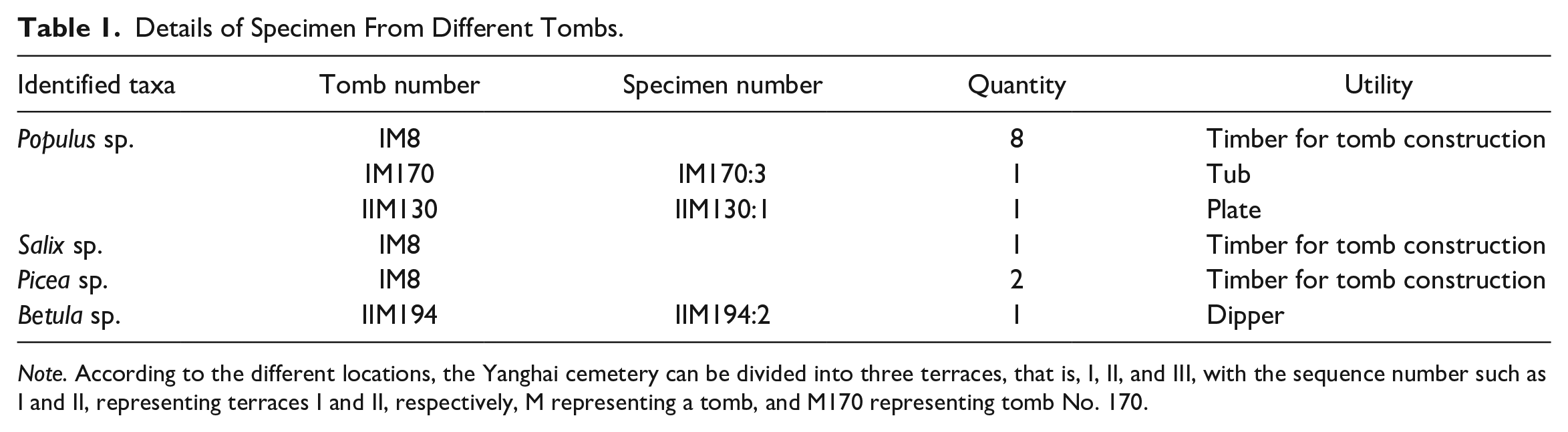
Note. According to the different locations, the Yanghai cemetery can be divided into three terraces, that is, I, II, and III, with the sequence number such as I and II, representing terraces I and II, respectively, M representing a tomb, and M170 representing tomb No. 170.
Results
Among the 14 specimens examined, 2 samples were identified to be of spruce (Picea sp.), 10 of poplar (Populus sp.), 1 of willow (Salix sp.), as well as 1 identified as birch (Betula sp.) (Table 1).

Wood structure of Picea sp. (a) Transverse section, showing growth rings and axial resin canals. Scale bar 100 μm. (b) Tangential section, showing uniseriate ray cells and radial resin canals. Scale bar 200 μm. (c) Radial section, showing uniseriate bordered pits. Scale bar 50 μm. (d, e) Radial section, showing piceoid cross-field pitting. Scale bar 50 μm.

Wood structure of Salix sp. (a) Transverse section, showing diffuse porous wood, vessels usually solitary. Scale bar 100 μm. (b) Radial section, showing heterogeneous ray cells. Scale bar 100 μm. (c) Radial section, showing simple perforation plate, vessel-ray pits simple, pits rounded, or angular. (d) Tangential section, showing the inter vessel pits alternate, polygonal. Scale bar 50 μm. (e) Tangential section, uniseriate ray cells. Scale bar 100 μm.

Wood structure of Populus sp. (a, b) Transverse section, showing wood diffuse-porous, growth ring boundaries distinct. Scale bar 200 μm. (c) Transverse section, showing fibers thin-walled, vessels usually in short radial multiples. Scale bar 100 μm. (d) Tangential section, showing rays uniseriate, some biseriate, 2 to 26 cells high, inter-vessel pits polygonal, alternate. Scale bar 100 μm. (e) Radial section, showing simple perforation plates, vessel-ray pits simple, pits rounded, or angular. All ray cells procumbent. Scale bar 100 μm.
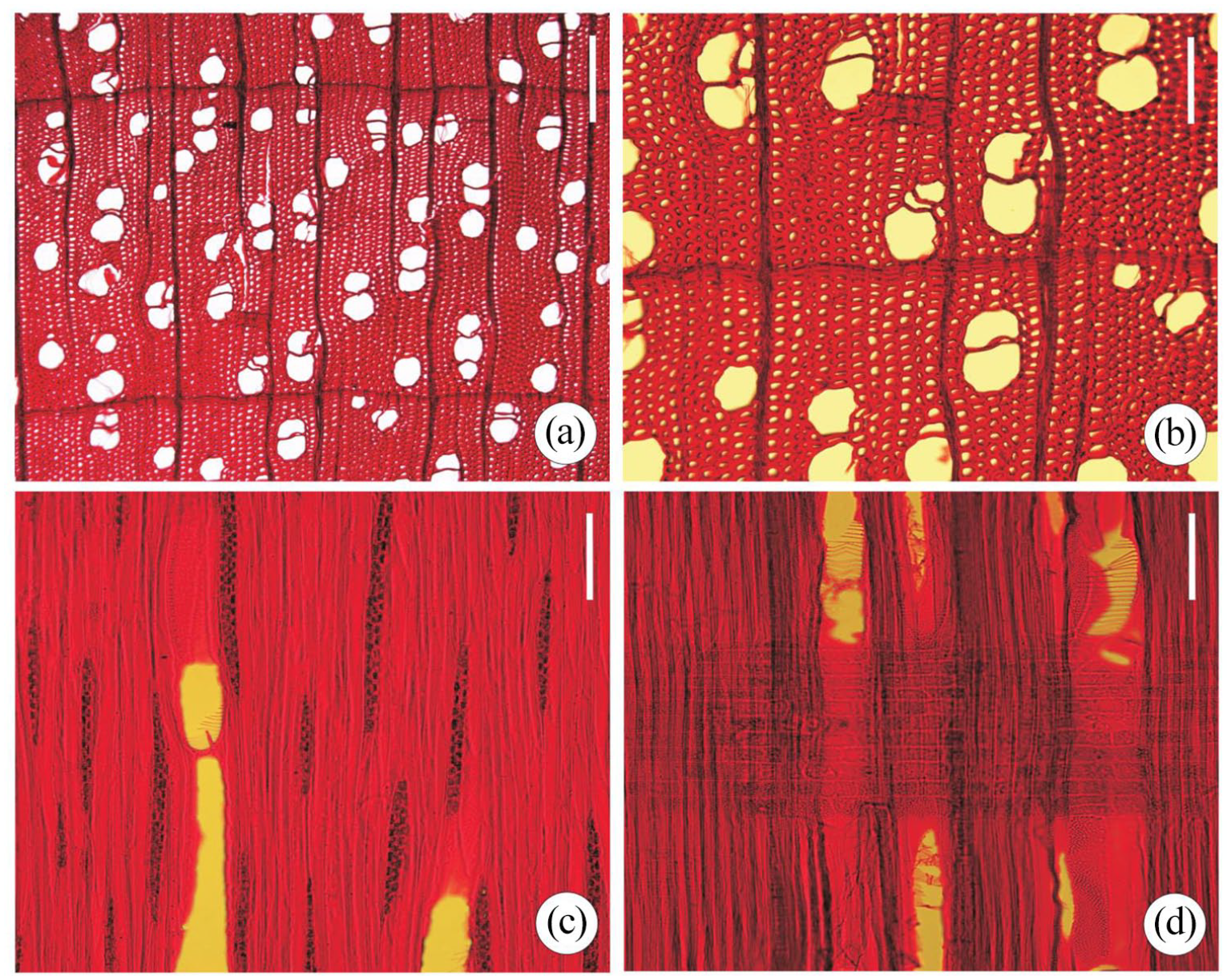
Wood structure of Betula sp. (a) Transverse section, showing wood diffuse-porous, growth ring boundaries distinct. Scale bar 200 μm. (b) Transverse section, showing vessels usually solitary, or in short radial multiples of 2 to 3, cell wall thick. Scale bar 100 μm. (c) Tangential section, showing rays mostly 2 to 3 seriate, few uniseriate, up to 35 cells high. Scale bar 100 μm. (d) Radial section, showing scalariform perforation plates, vessel-ray pits polygonal, alternate, or opposite. All ray cells procumbent. Scale bar 100 μm.
Discussion
The natural distribution of woody plants is quite limited in the Turpan Basin and the surrounding mountains. Before the Industrial Revolution, the local people lived in the oasis and relied only on the glacial water of the Tianshan Mountains. All water was transported to the oasis by the Karez underground system before the introduction of motor-pumped wells. In the oasis, people now plant diverse trees, like mulberry (Morus), poplar (Populus), elm (Ulmus), and willow (Salix), among others, alongside the ditches, rivers, and roadsides of the village. On farms, inhabitants mainly plant grape (Vitis vinifera), but also fruit trees, like peach (Amygdalus persica), apple (Malus pumila), pomegranate (Punica granatum), and walnut (Juglans regia), among other fruit trees. There are also wild woody plants in the oasis, including calligonum (Calligonum), clematis (Clematis), tamarisk (Tamarix), and caper (Capparis spinosa). Outside the oasis is the stony desert with neither surface runoff nor vegetation. On the southern slopes (sunny slopes) of the Tianshan Mountains are mountainous desert and steppes from low to high altitudes, without the existence of arbor (Bai, 2004). On the northern slopes (shady slopes) at high altitudes are forests of Picea. Trees adapted to the cold, such as Betula and other shrubs, are distributed on the lower edges of the Picea forest (Figure 7). In the river valley tend to be deciduous trees of Betula, elm (Ulmus), Populus, and Salix (Zhang et al., 2006).

Modern vertical vegetation of the Tianshan Mountains near the Turpan Basin. Red dots represent trees of Salix, and/or Populus sp., and/or Ulmus sp., while blue ones represent Betula sp. (based on Bai, 2004; Gao et al., 2002).
Among the several arbors discovered, the woody plant poplar (Populus) had a very wide distribution in arid Xinjiang and has been utilized by the ancient Xinjiang people from the Bronze Age to modern times. For example, wood of Populus was selected to make wood sculptures, boat-shaped coffins, and solar-shaped tombs of the Gumugou cemetery as early as the Bronze Age (~3,900–3,700 years BP) (Zhang et al., 2017). During the historical period, wood of Populus was discovered uniquely in the ancient ruins of Loulan City (~500–600AD), mainly used for construction (Li et al., 2019). The hydrophilic trees of Salix and Populus grow only alongside rivers or on the edges of wetlands. These two types of tree have natural distributions in not only the river valleys of the Tianshan Mountains, but also alongside the river and spring in the Turpan oasis. As a result, no difficulty would seem to have presented itself for the collection of these two types of tree by the ancient Yanghai people. For instance, wood samples of Populus and Salix were discovered for fire-drilling kits and hearth construction in the Yanghai cemetery (Jiang et al., 2018). In the present study, both types of wood were discovered again in the Yanghai cemetery for tomb construction, with the former also selected for tub and plate-making. It seems as if the ancient Xinjiang people had a tradition of making utensils of the wood of Populus. If fact, currently the local people of the Lop Nur region still utilize traditional methods to make plates, bowls, tubs of wood of Populus euphratica.
Two species in the genus, Picea schrenkiana and P. obovate, exist in Xinjiang (Yang et al., 1992). The latter is only distributed in the Altai Mountains, located too far from the Turpan Basin. The former has a wide distribution on the northern slopes of the Tianshan Mountains at an altitude of 2,200 to 2,700 m. As a cryophilous plant, Picea has no natural distribution in the Turpan basin. Wood of Picea would have been cut on the northern slopes or in the river valleys on the southern slopes of the Tianshan Mountains and some of it transported to the permanent residence of the ancient Yanghai people. Archeological studies indicate that several ancient cemeteries and settlements in the Tianshan Mountains also belonged to the Subeixi culture (Guo, 2011). The interactions between the two groups of people, both belonging to the Subeixi culture, improved the culture communications inside and outside of the Tianshan Mountains region. Among the 11 pieces of timber used for the construction of tomb IM8, only two were identified to be of Picea sp., which also indicates its rarity.
Wood of Picea can be utilized for different purposes. In modern times, Picea timber is often selected for construction, aircraft, machines, poles, and wood pulp (Cheng et al., 1992). Furthermore, wood charcoal of Picea was discovered in an earthen pot of the Yuergou site, also belonging to the Subeixi culture. It has been deduced that this wood was used to ignite fires, as it contains resin and has a good combustion value (Jiang et al., 2013). Wood of Picea was also used for hearth-making, a component of the fire-drilling kits in the Yanghai cemetery, which may also be due to the rich resin present in the wood (Jiang et al., 2018). In the present study, wood of Picea sp. was found to have been used in the construction of the roof of Tomb IM8. In brief, in addition to Populus and Salix, the advantages of Picea wood were well known and understood by the ancient Yanghai people more than two millennia ago.
The discovery of the wooden dipper proved to be very provocative. Based on modern ethnological studies, this type of spoon is still in use by nomadic people, such as the Mongolian and Kazakh ethnic groups in today’s Xinjiang. It is usually used to transfer milk from container to container. During the preparation of defatted milk or yogurt, milk is boiled and stirred several times to concentrate it with a dipper of similar shape as the one discovered (Enguo Lv, personal communication, Xinjiang Institute of Archeology, 2019). This type of dipper is also comparable to similar pieces of pottery discovered in the cemeteries of the Subeixi culture in the northern and southern parts of the Tianshan Mountains, and also comparable with those discovered in the coeval Pazyryk tombs of southern Siberia (Rudenko, 1970). Based on the funeral objects and ethnological research, it has been concluded that the dynamic males (and females) of the ancient Yanghai people >2,000 years ago tended to cross the Flaming Mountains and graze flocks in the lowland hills of the southern slopes (sunny slopes) of the Tianshan Mountains during spring and autumn and graze them in the higher and cooler meadows of the northern slopes (shady slopes) during summer. The elders, children, and pregnant women tended to remain at home and take care of the farms and stabled livestock. Before the coming of winter, shepherds would return home and help with the harvest of cereals, and then graze their animals on the farms or lowland meadows around their respective villages (Guo, 2011). This type of lifestyle is in accordance with some of the modern people of Turpan today, who still graze their sheep and goats on the grasslands and meadows of Jimusaer or Qitai in the middle of the Tianshan Mountains, >100 km away from their homes, from spring to autumn, and then return home to the oasis before the arrival of winter (Bai, 2004).
According to the flora of Xinjiang, six species of Betula are naturally distributed in Xinjiang (Yang et al., 1992). As a plant adapted to the cold, Betula does not exist in the Turpan Basin. However, two species, that is, B. pendula, and B. tianschanica, are naturally distributed in Qitai, Mulei, and Jimusaer Counties of the Changji District, located on the northern slopes of the Tianshan Mountains. In the oasis, the ancient Yanghai people could find trees of Populus and Salix; in the river valleys and on the northern slopes of the Tianshan Mountains, they could find wood of not only Populus and Salix, but also Betula and Picea (Figures 7 and 8). Wood of Betula is hard and widely used for furniture, board, tools, and other uses, while its bark also has multiple utilities (Cheng et al., 1992). On the northern slopes of the Tianshan Mountains, a quiver made of birch bark was discovered in the Ergonghe Reservoir Cemetery (the Tang Dynasty, 618–907AD) of the Jimusaer, where Betula is naturally distributed (Rao et al., 2017). The Betula dipper could also have been fashioned by the local Yanghai people or obtained from another people during seasonal transhumance in the Tianshan Mountains. The existence of Betula sp. and Picea sp. wood is well in accordance with the agro-pastoral lifestyle of the ancient Yanghai people, and the dipper could also serve as physical evidence of their subsistence strategy. However, with the passage of time, this type of wooden dipper is now seldom used in modern times, and has been replaced by plastic and stainless steel dippers.

Possible location of the wood collected by the ancient Yanghai people.
Conclusion
By studying the wood remains discovered in the Yanghai cemetery, researchers in this study discovered that the ancient dipper was made of Betula sp., while the tub and plate were made of Populus sp. Among the other 11 wood species selected for tomb construction, 8 were of Populus sp., 2 of Picea sp., and 1 of Salix sp. Wood of Picea sp. and Betula sp. would have been collected on the northern slope of the Tianshan Mountains during transhumance, while the other species of wood would have been collected locally alongside rivers or springs in the oasis, but also possibly collected in the river valleys of the Tianshan Mountains.These wood specimens not only begged the exploration of their sources, but also indicated cultural communication between the different groups of people of >2,000 years ago, since the shape and style of the wooden dipper was more akin to the one discovered in the southern Siberia, and, additionally, since the wood of Picea sp. as well as Betula sp. was not available in the dry and hot Turpan Basin, but could only have been collected in the Tianshan Mountains.
Footnotes
Acknowledgements
We would like to thank Prof. Enguo Lv, Prof. Wu Guo, and Dr. Xiyong Wang for their many useful discussions, and Ms. Xiuhong She for her help in the references. We thank Prof. Timothy Conboy from the University of Chinese Academy of Sciences for English correction.
Author Contributions
CSL organized the work, and took part in the field work. HJ and YC took part in the field work, made the wood anatomy and identification, and wrote the manuscript. HC and PS took part in the field work, and supplied materials. All authors read and approved the final manuscript.
Declaration of Conflicting Interests
The author(s) declared no potential conflicts of interest with respect to the research, authorship, and/or publication of this article.
Funding
The author(s) disclosed receipt of the following financial support for the research, authorship, and/or publication of this article: National Natural Science Foundation of China (Nos. 41672171 and 31970234).
Ethics Statement
This just an archeological study with concerning of modern people.
