




Abstract
This research set out to examine the role of negative evaluations of national ethics in escalating Islamic radicalism. To this end, we conducted three studies among samples of Muslims in Indonesia. In Study 1b involving 610 participants, we tested in an explorative way the latent structure or the number of dimensions of negative evaluations of national ethics reflecting the perceived immorality, illegitimacy, and inefficiency of national ethics based on participants’ religious beliefs. We confirmed the number of dimensions of the negative evaluations of national ethics in Study 2 (N = 214), which also showed as expected how they augmented feelings of in-group superiority and tendencies to justify violence. These radical beliefs ultimately evoked intentions to carry out unlawful collective actions and offensive Jihad, negative intergroup attitudes such as out-group blame and negative group-based emotions such as anger. We also observed in Study 2 how the acknowledgment or awareness that Islam and the nation are of equal importance to the Indonesian context, which we referred to as dual identity centrality, explained fewer negative evaluations of national ethics. In Study 3, we recruited 583 participants through an online experiment devised as an intervention that proved significant for the enhancement of dual identity centrality. Designed as an extension of Study 2 in which radical beliefs were complemented with radical thoughts such as dogmatic intolerance, Study 3 also demonstrated that each of those radical tendencies significantly contributed to negative group-based attitudes and emotions, as well as motivations to engage in violent actions. What can be derived from these empirical findings is that dual identity centrality holds potential for reducing the negative evaluations of national ethics, which in turn may overcome Islamic radicalism along with its detrimental intergroup consequences.
Keywords
Introduction
Radicalism is a common phenomenon that spares no groups of any kind. This is because multifarious groups as diverse as religiously motivated, nationalistic or separatist, extreme right-wing or left-wing, as well as non-ideological groups are not immune to radicalism (Doosje et al., 2016). This observation is taken to suggest that radicalism is not a unique phenomenon to religious extremist groups. Yet terrorist attacks perpetrated by religiously motivated groups from 1968 to 2005 resulted in the highest estimated casualties, and violent Islamists groups have been considered to be the most accountable for the atrocities as compared with other religious groups (Piazza, 2009). The evidence for this conclusion is the 9/11 attacks in 2001 that killed 2,977 victims and injured 6,000 others (Plumer, 2013). The second is a series of acts of terrorism by Islamic State in Iraq and Syria (ISIS) that declared its self-proclaimed caliphate in 2014, which are estimated to have taken 67,376 lives in Iraq and 346,600 in Syria since 2014 (Romano, 2018), as well as 2,043 lives worldwide outside Syria and Iraq (Lister et al., 2018). These notorious acts of terrorism have led social psychologists to pay special attention to Muslims’ radicalism (Koomen & van der Pligt, 2016; McCauley & Moskalenko, 2017).
A variety of social-psychological theories or models (for reviews, see Borum, 2011; King & Taylor, 2011; Rahimullah et al., 2013) have been proposed to unfold factors that can trigger radicalism. And given its negative consequences that will be described in what follows, applied research deems it sorely needed to devise and implement social interventions that are effective in tackling radicalism (Stephens et al., 2021). To these ends, applying the insights from several theories (Bandura, 2004; Sageman, 2008; Sprinzak, 1991, 1995), our work examines the psychological mechanism by which negative evaluations of the national ethics, radicalism, and dual identity centrality are interconnected. When negatively evaluating the ethics of a country they live in, as we demonstrate, Muslims become receptive and vulnerable to radicalism. This grievance, in other words, constitutes a risk factor that arguably fosters Muslims’ radical thoughts and beliefs, and, in turn, extreme and violent behavioral intentions. We further show that construing Islamic identity and national identity as an equally important social identity, that is, dual identity centrality, is beneficial for curbing radicalism because of its role in motivating Muslims to abide by the ethics of their nation. Indonesia, the predominantly Muslim country where Islamic radicalism and terrorism are still rife and posing a formidable, unresolved national problem (Milla et al., 2019), is the contextual background we used to test those ideas.
The Background of the Current Research
Indonesia is a country with the largest Muslim population in the world, which is home to approximately 12.7% of the world’s Muslims (“The Future of the Global Muslim Population: Projections for 2010–2030,” 2011). The latest census in 2010 reported that the total population in Indonesia was 237.6 million people. Of this total population, 87.2% are Muslims, 16.5% Protestants, 2.9% Catholics, 1.7%, Hindus, and the rest embraced Buddhism, Confucianism, and other faiths (“Population of Indonesia,” 2017). Pancasila (English: the Five Pillars) is the Indonesian national ideology, with the first principle declaring “Beliefs in One Supreme God” (Suryadinata, 2018). In Indonesia, Pancasila is considered to be more inclusive as opposed to a strict version of Sharia or Islamic law that is particularly endorsed by some Muslim radicals (Abuza, 2006). Constituting a common, shared platform for the six major religions and other faiths, the term “God” (Indonesian: Tuhan) in the first pillar of Pancasila absorbs and appreciates distinct labels of God in the six major religions and other faiths, for example, Allah in Islam, and Jesus in Christianity (Abdillah, 2013).
Yet the history of Indonesia has demonstrated that some of the conservative Muslims disagreed with the first pillar. In June 1945, they once aspired to modify it into “Beliefs in One Supreme God and obligation for Muslims to abide by Sharia law” (Zuhdi, 2018). The additional clause, that is, obligation for Muslims to abide by Sharia law, was to assert Muslims’ exclusionist identity, which was rejected by Indonesia’s founding fathers (Salehudin, 2018). Indeed, in contrast to Pancasila, Islamic ideology fought by some of the conservative Muslims in Indonesia idealizes the establishment of Islamic state, which recognizes only God in Islam, that is, Allah. Recognizing God believed by religions apart from Islam is oftentimes considered to be heretical (Fealy, 2004). Moreover, positive law in Indonesia accommodates Islamic jurisprudence through religious courts. However, by adopting Pancasila as the national ideology, the state restricts the implementation of Islamic jurisprudence such that religious courts are allowed to handle only civil issues such as divorce, inheritance, finance, and marriage (Alfitri, 2018). Criminal issues are under the control of public courts, whereas Indonesian Muslims can still opt for public courts rather than religious courts to seek justice in dealing with those civil issues (Lukito, 2013). Herein then lies a problem as some Indonesian Muslim hardliners have engaged in radicalism to establish Islamic law in its entirety, not only in the domain of civil issues but also that of criminal issues, by force for all Indonesians, be they Muslims or non-Muslims (Azra, 2005a).
Indeed, Islamic radicalism has emerged since the establishment of the Republic of Indonesia in 1945. The most prominent example is the Darul Islam movement (Indonesian: Darul Islam/Tentara Islam Indonesia, DI/TII), which involved in a series of armed insurgencies from the 1950s until the mid-1960s to protest Pancasila and establish an Islamic State in Indonesia (Azra, 2005b). Recently, in 2017 the Indonesian government officially disbanded Hizbut Tahrir Indonesia (Indonesian: HTI), due to this hard-line Islamic group’s aspiration to establish the caliphate in Indonesia that contradicts and threatens Pancasila (Sinaga et al., 2017).
At the root of Islamic radicalism in Indonesia, thus, in part is the desire of some Muslims in this country to alternate Pancasila with an Islamic ideology (Azra, 2004). Within the context of our research, it is politically too sensitive to assess participants’ opposition against Pancasila and their aspiration to support Islamic ideology per se, given that these expressions break the Indonesian law (Nathalia, 2019). Alternatively, our focus was on the Indonesian national ethics. These ethics are based on Pancasila and have been formulated in Decree Number VI, 2001 by People’s Consultative Assembly of the Republic of Indonesia (Indonesian: Majelis Permusyawaratan Rakyat Republik Indonesia, MPR-RI) (Budilaksono, 2017). The national ethics include socio-cultural ethics which emphasize the importance of loving fellow human beings, respecting differences in religion, culture, and ethnicity. The second is political and governance ethics which emphasize the importance of statesmanship, honesty, and politeness in the competition for power. Third is legal ethics which emphasizes the importance of equality and justice for everyone before the law. Within the Indonesian context, we argued that negative evaluations of national ethics could indicate opposition to Pancasila, because the ethics are derived from the Indonesian national ideology. This implies that the assessment of negative evaluations of national ethics is hence not only representative of, but also a politically more acceptable indicator of negative evaluations of Pancasila.
To examine those ideas, the present work recruited a sample of Indonesian Muslim students as participants, with one rationale. Youth are at the stage of identity crisis where they feel confused about themselves and, accordingly, seek a meaning for their role in a society (Dalgaard-Nielsen, 2010). Identifying with a radical group or a group that is perceived as hierarchically structured, cohesive, homogeneous, and clearly defined, as uncertainty–identity theory (Hogg, 2007) posits, may reduce such a sense of self-uncertainty. These arguments are taken to suggest that youth are vulnerable to radicalism (Cohen et al., 2019). In support of this notion, surveys conducted by various institutions have reported some indications of radicalism among students in Indonesia. For example, the results of a survey by the State Intelligence Agency (Indonesian: Badan Intelijen Negara/BIN) in 2017 showed that 39 per cent of Muslim students across 15 provinces in Indonesia had been exposed to radicalism (Azzam & Dianti, 2018). Of the 39 per cent of students, 24 per cent agreed with the idea of establishing an Islamic state in Indonesia (“State Intelligence Claim 39% College Students Are Radicalized,” 2018). Meanwhile, Alvara institute in the same year, 2017, conducted a similar survey among 18000 Muslim students across 25 top-ranked universities in Indonesia. The results of this survey showed that of the total participants, 23.5% endorsed the ideas of the caliphate compared with the Republic of Indonesia, while 23.4% supported Jihad in upholding an Islamic state or Khilafah (Sheany, 2017). Based on these findings, investigating religious radicalism among Muslim students in Indonesia and the causes and strategies to reduce it is a relevant and timely topic.
In the following sections, we first describe Islamic radicalism along with its negative intergroup consequences and explain why it can arise from Muslims’ negative evaluations of Indonesia’s national ethics. Then, we argue why promoting dual identity centrality among Muslims is beneficial to the reduction of negative perceptions of the ethics of their nation.
Radicalism and Its Negative Consequences
Prior literature (Bötticher, 2017) has interpreted radicalism in various ways. In a broader sense, radicalism is defined as an ideologically motivated behavior that is unbalanced because it only focuses on one purpose in life, denying and sacrificing other goals (Kruglanski et al., 2014). It also can be generally defined as the desire to actively pursuit fundamental transformations in society (Veldhuis & Staun, 2009). In its more specific form, radicalism refers to as extreme beliefs reflecting a strong conviction in the supremacy of people’s in-group vis-à-vis out-groups, based on race, religion, or politics (Trip et al., 2019). In a similar vein, Doosje et al. (2016) argued that one of the characteristics of radical beliefs is the endorsement of people on the superiority of their in-group’s norms, values, or ideology, which creates a strong “us-versus-them” mindset. In addition to this sense of in-group superiority, radical beliefs, still according to Doosje et al. (2016), may also reflect a process in which, to achieve political goals of their in-group, people become very motivated and feel efficacious to use violence against out-groups. This operationalization of radical beliefs is aligned with McCauley and Moskalenko (2008; see also Stankov, 2018) who interpreted radicalism as a change in belief systems that justifies the use of violence against other groups and justifies demands for self-sacrifice for the sake of the group.
Meanwhile, other literature thinks of radicalism as extreme thoughts that are characterized by the presence of a black-and-white mindset, which tends to simplify the solution of a problem and overly generalize a social issue (van Prooijen & Krouwel, 2019). This extreme thought can take the form of dogmatic intolerance in which people have the moral conviction that other people have the same views as themselves and those who disagree with their views are morally inferior (Skitka, 2010). Because of its characteristics that overly generalize social issues, extreme thoughts also manifest themselves in negative intergroup stereotypes denoting the degrading images in-group members hold toward the out-groups (Ahmed, 2016).
Based on the above explanations, we operationalize radical beliefs as extreme belief systems, in which radicalized Muslims perceive that their in-group is superior to other religious groups, and approve the use of violence to achieve their in-group goals. Radical thoughts are operationalized as an extreme mindset where radicalized Muslims have high dogmatic intolerance such that they do not accommodate the different norms, values, or ideologies of other religious groups. Radical thoughts in the present work are also assumed to take shape via negative stereotypes where radicalized Muslims have negative views of other religious groups.
Radicalism, in its multifarious forms, hinders intergroup reconciliation given its role in escalating collective tensions and conflicts (Emerson, 2009). Radicalism is characterized as such because radicals tend to hold high levels of distrust against out-groups, whereas out-group distrust in and of itself is the central component of collective conflict (Tam et al., 2008). Even the benefit of the out-group’s expressions of empathy and responsibility in facilitating a process of reconciliation may backfire when in-group members distrust the out-group (Nadler & Liviatan, 2006). Supporting these rationales, research by Zaduqisti et al. (2020), for example, found that the less Muslims endorsed a moderate version of Islam they demonstrated more distrust toward non-Muslims. The second reason relates to the chronic tendency of radicals to engage in out-group blame, which reflects moral disengagement (Bandura, 2004). By attributing the blame to another group, not only are the radicals’ harmful actions made excusable, but the radicals themselves can feel righteous in committing the violence (Bandura, 2004). Applying these rationales to the context of the present research, we argued that the more radical Muslims’ beliefs and thoughts are the higher their hostile intergroup attitudes, which makes them easily involved in distrusting and blaming an out-group.
Besides provoking hostile intergroup attitudes, radicalism may also lead to hostile intergroup emotions. Anger is one hostile intergroup emotion that is oftentimes expressed by radicals to vent their feelings that the actions of out-group are deemed to be unjust or violate the acceptable norms of their in-group (Espinosa-Aguilar, 2005). Anger is viewed as having a detrimental emotional force due to its role in provoking aggressive behavior (Čehajić-Clancy et al., 2016), which makes it a potent emotional barrier to conflict reconciliation (e.g., negotiation, compromise, and forgiveness; Tam et al., 2007). The second hostile intergroup emotion that we focus on in this article is intergroup schadenfreude, that is, feelings of joy in-group members experience in responding to another group’s miseries (Leach & Spears, 2008). Intergroup schadenfreude can stem from collective narcissism signifying extreme feelings of in-group superiority (Golec de Zavala et al., 2016), and is activated especially when people view that violent actions of their group are morally justified, which drives them to feel that the adversary out-group deserves experiencing the plights caused by the infractions of those people’s own group (Cikara, 2015).
Moreover, empirical evidence suggests that negative stereotypes may elicit anger directed to the stereotyped group. For example, Mashuri and Zaduqisti (2019) found that Muslims’ negative stereotypes of the West positively predicted the first group’s anger toward the actions of the latter group perceived to inflict harm on the first group. Note too, plausibly because of their high dogmatic intolerance (van Prooijen & Krouwel, 2017), radicals, be they rights or leftists, tend to harbor negative emotions against members of a disliked out-group (van Prooijen et al., 2015; van Prooijen & Krouwel, 2019). What can be derived from these arguments is that, within the context of our work, Muslims’ radical beliefs and thoughts are assumed to trigger negative emotions toward the out-groups including schadenfreude and anger.
Not only does radicalism evoke intergroup attitudes and emotions but also the acts of religious, ideological, and political violence (Aly & Striegher, 2012; Argomaniz & Lynch, 2018; Borum, 2011; Hageback, 2016; Muluk et al., 2013). Congruent with this argument, research by Muluk et al. (2013) in Indonesia demonstrated that the more Muslims legitimized religious violence believed to defend Islam, the more they were willing to carry out non-normative actions. Yustisia et al. (2020) reported that high levels of self-reported efficacy of violence were positively related to terrorist detainees’ support for violent or offensive Jihad. In the Netherlands, some studies (Doosje et al., 2012, 2013; Van Bergen et al., 2015) revealed that the more Muslims in the country felt superior to people with other religions the more they supported and were willing to commit non-normative, violent actions. Research by Mashuri and Zaduqisti (2019) observed that Muslims’ negative stereotypes of non-Muslims, that is, the Western people, significantly predicted the first group’s intentions to confront and harm the latter group. Similarly, American’s negative stereotypes of Muslims increased the first group’s support for the war against the latter group (Sides & Gross, 2013). van Prooijen and Krouwel (2017) found that dogmatic intolerance was a positive, significant predictor for antisocial, pro-violence behaviors. Taken together, these findings speak to the profound impact of radical beliefs and radical thoughts on violent, non-normative behavioral intentions.
Negative Evaluations of National Ethics
Existing literature suggests that ethics is fundamentally interpreted as values that guide individuals not to justify means to achieve goals, or not sacrifice others to achieve profits (Kennedy & Kray, 2014; Ludigdo & Kamayanti, 2012). Ethics also refers to rules or criteria about the truth and goodness given and determined by external sources, outside the individual. Ethics is regulated in religion and also in organizational life which is formally compiled in a code of ethics (Wray-Bliss, 2009). Ethics also exist in the national sphere which gives the character of a nation, how a nation regulates the lives of its people properly and correctly (Miller, 1988).
Morality has similarities with ethics where both refer to the goodness and truth of a thing. However, in contrast to ethics which emphasizes the rules or criteria of truth and goodness based on external sources, morality emphasizes the criteria of truth and goodness based on each individual’s self (Peterson, 2003). Ethics and morality thus do not necessarily work in harmony because the interpretation of ethics depends on the morality of each individual. This principle is referred to as egocentric ethics (Epley & Caruso, 2004) where ethics will be interpreted positively if it is in line with the moral beliefs of each individual. Conversely, when it intersects with an individual’s moral beliefs, ethics can be interpreted negatively. Religious, social, and national ethics which certainly regulate positive things are likely to be interpreted as something that is not true and not good according to individual moral beliefs. This gap between ethics and morality reduces what is called ethics sensitivity (Narvaez, 2001). Decreased ethics sensitivity occurs when people do not value the ethics that are governed by the organization, religion, and nation because they view that such ethics are inconsistent with their moral beliefs. In this study, we have argued that religious radicalism can be triggered by these dynamics in which some Muslims view that, based on their religious beliefs, national ethics of their country are immoral, illegitimate, and inefficient.
Many theorists (e.g., Borum, 2010; Moghaddam, 2005; Sageman, 2008; van den Bos, 2018) argue that the point of departure of radicalism is a sense of relative deprivation denoting the perceptions that people’s in-group receive less than it deserves, and a sense of injustice denoting the perceptions that people’s in-group has been or is currently being treated unfairly. These subjective claims resonate with what Wiktorowicz (2004) termed “the cognitive opening,” the perceived or real situational crisis that makes people susceptible to be exposed with and accept radical narratives and ideology. According to van den Bos (2018), the perceived relative deprivation or injustice is analogous to the perceptions of immorality wherein people feel that the situations and conditions their group is experiencing are neither good nor right. In a similar vein, Sageman (2008) posited that radicalism arises because of the perceived moral violations, denoting the perceptions that certain issues or events have deviated from or violated the morality that people believe so that those events or issues are considered not good and not right. Aside from this issue of immorality, radicalism, according to Sprinzak (1991, 1995), may also originate from the crisis of legitimacy. This concept has to do with delegitimization of the established economic, political, cultural, or ideological system, which paves the way for questioning the efficacy and efficiency of the established societal system and its regime.
Corroborating those arguments, the surveys revealed that suicide bombings, reflecting the ideology of justifying violence, in part stemmed from Muslims’ perceptions that the U.S. government and media have discriminated against or unjustly treated them. These findings are in line with the arguments made by van den Bos (2018), Sageman (2008), and Wiktorowicz (2004) that social grievances serve as the risk factor for radicalism. In Indonesia, pro-jihadi groups have justified their acts of terrorism against the Indonesian government because they immoralize and delegitimize Pancasila, which they consider deviate from their pro-Islamic state ideology (Suryadinata, 2018). Applying these insights to the context of the current research, we assumed that when evaluating their national ethics as immoral, illegitimate, and inefficient, Muslims in Indonesia may engage in moral disengagement (Bandura, 2004), based on which religious radicalism then arises. Radicalism in the perspective of moral disengagement theory (Bandura, 2004) reverses the logic of moral standards such that national ethics are negatively evaluated as immoral, illegitimate, and inefficient, whereas the use of atrocities and terrorism are judged as not criminal, but moral and justified actions. Negative evaluations of national ethics, thus, ignite radicalism because they motivate Muslims to justify or legitimize their violence.
Dual Identity Centrality
Dual identity centrality in our work is conceptualized based on three theoretical arguments. First, self-categorization theory (SCT; Oakes et al., 1994) suggests that when identifying with their group, people construe their group as a central aspect of their self-concept. In particular, identity centrality is one component of group identification, which is implicated in the subjective importance that group members assigned to their group (Cameron, 2004; Leach et al., 2008). Second, relative identity centrality (Jung et al., 2018) describes that depending on certain contexts, people may see their in-group or subgroup as more important than an overarching, superordinate group encompassing both their group and out-groups, or vice versa. Third, dual identity theory (Dovidio et al., 2007) stipulates that people may simultaneously preserve both their unique in-group identity and a superordinate identity. With reference to these theories and applying them to the context of the current research, dual identity centrality in our work refers to the awareness of Indonesian Muslims to consider their subgroup, Islamic identity as important as their superordinate, national identity.
In Indonesia, research by Mashuri et al. (2017) revealed that dual Abrahamic categorization, which in part implies the perceived equal importance of Muslims and Christians within the superordinate category of Indonesia, was a positive predictor of Muslims’ support for reparative actions toward Christians. In Indonesia, six religions, including Islam, Protestantism, Roman Catholicism, Buddhism, Hinduism, and Confucianism, are officially recognized and legally protected by the government (Heriyanto, 2017). Promoting dual identity centrality in this regard can be thought of as an effective medium through which Muslims in Indonesia appreciate the existence of other groups (religious and non-religious) apart from Muslims. This constructive orientation in turn arguably has merit in prompting Muslims in Indonesia to respect national ethics, which encourages interreligious harmony and tolerance. Building upon these arguments, we posit that dual identity centrality attenuates the likelihood that Muslims in Indonesia evaluate their national ethics as immoral, illegitimate, and ineffective.
Studies 1a
Participants and Design
Participants were 10 Muslim students from a university in Malang, East Java, Indonesia. 1 Study 1a was designed as a focus group discussion.
Procedure and Measures
The focus group discussion was administered in the classroom where participants were handed a questionnaire by research assistants. The questionnaire began with a text about Indonesia’s national ethics. As described in the previous section, the national ethics covers three domains: socio-cultural (e.g., intergroup tolerance and respect), political (e.g., fair and honest power competition), and legal (e.g., justice equality and fairness). The complete wording of each of these national ethics is presented in the appendix. It is important to note that in the present work, Indonesia’s national ideology Pancasila was not mentioned, to minimize sensitivity, although in fact the national ethics are derived from it.
Participants then were presented with 12 items to measure the negative evaluations of national ethics. This construct consisted of three variables. The first is the perceived immorality of national ethics. The judgment of immorality within this variable was based on Camacho et al. (2003), as well as Leach et al. (2007), in which participants were asked, based on their religious beliefs, how much they viewed Indonesian national ethics as “wrong,” “bad,” and “untrustworthy.” The second variable is the perceived illegitimacy of national ethics. The judgment of illegitimacy within this variable was adapted from some literature (Costarelli, 2007; Weber et al., 2002), in which participants were asked to rate, based on their religious beliefs, the extent to which Indonesian national ethics was “illegitimate,” “unfair,” and “unjustified.” The third variable is the perceived inefficiency of national ethics, assessed with six items (i.e., “According to my religious beliefs, the implementation of national ethics in Indonesia is futile/useless/misdirected/inefficient/impractical/counterproductive”), which were developed by the authors in an exploratory way. After giving their feedback on each item, participants were asked to answer three questions: (a) Are there some questions that you think too sensitive to answer? (b) Are there some questions that you think socially desirable so that people will answer not based on their own, genuine thoughts and feelings, but based on what is good or bad by society and culture? (c) Are there some questions that should be modified because they are difficult to understand? We debriefed, thanked, and paid participants after finishing the focus group discussion.
Results and Conclusion
The results of the focus group discussion demonstrated that all participants judged that the 12 items in the questionnaire were all politically acceptable, less socially desirable, and easy to comprehend. Based on these findings, we decided to retain the 12 items in Study 1b.
Study 1b
Studies1b aimed to develop a new scale of negative evaluations or the perceived immorality, illegitimacy, and inefficiency of Indonesia’s national ethics and verified in an explorative way its dimensionality.
Participants and Design
Participants were 610 Muslim students from various faculties in a university in Malang, East Java, Indonesia (218 were males, 378 were females, 14 did not self-reported their gender; Mage = 19.278; SDage = 1.167). Study 1b was designed as exploratory quantitative research, as a preliminary step to assess the latent structures of the negative evaluations of national ethics.
Procedure and Measures
Research assistants distributed the questionnaire to participants in the classroom. After reading and signing informed consent, identical to the procedure in Study 1a, participants were presented with the text about Indonesia’s national ethics. They were then asked to indicate to what degree they agreed with 12 items in a Likert-type answering scale that varied between 1 (strongly disagree) and 5 (strongly agree). Adopting from Study 1a, these items served as a measure of three constructs, and scores for each construct were tabulated by averaging participants’ answers on each of the items. The results showed that the perceived immorality of national ethics was reliable (α = .89), so was the perceived illegitimacy (α = .86) and inefficiency of the national ethics (α = .91). After answering all the questions, at the end of the questionnaire participants were asked to self-report their gender and age.
Results and Conclusion
The data were analyzed using SPSS 18 for Windows (Field, 2013). Following recommendations (Samuels, 2017; Watson, 2017), we used principal axis factoring with promax rotation through several steps. The first step was to assess the adequacy of the number of participants in Study 1b. The results showed the value of Kaiser–Meyer–Olkin test of sampling adequacy (KMO) was .911, which was greater than the minimum standard of .60 (Tabachnick & Fidell, 2013). Meanwhile, the value of Bartlett’s test of sphericity was significant, χ2(45) = 5280.586, p < .001. These findings overall confirm that the number of participants in Study 1b was warranted to be analyzed using principal axis factoring.
The second step was to assess the commonality of each item. The rule of thumb is that items with commonality being less than .20 should be eliminated. The results showed the commonality of the 12 items were all greater than .20 (see the extraction column in Appendix, Table A1). The third step was to analyze the factor loadings for each item. Following a recommendation by Tabachnick and Fidell (2013), items with factor loadings being less than .32 should be eliminated in the analysis. As shown in Table 1, there were no items with factor loadings smaller than .32.
The Results of Exploratory Factor Analysis Using Principal Axis Factoring (Oblique, Promax Rotation) on the Negative Evaluations of National Ethics in Study 1b.
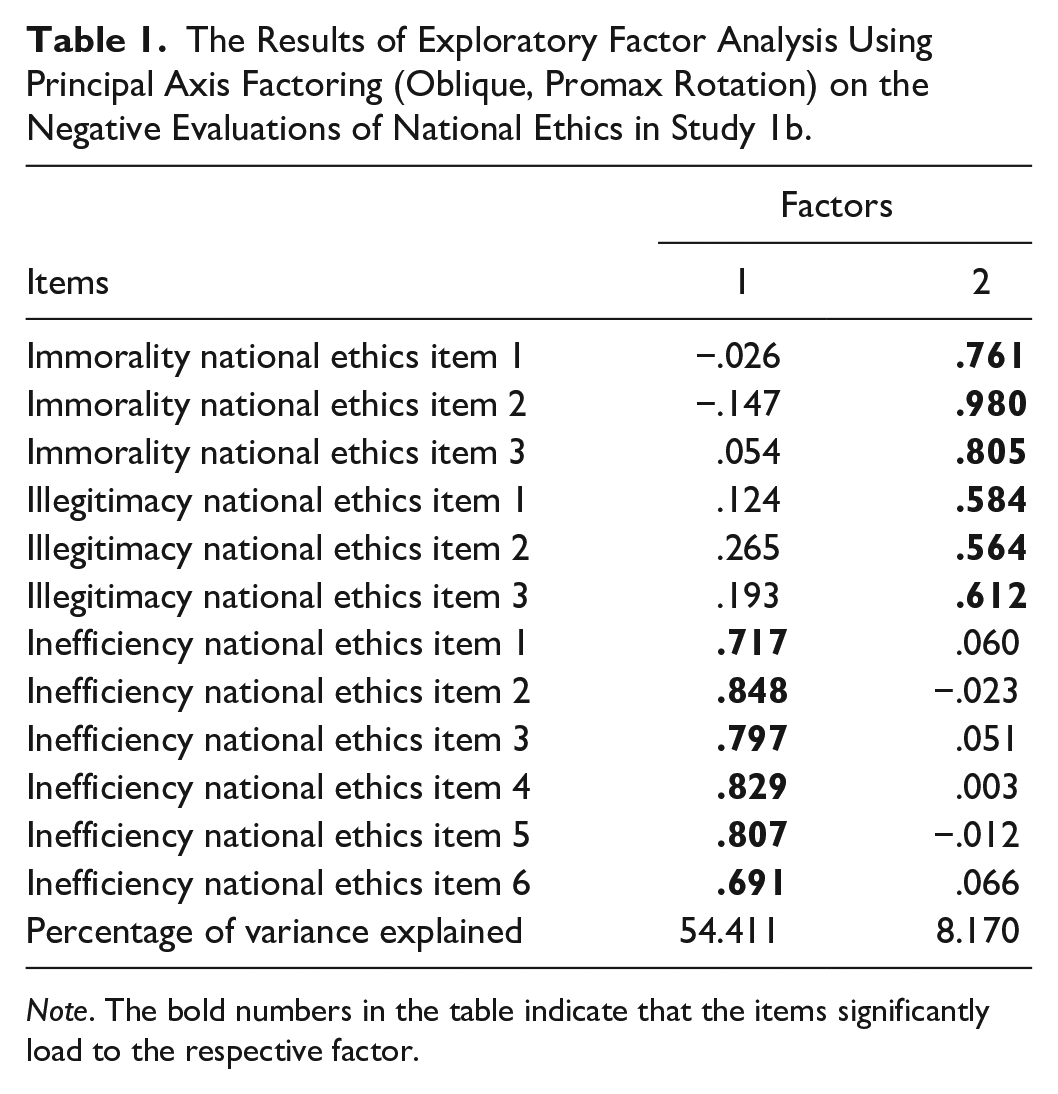
Note. The bold numbers in the table indicate that the items significantly load to the respective factor.
The final step was to check the number of dimensions of participants’ negative evaluations of national ethics. Table 1 showed that the construct consisted of two dimensions. The first dimension is the perceived inefficiency of national ethics, which explained 54.411% of the total variance, while the second dimension is a combination of the perceived immorality and illegitimacy of national ethics, which altogether explained 8.170% of the total variance. Taking into account the arguments made by Samuels (2017), the two dimensions within the construct are statistically warranted, given that they explained more than 50%, or more precisely 62.5810% of the total variance.
To conclude, the findings reported above in sum have answered the research question in Study 1b, in which there are two dimensions or factors in the construct of negative evaluations of national ethics.
Study 2
Study 2 was designed as a second test to confirm the dimensionality of the negative evaluations scale as was found in Study 1b. Moreover, in Study 2, we examined the role of radical beliefs, including participants’ feelings of in-group superiority and proneness to justification and efficacy of violence, in exacerbating negative intergroup attitudes, including out-group blame and out-group distrust, as well as negative group-based emotions, including schadenfreude and anger. Study 2 also aimed to assess how much the radical beliefs predicted intentions to commit violent acts, including offensive jihad and unlawful, non-normative collective actions. Finally, Study 2 was designed to examine the extent to which dual identity centrality negatively predicted participants’ negative evaluations of national ethics.
Based on theoretical rationales and relevant findings elaborated in the previous sections, in Study 2 we generated some hypotheses. First, we hypothesized that participants’ negative evaluations of national ethics would positively predict their radical beliefs (Hypothesis 1a). In turn, radical beliefs would give rise to participants’ negative intergroup attitudes, negative group-based emotions, and intentions to perpetrate violent actions (Hypothesis 1b) and mediate the role of the negative evaluations of national ethics in augmenting each of these outcomes (Hypothesis 2). Finally, dual identity centrality was hypothesized to be a negative predictor of the negative evaluations of national ethics (Hypothesis 3).
Participants and Design
Participants in Study 2 were 214 Muslim students (65 males, 146 females, 3 participants did not specify their gender; Mage = 19.44; SDage = 1.341) from multifarious faculties in a university in Malang, Indonesia. Participants were recruited based on a convenient sampling and took part in the research in return for a small fee. Study 2 was designed as a correlational survey.
Procedure and Measures
Study 2 was administrated in a classroom where research assistants handed participants a questionnaire. The questionnaire commenced with informed consent, followed by a series of questions with which participants were asked to indicate their agreement between 1 (strongly disagree) and 5 (strongly agree). Scores were calculated by averaging participants’ answers on each of the items measuring a number of constructs or variables. Dual identity centrality was assessed with three items (i.e., “I often think of myself as a Muslim as well as myself as an Indonesian”; “My identity as a Muslim is as important as my identity as an Indonesian”; “I see myself as a Muslim as well as an Indonesian”; α = .78), derived from the concept of identity centrality from Leach et al. (2008). Adopted from Study 1b, the subsequent variables were the perceived immorality of national ethics (6 items; α = .93) and the perceived inefficiency of national ethics (6 items; α = .94). In Study 2, the same as in Study 1b, these two variables were combined into a latent construct of negative evaluations of national ethics. In-group superiority was assessed with three items (i.e., “I believe that people who are really proud of being Muslim are very special people. They are predestined to change things in the world”; “I believe that it is better to be proud of the Muslims than of other things.”; “I believe that Muslims are better people than people who endorse another religion”; α = .90), adapted from Doosje et al. (2012, 2013). Following this variable was four other items to measure justification of violence (i.e., “I believe that fighting against infidels is a good thing”; “I believe that fighting against infidels is the right thing”; “I believe that fighting against infidels is legal”; “I believe that fighting against infidels is a fair thing”; α = .96) and three items (i.e., “ I am convinced that it is only through war that injustice against Muslims can be stopped”; “I believe that war is the only way for Muslims to protect their rights”; “I believe that war is an effective way for Muslims to become a powerful group”; α = .94) to measure efficacy of using violence. Justification of violence and efficacy of violence were developed by the authors based on the theoretical arguments of Doosje et al. (2016). Together, these three constructs were combined into a latent construct of radical beliefs. Hostile intergroup emotions is a latent construct, composed of anger (3 items; i.e., “I feel anger/irritated/furious toward the injustice of non-Muslims have done against Muslims”; α = .95), adapted from Stürmer and Simon (2009), and schadenfreude (3 items; i.e., “When I think of misfortunes that afflict non-Muslims, I cannot resist a little smile/this gives me satisfaction/I feel pleasure/”; α = .92), adapted from Ouwerkerk et al. (2018).
Out-group distrust was assessed with four items (i.e., “I do not trust in non-Muslims when they want peace with Muslims”; “I cannot trust non-Muslims because they want to take revenge on Muslims”; “I cannot trust that non-Muslims can act fairly in the interests of everyone”; α = .93), adapted from Tam et al. (2009). Out-group blame was assessed with two items (i.e., “I think that non-Muslims should be blamed for any conflict that pits them against Muslims”; “I think that non-Muslims are more responsible than Muslims for any dispute between the two parties”; α = .87), which were adapted from Anagondahalli and Turner (2012). Both of these variables were combined into a single latent variable of hostile intergroup attitudes. Intentions to involve in non-normative collective actions were assessed with five items (i.e., “To protest against non-Muslims who insult Islam, to the extent you will do the following actions: . . . [Setting fires/Destroying property/Attacking police/Throwing bottles and stones/Attacking people who are considered responsible]”; α = .91), adapted from Tausch et al. (2011). Intentions to commit offensive jihad was assessed with eight items (i.e., “I will do jihad by attacking non-Muslim people or territories to expand Islamic power”; “I will do jihad by expelling non-Muslims from Muslim areas”; “I will do jihad by enforcing the implementation of Islamic Sharia law worldwide”; “I will do jihad by refusing to use Western and Jewish products”; “I will do jihad by opposing a government that does not implement Islamic ideology”; “I will do jihad by fighting against non-Muslim governments”; “Before it is too late, I will do jihad by initiating attacks to non-Muslim people or nations”; “I will do jihad by waging war against unbelievers to avenge their attacks”; α = .92), adopted from Zaduqisti (2019). These two variables were combined into a single latent construct of violent behavioral intentions. At the end of the questionnaire, we asked participants to self-report their age, gender, and ethnicity. Upon finishing the questionnaire, participants were debriefed, thanked, and paid.
Results and Conclusion
Confirmatory factor analysis
Table A2 in the appendix presents the results of the confirmatory factor analysis, to test the consistency of the number of dimensions or latent structure of the negative evaluations of national ethics. As shown in Table A2, consistent with the results of 1b, negative evaluations of national ethics consisted of two dimensions, which explained 71.995% of the total variance.
Descriptive statistics
Table 2 presents the descriptive statistics and inter-correlations among variables in Study 2. As shown in Table 2, dual identity centrality tended to negatively, but the perceived immorality and inefficiency of national ethics negatively relate to radicalism and its negative outcomes, including hostile intergroup emotions, hostile intergroup attitudes, and violent behavioral intentions.
Descriptive Statistics and Inter-Correlations Among Observed Variables in Study 2.

p < .05. **p < .01. ***p < .001.
Hypothesis testing
To test Hypotheses 1 to 3, we used item parceling to make indicators in structural models (Little et al., 2002), because of our interest in assessing the relationships among latent constructs. Following the recommendations of Little et al. (2002), the dimensions of each construct were examined using exploratory factor analysis with oblique rotation. If the construct was unidimensional, we used the item-balancing algorithm technique. If the construct was multidimensional, we used domain-representative techniques (Kishton & Widaman, 1994).
We used some parameters of the goodness of fit to determine the extent to which the hypothesized structural model explains the data. These parameters include the root mean square error of approximation (RMSEA), the comparative fit index (CFI), and the Tucker–Lewis index (TLI). As a rule of thumb (Hu & Bentler, 1999), RMSEA values less than .08 and CFI and TLI values greater than .90 indicate that the structural model has an acceptable goodness of fit.
The data in Study 2 did not contain missing values but violate the assumption of multivariate normality (Skewness = 45.166, M = 15.424, SD = 1.020, p < .001; Kurtosis = 288.736, M = 221.814, SD = 2.626, p < .001). To assess the goodness of fit of the structural model, we, thus, used MLM estimator that is said to be suitable for complete data that do not meet the assumption of multivariate normality (Muthén & Muthén, 1998–2015). The data then was analyzed by means of structural equation modeling (SEM) using Mplus version 7 (SEM; Muthén & Muthén, 1998–2015).
The structural model in Figure 1 had a good fit to the data (RMSEA = .041, 90% confidence interval [CI] [.015, .061], CFI = .99, TLI = .99). The structural model explained 53% variance of violent behavioral intentions (SE = .05, p < .001), 41% variance of hostile intergroup attitudes (SE = .06, p < .001), 36% variance of hostile intergroup emotions (SE = .06, p < .001), 06% variance of radical beliefs (SE = .03, p = .057), and 16% variance of negative evaluations of national ethics (SE = .07, p = .016). Negative evaluations of national ethics significantly and positively predicted radical belief (β = .24, SE = .06, p < .001, 95% CI [.116, .361], power = .91), substantiating Hypothesis 1a. 2 Radical beliefs, in turn, fostered hostile intergroup emotions (β = .52, SE = .06, p < .001, 95% CI [.407, .630], power = 1.00) and hostile intergroup attitudes (β = .59, SE = .05, p < .001, 95% CI [.494, .692], power = 1.00), as well as violent behavioral intentions (β = .56, SE = .05, p < .001, 95% CI [.471, .649], power = 1.00), in line with Hypothesis 1b. Within these relationships, supporting Hypothesis 2, radical beliefs significantly mediated the role of negative evaluations of national ethics in triggering hostile intergroup emotions (indirect effect: β = .12, SE = .03, p < .001, 95% CI [. 059, .188], power = .91), hostile intergroup attitude (indirect effect: β = .14, SE = .04, p < .001, 95% CI [066, .217], power = .91), and violent behavioral intentions (indirect effect: β = .13, SE = .04, p = .001, 95% CI [.065, .202], power = .91). Finally, in support of Hypothesis 3, dual identity centrality negatively predicted negative evaluations of national ethics (β = −.40, SE = .08, p < .001, 95% CI [−.556, −.234], power = 1.00).

The results of the hypothesized structural model in Study 2.
Study 3
Study 3 was an experimental study devised as an intervention to promote dual identity centrality. In Study 3, we also aimed to extend Study 2 wherein radical beliefs were complemented with radical thoughts that consisted of negative out-group stereotypes and dogmatic intolerance, and assessed their relationships with dual identity centrality, negative evaluations of national ethics, hostile intergroup attitudes and emotions, as well as violent behavioral intentions in a single structural model. In Study 3, extreme pro-group behaviors (Swann et al., 2009) were included as a new construct, complementing non-normative actions and offensive jihad intentions, which altogether are assumed to tap into violent behavioral intentions.
Hinged upon these objectives as well as the theoretical rationales and empirical findings as explained earlier, Study 3 proposed several hypotheses. First, negative evaluations of national ethics would enhance not only radical beliefs but also radical thoughts (Hypothesis 4a). The next hypothesis specified that radical thoughts, the same as radical beliefs, would give rise to negative group-based emotions, negative intergroup attitudes, or intentions to perpetrate violent actions (Hypothesis 4b) and they would mediate the role of negative evaluations of national ethics in fostering each of the outcomes (Hypothesis 5). Dual identity centrality could be enhanced by means of a persuasion emphasizing the awareness of how equally important are national identity and Islamic identity (Hypothesis 6).
Participants and Design
Participants were 583 Muslim students from various universities in Indonesia (males = 190, females = 382; 11 participants did not mention their gender; Mage = 19.774; SDage = 2.133). A total of 28 respondents were eliminated from the analysis for not being in accordance with the established criteria, that is, Muslim students who were still active and aged 18 years and over or Muslim students who were not complying with the instructions given. Participants were selected based on convenience sampling. Study 3 was designed as an experimental study in which participants were randomized into one of two conditions: (a) control, (b) experimental.
Procedure and Measures
Study 3 was administered online where research material was compiled in a questionnaire using Google forms and disseminated through multifarious social media platforms. In this questionnaire, to measure each construct in Study 3, participants were asked to indicate their agreement with some items in a Likert-type-scale format that varied from 1 (strongly disagree) to 5 (strongly agree). Scores for each construct were tabulated by averaging participants’ answers to the items.
The online questionnaire started with informed consent, which was followed by an article and instructions to manipulate dual identity centrality. In the experimental condition, participants were presented with an article, ostensibly excerpted from various mainstream newspapers, about the importance of acknowledging Islam and Indonesia as equal identities in Indonesia. After reading the text, participants were asked to give a brief conclusion about the contents of the article. In the control condition, the text was absent and participants were directly asked to briefly describe their activities on a given day. 3 After completing this section, participants were asked to answer some questions to measure constructs in Study 3.
These constructs included the perceived dual identity centrality (3 items; α = .86), the perceived immorality of national ethics (3 items; α = .96), and the perceived inefficiency of national ethics (6 items; α = .95), each of which was adopted from Study 2. The perceived immorality of national ethics and the perceived inefficiency of national ethics were combined into a latent construct of the negative evaluations of national ethics. The subsequent constructs were in-group superiority (α = .88), justification of violence (4 items; α = .93), and efficacy of violence (3 items; α = .94), which were adopted from Study 2 and combined into a latent construct of radical beliefs. Dogmatic intolerance was assessed with six items (i.e., “I believe that everyone should think like me”; “If everyone would think about it, they would hold the same opinions as I do”; “How I feel about issues is the truth”; “People who think differently than me are of lesser value than I am”; “It scares me if people think differently than I do”; “I never really encounter people who think differently than I do” α = .84), adapted from van Prooijen and Krouwel (2017). Negative stereotypes were assessed with six items, adapted from Fiske et al. (2002), in which participants were asked to rate how much they perceived non-Muslims as having six traits (i.e., “unfriendly”; “ill-intentioned”; “untrustworthy,” “insincere”; “cold”; “ill-natured”; α = .95). These two constructs, that is, dogmatic intolerance and negative stereotypes, were combined into a latent construct of radical thoughts. Adopted from Study 2, anger (3 items; α = .96) and schadenfreude (3 items; α = .90) were combined into a latent construct of hostile intergroup emotions, whereas out-group distrust (4 items; α = .92) and out-group blame (2 items; α = .84) were combined into a latent construct of hostile intergroup attitudes. Extreme pro-group behaviors were assessed with six items (i.e., “I would fight someone physically threatening another Muslim,” “I would fight someone insulting or making fun of Islam/Muslims as a whole,” “I would help others get revenge on someone who insulted Islam/Muslims,” “Hurting other people is acceptable if it means protecting Islam/Muslims,” and “I’d do anything to protect Islam/Muslims”; α = .88), adapted from Swann et al. (2009). Non-normative collective actions intentions (5 items; α = .92) and offensive jihad intentions (8 items; α = .91) were adopted from Study 2. Extreme pro-group behaviors, non-normative collective actions intentions, and offensive jihad intentions were combined into a latent construct of violent behavioral intentions. At the end of the questionnaire, participants were asked to self-report their gender and age.
Results and Conclusion
Confirmatory factor analysis
In Study 3, as shown in Table A3 in the appendix, the results from the confirmatory factor analysis showed that consistent with Study 1b and Study 2, the negative evaluations of national ethics consisted of two dimensions or factors. In aggregate, the two dimensions explained more than 50%, or more precisely 79.881% of the total variance, which implies that both dimensions are worth maintaining.
Descriptive statistics
Table 3 presents the descriptive statistics and inter-correlations among observed variables in Study 3. As shown in Table 3, consistent with the findings in Study 2, there were negative relationships between dual identity centrality with, but the perceived immorality and inefficiency of national ethics negatively related to radicalism and its negative outcomes, that is, hostile intergroup emotions, hostile intergroup attitudes, and violent behavioral intentions.
Descriptive Statistics and Inter-Correlations Among Observed Variables in Study 3.

p < .05. **p < .01. ***p < .001.
Hypothesis testing
The next analysis was to test the hypotheses in Study 3. In doing so, the relationships among the variables specified in the hypothesis were integrated into a single structural model, which was then analyzed using SEM. These variables were transformed into latent constructs by adopting the item parceling techniques applied in Study 2. The data in Study 3 did not contain missing values, but turned out to violate the assumption of multivariate normality (Skewness = 68.998, M = 15.792, SD = 0.599, p < .001; Kurtosis = 625.722, M = 438.741, SD = 2.461, p < .001). Considering these findings, Study 3 employed MLM as an estimator to test the extent to which the structural models fitted to the data.
The hypothesized structural model is presented in Figure 2, which fitted to the data very well (RMSEA = .023, 90% CI [.013, .031], CFI = 1.00, TLI = .99). This hypothesized structural model explained 54% variance of violent behavioral intentions (SE = .04, p < .001), 49% variance of hostile intergroup attitudes (SE = .05, p < .001), 33% variance of hostile intergroup emotions (SE = .04, p < .001), 08% variance of radical thought (SE = .03, p = .011), 5% variance of radical beliefs (SE = .02, p = .026), 02% variance of negative evaluations of national ethics (SE = .01, p = .144), and 01% variance of perceived dual identity centrality (SE = .01, p = .24).

The results of the hypothesized structural model in Study 3.
As shown in Figure 2, the negative evaluations of national ethics were a positive predictor of radical beliefs (β = .23, SE = .05, p < .001, 95% CI [.127, .326], power = 1.00), and radical beliefs ultimately augmented hostile intergroup emotions (β = .41, SE = .04, p < .001, 95% CI [.326, .494], power = 1.00), hostile intergroup attitudes (β = .37, SE = .04, p < .001, 95% CI [.283, .450], power = 1.00), and violent behavioral intentions (β = .55, SE = .04, p < .001, 95% CI [.465, .630], power = 1.00). These findings were consistent with Study 2 (see Hypothesis 1a and Hypothesis 1b). Moreover, replicating Study 2 (Hypothesis 2), radical beliefs significantly mediated the role the negative evaluations of national ethics played in fostering hostile intergroup emotions (indirect effect: β = .09, SE = .02, p = < .001, 95% CI [.047, .139], power = 1.00), hostile intergroup attitudes (indirect effect: β =.08, SE = .02, p < .001, 95% CI [.042, .124], power = 1.00), as well as violent behavioral intentions (indirect effect: β = .12, SE = .03, p < .001, 95% CI [.068, .180], power = 1.00). In line with Hypothesis 3 in Study 2, the perceived dual identity centrality was a significant, negative predictor of the negative evaluations of national ethics (β = −.14, SE = .05, p = .004, 95% CI [−.228, −.045], power = .872).
The next analyses revealed that, in support of Hypothesis 4a in Study 3, negative evaluations of national ethics positively predicted radical thoughts (β = .27 SE = .05, p < .001, 95% CI [.168, .381], power = .87). Radical thoughts, confirming Hypothesis 4b, significantly promoted hostile intergroup emotions (β = .23, SE = .05, p < .001, 95% CI [.135 .322], power = .87), hostile intergroup attitudes (β = .40, SE = .05, p < .001, 95% CI [.306, .493, power = .87), and violent behavioral intentions (β = .26, SE = .04, p < .001, 95% CI [.176, .347], power = .87). In turn, radical thoughts significantly mediated the role of negative evaluations of national ethics in augmenting hostile intergroup emotions (indirect: β = .06, SE = .02, p = .002, 95% CI [.024, .102, power = .87), hostile intergroup attitudes (indirect: β = .11, SE = .03, p < .001, 95% CI [.057, .162, power = .87), and violent behavioral intentions (indirect: β = .07, SE = .02, p < .001, 95% CI [.036, .108, power = .87). These findings were in line with Hypothesis 5. Finally, substantiating Hypothesis 6, a persuasion focusing on the equal importance of national identity and Islamic identity significantly increased the perceived dual identity centrality (β = .10, SE = .04, p = .019, 95% CI [.016 .180], power = .62).
Discussion
Our goal in the present research was to examine the psychometric properties, that is, the latent structure, of Muslims’ negative evaluations of national ethics and the interplays between this construct and radicalism as well as dual identity centrality. Largely corroborating the hypotheses specified, we found that Muslims’ negative evaluations of national ethics precipitated members of this particular group’s radicalism and its detrimental consequences, that is, anger and schadenfreude reflecting negative group-based emotions, out-group blame and out-group distrust indicating negative intergroup attitudes, as well as support for offensive jihad and non-normative collective actions denoting intentions to perpetrate violent actions. The final findings showed that promoting dual identity centrality held the potential for the reduction of Muslims’ negative evaluations of national ethics and, ultimately, this religious group’s radicalism.
Theoretical Implications
In the present work, our focus was on domestic radicalism. The well-cited definition of domestic radicalism is support for the use of politically driven violence directed to domestic targets, that is, people who currently reside in a country and share similar nationality with the radicals (Jasko et al., 2017). However, instead of emphasizing the targets, we alternatively focus on the reasons. Construed as such, domestic radicalism denotes support for the use of politically driven violence that is based on an internal cause, which in the context of our research manifests in the perceived immorality, illegitimacy, and inefficiency of national ethics. Our findings that the negative evaluations of national ethics fostered Muslims’ radical beliefs (Studies 2 & 3) and radical thoughts (Study 3) were noteworthy. This is because the prime targets of radicalism in the present work were on a broad category of non-Muslims who are not confined to non-Muslims in Indonesia. This observation brings two implications. First, a trigger of Muslims’ radicalism within a country is not exclusively grounded on external or international causes (e.g., Sageman, 2008) such as protesting the invasions of Afghanistan and Iraq by the United States, defending Palestinian people in Israel or Muslim minorities in Myanmar and China. Rather, internal or domestic causes can also be a powerful driver of radicalism. Second, owing to its far-reaching targets, domestic radicalism may spill over to transnational violence, as suggested by Enders et al. (2011), such that the target countries like Indonesia cannot cast aside its dangers.
Within the context of our research, Muslims are a religious majority group in Indonesia and have dominated the politics of this republic (Mujani & Liddle, 2009). Yet despite these actual advantageous conditions, which give Muslims some privileges that other religious groups cannot enjoy, some segments of radical Muslims in Indonesia still subjectively experience a sense of deprivation. This grievance particularly has to do with their hindered aspirations to make Indonesia an Islamic country. Pancasila as Indonesia’s national ideology and its derivatives such as Indonesian national ethics becomes the foundational sources of the grievance. We assume that such grievance is implicated in the negative evaluations of national ethics, which we found consequential in provoking Muslims’ radicalism. This observation resonates with the theoretical arguments of Belanger et al. (2019) suggesting that radicalism arises in part because of people’s desire to restore the loss of life significance. Within the context of our work, this mechanism describes how some Indonesian Muslims, regardless of their status as a majority and dominant group, subjectively experience feelings of deprivation denoting a perceived negative condition and become radicalized in their efforts to establish Islamic country, a condition that is perceived as positive and ideal.
Previous literature (Bartlett & Miller, 2012; Ozer & Bertelsen, 2018) has made a distinction between non-violent and violent radicalism. The first generally refers to some extreme psychological features such as opposition to the status quo, aspirations to a drastic change of the societal system, or intolerance against the different worldviews (norms, values, culture, or ideology). The aspect of violent radicalism centers on justification or legitimization of violence, to achieve the goals of people’s in-group while disrespecting the interests of other groups. Various psychological models or theories of radicalism (see King & Taylor, 2011, for a review) assume that the transformation from non-violent into violent radicalism passes a linear and not an emergent process. This argument implies that non-violent radicalism is closely linked to violent radicalism. What has been unexplored within the existing literature pertains to the relative strength of the two modes of radicalism in predicting intentions of committing violence. Indeed, intuitively, we may converge upon the idea that violent radicalism should perform a better job than non-violent radicalism in provoking violent intentions. However, we contrarily found that radical thoughts that manifested themselves in negative out-group stereotypes and dogmatic intolerance, reflecting non-violent radicalism, significantly and positively predicted violent behavioral intentions, so did Muslims’ radical beliefs that manifested themselves in their tendencies toward justification and efficacy of violence that reflect violent radicalism. In brief, our work has demonstrated that, although possibly distinct to one another, non-violent radicalism resembles its counterpart, that is, violent radicalism, in igniting violent intentions.
Limitations and Recommendations for Future Research
In this research, negative evaluations of Indonesia’s national ethics were based on religious beliefs. As described earlier, radicalism can take in the multifarious forms, which imply that skepticism and resistance to national ethics may also be grounded on some reasons besides religious beliefs. In addition to Islamic radicalism, Indonesia should deal with separatist conflict in West Papua, the easternmost region of the republic, which is currently rife and unresolved (Singh, 2019). To test the generalizability of the current work’s empirical findings, future studies, thus, may profit from researching a sample of the separatist group. This step is of high relevance and importance to conceptually replicate the structural model hypothesized in this research.
The second limitation touches upon the confined focus of our work on the macro or societal factor, namely national ethics, and intergroup factor, that is, a social categorization of Muslims versus non-Muslims, whereas radicalism may stem from individual factors (Doosje et al., 2016). To overcome this drawback, future studies can assess motivational foundations of radicalism such as quest for significance (Kruglanski et al., 2018), or cognitive and personality factors (Soliman et al., 2016), to get a better insight into an integrative and comprehensive perspective of Islamic radicalism. Moreover, external causes or reasons such as the perceptions that Muslims are under threat (Doosje et al., 2016) and beliefs in anti-West conspiracy theories against Islam or Muslims (Mashuri et al., 2016) deserve testing in future studies, to examine the extent to which these external reasons and the domestic reasons, which are the focus of the current work, may combine in predicting Muslims’ radicalism.
In this research, we recruited a sample of Muslim students as participants. In doing so, we reasoned that concern over the growing trend of radicalism among Muslim students in Indonesia has recently been on the rise. Moreover, students in Indonesia’s history have played a major role in influencing the dynamics of national politics in Indonesia (Madrid, 1999). Yet despite this reasoning, future studies may recruit non-student participants and test how much the plausibility of the hypothesized model of our work can be applied to a more divergent sample.
Footnotes
Appendix
Authors’ Note
Both authors have agreed to share the first authorship for this article.
Declaration of Conflicting Interests
The author(s) declared no potential conflicts of interest with respect to the research, authorship, and/or publication of this article.
Funding
The author(s) disclosed receipt of the following financial support for the research, authorship, and/or publication of this article: This research was funded by University of Brawijaya’s grants for professor, which was awarded to the first author (Grant number: 473/UN10.F11/PN/2019).
