



Abstract
The use of a computer and internet connection allows high school and university students to access more relevant information. However, there is no consensus on the effects of the use of these tools on academic results. This work evaluates the impact of computers and the internet at home on the results of the Saber 11 test, a national exam taken by all students finishing their secondary education in Colombia, between 2017 and 2019. This impact was estimated from a pooled two-stage least squares (pooled 2SLS) model, applied to data from 1,578,460 Colombian high school students. We found that computers and the internet at home had a positive impact on English language performance in the Saber 11 test in Colombia. This work allows a better understanding of the technological effects on educational achievement and provides information for the design of public policies for education in developing countries.
Introduction
Technology provides access to a wide range of educational materials that can promote self-learning and the development of new skills (Bulman & Fairlie, 2016; Jo Shan, 2013). Nevertheless, the impact of technology on academic performance depends on how students use this tool to enhance their knowledge (Tamim et al., 2011). Some researchers have found that personal computers and internet access at home can have a negative effect on academic performance if this technology becomes a distraction or a substitute for other forms of learning such as reading (Fuchs & Woessmann, 2004). There is no consensus in the literature on the impact of technology on educational outcomes; therefore, the objective of this research is to evaluate the effects of computers and the internet at home on Saber 11 test scores in Colombia between 2017 and 2019.
The Saber 11 test is a standardized assessment of the development of the competencies of students who are close to finishing high school. This is a test administered by an institute (The Colombian Institute for Education Assessment [ICFES]) affiliated with the Colombian Ministry of Education, and it is a national exam taken by all students finishing their secondary education. This standardized exam covers five subjects, such as mathematics, critical reading, natural science, social and civic sciences, and English language. The results of these subjects are presented at the individual level on a scale of 0 to 100 points, and the overall score is constructed from a weighted average of the scores in the five tests. These scores are generated using the item response theory model, which defines the probability of success as a function of student’s ability, item difficulty, item discrimination, and pseudo-chance (ICFES, 2018).
In Latin America, some empirical research found that students who had a computer or internet at home scored better on Programme for International Student Assessment (PISA) or on standardized tests (Alderete, 2016; Botello & Guerrero, 2015; Castro Aristizabal et al., 2012). In addition, students with a personal computer had better computer skills (Cristia et al., 2012; Malamud & Pop-Eleches, 2011; Sprietsma, 2011). Nevertheless, some research did not find significant effects of Information and Communication Technologies (ICTs) at home on academic outcomes (Aypay, 2010; Beuermann et al., 2013; Cristia et al., 2012; Fairlie & Robinson, 2013; Wittwer & Senkbeil, 2008). In some cases, the potentially positive effects of the computer on the educational outcomes were countered by a reduction in the homework time resulting in a null effect (Beuermann et al., 2013; Fairlie & Robinson, 2013).
In contrast, some research found that computers and the internet at home had negative effects on academic performance (Fuchs & Woessmann, 2004; Kubey, 2001; Vigdor et al., 2014). According to Sprietsma (2011), computers at home have a negative effect on educational outcomes in students who have a high likelihood to use computers for entertainment. In Peru, a study found that students with a computer at home had lower academic performance because they spent more time helping with household chores than doing homework. In this case, parents used the computer as a reward to encourage their children to help with household chores (Beuermann et al., 2013). In summary, the family background of children is the strongest predictor of the impact of ICTs on academic outcomes (Sunkel & Trucco, 2010).
In Colombia, students with computers or the internet at home had better academic performance and a higher average score on the Saber 11 test and PISA (Castro Aristizabal et al., 2012; Posada & Mendoza, 2014). However, in some cases, these results were influenced by the educational level of the student’s mother (Posada & Mendoza, 2014). On the contrary, Barrera-Osorio and Linden (2009) using a randomized controlled trial evaluated the effect of the public program Computadores para Educar on academic results in Colombia. This program is a public–private partnership to donate computers in public schools. The researchers did not find the positive effects of this program on academic performance in any subject. However, Rodriguez et al. (2011) found that students who completed their high school education in schools benefiting from the Computadores para Educar program were more likely to attend a college.
The impact of the internet or computers at home on students’ standardized test scores in Colombia is unclear. Therefore, this article addresses the question: What is the impact of computers and the internet at home on students’ Saber 11 test scores in Colombia between 2017 and 2019? Thus, the main objective of this research is to evaluate the impact of computers or the internet at home on Saber 11 test scores by estimating a two-stage ordinary least squares model that explains the score of a student by their individual and family characteristics and school inputs.
In Colombia, there is little research on the impact of ICTs at home on students’ standardized test scores, because most of the studies on these topics are most focused on estimating the effects of ICTs on academic achievement. Thus, this article has two main contributions to the literature. First, it assesses the differential impact that computers or the internet at home has on each subject of Saber 11 test. Second, this research contributes to a better understanding of the potential technological impact on the Saber 11 test scores and provides preliminary information for the design of public policies on the development of technological skills in secondary school students.
This article is divided into four sections. The first section presents the theoretical framework to evaluate the effects of computers and the internet at home on test scores. The second section has the econometric model and discusses the identification strategy of the estimated effects in the pooled ordinary least squares (POLS) model. The third section shows the descriptive statistics. Finally, the fourth section presents and analyzes the research results.
Method
In this article, the effect of computers and the internet at home on the Saber 11 test score is evaluated using an educational production function. The conceptual framework of this function is a linear relationship between the inputs used in the educational process and the school output at the student level (Carnoy et al., 2006). In general, the common inputs that make up the production function in education are the characteristics of the student, the family background, and the school resources, and the output is the cognitive skills of the student (Maradona & Calderón, 2004; Wößmann, 2005). Thus, the theoretical model proposed is as follows:

where
Characteristics of students include variables such as gender, age, employment status, and ethnic origin. These variables are included in the model because they have a significant effect on academic performance (Gaviria & Barrientos, 2001). Student gender is important because some investigations in Latin America have found that, on average, men obtain higher scores than women on standardized tests (Abadía & Bernal, 2017; Gaviria & Barrientos, 2001; Niederle & Vesterlund, 2010). For this reason, this research included a binary variable equal to 1 if the student is male and 0 if the student is female.
In addition, the student’s age is included as an independent variable because there is evidence of a negative effect between age and academic performance. Older students are more likely to repeat grades or drop out, and therefore, they could have lower scores in the Saber 11 test (Abadía & Bernal, 2017; Gaviria & Barrientos, 2001). Also, a binary variable is included for whether a student works. This variable is relevant to determine academic performance because the responsibilities of a job reduce the availability of time to study, and therefore, these students may have low levels of educational attainment.
Moreover, among the student characteristics, a dummy variable is included that indicates whether or not the student reads every day. According to some research, students who read more frequently obtain higher scores on standardized tests and school grades compared with those who do not read (Cullinan, 2000; Whitten et al., 2016). In addition, an independent variable, the time per day that the student spent surfing the net in non-academic activities, is included. This variable is important not only to access computer and internet at home but to know how students use this technology to improve their academic knowledge (Jaramillo, 2005; Sprietsma, 2011).
Finally, a binary variable is included for whether a student recognizes himself or herself as belonging to an ethnic group. The question concerning ethnic membership in the socioeconomic questionnaire is answered with a pen on the Saber 11 answer sheet; this is optional and does not affect the score. This variable is important because in Colombia, students who belong to an ethnic group have a lower performance in standardized academic tests (Sanchez-Jabba, 2011). According to the National Administrative Department of Statistics in Colombia (DANE), the country has four recognized ethnic groups: indigenous, Afro-Colombians, gypsies, and the Raizal population of the Archipelago of San Andrés, Providencia, and Santa Catalina.
The second factor in Equation 1 is related to the characteristics of the student’s family. These characteristics are important because there is a positive and significant correlation between the economic and cultural background of parents and student achievement (Abadía & Bernal, 2017; Gaviria & Barrientos, 2001). In this research, the variables evaluating the importance of family characteristics on academic results are the occupation and education of the parents, the number of people in the household, and a binary variable indicating whether or not the student’s mother stays at home during the day.
The parental background has a positive impact on student performance in Colombia (Gaviria & Barrientos, 2001). According to the literature, parents with more education are better able to help their children with their homework and other learning activities (Alomar, 2006; Davis-Kean, 2005). In addition, wealthier parents may send their children to better and more expensive schools (Davis-Kean, 2005). Finally, a better educational and cultural background in the family contributes to the development of new cognitive skills in students (Gaviria & Barrientos, 2001; Mullis et al., 2003; Wößmann, 2003).
The number of people in the household will affect the time and financial resource allocation of parents to the care and instruction of their children (Black et al., 2010; Rosenzweig & Zhang, 2009). Then, in this research, a discrete variable is included that reports the number of people in the household to control for the attention that the student receives. On the contrary, the time that mothers dedicate to the education of their children is important. Gaviria and Barrientos (2001) found that students whose mothers work have lower results than those whose mothers remain at home. For this reason, a binary variable is included for whether the student’s mother works.
Finally, the impact of schools on student performance is analyzed with variables related to the type of school (public or private), the high school schedule, and the school calendar. In Colombia, the academic quality of the school is a major contributor to test scores in maths and language (Núñez et al., 2002). Similarly, researchers found that students who attended private schools generally perform better on standardized tests than their peers in public schools (Bonilla, 2011; Elacqua et al., 2018). Therefore, a binary variable equal to 1 if the school is public and 0 if it is private is included in the model.
Moreover, evidence suggests that high school socioeconomic context matters in student academic achievement (Borman & Dowling, 2010). In Colombia, the socioeconomic status of a high school is based on the cost of registration and tuition. According to the Ministry of National Education, the least expensive schools are also classified in Stratum 1 and more expensive schools in Stratum 4. To assess the effects of the high school socioeconomic context on the Saber 11 test, a binary variable equal to 1 if the socioeconomic level of the school is 3 or 4 and equal to 0 if it is 1 or 2 is included.
According to Gaviria and Barrientos (2001), students who study at an academic school do better on Saber 11 test. Therefore, a dummy variable equal to 1 is included if the student attends an academic school and 0 if it is technical or technical–academic. Moreover, in Equation 1, a binary variable equal to 1 if the scheduled school is morning or afternoon and 0 if the scheduled school is evening or Saturday is included. This variable is included because students who attend classes at night or on Saturday are more likely to have lower scores on the Saber 11 test (Bonilla, 2011).
In Colombia, there are two school calendars, Calendar A and Calendar B, and therefore the Saber 11 exam has two applications during the year. In general, students in the B calendar take this exam in the first half of the year, and students in the A calendar take this exam in the second half of the year. The Saber 11 test evaluates the same competencies in the two application periods, but the difference in the questions may affect the results and generate biases in the estimation. This research, therefore, includes the academic calendar as an explanatory variable of the results in the Saber 11 test.
In econometric terms, the impact of computer and internet possession on the academic results of the Saber 11 test is evaluated with a POLS model. Thus, Equation 1 of the theoretical model is expressed according to the following equation:

where
A computer at home and access to the internet may have positive effects on score achievement tests mainly for two reasons. First, these tools help to complete academic activities and encourage students to research topics of interest to them or those taught in school. Second, students with computers and the internet may have readily available information at any moment, compared with those without access (Apuke & Iyendo, 2018).
Identification Strategy
The estimated impact of computers and the internet at home on Saber 11 test scores may be biased by unobserved factors that may influence achievement tests, such as academic skills and motivation of students or parents’ commitment to the children’s education. For example, if students with a greater academic ability or who have parents with a greater interest in education are more likely to have computers and internet at home, it could overstate the effect of this technology on achievement tests. On the contrary, if students with less academic ability have a computer or internet at home, it could understate this effect (Wooldridge, 2010).
To obtain unbiased estimates, the impact of computers or the internet at home on Saber 11 test scores is evaluated using an instrumental variable approach. This research uses the likelihood that a child’s parents use a computer and internet at work as an instrument for having a computer or internet at home. Parents who use internet and computer at work are more likely to have computer or internet at home but are unlikely that the use of internet and computer at work by the child’s parents has an impact on Saber 11 test scores. Thus, the instrument is likely exogenous and, therefore, valid to identify the causal impacts of the possession of the computer and the internet on Saber 11 test scores.
Data
The analysis is performed on a sample of 1,578,460 students from 10,187 schools in Colombia (6,299 public and 3,888 private) enrolled in Grade 11 who took the Saber 11 test between 2017 and 2019. The unit of analysis is all students between 14 and 25 years of age who have a score greater than zero on the Saber 11 test. The sample is distributed in 1,103 municipalities and 32 departments of Colombia, that is, there is nationwide representativeness. The distribution of the sample in terms of gender is as follows: 46% of the students are male and 54% of the students are female. Finally, most of these students have middle-income families, and 71% have access to the internet or computer at home.
Students who took the Saber 11 test were selected as the unit of analysis for evaluating the effect of the possession of a computer or internet in the student’s home on standardized test scores because senior high school students are more likely to use computers. Specifically, some research has found that students in the last grades of secondary school use ICTs more frequently, whether for academic or other purposes, compared with students in elementary school or the first grades of high school (Cleary et al., 2006). Therefore, it is expected that personal computers and internet access at home will have a higher effect on the academic performance of these students.
This research uses the Saber 11 database of students assessed between 2017 and 2019 in Colombia. This database has the student scores on the Saber 11 exam, as well as the socioeconomic information and the student’s activities that can explain the performance in the test. The Saber 11 database is available in anonymous form on the ICFES website. In addition, as part of the Saber 11 exam registration process, the student gives permission to ICFES treat personal data for statistical or research use, and this entity must keep this information confidential and can only publish this database anonymously.
The Saber 11 is a standardized test applied to students of 11th grade in high school, and it is commonly used as the major criterion for admission to higher education programs in Colombia. This exam consists of 254 multiple-choice questions, and it is administered biannually in April and November during two 4-hr sessions. The questions are distributed as follows: 50 mathematics questions, 41 critical reading questions, 50 social science questions, 58 natural science questions, and 55 English questions (see Appendix B for some samples of the questions). The test of math evaluates the ability of students to interpret, represent, and solve math problems in statistics, geometry, algebra, and calculus. Similarly, the critical reading test measures the student’s ability to understand, interpret, and critically evaluate a text.
The social science test evaluates the knowledge of students in history, geography, political constitution, and citizen competencies. The natural science test is composed of three thematic areas: biology, physics, and chemistry. This module evaluates the student’s ability to understand and use natural science concepts and theories to solve problems. Finally, the English test evaluates the student’s ability to complete conversations as well as read and understand articles in English. In this test, the student performance is measured according to the six levels of the Common European Framework of Reference for Languages (A1, A2, B1, B2, C1, C2).
The analysis considers only students who live in Colombia, aged between 14 and 25 years old; this excludes 2.8% of the sample. The main justification for removing students over 25 years of age is that they entail a heterogeneity in socioeconomic, family, and academic conditions in comparison with those of median age, which may bias the results. Also, students are excluded who scored zero on total score, mathematics, or language as well as who had null values in the independent variables. In the end, there is a sample of 1,578,460 students attending 10,187 schools.
The variable of interest is the possession of a computer or internet in the student’s home. This variable was constructed using the following socioeconomic questions from Saber 11: Does your household have an internet connection? or Do you have a computer at home? When the answer is affirmative in either of these two questions, the binary variable that identifies the possession of a computer or internet in the student’s home is equal to 1, and 0 otherwise.
Also, a categorical variable, the time that the student spent exploring the internet for non-academic activities, is included and corresponds to the question: Usually, how much time do you spend per day surfing the internet (exclude academic activities)? This variable takes the value 1 if the student has dedicated at least 30 min to surf the internet, 2 if the student surfs between 30 and 60 min, 3 if the student surfs between 1 and 3 hr, and 4 if the student surfs more than 3 hr per day.
The econometric estimation also included the gender and age of students. The latter is a discrete variable that reports the age of the student at the time of registration for the Saber 11 test. Student gender is a dummy variable equal to 1 if the student’s sex is male and 0 if it is female. Moreover, a variable is included that shows whether the student works. This variable is equal to 1 if the younger students have dedicated at least 1 hr to work in the previous week of registration for the Saber 11 test.
In addition, some family background characteristics of the student are included as independent variables. One of these is parents’ education; this variable was obtained from the questions: What is the highest grade level completed by your mother? and What is the highest grade level completed by your father? To avoid potential selection bias, for each student, the education of the parent with the highest educational level was selected. Parents’ education is a categorical variable, and it is split into four categories: less than high school, high school, bachelor’s degree, and postgraduate degree.
Another important measure is the number of people in the household. This is a discrete variable whose minimum value is equal to 1 and corresponds to the question: Including you, how many people live in your house or apartment? Similarly, a variable, the group of socioeconomic characteristics, is included that indicates whether the student’s mother works. This variable is a dummy equal to 1 if the student in the socioeconomic questionnaire of the Saber 11 indicated that his/her mother worked in the last year.
Finally, the econometric model includes independent variables associated with the school. One of these is a binary variable that takes the value 1 if the school that a student attends is public and 0 if it is private. Another variable is the educational modality of the school; this is a dummy variable equal to 1 if the school is only academic and 0 if the educational modality of the school is technical/academic or technical. Furthermore, the socioeconomic level of the schools is included. This is a dummy variable equal to 1 if the socioeconomic level of the school is 3 or 4 and equal to 0 if it is 1 or 2. Also, a binary variable equal to 1 if the scheduled school is daytime and 0 if it is nighttime or Saturday is included.
In addition, the school calendar is included as a binary variable equal to 1 if the school belongs to Calendar A and 0 if it belongs to Calendar B. In Colombia, academic Calendar A starts in February and ends in November, and Calendar B starts in September and ends in June. In Calendar A all schools are public while private schools can choose any of them. However, most private schools with a higher economic level or focus on bilingualism develop their academic activities in the B calendar. The quality of education is the main difference between schools in the two academic calendars. B-calendar schools have better results in standardized tests than A-calendar schools.
The instrumental variable used in this research is a binary variable equal to 1 if the student’s father or mother uses a computer and the internet at work, and 0 otherwise. This variable is used on the assumption that parents’ employment will affect the likelihood of having a computer or internet at home, but parents’ employment does not affect the student performance. For the construction of this variable, the information that the student registers in the socioeconomic questionnaire on the employment of his or her mother and father is used. Based on the technological intensity, the jobs are divided into two groups: jobs most likely to use computer and internet, and jobs which are less likely to use this technology.
The sets of occupations most likely to use computers and the internet are managerial and administrative positions, professional work (e.g., doctor, lawyer, engineer), or businessman. On the contrary, the occupations with less likely to use computers and the internet are construction and farm workers, cleanup workers, household chores, works in the sector’s sales and service, self-employed workers (e.g., plumber, electrician, machine operator, or vehicle driver), or informal sector business owners. People who are neither in work nor in education are classified in the category of occupations with less likely to use computers and the internet because they may not have enough money to invest in this technology.
Results
Table 1 shows the descriptive statistics of the students’ Saber 11 test scores evaluated between 2017 and 2019. This analysis is carried out by the group and differentiates the scores obtained between students with access to a computer or internet at home and those who did not have access to this technology at home. As illustrated in Table 1, students with a home computer or internet access scored higher on all tests, compared with those without access.
Differences in Saber 11 Scores Between Students With and Without Computer or Internet at Home, 2017–2019.

Source. The Colombian Institute for Education Assessment—Saber 11, 2017–2019.
A sample of 1,578,460 students who took the Saber 11 test in Colombia between 2017 and 2019 shows that 71% of the students have a computer or internet at home, and this percentage does not vary over the 3 years in the sample. In addition, on average, students scored 255 points on the Saber 11 out of a possible 500. According to descriptive statistics, there are differences in Saber 11 scores between students with and without a computer or internet at home. Students with a home computer or internet access scored on average 12 points higher than students without access.
Scores obtained on each subject of the Saber 11 test are approximately 52 points out of a possible 100. As in the total score of this test, the students with computers or the internet at home obtain scores above the average in each subject of the Saber 11 test. Students with access to a computer or internet at home obtained around 2 points above the average. In contrast, students who did not have this technology scored around 4 points below the average.
Table 1 shows that children who do have a home computer or internet spend on average between 30 min and 1 hr surfing the internet in non-academic activities. As expected, students with a computer or internet at home spend more time browsing the internet in non-academic activities. Specifically, 60% of the students used the internet a little more than an hour to surf the internet in non-academic activities, compared with 26% to those without access. This would mean that children who were users of home computers did spend much less time on academic activities and may tend to achieve less well than children who did not use computers.
Table 2 presents the descriptive statistics of the independent variables for individual, parental, family, and school characteristics that affect academic results.
Descriptive Statistics, 2017–2019.

Source. The Colombian Institute for Education Assessment—Saber 11, 2017–2019.
According to the descriptive statistics from Table 2, 46% of the tested students are men and 54% women. This finding is consistent with the distribution of schooling rates by gender in Colombia. The average age of the tested students was 17 years old, and the majority were students enrolled at academic high school. Moreover, 31% of students reported that they had worked part-time during the week before exam enrollment. This value is relatively high because this research excluded students from high school by cycles or validation.
The average size of the student’s household was four or five people, and 7% of the students recognize themselves as belonging to an ethnic group in Colombia. In addition, 63% of students have parents whose highest level of education attained was high school. Likewise, approximately 19% of students have parents employed in managerial, professional, or administrative jobs. Finally, 88% of the students were enrolled in academic programs and 74% attended public schools. On the contrary, 42% of the students who presented the Saber 11 test between 2017 and 2019 studied in schools of Socioeconomic Level 3 or 4.
Table 3 shows the effect of computer or internet at home on students’ Saber 11 test scores in Colombia between 2017 and 2019. Three estimated effects are presented in this table: The first evaluates the impact of the only computer at home on students’ Saber 11 test scores, the second estimated effect shows the impact of the only internet at home on students’ Saber 11 test scores, and the third estimated effect is the impact of computer or internet at home on students’ Saber 11 test scores. These estimated effects include independent variables for individual, parental, family, and school characteristics that affect academic results.
Estimation of the Model by Ordinary Least Squares With Instrumental Variables (IV).

Source. Author’s calculation based on the Colombian Institute for Education Assessment—Saber 11, 2017–2019.
Note. Robust standard errors in parentheses.
p < .1. **p < .05. ***p < .01.
According to the results, students who had computers or internet at home obtained higher test scores compared with those without access. A two-stage POLS model shows that students with computers or the internet at home scored 1 more point on a Saber 11 test than students without this technology, although this result was not statistically significant. However, students who have a computer but not internet at home obtained lower scores on Saber 11 test. On the contrary, students who used the daily internet had approximately 2 more points on a Saber 11 test than students who use computers less often. However, the use of the internet had to decrease marginal returns on score tests as more time spent surfing on the internet the student scored 0.2 points less.
The results show that men scored on average 10 points higher than women on the Saber 11 test, after controlling for observable characteristics. These results are comparable with those obtained by several investigations in Latin America that found gender differences in favor of males in mathematics and science performance as the higher scores become more pronounced (Abadía & Bernal, 2017; Gaviria & Barrientos, 2001; Niederle & Vesterlund, 2010). Different hypotheses have been put forward by researchers to explain this gap in gender in standardized tests. One set of issues relates to unobserved factors such as motivation, expectations, school, and cultural environment. Another hypothesis states that women have a slightly higher propensity to anxiety than men in tests in highly competitive environments (Gneezy et al., 2003; Niederle & Vesterlund, 2010; Paserman, 2011; Shurchkov, 2012).
On the contrary, some researchers found that the cultural stereotype that men have greater mathematical skills than women leads them to lose interest in this area from an early age and effectively perform worse than men (Miller & Halpern, 2014; Reilly, 2012). In addition, Guiso et al. (2008) found that the difference in mathematics scores between men and women in the PISA tests was smaller in Latin American countries with greater gender equality in the labor market and more access to higher education, as well as the economic and social development of the country.
According to the results in Table 3, younger students on average scored higher on the Saber 11 than older students. This could be because the latter have a higher likelihood to repeat grades or to dropout. Similarly, students who studied during the evening and Saturday got low scores on the Saber 11 tests. Students who worked during the day scored about 8 points lower on the Saber 11 test possibly because they could not have had enough time to study. On the contrary, students who had read at least 30 min per day obtained on average 12 more points on Saber 11 test than students who read less often.
There was a strong correlation between the education of parents and the students’ Saber 11 test scores. Students with parents with a bachelor’s degree scored on average 7 points more than students whose parents had a lower level of education. This finding is consistent with researcher that found evidence that students with parents with more education are more likely to be academically successful because they have a family with more academic, economic, and cultural resources that contribute to their learning than students with less-educated parents (Alexander et al., 2008; Alomar, 2006; Davis-Kean, 2005). Specifically, parents with higher educational attainment generally have the income necessary to obtain tools that contribute to their children’s learning and also possess the skills to guide them in the use of these tools (Frenette, 2019).
In addition, some research finds that there is an intergenerational correlation in IQ between parents and children (Plomin & Von Stumm, 2018). So the correlation between parents’ educational attainment and children’s academic success is related to genetic factors (Branigan et al., 2013). Therefore, parents with higher education and perhaps higher cognitive skills have smarter children and thus better academic outcomes. In addition, parents with more education, either through achievement linked to intelligence or disciplined study, generally value education more highly and this behavior is very likely to be passed on to their children (Branigan et al., 2013).
By contrast, students whose mother worked got around 0.6 points lower than students whose mother stayed at home. Furthermore, the number of people in the household had a negative effect; for example, for each additional person in the household, the students obtained an average of 2 points less in the Saber 11 test.
Differences in test scores of students who attend public and private schools were significant and most of which seem to be attributable to schools’ socioeconomic characteristics. Students enrolled in private schools scored 2 points higher than students enrolled in private schools on average on the Saber 11 test. Similarly, the economic level of the school was one of the major factors contributing to improvements on Saber 11 scores; in particular, students enrolled in schools of a higher economic level obtained an average of 12 points higher than students from other types of schools. Likewise, students enrolled in schools with Calendar B, which are most of the private schools, scored on average 25 points more than students in Calendar A.
The instrument used in this model is exogenous and significant because the Cragg–Donald Wald F test is greater than 10 in the first stage. The Hansen J test is greater than 1%, 5%, and 10%, and the null hypothesis of exogeneity is not rejected (Durbin–Wu–Hausman endogeneity test). This would suggest that the POLS estimation does not differ significantly from the estimation by instrumental variables; thus, the POLS estimation does not present inconsistency problems due to endogeneity in the model (see Table A1 in Appendix A).
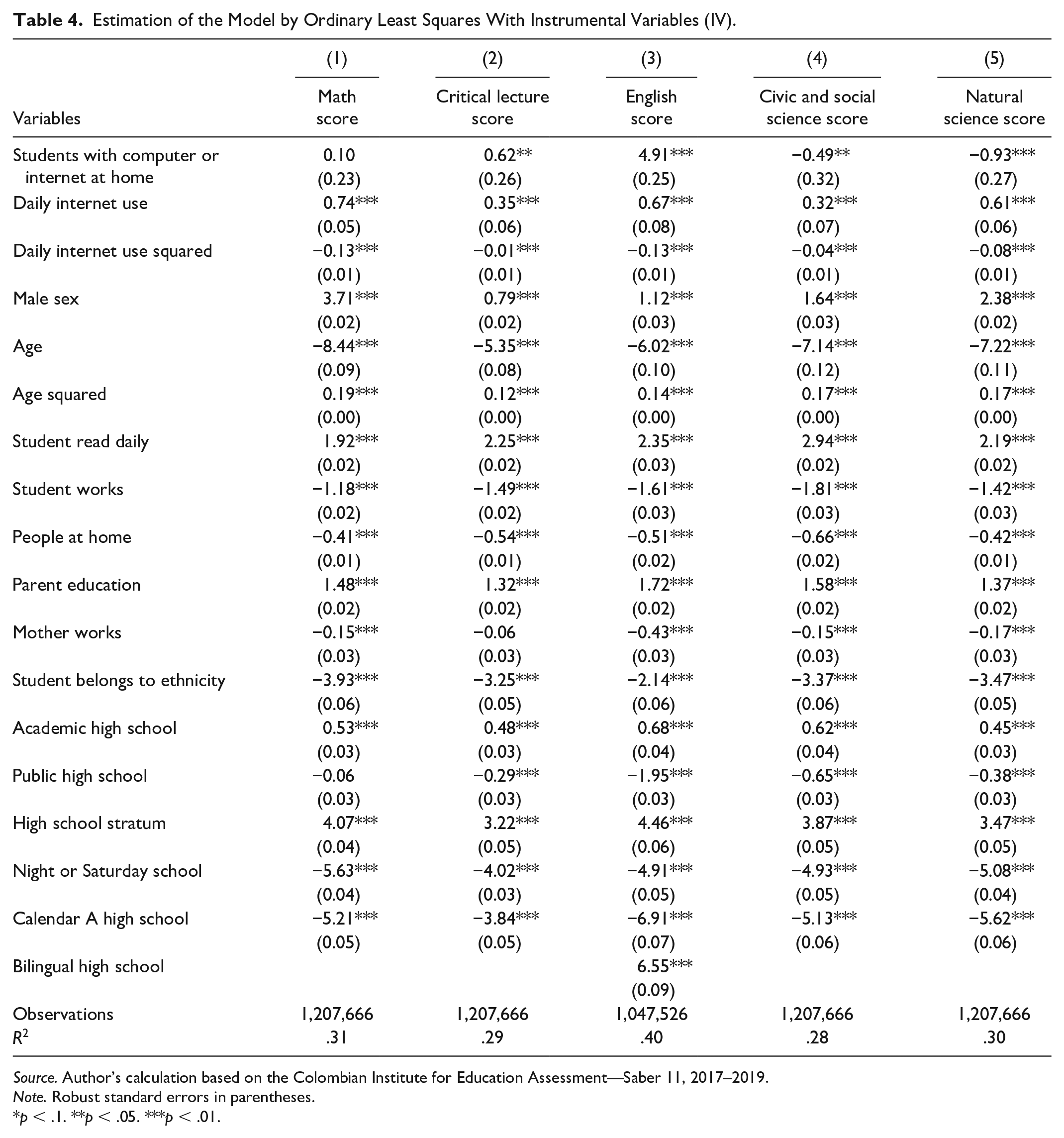
Table 4 presents the same estimated effects for the different subjects evaluated in Saber 11 test: mathematics, critical reading, English, social and civic sciences, and natural science. The results show that students with a home computer or internet access scored 5 points higher on English tests, compared with those without access. Nevertheless, computers or the internet at home had a negative impact on natural science score and the civic and social science score.
Estimation of the Model by Ordinary Least Squares With Instrumental Variables (IV).
Source. Author’s calculation based on the Colombian Institute for Education Assessment—Saber 11, 2017–2019.
Note. Robust standard errors in parentheses.
p < .1. **p < .05. ***p < .01.
The results show that computers and the internet at home rose 5 points in the English score and 0.6 points in the critical lecture score. This technology had a positive but not significant impact on math scores. On the contrary, there was a negative and significant impact on social science and natural science scores. In all areas, the use of the internet had a positive and significant impact. However, consulting the internet for more than 30 additional minutes has negative effects on the score obtained in Saber 11 test.
In this research, it is not possible to know why students who had a computer or internet at home scored lower on social science and natural science in Saber 11 test between 2017 and 2019 compared with those without this technology. Nevertheless, previous studies have found that the absence of software in personal computers to support young people’s learning could affect negatively the use of ICTs on academic performance (Cristia et al., 2012). On the other hand, previous studies suggest that although there are many software to support the learning of sciences such as physics, the challenge is to map these problems in the characteristics of computational solutions (Weintrop et al., 2016).
Finally, men significantly outperformed women in all subjects, but gender differences on scores were greatest in math and science. However, men outperformed women just by less than 1 score point in critical lecture. Similarly, the age of the student has a greater negative effect on the math score. On the contrary, family characteristics and especially those related to parents’ education had a positive effect, while the number of people in the household had a negative effect on the Saber 11 scores. Finally, students in a bilingual school scored about 7 additional points in their English score.
Discussion
According to the results, in Colombia, students who had a computer or internet at home scored better in Saber 11 test between 2017 and 2019. However, this technology did not improve the performance in all subjects evaluated and its greatest positive impact was on English scores. These results are similar to those obtained by some research for Latin America that found a positive and significant effect of the use of ICTs on students’ educational outcomes (Botello & Guerrero, 2015; Castro Aristizabal et al., 2012). While these findings are preliminary, they help to understand the importance of ICTs on education and self-learning.
However, further research is important for identifying the mechanisms, which lead to a positive correlation between the possession of a computer and the internet at home and the scores obtained in the Saber 11 test. For example, students who have computers or internet at home likely have parents with higher education and better socioeconomic conditions. In this case, family background characteristics could be the mechanism through which the technology improves academic performance. Furthermore, it needs to identify what activities students perform on the computer or internet and their effects on academic performance.
This research has some limitations. First, because we do not have detailed information on the time and use of the internet and computers at home, it is not clear how this technology influences test scores. Second, the relationship between Saber 11 test scores and the use of technologies may be affected by unobserved factors such as student discipline leading to wrong inferences. Third, the use of technology for academic purposes depends to a large extent on the computer skills of students along with the knowledge they may acquire in schools.
Conclusion
This research finds that computers or the internet at home had a positive impact on the Saber 11 test score in Colombia between 2017 and 2019. However, the results at the subject level show that the greatest positive impact of this technology is in English. In mathematics and critical reading, there is evidence of a positive correlation, although only significant for the latter subject. Finally, having a computer or internet at home reduces the result of social and natural science in Saber 11 by approximately 1 point.
Based on the results, there is a need to consider differential policies by subject given the comparative advantages of having computers and the internet at home in the Saber 11 test scores, mainly in English. Establishing strategies for the use of ICTs by knowledge area will make it possible to take better advantage of these tools in education and develop strategies to improve their use in areas where they currently have a negative or positive effect.
Daily use of the internet had a positive correlation with scores obtained in all academic areas of Saber 11. However, it had marginal diminishing returns in the scores, because students who spent more time browsing scored lower than those who browse less often. On the contrary, the educational levels of parents were highly correlated with the technological disposition at home. Thus, it could be thought that the technological capacities in the home and the absorption of technologies of the family members, approximated by the possession of a computer and the internet, are also associated with higher scores and a greater cognitive capacity in children.
These results approximate the technological effects on educational achievement and provide information for the design of public policies in the development of technological skills. However, it is necessary to understand the mechanisms by which the internet and the computer at home improve students’ Saber 11 test results. Likewise, it is necessary to know which are the activities developed by students on the computer or internet influence the results in standardized tests.
Supplemental Material
sj-pdf-1-sgo-10.1177_21582440211040810 – Supplemental material for The Impact of Computer and Internet at Home on Academic Results of the Saber 11 National Exam in Colombia
Supplemental material, sj-pdf-1-sgo-10.1177_21582440211040810 for The Impact of Computer and Internet at Home on Academic Results of the Saber 11 National Exam in Colombia by Fernando Barrios Aguirre, Diego A. Forero, Martha Patricia Castellanos Saavedra and Sandra Yaneth Mora Malagón in SAGE Open
Footnotes
Appendix A
The First Stage Model of Students With Computer or Internet at Home.

| Variables | (1) |
|---|---|
| Students with computer or internet at home | |
| Parents use computer at work | 0.09*** |
| (0.00) | |
| Daily internet use | 0.19*** |
| (0.00) | |
| Daily internet use squared | −0.02*** |
| (0.00) | |
| Male sex | 0.03*** |
| (0.00) | |
| Age | −0.04*** |
| (0.00) | |
| Age squared | 0.00*** |
| (0.00) | |
| Student works | −0.03*** |
| (0.00) | |
| People at home | −0.01*** |
| (0.00) | |
| Parent education | 0.04*** |
| (0.00) | |
| Mother works | 0.04*** |
| (0.00) | |
| Student belongs to ethnicity | −0.10*** |
| (0.00) | |
| Academic high school | 0.02*** |
| (0.00) | |
| Public high school | 0.01*** |
| (0.00) | |
| High school stratum | 0.15*** |
| (0.00) | |
| Night or Saturday school | −0.00 |
| (0.00) | |
| Student read daily | −0.01*** |
| (0.00) | |
| Calendar A high school | 0.04*** |
| (0.00) | |
| Observations | 778,476 |
| R 2 | .30 |
Note. Standard errors in parentheses.
p < .1. **p < .05. ***p < .01.
Appendix B
Declaration of Conflicting Interests
The author(s) declared no potential conflicts of interest with respect to the research, authorship, and/or publication of this article.
Funding
The author(s) received no financial support for the research and/or authorship of this article.

Supplemental Material
Supplemental material for this article is available online.
References
Supplementary Material
Please find the following supplemental material available below.
For Open Access articles published under a Creative Commons License, all supplemental material carries the same license as the article it is associated with.
For non-Open Access articles published, all supplemental material carries a non-exclusive license, and permission requests for re-use of supplemental material or any part of supplemental material shall be sent directly to the copyright owner as specified in the copyright notice associated with the article.
