




Abstract
Disparities in academic performance based on race in the United States are a persistent problem. As a result, a plethora of remedies such as using student-centered instructional strategies, de-tracking, ensuring low teacher–student ratios, and promoting high teacher expectations for all learners have been tried with limited success. Thus, this phenomenological qualitative study explored other possible solutions from the experiences and perspectives of students. Participants were 33 high school students of color.1 Data showed that the participating learners considered the use of culturally inclusive2 teaching practices and learning resources, implemented in caring schools by caring educators a viable solution to issues of poor academic performance among learners of color.
Keywords
All students, irrespective of their differences, both natural and socially constructed should experience and achieve educational success. This is especially true in the United States because the goal of education is to equip learners with knowledge, skills, and dispositions essential for “publicness,” that is, learning “what it means to be a public and to start down the road toward common national and civil identity” (Goodlad, Mantle-Bromley, & Goodlad, 2004, p. 35). Unfortunately, attaining educational success has historically eluded many students, learners of color in particular, because their lived experiences and cultures are rarely represented in curricula (Apple, 2004). When education fails to reflect the experiences and contributions of everyone, the excluded groups are likely to refuse to participate (Giroux, 2001; Kohl, 1994; Sleeter & Grant, 2009). Such refusal could lead to poor academic performance. Therefore, Brown (2017) and Williams (2011) reported that perhaps because of learner refusal to participate in exclusive education, students of color have consistently performed dismally on almost every measure of educational achievement. But what is most concerning is the fact that in spite of the proposed solutions by multiple studies, there has been little progress in solving the problem. This conundrum requires the development of other remedies. Therefore, we (researchers) designed this study to identify alternate solutions based on students’ lived experiences and perspectives. Specifically, we were interested in investigating the conditions and contexts such as pedagogy, learning environments, resources, opportunities, and challenges (Nieto & Bode, 2012) that the participants experienced.
Previous studies concluded that, in general, learners of color in the United States experience unfavorable learning conditions and contexts. For example, Kumar and Lauermann (2018) and Kumar and Hamer (2013) found a positive correlation between teacher attitude toward culturally diverse learners and their motivation to implement learning that meets the needs of all learners. As a result, educators who hold limited worldview, and have negative attitude toward cultural diversity, are less likely to implement culturally inclusive education, thus limiting the academic success for many learners of color (Darling-Hammond, 2010). A culturally exclusive education is problematic because it does not examine, disrupt, and redress unjust learning conditions and contexts that learners of color contend with on a regular basis (Banks, 2001, 2008; Oikonomidoy, 2014; Rankin & Reason, 2005; Sanchez & Hagopian, 2017; Sleeter & Grant, 2009).
Addressing the matter of cultural exclusivity, King (2017, p. 15) contended that in social studies, for example, students of color were likely to experience a high degree of academic alienation, cultural isolation, and misunderstanding because “teachers ignore Black history and that what is taught is sometimes lethargic, too celebratory and lacks complexity.” In a similar analysis, Adams and Busey (2017, p. 13) found that Afro-Latino/a experiences were generally “omitted from K-12 social studies curriculum.” Such exclusionary education is unacceptable particularly in the current educational context that expects educational success for all learners. As a result, the current study explored the educational experiences of high school students of color. Specifically, we focused not only on learners’ lived experiences and perspectives about what was working educationally, but also their ideas about quality schools and classroom environments.
Conceptual Framework
The framework of Culturally Responsive Pedagogy (CRP) grounded this study. The researchers favored a CRP framework because it focuses on the processes involved in creating representative educational opportunities in contexts of cultural inclusivity, fairness, and justice (Banks & Banks, 2004; Gay, 2012; Wurzel, 2004). The framework of CRP supports an education that values heritage cultures. Thus, an education founded on its principles favors curricula that are culturally inclusive (Ladson-Billings, 1995, 2001; Nieto, 2004; G. P. Smith, 1998). Therefore, Brown-Jeffy and Cooper (2011) considered an education that is grounded on the principles of CRP, empowering and liberating, because it is not only culturally inclusive but also exposes and confronts various dimensions of oppression. Furthermore, an education based on the ideals of CRP is inspiring because it relies on instructional practices that support learners socially, emotionally, and cognitively. By using a CRP framework, therefore, this phenomenological study focused not only on educational experiences of the participating students of color, but it also critiqued existing educational practices.
Method
This qualitative phenomenological study (Moustakas, 1994) explored the educational conditions and contexts (pedagogy, learning environments, resources, opportunities, and challenges) experienced by high school students of color in Grades 10 through 12. Because the schools that the participants attended were located in predominantly White 3 communities in the Rocky Mountain region of the United States (see Table 1) where the researchers lived and worked, this study explored not only the nature of pedagogy, learning environments, resources, opportunities, and challenges that the participants experienced, but also the impact that school experiences had on learners. In addition, the researchers planned to identify experience-based solution/s to the problem of poor academic performance that affect learners of color in the United States.
Studied High Schools by Region.
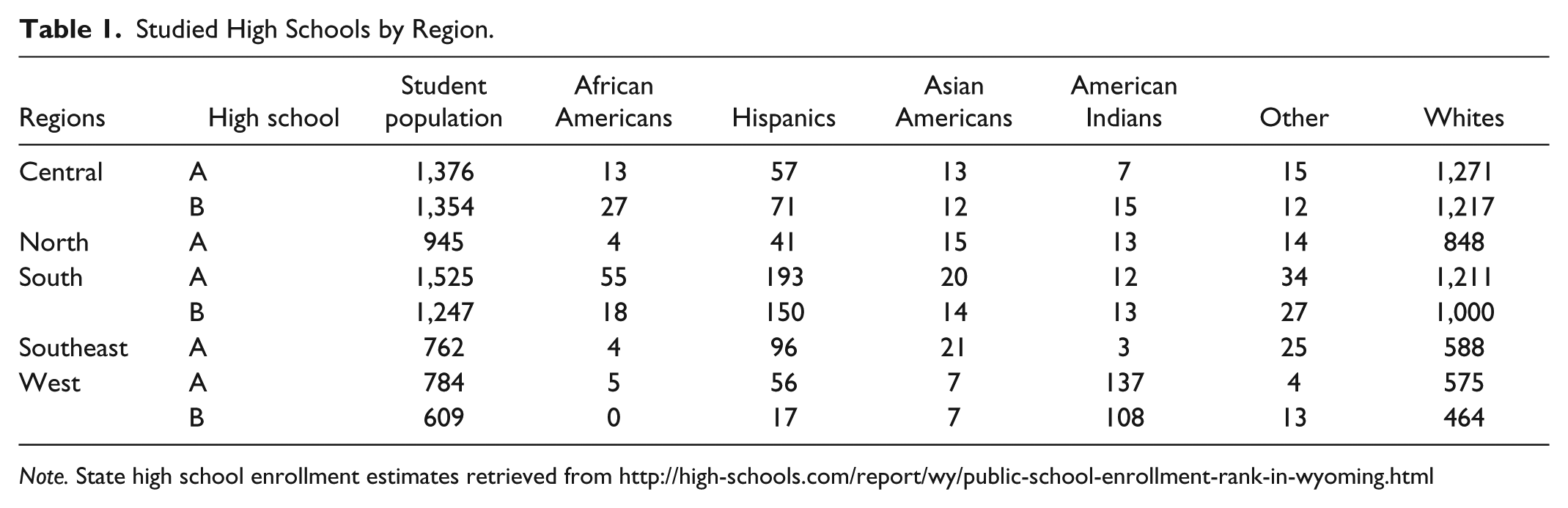
Note. State high school enrollment estimates retrieved from http://high-schools.com/report/wy/public-school-enrollment-rank-in-wyoming.html
Disparities in academic performance based on race in the United States are a persistent problem (Kumar, Karabenick, & Burgoon, 2015). Therefore, multiple scholars have recommended remedies that have had limited success. As a result, the researchers designed the current study to seek additional solutions based on learner lived experiences and perspectives. A total of 33 students from eight different high schools participated. According to enrollment data by race, 83.9% of the total student population in these eight high schools was White, 7.9% Hispanic, 3.6% American Indians, 1.5% African Americans, 1.2% Asian Americans, and 1.6% “Other.”
To identify potential participants, the researchers mailed a letter (see Appendix A) to high school principals in all five regions of the state requesting them to not only authorize them to conduct the study in their respective schools, but also to help the researchers identify a representative sample of students of color in terms of sex, gender, race, ethnicity, social economic status, grade level, and academic ability/performance. Also included in the letter was a detailed description of the study, including the availability of a US$20 gift certificate for each participant. Later, the researchers telephoned school principals to see if they needed additional information regarding the planned study. In addition, they met with school principals and/or their designees who needed additional information before committing.
The consenting school principals collaborated with their respective assistant principals, school counselors, and classroom teachers in the process of identifying potential participants. First, the concerned school administrators and/or their representatives contacted and explained the study to all learners in their respective schools who had identified themselves in the school records as non-White. Second, they invited learners of color to participate in the study and assured them that because participation was voluntary, they could withdraw from it any time during the course of the study without penalty. In addition, they assured potential participants that their respective parents/guardians would grant them permission to participate, and that their respective parents/guardians could stop them from participating at any time during the course of the study without any penalty. All potential participants signed consent/assent forms. In the end, 19 males and 14 females volunteered to participate (the researchers did not have any prior knowledge of and/or relationship with participants).
Of the 33 volunteers, 10 were Hispanics, 12 were African Americans, six were Asian Americans, three were Native American, and two identified themselves as “other.” The participants were enrolled in 10th grade (n = 12), 11th grade (n = 11), and 12th grade (n = 10). In addition to racial, gender and grade diversity, the participants were dissimilar in academic abilities (high, medium, and low performing), language (English Language Learners [ELLs] and native English speakers), geographical region (state natives and new comers), and national origin (American born and immigrants). While some participants readily expressed their ideas and perspectives about their school experiences, others were timid. Thus, they provided brief responses necessitating the researchers to ask multiple probing questions.
Given the diversity of the participants, it is probable that the data generated from this study were accurate representation of the experiences and perspectives held by learners of color in the studied schools. Equally helpful were the research questions (see Appendix B) the researchers used because they required open-ended responses. As a result, the participants had ideal space to share their thoughts and experiences freely and in critical details. In addition, we conducted interviews in locations and times recommended by individual participants. We also assured the participants a high degree of anonymity and confidentiality. The participants were agreeable to the established research protocol. Thus, they participated eagerly (some even wondered why this was the first time researchers were interested in hearing their stories). Although establishing trusting relationships between researchers and research subjects is potentially beneficial, it could also cultivate researcher/subject bias. To mitigate this potential pitfall, the researchers conducted member check to ascertain that data presentations were accurate. Also, they worked individually during data analysis. Then, we compared notes to mitigate individual bias.
Data Collection and Analysis
Because phenomenological studies help research subjects to create critical meaning from lived experiences and/or phenomena (Bogdan & Taylor, 1975; Moustakas, 1994), the researchers used literature on CRP (Banks, 2002; Gay, 2012) to design survey questions that gauged the participants’ experiences, perceptions, feelings, and judgment about school and classroom practices. In addition, they adopted and modified interview questions from a previous study (Castaneda, Kambutu, & Rios, 2006) that examined the experiences of educators of color. The adopted interview questions afforded the participants essential freedom to discuss their lived experiences and perspectives in deep and informing manner.
Before engaging in data collection, the researchers assured the participants a high degree of confidentiality. Thus, only the researchers had access to coded raw data that were transcribed by a professional. And because this study involved minors, it was necessary to keep a high degree of anonymity. Thus, in addition to coding raw data, the researchers scheduled interviews at locations, times, and days when the participants were less visible to the general school community. The researchers analyzed data qualitatively using an emergent grounded approach (Strauss & Corbin, 1998). From this analysis, several minor themes emerged. Next, the researchers applied theoretical assertions from the framework of CRP as they melded and juxtaposed the identified minor themes. Although several robust themes emerged, for purposes of this report, the researchers have addressed data related to school, classroom, and race only.
The findings reported here are not necessarily new. Previous studies on culturally responsive teaching have had similar findings. What is unique, though, is that data were generated from the experiences and perspectives of high school students of color living and studying in communities isolated from cultural and ethnic diversity that is largely prevalent in cosmopolitan communities in the United States. Also exceptional is the fact that instead of conducting comprehensive data analysis, the researchers opted to let students’ voices speak directly to educators and administrators so they (teachers and administrators) could formulate their respective individualized pedagogical insights. Consequently, the researchers have included detailed samples of selected responses (pseudonyms used—see Table 2) that they deemed poignant representation of these themes.
Sampled Feedback for Inclusion—Pseudonyms Used.

Findings
School Environment Matters
Two of the planned interview questions focused on defining quality schools and classrooms. A majority of the participants used the word “care” to define both. To these participants, caring schools are “democratic, socially just, inclusive and friendly—they are like a family. They listen and protect. They have quality teachers and academics, and have diverse workforce.” Other studies on caring learning environments identified similar characteristics. For example, while McLaughlin (1991) considered a caring learning environment as one that invites learners to speak freely. Noddings (1994) reported that caring learning environments have educators that are genuinely interested in learners’ well-being. Consequently, they ensure curricula inclusivity; an idea that emerged in this study also.
Addressing the importance of caring school environments, Mary, a high achieving 10th grader who identified herself as “Other” described her school as caring because it had “really good teachers that are trustable, have a sense of humor, won’t judge you, and they care about your grades and want to do their best to help you succeed.” To Mary, the hallmark of a caring school environment is the presence of relatable educators, a finding that was consistent with R. L. Smith and Emigh’s (2005) postulate that a caring school is grounded on kindness, thoughtfulness, and positive human relationships. And while other participants in this study held similar sentiments, Isabella, a 12th-grade Hispanic female explored further the nuances of care in the following feedback: For me, a caring school is a place that has teachers and students of different colors. I mean, differences are appreciated. For instance, two people of color; not of the same race; people who are totally different would be communicating and having the freedom to be how they want to be without being stopped by the school because we don’t have to be alike—like just one way. No, I believe I am an individual. So, in a caring school, teachers have an open mind. Thus, they pay more attention to the stuff that goes on in the school. They make the effort to know their students; like they would question their students about how it is to be Mexican or how it is to be a student of color. They put effort to include every student, and so there is understanding instead of looking at students of color as weird. So, to these teachers, diversity is something that is just normal.
To surmise, Isabella explains that caring schools establish and nurture friendly and inclusive human relationships.
Establishing nurturing and inclusive learning environments is an intentional act. To Isabella, for example, a caring learning environment has educators that view diversity as “just normal.” By invoking “normal” Isabella was undoubtedly speaking to the challenges and struggles that she and other students of color faced as “othered” people. Addressing the challenges of being othered, Gupta and Ferguson (1997) found that people of color (and therefore, students of color) living as minorities in terms of population are likely to be excluded by the dominant culture. As a result, they live in a state of constant racial and cultural displacement that gives them feelings of “outsiderness and alienation” (Bammer, 1994, p. xi). To help ameliorate this predicament, people of color enact various strategies such as a human-rights appeal, revolutionary, separatist and/or supremacist oppositional stand (Sandoval, 2000). And although each of these approaches has merit, wherever people of color are few in population, they tend to use a human-rights approach because it is less risky compared with other radical strategies.
A human-rights approach appeals for justice and fairness from a lens of human goodness—as in we are all humans or as Rodney King put it “Can we all just get along?” (Walker, 2017). Put differently, human-rights strategies often invoke the “golden rule” principle or treating others the way one would like to be treated. This approach to social injustice is problematic because it assumes that people are naturally good, and therefore, they would freely create rules and practices that benefit everyone. The reality, though, is that groups in positons of power and privilege tend to sets rules that best serve their interests. Therefore, Scheurich and Young (1997) favored strategies that interrogate, disrupt, and replace unjust and oppressive societal institutions, systems, and structures. Replacing oppressive systems and institutions is a sure way to create lasting justice for everyone. In asking for inclusive learning environments, for example, Isabella and other learners of color in this study advocated for institutional change, an action that Scheurich and Young would support because it seeks to create permanent educational change by replacing exclusive instructional structures. In the presence of integrative learning spaces, Isabella and other participants would have social and academic inclusion; a benefit that is clearly addressed by the framework of CRP.
To Gay (2012), establishing a school environment that not only values students’ lived experiences, but also understands and appreciates diversity is central to quality and empowering learning. Therefore, given the importance of an education that values learner experiences, Banks (2002) argued in favor of schools that implement inclusive curricula while ensuring that educators are racially and culturally diverse. Notwithstanding the recommendation, however, a majority of participants in this study rarely experienced educators and administrators from their racial groups.
Addressing the advantages of having ethnically diverse faculty, Brown (2017) identified a preference for teachers of color by “racial minorities” because they are able to engage them both academically and socially, thus increasing their chances of experiencing academic success. Further, Brown (2017, n.p.) argued that in the current era of “race-based bullying in schools, a diverse teacher workforce can help students develop a more realistic and inclusive worldview.” Camila, an 11th-grade Hispanic female in this study confirmed Brown’s position about the benefits of diverse faculty in her summation that faculty of color could “easily understand my challenges because as people of color, they probably have had similar struggles.” Current demographics show that by 2030, 40% of the school-age population in the United States will be ELLs (Morrow, 2015). Notwithstanding these demographic shifts, educators in the United States are still predominantly White (82%; U.S. Department of Education, 2016). To Bloom, Peters, Margolin, and Fragnoli (2015, p. 556) a “cultural mismatch between the majority of teachers and students of color, often leads to a focus on deficit-based theories regarding achievement for students of color.” Thus, Camila’s sentiments are valid because teachers of color are more likely than White educators to be conscious and empathic about racial issues because they have lived experiences (Howard, 2010). Meanwhile, the participants in this study reported that caring school environments have caring classrooms, staffed with caring teachers.
Classroom Environment Matters
According to data, the participants in the current study had a strong sense of belonging in their classrooms because their teachers cared. This was an important finding considering that caring teachers ensure learner safety, both emotionally and physically (Arends, 2015). As a result, Mariana, an 11th-grade immigrant Hispanic female reported feeling safe because her caring educators reduced the anxiety she felt as an ELL. As a result, she was excelling academically. Similarly, Rashad, a 12th-grade African American male was excelling academically because his teachers cared as is evident in his response below: I feel pretty good in my new school and classes because I have good teachers. They have accepted me and my brother in this community. Thus, I am a straight “A” student. My teachers don’t really treat me any differently. I feel I am given the same level of respect as my other non-African-American peers. Teachers give me access to the same opportunities and stuff. And actually, maybe in some cases, a little more attention just because of underlying things like affirmative action. Yes, we still have race relation issues today, but I think that compared with past periods in our history, people have become a lot more accepting of other races. Perhaps as a result, my experience as a student has been very good because of caring faculty and students.
Caring educators play a crucial instructional role. To that end, McNeil (1988) expressed the need to have caring educators in every classroom because of their ability to establish nurturing learning environments. Evidently, because Rashad’s teachers were caring, they established welcoming and inviting classroom environments that supported his academic growth. When educators care, learners are likely to engage self-efficacy as is evident in the following feedback given by Sergio, a shy 10th-grade Hispanic male: I have teachers that know I’m Hispanic, and sometimes they will talk to me in Spanish. I know them personally; I mean most teachers care and they don’t treat me any differently. They treat me like “a normal student.” But like I said, sometimes students treat me a little differently or say things or make jokes about Mexicans just to get to me. I don’t think it’s them being mean. I think it’s just them not understanding, and sometimes I feel bad for them that they don’t get that in the real world there is going to be more people of color. That’s why I like my English class because the teacher asks us to share our cultures. I think that’s one of the classes I get a lot of stuff from. And in History class also because we learn, even if it’s just like for a day, something from a different culture. Because of it, I feel like kids get it that everybody has gone through the same stuff; it’s just in a different place. Like we’ve gone through wars in Mexico, we’ve gone through wars here in the U.S. We’ve gone through nuclear radiation here in the U.S. just like in Japan. War is everywhere. It’s just the same thing in a different place and location. I feel if schools could focus on teaching how people’s experiences are the same, students would get it. So, I feel very good in my classes when I’m surrounded by caring teachers and my White friends.
Caring educators enhance students’ learning by creating inviting classrooms (Irmsher, 1997). While inviting classrooms have diverse dimensions, it is evident from Sergio’s feedback that learners appreciate the use of inclusive curricula that explore multiple ways of knowing. To Sergio, the use of inclusive curricula was especially invaluable to him because it created learning spaces ideal for comparing human cultures and histories; a benefit that eluded Haruto, a highly expressive 12th-grade Japanese-American as is evident in his report below: When learning about second world war in social studies, Japanese people are looked at just as bad people. I mean, such mindset is understandable in the general American culture, but it is not when we are learning about it in social studies. Such biased opinion is not acceptable. And because teachers don’t know that I am Japanese, they don’t show much respect when teaching about the war because they don’t know that there is someone who is obviously Japanese in the room. Maybe that’s just the way some teachers teach certain stuff about Japanese culture and other cultures, but I feel like teaching about war should also include Japanese’ perspectives. To Americans, you know, Pearl Harbor was such a big deal. It was a disaster. But to Japanese, dropping bombs at Pearl Harbor was just some kind of pay back. So, Japanese are not just terrible people; it is just that they started the war. And yes, they did terrible stuff, but Americans also did terrible stuff. Teachers don’t teach about the terrible stuff that Americans did back to Japanese. So, students don’t really get both sides. Thus, Japanese are seen as bad people. And I don’t think textbooks discuss Japanese’ culture accurately. I think there are a lot of good things in Japanese culture that aren’t really ever seen in textbooks. Instead, they focus on the war and how America is the land of opportunity. So, when Japan is not taught positively, I refuse to let people know that I am Japanese because I am afraid of their judgment or how they will think about me because there is that stereotype that if you are Japanese, you bombed Americans. It kind of does hurt my feelings that people would just look at me in a stereotypical way rather than just the person I am.
The framework of CRP supports the use of curricula that teach to students’ cultural backgrounds (Gay, 2012). So, it is not surprising that Haruto was yearning for an education that was culturally inclusive. To address his need, therefore, it is essential for educators to implement an education that is culturally inclusive. Indeed, Brown-Jeffy and Cooper (2011) considered the use of culturally inclusive education incredibly important because it empowers learners, racial students especially because race matters (DiAngelo, 2012; Lee & Kumashiro, 2015).
Race Matters
On the issue of race, a majority of the participants in this study reported that race impacted their school experiences somewhat. Specifically, these data revealed that race was always omnipresent. For example, Chilam, an 11th-grade Native American female reported having positive school experiences because the school in general recognized and appreciated her racial background. Below is her explanation: I am American Indian or Native American. I am Shoshoni. The history of my people is very special. Native Americans have oral traditions—we didn’t write down stories. So, I don’t think a lot of people have any idea about what our culture really is about or that we live like normal people, stay in houses not just tepees, and we wear regular dresses. All they use is what is in textbooks. My school is mainly White in terms of race. I really don’t face any racial struggles in this school because I have a lot of friends from different races who just accept me for who I am. They help me a lot with my school work. They are always there for me. They push me to finish assignments. They are like—you need to get this (schoolwork) done so you can walk with us on graduation. I want to go to college; that’s why my mom moved me out to this school so I could get a better education and go to college. My teachers are mostly helpful. They know that I can do the best that I can. Recently, I wrote a story in my English class about how my grandma used to tell me stories about when she was taken to a boarding school as a little girl. That’s when my teacher found out that I was Native. And he told my other English teacher that I was Native American. Both teachers seemed kind of interested in my heritage and wanted to know more. I think there is a White and a Native American version of our history, and they are different. Whites get theirs from textbooks, and it is kind of twisted or they don’t really let out a lot of information. So, some teachers in my school don’t expect a lot from me. I think they don’t think I am as good as I think I am. But I know myself. I know what I am able to do.
Evident in Chilam’s feedback is the complex nature of race. In some instances, for example, racial considerations facilitated implementation of inclusive and supportive learning environments (consider how Chilam was supported academically both by her peers and teachers, perhaps because of race). They all wanted her to succeed and attend college. And to the extent that these educators were interested in her racial and cultural background, they were enacting and practicing various principles of CRP.
CRP supports an education that utilizes heritage cultures because it creates a sense of belonging for learners, learners of color especially (Banks, 2008). But notwithstanding the support Chilam experienced, she showed a strong awareness of being “othered” as a Native American. Similar to Isabella, Chilam invoked the concept of normality (Native people are normal) and thus recommended that people get accurate and authentic knowledge about Native people. And in doing so, Chilam advocated for purposeful interrogation of epistemological and institutional levels of racism (Scheurich & Young, 1997) as a viable solution to her experiences of marginalization and isolation based on race. In the meantime, though, Chilam was motivated to keep her focus for a college education by drawing energy from within saying “I know myself. I know what I am able to do.” In doing so, she reversed back to a human-rights strategy (Sandoval, 2000) possibly because it is less risky. But other participants took an activist (Harro, 2000) approach while confronted with racism as is evident in Regio’s feedback below. Although less expressive, this 12th grader articulated his experiences with race thusly: I’m African-American, and that is important to me because I feel that on just about everything, you are asked to define who you are by race. So, I am always cognizant of the fact that others see me in racial light. My school is over 90 percent White, but my classes are usually like 99 percent White, so I might be the only student of color. I take mostly Advanced Placement (AP) courses. But perhaps because of my race, people don’t expect me to be in AP classes. Rather, they expect me to excel in sports only. So, every time, the first time people meet me, a tall African-American, they say, you must play basketball; you must be good at sports. Nothing academic like what classes are you in, or where are you going to college? It’s always: Are you going to college for basketball or sports? And I feel you cannot categorize me based on just how I look. So, I would say it sometimes frustrates me that this is all people believe I can be or who I am. In terms of school struggles, I rarely ask teachers for help. Instead, I’ll look up stuff on my own, and partially it’s because of that stereotype thing. I don’t want teachers to see me as being weak in anything. So, I’ll look it up on my own and I will study it on my own and then I will go back to class and do better. Then some teachers are surprised by the quality of an essay I write or a test score I receive. They have certain mindsets, and you can tell because when handing back graded work, they will make comments such as “wow! very good essay!” It is kind of like they are surprised that I wrote a very good essay. Then some of them even turn around and ask me: “Are you playing basketball?” Or “Are you playing football?” Stuff like that, that they don’t ask other kids. I’m sure there are requirements in order to get a teaching certificate. I encourage teachers to take classes in diversity and cultural awareness; maybe have something on cultural or diversity competence as a requirement for a teaching certificate. Teachers should teach their students how to accept knowledge, and to be aware of others’ opinions and views.
Regio did not communicate his feelings to his teachers perhaps because of teacher/learner power dynamics. Equally restricting is the fact, being few in number in these rural settings, people of color “exercise a high degree of caution so as not to aggravate the larger community in these rural settings where, like a ‘fly in the milk,’ they live” and go to school (Kambutu, Rios, & Castaneda, 2009, p. 97). Notwithstanding his silence, however, Regio’s support for educational systems that align with culturally responsive teaching reveals his critical consciousness about institutional and societal injustice (Scheurich & Young, 1997). Indeed, his feedback depicts a burdened young learner yearning for educational change. Consider, for example, Regio’s frustration with having to push back against continuous racial stereotyping that considered African Americans academically inferior. And to the extent that Regio avoided seeking help from his teachers to avoid stereotypical judgment, then, his school was in contempt of McLaughlin’s (1991) principles of a caring learning environment. To McLaughlin, a caring learning environment invites learners to speak freely with their teachers. But in the absence of a caring learning environment, Regio, took an activist form of resistance (Sandoval, 2000) to help ameliorate the pain involved. Thus, he solicited help from professional educators by specifically recommending they change existing curricula to make them culturally inclusive. Simply, Regio is calling for a careful investigation, interruption, and replacement of educational conditions and contexts. In doing so, Regio invoked various principles of CRP, especially the ones that support high academic expectations for racialized learners.
Discussion
Data from this study disclosed that the participating students of color generally had favorable school experiences because they had schools and teachers that cared. Equally evident was the fact that the participants had a deep understanding of their experiences as “othered” outsiders. Thus, they recommended “normalization” of diversity by implementing culturally responsive education. Given that culturally responsive education is rooted in the perspective that educators have a moral and ethical responsibility to implement inclusive education (Dewey, 1916; Goodlad & McMannon, 2004), it is essential to dismantle exclusive education by interrogating, interrupting, and replacing all unjust educational contexts, structures, and systems. Data in this study proved that the participants favored an education thus designed and offered in caring schools and classrooms. They especially appreciated the fact that their teachers invited them to participate fully in the learning process, and that they were generally sensitive to learners’ individual educational needs. This is an issue of equity or the appreciation that learners have different educational needs because they all have different lived experiences (Chamberlain, 2005).
Addressing the importance of considering equity while planning and implementing instruction, Zamudio, Russell, Rios, and Bridgeman (2011) challenged educators to always promote educational justice by interrogating learners’ lived experiences because it is in doing so that teachers design effective differentiated instructional processes. To Sleeter and Grant (2009, p. 53) understanding learner experiences is critical because it helps educators to “ensure as much cultural continuity as possible to teach mainstream academic content and to maintain high expectations for all students.” For Scheurich and Young (1997), however, educational equity is impossible to achieve unless different levels of injustice—epistemology, societal, institutional, and individual are replaced with more just ones. Consequently, Sleeter and Grant (2009, p. 198) argued strongly in support of educators who work toward a vision of social justice. Educators thus oriented serve the interests and needs of the underserved groups, particularly learners of “color, female, gay, lesbian, transsexual, disabled, and of any combination of these.” Meanwhile, this study’s participants reminded educators of the importance of establishing caring schools where human diversity is normalized.
By using “normal” the participants not only invited educators to investigate their lived experiences as “othered” outsiders, but also challenged teachers and administrators to consider offering caring schools, run by caring administrators and educators. Caring schools have multiple advantages because they are grounded on the principles of social democracy and justice (Goodlad et al., 2004). To Goodlad and McMannon (2004) an education for social democracy is particularly impactful because it cultivates important social attributes such as fairness, kindness, justice, and equity. These attributes, also espoused in social justice work, are the foundation of an inclusive and functioning political democracy (Dewey, 1916). In a social democracy, citizens are engaged fully not just in voting (political democracy), but also in the process of protecting all citizens’ rights and freedoms without regard to human differences. In others words, a social democracy ensures the elimination of all unjust practices so that all citizens can enjoy fully various fundamental rights and privileges such as the right to life, liberty, and the pursuit of happiness as guaranteed by the U.S. Constitution and the Bill of Rights. That being the case, then, schools have a critical obligation to teach for social democracy because in its absence human differences such as gender, sexual orientation, class, age, religion, ability/disability, ethnicity, language, and race interfere negatively with human interactions, a fact that the participants in this study recognized. To these participants, social democracy was especially invaluable because it generally transformed their schools into places that cared and affirmed human diversity (Rashad had pleasant academic experiences because his school embraced and normalized diversity).
Data from this study disclosed that when cultural differences are appreciated, learners are likely to develop a strong sense of belonging and self-efficacy (Sergio had a sense of belonging because of teachers who sometimes would speak to him in Spanish). Conversely, an education that fails to acknowledge and appreciate lived experiences risks causing learner alienation (Haruto was alienated by content that used a deficit approach while educating about Japanese role in World War II (WW2). Meanwhile, Regio’s strong academic focus was rarely recognized. Rather, he was judged to be good at sports perhaps because of race). Also according to data, the participants were likely to develop a strong sense of belonging when learning was inclusive (although an ELL, Mariana had a strong sense of belonging because she had caring teachers who accepted and invited her to participate fully in the learning process).
Learner inclusion is critical to reducing student resistance that negatively impacts academic performance. Learner resistance manifests itself in a variety of ways including a refusal to pay attention during instruction, displaying negative attitude toward the curricula in use (Haruto chose to be silent after experiencing social studies curricula that rarely affirmed Japanese culture), engaging in unacceptable behaviors, claiming ignorance and/or going on intellectual strike (Giroux, 2001). Because academic inclusion is likely to reduce learner resistance, curricula inclusion, as recommended by the participants in this study is a viable solution to the problem of poor academic performance that continues to affect learners of color. Equally critical is the presence of caring educators.
All the participants in this study favored caring teachers because they are “friendly and kind.” Because the participants in this study generally had caring educators, they were often invited to participate in the learning process (because Mary’s teachers were caring, they were relatable, trustable, had a sense of humor, didn’t judge, cared about her grades and did their best to help her succeed). Mary’s teacher invited her to participate in the learning process, thus making her visible. Arends (2015) contended that good teachers make learners visible by applying instructional practices that are inclusive and empowering. Using learner-centered instructional practices is especially helpful relative to promoting learner empowerment (Nganga & Kambutu, 2009; Bruner, 1986; Dewey, 1916). Data from this study showed that while learners disfavored decontextualized learning, they considered individualized and personal learning empowering.
Planned carefully, learner-centered instructional practices afford students essential presence to shape curricula practice, thus enabling them to take active role in their education (Angelis, 2003; Dewey, 1938). Data from this study showed that caring educators enact learner-centered pedagogy through dialogic instructional process (Portes, Canche, Boada, & Whatley, 2018). Inviting learners to a dialogue is especially powerful because talking engages the social, emotional and cultural dimensions of knowing that are critical to meaningful learning (O’Laughlin, 1992). Indeed, a majority of this study’s participants confirmed O’laughlin’s claim. For example, Chilam discussed how having a dialogue with some teachers got them interested in her heritage. Perhaps as a result, these educators developed great interest in Chilam’s academic success. Sergio offered a similar narrative and argued that because some teachers dialogued with him in Spanish, they knew him on a personal level. As a result, he was happy with his school experiences. Regrettably, this was not the case with Haruto and Regio. Both of these participants reported having school experiences based on cultural and racial stereotypes because they rarely dialogued with their teachers. Thus, Haruto was of the opinion that had his teachers talked with him they would have found that he is Japanese and as a result, they would have taught about WW2 in a way that was less disrespectful to Japanese people. Regio offered a similar sentiment and argued that his teachers did not know of his superior academic ability because they rarely dialoged with him. Thus, they judged him based of existing racial stereotypes about Black males excelling in sports only. As a remedy, Regio argued strongly in support of instructional practices that allowed open and free dialogue between teachers and students. Such dialogic learning is likely to thrive in caring and culturally inclusive classrooms. Repeatedly, data in this study showed that learners had a sense of belonging when learning was culturally inclusive. The message, then, is that establishing culturally inclusive education is critical to improving academic performance.
Conclusions
Generally, students of color in the United States experience diverse educational challenges that impact negatively their academic achievement, notwithstanding the availability of a plethora of studies offering remedies. Therefore, to find additional solutions, this study explored the lived experiences and perspectives of high school students of color living in the Rocky Mountain region in hope of identifying other solutions based on learners’ perspectives and lived experiences. Data showed that the participants generally experienced caring school and classroom environments. As a result, they had a strong sense of belonging, a critical factor relative to reducing learner resistance that impacts negatively academic performance. However, although these participants reported experiencing caring schools and teachers, they also resented living as alienated others. Thus, they asked for the normalization of human diversity by making learning wholly culturally inclusive.
An education that is culturally responsive is guided by the principles of CRP. Data from this study indicated a preference of such learning, implemented by caring educators. Equally evident in data is the critical role that caring teachers play relative to designing culturally inclusive educational practices. Therefore, this study concludes that it is essential for educators to possess the skills and knowledge espoused by the framework of Culturally Response Pedagogy in order for them to implement an education for inclusivity and empowerment. Such an education is easily practiced in caring learning environments.
Using data from this study, the researchers conclude that caring school environments have a variety of characteristics such as educators who are friendly, affirming, inviting, welcoming, understanding, have high expectations, are nonjudgmental, and inclusive—the school workforce is culturally and racially diverse. In caring schools, there is total commitment to learning environments that are free from race-based discrimination. Equally embraced in caring schools is congruency between school and home cultures. In caring schools, there is continuous examination of educational conditions and contexts to ensure availability of inclusive curricula. According to Regio (one of the study’s participant), caring schools ensure that all educators are certified to teach for diversity. Consider Regio’s recommendation for diversity competences to be required in teacher certification programs because teachers are entrusted with the all-important task of educating society’s youth. By invoking teacher certification, Regio reminded educators, and we concur, that while having nice and friendly educators has value, also invaluable is continuous interrogation and improvement of institutional contexts and structures to provide more inclusive learning environments.
Other studies have identified diverse solutions to academic disparities that affect learners of color in the United States. The solutions forwarded in this study are, therefore, critical additions because they are developed from the perspectives and lived experiences of students of color. For example, these students of color remind educators about the importance of offering culturally inclusive education, implemented in caring schools and classrooms by caring educators. An education thus designed could truly enhance the academic achievement of learners of color, an acceptable outcome in the current educational reality in the United States that demands academic success for all students.
Footnotes
Appendix A
Appendix B
Declaration of Conflicting Interests
The author(s) declared no potential conflicts of interest with respect to the research, authorship, and/or publication of this article.
Funding
The author(s) received no financial support for the research, authorship, and/or publication of this article.
