




Abstract
With the rapid advancement of extended reality (XR) technologies, particularly virtual reality (VR) and augmented reality (AR), metaverse tourism has emerged as an innovative approach to addressing overtourism by offering immersive virtual experiences. This study empirically investigates how metaverse tourism influences tourists’ behavioral intentions, specifically exploring its potential to mitigate overtourism by shaping travel-related decision-making. By integrating the Technology Acceptance Model (TAM) and the Theory of Planned Behavior (TPB), the study examines how perceived usefulness (PU) and perceived ease of use (PE) affect tourists’ attitudes (AT), subjective norms (SN), perceived behavioral control (PB), and ultimately their behavioral intentions (BI) to adopt metaverse tourism. Data were collected from 356 tourists who had visited popular Chinese destinations and experienced metaverse tourism. The results reveal that both PU and PE significantly influence AT, SN, and PB, with PE exerting a stronger direct impact on BI than PU. Additionally, the moderating effects of education and income levels highlight demographic variations in technology adoption behavior. This study contributes to the theoretical understanding of metaverse tourism’s role in sustainable tourism management and provides practical insights for leveraging virtual tourism technologies to optimize visitor distribution and alleviate overtourism in high-density tourist destinations.
Plain language summary
With the rapid development of virtual reality (VR) and augmented reality (AR), metaverse tourism has become a new way to reduce overtourism by offering immersive virtual experiences. Instead of physically visiting overcrowded tourist spots, people can explore famous destinations through digital environments, which may help manage high visitor numbers. This study examines how metaverse tourism influences people’s travel decisions and whether it can help ease overtourism. Using a research model that combines technology acceptance and behavioral psychology theories, we explore how travelers’ perceived usefulness (PU) and ease of use (PE) of metaverse tourism shape their attitudes (AT), social influences (subjective norms, SN), and sense of control (perceived behavioral control, PB) over their travel choices. The study also looks at whether these factors ultimately encourage travelers to adopt metaverse tourism instead of traditional travel. To understand these effects, we collected survey data from 356 tourists who had visited popular Chinese destinations and experienced metaverse tourism. The findings show that PU and PE positively influence tourists’ attitudes and decision-making, with PE (ease of use) having a stronger impact on their willingness to use metaverse tourism than PU (usefulness). The study also found that education and income levels affect how people adopt this technology, suggesting that different groups of travelers respond differently to virtual tourism options. This research provides valuable insights into how metaverse tourism can be used to balance visitor distribution and reduce overcrowding in highly visited tourist areas. The findings can help policymakers and tourism managers develop strategies to integrate virtual tourism technologies into sustainable tourism management.
Keywords
Introduction
In recent years, the rapid development of extended reality (XR) technologies—particularly virtual reality (VR) and augmented reality (AR)—has facilitated the emergence of metaverse tourism as an innovative alternative to traditional travel experiences. By creating highly immersive and interactive virtual environments, the metaverse enables tourists to explore destinations in depth without physically visiting them. This digital transformation is poised to reshape the global tourism industry (Buhalis et al., 2023; Dwivedi et al., 2022). According to Alsop (2024), the metaverse market is projected to reach US$1 trillion by 2030, while investments in metaverse-related tourism and hospitality have also been growing; in 2022, such investments accounted for 6% of total digital tourism investments (Statista Research Department, 2024). In addition, Gartner predicts that by 2026, at least 25% of individuals will use the metaverse daily for work, business, education, or entertainment (Rimol, 2022). As its influence continues to expand, metaverse tourism is increasingly regarded as a potential solution to various challenges confronting traditional tourism, including overtourism.
Globally, China’s tourism market stands out. As the world’s largest domestic tourism market, China experienced a rapid recovery from the pandemic, with domestic travel reaching 4.891 billion trips in 2023—a 93.3% year-on-year increase (Ministry of Finance, 2024). This surge in demand has exacerbated overtourism in several iconic destinations: the Forbidden City, the Great Wall, and West Lake each see peak daily visitor counts of over 100,000, leading to congestion, environmental degradation, and diminished visitor experiences (Creaders.net, 2023). Under the policy direction of “promoting tourism consumption,” the Chinese government has also recognized the importance of digital innovation for dispersing visitor flows and enhancing the overall travel experience. Notably, the Outline of the 14th Five-Year Plan for National Economic and Social Development and the Long-Range Objectives Through the Year 2035 underscores the development of emerging sectors such as the digital economy and smart tourism (Government of China, 2021), thereby providing a strong policy and market foundation for the implementation of virtual and metaverse tourism technologies. Consequently, China has been chosen as the context for this study not only for its vast tourism market and governmental support but also because its large-scale environment offers a compelling setting in which to examine how metaverse tourism can effectively mitigate overtourism.
China’s tourism consumption patterns exhibit unique temporal clustering, particularly during “Golden Weeks” and official national holidays, when tourism demand surges in a short period (Y. Yang & Zhang, 2019). During these intervals, large crowds converge on popular attractions, leading to a rapid decline in the visitor experience, an excessive strain on resources, and increased traffic congestion—phenomena often interpreted as “overtourism.” Some researchers, however, differentiate between temporary tourism peaks, which result from holiday policies and consumer behavior, and structural overtourism, in which consistently high visitor volumes throughout the year cause irreversible resource or environmental damage (Peeters et al., 2018; Seraphin et al., 2018). While holiday regulations undoubtedly intensify periods of high visitor concentration in China (Zhang et al., 2016), they are not the sole contributor to overtourism. Even outside national holidays, such as weekends or peak travel seasons, well-known destinations (e.g., West Lake, Jiuzhaigou, Lijiang Ancient Town) frequently contend with heavy visitor pressure; some attractions also face environmental and infrastructural challenges during low seasons (G. Li et al., 2023). Hence, although concentrated holidays magnify certain congestion issues, metaverse tourism research extends beyond peak holiday travel and focuses on longer-term optimization of resource allocation to ease the strain on high-traffic areas.
One critical question for implementing metaverse tourism in China is how to strike a balance between “promoting tourism consumption” and “alleviating overtourism.” While a sharp increase in tourism demand can spur economic growth, it also generates externalities such as overcrowding, environmental stress, and diminished well-being for local residents during peak periods (Santos-Rojo, 2023). Metaverse tourism does not aim to reduce overall tourism demand; rather, it seeks to distribute visitors more evenly across time and space, thereby achieving both economic and sustainable development objectives. Specifically, metaverse technology can attract some travelers to virtual environments during peak seasons, easing congestion in popular destinations or stimulate new travel demand by providing “pre-experiences” for off-peak or less-visited locations (Akyürek et al., 2024). Integrating metaverse tourism into destination marketing strategies need not dampen travel intentions; in fact, it may bolster technological capacity and contribute to a more intelligent and sustainable tourism industry overall.
Although previous research has explored digital tourism technologies in destination marketing and management (Buhalis et al., 2023; Chaney & Séraphin, 2023), empirical investigations into whether metaverse tourism can actually reduce physical travel intentions and mitigate overtourism remain scarce. Specifically, few studies have systematically analyzed how travelers’ acceptance of metaverse tourism influences their behavioral intentions to replace physical travel, particularly in the context of China’s high-density tourism destinations. Existing studies have primarily focused on technological feasibility, user experience, or virtual tourism’s role in destination branding (Buhalis et al., 2023; Chaney & Séraphin, 2023). However, empirical evidence on whether metaverse tourism can serve as an effective behavioral intervention to redistribute tourist flows is lacking.
Given these research gaps, this study aims to empirically investigate whether metaverse tourism can serve as a viable alternative to physical travel, thereby alleviating overtourism in heavily congested destinations. Specifically, we integrate the Technology Acceptance Model (TAM) and the Theory of Planned Behavior (TPB) to explore how tourists’ perceived usefulness (PU) and perceived ease of use (PE) influence their behavioral intentions (BI) to adopt metaverse tourism in place of physical travel. Prior studies have established that perceived usefulness and perceived ease of use significantly shape travelers’ adoption of digital tourism technologies (F. Li et al., 2024; Nguyen et al., 2023; C. Yang et al., 2022). Meanwhile, TPB-based research suggests that behavioral intentions are influenced by attitudes, subjective norms, and perceived behavioral control, which collectively determine an individual’s likelihood of adopting alternative tourism options (Ajzen, 1991; Choe et al., 2021). By combining these two perspectives, the present study offers a systematic examination of travelers’ acceptance of metaverse tourism and its capacity to mitigate overtourism.
This study contributes in several ways. First, it provides empirical evidence on the potential of metaverse tourism to reduce overtourism, expanding beyond the focus on marketing, management, and user experience prevalent in existing research. Second, by accounting for China’s distinctive holiday schedules and consumption patterns, this study underscores how metaverse technology can not only address congestion during holiday periods but also facilitate more intelligent visitor distribution over the long term. Finally, by merging TAM and TPB, the study elucidates both technological and socio-psychological drivers behind travelers’ adoption of metaverse tourism, thereby offering a comprehensive theoretical framework for future research and industry practice. In sum, metaverse tourism aligns with the ongoing pursuit of digitalization and sustainability, presenting a viable means of altering travel decisions and behaviors to alleviate overtourism in certain destinations.
Literature Review
Metaverse Tourism
The concept of the metaverse, initially introduced by Stephenson (1992) in his novel Snow Crash, has evolved from a fictional digital universe into a transformative technological framework, driven by rapid advancements in virtual reality (VR), augmented reality (AR), and blockchain technologies (Dwivedi et al., 2022). The metaverse is an immersive, interactive digital environment where users engage with virtual spaces and interact with others in real time via devices such as VR headsets, AR applications, and computers. In this context, metaverse tourism refers to the virtual exploration and experience of real or imagined destinations, encompassing activities like virtual tours, cultural and recreational engagements, social interactions in digital settings, and pre-travel simulations that influence travel decisions. It offers sensory-rich, real-time experiences that closely replicate the emotional and experiential dimensions of physical travel (Buhalis et al., 2023). As VR and AR technologies become increasingly sophisticated, metaverse tourism is emerging as an innovative alternative to traditional tourism, offering immersive experiences that simulate real-world environments while reducing the need for physical travel (Gursoy et al., 2022).
The metaverse has garnered significant attention from both industry and academia, with the global market valued at approximately USD 105.40 billion in 2024 and projected to grow at a compound annual growth rate (CAGR) of 46.4% from 2025 to 2030 (Grand View Research, 2024). In tourism, metaverse technologies are being actively integrated to enhance destination marketing and visitor experiences. For example, Seoul’s Metaverse Seoul project allows users to explore cultural landmarks virtually, while Dubai’s Department of Economy and Tourism offers immersive virtual tours of iconic sites to attract global audiences (Kroll, 2022). In China, the “Zhangjiajie Star” metaverse platform enables users to experience Zhangjiajie’s scenic landscapes virtually, promoting sustainable tourism by reducing physical crowding at natural sites (Sohu News, 2022). These cases illustrate how metaverse tourism is reshaping travel experiences and supporting sustainable tourism development.
From an academic perspective, researchers have investigated metaverse tourism from multiple angles. Akyürek et al. (2024) applied the Technology Acceptance Model (TAM) to understand the factors influencing user adoption of metaverse tourism platforms. Their findings indicated that perceived usefulness (PU) and perceived ease of use (PE) significantly impact tourists’ willingness to engage with virtual travel experiences. Similarly, Yoon and Nam (2024) explored the psychological dimensions of metaverse tourism, highlighting the role of situational awareness and place attachment in shaping users’ behavioral intentions. Their study demonstrated that virtual environments could evoke emotional connections comparable to those experienced during physical travel, suggesting that metaverse tourism may fulfill not only informational but also affective travel motivations.
In addition to user adoption and behavioral studies, scholars have examined the ethical and privacy concerns associated with metaverse tourism. Petr and Caudan (2024) emphasized the importance of safeguarding user data and ensuring ethical standards in virtual environments. Issues such as data security, digital identity management, and the psychological effects of prolonged exposure to virtual spaces were identified as critical challenges that must be addressed to ensure the sustainable development of metaverse tourism. Furthermore, Dwivedi et al. (2022) highlighted the potential of metaverse technologies to support sustainable tourism by reducing the environmental footprint associated with traditional travel, such as carbon emissions from transportation and the degradation of natural and cultural heritage sites due to overtourism.
Despite these valuable contributions, existing research predominantly focuses on the technological feasibility, user experience, and marketing potential of metaverse tourism. There remains a notable gap in understanding whether metaverse tourism can effectively influence tourist behavior to reduce physical travel intentions, particularly as a strategy to mitigate overtourism in popular destinations. Although studies by Buhalis et al. (2023) and Chaney and Séraphin (2023) have explored digital tourism technologies in destination management, empirical investigations into metaverse tourism’s role as a behavioral intervention for redistributing tourist flows are scarce. Specifically, few studies have systematically analyzed how travelers’ acceptance of metaverse tourism—shaped by factors such as PU and PE—affects their behavioral intentions to substitute physical travel with virtual experiences.
Addressing this gap, the present study integrates the Technology Acceptance Model (TAM) and the Theory of Planned Behavior (TPB) to investigate how metaverse tourism influences tourists’ behavioral intentions to reduce reliance on physical travel. While TAM provides insights into the technological determinants of adoption, TPB offers a comprehensive framework for understanding the psychological factors—attitudes, subjective norms, and perceived behavioral control—that shape tourists’ decision-making processes (Ajzen, 1991; Choe et al., 2021). By combining these theoretical perspectives, this study aims to provide a data-driven analysis of whether metaverse tourism can serve as an effective tool for mitigating overtourism, particularly in the context of China’s high-density tourist destinations.
Technology Acceptance Model (TAM)
The purpose of Davis et al.’s (1989) Technology Acceptance Model (TAM) is to describe how people accept and employ new technology. TAM is based on two main constructs: perceived usefulness (PU), which measures how much a user thinks utilizing a specific technology will increase their productivity at work, in their studies, or in their daily lives; and perceived ease of use (PE), which measures how much a user thinks the technology is simple to use and comprehend (Davis et al., 1989). These two components have the power to shape users’ behavioral intentions and assess how willing they are to embrace and use technology. Information technology, education, healthcare, and tourism are just a few of the industries where TAM has found extensive application because of the rapid progress of digital technologies, notably VR, AR, and AI (Akyürek et al., 2024). Its simplicity and adaptability have made it a dominant framework for studying initial technology adoption, long-term use, and sustained user behaviors (Xia et al., 2018). Consequently, TAM has gained widespread acceptance as a technique for assessing the efficacy and user experience of novel tools in both academia and industry.
The tourism sector has made considerable use of TAM to study how tourists are embracing new technologies. Chung et al. (2015) examined augmented reality apps in historical tourism and found that tourists’ desire to visit was significantly influenced by their perceptions of the applications’ perceived usefulness and ease of use. This finding highlights the potential of technology to enhance travel experiences. Xia et al. (2018) investigated how passengers’ perceptions of places were influenced by their encounters with internet tourism. They discovered that smartphone users’ perceptions of their devices’ usability and simplicity of use affected both their opinions of their vacation locations and their online experiences. In Yan et al.’s (2024) study on users’ acceptance of online tourism programs, the TAM and the TPB were employed. The findings indicated that perceived behavioral control and usefulness had a significant influence on users’ acceptance of these programs. Akyürek et al. (2024) further on TAM in their study of metaverse applications in tourist education, highlighting the significance of perceived usefulness and perceived ease of use as critical components in user acceptance, particularly in immersive virtual environments. While these studies highlight the importance of technology-assisted tourism (TAM) in comprehending how technology improves visitor experiences, they mostly concentrate on transient behaviors and leave out the long-term effects of technology on tourism models. As a result, this study uses TAM to explore how attitudes, subjective norms, and perceived behavioral control are impacted by metaverse tourism technology, providing fresh insight on lowering the dependence on physical travel and minimizing overtourism in well-known locations.
Theory of Planned Behavior (TPB)
Established by Ajzen (1991), the Theory of Planned Behavior (TPB) is a well-known conceptual framework that explains the behavioral intentions and decision-making processes of individual participants. According to TPB, behavior is greatly influenced by behavioral intention, which is shaped by three primary factors: attitude (AT), which expresses a person’s positive or negative assessment of a behavior; subjective norms (SN), which refers to the perceived pressure from society to perform or not perform the behavior; and perceived behavioral control (PB), which measures how easy or difficult a behavior is perceived to be performed (Ajzen, 1991). Together, these elements determine an individual’s intention to participate in a certain activity; more robust intentions are more likely to materialize in actual behavior, especially when the individual feels competent of doing the action, has a good attitude, and has social support (Huang, 2023). TPB has been widely used in a variety of fields since its launch, including environmental decision-making, health behavior, and consumer behavior.
To comprehend visitor behavior and technological uptake, TPB has been used extensively in the tourism environment. In order to examine the adoption of drone food delivery services, Choe et al. (2021) integrated the TPB with the TAM. They discovered that PU, PB, and SN had a significant impact on tourists’ adoption intentions, underscoring the importance of TPB in contexts involving technology. According to Yan et al.’s (2024) analysis of user acceptance of online tourism programs, user acceptability was considerably impacted by perceived behavioral control, subjective standards, and learning results. L. Wang et al. (2024) explored metaverse tourism and showed that TPB constructs effectively explained investor behavior in virtual tourism scenarios, especially under risk perceptions. Similarly, Huang (2023) combined UTAUT and TPB to examine virtual reality adoption in retail, further validating TPB’s explanatory power in technology acceptance. Thus, this study applies TPB to investigate how metaverse tourism can influence tourists’ behavioral intentions, aiming to reduce reliance on physical travel and alleviate overtourism at popular destinations.
The integration of TAM and TPB offers a complementary framework to understand the complex behavioral dynamics involved in metaverse tourism. While TAM explains the technological determinants of adoption through perceived usefulness (PU) and perceived ease of use (PE), TPB provides insights into psychological and social factors such as attitude (AT), subjective norms (SN), and perceived behavioral control (PBC). Given that metaverse tourism involves both technological acceptance and a behavioral shift from physical to virtual experiences, combining these models allows for a more holistic analysis. This approach aligns with previous research (Choe et al., 2021; Yan et al., 2024), demonstrating that integrating TAM and TPB enhances explanatory power in contexts where both technology adoption and behavior change are critical.
The Relationship Between Perceived Usefulness, Perceived Ease of Use, Attitude, Subjective Norms, and Perceived Behavioral Control
The impact of perceived usefulness (PU) and perceived ease of use (PE) on attitude (AT), subjective norms (SN), and perceived behavioral control (PB) has been thoroughly validated in research integrating the Technology Acceptance Model (TAM) and the Theory of Planned Behavior (TPB; Chen et al., 2007; Choe et al., 2021; Lu et al., 2009; Rejali et al., 2023). Within the metaverse tourism context, PU reflects the extent to which travelers believe immersive virtual platforms enhance their tourism experience. For instance, by offering realistic simulations, interactive cultural encounters, or convenient trip planning—thus potentially boosting performance or satisfaction (Davis et al., 1989;Venkatesh & Davis, 2000). When users perceive metaverse tourism as beneficial, they are more likely to form favorable attitudes toward its adoption (Elkhwesky et al., 2023). Furthermore, travelers who deem metaverse technologies to be truly advantageous may also assume that significant others (e.g., friends, family, influencers) expect or support them in using these platforms, thereby raising their subjective norms (Y. Zhang & Hwang, 2024). Moreover, recognizing clear benefits can enhance users’ trust in the virtual environment, resulting in a stronger perceived behavioral control, since travelers feel confident in effectively managing virtual experiences (Yan et al., 2024).
Similarly, perceived ease of use (PE) plays a pivotal role in the uptake of metaverse tourism platforms. PE is defined as how simple and user-friendly travelers perceive a technology to be (Davis et al., 1989). In the case of metaverse tourism, this may entail intuitive interfaces, low technological barriers, and accessible VR or AR hardware. Users who find metaverse platforms easy to navigate are more prone to develop positive attitudes toward virtual travel, as they feel less cognitive and operational burden (Venkatesh & Davis, 2000). Studies on virtual tourism further suggest that a user-friendly interface can lead travelers to believe that others would likewise endorse or expect the use of this technology, reinforcing subjective norms (S. Wang et al., 2024). In addition, straightforward metaverse platforms bolster users’ sense of control or self-efficacy, thereby increasing perceived behavioral control (Huang, 2023; Liu et al., 2022). The easier it is to operate the virtual environment, the more likely travelers will feel they can successfully engage in metaverse tourism.
Taken together, the usefulness and user-friendliness of metaverse tourism platforms can simultaneously shape travelers’ attitudes, align social expectations, and enhance their perceived ability to utilize such technology—ultimately facilitating adoption in ways that may reduce reliance on traditional travel. Therefore, drawing on the TAM–TPB integration, this study proposes the following hypothesis:
H1: Perceived usefulness and perceived ease of use have significant positive effects on tourists’ attitudes, subjective norms, and perceived behavioral control in metaverse tourism.
H1-1: Perceived usefulness (PU) has a significant positive effect on tourists’ attitudes (AT) toward adopting metaverse tourism.
H1-2: Perceived usefulness (PU) has a significant positive effect on tourists’ subjective norms (SN) regarding metaverse tourism.
H1-3: Perceived usefulness (PU) has a significant positive effect on tourists’ perceived behavioral control (PBC) when using metaverse tourism.
H1-4: Perceived ease of use (PE) has a significant positive effect on tourists’ attitudes (AT) toward adopting metaverse tourism.
H1-5: Perceived ease of use (PE) has a significant positive effect on tourists’ subjective norms (SN) regarding metaverse tourism.
H1-6: Perceived ease of use (PE) has a significant positive effect on tourists’ perceived behavioral control (PBC) when using metaverse tourism.
The Relationship Between Attitude, Subjective Norms, Perceived Behavioral Control, and Behavioral Intention
According to the Theory of Planned Behavior, attitude (AT), subjective norms (SN), and perceived behavioral control (PB) collectively determine behavioral intention (BI; Ajzen, 1991). Specifically, attitude reflects an individual’s overall appraisal of the behavior as favorable or unfavorable, subjective norms indicate the perceived social pressures exerted by significant others, and perceived behavioral control captures one’s belief in having the requisite skills and resources to perform the behavior (Ajzen, 2002). A robust body of empirical research confirms that these three constructs exert significant positive effects on behavioral intentions in technology adoption contexts (Islam, 2023; Ivanov et al., 2024; K. Yang, 2012).
In the domain of metaverse tourism, this study conceptualizes behavioral intention as the inclination to reduce physical (on-site) travel by substituting or supplementing traditional trips with virtual experiences. Individuals who hold a favorable attitude toward metaverse tourism, perceive strong social endorsement for this alternative travel mode, and feel sufficiently capable of using immersive platforms are more likely to opt for virtual exploration instead of onsite visits (Wallace & Buil, 2023). For instance, a positive attitude toward virtual travel may stem from recognizing that metaverse platforms can deliver meaningful simulations of cultural or scenic experiences (Yan et al., 2024). Similarly, a traveler’s subjective norms may strengthen if family, peers, or online communities advocate sustainable travel practices or endorse crowd-avoidance strategies, thereby reinforcing the individual’s motivation to adopt metaverse-based alternatives (Choe et al., 2021). Lastly, perceived behavioral control is enhanced when travelers believe they possess the required technical competence, internet connectivity, and familiarity with virtual reality interfaces, which collectively lower barriers to using metaverse technologies.
Drawing on the TPB framework, this study hypothesizes the following regarding the intention to reduce physical travel through metaverse tourism:
H2: Attitude, subjective norms, and perceived behavioral control have significant positive effects on tourists’ intention to reduce on-site travel by using metaverse tourism.
H2-1: Attitude (AT) has a significant positive effect on tourists’ behavioral intention (BI) to reduce physical travel by using metaverse tourism.
H2-2: Subjective norms (SN) have a significant positive effect on tourists’ behavioral intention (BI) to reduce physical travel by using metaverse tourism.
H2-3: Perceived behavioral control (PBC) has a significant positive effect on tourists’ behavioral intention (BI) to reduce physical travel by using metaverse tourism.
The Relationship Between Perceived Usefulness, Perceived Ease of Use, and Behavioral Intention
In the context of metaverse tourism, perceived usefulness (PU) denotes the extent to which travelers believe virtual platforms can provide meaningful and valuable travel experiences. Meanwhile, perceived ease of use (PE) concerns the degree to which these platforms are perceived as straightforward and low-effort to engage with. A considerable body of research has shown that PU and PE play significant roles in shaping behavioral intention, particularly regarding innovative technologies (Han et al., 2021; F. Li et al., 2024; C. Yang et al., 2022). Recent tourism studies further indicate that travelers become more inclined to adopt metaverse tourism—and thereby reduce their dependence on physical travel—if they regard such technology as both beneficial for meeting trip-related needs and relatively easy to operate (Geng et al., 2022; Nguyen et al., 2023; Sharmin et al., 2021; Yan et al., 2024; Y. Zhang & Hwang, 2024).
Building on these insights, this study posits the following hypothesis regarding tourists’ decisions to shift part of their travel activities from on-site to virtual environments:
H3: Perceived usefulness and perceived ease of use have significant positive effects on tourists’ behavioral intention to use virtual tourism technology to reduce reliance on physical tourism.
H3-1: Perceived usefulness (PU) has a significant positive effect on tourists’ behavioral intention (BI) to use metaverse tourism to reduce reliance on physical travel.
H3-2: Perceived ease of use (PE) has a significant positive effect on tourists’ behavioral intention (BI) to use metaverse tourism to reduce reliance on physical travel.
The Moderating Role of Education and Income
While perceived usefulness (PU) and perceived ease of use (PE) are established predictors of behavioral intention in technology adoption, their effects can vary across demographic segments. Prior research suggests that individual differences in education and income levels influence how people evaluate and adopt new technologies, including virtual tourism (Mandal et al., 2024; Tavitiyaman et al., 2022). Education enhances individuals’ cognitive abilities, digital literacy, and critical thinking, making them more likely to recognize the benefits of novel digital platforms (Akyürek et al., 2024). Higher education levels may thus amplify the positive influence of PU and PE, as more educated individuals are typically more adept at evaluating and integrating emerging technologies into their behavioral routines (Tavitiyaman et al., 2022).
Similarly, income level plays a crucial role in determining access to and willingness to adopt digital innovations. Individuals with higher disposable income tend to have greater financial flexibility to invest in new technologies, such as VR headsets or high-speed internet, which are often necessary for immersive metaverse tourism experiences (Wiangkham et al., 2025). Additionally, high-income consumers may be more open to experimenting with non-traditional tourism options, viewing them as convenient and cost-effective alternatives to physical travel. In contrast, lower-income groups might perceive greater financial and technological barriers, potentially weakening the impact of PU and PE on their behavioral intentions (Mandal et al., 2024).
Empirical research suggests that education and income can moderate how individuals perceive and adopt new technologies (Mandal et al., 2024; Tavitiyaman et al., 2022). Travelers with higher education and income levels may show stronger intentions to reduce physical travel if they find a metaverse platform both useful and easy to use. Conversely, those with lower education or income may require additional support to reach a similar level of intention. Based on these theoretical considerations, the following hypothesis is proposed:
Hypothesis 4: Education and income levels moderate the effects of perceived usefulness and perceived ease of use on tourists’ behavioral intention to adopt metaverse tourism as an alternative to physical travel.
H4-1: Education level moderates the relationship between perceived usefulness (PU) and behavioral intention (BI) to reduce physical travel through metaverse tourism.
H4-2: Education level moderates the relationship between perceived ease of use (PE) and behavioral intention (BI) to reduce physical travel through metaverse tourism.
H4-3: Income level moderates the relationship between perceived usefulness (PU) and behavioral intention (BI) to reduce physical travel through metaverse tourism.
H4-4: Income level moderates the relationship between perceived ease of use (PE) and behavioral intention (BI) to reduce physical travel through metaverse tourism.
As shown in Figure 1, in order to investigate whether the employment of metaverse tourism technology might lessen visitors’ dependency on physical tourism and, thus, alleviate the problem of overtourism, this study builds a model merging the TPB and the TAM based on the aforementioned research hypotheses. The following graphic illustrates the particular framework and the connections between the model’s variables.

Research model and hypotheses.
Methods
Measurement and Data Analysis
The study’s measuring scales were modified from well-known tools frequently employed in behavioral and technological acceptance studies. The model’s validity in assessing the adoption of novel technologies, notably metaverse tourism, was demonstrated by the perception of PU and PE, which were based on the TAM and modified from Seong and Hong (2022), Akyürek et al. (2024), and S. Wang et al. (2024). For the purpose of capturing users’ psychological attitudes and behavioral intents toward adopting metaverse tourism, the TPB was used to extract AT, SN, and PB, which were adopted from Wallace and Buil (2023), Choe et al. (2021), and L. Wang et al. (2024). Behavioral Intention (BI) was adapted from Yoon and Nam (2024) and Schiopu et al. (2022), which have proven effective in predicting technology adoption behaviors. A 5-point Likert scale (1 being strongly disagreed, and 5 being strongly agreed) was used to rate each item. A back-translation process was employed to ensure linguistic and contextual accuracy, with minor adjustments made to suit the study context. Detailed measurement items areprovided in Table 1.
Measurement Items of the Questionnaire.

Sampling and Data Collection
A pre-survey was done to modify the questionnaire based on comments from tourist management professors, doctorate candidates, and master’s students. This input led to adjustments for clarity and the removal of overly technical language. The formal survey was conducted from July 1 to July 21, 2024, using Wenjuanxing (https://www.wjx.cn/), the most popular survey platform in China. Participants were required to meet two eligibility criteria: they must have previously visited popular tourist attractions in China and experienced metaverse tourism through virtual devices. These criteria were chosen because tourists who have visited heavily frequented sites are more likely to be aware of overtourism’s negative impacts, such as overcrowding and environmental degradation.
The primary objective of this study is to examine the key technological (perceived usefulness [PU], perceived ease of use [PE]) and psychological (attitude [AT], subjective norms [SN], perceived behavioral control [PB]) factors that influence travelers’ behavioral intentions to adopt metaverse tourism, drawing on the Technology Acceptance Model (TAM) and the Theory of Planned Behavior (TPB). Although this study does not directly measure the reduction of overtourism, it investigates whether the behavioral intention to engage in metaverse tourism reflects a potential shift from physical to virtual travel. This intention serves as a proxy to understand how the adoption of metaverse tourism could contribute to alleviating overtourism pressures in the long term. By focusing on these behavioral mechanisms, the study provides insights into the potential role of metaverse tourism in promoting sustainable travel behaviors.At the beginning of the survey, screening questions were added to make sure that only qualified respondents continued. After removing erroneous or incomplete inputs, 356 valid replies were kept out of the 384 total responses, which provided a sufficient sample for empirical analysis.
Data Analysis Process
SPSS 27.0 and AMOS 29.0 were used for the data analysis in this study. Initially, the sample’s demographic information was compiled using frequency analysis using SPSS. The questionnaire underwent validity and reliability testing, such as confirmatory factor analysis (CFA) to assess the measurement model and Cronbach’s alpha for internal consistency. Convergent and discriminant validity, as well as composite reliability, were evaluated using the CFA. Factor loadings and the average variance extracted (AVE) were used to establish convergent validity, while the square root of the AVE was used to validate discriminant validity by contrasting it with the correlations between the constructs. Lastly, AMOS was used to test the presented hypotheses using structural equation modeling (SEM), with model fit evaluated using indices including χ2/df, RMSEA, CFI, and TLI. In addition, a Multi-Group Analysis (MGA) was performed to examine whether differences in income and education levels moderate the influence of perceived usefulness (PU) and perceived ease of use (PE) on behavioral intention (BI). By comparing the unconstrained and constrained models, the MGA results provide insights into how these demographic factors may alter the relationships among PU, PE, and BI, adding depth to our understanding of different subgroup behaviors.
Results
Demographic Profile
As shown in Table 2, the sample displayed considerable demographic diversity, enhancing the generalizability of the study’s findings. Gender distribution was relatively balanced, with 48.6% male and 51.4% female respondents, reflecting an even interest in metaverse tourism across genders. The majority of participants were aged between 21 and 40 years (55.9%), with a notable concentration (29.5%) in the 31 to 40 age group, suggesting that metaverse tourism primarily appeals to younger, tech-savvy individuals. In terms of occupation, professionals (18.8%) represented the largest segment, followed by office workers (17.7%) and self-employed individuals (16.9%), indicating a broad range of employment backgrounds among users. Additionally, a significant portion of respondents were unmarried (64.9%), highlighting the potential preference for digital tourism among younger, independent travelers. Income levels were diverse, with the largest proportion (37.9%) earning between 4,001 and 8,000 yuan monthly, followed by 28.7% earning between 8,001 and 12,000 yuan. This suggests that metaverse tourism is accessible to middle-income groups. In terms of education, most participants had at least a college degree (34.6%), while 31.7% held a bachelor’s degree and 15.2% had a master’s degree, indicating that individuals with higher educational attainment are more likely to engage with emerging digital tourism technologies.
Sample Profile.

Confirmatory Factor Analysis
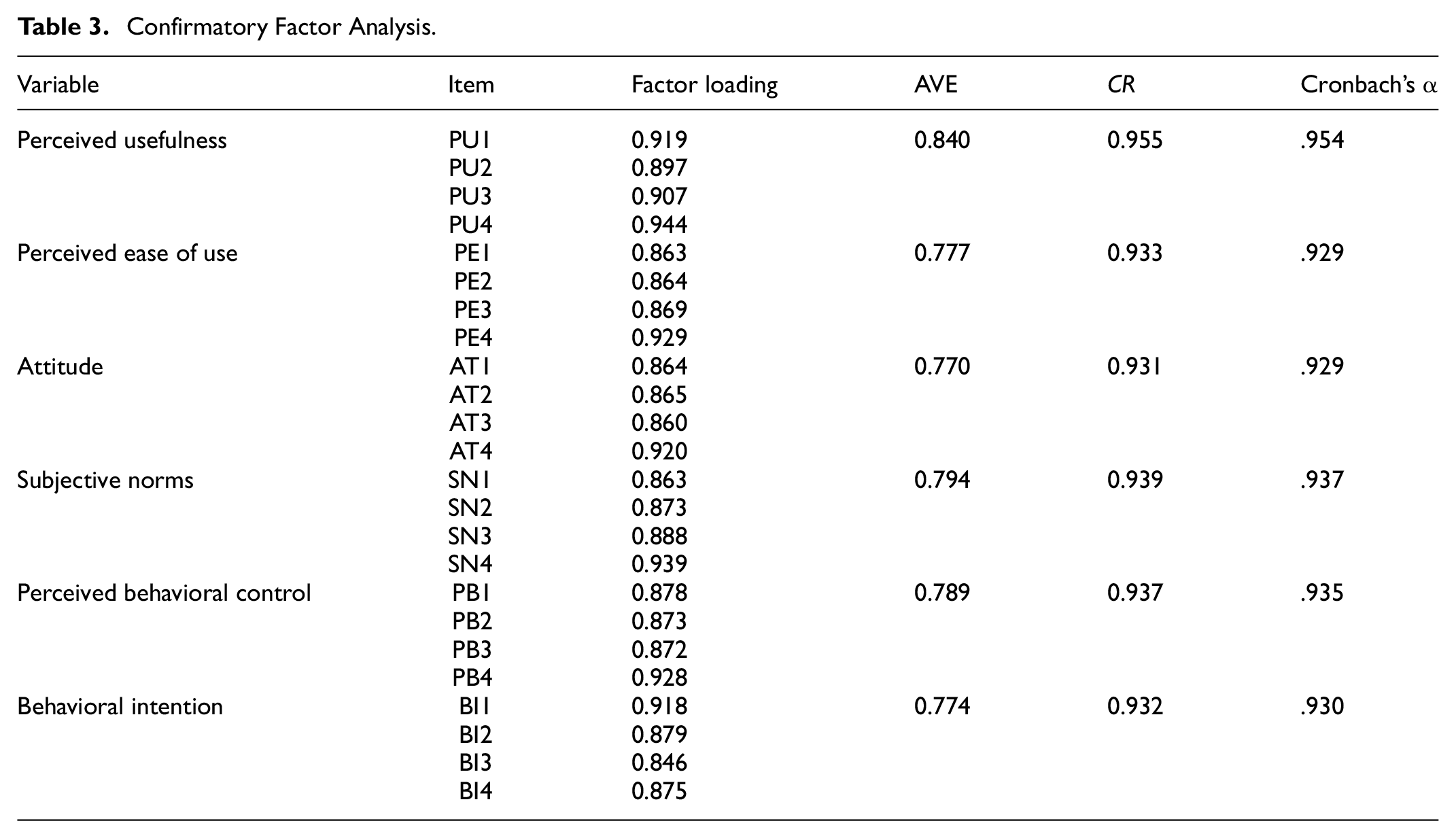
The data demonstrated strong suitability for factor analysis, with the Kaiser-Meyer-Olkin (KMO) measure yielding a value of 0.914 (p < .001), indicating excellent sampling adequacy. The internal consistency of all constructs was confirmed through Cronbach’s alpha values ranging from .929 to .954, reflecting high reliability. Confirmatory Factor Analysis (CFA) further validated the measurement model, as shown in Table 3. All factor loadings exceeded the recommended threshold of 0.70, indicating strong indicator reliability. Convergent validity was established as the Average Variance Extracted (AVE) values ranged from 0.770 to 0.840, surpassing the minimum criterion of 0.50. Composite Reliability (CR) values ranged from 0.931 to 0.955, further confirming internal consistency. Discriminant validity was assessed using the Fornell-Larcker criterion, where the square root of the AVE for each construct was greater than the corresponding inter-construct correlations, supporting adequate discriminant validity, as illustrated in Table 4. The measurement model exhibited a satisfactory fit, as evidenced by model fit indices: the Root Mean Square Error of Approximation (RMSEA) was 0.071, within the acceptable threshold of 0.08. The chi-square to degrees of freedom ratio (χ2/df = 2.769) was below the recommended limit of 3.0. Additional fit indices, including the Comparative Fit Index (CFI = 0.951), Tucker-Lewis Index (TLI = 0.943), Incremental Fit Index (IFI = 0.951), and Normed Fit Index (NFI = 0.926), all exceeded the recommended threshold of 0.90, confirming the robustness of the measurement model.
Confirmatory Factor Analysis.
Discriminant Validity Analysis From CFA.

Note. The values on the diagonal (in bold) represent the square root of AVE.
Hypothesis Testing
The results of the structural equation modeling provided strong support for the hypothesized relationships, as shown in Table 5. Perceived Usefulness (PU) and Perceived Ease of Use (PE) significantly influenced all three key constructs from the Theory of Planned Behavior (TPB). PU positively affected Attitude (AT; T = 4.423, p < .001), Subjective Norms (SN; T = 5.689, p < .001), and Perceived Behavioral Control (PB; T = 5.668, p < .001). PE demonstrated an even stronger effect, significantly influencing PB (T = 9.671, p < .001), SN (T = 8.999, p < .001), and AT (T = 7.945, p < .001).
Results of Hypotheses Testing.

Note. **p < .01, ***p < .001.
These findings suggest that while both PU and PE shape tourists’ perceptions of metaverse tourism, PE plays a more dominant role in influencing attitudes and social norms. This indicates that the ease with which tourists can use metaverse tourism platforms has a more immediate impact on their perceptions compared to the perceived benefits of the technology.
Behavioral Intention (BI) was also significantly influenced by the TPB constructs. AT (T = 2.738, p < .01), SN (T = 5.301, p < .001), and PB (T = 3.647, p < .001) each had a positive and significant effect on BI. These results highlight the importance of social and psychological factors in shaping tourists’ intentions to adopt metaverse tourism as an alternative to physical travel, underscoring the relevance of TPB in this context.
Finally, the direct effects of PU and PE on BI were examined. PE had a significant positive effect on BI (T = 5.207, p < .001), suggesting that when tourists find metaverse platforms easy to use, they are more likely to intend to adopt them. However, PU did not have a significant direct effect on BI (T = −1.476, p = .14), indicating that while perceived usefulness influences BI indirectly through attitudes and social norms, it does not directly drive tourists’ intentions to engage with metaverse tourism. This underscores the critical role of user experience and ease of use in the adoption of emerging digital tourism technologies.
Moderating Effects of Education and Income on the Relationship Between PU, PE, and BI
To examine whether education and income levels moderate the influence of PU and PE on BI to adopt metaverse tourism as an alternative to physical travel, a multi-group analysis (MGA) was conducted. The sample was divided into high- and low-education groups based on whether participants had attained a bachelor’s degree or higher, and into high- and low-income groups using a threshold of 8,000 RMB in monthly income. A chi-square difference test was employed to compare unconstrained and constrained models, assessing potential moderating effects.
Moderating Effect of Education Level
The chi-square difference test confirmed a significant moderating effect of education level on the relationships between PU, PE, and BI (Δχ2 = 32.897, df = 3, p < .001; Table 6).
Multi-Group Analysis Results for Education Level Moderation.

As shown in Table 7, PE had a significant positive effect on BI in both the high-education group (β = .357, p < .001) and the low-education group (β = .304, p < .001). This suggests that, regardless of educational background, the ease with which travelers can engage with metaverse tourism plays a crucial role in their willingness to reduce reliance on physical travel. However, PU did not exhibit a significant effect on BI in either group (high-education: β = −.043, p = .511; low-education: β = −.098, p = .16), indicating that the perceived benefits of metaverse tourism may not strongly influence the decision to substitute physical travel, irrespective of education level. Thus, the results confirm that H4-2 (the moderating effect of education on the relationship between PE and BI) is supported, while H4-1 (the moderating effect of education on the relationship between PU and BI) is not supported.
Moderating Effect of Education Level on Path Coefficients.
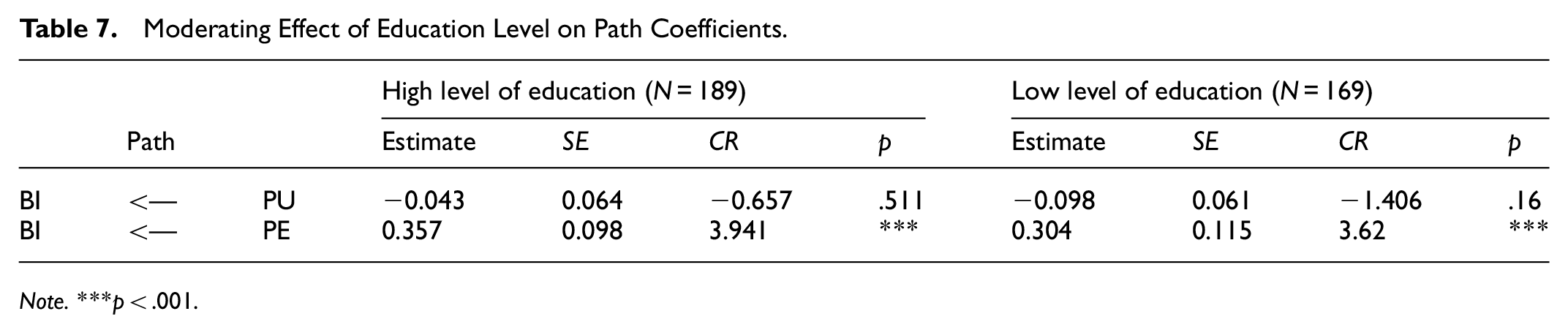
Note.***p < .001.
Moderating Effect of Income Level
The chi-square difference test also indicated a significant moderating effect of income level on the relationships between PU, PE, and BI (Δχ2 = 27.224, df = 3, p < .001; Table 8).
Multi-Group Analysis Results for Income Level Moderation.

Table 9 reveals that PE exerted a significant positive impact on BI across both income groups, with a slightly stronger effect among high-income travelers (β = .417, p < .001) than among low-income travelers (β = .338, p < .001). In contrast, PU exhibited a negative and statistically significant effect on BI in the low-income group (β = −.129, p = .04), while it was non-significant in the high-income group (β = .008, p = .91). This finding suggests that lower-income travelers may perceive metaverse tourism as a less viable substitute for physical travel, possibly due to concerns about affordability, technological accessibility, or the adequacy of virtual experiences in replicating real-world travel. Based on these results, H4-4 (the moderating effect of income on the relationship between PE and BI) is supported, while H4-3 (the moderating effect of income on the relationship between PU and BI) is not supported (Table 10).
Moderating Effect of Income Level on Path Coefficients.

Note.***p < .001.
Summary of Moderation Hypothesis Results.

Discussion and Conclusions
This study aims to explore how tourists’ acceptance of metaverse tourism (measured by TAM) and their psychological decision-making processes (modeled by TPB) shape their intention to use virtual tourism as an alternative to physical travel, providing a theoretical basis for understanding its potential role in influencing travel behavior and contributing to the long-term mitigation of overtourism. By integrating the Technology Acceptance Model (TAM) with the Theory of Planned Behavior (TPB), the study examined how perceived usefulness (PU) and perceived ease of use (PE) affect tourists’ attitudes (AT), subjective norms (SN), perceived behavioral control (PB), and ultimately, their behavioral intentions (BI). Additionally, the moderating effects of education and income levels were explored to provide a more nuanced understanding of tourists’ adoption behavior.
The findings confirmed that both PU and PE significantly influence AT, SN, and PB, supporting hypotheses H1-1 to H1-6. This is consistent with the foundational propositions of TAM (Davis et al., 1989;Venkatesh & Davis, 2000), which suggest that when individuals perceive technology as useful and easy to use, they are more likely to form favorable attitudes toward its adoption. Specifically, PU demonstrated a significant positive effect on AT, SN, and PB, indicating that when tourists believe metaverse tourism can enhance their travel experiences, they not only develop favorable attitudes but also perceive greater social support and feel more confident in their ability to engage with the technology. This aligns with prior research emphasizing the role of PU in shaping technology adoption behaviors (Elkhwesky et al., 2023; Yan et al., 2024; Y. Zhang & Hwang, 2024).
Furthermore, the stronger influence of PE on AT, SN, and PB suggests that the simplicity and user-friendliness of metaverse tourism platforms play a critical role in shaping tourists’ psychological responses and behavioral control. This finding supports the work of L. Wang et al. (2024) and Huang (2023), who highlighted the importance of minimizing cognitive and operational barriers to facilitate the adoption of new technologies. In the context of metaverse tourism, where technological novelty may present initial adoption challenges, the ease of use appears to be a more immediate determinant of tourists’ willingness to engage with virtual experiences.
The results also confirmed that AT, SN, and PB have significant positive effects on BI, supporting hypotheses H2-1 to H2-3. This finding aligns with Ajzen’s (1991) TPB, which posits that behavioral intentions are shaped by individuals’ attitudes, perceived social pressures, and self-efficacy. Tourists who hold positive attitudes toward metaverse tourism, perceive strong social endorsement, and feel confident in their ability to use the technology are more likely to intend to reduce physical travel. These results are consistent with studies by Wallace and Buil (2023) and Ivanov et al. (2024), which emphasize the critical role of social influence and perceived behavioral control in technology adoption.
However, the analysis revealed that PU does not have a significant direct effect on BI (H3-1 not supported), whereas PE has a significant positive effect (H3-2 supported). This contrasts with prior studies (F. Li et al., 2024; Y. Zhang & Hwang, 2024), where PU was identified as a primary driver of behavioral intention. One possible explanation for this divergence lies in the nature of metaverse tourism as an emerging technology. Tourists may perceive metaverse tourism as a complementary rather than a substitutive experience for physical travel. While the perceived benefits of metaverse tourism contribute to shaping favorable attitudes and social norms, they are insufficient to directly drive behavioral intentions. Instead, the ease of use reduces psychological barriers, thereby facilitating initial adoption. This aligns with the findings of Nguyen et al. (2023), who argue that ease of use is a critical factor in the early stages of technology adoption, particularly for novel digital platforms.
The moderating effects of education and income levels provided additional insights into the variability of technology adoption behavior. The results indicated that education significantly moderates the relationship between PE and BI (H4-2 supported), but not between PU and BI (H4-1 not supported). This suggests that individuals with higher education levels are more sensitive to the ease of use of metaverse tourism platforms, likely due to greater digital literacy and familiarity with emerging technologies (Akyürek et al., 2024; Tavitiyaman et al., 2022). In contrast, the perceived usefulness of metaverse tourism does not vary significantly across educational backgrounds, indicating a consistent recognition of its potential benefits regardless of educational attainment.
Regarding income, the findings showed that income level moderates the relationship between PE and BI (H4-4 supported), but not between PU and BI (H4-3 not supported). PE had a stronger effect on BI among high-income individuals, suggesting that financial resources may enhance the accessibility and perceived value of metaverse technologies. Conversely, PU exhibited a negative effect on BI for low-income groups, potentially due to concerns about the cost-effectiveness and practical utility of virtual tourism compared to traditional travel options (Mandal et al., 2024;Wiangkham et al., 2025). This finding underscores the role of economic factors in shaping technology adoption decisions, with affordability and perceived value being key determinants of behavioral intention.
Theoretical Implications
This study provides significant theoretical contributions to the understanding of how metaverse tourism technology influences tourists’ behavioral intentions, particularly concerning its potential role in mitigating overtourism. By integrating the Technology Acceptance Model (TAM; Davis et al., 1989;Venkatesh & Davis, 2000) with the Theory of Planned Behavior (TPB; Ajzen, 1991), this research establishes a comprehensive framework that elucidates both technological and psychological determinants of metaverse tourism adoption.
Firstly, this research extends the TAM by revealing that perceived ease of use (PE) plays a more critical role than perceived usefulness (PU) in influencing tourists’ behavioral intentions (BI) to adopt metaverse tourism. While previous studies (Nguyen et al., 2023; L. Wang et al., 2024) emphasized PU as a dominant predictor in technology adoption, this study finds that PE exerts a stronger influence on BI. This suggests that for emerging technologies like metaverse tourism, the simplicity, intuitive design, and user-friendliness of the technology are prioritized over its perceived functional benefits. This insight broadens the scope of TAM by emphasizing that the reduction of cognitive and operational barriers is essential for fostering initial user engagement. In contexts where technology is novel and not yet deeply integrated into daily life, ease of use functions as a psychological gateway, lowering resistance and increasing the likelihood of adoption (Akyürek et al., 2024). This shift in focus challenges traditional TAM assumptions and calls for a more nuanced understanding of usability as a dynamic factor influenced by both user readiness and technology maturity.
Secondly, by integrating TAM with TPB, this study contributes to a more holistic understanding of the factors influencing metaverse tourism adoption. The findings underscore the significant role of attitudes (AT), subjective norms (SN), and perceived behavioral control (PB) in shaping BI, consistent with TPB’s propositions (Choe et al., 2021; Wallace & Buil, 2023). This integration reveals that technology adoption is not merely an individual cognitive process but is deeply embedded in social contexts. Tourists’ decisions to engage in metaverse tourism are shaped not only by their perceptions of the technology but also by their social environment and personal agency. For instance, the influence of subjective norms highlights the role of peer recommendations, cultural acceptance, and perceived societal expectations (Y. Zhang & Hwang, 2024). This finding enriches the theoretical landscape by positioning technology adoption as a socially constructed behavior, influenced by interpersonal dynamics as much as by technological attributes.
Thirdly, this study offers new insights into the role of metaverse tourism in mitigating overtourism. Contrary to the assumption that metaverse tourism could directly substitute physical travel, the findings suggest that it serves more as a complementary experience. The lack of a significant direct effect of PU on BI indicates that tourists do not view virtual experiences as full replacements for physical travel. Instead, metaverse tourism can indirectly alleviate overtourism by influencing tourists’ decision-making processes regarding when, where, and how to travel. Through virtual pre-experiences, metaverse tourism can redistribute tourism demand temporally and spatially, offering alternative engagements during peak seasons or in overcrowded destinations (Buhalis et al., 2023; Gursoy et al., 2022). This reframing challenges the binary view of physical versus virtual tourism and introduces a more fluid perspective where virtual experiences act as mediators of physical travel behavior, shaping preferences and potentially reducing environmental pressures without diminishing overall tourism demand.
Furthermore, this study deepens the theoretical understanding of demographic influences on technology adoption by examining the moderating effects of education and income. The findings indicate that these socio-demographic factors significantly moderate the relationship between PE and BI, but not between PU and BI. This suggests that individual differences in digital literacy and resource accessibility—often correlated with educational attainment and income levels—enhance sensitivity to usability factors. Higher educational levels may foster greater cognitive flexibility and problem-solving skills, facilitating ease of technology adoption, while higher income levels can reduce perceived risks associated with trying new technologies (Akyürek et al., 2024; Tavitiyaman et al., 2022). These results advance TAM and TPB by demonstrating that technology adoption is context-dependent, shaped not only by technological and psychological factors but also by the socio-economic environment. Recognizing these moderating effects emphasizes the need for contextualized models in technology adoption research, accounting for demographic variability in user behavior.
In conclusion, this study makes critical theoretical contributions by advancing the TAM framework through a reconsideration of PU and PE’s roles, emphasizing the dominance of ease of use in the context of emerging technologies like metaverse tourism. The integration of TPB adds depth to this understanding, highlighting the interplay between technological perceptions and social-psychological factors such as attitudes, subjective norms, and perceived behavioral control. The findings challenge conventional views by positioning metaverse tourism not as a substitute but as a complementary tool that can influence travel behaviors and indirectly mitigate overtourism through demand redistribution. Additionally, by incorporating demographic moderators such as education and income, this research enriches the explanatory power of TAM and TPB, offering a more comprehensive and context-sensitive framework for understanding technology adoption in the tourism sector. These theoretical insights not only fill gaps in the existing literature but also provide a robust foundation for future research exploring the dynamic interactions between technology, behavior, and sustainable tourism management.
Managerial and Practical Implications
This study offers several managerial and practical implications that can guide tourism stakeholders, policymakers, and destination managers in leveraging metaverse tourism technology to address the challenges of overtourism while fostering sustainable tourism development.
Firstly, the findings reveal that perceived ease of use (PE) plays a critical role in influencing tourists’ behavioral intentions to adopt metaverse tourism technologies. This suggests that tourism managers and technology developers should prioritize the design of user-friendly, intuitive interfaces that minimize cognitive load and operational complexity. Simplified navigation, engaging interactive features, and seamless user experiences are essential, especially in the early stages of metaverse tourism technology adoption. Reducing technological barriers will not only attract new users but also encourage repeat engagement, ultimately increasing the technology’s penetration in the tourism market. Tourism enterprises should invest in usability testing, continuous feedback mechanisms, and adaptive design strategies to enhance the accessibility and attractiveness of virtual tourism platforms.
Secondly, the integration of the Theory of Planned Behavior (TPB) highlights the significant influence of subjective norms (SN) and perceived behavioral control (PB) on tourists’ behavioral intentions. This underscores the importance of social influence strategies in promoting the adoption of metaverse tourism. Destination marketing organizations (DMOs) and tourism stakeholders should collaborate with key opinion leaders (KOLs), social media influencers, and community leaders to create positive perceptions and social endorsements of virtual tourism experiences. Campaigns that showcase testimonials, peer recommendations, and user-generated content can amplify the social desirability of metaverse tourism. Additionally, incorporating metaverse experiences into educational programs, community events, and tourism exhibitions can enhance perceived behavioral control by familiarizing potential users with the technology, thereby reducing psychological barriers to adoption.
Thirdly, one of the pivotal contributions of this study is the recognition of metaverse tourism as a complementary tool for sustainable tourism management rather than a direct substitute for physical travel. Policymakers and destination managers should integrate metaverse tourism into broader strategies aimed at mitigating overtourism. For instance, virtual tours can be strategically promoted during peak seasons or in environmentally sensitive areas, providing alternative experiences that help redistribute tourist flows temporally and spatially. This can alleviate pressure on overburdened attractions while offering immersive, meaningful experiences that complement physical visits. Furthermore, virtual pre-experiences can be used as marketing tools to stimulate interest in lesser-known destinations, thereby dispersing tourist demand more evenly across regions.
Furthermore, to maximize the potential of metaverse tourism in alleviating overtourism, government agencies and tourism authorities should consider implementing policy incentives. These could include subsidies for metaverse tourism startups, tax benefits for companies integrating virtual experiences into their offerings, and discounts or loyalty rewards for tourists who engage in virtual tourism activities. Such incentives can stimulate both supply and demand, encouraging businesses to innovate and tourists to explore virtual alternatives. Additionally, integrating metaverse tourism into destination management plans and sustainable tourism policies can ensure that virtual tourism contributes to economic growth while minimizing environmental degradation.
Finally, the study’s findings on the moderating effects of education and income levels provide critical insights for market segmentation and targeted marketing strategies. For instance, individuals with higher education and income levels are more responsive to the ease of use of metaverse technologies, suggesting that premium virtual experiences with advanced features may appeal to these segments. Conversely, for lower-income or less tech-savvy populations, simplified versions of virtual tourism platforms, coupled with educational initiatives to enhance digital literacy, can broaden adoption. Tourism managers should develop differentiated marketing and outreach strategies that cater to diverse demographic groups, thereby maximizing the reach and impact of metaverse tourism.
In conclusion, this study provides actionable insights for tourism managers, policymakers, and technology developers. By focusing on user-centered design, leveraging social influence, integrating metaverse tourism into sustainable destination management, offering policy incentives, and tailoring strategies based on socio-demographic factors, stakeholders can harness the transformative potential of metaverse tourism to mitigate overtourism, promote sustainable development, and foster inclusive growth in the global tourism industry.
Limitations and Direction for Future Research
Despite the fact that this study offers empirical evidence in favor of using virtual tourism technologies to reduce overtourism, there are a few noteworthy limitations that should be noted. study’s sample is highly homogenous, with a focus on particular geographical and demographic groups. This might potentially restrict the findings’ generalizability. Future research should employ a broader sample that includes different countries, cultural backgrounds, and age groups to validate the cross-cultural applicability of the conclusions. Second, this study largely ignores other potentially important elements, such as perceived immersion, emotional experience, and the interactivity of virtual tourism technology, in favor of concentrating on the impacts of perceived utility and reported ease of use on travelers’ behavioral intentions. These elements could have a greater impact on how tourists behave. These variables could be added in future studies to broaden the adoption model of virtual tourist technology. Finally, the long-term impacts of virtual tourism technology on visitor behavior may not be fully captured by the cross-sectional data employed in this study. For a more accurate analysis of the dynamic shifts in technology adoption and usage intentions across time, the time dimension should be included in future longitudinal research.
Footnotes
Acknowledgements
The author wishes to thank all the participants who contributed to filling out the questionnaires for this research.

Ethical Considerations
This study was conducted in accordance with the research ethics policy of Wuxi Taihu University, School of Business. The study involved a low-risk online questionnaire survey, did not collect any sensitive personal or health-related data, and posed no psychological, physical, or social risks to participants. Based on the institutional guidelines, this study was deemed exempt from formal ethical approval and thus was not assigned an ethics review reference number. All participants were informed about the study’s purpose, data usage, and voluntarily provided electronic informed consent before participation. The study adhered to all necessary ethical standards to ensure data privacy, anonymity, and confidentiality.
Consent to Participate
All participants in this study were fully informed about the research purpose, data collection process, and intended use of the data. Before participating, they voluntarily provided electronic informed consent, acknowledging their right to withdraw at any time without any consequences. The study ensured full compliance with ethical research standards, maintaining strict confidentiality and anonymity of the collected data.
Author Contributions
The research, writing, and all activities involved in the creation of this manuscript were carried out solely by the author, Xiaoqing Jiang.
Funding
The author(s) received no financial support for the research, authorship, and/or publication of this article.
Declaration of Conflicting Interests
The author(s) declared no potential conflicts of interest with respect to the research, authorship, and/or publication of this article.
Data Availability Statement
The data used in this study were collected through an online survey, ensuring complete participant anonymity and confidentiality. Due to privacy concerns and ethical constraints, the dataset is not publicly available. However, de-identified data may be provided upon reasonable request to the corresponding author, subject to institutional ethical guidelines and legal considerations. This study does not include Figshare-referenced data, and no datasets have been deposited in public repositories.