



Abstract
Foreign language classroom anxiety (FLCA) is a very critical affective factor for learners’ language learning and development. The present study was designed to explore the features of Chinese university students’ FLCA and to investigate the possible influencing factors on the fluctuations of Chinese university students’ FLCA. Two female and two male Chinese university students were selected as the participants and their in-class performances were recorded. Data collection instrument included the classroom observation, the self-rated evaluation of FLCA, and the stimulated recall interview. To capture the micro-changes of the Chinese learners’ FLCA per second, an idiodynamic approach was adopted to carry out the exploratory analysis for the learners’ experiences of FLCA over the language instruction. Zooming in on the microdynamic variation of the participants’ FLCA, the final results indicated that Chinese university students’ FLCA, both within individuals and across individuals, is characterized of a dynamic system’s features. Furthermore, a series of contributing factors were identified to trigger the participants’ FLCA, with the classroom activity types and the teacher’s feedback being the key external factors and the gender difference and self-efficacy being the major internal factors. The idiodynamic method shed new light on exploring the FLCA from an emic and dynamic perspective and some pedagogical implications were also put forward as well.
Introduction
Anxiety is one of the critical individual affective factors in the process of learning a second language or a foreign language. With the popularity of learner-centered language teaching model in the 1970s, learners’ emotional factors, especially anxiety, has become a hot issue. Researchers and scholars have carried out mountains of studies to explore the language anxiety in a second or a foreign language learning process from various perspectives, like the overall description of learners’ foreign language anxiety (FLA; Gardner & MacIntyre, 2010; Horwitz et al., 1986), the correlation between learner’s FLA and the individual language achievement (MacIntyre & Gardner, 1989; Saito & Samimy, 1996), and the possible causes of L2 learners’ FLA and suggested countermeasures and so on (Koch & Terrell, 1991; Price, 1991; Young, 1991). The majority of these previous FLA studies have generally examined the learners’ FLA by conducting the experimental studies or questionnaire survey from an etic perspective, yet the static quantitative analysis can only provide quite limited explanations for the FLA changes L2 learners might go through given the dynamic features of FLA.
Language learning is “an emotionally and psychologically dynamic process that is influenced by a myriad of ever changing variables and emotional vibes that produce moment-by-moment fluctuations in learners’ adaptation” (Gregersen et al., 2014, p. 574). Foreign language classroom is a special ecological situation consisting of various ingredients, and all the things learners encounter during the process within the classroom ecosystem may exert subtle impacts on the foreign language instruction, resulting in the trigger of language learners’ anxiety and causing the fluctuations of learners’ foreign language classroom anxiety (FLCA). As a particular situational anxiety, learners’ FLCA is full of complex, non-linear, dynamic, and unpredictable changes (de Bot et al., 2007; Larsen-Freeman, 2016). Consequently, a dynamic and nonlinear analyzing approach is of vital significance for a better understanding and a more in-depth investigation concerning the dynamics of learners’ FLCA as well as how, why and due to what reasons learners’ FLCA might fluctuate.
By adopting an idiodynamic approach, the present study attempts to investigate the microchanges of FLCA Chinese university students experience over the interaction with teachers and peer students within the English language class.
Literature Review
This study is set within the context of a qualitative analysis on L2 learners’ FLCA and the literature review is oriented to the development of L2 learners’ FLCA, including its construct, investigating methods, and related theoretical foundation.
Foreign Language Classroom Anxiety
Anxiety is an essential psychological construct and is conceptualized as “the subjective feeling of tension, apprehension, nervousness, and worry associated with an arousal of the autonomic nervous system” (Spielberger, 1983, p. 15). Foreign language anxiety (FLA) is a common “worry and negative emotional reaction aroused when learning or using a second language” (MacIntyre, 1999, p. 27) in language learning settings such as classrooms. Being a special situation-specific anxiety, foreign language classroom anxiety (FLCA) refers to “a distinct complex of self-perceptions, beliefs, feelings, and behaviors related to classroom learning arising from the uniqueness of the language learning process” (Horwitz et al., 1986, p. 128).
Horwitz et al. (1986) made huge contributions to the development of FLCA theory and they designed the Foreign Language Classroom Anxiety Scale (FLCAS) for the measurement of language learners’ FLCA. Since FLCAS came into being, it has become a popular instrument and has been widely adopted to analyze learners’ foreign language anxiety in classroom contexts (Arnaiz & Guillen, 2012; Dewaele, 2013; Kitano, 2010; Park & French, 2013; Sparks et al., 2011; Sparks & Patton, 2013; Yashima, 2002). Based on the students’ classroom academic performance evaluation, Horwitz et al. (1986) made a further classification of FLCA into three affecting constructs, namely “communication apprehension, fear of negative evaluation and test anxiety.” More underlying stressors of FLCA have been identified, including “teacher-learner interactions and classroom procedures” (Young, 1991), “peer competition and harsh teachers’ error correction” (Gregersen & MacIntyre, 2014), and the fear of failing (Toyama & Yamazaki, 2018).
To achieve a comprehensive comprehension of learners’ FLCA, a great number of empirical studies have been conducted from a diversity of angles, such as the possible correlation between learners’ FLCA and their language performance (MacIntyre & Gardner, 1991; Woodrow, 2006), the connection between learners’ FLCA and language enjoyment in classroom setting (Dewaele & MacIntyre, 2014), the compositions of classroom speaking anxiety and learners’ L2 speaking fluency (Gkonou, 2014), and the link between learners’ speaking anxiety and speaking motivation (Baran-Łucarz, 2017). In addition, some scholars have also carried out more empirical research studies to develop some effective measures to overcome learners’ FLCA (Horwitz et al., 1986), to explore the learning deficits caused by the FLCA (Sparks & Ganschow, 1993), to investigate the part of FLCA in distance learning (Hauck & Hurd, 2005), as well as to explain the possible relationship between FLCA and the computer-technology-assisted foreign language learning (Grant et al., 2013; Kruk, 2016; Majid et al., 2012).
Despite a diversity of empirical studies conducted on FLCA, previous research is more likely to analyze the statistic features of learners’ FLCA, yet fewer studies has examined the momentary changes of learners’ FLCA. Given the changing character of learners’ FLCA, a conventional linear predictive approach cannot offer a thorough and clear understanding of the dynamic changes in the learners’ FLCA development within the complex ecosystem of classroom interaction. As a changing and short-lived emotion, FLCA has the ideal properties to be explored from a dynamic perspective. Thus, there is a need to shed light on a broader view of the dynamic changes of FLCA and analyze the moment-to-moment changes of individual L2 learners’ FLCA from an idiodynamic perspective.
Dynamic Systems Theory
Originated from physics and applied mathematics, Dynamic Systems Theory (DST) was introduced into the field of second language acquisition (SLA) researches by Larsen-Freeman (1997). DST claims that any complex systems are composed of various subsystems at different levels, which are in constant interplay with each other, and all the systems and subsystems are in a state of non-linear and dynamic development.
de Bot et al. (2007) defined the four essential features of a complex dynamic system as the following: (1) A dynamic system keeps changing all the time and all the present states are transformed from the previous ones. (2) Within a dynamic system exist the mutual interactions between systems and subsystems at various levels. (3) With the shifts between attractor states and repeller states on various levels, a dynamic system is open and adaptive and can self-organize itself into a preferred state. (4) A dynamic system will be strongly influenced by the subtle butterfly effect, and any minor changes can result in dramatic changes in the long run.
Upon its emergency and introduction into SLA, researchers have become keenly interested in DST and have tried applying this theory into SLA research (de Bot & Makoni, 2005; MacIntyre & Legatto, 2011). DST provides a novel dynamic perspective to explore the complex systems’ changing and self-organizing (de Bot, 2008), and it has been frequently utilized to account for various phenomena in SLA context and has made huge contributions to the language development research, including language change (Cooper, 1999), speech production (van Lieshout, 2004), and language process (Elman, 2004).
The Idiodynamic Method
The term of idiodynamic was first coined by Saul Rosenzweig (Rosenzweig, 1986, p. 242) and the idiodynamic method refers to the approach to analyze the dynamics of events to distinguish individuals’ personality in particular situations through time. Being “an individual acting during an event as the basis for analysis and focuses on how the process develops”(MacIntyre, 2012, p. 362), the idiodynamic method can be adopted to examine the dynamic changes of various variables, such as the individual emotions on different times.
Through the individual’s self-rating via specially designed software, MacIntyre and Legatto (2011) first utilized the idiodynamic approach to measure learners’ willingness to communicate (WTC) and found that learners’ WTC develops in a dynamic way, with the learners’ self-ratings of WTC fluctuating over the course of a communication event. Since then, the idiodynamic approach has aroused huge attentions and an increasing number of researchers have managed to apply this method to carry out their studies. Gregersen et al. (2014) examined the participants’ anxiety fluctuations during the oral presentations with the assessment of idiodynamic self-rating anxiety and heart rates. MacIntyre and Serroul (2014) took the idiodynamic method to examine participants’ motivation trajectory in an L2 communication task and found that L2 learners’ motivation fluctuated under the influence of several factors. Gregersen and MacIntyre (2017) carried out the comparisons between the experts’ idiodynamic assessment and peers’ idiodynamic assessment of non-verbal language anxiety cues.
Until now, the application of the idiodynamic method in the previous investigations has produced positive results that would not have been obtained using the conventional static and linear analyzing technique. Despite the flourishing application of the idiodynamic approach in the studies of the instantaneous changes of FLA variables, few Chinese scholars have tried the idiodynamic method to explore the Chinese L2 learners’ emotion changes, especially Chinese learners’ FLCA fluctuation at the individual level on a micro timescale.
Research Design
Research Questions
The target of the present study is to investigate the changing patterns of the Chinese university students’ FLCA on a per-second timescale over four different classroom activities and to figure out the possible affecting factors of their FLCA development. The research questions are as follows:
(1) What are the main features of the Chinese university students’ FLCA changing trajectories?
(2) What are the possible factors triggering the fluctuations of Chinese university students’ FLCA?
Participants
The participants were selected with a two-stage process. To begin with, the researcher chose an intact class consisting of 20 junior English majors in a provincial university in China to conduct the current research. After filling in their informed consent, all students took part in the questionnaire survey. On the second stage, four 21- to 22-year-old Chinese university students were meticulously selected with regard to their normal class performances based on the language teacher’s classroom observations and their academic recordings in the past academic semester. To counterbalance the influences of English proficiency, the four participants have similar English learning experiences and parallel scores for the Advanced English course. With the consideration of the gender and personality influences, there are two males and two females, and the male and female participant in each gender group come from city and countryside, respectively. All the four participants can be actively involved in the class activities according to the language teacher’s class observation. The participants’ given names are substituted with pseudonyms for confidentiality and their general information is shown in Table 1.
Participants’ general information.

Research Instruments
Questionnaire
The questionnaire survey was piloted with learners not participating in the research project and the Cronbach’s alpha was identified as .96.
There are three parts of the questionnaire:
(1) The first part section asks for the participants’ background information, including the age, gender, English learning experience, and birthplace.
(2) The second part is the State-Trait Anxiety Inventory (STAI) (Spielberger, 1983), which consists of two 20-item scales, including State Anxiety Inventory (S-AI) and Trait Anxiety Inventory (T-AI). Anchors of the 4-point scale were “never to nearly always.” Half items of S-AI described negative emotions and the other half for positive emotions; 11 items of the T-AI described the negative emotions and 9 positive items were for the consistent anxiety or anxiety in daily life.
(3) The third part comes from the 33-item Foreign Language Classroom Anxiety Scale (FLCAS) (Horwitz et al., 1986). The anchors of the 5-point scale ranged from “strongly disagree to strongly agree.” The final score can be served to classify the levels of FLCA, namely no anxiety (<66), low anxiety (66–99), moderate anxiety (99–132), and high anxiety (>132).
English language classroom activities
The Advanced English course was the chosen setting for the present study. The textbook of Advanced English was published by the Foreign Language Teaching and Research Press in Shanghai China and the third unit (Inaugural Address) was chosen as the language topic. Four types of language activities were designed: (1) Reading. Reading activity means reading aloud any written texts, like words, phrases and paragraphs; (2) Speaking. All the activities concerning speaking go to this type, including question-and-answer, discussion, words’ or sentences’ explanations, and paraphrasing; (3) Text analyzing. Text analyzing involves all the understanding of the text content, implied meaning of the sentences, and structure of the paragraphs; and (4) Translating. This activity is particularly confined to English-to-Chinese translation, namely to translate Lincoln’s inauguration speech into suitable Chinese.
The Anion Variable Tester Software
The Anion Variable Tester Software, developed by Maclntyre and his student (2011), is a window-based software for participants to self-evaluate their dynamic changes of affective variables. In the current study, the second version of Anion Variable Tester was adopted to evaluate the dynamic variations of participants’ FLCA. The software working interface was shown as the following screen shot (see Image 1):

Working interface of anion variable tester software.
As shown in Image 1, the participants’ class performance is presented on the top left section of the interface, under which two buttons of Increase and Decrease are listed. The FLCA level will be shown instantly in the right-side bar with clicking the button and the scope of variation from Increase to Decrease is between −5 and +5, at zero if no responses are given. By keeping clicking the buttons while watching the replayed video, the participants can self-evaluate their FLCA based on their class performance. Upon clicking the Finish button at the bottom right corner, a final graph describing the fluctuation of the FLCA in the Advanced English class and a relative Excel sheet data will be automatically generated and saved.
The stimulated recall interview
There is a consensus that “The honest and real-time report of the attentive individual is the least flawed among all the measures of subjective experience” (Gilbert, 2006, p. 71). In this study, an immediate stimulated recall interview was conducted on the participants to report the possible reasons of noticeable fluctuations in their anxiety developing trajectories.
Procedures and Data Collection
The instruction of Advanced English course was conducted in an intelligent classroom with the wireless network on the morning of October 20, 2019. Before attending the English instruction, the four participants filled in the questionnaire survey on the State-Trait Anxiety and FLCA. Their final scores on the two scales were illustrated in Table 2.
Participants’ General Characteristics Based on Anxiety Scores.
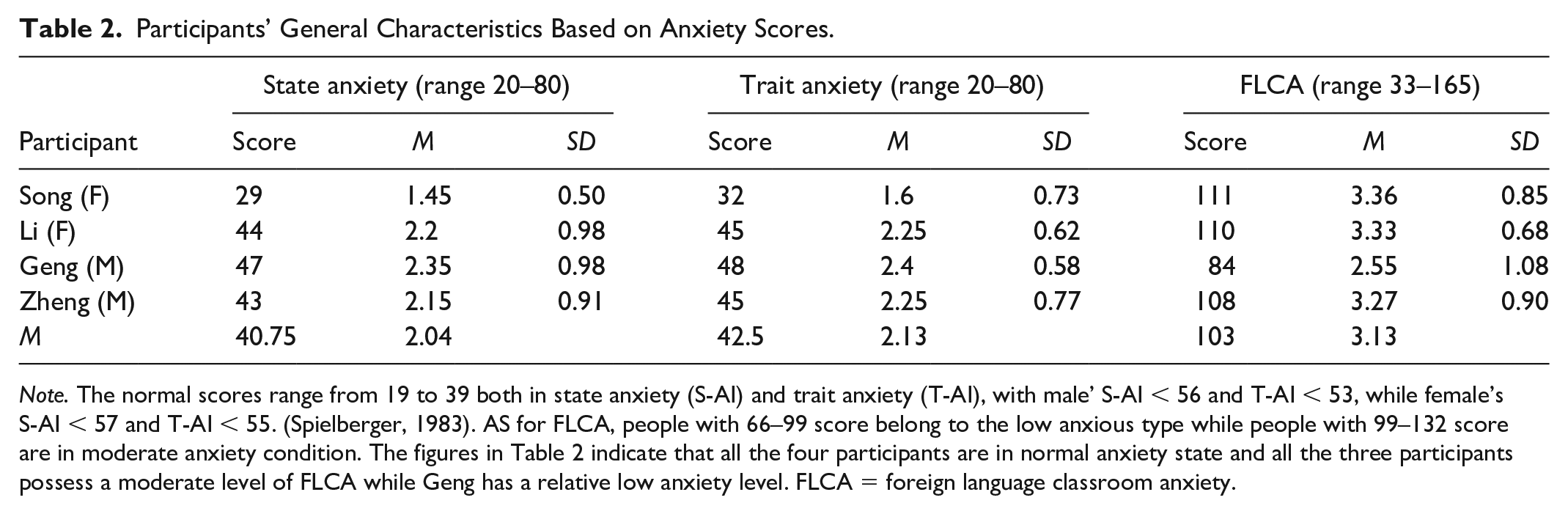
Note. The normal scores range from 19 to 39 both in state anxiety (S-AI) and trait anxiety (T-AI), with male’ S-AI < 56 and T-AI < 53, while female’s S-AI < 57 and T-AI < 55. (Spielberger, 1983). AS for FLCA, people with 66–99 score belong to the low anxious type while people with 99–132 score are in moderate anxiety condition. The figures in Table 2 indicate that all the four participants are in normal anxiety state and all the three participants possess a moderate level of FLCA while Geng has a relative low anxiety level. FLCA = foreign language classroom anxiety.
The language teacher carried out the four language tasks in sequence and the four participants were asked to complete each task in random order. This language instruction lasted for 90 min (two teaching periods) and all the classroom practices were recorded with the multimedia recording set. The researcher observed the participants’ facial micro-expressions and their body gestures through the monitoring screen of the camera while the participants were performing different classroom tasks. It should be pointed out that to avoid the students’ unnatural performances caused by the presence of video camera and observers, two trials were conducted in intelligent classroom before the recording on other days.
After the completion of the class recording, the video was replayed to the participants through the Anion Variable Tester software. While watching their recorded performances, participants would click the mouse whenever they felt nervous or did not. When the graphs about the development of the participants’ FLCA were exported, a stimulated recall interview was followed up for the participants to account for the possible reasons of their FLCA changing patterns. The whole interviews were recorded, transcribed, and coded for further analysis.
Results
The video clips were shown to the individual participants to help them to recall the situations where their the instant FLCA were triggered and the sources behind these changes were claimed with the participants’ self-explanations in the stimulated recall interview. All the collected data were analyzed from both vertical and horizontal perspectives. During this analyzing process, the triangulation was conducted by comparing the participants’ self-scoring, the language instructor’s classroom observation, and the researcher’s observations of the participants’ performances in the video clip so as to ensure the validity and reliability of the final result.
Results From the Vertical Analysis
With a focus on the individual participant’s unique pattern of FLCA fluctuations, the result findings from the vertical analysis are illustrated one by one as follows:
Figure 1 indicates that song experienced a dynamic change of FLCA when performing the four language activities. The trace of her FLCA was first characterized by a decline of FLCA score (−5 to 1) in the reading task, followed by a stable score of anxiety level (around 0) in the task of speaking. Thereafter, Song’s FLCA climbed to the top (4) in analyzing the text and fluctuated when she was translating the English sentences into Chinese ones.

Song’s dynamic trajectory in FLCA.
According to Figure 2, there is a significant increasing trend in Geng’ FLCA level when performing the four tasks. Geng’ anxiety level was below zero in the reading task and then jumped to 4 before dropping rapidly to −2 in the speaking task. Then, his anxiety gradually climbed to the top (5) and came back to normal when finishing analyzing the text. For the translation task, Geng’ anxiety score remained relatively high at around 4–5 in the process of the translation task.

Geng’s dynamic trajectory in FLCA.
A non-linear changing trace of Li’s FLCA trajectory can be found in Figure 3. Li had relatively low anxiety level in the reading task, while the anxiety level was much higher in other three tasks. With a sudden rise at 4 at the start of speaking task, Li’s anxiety level sharply reached the top at the very start, followed by a sudden slump, then it climbed significantly again and fluctuated at around 3–4 in analyzing the text. Li’s FLCA level in translating soared to the peak at the very beginning and then decreased to normal before a small rise.
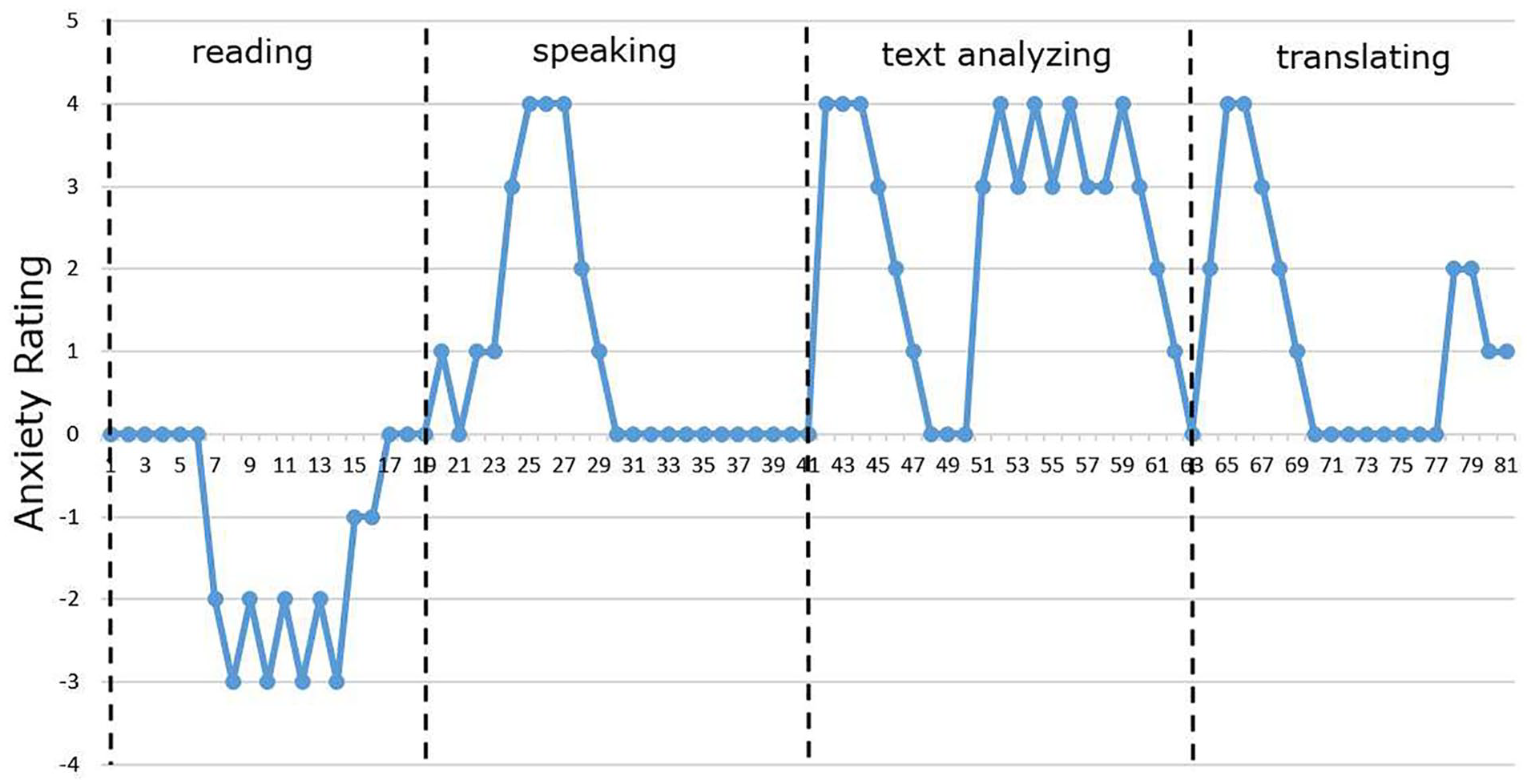
Li’s dynamic trajectory in FLCA.
As illustrated in Figure 4, Zheng’s FLCA level ranged from −4 to 4 during the task-performing journey. There were frequent ups and downs of Zheng’s anxiety trajectory in completing the four tasks. On the whole, there is an obvious rising trend in his anxiety rating from Task I to Task IV.
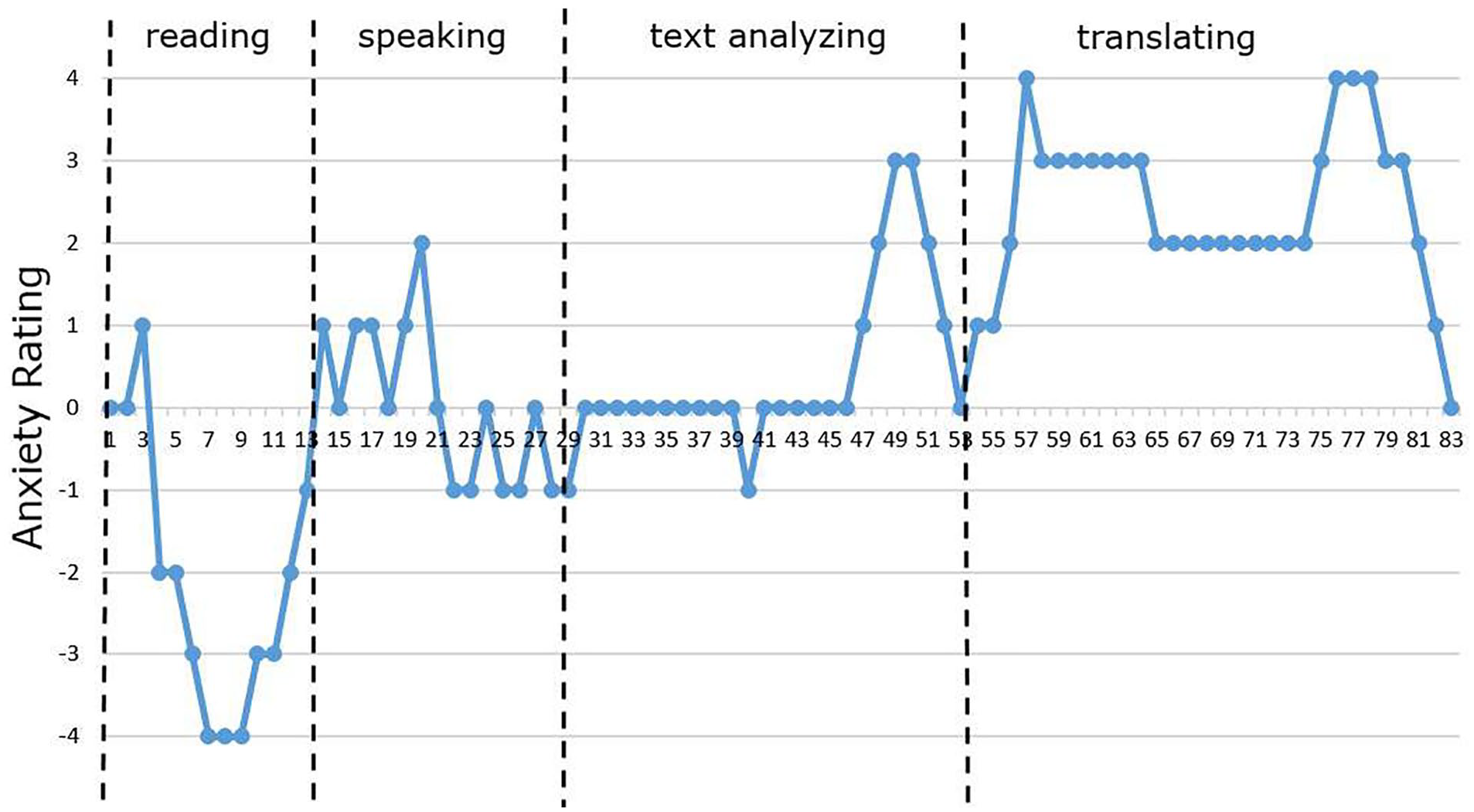
Zheng’s dynamic trajectory in FLCA.
Results From the Horizontal Analysis
To probe the possible influencing factors of participants’ FLCA, the horizontal analysis was carried out through comparing the changing patterns of the individuals’ FLCA curves within the same activity. The result findings from the horizontal analysis are illustrated task by task as follows:
Differences between participants’ FLCA in reading
In Figure 5, nearly all parts of the four anxiety curve lines are under the 0 axis, indicating the participants’ low anxiety levels in reading task. The four participants reported no anxiety in reading because they had little difficulty in doing this task. In the video recording, it is found that the four participants were reading fluently. The language teacher also verified the participants’ good reading performances in the class interaction. Despite the overall lower anxiety scores, different fluctuations could also be identified in the four participants’ reading anxiety curve lines. At the very start of the reading, the individual participant had different initial anxiety state and then experienced a unique anxiety journey. As a result, the curve lines of the four participants’ FLCA in reading had distinct developing trajectories with few overlaps.

Differences between participants’ FLCA in Reading.
Differences between participants’ FLCA in speaking
According to Figure 6, three participants, except Song, had experienced the noticeable FLCA variations within the speaking process. Among the three participants, both Geng and Li were under huge pressure with a high level of anxiety at 4, while Geng, compared with Li, had more ups and downs of speaking anxiety. Song reported a low score for her anxiety in speaking. The language teacher confirmed Song’s high speaking proficiency in class and Song’s smiling face in the video recording further revealed her confidence in speaking. Starting with different initial anxiety level, the four participants’ FLCA in speaking developed with different patterns and sharp gaps between the four trajectories of speaking anxiety were finally formed.

Differences between participants’ FLCA in Speaking.
Differences between participants’ FLCA in text-analyzing
In Figure 7, there are three anxiety curve lines above the 0 axis, indicating that the four participants, except Zheng, had great anxieties when analyzing the text. Compared with other participants, Geng experienced more changes of the anxious emotions, and he reported a moment of top anxiety at 5. Clearly, the initial states of the four participants’ anxiety in the text-analyzing differed greatly, with higher scores of female participants (Song & Li) and lower self-rankings of male participants (Geng & Zheng). Thereafter, the four participants run into different experiences of analyzing the text and their anxiety trajectories came into different shapes.

Differences between participants’ FLCA in Text-analyzing.
Differences between participants’ FLCA in translating
As can be seen from Figure 8, the majority of the anxiety curve lines are above the 0 axis and the duration of higher anxiety lines keeps longer. When compared with others figures (Figure 5 to Figure 7), the four lines in Figure 8 may indicate that the four participants could have suffered more serious anxieties in translating than in other language tasks. With distinct initial states, the four individuals’ anxieties in translating developed into their distinctive directions and formed their particular trajectories. A closer look at the findings in Figure 8 would reveal that the participants with the same gender, to be more specific, the male group with Geng and Zheng, and female group with Song and Li, share similar anxiety fluctuating patterns. Moreover, male participants’ anxiety curve lines were noticeably above those of female participants, showing that male participants may suffer more serious anxieties during the translation process when compared with female peers.

Differences between participants’ FLCA in Translating.
Discussion
The Main Features of Chinese Learners’ FLCA
Under the theoretical framework of DST, this study carries out the investigation of the Chinese university students’ FLCA with idiodynamic method. The first research question addresses the changing patterns of the Chinese university students’ FLCA. Given the final results of both vertical analysis and horizontal analysis, the main features of Chinese learners’ FLCA can be summarized as follows.
To begin with, both the intra-participants’ and the inter-participants’ fluctuations could be identified in the dynamic curve of Chinese university students’ FLCA trajectory within different language tasks. Figure 1 to Figure 4 show that each individual participant reported distinctive changes of FLCA level across the four language tasks, whereas Figure 5 to Figure 8 display the various changing pattern of the different participants’ FLCA trajectory in the same language task. Moreover, the fluctuations of all reporting anxiety levels happened from the very start to the end of the task accomplishment and no overlaps could be extracted between any of two lines. Alternatively, among all these anxiety curves, any instantaneous changes of the anxiety level are “transformed” from the previous emotional state. For instance, in Figure 1, Song experienced several ups and downs of anxiety in fulfilling the task of translation. Her first sharp anxiety increase to level +3 comes immediately from the previous level 0 in one second following an immediate decrease to level −2. Then after a considerable climbing process, Song’ anxiety jumps to level +4, following an immediate drop to level −1. Thereafter, with a sudden rise, her anxiety soars up from the lower level −1 to the top level +4. Given all these considerations, it is safe to conclude that Chinese university students’ FLCA keeps changing in a nonlinear pattern all the time and all the present state of anxiety are transformed from the previous one.
Next, Chinese university students’ FLCA is a distinct system or a construct what MacIntyre and Vincze (2017) has defined in the foreign language classroom settings. According to what the participants have reported, it can be summarized that the speech anxiety, the fear of negative evaluation from teachers and the fear of losing face may be the components of their FLCA. These ingredients are in accordance with the subcomponents of FLCA posited by previous anxiety researchers (e.g., Aida, 1994). In the present study, all the subcomponents of Chinese university students’ FLCA would interact with each other and the interconnectedness between the subcomponents causes a comprehensive impact on various layers, resulting in the dynamic changes of Chinese university students’ FLCA. The fear of negative evaluation, for example, through exerting a strong influence on the participants’ cognitive system, can easily trigger the participants’ psychological anxiety in return.
Third, all the subcomponents and subsystems of Chinese university students’ FLCA are in the process of dynamic motion and can constantly self-change and self-organize into its preferred states, including attractor states and repeller states. In this study, the shift of Chinese university students’ FLCA between attractor states and repeller states can be displayed in the above figures (Figure 1 to Figure 8). The rising trend of anxiety curve line stands for the repeller state the participants might run into while the decreasing trend of the anxiety curve line represents the attractor state the participants would come into. Under various potential impacts, Chinese university students are riding the emotional roller coaster, constantly climbing to the top of the repeller state and then suddenly rushing to the bottom of the attractor state within the language task and across different language tasks.
Fourth, the language classroom instruction is a complex ecosystem with various ingredients and the FLCA is a special construct consisting of different components. Under such circumstances, any kind of minor changes would generate a delicate butterfly effect resulting in huge impacts on the development of Chinese learners’ FLCA in the long run. For example, when the teacher suddenly invited Li to share her understanding about Kennedy speech in the speaking task, Li was greatly surprised because “It was so unexpected a job” to her. Her anxiety curve rushed to the top of level 4, but when the teacher gave her a positive feedback, Li’s anxiety curve line had an instant downward change just as she said “I really got relaxed” (see Figure 3). In this case, the butterfly effect triggered by Li’s sensitivity to teacher’s feedback leads to her dramatic anxiety swing in speaking.
Consistent with what the researcher has expected, the above findings from the moment-to-moment analysis prove that Chinese university students are experiencing the dynamic and non-linear anxiety changes in the foreign language classroom instruction. With reference to the key features of the complex dynamic system, it is safe to conclude that all the data analyses support the notion that Chinese university students’ FLCA is characterized with the essential features of the complex dynamic system. In other words, Chinese university students’ FLCA in itself is a dynamic system.
The Influencing Factors of Chinese Learners’ FLCA
The second research question investigates the possible influencing factors that may trigger Chinese learners’ language anxiety in the English language classroom settings. Considering what the participants have reported, the possible stressors to arouse Chinese learners’ FLCA in this study can be extracted and grouped as the external factors and the internal factors.
With regard to the external factors, one finding of the present study is that the type of language task may be an important external factor impacting Chinese learners’ FLCA. Previous studies, both qualitative and quantitative studies, have commonly focused on the possible language anxiety within single language activity, for example, speaking task (Horwitz et al., 1986), listening task (Vogely, 1998), or reading activities (Saito et al., 1999), while the present study has successfully extended the exploration to the text analyzing and translating activities. The comparison between the anxiety curve lines from Figure 1 to Figure 4 can reveal that all the participants suffered more anxiety in the tasks of text analysis and translation than in the tasks of reading and speaking. During the interview, all the participants reported that text analysis and translation were more difficult tasks than reading and speaking and that they had more stressful experiences in analyzing text and translating. This result, to a certain extent, revealed that the participants’ anxiety level did increase in line with the task difficulty. Given the possible relationship between the two, it appears that task difficulty must have been contributing the participants’ overall anxiety levels in completing the language task. Such a finding lends support to the result of Price (1991) study, which claimed that the difficulty level of language task in some foreign language classes was the possible cause of anxiety in foreign language classroom settings.
Besides the language activity type, the findings of the current study also reveal that the evaluations from teacher and peer students could have adverse effects on the participants’ language performance. During the interview, all the participants reported that their language teacher’s behavior made a huge difference on their feelings and emotions. For example, Song reported her embarrassment in translating when the teacher said “What an amazing English sentence, but you screwed it up.” She felt very shameful for performing below the teacher’s expectations and consequently her anxiety level went up immediately. Similarly, when the teacher corrected his mispronunciation in the speaking task, Geng felt sorry for making the silly mistake and later his anxiety level had an instant rise. Alternatively, both Li and Zheng mentioned their appreciation for teacher’s encouragement by nodding head, smiling and saying “Very good,” because such positive feedbacks could make them feel at ease and get relaxed. However, the teacher is unlikely to be the only source of anxiety in language classroom. For example, when accounting for why she had a high anxiety level after completing of the translation (see Figure 4), Song said, “When the teacher gave me a negative feedback, my classmates burst into laughing. I felt so embarrassed and shameful.” In this case, it seems to suggest that negative judgments by the peer students may also arouse the students’ anxiety in language classroom. Such findings may favorably support the results of previous studies (e.g., Cheng et al., 1999; Saito & Samimy, 1996; Sellers, 2000; Young, 1994) that the fear of teachers’ evaluation and the worries about others’ negative judgments were the leading factors to trigger students’ language anxiety.
When it comes to the internal factors, gender difference might be one possible reason to account for the participants’ language anxiety difference. From Figure 8, it can be obviously judged that the FLCA levels of male participants was considerably higher than those of their female counterparts in translation task. To be more specific, these findings seem to suggest that male participants were suffering more serious anxiety than the female peers in terms of translation. Geng and Zheng attributed their anxiety to the lack of confidence in translation and their worry about making mistakes. The male participants’ reports lend support to the idea that male students are prone to feel anxious in the language classroom (Awan et al., 2010). This finding is consistent with the results of previous studies (e.g., Awan et al., 2010; Aydemir & Akkaya, 2011; Cui, 2011; Na, 2007; Wang, 2014) and all these studies asserted that male learners experienced higher levels of FLCA than female learners.
Apart from the gender difference, the participants’ different anxiety levels seem to be partly caused by their self-efficacy in English learning. Self-efficacy refers to the learners’ “judgments of their capabilities to organize and execute courses of action required to attain designated types of performances” (Bandura, 1997, p. 391). Learners’ self-efficacy level could strongly impact learners’ capability to complete tasks in the target language (Bandura, 1997) and thus bring about potential influences on the rise or fall of learners anxiety. Previous studies (e.g., Bandura, 1997; Cubukcu, 2008; Matsuda & Gobel, 2004) have revealed the possible relationship between self-efficacy and FLCA levels, namely learners with higher levels of self-efficacy may experience reduced anxiety, whereas learners with lower levels of self-efficacy may suffer the above average levels of FLCA. Learners’ low self-efficacy in foreign language learning can be generally reflected through their lack of self-confidence in another language. Learners’ self-perceptions of their language abilities (Pellegrino, 1998) and their perceptions about the difficulty of a language task (Torres & Turner, 2016) were thought to be the key factors to determine learners’ confidence in foreign language learning. During the interview, both Geng and Zheng reported their lack of confidence in translation, as Zheng explained, “A good translation is too demanding, and I am not confident about my knowledge of Chinese and English.” In this case, it appears that Zheng’s low self-efficacy in his translation ability must have been contributing to his higher FLCA levels.
Conclusion
The present study zoomed in on the microscopic changes of Chinese learner’ FLCA on the timeline of per second. The final results show that Chinese university students’ FLCA keeps changing both intra-individually and inter-individually. The vertical and horizontal analyses of the fluctuations of the participants’ FLCA indicate that Chinese university students’ FLCA is a dynamic system, changing with a non-linear pattern. Two key external factors that may trigger Chinese university students’ FLCA included the difficulty level of language task and the evaluations from other people while the leading internal factors might be the gender difference and learners’ self-efficacy.
This research study offers a Chinese perspective to account for the changes of L2 learners’ FLCA and the result findings make a Chinese contribution to the relative research. The employment of idiodynamic approach offers a deeper insight into the detection of moment-to-moment changes about the dynamics of FLCA unavailable from conventional static analyzing methods in previous research. The result findings may offer some pedagogical implications for the in-class foreign language instruction. For instance, language teachers should have a better knowledge of their students and choose appropriate design for language tasks with proper forms and difficulty levels. Alternatively, language teachers could try every means to stimulate the students so as to improve their self-confidence and self-efficacy as well.
However, some limitations should never be ignored. First, in terms of the sample size, the results in present study may not be sufficient enough to provide in-depth insights into the micro-changes of Chinese learners’ FLCA within the passage of time. Further study should involve more participants so as to achieve a more comprehensive understanding of the changing patterns of Chinese learners’ FLCA. Furthermore, the present study focuses on the fluctuations of Chinese university students’ FLCA, and the final reports cannot be generalized into other contexts. More empirical studies with different languages and learners would shed more light into the secrets of the dynamics of learners’ FLCA.
Supplemental Material
sj-docx-1-sgo-10.1177_21582440211037676 – Supplemental material for An Empirical Study on Chinese University Students’ English Language Classroom Anxiety With the Idiodynamic Approach
Supplemental material, sj-docx-1-sgo-10.1177_21582440211037676 for An Empirical Study on Chinese University Students’ English Language Classroom Anxiety With the Idiodynamic Approach by Xiang He, Dandan Zhou and Xiaofei Zhang in SAGE Open
Footnotes
Acknowledgements
The authors would like to thank the following for helping to implement the research: M.S. Yongli Qin’s conducting of the in-class English instruction; the university students from Jiangsu University of Science & Technology, especially the four selected students, Song, Li, Geng, Zheng, who participated the research.
Declaration of Conflicting Interests
The author(s) declared no potential conflicts of interest with respect to the research, authorship, and/or publication of this article.
Funding
The author(s) disclosed receipt of the following financial support for the research and/or authorship of this article: The author(s) received financial support from Ministry of Education Humanities & Social Sciences of China (14YJC740030) and 2021 Philosophy & Social Science Funding from Jiangsu Provincial Department of Education, China (Research on Chinese University EFL learners’ classroom emotion from the perspective of positive psychology) for the research, authorship, and/or publication of this article.
Ethics Statement
The study was approved by the institutional review board of Foreign Language School, Jiangsu University of Science & Technology, Jiangsu, China. All the participants provided written informed consent.

Supplemental Material
Supplemental material for this article is available online.
References
Supplementary Material
Please find the following supplemental material available below.
For Open Access articles published under a Creative Commons License, all supplemental material carries the same license as the article it is associated with.
For non-Open Access articles published, all supplemental material carries a non-exclusive license, and permission requests for re-use of supplemental material or any part of supplemental material shall be sent directly to the copyright owner as specified in the copyright notice associated with the article.
