



Abstract
Women have previously been discouraged from pursuing careers in the mining industry given the intense nature of the work in the field and societal norms. However, with the attainment of democracy in South Africa, new legislative frameworks were introduced which advocated for women to not be discriminated against working underground. This article, therefore, focused on exploring the motivations of 10 underground woman mine workers to pursue careers in the mining industry despite the masculine work culture which is deemed exclusionary to women. The article used semi-structured interviews to collect data. Data collected from participants were analyzed using thematic analysis, in conjunction with the literature reviewed. The article unraveled that although the new democratic dispensation has tried to make the mining industry attractive to women, many of them went into the industry as a result of their economic and social circumstances.
Keywords
Background
Women’s status in society has been contested over the years, with arguments centered on the deliberate marginalization of women by ancient policies and legislations, which compelled women to assume secondary status in society (Scheepers, 2013). The subsequent uneven allocation of resources and power meant that certain occupations and sectors, such as mining and construction, were specifically designated for men based on socially constructed ideas of what men and women ought to be (Holmes, 2007; Khunou, 2009; Nimbark, 2013; Reeves & Baden, 2000). Extractive industries such as mining have been accused of being gender-blind, with little representation of women reported within the workforce worldwide (Lahiri-Dutt, 2011). However, there are efforts to renegotiate women’s place in society and in the workplace, and to transform spaces deemed discriminatory against women.
Problem Statement
Growing numbers of scholars internationally have shown an interest in the topic of women in mining and efforts to address skills shortages within the mining industry caused by a lack of gender diversity (Hughes, 2012; Singer, 2002; Mihychuk, 2010). Considerable focus has been directed toward the inclusion of women living in mining communities into the industry and capturing women’s socio-economic experiences within mining communities (Lahiri-Dutt 2011; Musvoto, 2001; Ranchod, 2001). Emerging literature in Africa has shown that the inclusion of women is key to ensuring sustainability, not only within mining communities, but in mining organizations too (Musvoto, 2001; Ranchod, 2001). This comes with the perception that women’s dedication and diligence may improve mining companies’ performance (Ranchod, 2001). Musvoto (2001) asserted that female employees are an asset to the mining industry and that their vigilant character could assist in promoting a safer working environment.
Like its international peers, South African mining is being challenged to incorporate women into the industry, a move that defies the traditional occupational culture of mining (Benya, 2009). Women comprise 11% of the total workforce in the South African mining industry. As this figure is inclusive of women occupying nonessential roles, it is difficult to determine the exact percentage of women employed in key mining positions such as geology and engineering (Hancock, 2014). Underrepresentation of women in South African mines persists, particularly in managerial and underground positions, thereby retaining the industry’s reputation as a “male dominated and chauvinistic society” (Hancock, 2014, p. 1). New legislations adopted following South Africa’s transition to a democracy made provision for fair practices in the workplace. The recruitment of females within the mining industry were postulated, thus putting mining organizations under pressure to ensure the incorporation of women.
It was against this background that the study aimed to probe into the occupational experiences of women within the mining industry. The study was conducted by exploring the motivations behind women penetrating this field, and the constraints and opportunities they faced. This study was motivated by the knowledge that the mining sector is a major contributor to the South African economy, its gross domestic product, foreign exchange earnings and job creation (Benya, 2009; Moyo, 2011; Scheepers, 2013). Previously, the industry directed much of its attention to placing women on its executive boards and involving them directly in the decision-making process (Ethical Corporation, 2015; Hughes, 2012). This stemmed from the assumption that women could achieve true empowerment if they were given the opportunity to be involved in the core business of mining.
Questioning the division of labor in the mining industry would allow for a critical assessment of the progress made in facilitating transformation and formulating strategies for mining companies to accommodate women within the industry. This is in line with the mandate of occupational social work, “a specialised field of social work practice which addresses the human and social needs of the work community through a variety of interventions aimed to foster optimal adaptation between individuals and their environments” (Straussner, 1990, p. 2).
Theoretical Framework
Feminist discourse has influenced the compilation of this research article by unraveling the experiences of female underground mine workers (Boonzaier & Shefer, 2006). Samkange (2015) maintained that, although different theoretical underpinnings exist within feminist discourse, they all acknowledge that gender norms have led to oppression and uneven distribution of resources between men and women in society. Similarly, Lahiri-Dutt and Macintyre (2006) contended that the mining industry had been disempowering to women, considering how the industry is socially constructed—male superiority is reinforced while women remain confined to subordinate positions.
Feminist theory is essential to fostering the empowerment of women in different settings by advocating for their ability to regain control over various aspects of their lives and eliminating structures that undermine their integrity (Lindsey, 2011). Liberal feminist theory best fits the arguments of this article. Liberal feminist theory assumes that gender inequality is embedded “in the structure of social order” (Lorber, 2010, p. 10). This theory is built on the assumption that gender prejudice may well be self-inflicted; therefore, affected individuals need to take ownership of their will to change to achieve equal rights and freedom (Samkange, 2015). Conversely, Giddens (2001, p. 692), perceived liberal feminist theory as a “feminist theory that believes gender inequality is produced by reduced access for women and girls to civil rights and allocation of social resources such as education and employment.” Essentially, liberal feminism believes in less radical reforms against gender discrimination through the promotion of equal rights by engaging and formulating laws and policies that will ensure equality.
The marginalization of women is believed to have been informed by socially constructed perceptions of how people of the opposite sex ought to be and how they should interact with one another (Lahiri-Dutt, 2011). Structures in the mining industry deemed oppressive to women have been challenged to ensure that gender equilibrium is achieved and discriminatory practices are exposed to create a gender-sensitive work environment for all employees. Liberal feminist theory has helped to uncover obstacles within the mining sector affecting women’s positions, particularly those working underground. As liberal feminists focus on improving policies to ensure that power and opportunities are evenly distributed among men and women (Lorber, 2010), South Africa’s legislative frameworks have been strategically formulated to reconcile previous injustices and to steer transformation in mining. The Mining Charter of 2002 (amended 2011), the Mineral Petroleum Resources Development Act 28 of 2002 and the Employment Equity Act 55 of 1998 have been analyzed to determine the extent to which they are being implemented to drive transformation in the sector.
Literature Review
Although more women have reportedly entered the mining industry over the years, certain aspects of the industry are still frowned upon as a career choice for women (Botha, 2013; Botha & Cronjé, 2015; Lahiri-Dutt, 2011). As a global industry, mining has been harshly criticized over the years for its failure to keep up with global trends, most crucially gender mainstreaming in the workplace. There are widespread reports of gender imbalances within the mining industry, particularly regarding its poor progress in incorporating women in core mining positions.
International and Local Overview on Women in Mining
The literature on women’s involvement in the mining industry is not new. It illustrates the strides taken by women to penetrate the mining industry and reveals how the discrimination of women has been contested from a legal and social perspective from as early as in the 1800s (Botha, 2013). Efforts to exclude women from underground mining were based on cultural norms as well as legal terms that justified their exclusion based on safety concerns. The 1842 Mines Act barred women from working underground but allowed them to occupy surface roles which did not require much physical strength, that is, administrative and cleaning roles. To strengthen efforts to prohibit women from working in the mining sector, Article 2 of the International Labour Organization (ILO) Convention 45 of 1935 officiated the exclusion of women in underground work. However, an exception was made for:
any females who occasionally have to enter the underground parts of a mine for the purpose of a non-manual occupation; females holding positions of management who do not perform manual work; females employed in health and welfare services; and females who in the course of their studies, spend a period of training in the underground parts of a mine.
Global industry change agent, International Women in Mining (IWim, 2013), acknowledged that the incorporation of women at all levels of the mining business has been a massive challenge for the industry across the globe. According to IWim, women comprise approximately 10% of the mining workforce globally, with no clear indication of what proportion occupy core mining roles.
As in many other countries, the origins of disproportionate gender representation in the mining industry can be linked back to South Africa’s history and the history of the involvement of women in labor in general. According to Buthelezi (2013), historically the mines migrated males from rural areas to establish their workforce. Moyo (2011) maintained that the hostel system that was introduced in many mining sites for male migrant workers marginalized women from the mining industry, affected family structures and was implemented to deliberately exclude women. Many reasons have been given for the exclusion of women from the mining industry, including limited access to education and other opportunities, which prevented women from acquiring crucial skills needed for mining jobs (Botha, 2013; Moyo, 2011).
Rabe (2006) stated that women were openly allowed to work underground in South African mines in the late 1990s and early 2000s following pressure from new legislative frameworks such as the Employment Equity Act 55 of 1998, the Mining Charter of 2002 (amended 2010), and the Skills Development Act 97 of 1998, which were introduced when South Africa became a democratic state. Empirical research has shown that many mining houses are struggling to achieve the goal of including and promoting more women within the industry, thus failing to meet the 10% quotas that have been set in the Mining Charter (Benya, 2009; Botha, 2013; Rabe, 2006)
Reinforcement of Gender Division of Labor in the Mining Industry
The exclusive reservation of the mining industry for men is based on the nature of core mining jobs which require physical strength and are associated with high risk (Botha & Cronjé, 2015). The employment of more males than females in underground mining was based on exaggerated views of what a miner ought to be, that is, displaying dominant masculine attributes (Botha, 2013). Lahiri-Dutt and Macintyre (2006) argued that this attitude perpetuated a capitalist and patriarchal ideology as many women within the industry are appointed to positions that are supportive of the roles carried by their male counterparts. Various scholars have shown how the male-dominated nature of the industry subjects women to stereotyping by their male counterparts, thus making it difficult for them to progress or build firm careers in mining (Benya, 2009; Hughes, 2012; Lahiri-Dutt, 2011).
Initiatives to Incorporate Women Into the Mining Industry
The mining industry has not been entirely complacent in extending the opportunity to incorporate women. The government, along with the private sector, has made considerable strides to undo the imbalances of the past through various initiatives to attract women into mining (Naidoo, 2015). One initiative is to encourage more women to consider mining as a career choice through the provision of bursaries. The mining engineering school of the University of the Witwatersrand has reported that this initiative has boosted female student enrolments, demonstrating that women are developing a genuine interest in the mining industry and are keen to have successful careers.. Approximately 35% of female students are enrolled in the program at undergraduate level, with many taking their careers a notch further by enrolling in postgraduate degrees.
In line with the requirements of the Mining Charter, and in response to the needs of women within the industry, several mining companies in South Africa have taken the initiative to implement structured programs for women within their organizations. One such company was Impala Platinum, which extended its efforts by implementing the Women in Mining program aimed at addressing gender imbalances within the mining industry by continuously monitoring progress in terms of the integration of women into the sector (Benya, 2009). Impala became committed to sensitizing its workforce to the introduction of women into the mining industry by introducing a call center for supportive counseling. It promoted the inclusion of women through various media such as posters and videos which were played in waiting areas for cages to take workers underground.
Impala’s transformation of the working environment included the introduction of more accommodative pregnancy and sexual harassment policies, introducing separate changing rooms, and providing learnership and mentorship programs to accommodate women effectively within the sector. However, Impala’s efforts may have been in vain—by May 2007, the organization had only managed to attract 5.8% women to join its organization (Impala Platinum, 2007 as cited in Benya, 2009). This gloomy picture illustrates the challenges mining houses are experiencing in recruiting and retaining women, irrespective of their desire to promote transformation.
Barriers for Women in the Mining Industry
The introduction of women into previously male-dominated industries such as mining poses many threats to women and has been perceived as undermining an embedded mining culture (Benya, 2009). These perceptions originate from traditional gender divisions and hierarchies constructed through structures within society, with the family unit considered a powerful force that reinforces male dominance (Martin & Barnard, 2013). Stereotypical attitudes in certain countries have perpetuated the exclusion of women from the mining industry, coupled with superstitious beliefs and societal expectations of the roles that men and women ought to hold (Benya, 2009; Botha, 2013; Calitz, 2004; Lahiri-Dutt, 2011).
Benya (2009) pointed out that mining is one of many industries that are not gender neutral (p. 17). This stems from perceptions held mostly by black traditional men who view women as not belonging in the industry and regard their presence as disrespectful to traditional gender norms (Benya, 2009; Martin & Barnard, 2013). According to Moyo (2011), many factors embedded in the colonial era propagated the marginalization of women in mining. Gender stereotypes persist, particularly in underground mine work, where women are viewed as being too soft. Women’s attempts to fit into the male mold often affects their productivity and strips them of their femininity.
Occupational health and safety are a major concern affecting both men and women within the mining industry. Strict measures are taken to ensure that people employed in mining possess a certain level of physical strength. Schutte and Edwards (2012, as cited in Botha & Cronjé, 2015) confirmed that women were more likely to experience severe physical strain from manual labor, making them more susceptible to becoming fatigued, which is defined as “reduced muscular ability to continue an existing effort” (Ashworth et al., as cited in Botha & Cronjé, 2015, p. 3). The danger of having fatigued workers working underground, besides affecting productivity, is that it increases the risk of injury and accidents. Zungu (2012) indicated that incident rates are reported more frequently among women than men. Many of these women were found to be suffering from back-related injuries and musculoskeletal disorders affecting movement because of the manual jobs they were performing underground.
Women have been excluded, based not only on their physical strength but also on their reproductive health, as they are likely to fall pregnant and their absence from work would hamper productivity. The incorporation of women and their reproductive roles such as pregnancy and breastfeeding are an ongoing challenge for mining companies (Botha & Cronjé, 2015; Zungu, 2012). Most women of an employable age would be in their fertile years, which is perceived as disadvantageous, particularly in underground mining roles. They would need to be removed from working underground to working on the surface when they are approximately 4 months pregnant (Rabe, 2006).
Despite the introduction of legislative frameworks promoting the inclusion of women into the industry, progress in implementing transformation has been slow (Martin & Barnard, 2013) and enforcement disappointing (Moyo, 2011). These sentiments echo those of Benya (2009) who argued that, irrespective of legislative frameworks promulgated, structural challenges within the mining industry persist, severely disadvantaging women.
Mayes and Pini (2014) stated that continued workplace gender inequality meant that women enjoyed fewer benefits and earned less than their male counterparts. Because women continued to assume most household duties, they found it difficult to achieve equilibrium between their work and family lives because of the lack of flexibility embedded within the mining system (Worldwide Recruitment Solutions, 2014). Working extended and unsociable hours affected both men and women in the industry, but because women had a primary caregiving role, they had difficulties balancing child care and work. Ranchod (2001) stated that inadequate and/or poor housing conditions perpetuated these challenges because women sometimes had to live separately from their families, whereas men could share hostels away from their families.
It is evident that the inclusion of women has been compromised at many levels, including providing them with comprehensive protection particularly when performing underground roles (Zungu, 2012). Personal protective equipment (PPE) provided to women within the industry is designed to fit men. Women generally have shorter feet, smaller bodies, narrower shoulders and wider hips than their male counterparts, and having to wear ill-fitting PPE compromises their comfort and efficiency in carrying out their tasks, while also exposing them to greater environmental danger as they are not adequately protected. The safety clothes include a one-piece jumpsuit, which becomes problematic for women as they need to remove the entire garment before using the toilet (Polity, 2011).
Ranchod (2001) explained that underground working conditions were undesirable for both men and women, but affected women more severely because the high temperatures they work under becomes extremely uncomfortable during menstruation when their body temperature is higher than normal. Male underground workers are able to tolerate the heat better as they can lower the top half of their jumpsuit, which women cannot freely do. In addition, the sanitary systems in underground mining environments are reported to be in a poor condition, thus affecting women’s hygiene and overall health (Zungu, 2012). Women in the industry report the most cases of work-related diseases, owing to the lack of accessibility to hygienic sanitary facilities. In addition, because women’s issues have been neglected, harassment, rape, gender-based violence and HIV have been reported by women working underground in mines (Ralushai, 2003).
Methodology
The study explored women’s motivations for entering the mining industry, and examined the constraints and opportunities they faced. A qualitative research approach made it possible to obtain an in-depth understanding of this phenomenon from the participants’ viewpoint. Rubin and Babbie (2011) postulated that a qualitative research approach was most desirable for a research study aimed at understanding participants’ experiences and perceptions and unraveling the meanings attached to a social phenomenon. The researchers accepted the subjective views of participants to best understand the phenomenon under study (Marlow, 2005). The researchers interacted with the participants in a manner that allowed them to adequately learn the motivation behind the participants’ behavior and meanings, rather than “collecting data to assess preconceived models, hypotheses or theories” (Babbie & Mouton, 2010; Taylor et al., 2016, p. 7). Required the researchers to study the experiences of women mine workers holistically, not only by interacting with the participants, but also engaging with the setting to thoroughly assess potential obstacles to women’s development within the mining sector.
Research Design
A case study research design was utilized to enable the researchers to study in-depth the experiences of the individual participants. A case study design is commonly associated with qualitative research studies and can be defined as “a systematic inquiry into the event or a set of related events which aims to describe and explain a phenomenon of interest” (Bramley, 1990, as cited in Baxter & Jack, 2008; Ehrlich & Joubert, 2014; Zucker, 2009). Gathering and assessing the literature on women in mining globally and locally was fundamental to putting the data presented by participants into perspective and relating it to the specific context in which women exist.
The researchers opted for a case study design to study underground women mine workers in isolation, to gain a deeper understanding of the setting in which they functioned, and to examine how this affected their development within the industry. Zainal (2007) stated that a case study research design ought to be based on real life issues and on a limited sample that is richly explored and investigated by the researcher. The case study design was preferable for the research study as it allowed the researchers to study the experiences of women mine workers in greater detail within their context.
Population and Sampling
A non-probability sampling procedure was used to select relevant participants for the study. The choice was informed by an element of judgment with the intention of carefully selecting participants based on specific attributes of interest to the researchers (Brick, 2014; Doherty, 1994). The form of non-probability sampling procedure employed was purposive in nature, implying that it was based on the researcher’s judgment. Marshall (1996) stated that purposive sampling is a method used by qualitative researchers to select participants “who have experience or knowledge of the issues being addressed in the research” (p. 203). It was desirable for the researchers to choose a sample based on judgment because the research study did not intend to make generalizable conclusions (Onwuegbuzie & Leech, 2007) from the data collected. Instead, the researchers carefully selected participants with a knowledge of the experiences of women within the mining industry. Accessibility was the core function of this form of sampling (Doherty, 1994) and obtaining formal permission was crucial, not only for ethical purposes, but also to have better access to the research participants. Therefore, the researchers approached a mining house based in the North West province to gain access to the potential research participants, by obtaining formal permission from the management to conduct the research study.
Ten women mine workers were approached to take part in the study. A deliberate decision was made to include underground women miners and have them share their experiences. This echoed the aim of the research study which was to gain a better understanding of the experiences of women mine workers by having them form a core part of the study. This research was in line with feminist research methodologies which are concerned with questioning gender dynamics, with a focus on women and women’s “own knowledge and experience” (Shefer et al., 2006, p. 8). This approach empowered women to take ownership of their social realities and tell their stories as they had experienced them. The selection criteria required the research participants to be women, working underground. In addition, they needed to have been working at the mining house for at least 1 year, preferably be proficient in Sesotho and be willing and available during data collection. The exclusion criteria were women under the age of 18.
Triangulation of data sources was applied, which meant using more than one research method and theories to study the same phenomenon (Balnaves & Caputi, 2001). This involved the use of written literature, theoretical frameworks, data collected from research participants and data from key informants. Two key informants, who held senior positions underground, were approached and interviewed. This assisted in ensuring the trustworthiness of the data as they provided a broader understanding of the experiences of underground women mine workers, strengthened by their years of experience.
Research Instrument
The research study employed a semi-structured interview schedule containing predetermined questions which helped in providing prompts for extracting important data to inform the study (Ehrlich & Joubert, 2014). An interview schedule is a tool containing essential questions (mostly open-ended) to give researchers an in-depth understanding of the social phenomenon under study, in this case, the experiences of women within the mining industry (DiCocco-Bloom & Crabtree, 2006; Padgett, 2008). The research instruments were pretested on one individual who fit the criteria of the participants needed for the study, which enabled the researchers to identify areas of improvement.
Data Collection
Individual face-to-face interviews were used as a data collection method. Interviews were the preferred form of qualitative data collection method as they are useful in collecting rich descriptive data from a small sample (Roberts et al., 2003). This was prudent for this study as it sought to explore the experiences of women employed underground as mine workers, and provided a thorough understanding of opportunities and constraints within their working environment. Interviews with participants took approximately 45 to 60 min and additional interviews were facilitated until data saturation was reached.
Data Analysis
The data collected were analyzed using thematic analysis, which is defined as “a method for identifying, analysing and reporting patterns (themes) within data” (Braun & Clarke, 2006, p. 6). The analytic method employed complemented the research approach and design as it allowed the researchers to identify recurring themes from the data collected in relation to the experiences of women within the mining industry. The researchers made use of the open coding technique, which Sarantakos (2013) described as a process of data conceptualization which lays the way for theory formulation. To comply with the moral standard of conducting a social research study, the following techniques were employed:
Informed consent and voluntary participation
Informed consent was obtained from the participants prior to interviewing them, ensuring that they were well informed about the content of the study. Field and Morse (1992, as cited in Orb et al., 2000, p. 94) mentioned that obtaining informed consent required “that participants exercise their rights as autonomous persons to voluntarily accept or refuse to participate in the study.” The participants took part on a voluntarily basis and their decision to participate was made after a detailed description was provided of what the study entailed.
Beneficence
The research study intended to benefit and not harm the research participants (Orb et al., 2000). The risk factors andbenefits involved in participating in the research study were discussed with the participants prior to conducting the interviews.
Deception
Sarantakos (2013) stated that “deception occurs when researchers encourage people to take part in a study by deceiving them, for example by hiding aspects of the research that respondents might find undesirable” (p. 18). The researchers did not present any misleading information to the research participants when seeking their consent to partake in the study.
Anonymity and confidentiality
The identity of the research participants was fully protected and was not mentioned in the research report, ensuring that no information shared could be linked to a specific participant. Identifying information was omitted and would not be included in the final report (Ehrlich & Joubert, 2014). Pseudonyms were utilized in the research report to ensure full protection of the participants’ identity.
Findings and Discussion
The data collected captured the experiences of underground women mine workers through an exploration of the gender barriers embedded within the mining environment. Using thematic analysis, four major themes relating to the objectives of the study were identified.
Demographic Information of the Study Participants
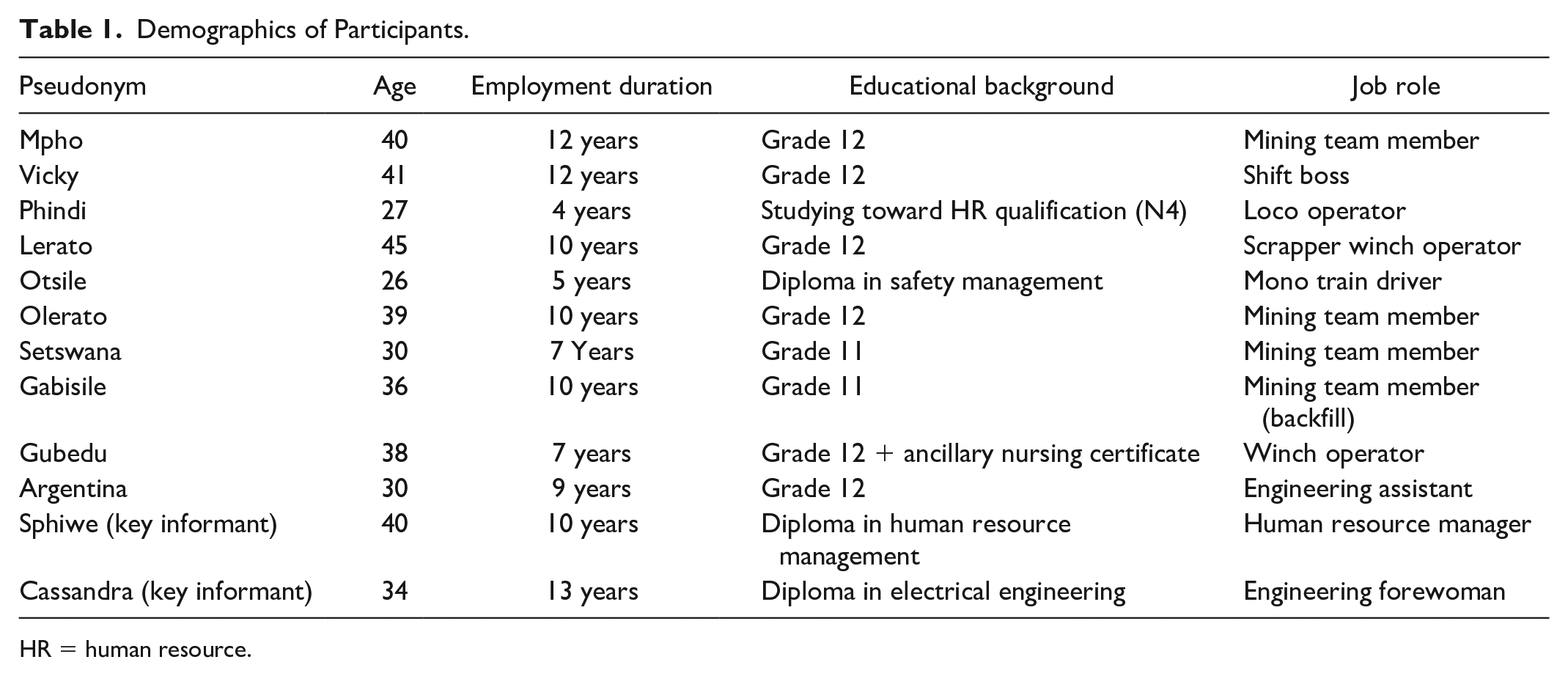
Using purposive sampling, 10 participants and 2 key informants were interviewed for the study. The sample comprised black women mine workers who were employed underground and who were all, at the time of data collection, permanent employees at the mining company situated in the North West province. Although women of different races worked within the mine, the majority occupying underground mining roles were black. Of the two key informants interviewed, one was designated to work underground while the other was based at the surface. An interesting picture emerged of the participants’ educational background, with seven participants having only a secondary education. Of the remaining five with a tertiary education, only two had qualifications related to the mining industry. Tracing the path that led to the participants entering the mining environment was fascinating as their journeys varied. However, they were mostly motivated by one common need—to combat poverty in their lives.
Table 1 provides a summary of the participants’ demographic information. For ethical purposes, pseudonyms have been used to protect the participants’ identities.
Demographics of Participants.
HR = human resource.
Discussion of Themes
The key themes identified using thematic analysis relate to the overall experiences of women in the mining industry. The themes identified included an exploration of the factors that motivated participants to enter the mining industry. The researchers’ aim was to acquire a deeper understanding of whether their decision was based on their circumstances or whether it was in line with their career prospects.
Motivations to work in the mining industry
The introduction of women into the mining industry presents some interesting dynamics, with the new South African democratic legislation playing a fundamental role in advocating for the incorporation of women into this traditionally male-dominated field. The data collected have shown that unemployment, the lack of further educational opportunities, the need for a better living wage and the availability of mining bursaries were some factors that persuaded the participants to consider working in a mining environment. Of all those interviewed, only one participant had the desire to pursue a career in the engineering sector, but never imagined that she would be presented with an opportunity to work in the mining sector. The high rate of unemployment in South Africa was a key factor in many participants’ decision to work in the mining industry.
Unemployment
The data collected from the study participants revealed that their choice to enter the mining industry was neither out of their own desire nor will, but out of desperation to find a means to survive and provide for their families. The researchers discovered that although the participants ultimately made the decision to enter the mining industry, it was not by choice that they were placed underground as they had very little knowledge of the different roles within the mining industry and were not given any options.
Many of the participants referred to their struggle of political marginalization due to unemployment a key driver for seeking a job in the mining industry. Faced with societal pressures and the need to survive, exploring a job in the mining industry seemed viable for most participants as many originated from the area where the mine is situated. In addition, the struggle of securing a permanent job also contributed to their decision to enter the mining industry. A similar experience detailing the motivations to enter the mining industry was shared among most participants. The following quotations illustrate the effects of poverty and unemployment on participants’ decision to join the mining industry: Honestly, I am not going to say I decided that I wanted to be here (at the mine). I never even dreamt of working in the mines, but circumstances that were beyond my control forced me to stand and try and make something happen. I am a parent and a single parent at that, and I could not expect my parents to take on my responsibilities and you can’t sit at home without doing anything. (Argentina, 30 years old, engineering assistant)
This statement confirms that poverty and unemployment can lead people into career fields that they had not envisioned for themselves. Entering the mining industry was presented as a form of sacrifice that took precedence over their personal desires, so that women could provide for their families.
It could be argued that the above response refers to the narrow definition of unemployment, which is a state where “a person is without work, but is currently available for work, and is seeking or wanting to work” (Barker, 1999, p. 165). Although the participants were without a stable job at that point, they were actively seeking employment but were not finding work that was satisfactory. In their search for any employment that would enable them to be able to sustain their lives and that of their loved ones, they landed jobs in the mining sector.
This finding supports the arguments made by Benya (2009) who contended that the introduction of women into the mining industry may also be perceived as a form of response to the harsh economic reality of South Africa. Therefore, in their quest for social inclusion, women went out of their way to secure employment and to fulfill their societal roles successfully as mothers and breadwinners (Calitz, 2004). The findings depict women’s hesitation to pursue a career in an industry that has previously been associated with masculinity and that was notorious for its undesirable working conditions (Botha, 2013).
Lack of further educational opportunities
Availability and accessibility of further education can open job opportunities for an individual. Having a formal education is considered a gateway out of poverty and access to better employment opportunities. As evident in Table 1, most study participants had a Grade 12 certificate. However, the interviews revealed that a lack of further academic opportunities saw them pursuing a career in mining, which required only secondary education to be recruited. The following extract from a research participant is indicative of the views of many in terms of securing a job in underground mining: I did not think I would work in the mines, but circumstances forced me. So I had to find a job, because I did my matric but after matric I fell pregnant, so as a parent you have to be able to do things for your child. My mother was also a single parent who was not able to do everything for us, so I had to help her out because I was the eldest. (Gabisile, 36 years old, mining team member)
The findings from the study show that having a secondary school certificate only hinders access to certain jobs. The role of further education in improving an individuals’ capacity to access specialized employment opportunities is supported in other studies (Altman, 2001). This is in line with classical labor market theory, which states that suitability for a job is determined by an individual’s level of experience and qualifications (Benya, 2009). These studies maintain that there is a correlation between the level of education and employment, and that the higher one’s educational level the better one’s chances of being employed. However, the findings from this study partially refute the notion that an individual is more likely to secure employment if in possession of a tertiary level qualification. The data from the women working in underground mining has shown that, although mining is a highly technical sector (Benya, 2009; Botha, 2013; Ranchod, 2001), an individual does not need any formal education to be employed in underground mining, and the skills required can be learnt on the job. Humphrey (1987) and Bradley (1989) confirmed that many women involved in underground mining are classified as unskilled laborers as most are not in possession of formal training or specialized knowledge of mining and are at the bottom of the hierarchy in the workplace. Malakwane (2012) supported the view that “the level of education does not translate into an automatic employment opportunity,” particularly in South Africa where the levels of unemployed graduates are high (p. 19).
Better working wage
Better earning capacity was a key driver that prompted participants to joining the mining industry. Not only did mining offer the participants permanent employment, but it also gave them an opportunity to earn a considerable wage which would enable them to sustain their lives and that of their loved ones. The need to survive and meet the basic needs of participants and their families was a constant theme when exploring the factors that attracted the participants into mining. Although expressed in different ways, the following response provided by a respondent best depicts their opinion: You know, coming here to the mines, I just came because I stayed unemployed for a long time. When I tried looking for a job, I would find cleaning jobs of a domestic worker and the money was too little. And, you know, I am a mother and I have responsibilities, I have to take the children to school and the family too. So mining is much better, the money is way better than what I was getting, it’s close to R5000 and it can cover everything that I need. (Mpho, 40 years old, mining team member)
Lahiri-Dutt and Macintyre (2006) confirmed that finding employment in the mining industry provided individuals with opportunities to improve their quality of life as they earned a higher living wage. Findings from Benya’s (2009) study revealed that because most women working in the mining sector were sole or secondary breadwinners, securing better paid employment was essential. Their wages would enable them to attend to the needs of their immediate family and those of their extended family.
Mining bursaries offered
Some respondents were drawn to the industry because of the bursaries and scholarships awarded in mining. These bursaries presented a beam of hope in building solid careers within the industry. Although the means to survive was at the heart of many of the women’s decision, other respondents had clear intentions of using the opportunity to ultimately assist them in developing their careers, as outlined in the following response by a participant who had received a bursary: Honestly speaking, it was not like it was my dream to work in mining. It’s just the studies that I have done at the college. Actually, I liked engineering since high school, but in my mind, I wanted to work at Eskom and all those companies. But you can’t choose; if there is no space at Eskom, I cannot say I cannot work somewhere else. I can say I was fortunate enough, by the time I was about to complete my studies then this company as a whole came to the schools. They wanted learners and I was one of those so that is how I got the opportunity to be in the mine. (Cassandra, key informant, 34 years, engineering forewoman)
The findings show that bursaries seem to attract more young people who are eager to pursue mining-related careers. Grobler and Bruyn (2011) referred to this phenomenon as a “talent war,” where more companies are revising their strategies, not only recruit the best talent, but also to also employ innovative strategies to attract and retain young people within formal work structures (p. 63). Over the years, mining has made an effort to become more attractive to women by offering study bursaries that, in the end, will assist companies in increasing their female labor force and retaining their skills pool (Botha, 2013; Moyo, 2011).
Main Findings
Motivations to Work in the Mining Industry
With the introduction of democratic laws in South Africa, more women have been employed as underground mine workers. Given the intensity of underground work and the general exclusion of women from working underground, the first objective of the study focused on exploring women’s motivations to work in the mining industry. The data collected have shown that unemployment, lack of further educational opportunities, better living wages and the availability of mining bursaries are some of the factors that persuaded the participants to consider working in a mining environment. The high levels of unemployment in South Africa prompted many of the participants to pursue a career in the mining industry as a means of survival.
The participants’ lack of further academic opportunities increased the likelihood of employability in the mining industry as the nature of the work was highly technical, and an individual did not need any formal education to work underground, but could acquire the skills on the job (Benya, 2009; Botha, 2013; Ranchod, 2001). This finding contradicted assumptions made by labor market theory as it proved that industries such as mining did not always require an individual to be in possession of a tertiary qualification to be employed (Benya, 2009). Furthermore, the participants of the study revealed that they were attracted by the wages offered by the mining companies. The mining industry was presented as a viable route for the participants to improve their standard of living through improved earning capacity. There were some participants whose entry into the industry was motivated by their desire to build a sound career within the mining industry.
The data collected have shown that unemployment, lack of further educational opportunities, better living wages and the availability of mining bursaries are some of the factors that persuaded the participants to consider working in the mining environment. Bursaries to attract women into the mining industry applied mainly to younger participants. The mining industry was presented as a viable route for the participants to improve their standard of living by improving their earning capacity. The findings, which were supported by the literature, revealed that motivation for working in the mining industry was intertwined with an attempt to escape political marginalization.
Recommendations
Based on the summary and conclusions, the following recommendations can be made:
For Occupational Social Work Practice
A comprehensive employee wellness program should be introduced which assists in responding to the employment and social needs of underground women mine workers. This would best be facilitated by an occupational social worker. It would require an organizational development intervention in which an educational strategy would be introduced to change the beliefs, values, attitudes, and structure of mining organizations to ensure that they adequately respond to the needs of women.
For the Mining Company
Learning programs should be implemented to engage male employees in issues affecting women. A well-structured induction program needs to be implemented and follow-up sessions held to conscientize male employees about the existence of women in the mining environment and how they ought to be treated. This will help in developing mutual respect and value for all employees within the mining environment.
For Policy Makers
Constant monitoring and evaluation should take place on the implementation of all mining policies as well as employment equity. The implementation of policies needs to go beyond reaching targets but also ensuring that women mine workers are working in conducive environments and that their unique needs are being catered for. This will require the incorporation of good monitoring and evaluation into all mining operations.
For Future Research
Future research should consider investigating the implementation of equity policies within the mining sector. An investigation of growth and development plans for women within the mining sector also needs to be considered.
In conclusion, as long as the mining industry remains male-dominated, there is the danger that conditions will be less favorable to women employees. Gender imbalances, particularly in underground mining, are a root cause of women’s reluctance to pursue careers in the industry. This was discovered by exploring underground female mine workers’ motivations for entering the mining industry and the occupational challenges they faced. Despite the mining company’s efforts to create a gender-sensitive working environment for all employees, more needs to be done. This affirms the need for occupational social workers to penetrate the mining industry to influence employee wellness programs, policies, and overall structural organization to ensure that the unique needs of underground woman mine workers are prioritized.
Footnotes
Declaration of Conflicting Interests
The author(s) declared no potential conflicts of interest with respect to the research, authorship, and/or publication of this article.
Funding
The author(s) received no financial support for the research, authorship, and/or publication of this article.
