




Abstract
This article examines how the preschool child is enabled to withdraw from the peer group and create a private, individual space within the institutional collective. The question under consideration is, “What factors are necessary to enable a child to create and maintain a withdrawal space in the preschool?” Data were collected through ethnographic fieldwork at two Montessori schools in the south of Sweden. Analysis of the results reveals that a child is enabled through a combination of two elements: a level of opportunity to create a space and a level of defense of a created space. These two factors are dependent on the teachers’ ability to correctly identify space creation, alongside their desire for the child’s space creation effort to be successful.
Introduction
The majority of children in Sweden come into contact with the educational system from an early age. Children aged 1 to 5 are no longer spending their childhood at home but rather in the institution of the preschool (Markström, 2005; Tallberg Broman, 1995). It is in this institution that children’s peer cultures are formed and social relations constructed (Corsaro, 1988, 2005; Dahlberg, Moss, & Pence, 1999). Without these peer cultures, there is no institution (Markström, 2007a).
Children do not always comply with the preschool’s social demands. They seek out opportunities and use various strategies to withdraw from the peer group, finding an individual, private space to retreat to (Markström, 2010; Skånfors, Lofdahl, & Hagglund, 2009). The withdrawal strategies that children employ do not necessarily result in the physical creation of a space. By being nonresponsive, acting distant, reading, or walking calmly around the preschool, the child silently withdraws from the group (Änggård, 2007; Markström, 2007a, 2007b; Skånfors et al., 2009).
Regardless of whether the withdrawal space is a blanket fort or a psychological construct, the child who creates this space must be able to do so. It is therefore possible to discuss withdrawal from the peer group in terms of enablement, and this is the focus of this research, to identify the enabling factors that allow the individual child to create and maintain a withdrawal space within the preschool’s collective space.
The Individual in the Collective Institution
The preschool is created for the collective. At the same time, the United Nations Convention on the Rights of the Child (United Nations, 1989) and extracts from the Curriculum for the Preschool (Skolverket, 2016) place emphasis on the needs of the individual. This can create conflict within the preschool when the individual’s needs do not fall in line with the needs of the collective (Markström, 2005, 2007a; Nordin-Hultman, 2004). Markström’s (2005) study shows evidence of preschools striving toward a collective norm, creating a setting for the “normal” or “desired” preschool child who will have a predetermined preschool experience as part of the collective. The individual who shows unwillingness to participate in group activities or engage in cooperative play shows no adherence to the preconceived norm of the child as a social being who thrives in a collective setting (Corsaro, 2005; Johannesen & Sandvik, 2009; Markström, 2005, 2007a, 2007b, 2010; Nordin-Hultman, 2004; Tullgren, 2004). Normalization, as well as the absence of privacy, is seen as beneficial and even necessary for the maintenance of order and discipline in the institution (Foucault, 1991).
Children do not choose to participate in preschool life. Rather, this choice or decision is in the hands of those who have guardianship of the child. The paradigm shift of the 1970s welcomed children as competent agents in society, whose views, opinions, and choices should be respected (Sommer, 2005). This competence, however, is limited by the child’s mental capacity to make decisions, as well as being limited by the adults to whom the child is entrusted. In preschool, the environment comprised of time and space is a construct of the institution, not the individual child (Markström, 2005, 2007a; Nordin-Hultman, 2004). Circle times, meal times, cleanup times, and naps times are schematic routines that are implemented by adults to assist in the creation of a preschool community (Corsaro, 2000; Williams, 2001), but a naturally occurring result of this is the restriction of the individual child’s freedoms (Markström, 2007a; Nordin-Hultman, 2004; Van Manen & Levering, 1996). The children’s movements within the preschool are to an extent determined by the clock, and therefore, time and space are intertwined (Asplund, 1983; Markström, 2005, 2007a; Nordin-Hultman, 2004). Time positions the children and is therefore an integral part of the preschool institution and an important determinant of how much potential freedom and influence the individual has in the regulation of his or her own space (Markström, 2005, 2007a; Nordin-Hultman, 2004).
Corsaro (2005) refers to school as the child’s work. Just as adults have to work to pay the bills, the child has to attend his or her place of work, the preschool, to be educated and integrated into society, while giving the parents the freedom to have a career. Children, just like adults, need a break from this work. This can include a break from organized activities and schedules, as well as a retreat from the collective (Van Manen & Levering, 1996).
Spaces Within Spaces
Traditionally, preschools are comprised of spaces that are designed, created, maintained, and managed by adults (Koralek & Mitchell, 2005; Nordin-Hultman, 2004; Rasmussen, 2004). They are designed in keeping with what the adult views as being important to the child, or important for the child (Nicholson, 2005). Löfdahl and Hägglund (2007) comment on the physical spaces of the Swedish preschool as being designed with the collective in mind rather than the individual, due to the emphasis on children’s social development. However, several studies have revealed how children on occasion adapt this space to create their own individual space (Änggård, 2007; Corson, Colwell, Bell, & Trejos-Castillo, 2014; Markström, 2005, 2007a, 2007b, 2010; Markström and Halldén, 2009; Skånfors et al., 2009). Space has a language and a meaning that speaks to those who occupy it (Lawson, 2001; Rasmussen, 2004; Rinaldi, 1998), but these studies show that this does not necessarily mean that the space must remain stagnant. Even if the space speaks of the collective, it can be adapted in accordance with the individual’s needs and desires. Spaces are affected by those who inhabit them, and as a result, their identity is not singular and fixed (Massey, 1994). It is when children apply their own meaning to a space that it becomes a “children’s place” rather than a “place for children” (Rasmussen, 2004).
When children at a primary school in London were asked to use art to represent their current school space and desired changes, many chose to draw representations of withdrawal spaces (Koralek & Mitchell, 2005). They proposed the need for spaces that allowed for escape and relaxation, as well as spaces for fun. Koralek and Mitchell (2005) attribute this need to the possible perception of stress in the school setting. Large child groups may contribute to this stress due to high noise levels and reduced opportunities for privacy and/or solitude (Williams, Sheridan, & Pramling Samuelsson, 2016). Noisy environments and environments that fail to provide opportunities for personal space are not regarded as being conducive to children’s well-being (Fattore, Mason, & Watson, 2009).
According to a report from Sweden’s official statistics office (Statistics Sweden [SCB], 2002), 75% of children between the ages of 0 and 17 had their own room in the year 2000. At home, the majority of children find a ready-made retreat, a private space for their own belongings, thoughts, and time (Corsaro, 1988). In the preschool, toys and space are communal. The preschool space is both a shared and sharing space. It can also be an overwhelming space filled with strangers, newcomers, and authority figures, all with different expectations of the child (Corsaro, 1988; Nordin-Hultman, 2004; Van Manen & Levering, 1996). Routine and continuity are viewed as being essential to the child’s feeling of security in preschool (Kihlbom, Lidholt, & Niss, 2009); however, the preschool is a forever changing space. It is, according to Rinaldi (1998), a “living organism” that transforms from one day to the next. Even with routines in place to provide structure for the children, change is an inevitable part of the preschool setting, and this can create increased stress levels in the child (Kihlbom et al., 2009). According to Ellneby (1999), children need a space where they can relax and reflect in peace and quiet away from the noise of the collective, a place for the “I,” not only the “we” (Rinaldi, 1998).
Children’s withdrawal from the collective can be a pedagogical challenge for preschool teachers, but it may also be of benefit to children’s social and emotional development. Several studies have discussed private spaces in relation to the developing child’s need for self-reflection, autonomy, and sanctuary (Corson & Colwell, 2013; Fattore et al., 2009, 2016; Markström & Halldén, 2009; Sandseter & Seland, 2016). Through taking control over the artificial child-centered world that has been designed for them, rather than by them, children gain the power to express the needs and desires of the self. The children thus become active agents in the construction of their own childhood (Markström & Halldén, 2009). According to Fattore, Mason, and Watson (2007), agency is one of the core factors for children’s well-being. In their private spaces, children create their own experiences, gain spatial autonomy, and claim ownership over their environment (Colwell et al., 2016; Corson et al., 2014; Green, 2013, 2015). Here, they are able to create a barrier between the adult and child world and make their own decisions with regard to the activities in which they wish to engage. Private spaces may allow for the development and expression of individuality and autonomy within the collective institution (Markström & Halldén, 2009).
It should be noted that a private space is not necessarily synonymous with being separated from the group. Children also use tactics to create their own space while still in the presence of their peers, for example, through refusing to engage in conversation, acting distant, and withdrawing inwards (Änggård, 2007; Markström, 2007a; Skånfors et al., 2009). With the constant monitoring and regulation of children in school and society in general, James, Jenks, and Prout (1998) question whether this internal, psychological space is indeed the last remaining space for autonomy and the child’s “self.”
The “Being and Becoming” Child
The expectations of how a child should be, as well as the teachers’ views on childhood, can be determining factors in whether or not the preschool child gains access to a private space. McKinney’s (1998) study on parental perceptions of privacy needs reveals that children’s privacy requirements are not at the forefront of parental concerns. Any rules regarding privacy in the home were found to be in place to protect the privacy of the parents, not vice versa, and the child who sought privacy was often looked upon with suspicion and negativity. Negativity toward children’s privacy is also found in the educational sphere, where the child should be seen to be a fully integrated member of the institution (Davis, 2001; Markström, 2007a, 2010; Nordin-Hultman, 2004; Van Manen & Levering, 1996). The child who withdraws from the collective is viewed as engaging in social resistance (Markström, 2007a, 2010; Nordin-Hultman, 2004).
Social interaction is not only regarded as being important to the working of the institution but also of developmental importance to the child. The Curriculum for the Preschool (Skolverket, 2016) is largely built upon Vygotsky’s (1978) social development theory, which is based on the premise that children’s learning occurs through interactions with others. It is in these interactions that the child is challenged to work within the zone of proximal development (ZPD), learning to move beyond that which is already mastered (Vygotsky, 1978). The child who is resistant to social interaction can be viewed as withdrawing from the educational institution’s provisions for development and learning. Corsaro (2005) refers to socialization as having a future-oriented perspective of childhood. The social, learning child is the “becoming” child, the child who is developing toward adulthood, the goal (Markström, 2007a; Nordin-Hultman, 2004; White, 2002). The “being” child, on the contrary, is the competent, able child of today, rather than an unfinished product (Dahlbeck, 2012; Uprichard, 2008; White, 2002).
Uprichard (2008) states that children are continuously in a state of both “being and becoming.” Time dictates that the being child will one day enter adulthood and this needs to be acknowledged when addressing the child’s needs in the present. The child’s inevitable entrance into adulthood places demands on the child to learn and develop, which according to Vygotsky’s philosophy is a social process. However, the being child also has needs, which require a here-and-now perspective rather than one which is future oriented. When the child withdraws from the peer group, it is not a reaction to a future event but is oriented in the present. There is therefore a demand on the teacher to assist in finding a balance between the becoming child and the being child so that a child who perhaps prefers to spend time alone also has the opportunity to develop in the presence of others, to enter the ZPD. To use a phrase from Reggio Emilia, a “pedagogy of listening” is required to attempt to understand and interpret what the child’s needs are and why (Moss, 2001; Rinaldi, 2004, 2012).
How the child is enabled to create a private space within the collective remains relatively unexplored within the field of preschool children and withdrawal. Research has mainly focused on the preschool as a social arena, regarding children who withdraw as being resistant to the institution and its aims. Those who have researched children’s withdrawal strategies and institutional resistance, for example, Markström (2005, 2007a) and Skånfors et al. (2009), have mentioned the preschool’s organization and the children’s adaptation of time and space as being enabling factors in the creation of private spaces. Enablement, however, has yet to be the primary focus within this field of research. This study seeks to fill that gap and answer the following question: What factors are necessary to enable a child to create and maintain a withdrawal space in the preschool?
The Motivated and Enabled Child
It can be said that the child who creates a withdrawal space in preschool has both a level of motivation, a desire, to create such a space and a level of enablement to do so. The levels of motivation and enablement present in any particular child are not simply True/False values but rather may take a range of values depending on a host of circumstances. In other words, a child with a low degree of enablement may still be found to create a space if they have a sufficiently high degree of motivation to do so. It should be noted that the motivation behind the child’s space creation effort can be extrinsic or intrinsic (Deci, 1972; Fisher, 1978). The withdrawal space has the potential to be a space of exclusion with the child extrinsically motivated to create a space through lack of choice or force due to, for example, bullying or the removal of the child from the group (Markström, 2005). It is not always clear whether a withdrawal space is the result of exclusion or voluntary withdrawal, as the lines between inclusion, exclusion, and withdrawal are blurred (Skånfors et al., 2009).
The motivation to create a withdrawal space can stem from a variety of factors, including stress, a need for silence, or a desire for time alone. The motivational forces are, however, beyond the scope of this research, which seeks not to answer why the child creates a withdrawal space but rather how the child is enabled to create this space.
Method
Analytical Procedures
A first step in this research was the creation of an Ontology Log (olog; Spivak, 2014; Spivak & Kent, 2012), the output of which is shown in Figure 1. An olog is a conceptual map of a given situation, a graphical representation of the different “things” under investigation, and the logical and causal links between them. Although superficially similar to a traditional mind-map, an olog has a well-defined set of mathematical rules governing its creation. It is these rules that give ologs the power to clarify the complexities inherent in real-world situations.
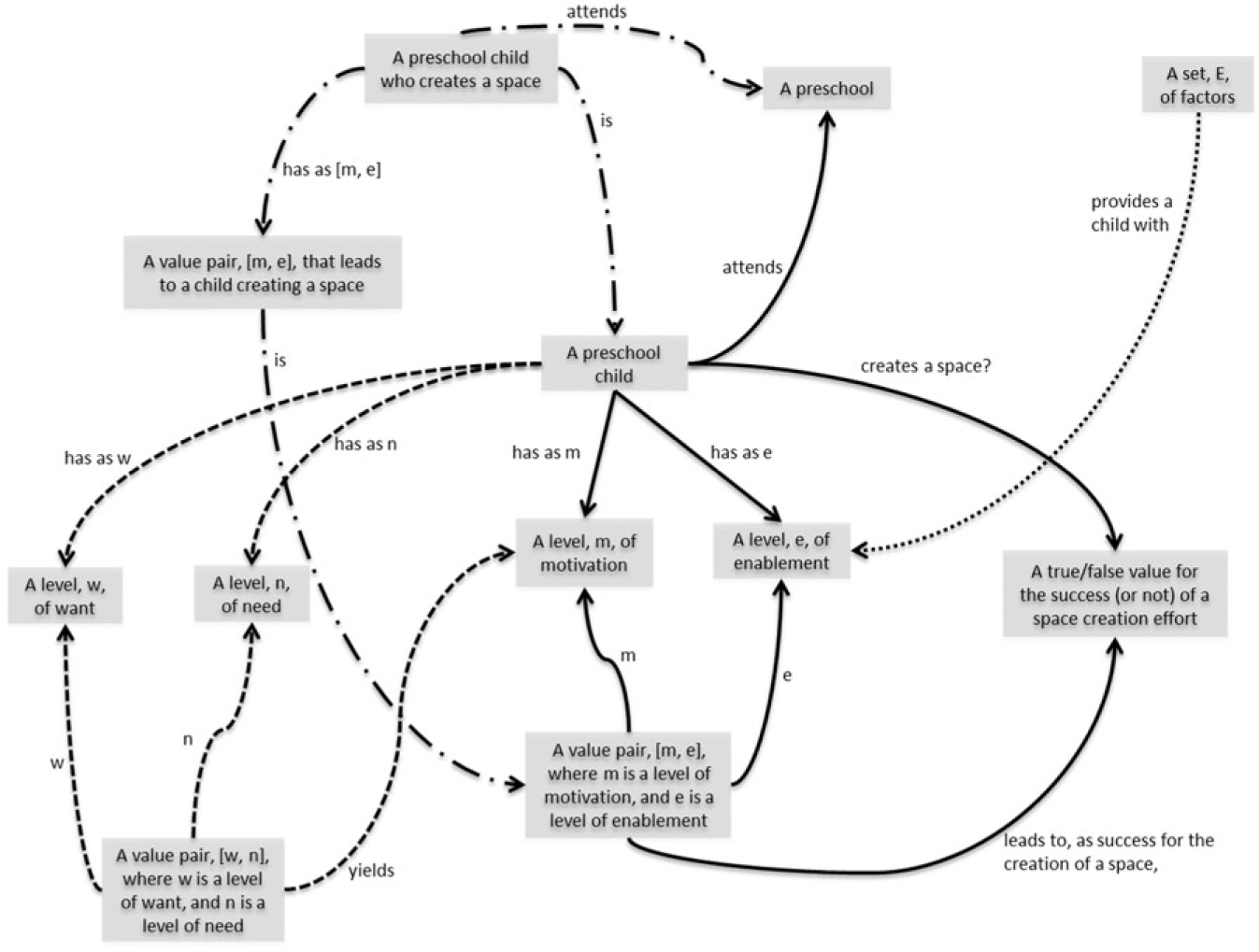
Ontology Log showing the worldview assumed in advance of the research.
The creation of the olog was based on the study of currently existing literature on children’s withdrawal spaces, and was drawn for the purpose of clarifying the worldview that shaped this research. The process of drawing the olog uncovered an area neglected by previous researchers—that of the enablement of the child.
For ease of discussion, the line types within the olog have been coded to form four distinct sections. Although it was not drawn with this intention in mind, the development of the olog has resulted in the preschool child taking a central position in the diagram, giving an indication that it is the preschool child who is of primary interest to the research question. The first area of discussion will focus on the solid, black branches that grow from this central box.
The fact that the preschool child attends a preschool is perhaps obvious, but its statement is essential to the research. It is not any child that is being investigated but a particular set of children—those within the preschool setting. The preschool’s inclusion as a separate entity in the olog also shows that at the outset of the research effort, the worldview did not assume any particular causative effects of the preschool beyond its function as setting the stage for the research. This lack of causation is shown by the absence of any arrows emerging from this box.
As stated earlier, the preschool child is assumed to have both a level of motivation, m, as well as a level of enablement, e, with the combination of these resulting in the creation of a value pair, [m, e]. From here, there exists some unknown function that acts on this value pair, thus indicating whether these two inputs will result in the creation of a space or not. It is only when the Boolean value is “True” that a space is created.
The enablement and motivation values will vary from child to child, but for the purposes of this research, the function that acts on these variables will be regarded as being the same for all children. The function can be thought of as the child’s inner interpretation of the inputs, based on the preschool’s peer culture. As will be shown later, there is little difference between the populations involved in the study, and so it can be assumed that the children’s peer cultures are similar. Thus, the function that determines the output is identical for all children under consideration. Note that this shows some of the power of expressing the basis for this research in the form of an olog. Although it is clear that the determination of the levels of motivation and enablement that lead to the successful creation of a withdrawal space is hugely complex, it is possible to encapsulate it within a single function. Thus, the complexity is acknowledged as existing within the worldview, while allowing it to be “placed to one side” for the remainder of the research.
By looking at the area marked by the dash-dotted lines, it can be seen that the special case of a preschool child who creates a space is considered. The study is therefore even more clearly defined as involving a particular subset of preschool children. Again, this preschool child who creates a space attends a preschool, and has a value pair [m, e], which is restricted to the subset of values for which a space can and will be created.
What is meant by motivation in this worldview is covered within the section that utilizes the dashed lines. The child who creates a space is regarded as being motivated due to the combination of a level of need and a level of want, resulting from extrinsic or intrinsic factors. Here, another benefit of the olog is brought to the fore. In this case, it not only acknowledges the varying levels of need and desire to create a withdrawal space within different preschool children, but also shows that the child’s level of motivation is actually defined by the action of some, again, unknown function on the levels of want and need. Thus, the olog serves the purpose of offering a clear visual indication of the definitions used within this research.
In the same way that the level of motivation was broken down to a functional dependence on the levels of want and desire to create a withdrawal space, the various factors that influence the child’s level of enablement may be considered. This is displayed in the dotted branch, and it is immediately evident that exactly what the factors are that produce an enablement value is unclear. It is from this branch that the research question stems. The child’s wants and needs, influenced by their surrounding environment, provide the intrinsic or extrinsic motivation to create a space, but what are the factors that serve to assist the child in his or her space creation effort?
The Preschool Setting
The empirical data are based on participant observation and informal interviews at two preschools in a medium-sized, southern Swedish town. The children in the observed peer groups were in the 3- to 5-year-old age range. Pseudonyms for the preschools, as well as the preschool participants, are used throughout to preserve anonymity.
Both preschools employ the Montessori method as the framework for their work. At the heart of this pedagogical method is the view that children are competent, and can and will learn when intrinsically motivated to do so (Lillard, 2007; Montessori, 1667/1995). Children participate daily in a 3-hr work cycle in which they freely choose what material they will work with, following their own interests. In both preschools, this work cycle is scheduled between 8 a.m. and 11 a.m. During this time, adult interruption is kept to a minimum, as the Montessori child is viewed as seeking to act independently (Montessori, 1667/1995).
As time and space have been mentioned in previous research as enabling factors in the creation of withdrawal spaces, the decision to perform the observations within Montessori preschools was deliberate. Here, the children are relatively free from imposed schedules, potentially providing increased opportunities for the creation and observation of withdrawal spaces. Independence is at the heart of the Montessori tradition, and personal space and time is to be respected and protected from external interference. Teachers are thus trained in the maintenance and protection of children’s space and time.
Preschool 1—Little World
Little World is located in the town center on the ground floor of a small apartment building. The outside area is communal and shared with the surrounding apartments. The inside space is divided into two departments: the 1- to 3-year-olds and the 3- to 5-year-olds. Observations were focused on the older children’s department, which consists of two fairly large, open rooms connected by a small kitchen area. There is also a small, self-enclosed atelier, as well as a medium-sized play room, “the family room,” which contains a variety of toys for role-play. The department has 12 children and two preschool teachers who are also qualified Montessori educators.
Preschool 2—The Haven
The Haven is located on the edge of town, with a view over fields and a small lake. It is comprised of four departments: two departments for the 1- to 2-year-olds and two departments for the 3- to 5-year-olds. The large outside space is divided into two sections: one for the younger children and one for the older children. Observations indoors were focused on only one of the older children’s departments, comprised of 24 children and four preschool teachers, three of whom are also qualified Montessori educators. The department consists of two large rooms, separated by double doors, and a large atelier that is shared with the other department. Observations outdoors included the children from both departments.
Data Collection
As previously mentioned, the data were collected through participant observation and daily, informal interviews with the six teachers present during the study. These interviews were unstructured and open ended, resembling a private conversation (Babbie, 2013; Brewer, 2000). They varied in length, from 2 to 30 min, and a variety of topics were discussed based on what was being observed on any particular day. Through these interviews/conversations, the teachers were able to express and reflect on their own perspectives regarding the children’s use of withdrawal spaces. Occasionally, notes were taken during the interviews, but on most occasions, field notes were made immediately after the conversation’s completion. While this does increase reliance on memory, it also allows for a more natural conversation without a barrier between the interviewer and the interviewee (Babbie, 2013). The repetition of the discussion topics due to the regular occurrence of interviews throughout the study significantly reduced the risk of misinterpretation. Member checking via verbally restating and summarizing the information the interviewee had provided was used as a means of checking validity (Lincoln & Guba, 1985). This gives the participant the opportunity to clarify and correct any misinterpretations. Each question was posed to several teachers in the preschool, and then written down and posed in the other setting to increase the study’s reliability and allow for comparisons and cross-referencing. An exception to this was when the question being posed related directly to what was being observed, for example, when the interviewee was asked about the habits of a particular child or when asked about his or her own interpretation of an ongoing observation. At The Haven, 46 interviews were carried out with the four preschool teachers. Twenty interviews were conducted with the main informant, Nina, and the remaining interviews were distributed as follows among the other teachers: eight, eight, and 10. At Little World, a total of 34 interviews were evenly distributed between the two preschool teachers.
The research was carried out over a period of 8 months (2013-2014) and includes 200 hr of observation. A number of weeks were spent as a full-time participant at Little World using ethnographic methodology (Carspecken, 1996). The remaining observations occurred during various visits throughout the 8 months, each lasting approximately 3 hr.
Documentation was done through the use of field notes. All observations were unstructured, and events were documented as they were happening, or as soon as possible after the completion of the event in question. Not all visits involved the taking of notes, especially at the onset of the study when it was important that the children became acquainted with the presence of a researcher. A familiarization period is viewed as being essential when engaging in research with children (Barley & Bath, 2014; Punch, 2002).
The observations focused on the individual children, following their interactions with their peers and watching for when an individual sat alone or withdrew from the group. In conjunction with writing field notes on these events, questions were posed to the teachers through the informal interviews, for example, “Does this child often withdraw from the group?” “Is this a space that has specifically been designed as a place for solitude?” “How can you be assured that the child wishes to be alone and isn’t being excluded?”
The children were never questioned about their private spaces. This does mean that the motivations behind the children’s withdrawal space use and/or creation remain open to interpretation, but due to the nature of the research, there was seen to be an ethical obligation to respect and protect the children’s privacy.
Analysis
The starting point for the analysis was using the written documentation from the interviews and observations to identify and categorize the factors that assisted in enabling the children to find and/or create a withdrawal space within the collective. Each documented event was analyzed individually, and the dominant factors assisting the child’s withdrawal were noted. Guiding this empirical analysis were the following questions: How has the child withdrawn? Where has the child withdrawn to? How is the child’s privacy/withdrawal space being maintained? What, or who, is marking the boundaries of the private versus collective space? The assisting factors from each individual event were then compared to reveal commonality and emerging themes.
Data from the observations and interviews were triangulated and compared with previous studies of children’s withdrawal spaces, in particular the studies of Markström (2005, 2007a, 2007b, 2010), Nordin-Hultman (2004), and Skånfors et al. (2009), to look for convergence and divergence among the data sources (Patton, 2002). The converging categories/themes that emerged from the analysis form the framework for the results.
Results
The data have been analyzed under four themes, which reveal that withdrawal space creation is enabled by (a) the environment, (b) the teachers, (c) the peer group, and (d) the child’s own choices regarding the creation of a space.
The Environment
This section is subdivided into three subcategories: the indoor environment, the outdoor environment, and time.
The indoor environment
The provision of spatial variety can assist the child in finding an individual space in the preschool. The arrangement of the physical environment in The Haven immediately provided clues as to how each space should be used. There were small desks scattered throughout, each with a single chair, signaling that these spaces were reserved for the individual. These stood in contrast to the larger tables surrounded by several chairs, suggesting collaboration and interaction. Children often sat alone at the smaller desks when they withdrew from the collective.
The indoor environment in The Haven provided the children with not only ready-made spaces for privacy but also an environment that was open to manipulation. Doors could be closed between rooms, and movable screens could be positioned as needed to create smaller, more enclosed spaces, thus providing greater privacy and a calmer working environment. The teachers were frequently observed manipulating the environment to protect a child’s individual space. In one situation, Anna (4) was sitting alone doing a jigsaw on a mat that she had placed on the floor in a corner of one of the large rooms, far away from the other children. A teacher observed her for a short time before positioning two screens alongside Anna’s mat, providing her with a private space within the relatively large, open space of the room. The screens served the purpose of assisting Anna in her space creation effort while shielding her space from intrusion by signaling to the other children that this space was protected.
The children themselves were also observed manipulating the environment. Small mats were provided that could be fetched by the child and positioned as needed, allowing the child to mark his or her own individual territory. The edge of the mat created a physical boundary between the individual and the collective. If another child crossed this boundary, it was seen as an intrusion on the individual’s space. Name tags were also provided that could be placed on the mat, providing further emphasis as to whom the space belonged. This territorial marking of spaces was also observed in Stairs Vaughn’s (2002) study on empowerment in a Midwestern Montessori school.
Nina explained that a conscious decision had been made to create a space that allowed for pair, group, and individual work. According to Nina, when a child withdraws to a space and works alone, it helps in the development of concentration and self-discipline, something that cannot be developed by working in a group. She also mentioned that the children are made aware of how to use and adapt the space in accordance with their needs, as well as how to move within the preschool without disturbing the space of others. Children are taught, for example, that a mat that has been placed on the floor defines a workspace and it is only with permission that another child is allowed to enter this space. Nina stated that individual space provides the child with time for reflection and assimilation, which is essential to both learning and the child’s well-being in the present. Time alone can therefore assist in satisfying the needs of both the being and becoming child.
Little World was a smaller setting providing less variety with regard to spatial arrangements. The largest room consisted of two long tables, each surrounded by approximately eight chairs. The ability to withdraw to an individual table was not an option so if a child sought to work alone at a table, he or she attempted to find a place as far away as possible from the other children. As a result of this, a single child was often observed sitting alone at the far opposite end of the table from his or her peers.
Characteristic of both schools was the abundant provision of material that could be worked with individually. When children withdrew from the group, they gravitated toward these individual activities. Everything within the preschool setting can be said to have a silent language that speaks to the children, telling them how to use spaces and material—collaboratively or individually. There seemed to be a universal understanding of these signals within the preschools, and so children who were occupying a ready-made individual space or engaging in an individual activity remained largely undisturbed.
It should be noted that although children withdrew from the group, they were never seen to “hide” from their peers. Spaces were almost exclusively created in the vicinity of others or within an area where the other children could be observed. Emma, a teacher at Little World, emphasized that it is difficult for children in preschool to find a space that is completely isolated due to the size of the peer group. However, in this study, it appeared that most children were not seeking out complete isolation. With the exception of one older child (5) at Little World who sometimes worked alone in the atelier, all the children created their private spaces within the group’s observable vicinity. Many of these children used their individual space seemingly solely as a means of observing their peers. They would sit or stand alone, but their eyes would follow the activity of their peers. A possible interpretation could be that these children took on a new role within the institution, shifting from participant to observer.
The outdoor environment
The provisions in the outdoor environment can also help or hinder the child in finding time alone. Outdoors, the swings were frequently used as a withdrawal space. Here, the child could again be alone while, if desired, observing the peer group. In The Haven, Olivia (3) consistently used the swings as a means of withdrawal. On one occasion, she remained on the same swing for 45 min, silently observing her surroundings. She made no attempt to communicate with the children present on the swings beside her. When they moved from the swing area, she followed them only with her eyes, showing no physical sign of wishing to follow. Olivia returned to the same swing several times throughout the morning, always standing and gently swinging while overseeing the garden. She was never actively engaged in making the swing move, suggesting that her motivation for being there was not to “play” but to have a private space from which to watch the other children. This can again be interpreted as revealing a shift in role from participant to observer.
Olivia appeared to have a preferred swing as her withdrawal space. On another occasion, she had been standing on the swing for a while, seemingly observing, before deciding to wander around the garden. It was not long before she caught sight of three girls running toward the swing area. Olivia immediately started running toward them, overtook them, and quickly grabbed the swing she had previously utilized. The other girls took occupation of the three remaining swings. The provision of more than one swing enabled Olivia’s space to be protected.
In Little World, children sometimes retreated to the nest swing when withdrawing from the group. This swing was positioned at the far opposite end of the garden from the other outdoor equipment, so it was a ready-made private space. However, as there was only one nest swing, this space was easily disrupted if another child wished to use the space.
Catherine (6) was new to the preschool and, having recently arrived in Sweden, could not speak Swedish. Outdoors, she often withdrew from the group by retreating to the nest swing; however, on several occasions, she was forced to leave this space due to the arrival of another child. Catherine was never seen to defend her space, possibly due to communication issues, but left the swing and continued her withdrawal by slowly wandering around the outside area, creating a moving space.
Time
As previously mentioned, time and space are intertwined as time often dictates where the child should be positioned physically within the preschool setting. The preschool’s routines and schedules dictate whether or not the child has the temporal freedom to create a withdrawal space and whether or not a space that has been created is disrupted. Nina commented that children today are overstimulated and overscheduled, and as a result of this, they have little time to be alone without disruption. The daily fruit snack was the only disruption to the individual’s own time during the morning work cycle. In Little World, the snack was available at 10 a.m., but it was up to the individual child to decide whether or not to come to the table and eat.
Within the last 2 months of the study, The Haven started a new approach to the daily fruit snack. This involved providing each room with a small table surrounded by two chairs. In the center of each table was placed a bowl of fruit that was available throughout the entire morning, rather than at a designated time. Nina explained that the reason for this change was to give the children more control over their own time. The availability of only two chairs at the table allowed the snack time to be a quiet time. For the child who was motivated to withdraw, there was no fear that snack time would result in being surrounded by a large group of children. Privacy could thus be maintained throughout the morning, if desired.
In both preschools, there were occasions when the child’s time was scheduled, for example, the daily circle time and lunchtime. The majority of the day, however, remained unscheduled, allowing each child freedom of choice with regard to how he or she would spend his or her time.
Enablement by the Teachers
Teachers play a large role in determining whether a space creation effort will be successful. Passive and active enablement by the teachers will be discussed in the following two subsections.
Passive enablement
Passive enablement does not mean that the teacher is nonattentive to the child who has withdrawn from the collective. Indeed, the teachers in both preschools appeared to be acutely aware of the children’s needs with regard to space and privacy. What is meant by passive enablement is that the teacher respects the child’s need for privacy and does not try to force the child to engage with the peer group. Passive enablement was always coupled with active observation to ensure that the reasons behind the child’s retreat were due to choice, not exclusion.
Andrew (4), who attended Little World, was rarely observed interacting with the other children. He wandered daily around the preschool, seemingly content to be withdrawn from his peers. The other children made attempts to include him but to no avail. When Andrew did seek contact, he did so with the adults, not the children. In an interview with Emma and Sarah, his teachers, the conundrum that results from such a situation was discussed. They stated that on one hand his space must be respected, but on the other hand, the preschool’s social aspect is important with regard to development. There appeared to be uncertainty regarding where the balance lies between the being and the becoming child. The teachers respected his choices but made sure to show that he was welcome in the group by engaging him in conversation when it was seen to be appropriate. The following extract from the field notes shows an example of an interaction between Andrew and his teachers:
Andrew (4) is wandering around the younger children’s department, seemingly having no desire to join his own peer group. Emma approaches him.
Is everything okay?
Yes.
Andrew turns away and walks toward the small bookshelf that is attached to one of the walls. He stares at the books but does not touch them.
How did you get here today?
She is met with silence.
Did you travel by aeroplane?
Andrew laughs and continues to stare at the bookshelf, making no eye contact with his teacher.
No.
Emma interprets Andrew’s responses as a sign that he wants time alone, and so she turns and walks away.
Such interactions were typical in both preschools. The teachers would try to engage in conversation with the child who had withdrawn from the group and would then make a judgment as to what action should be taken. There is a paradox in this type of enablement in that the child is assisted in his or her attempt to have a space free from disruption as a result of disruption by the teacher; passive enablement occurs after active interference.
The teachers in both preschools were interviewed about their thoughts regarding children’s withdrawal. Should the child be left alone, or be assisted in reintegrating into the group? They replied that every case must be judged individually. Sometimes, the child needs help to reintegrate into the group, whereas other times, they should be left alone. Nina pointed out that it can be stressful for a child to be constantly surrounded by others and time alone should be respected and on occasions even encouraged.
Active enablement
Active enablement involves the teacher helping a child create a withdrawal space, or actively preventing the disruption of a space. The children in The Haven frequently retreated to the sofas to read a book and have time alone. These children were often approached by the teachers who offered them blankets. The blankets were not used because the child was cold, but to provide comfort and signal to others that this space was reserved for the individual.
On several occasions, the teacher even became the withdrawal space. The younger children often used a teacher’s knee as a retreat from their peers. They did not seem motivated to engage in conversation, as any questions from the teacher were met with silence, but seemingly just needed a secure and comfortable place for time alone, while again observing the other children. This method of withdrawal was most commonly observed in the outdoor environments.
The withdrawal space sometimes needed protection from intrusion when other children became curious about what the child who was sitting alone was doing. Sometimes, the child was content to reengage with the peer group, but at other times, this was an unwelcome intrusion on the child’s privacy. A teacher would observe the situation and decide on the right course of action, often encouraging the other children to leave the individual in peace.
It should be noted that there were occasions when a conscious decision was made to reintegrate a child into the group. A child sitting alone in silence can, according to Nina, become invisible, and a teacher’s assistance may be required to make that child visible again. On one such occasion in The Haven, Elin (4) was lying on the sofa with a blanket, a teddy, and a book. She lay there for approximately 15 min before a teacher knelt down beside her and asked whether she was okay. Elin nodded and the teacher left her in peace. Fifteen minutes later, the teacher approached Elin again, encouraging her to rise from the sofa. She took Elin’s hand and led her into another room where some children were working with the Montessori material. Rather than directing Elin immediately to her peers, the teacher brought her to the fruit table and asked whether she would like something to eat. Elin took an apple and sat talking with the teacher for a while. When she was finished, she sat herself on a mat beside a couple of girls who were doing a jigsaw, and immediately engaged in conversation with them. Nina explained that Elin often retreated to the sofa, especially early in the day. Encouragement was needed to engage with other activities and children as otherwise she could spend each day alone in silence. Sitting and talking with a teacher at the snack table was viewed as being a gentle transition from individual space to reconnection with the collective.
The Peer Group
The peer group also has the ability to assist the child in his or her space creation effort. Enablement by the peer group most often occurred passively. The children respected the spaces of others and did not try to interact with the child who wished to have time alone. Whether this was an active decision or not was unclear. As previously mentioned, a child who is sitting alone in silence can become invisible among all the activity within the setting.
Only one incident was recorded that could be viewed as a child actively enabling another child to maintain a withdrawal space. This incident occurred during snack time in Little World. Eight children were seated around one of the large tables, eating fruit and engaging in conversation. Astrid (3) was eating in silence, avoiding eye contact with the others and appearing “in a world of her own.” The conversation suddenly turned to the topic of age:
Are you one?
Ingrid, Astrid’s twin sister who is sitting beside her, looks at Astrid who is now staring at Filip. Ingrid then turns her attention to Filip.
No. She is three, like me.
Astrid gazes down at the table again and continues eating in silence.
The conclusion cannot be drawn that Ingrid was intentionally protecting her sister’s withdrawal space, but regardless of her intentions, the fact that she replied to Filip’s question assisted in protecting Astrid’s space.
The Child’s Own Choices Regarding the Creation of a Space
A method by which children themselves increased the chances of maintaining a withdrawal space was through the creation of a moving space. As the moving space is not stationary and is not limited to a fixed location, the likelihood of the space being invaded is greatly reduced. Metaphorically, it can be said that a moving space involves the creation of an invisible bubble that encapsulates the child. This “bubble” floats freely throughout the preschool space, allowing for observation of others while maintaining a psychological boundary between the space of the individual and that of the collective. If someone gets too close to this boundary, the space can be moved and thereby protected. Moving spaces were predominantly created due to two factors: when a space creation effort had been disrupted by another child and/or when there was a lack of space in which to be alone.
Disruption by other children occurred frequently in the outdoor environment when a space creation effort relied on a physical location. Another child would want to use the swing, play on the slide, or sit on the climbing frame, thus disturbing any withdrawal space that had been created there. This was clearly seen in Catherine’s situation, as described under the subsection “The outdoor environment.” Catherine’s withdrawal space, which was located on the preschool’s only nest swing, was disrupted by other children who wished to play there, thus forcing her to create a new space, a moving space that she could more easily maintain.
Hugo (3) was frequently observed creating a moving withdrawal space. This occurred most often when the individual spaces provided by the preschool were already occupied. On one occasion, the children had been playing outdoors and had just come inside. Hugo was last to come in, and when he entered the main room, the only working spaces available were at the larger tables. Hugo wandered slowly between the other rooms looking at the children who had taken occupation of the individual tables. After completing a full lap, he proceeded to the hall where he sat on the low shelf at the bottom of his locker. A few minutes later, one of the children saw where Hugo was sitting and quickly reminded him that he was not allowed to be in the hall on his own. Hugo then rose and continued to wander within the classroom. When an individual table became available, he immediately retreated to that space.
Discussion
The objective of this study was to determine what factors are necessary to enable a child to create and maintain a withdrawal space in the preschool. Based on the analysis of the results, it can be concluded that enablement is comprised of two factors: a level of opportunity to create a space and a level of defense of a created space. These factors are provided predominantly by the environment and the teachers, as reflected in the olog shown in Figure 2.

Ontology Log showing the conclusions of the research.
The opportunity to create an individual space stems from the physical and temporal arrangements of the preschool environment, as well as assistance from the teachers. The level of temporal and physical manipulation, m, is a measure of the freedom that the child has to adapt the surroundings to suit his or her needs. Time and space become constructs of the child, not the institution. The child’s desire for control over his or her own time and space is also apparent in previous studies (Colwell et al., 2016; Markström, 2005, 2007a; Nordin-Hultman, 2004; Skånfors et al., 2009).
Predetermined spaces also contribute to the level of opportunity provided for the child who is motivated to create a withdrawal space. The extent, p, of the provision of suitable individual spaces, in particular spaces from which the peer group can be observed, provides assistance to the child who is motivated to withdraw. Here, the child not only finds a ready-made space but is also “told” by the language of the spatial arrangements that time alone is permitted and accepted (Lawson, 2001). Overscheduling of group activities and a lack of individual spaces can signal to the child that time alone is not desirable or approved of within the institution (Nordin-Hultman, 2004).
A level of assistance, a, from the preschool teachers is the third element of the triple [a, m, p], which determines the level of opportunity. This assistance can be active, where the teacher helps the child create the space, or passive, whereby the teacher stands back, allowing the space creation effort to occur without disruption. The teachers’ willingness to assist in space creation stands in contrast to Markström’s (2007a) study, which revealed a resistance by teachers to allowing children too much freedom with regard to individual space and time. Participation in the collective was seen to be the dominant discourse in Markström’s studied preschools in contrast to the preschools in this study, which appeared to place focus on the individual. The collective was rarely mentioned by the interviewed teachers.
As shown in the results, space creation can still occur even when the level, p, of provision of suitable spaces is low, as was the case in Little World. The child was still able to create a withdrawal space due to the high level of assistance from the teachers, alongside the high level of ability for temporal manipulation of the environment. Where the provision of suitable individual spaces by the preschool environment was lacking, the child adapted the available spaces to fit his or her needs, or he or she created a new space—the moving space. This is in line with previous observations by Skånfors et al. (2009), which also revealed that the creation of moving spaces can result from a lack of protected spaces to which to retreat.
It should be noted that the environment does not act alone, nor control itself. The teachers are the architects in control of the language of the preschool space, and so the opportunity to create a space ultimately lies in their hands. The preschool environment can be organized to promote the teachers’ expectations and desires, or the child’s needs and wants. These are not necessarily equivalent. If desired, the teacher can manipulate the physical and temporal environment as such that the child has no opportunity for privacy or time alone from the collective (Nordin-Hultman, 2004).
For the teacher to assist the child in creating a space, he or she first has to successfully identify the space creation effort, i. This requires the continuous, active observation of the children, something that is deeply engrained within Montessori philosophy (Lillard, 2007; Montessori, 1988a, 1988b). However, the successful identification of a space creation effort is not enough for the teacher to provide a level of assistance. The teacher also has to have a level of desire, d, that the space creation effort is successful. Every observed space creation in this study could easily have been disrupted if the teachers had wished it; however, both The Haven and Little World employed a philosophy that supported and respected the individual’s time and space. It would be interesting to consider how the children would have adapted their space creation efforts within a preschool where the teachers’ philosophy did not support privacy and time alone. Would the children have created “hidden” withdrawal spaces away from the observable vicinity of the other preschool participants? These hidden spaces were observed in the study of Skånfors et al. (2009), although as a means of two or more children withdrawing together. Psychological withdrawal spaces can also be regarded as a type of hidden withdrawal space whereby the child “hides” in plain sight.
The successful identification of a child’s space creation effort, coupled with a level of desire that the space creation act is successful, yields a level of assistance, passive and/or active, available to create a space. A level of assistance, a level of ability for manipulation of the environment, and a level of provision of suitable spaces together provide the child with a level of opportunity for space creation. However, enablement is not only comprised of a level of opportunity. A level of defense is also required so that the child’s created space can be maintained.
The teacher’s identification of a space creation effort, alongside a level of desire that a space creation act is successful, yields not only a level of assistance in the creation of a withdrawal space but also a level of defense for maintaining this space. The teacher who recognizes and wishes to support the child’s need for time alone actively defends the space from intrusion. The teacher can be seen to have three roles in enabling a child to create a private space within the preschool: observer, defender, and assistant. The role of observer is particularly important in ensuring that any space creation effort is not a result of bullying or exclusion. This would require a different course of action other than enabling withdrawal. It should also be noted that the signs of bullying and/or exclusion are not always shown or expressed explicitly by the child (Öhman, 2009), again emphasizing the importance of the teacher’s role as observer.
As shown in the olog, it is a preschool child who attends the preschool institution—an individual. The collective is comprised of individuals who have different norms and needs; children are not a homogeneous group. Respect for each individual child is what characterizes an enabling environment, an environment that provides both opportunities for and defense of private spaces within the collective, while attempting to ensure that these spaces are not due to exclusion. In such an environment, each child’s choices, time, space, needs, and interactions are dictated predominantly by the individual, as long as there is no encroachment on the freedoms of others. There is respect for the “being” child as he or she is in the present. With this in mind, the preschool becomes an institution not only for the collective but also for the individual.
Concluding Words
This research shows that children on occasion withdraw from the collective, seeking privacy and control over their own time and space. The preschool collective is comprised of individuals, “competent children,” who are for some reason motivated to resist institutional control (Markström, 2007a, 2010; Nordin-Hultman, 2004). Perhaps what is needed is greater freedom for the child to manipulate the spatial and temporal arrangements of the preschool to enable not only time in the collective but also time alone. The preschool is a living space, forever changing due to the nature of its participants. As such, both the environment and those in charge of it need to be adaptable to change rather than basing decisions on preconceived, desired norms, for example, the preconceived norm of the child as a social being who thrives in a collective. Both the being and becoming child need to be addressed and listened to in order to see not only who the child is expected to become but also who the child is. Researching children’s withdrawal spaces is important to understanding the needs of the child and how the preschool can best meet these needs.
Footnotes
Acknowledgements
The author gratefully acknowledges the assistance of Dr. Stephen Molloy, Lund University, Sweden, and Dr. David Spivak, Massachusetts Institute of Technology, USA, for their help in the application of Ontology Logs to this work.
Declaration of Conflicting Interests
The author(s) declared no potential conflicts of interest with respect to the research, authorship, and/or publication of this article.
Funding
The author(s) received no financial support for the research and/or authorship of this article.