



Abstract
The use of social media as a learning process is inevitable, as students need to be politically inclined. This study wants to contribute to the lack of research on the topic of political material. Complement the literature by evaluating the effects of social media use on political knowledge. The research used a cross-sectional survey method involving 508 undergraduate students of a distance learning program, Open University, Indonesia. They were 218 males (42.9%) and 290 females (57.1%). The study results showed that the use of social media influences political knowledge by mediating online discussions over different social media platforms. The more students use social media and discuss political issues, the higher their level of knowledge. The study implies that instructors can use social media to integrate the instructional design of relevant courses that facilitate political discussion to learn for the acquisition of students’ political knowledge.
Introduction
Social media be expressed by (a) the infrastructure and tools for creating and distributing content with individual value, but that represents shared values; (b) personal messages, news, and ideas become cultural items when they are converted to digital form; (c) the individuals, businesses, and industries that create and consume both tools and content (Howard & Parks, 2012). This shows that social media means exchanging content containing individual values that will contribute to cultural products, whereas individuals or organizations that enable new knowledge and values. Users can develop and engage in different communities through sharing, communicating, interacting, collaborating, publishing, and managing (Mao, 2014). Social media enables sharing content, and it has impressive features that allow users to link together through news feeds. In this study, internet-based one-to-one communication (e.g., instant messaging, email), the content generated by media organizations (e.g., online news sites), and simulated or fictitious social media sites are not considered social media (Stoycheff et al., 2017). Besides, the use of social media is focused on politics and the latest news. Aldahdouh et al. (2020) found that Higher Education Institution staff mostly use Facebook for work and personal purposes. Also, general innovativeness contributes to the adoption of technology social networking sites.
Research on students’ use of information and communications technology (ICT) was expected to benefit from an increased focus to help them work more thoughtfully than before. However, it affected the school regulation governing students’ use of smartphones (Olofsson et al., 2018). The previous study showed that social media could be constructed as an effective tool to promote PLC (Professional Learning Community) entry academics (Bedford, 2019). Furthermore, research has shown several students’ achievements, such as summative graduation and early departure in students using Facebook (Elaine et al., 2016). Additional research showed that all young people use social media (Eynon & Malmberg, 2011).
Political knowledge is a metric that assesses a citizen’s ability to respond correctly to a series of questions (Boudreau & Lupia, 2011). It is based in part on access to knowledge about governmental decisions, political assignment, and refers to specific information as well as civic and political skills and understanding of global, national, and regional (Molaei, 2017). According to Bathelt (2015), political knowledge produces politically aware, alert, articulate, and capable people who can assess their acts and interests to defend them in political situations. High political knowledge aids people in gaining a greater understanding of the current events that shape their communities and contribute to more stable and reliable political attitudes. It also assists people in pursuing their own goals and making choices that represent their attitudes and desires, as well as promoting democratic ideals, facilitating confidence in the political system, and motivating political participation (Galston, 2001). At the same time, political dropouts are citizens who do not have the necessary knowledge and skills to participate meaningfully in politics (Milner, 2010).
This study aims to see whether students’ use of social media impacts their political knowledge. This research increases empirical research on the relation between social media use and political knowledge among Open University students in Indonesia. We propose to investigate the effect of social media use on political knowledge and possibilities of the mediation of political talk; by answering the two following research question: Will the use of social media affect student political knowledge? Is political talk serving as mediation in the relationship between social media usage and the student’s political knowledge?
Literature Review
Political Knowledge and Social Media
The relation between media use and political knowledge has a proven track record (McLeod et al., 1999; McLeod & McDonald, 1985). Media generated information and how users receive news determining the political knowledge acquired (Ekström & Shehata, 2018). It happens by presenting enough news about current issues and politics, encouraging users to signalize those related to politics (Boomgaarden & de Vreese, 2013). An active search is the first step toward reading up news and encouraged by surveillance to collect a knowledge user environment (Eveland, 2001).
Accidental exposure stands uncertain even though it is concurrently beneficial to the knowledge of politics. However, access to incidental news will increase awareness because passive learning occurs when there is no desire to look for information. Others suggested that news access incidentally is not valuable to the knowledge of politics because users do not need to regularly check to preserve their political awareness (Gil de Zúñiga et al., 2017). Kahne and Bowyer (2017) claim accessibility of political issues to YouTube does not ensure one understands the whole message because of cognitive political engagement and politics’ predisposition (Kahne & Bowyer, 2017). The source of political learning puts on social media characteristics in news suppliers’ act, and it evaluates its widespread use among students as a major source of information that will influence political learning.
Political knowledge indicates facts about political systems in which individuals can remind memories to understand and learn events (Price & Zaller, 1993). Research measuring political knowledge on social media is mainly related to current events. Park (2017) found that Twitter use was a positive predictor of knowledge of political issues. H. Kim et al. (2020) also shows the influence of social media use on political knowledge.
Social media is distinct from other media, as it utilizes social ties, where shared information is obtained from its primary source (Y. Kim et al., 2013). Social media provides information acquisition options through networks of people with similar interests. Social ties play an essential aspect in embedding information. Face-to-face social networks also play a similar role (Ellison & Fudenberg, 1995), where information from credible people is considered more serious. This study also looks at the role of political talk concerning information obtained from social media to strengthen political knowledge.
The Performance of Political Talk
According to Scheufele (2000), discussing politics is a necessary condition for a healthy democracy. Political talk activity attributes sharing data relevant to awareness and engaging in the political process (Schudson, 1997). With the growth of the internet, scholars examine the role of online discussion as a form of political talk (Shah et al., 2007) since it allows individuals to explain their experience online (Scheufele et al., 2004). It enables users to join boundless political discussions through numerous interactive communication devices (Bennett & Segerberg, 2012).
Furthermore, political talk involves face-to-face communication and discussion, often encouraged by cross-ideological debate (Wojcieszak & Mutz, 2009). People who are conscious of the political issue’s importance are always involved in the discussion, and they usually express their thoughts about the subject. Therefore, political talk can be seen as an elaboration of the media (Jung et al., 2011) in the process of information sharing in a conversation aimed at integrating information relevant to long-term memory and the knowledge-building process (Hirst & Echterhoff, 2012). Political discussions are usually centered on facts obtained from the media (Scheufele et al., 2004). According to Scheufele and Nisbet (2002), the effect of political news is more reliable in the presence of discussion.
A study from Alami et al. (2019) shows that social networking sites positively affect students’ political knowledge. According to Park (2017), political talk confirms social media news consumption on political knowledge. Confirm the previous study; further examined the role of political talk mediation in the relationship between social media use and political knowledge.
Research Hypothesis
This research utilizes the Media System Dependency (MSD) perspective, as suggested by Ball-Rokeach (1985), to describe the relationship between reliance on social media and political knowledge. It focuses on a micro-level analysis of individual relationships within the media system. Therefore, it measures the influence of social media on the consequences of political knowledge. The theory of MSD includes the social and interpersonal relationships of individuals (Ball-Rokeach, 1998).
The following hypotheses were proposed:
Method
Participants
In this research, the participants consisted of 508 students currently enrolled in the distance learning program in the second year at the Department of Communication, Open University, Indonesia. Data were collected through an online survey from April 1 to 15, 2020. Based on the questionnaire link distributed via email to 550 second-year undergraduate students, 508 answered questionnaires were completed. The sample consisted of 218 males (42.9%) and 290 females (57.1%), and the composition of age with an average = 19.82 years (SD = 2.41). This study utilized spending to determine the level of the economic status of the student. The student consumed IDR 750,000 to 1,250,000 (34.6%) and IDR 1,25,000 to 2,000,000 (32.3%) monthly. IDR is the unit of Indonesian currency.
Measurements
Measurements refer to the framework for personalization and political participation (Groshek & Krongard, 2016). The students answered four political knowledge questions: (a) the name of the parliament leader, (b) the main party supporting the president, (c) the name of the COVID-19 outbreak management leader, and (d) Retno Marsudi’s position in President Jokowi’s administration. True answers have a value of 1, while false is represented by 0. The total value was measured for all four questions. This variable has an M = 3.42 and SD = 1.07 (α = .782).
The research questions on the use of social media measured the frequencies of student’s activities as follows: (a) receiving information related to politics, (b) sharing opinions relevant to current events, (c) following politicians, (d) posting experiences relating to politics, (e) re-sharing other people’s comments, (f) arguing with other people with different views, and (g) sharing photos, video, content, or current events. These answers were graded from never (1) to always (5) with an M = 2.08 and SD = 0.77 (α = .840).
Political talks were defined as face-to-face and online conversation variables. The frequently asked questions were on the political conversation between students with others, such as friends, people with different opinions, family, and strangers. The response varied from 1 (never) to 5 (always). Online political talks had an M = 1.89 and SD = 0.79 (α = .766), while offline political talks had an M = 2.27 and SD = 0.78 (α = .727).
The four constructs’ fit measurement model was measured using confirmatory factor analysis (CFA) to evaluate the proposed model using AMOS 23 program. The results showed that the chi-square (chi-square/df) = 1,675 fulfilled the specified criteria (less than 3). Root mean square error of approximation (RMSEA) = 0.036 meet standard criteria (less than .08), while goodness of fit index (GFI) = 0.969, Tucker–Lewis index (TLI) = 0.978, comparative fit index (CFI) = 0.984, and adjusted goodness of fit (AGFI) = 0.949 each of them meet standard criteria more than 0.9. Four measurement models fulfill the established standards (Zainudin, 2012). Based on the CFA test, the four constructs meet the specified validity. While each construct’s reliability meets the established Cronbach alpha standard (α > .70), the Cronbach alpha value is obtained using the SPSS 25 program.
Results and Discussions
Participants had nearly equal numbers of men (42.9%) and women (57.1%). Figure 1 showed the majority of ages ranged from 18 to 22 years, reaching 91.54% of the total participants. The rest were 22 years (0.79%), 23 years (1.77%), 24 years (1.38%), 25 years (1.57%), and 26 years (2.95%) old. Figure 2 showed that the most monthly consumption ranges from IDR 751,000 to 2,000,000 (66.93%), where the consumption was the average monthly consumption of a student living in Indonesian cities.
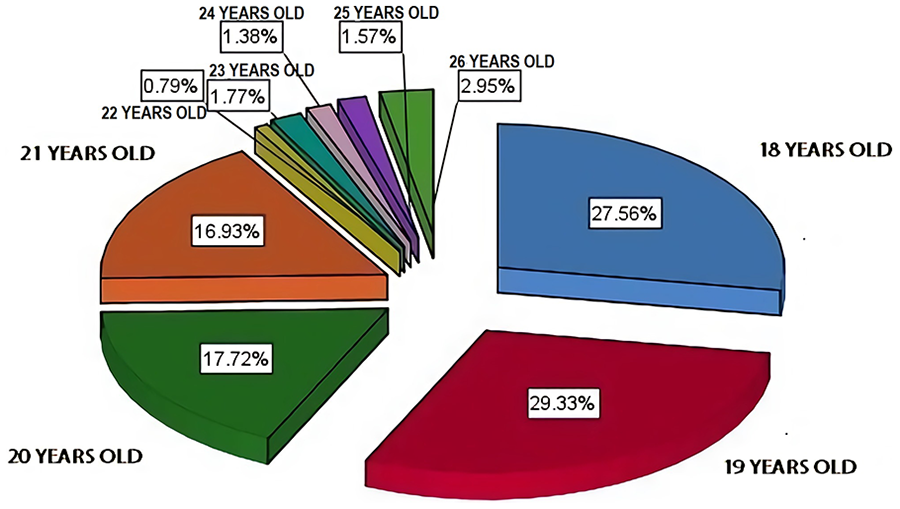
Age distribution of students.

Monthly consumption of students.
Table 1 showed the activity of using social media among students. About 32.25% of students have received political information from politicians or parties, including men (14.17%) and women (20.08%), but 29% never received it. Sharing opinions about current events through social media was always done by 2.75% of students, among men (1.18%) and women (1.57%). Posting personal experience relating to politics had the most significant percentage of activities that have never been undertaken by students (48.23%). Furthermore, the re-sharing comments of others were also not done by some students (47.44%). About 10.43% often argued with other people who had different views about politics, while 5.12% stated that they always did it. Besides, 6.10% shared photos, videos, and content related to politics. Table 1 describes using social media from students based on gender, where the gender variable is not included in the research model analyzed using the AMOS 25 application.
Students’ Activity of Using Social Media (N = 508).

Figure 3 showed the type of social media most frequently used by students; YouTube ranks first in the most used applications (43.31%), followed by Instagram (30.12%) and WhatsApp (9.65%), respectively.
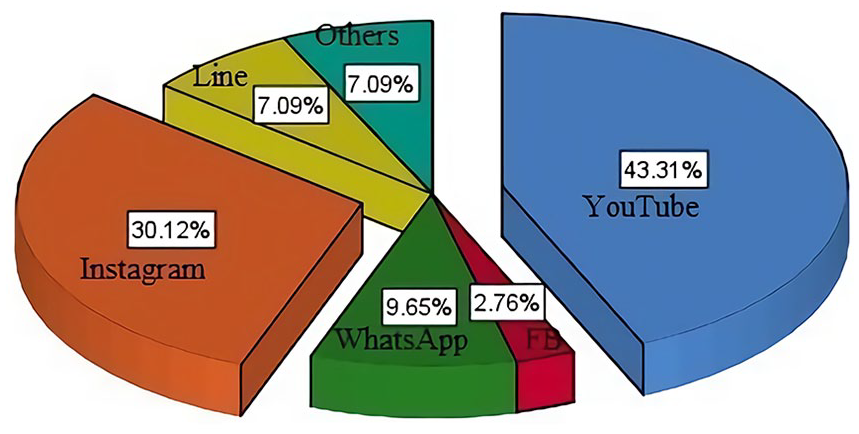
Social media favorite of students.
Table 2 showed Structural Equation Model (SEM’s) standardized regression weight, which evaluated research models with the Asymptotically Distribution Free (ADF) estimation method. The research model was in conformity with the established standards, and its indices were based on RMSEA = 0.033, normed chi-square = 1.568, CFI = 0.954, GFI = 0.953, TLI = 0.928, and AGFI = 0.917. H1 was rejected; social media use did not significantly influence the student’s political knowledge directly. H2 and H3 were accepted; the value of β = 0.746 indicated the significance of social media’s influence on the level of online political talk, while β = 0.804 showed the effect on face-to-face. H4 was accepted; the significance of the influence of online political talk at the level of its knowledge is β = 0.161. At the same time, H5 was rejected; the offline political talk did not influence the student’s political knowledge. An explanation of the mediating of online political talk shows that the use of social media affects online political talk (0.746), then online political talk affects political knowledge (0.161); this indicates that H6 (a) is accepted. The use of social media has an indirect effect on political knowledge mediated by online political talk. On the other hand, offline political talk has no significant effect on political knowledge, meaning that offline political talk does not function as mediation, and H6 (b) is rejected. Figure 4 shows a research model with standardized estimates that illustrated the pattern of the relationship between political knowledge and social media use, mediated by online political talk. It provided political information that was used as material for discussion both online and face-to-face. However, only the use of political information from social media through conversations on the platform provided learning to gain political knowledge. Social media does not directly affect the acquisition of student political knowledge.
Standardized Regression Weight (N = 508).

Note. Significant: p < .05.

Model of political knowledge and social media use.
The answer to the first research question states that using social media not directly affects students’ political knowledge based on the regression weight model results. Furthermore, to answer the second research question, online political talk functions as a mediator variable between social media use and students’ political knowledge.
This study illustrated the relationship that needs to be known when students learn from social media. Compared with other media, it had advantages for political learning, and it allowed the user to communicate directly with others. Furthermore, previous research showed that the studies established that online discussions mediate information through political knowledge development (Park, 2017). The recall became possible when the information was obtained and strengthened by discussions through online networks. This result is in line with an online learning community where people come together in an online space intending to share information, learning, talking, or collaborating on a project. Most college students surveyed recognize that they practice social media and feel well conscious of political issues and use SNS for political discussion (Ahmad et al., 2019).
According to Chaffee and Kanihan (1997), although the attention given was lacking, days of exposure can accumulate into significant knowledge. This opinion showed the importance of using social media as a conduit of political information to the student, where social media is used daily by students. Furthermore, short-term recall provided the capabilities for learning, which occurred in political information. Future research should consider the characteristics and types of posts preferred by students on social media, as it will potentially be regarded as political knowledge. The results showed social media needed to be strengthened by discussions through an online network. These conditions indicated that using social media can eventually become a habit, which was seen from students’ choices in the media environment. However, conceptualizing learning with social media was a necessary implication in theory. As a political communication tool, it complemented concepts about passive learning and incidental exposure (Tewksbury et al., 2001) more than media choices and selective exposure (Bowyer et al., 2017; Middaugh et al., 2017).
This research showed social media provided political learning, which further generated knowledge in politics, as students received political information incidentally while also carrying out other activities. Social media users’ distribution showed that YouTube and Instagram are the most commonly used applications by students (73.43%). Content production facilities allowed users to channel their creativity owned by the two applications. Especially now, creativity as a YouTuber attracts many young people’s attention as an income opportunity. Creating exciting content also required sufficient knowledge, which will create a pattern of learning relationships and the acquisition of ongoing knowledge. Future research should be focused on data collection by looking at the characteristics of each of the platforms.
The existence of a communication network allowed one to be exposed to the same post several times a day, sharing many friends about a popular issue. This type of repeated exposure will later produce excellent political knowledge about an issue, gaining something important in social media (Chaffee & Kanihan, 1997). Social media has stimulated many to interact with other people, such as discussing online news and adding it to political knowledge storage. Through interpersonal discussions, students can learn from one another and then process information more actively to increase political knowledge level.
The results confirm the MSD theory that online political talk serves as a mediation that strengthens the influence of social media use on political knowledge, where the acquisition of knowledge is a cognitive effect of media use.
Researches showed that learning could be obtained through social media to understand the flow of information in a modern media environment to source political information with full potential. The implications of political attitudes and behavior in students learning political information from social media at various levels can be investigated in the future. The study’s findings can be applied to online education by incorporating social media as part of the instructional design to promote student–instructor interaction. Social media with characteristics related to comfort, entertainment, and interaction can consider educators to use in educational practice and performance assessment (Kesici, 2018). This research’s findings have significant implications on using social media to follow political information due to its function on news websites through network recommendations and sharing practices.
According to Robertsona et al. (2016), social media that combines news and personal content has a detrimental effect on students’ knowledge. This leaves it up to news consumers to figure out what is related to and applied emotional states for affective content to more detached, related, or unrelated information. The ability to analyze facts is key in preventing being duped by false news (Cooke, 2017). The most common way for students to learn this skill in universities is to have information literacy training (Leeder, 2019). Subsequent research can consider student literacy skills to be a factor that affects social media use and the acquisition of political knowledge.
Conclusion
The study was designed to assess critical factors that influenced student’s political knowledge of social media use. To this end, theoretical frameworks of MSD were used. Using social media has a positive relation with political knowledge through mediated political discussions on the online network. The more students use social media and discuss political issues, the higher their level of knowledge. Therefore, social media research as an outlet of political information for enhancing political knowledge among students was greatly enriched by this effort.
This study presented several limitations. First, a sample of the study is students of one educational institution; a larger one could provide more insight. Second, social media consist of various platforms; it hoped further research could explain how political information can produce knowledge in each type of application based on the characteristics.
The results contributed to understanding the indirect effects of using social media on student’s political knowledge. This influence was mediated by interpersonal communication on social media networks. The political talk serves as a mediating effect on social media use related to politics on political knowledge among students.
Social media can help strengthen students’ political knowledge who have an online education learning system; furthermore, they can integrate social media as part of instructional design by either the instructor or the institution. Communication networks facilitate political discussion among students to enhance their political knowledge. Communication involving students about the benefits of using social media as a means of discussion should be highly encouraged.
Footnotes
Acknowledgements
Thank you to the Communication Faculty’s Doctoral Program, Pajadjaran University, for their assistance in carrying out this project.
Declaration of Conflicting Interests
The author(s) declared no potential conflicts of interest with respect to the research, authorship, and/or publication of this article.
Funding
The author(s) received no financial support for the research and/or authorship of this article.
Ethical Approval
This research has Ethical Approval from Research Ethics Committee Universitas Padjadjaran, Indonesia (Number 1215/UN6.KEP/EC/2019).
Informed Consent
Written informed consent was obtained from the participants of the study.
