




Abstract
This article analyzes the results of an inquiry into Latin American university community members’ perceptions about regulatory processes and asymmetries of information, as influential factors in the governance of Latin American universities. It does so, by examining the national laws in Argentina, Brazil, Colombia, Chile, and Mexico. Previous studies in this continent have not considered these aspects and perspectives. Our research found significant differences between countries in terms of the Board of Directors’ capacity to act and the control mechanisms they can employ—which can be interpreted as national differences in the availability of their resources and their regulatory capacities. On the level of asymmetry of information, there are differences between countries, which depend on the position of the university members in their institutions. Thus, regulation and information are important factors when it comes to the governance of Latin American universities, and can explain its’ diversity.
Introduction
Many contextual aspects have affected the governance of Latin American universities. Among other aspects, there has been an exponential expansion of enrollment, the diversity of institutions, and their methods and sources of funding (Ferreyra et al., 2018; Rama, 2006). Enrollment fees for Higher Education Institutions have doubled in Latin America and the Caribbean in recent years, which has been shown in studies surveying across 20 million students, 10,000 institutions and 60,000 programs. From the year 2000 onward, 2,300 new Higher Education Institutions were created. From this, not only have institutions diversified but so have the expectations that students have for Higher Education—explaining the growing demand for its’ services (Deming & Figlio, 2016). This, in turn, creates substantial changes in politics, the role of the State, and the funding of universities (Garcia de Fanelli, 2018; Rama, 2006). Commodification and transnational education have also recently developed in some countries (Acosta, 2015; Rama, 2015).
As a consequence, there is a need to regulate the provisioning and quality of undergraduate and post-graduate programs. The scenario, of course, is not identical in every Latin American country, but it explains some of the wider tendencies related to changes in governance regimes, mainly related to the emergence of entrepreneurial universities in Latin America (Brunner, 2011). Therefore, universities are expected to face significant challenges in their governances and the factors determining them, and that eventually there will be differences between countries and even within them, depending on the type of Higher Education Institutions.
The concept of governance has acquired growing importance in attempts to understand the functioning of universities (Ganga et al., 2014). In Latin America, increases in the complexity of Higher Education Institutions has created the need to incorporate all the multiple dimensions involved in the outcome of their purposes through their governance (Ganga & Abello, 2015; Rodríguez, 2017; Schmal & Cabrales, 2018). The diversification of these purposes and their relation to various stakeholders create different governance regimes (Brunner, 2011). Regulation is a component of university governance (Enders et al., 2013; Salto, 2017), revealed in norms and controlling options. Furthermore, the quantity and quality of information determine the decisions made over the management and, therefore, asymmetry in its access and operation between the different actors involved—and has essential consequences in education and, eventually, in the governance of universities (Ba & Duong, 2018; Ferreyra & Liang, 2012; Ganga & Burotto, 2012).
The study of incidental factors in university governance has been undertaken using various approaches (Ganga-Contreras & Nuñez-Mascayano, 2018). One of them, is looking at the perception of the parties involved in the execution of national politics and institutional management, which brings a subjective and first vision of reality, that is independent to the theoretical approach (Centro Interuniversitario de Desarrollo [CINDA], 2016a). The purpose of this study is to establish the views of members of the university community in Latin America on the regulatory capacities of the universities’ norms, and the existence of information asymmetries between agent and principal; as well as the possible differences among countries and organizational levels—considering their influence in universities’ governance.
University Governance, Regulation, and Information
Despite the growing importance given to governance to explain the functioning and performance of universities (De Boer & File, 2009; Kretek et al., 2013), the concept remains diffuse and controversial (Ganga et al., 2014). In general terms, it refers to how the landscape of collective control operates to achieve common goals. It is a process of direction and management of the provisions that public and private actors have to solve the problems of society; it also allows for taking advantage of social opportunities, articulating interests for collective goals, which means answering considerations relating to what, when, and who decides in the organization (Aguilar, 2007; De Boer & File, 2009; Li et al., 2019). University governance is understood as the processes and structures through which decisions are made and executed, as consequences of the interactions occurring between different stakeholders (Capano, 2011; Sierra-Sanchez et al., 2020).
Models of University governance consider board composition (formal structure), power issues among key actors (behavioral structure), board effectiveness, and the impact of external factors on processes of boards (behavior of processes; Carson, 2020; Erwin et al., 2019; Hambrick et al., 2008; Li et al., 2019). Models of university governance can be public or private; this distinction makes it possible to identify the people who participate in the governance of universities. In public institutions, they will be the stakeholders represented in the board of directors, which elect the unipersonal authorities in various ways. While in private or non-public institutions, these are governed by their owners (shareholders, foundations, or religious orders) who delegate governance to the authorities they designate (Sierra-Sanchez et al., 2020).
Olsen (2007) classifies European universities in four categories with regard to their organization and governance: a university visualized as a community of scholars; as an instrument for applying public policies; a representative democracy; or, as a service company integrated into competitive markets. De Boer and Maassen (2020) confirm the evolution of European universities from an academic community with representative democracy, to a vision of the university as a service company and as an instrumental entity for achieving the economic objectives of the countries in which they are located. Barnes (2020) reaffirms the same for the Australian case; and this generates structural changes in university governance, mainly in public universities, such as going from collegiate methods of academic self-government to more managerial modes of administration. In the management model, authority is granted to a specialized managerial level to the detriment of the academic staff’s participation.
Frequently, university governance has been associated with internal variables (Blaschke et al., 2014; Bleiklie & Kogan, 2007). However, essential factors operate beyond that level (Ganga et al., 2018). Institutional organization, the functioning of corporative governments, and internal and external relations are influenced by situations such as reforms and changes in national politics, processes of internationalization, inclusion, public expectations on the role of universities, reputation, and fusion of universities (Bennetot & Estermann, 2018; Capano & Regini, 2014; Christensen & Gornitzka, 2017; De Boer & File, 2009; Flórez-Parra et al., 2014; Safavi & Hakanson, 2018; Serger et al., 2015).
University governance can be measured through considering the following dimensions: context, transparency, autonomy, management orientation, and participation (Quyen, 2014; Rymarzak et al., 2020). In this work, we focus on examining context and transparency. The context represents the framework in which universities are managed, and encompasses the legal framework and the interaction between the university and the state. The states generate regulatory frameworks in the countries to protect the public interest of higher education. Regulations influence governance by requiring management accountability, establishing quality assurance systems and standards that must be met (Krüger et al., 2019; Mok & Jiang, 2020; Salto, 2017; Sukrismo, 2020; Thoenig & Paradeise, 2014). As a consequence, institutions organize and operate according to these regulatory demands (Weaver, 2014). Regulation can involve various costs associated not only with non-compliance with the requirements, but also with the incentives and measures needed to facilitate compliance with them (De Jong & Kloeze, 2013; Nielsen & Parker, 2012).
One of the dimensions of university governance is transparency, which can be internal or external to the organization, and allows to legitimize the existence of the organization in society. From the point of view of good governance, this dimension can be considered both as a condition or a strategy to increase institutional credibility before internal and external stakeholders (Abello-Romero et al., 2019a; Conesa-Carril et al., 2020; Sukrismo, 2020). The promotion of transparency, and the development of incentive mechanisms that encourage the agent to reveal their hidden knowledge, allows information asymmetry to be reduced (Bergh et al., 2019; Ghafoor et al., 2019).
When we mention information asymmetries, we refer to when one of the parties, universities or stakeholders, has relevant information that the other party does not have (Stiglitz, 2000). Asymmetry can be bilateral or unilateral; it is bilateral when neither party is aware of the other’s information. For example, in the university–student relationship, the university may not be aware of the capabilities of the students, and the student may have imperfect knowledge about the university. Whereas if the information from the university is common knowledge, the asymmetry is unilateral as the institution would not have the information from the students (Clarke, 2000; Flacher & Harari-Kermadec, 2013).
The levels of information asymmetry will be diverse depending on the interests and knowledge of the university’s stakeholders (Mancilla et al., 2020). The information gap is assumed in favor of an institution’s management team compared with internal stakeholders; this should translate into a higher perception of information asymmetry by academics and students compared with mid-level managers within the institution.
Latin American Context
According to CINDA (2016a, p. 81) in 2014, there were 4,081 universities in Latin America, of which 32.5% were public, and only 25% carried out research. In the 2014–2018 five-year period, 1,125 universities had at least one Scopus article. Also, the Latin American countries with the highest scientific production were Brazil, Mexico, Chile, Argentina, and Colombia—Placing them in Group 1, they are those with the most of 60,000 publications in the 2014–2018 five-year period (De-Moya-Anegón et al., 2020). Most of the universities that have scientific production capacity are public; in some cases such as Brazil, Mexico, and Argentina, 90% are public universities. The ownership of the patrimony by the state locates them within the public category, but the difference between public and private institutions can be a little more complicated; for example, the fact that a university is state-owned does not necessarily imply that it behaves like a public entity. Therefore, in Latin America, it is possible to find a university whose primary source of income is exclusively student fees; however, its institutional governance is determined with the participation of academics and students.
Based on CINDA (2016b, 2016c, 2016d, 2016e, 2016f), it is possible to provide a summary of the context in which university governance is developed in the five leading countries previously mentioned, that group together to form the largest number of universities in Latin America (Table 1). In the first place, it is observed that public universities acquire different names both between countries and within them. Regarding corporate governments, it is possible to see that while in Brazil, Chile, and Colombia, there is a uniform way to identify them, in Argentina and Mexico, they are named in different ways.
University Governance: Context of Public Universities in Argentina, Brazil, Chile, Colombia, and Mexico.

Source. Reworked according to Centro Interuniversitario de Desarrollo (2016b, 2016c, 2016d, 2016e, 2016f).
Regarding who elects the rector, in the public universities of Brazil and Chile, they are appointed by a higher institution such as the Ministry of Education, but ostensibly their appointment is based on an internal vote among the professors. In Argentina, different groups within the university elect the rector, and it is mainly by direct vote; although there are cases in which there are indirect votes. Public universities in Mexico have different mechanisms according to the categories; however, they range from appointments made by the governing board, to elections with direct and indirect voting, both for students and teachers.
In the five countries analyzed, differences exist in the capacities for regulation and its application to higher education between countries, and the fact that these capacities emerge from different resource availabilities and adequate norms (Table 2). According to the 2016 report on higher education in Ibero-America (CINDA, 2016a), there are one or more public institutions that govern, conduct, or guide the development of higher education in these countries. Chile is the country with more weaknesses and limitations in regulating Higher Education, particularly in resources of a different kind—in the capacity to conduct estate universities, and in regulating private universities. Brazil, on the contrary, has the resources, the use of information, the capacities, regulatory frameworks, and the politics to face regulatory processes, independent of the type of institution of Higher Education. Mexico only has very limited effective regulation of private entities. Argentina also has limitations in this aspect, in addition to limits in resources; while Colombia has limitations in politics for the creation of universities and regulatory frameworks on lucrative entities (Table 2). Furthermore, there is confirmation of the differences in the capacities for regulation and its application between countries, and the fact that these capacities emerge from different resource availabilities and adequate norms.
The View From University Community Members Regarding Weaknesses and Resource Limitations, Information, Articulation, and Regulatory Capacities of Government Institutions From Argentina, Brazil, Chile, Colombia, and Mexico.

Source. Reworked according to Centro Interuniversitario de Desarrollo (2016a, pp. 193–196).
Note. X = weakness or limitation.
Information disclosure is the tool by which universities generate transparency that reduces information asymmetry with their different stakeholders; society through the state regulates the transparency of information. The regulation of the transparency of information is reflected in the laws that countries are given to safeguard the right to information (RTI). Although, the above does not ensure transparency because, in addition to the legal framework, it is necessary to ensure the quality of the implementation. If a country has a robust legal framework but is weak in implementation, its legal framework will not guarantee openness if not implemented correctly.
The Global Right to Information Rating (RTI Rating) is a rating tool build by the Center For Law and Democracy (2011), which is designed to assess the strength of the legal frameworks of different countries to access information held by public authorities (or the RTI). In the context of university information disclosure, this regulatory context is important. More specifically, the RTI Rating corresponds to 61 indicators. All of these correspond to a wide range of international standards on information law and comparative studies of laws on the RTI worldwide. Abello-Romero et al. (2019b) used the data from this indicator for the five countries focused on in this study and proposed a model. They use the regulation of information transparency as an explanatory variable, to determine whether the differences in the legislative frameworks of Latin American countries affect the information they disclose. The authors find evidence favoring the thesis that the diversity of behavior in the disclosure of information in the countries is due to the differences in the regulations on information transparency.
Based on the literature’s antecedents, it seems pertinent to investigate the perception of the universities’ internal stakeholders (university community members), regarding the regulations and laws on higher education; and to examine whether these have affected the efficiency of university management. Another aspect to analyze is whether the corporate governments of the universities see their role in monitoring the university management team strengthened.
The availability of information is another crucial variable in university governance, as well as the differences in its provision between institutions and the central level. This asymmetry of information creates market failures, limitations on accountability, problems regarding internal functioning, among other things (Abello-Romero, 2015; Brunner & Uribe, 2007; Ganga & Burotto, 2012). In this context, the view of university community members is a valid and direct way to establish the regulatory quality of norms and potential asymmetries of information. This methodological approach has been used to approach different themes, like exploring organizational dynamics (Després, 2008) and student participation in governance (Planas et al., 2013).
Method
Regulation
A 49-question closed survey was applied to a diverse sample of university community members (or university members), such as professors and researchers with and without management experience, directors from different hierarchical levels, and professionals associated with university management. The survey was designed under the execution of research project n*1131134 of FONDECYT (National Fund for Scientific and Technological Research of Chile), called Government Systems In Iberoamerican Universities: An Analysis From Agency Theory. This project covers various aspects of University Governance. A panel of experts validated the applied questionnaire, items were adjusted, and it was submitted to statistical evaluation (Cronbach’s α = .85). The survey was applied both on-site and online, with a response rate of 90%. With regard to the on-site process, the survey was applied in different research meetings and conferences. The survey was undertaken between 2014 and 2016. A total of 766 responses were received from 18 Latin American countries (Mexico, Argentina, Chile, Ecuador, Brazil, Venezuela, Colombia, Peru, Paraguay, Costa Rica, Uruguay, Bolivia, Dominican Republic, Cuba, Panama, Honduras, Guatemala and Nicaragua), of which 77.4% are members of state universities, and 26.6% from private universities. The total of answers was analyzed in percentages to verify the general perception of the current norms and laws in Higher Education in every country, using four alternatives: very good, good, bad, very bad. The same procedure was used to show if (a) the norms regulating universities’ functioning in their countries do not allow the Board of Directors to monitor the work of the director appropriately; and (b) control systems are efficient. For these two items, the alternatives were “I strongly disagree,” “I disagree,” “I neither agree nor disagree,” “I agree,” and “I strongly agree.” Data were treated in groups, and every alternative was shown in relative terms as percentages. Decimal percentage values were estimated to the whole number greater than 0.5. For statistical analysis, χ2 was applied using STATA 12 statistical package.
For comparative analysis between countries, 489 answers from Argentina, Brazil, Chile, Colombia, and Mexico were considered, to verify potential differences in the opinions of university members or of every country about these two items. It is necessary to mention that some answers were left blank, so the tables’ total reported does not coincide with this total; χ2 was also applied to verify statistical differences. In addition, the general opinion of university members from these five countries was verified, making groups for the answers on each item. A relevant point of these five countries is they account for 83% of all Latin American universities; also, according to the Scimago Institutions Ranking (De-Mora-Anegón et al., 2017), between 2012 and 2015, they account for 89% of all publications in the region.
Asymmetry of Information
Using the same survey, opinions were solicited from Latin American university members about the existence of asymmetry of information in dichotomous terms (yes/no). At the same time, for those in which the answers were positive, their opinion about the asymmetry of information was considered in terms of whether it was high, medium, or low; their opinion about the existence of asymmetry of information and its possible levels varied according to the position of the surveyed. For the sake of comparison, the answers were separated between those from directorates, higher authorities, and medium authorities; and those from professorial and researcher roles. The same procedure applied for regulation was then used in the sample of university members from the five countries.
Decimal percentage values were estimated to the whole number greater than 0.5. For analysis, χ2 was also applied to verify statistically significant differences in the variety of views from the university members regarding the levels of asymmetry of information, as well as the differences between countries on their views according to the position of the surveyed.
Results
Regulations
The legislations regulating activities (Table 3) in Higher Education were positively assessed by 54% of the surveyed university community members from 18 Latin American countries (5% as very good, 49% as good); while 46% considered that they were inadequate (43% as bad, 3% as very bad). Therefore, even though there is a more positive view of the legislation, there exists important resistance to the mechanisms regulating universities. Of those who had a good or very good view of legislations in Higher Education, 64% pointed to having experienced proven positive effects on the efficiency of universities’ management. Instead, among those who viewed the legislations negatively, 85% pointed to them having had adverse effects on management.
Relative Views (%) on the Operation of the Current Regulations and Laws on Higher Education.

Source. Own elaboration.
Considering only university members from the five Latin American countries (Argentina, Brazil, Chile, Colombia, Mexico), the balance between positive and negative views on legislation regulating Higher Education was even tighter (Table 3). Only 51% of university members has a positive perception (4% as very good and 47% as good), while 49% had a negative perception (46% as bad, 3% as very bad).
When analyzing the situation separately in every country, the results reveal statistically significant differences (χ2 = 74.9; df = 12; p < .001; Table 3). However, different situations are verified in each case. In Argentina, 63% of the surveyed expressed the opinion that legislations are good or very good; in Brazil, the same opinion was held by 53% of the surveyed university members, and 50% in Mexico. Chile and Colombia are extreme cases. While in Colombia, 77% viewed the legislations as good or very good, in Chile, the same view is only held by 18%.
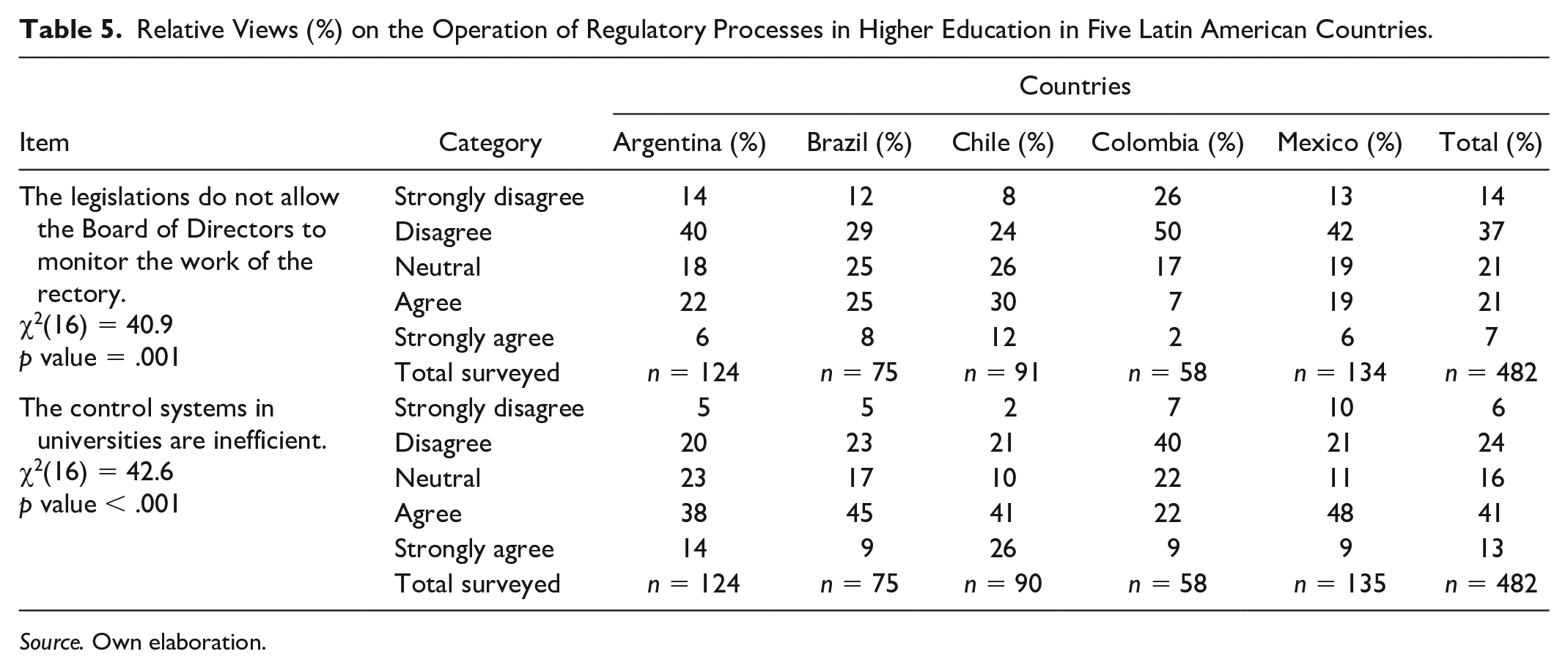
Concerning the roles of the Board of Directors and the functioning of control mechanisms, almost half of the surveyed disagreed or strongly disagreed, while only less than one third agreed or strongly agreed with the opinion that current norms allow monitoring the work of rectories (Table 4). With regard to differences in perceptions between public and non-public universities, Table 4 shows that perceptions were stronger among members from public universities that the legislations do not allow the Board of Directors to monitor the work of the rectory, as compared with non-public universities (31% vs. 20%; p value = .01). However, there were no significant differences in perceptions about control systems between public and non-public universities; the general perception is that 54% of members (agree 41% + strongly agree 13%) perceived the control systems as being inefficient.
Relative Views (%) on the Operation of Regulatory Processes in Higher Education in Public and Non-Public Universities From Argentina, Brazil, Chile, Colombia, and Mexico.

Source. Own elaboration.
However, there are statistically significant differences between selected countries (χ2 = 40.9; df = 16; p < .001). The least critical view was found in Colombia and, to a small extent, in Brazil, while the most critical views came from Chile and particularly Argentina (Table 5). In consequence, the negative views regarding regulations in Higher Education are important but differ between countries. The major problems are related to efficiency. Both in this aspect and the authority of the Board of Directors, it is possible to find a common pattern between countries. The most positive views were ascertained from Colombia, while the least positive came from Argentina and Chile.
Relative Views (%) on the Operation of Regulatory Processes in Higher Education in Five Latin American Countries.
Source. Own elaboration.
Asymmetry of Information
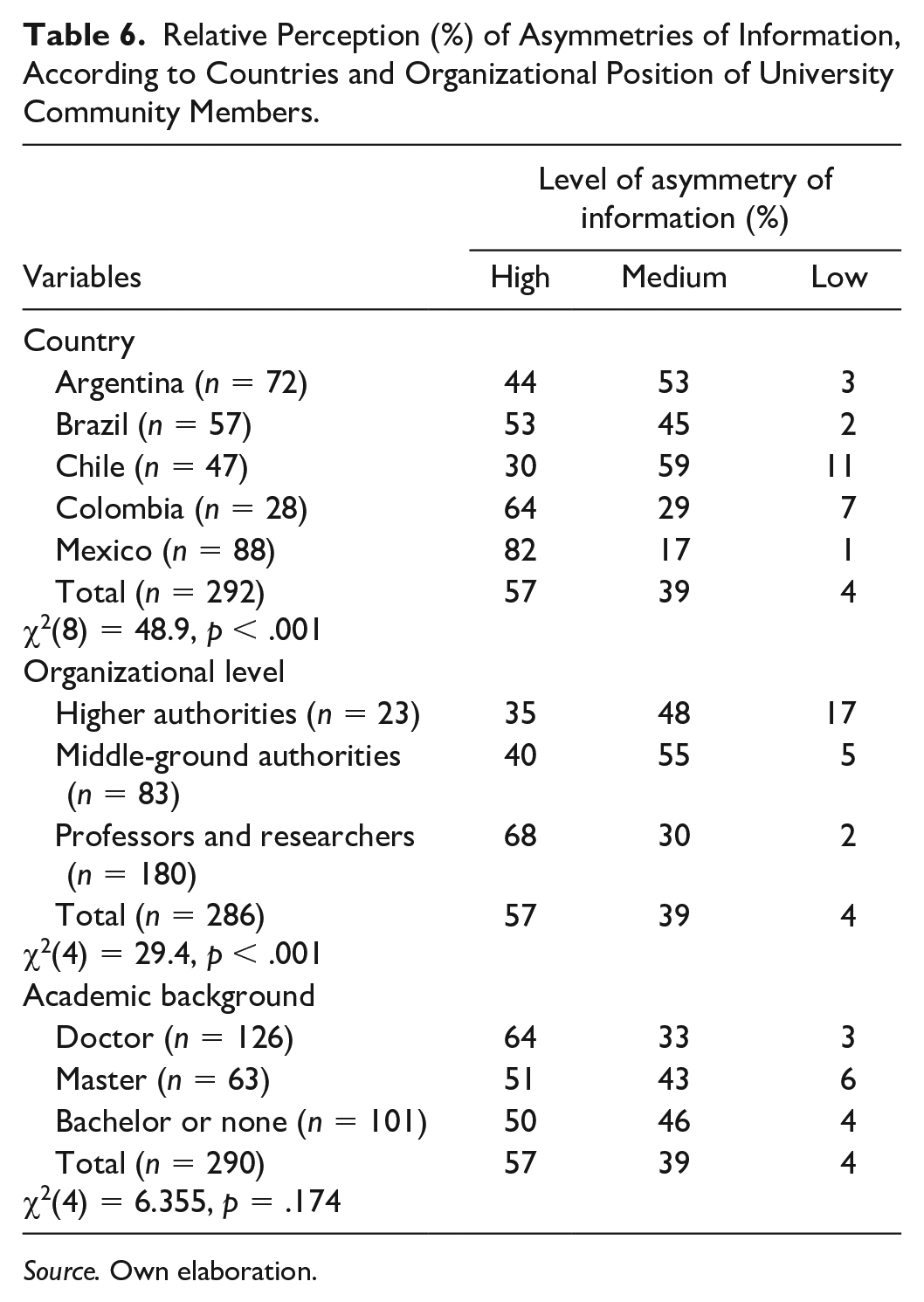
Furthermore, university members from the five studied countries estimated the existence of asymmetry of information, which varies between countries (χ2 = 21.6; df = 4; p < .001). Higher levels of perception of asymmetry of information were reported for Brazil (82%) and Mexico (74%), the lowest occurred for Colombia (53%) and Chile (56%); while Argentina was situated in the middle ground (64%).
The level of asymmetry of information follows a different pattern between the countries and the organizational level in which the surveyed were situated; however, there were no differences between different academic backgrounds. Even though Brazil was the leading country in terms of negative perceptions, those surveyed did not hold the perception that a high level of asymmetry of information was present (Table 6). In the cases of Mexico and Columbia, university members who perceived the existence of an asymmetry of information in their universities generally perceived this asymmetry to be at a high level.
Relative Perception (%) of Asymmetries of Information, According to Countries and Organizational Position of University Community Members.
Source. Own elaboration.
Another factor of variability in the responses of those surveyed was the organizational level in which the surveyed university members operate (p < .001); 35% of the higher authorities stated high levels of asymmetry of information; middle-ground authorities at 40%; and professors and researchers, 68% (n = 388). Furthermore, the perceptions on asymmetries of information were inversely related with the organizational level.
Discussions and Conclusions
Governance has been recognized as a critical aspect in the functioning of high-quality universities (Hax & Ugarte, 2014; Salmi, 2009). Thus, there is a need to understand how the variables that determine university governance work. In Latin America, the coverage and effectiveness of the norms in Higher Education have achieved a primary role, because of the regulatory requirements created by the expansion in the number of institutions—mainly as a result of the emergence of new private universities (Rama, 2006). This is in addition to expansion in the number of programs and students and changes in both private and public funding. In effect, regulation has conditioned the organization and the government in universities (Brunner, 2011). In Chile, for instance, university governance in state universities is no longer strictly academic, with the incorporation of proxies from the national government into the executive boards (Cox & Courad, 1990). Likewise, control over universities in the use of public funds is different between state and private universities. The establishment of new public management and market relations have created new links and stakeholders (Brunner & Uribe, 2007), and the regulation requirements are related to such situations. In the case of Chilean universities, the role of the market has penetrated more deeply than in other Latin American countries, creating strong reactions from students (López & Prado, 2016). Situations of this kind likely explain the negative perceptions of Chilean university members regarding the effectiveness of the legislation. For example, the cost of universities is the highest in the world, measured as a percentage of GDP (Gross Domestic Product) per capita. It also has the world’s highest in terms of the relation between the educational debt of professionals and their annual revenue (Meller, 2011). Even though the weight of the market in Higher Education exhibits differences between the five studied countries, in every case, the perception of university members revealed reservations toward the effectiveness of the legislation.
The results show difficulties that crop up in the role of the Board of Directors with regard to their relationship with the directories. The case of executive boards in Chile provides an example that having corporative representation of different stakeholders in the political decisions in universities alone does not ensure effectiveness (Rojas & Bernasconi, 2009). The complexity of the tasks demands information, time, and the professionalization of management. From this point of view, the functionality of the highest instance of the internal organization as Board of Directors must necessarily consider the dependence of directories as a problem that has to be solved; as much as the need to evince accountability processes that go beyond the managerial accomplishment of a public account from the directories. The processes of accountability must be evident in day-to-day practices undertaken by the whole government of the university.
These limitations explain why two thirds of Chilean university members agree on the ineffectiveness of control systems. Here, national studies taken by CINDA (2016a) allow for interpreting the differences between countries in the results. In addition, considering the opinions of experts, in Chile available resources were judged as insufficient (except technological resources), as well as the interlocution with the national government and the conduction and regulation capacities of private and state universities; this contrasted with responses from Colombia, Mexico, and Brazil.
Another variable that facilitates university governance is the distribution and application of information on the different organizational levels. This has an impact on the decisions, participation, and the coordination of organizational levels. The view from university members revealed that there are strong asymmetries of information, verifying the differences between countries and according to the organizational positions of university members. These results indicate that there is a need to establish mechanisms that may help overcome this situation. The regulatory processes associated with ensuring institutional quality in Chile have encouraged the emergence of internal unities of institutional analysis following the North American model (Middaugh, 2010), made to provide appropriate and reliable information to internal and external actors—as well as a national system providing information about Higher Education (www.sies.cl). The persistence of the perception of asymmetries in information is likely linked with the flow of information, the abilities to process it, and the limitations in internal organization.
In summary, the results from this research highlight the need to make changes to regulatory processes, as well as in access to and use of information by stakeholders and general society.
Footnotes
Acknowledgements
This work corresponds to an investigation framed in the project CONICYT / Fondecyt-Regular 1161353, for which the support and financing of the National Commission of Scientific and Technological Research of Chile is thanked.
Declaration of Conflicting Interests
The author(s) declared no potential conflicts of interest with respect to the research, authorship, and/or publication of this article.
Funding
The author(s) received no financial support for the research and/or authorship of this article.
