




Abstract
The trade-off between environmental sustainability and economic growth has been the focus of an extensive debate in the developing world and in this debate China is no exception, as it moves away from a single-minded growth-only policy toward a more sustainable economic model. The reason for this new policy trend has to be found in civil society’s rising environmental awareness and the growing accountability by local governments and multinational companies. Interviews with civil society and nongovernmental organizations (NGOs) mainly based in Zhejiang province, together with secondhand data from national online database show that a political feedback mechanism is possible also in a non-democratic country like China, and despite the Chinese political framework lacking an accountability mechanism, the civil society growing environmental concerns and multinational companies’ reputation abroad have indirectly forced policymakers to act toward tighter environmental regulation. In conclusion, this study shows that the Chinese middle class is not fully passive in its relationship with the local government, but it activates when its key interest is threatened, and as the Chinese middle class grows rich and educated and the economic growth slows down, a similar accountability mechanism could be replicated concerning issues where political legitimacy of the Chinese Communist Party (CCP) is not questioned like economic or social issues.
Introduction
Environmental degradation like air and water pollution has undoubtedly been the side effect of the Chinese economic miracle (Elizabeth, 2019; He et al., 2017). Nevertheless, the single-minded growth-only policy is shifting toward a sustainable economic model as shown by the national trend of growing regulation (D. Wong, 2018). Zhejiang province has been leading this trend while keeping economic growth above the national average of 6% (CGTN, 2019). Although Zhejiang province is among the wealthier provinces in China, it has been able to attract foreign direct investment (FDI) despite stricter environmental regulation and rising labor cost (Cochrane, 2019); furthermore, Zhejiang economic landscape is mostly focused on labor-intensive sectors like consumer goods, machinery, textiles, and chemicals, with consequent rising costs due to stricter regulations.
Therefore, the Zhejiang environmental case went from a loser and winners scenario to a long-term durable benefit for all stakeholders. This new scenario was achieved through a dialogue engaging civil societies, local governments, and multinational companies (MNCs). Indeed, while civil society demands MNCs to pay a higher pollution price, for the MNCs, this price has to be the closest possible to zero. Finding itself between two diametrically opposite claims, the local government’s implementation of a tighter environmental regulation would raise costs for MNCs, while the pollution derived from MNCs, if left unchecked, would increase costs deriving from remediating to water and air pollution, a cost that would then fall on civil society (Wu, 2012).
However, according to the most recent environmental law, a well-set regulatory framework is in place, with fines considerably risen in 2014 (Liu, 2014). Nevertheless, those fines are still lower than the cost of binding to the rules for major MNCs, with local governments likely to close one eye and earn twice from fines collection and tax revenues (Tan, 2012). Consequently, Zhejiang environmental regulation has a long story of pollution and low environmental standards, with on one hand Hangzhou city, a far-reaching reality in environmental standards implementation, sometimes pushing these standards even higher than the national one, while nearby, polluted rural towns like Wuli (物理), in the Xiaoshan district, a sadly famous example of cancer village in China, or the 16,000 pigs carcasses dumped in the Huangpu River near Jiaxing city near Hangzhou in 2013 (James, 2013).
Is in this scenario that the Zhejiang model stands as the true exception, and the reasons behind this new approach will be the focus of this study by answering the two research questions:
Our findings suggest that despite what was previously thought (Caitlin & Adam, 2020; Perry, 2015; Whyte, 2010), a dialogue among MNCs, civil society, and local governments exists, and it is built upon a cost–benefit interaction, which in the long run could go beyond environmental issues and escalate to other spheres. Broad awareness regarding environmental standard implementation is present across Chinese civil society, and it has pushed toward a higher added value and lower environmental impact industries. Therefore, this article will strengthen the relationship between higher gross domestic product (GDP) per capita and growing environmental awareness (Grossman & Krueger, 1995), as the Chinese middle class is not fully passive in its relationship with the local government, but it activates when its key interest is threatened, and ultimately as Chinese civil society grows rich and more demanding, a check and balance mechanism could become possible and potentially grow strains between the top and the bottom.
The Chinese Regulatory Framework of Environmental Governance
Scholarship across the globe widely agrees on the existence of a close relationship between democracy and a sustainable environment. The 2007 Nobel Peace Prize recipient Albert Gore defines democracy as “an essential prerequisite for saving the environment” (Gore, 1992). More recent studies have argued that the link between democracy and a sustainable environmental might be nonexistent in low-income countries, as weaker institutions are ineffective at protecting the environment when economic growth is at risk (Iwinska et al., 2019). Payne (1995) adds four essential prerequisites for protecting the environment: accountability, information, organized civil society, and international cooperation.
Payne’s four categories are present in different degrees in the European Union and the United States, as shown by public mobilization for a ban on chlorofluorocarbon (CFC)-12 already in the ‘80s or the implementation of stringent limits on water quality leading to the Safe Drinking Water Act in the United States and the Drinking Water Directive in the European Union (Hayes & Skubala, 2009). Public support pushed for tighter environmental regulation in the European Union, by setting air pollution limits below the World Health Organization (WHO) level (European Commission, 2001), and by setting far-reaching standards on transportation emission and minimum renewable as part of the total energy mix. Civil society engagement also pushed for the establishment of green parties in the ‘70s and ‘80s, with the German Green Party (Die Grünen) becoming a key party in German coalitions (van Haute, 2016) and environmental nongovernmental organizations (NGOs; for example, Greenpeace, Friends of the Earth, and the World Wildlife Fund) made the implementation of environmental regulation of public domain often in conflict with political authorities.
Differently from the European Union and the United States, Payne’s four categories are in antithesis with the Chinese political model, with international cooperation on environmental issues as the only element where China contributed at the world level, especially after the United States withdrew from the Paris agreement (Jacobo, 2020).
Indeed, despite a robust set of environmental regulations, the gap between central and local government and absence of a bottom-up feedback mechanism make policy implementation arduous in China (Ahlers & Schubert, 2014). As Tan (2012) argues, even though the policy commitment is serious at the national level, at the local level, there is a lack of willingness to engage with tight regulation as national funding is delivered mostly on the basis of provincial economic output, and tight environmental regulation might threaten economic growth. For instance, Air Pollution Prevention and Control Law was enacted against air pollution as early as 1987, but it has never been fully put into force, likewise the Energy Conservation Law of 1997 (Hernandez, 2015). Nevertheless, during the Hu Jintao secretariat, efforts to stop environmental degradation were stepped up. Accordingly, in 2004, premier Wen Jiabao demanded higher standards in energy efficiency regulations (China Daily, 2007), and after the mid-2000s, this trend was especially encouraged as the idea of development was altered from the route of a single-minded economic pursuit to the route of all-around development, including social development and environmental improvement (Hernandez, 2015). In line with Wen’s statement, the Vice Minister of Environmental Protection in China, Pan Yue, has argued “disclosing environmental information enables the public [to] understand environmental decisions and plans of local governments, and gives full play to the role of media and society to supervise law enforcement” (Tan, 2012). With this statement, for the first time, the involvement of media and society was encouraged to participate in environmental supervision.
In line with this new trend of a fight against air pollution, Beijing quota for internal combustion license plate cars (mostly non-Chinese brands) dropped from 240,000 in 2011 to 100,000 in 2018, whereas the quota for new energy car (mostly Chinese brands) has increased from 20,000 in 2014 to 60,000 in 2018 (Ma, 2019). The fight against pollution was made clear with the establishment of the Pollution Information Transparency Index (PITI) in May 2006, which ranks 113 municipal governments across China on their levels of environmental disclosure (Tan, 2012). The PITI created incentives for municipalities to improve disclosure practices, and generate a closer engagement between governments and NGOs on environmental cooperation. Hence, NGOs’ contribution and auditing was increasingly tolerated as the Chinese government’s attitude and policy toward NGOs has mainly tolerated NGOs by default without creating a clear set of laws or regulations which could legitimatise their activities (Shieh & Knutson, 2012).
NGOs have been efficient in canalizing and filtering environmental issues dear to civil society and bringing them up before the local governments and MNCs. Nevertheless, even in a political system lacking most sorts of check and balance like the Chinese one, the growing public concern on environmental matters was acknowledged by the Chinese Communist Party (CCP; Hernandez, 2015; Tan, 2012). In 2013, an online poll of China Daily with more than 675,000 participants enlisted environmental protection among top citizen concerns. Furthermore, as there is no direct petition framework or a similar tool to directly inquire local politicians, citizens have often turned to Weibo as a forum where to show dissent (Duncan, 2012). While especially in poorer provinces, anger has often escalated to public protests, with citizens openly confronting the police.
Therefore, a political willingness to engage with environmental degradation is fully acknowledged, and confrontation between the government and civil society is not only possible but even encouraged within limits (Tan, 2012). Moreover, in the pragmatic view of Chinese policymakers, environmental degradation is a political risk as much as an economic cost.
Indeed, the cost of environmental degradation in China was about US$230 billion in 2010 or 3.5% of the Chinese GDP, 3 times more than that in 2004 (E. Wong, 2013). According to the WHO, among the 10 most polluted cities in the world (on air, water, waste management, deforestation, desertification), seven were located in China in 2010 (WHO Press Release, 2013); none of these cities is currently on this list today, mainly substituted by India or other developing countries replicating the Chinese development path (Dhillon, 2018).
The first tangible economic cost resulting from environmental degradation is rising health cost. National authorities have acknowledged the direct link between environmental degradation and the rise in the cancer rate. Casualties resulting from pollution of the water sources remain extraordinarily severe and are accounted as the first cause for cancer: causing liver and stomach cancer, while air pollution remains the first cause of lung cancer. China mortality rates for water-related cancers (stomach, liver and bladder cancers) are considerably higher than the world average, and rural areas are the most affected (Guo et al., 2020).
The mortality of lung cancer has been on the rise ever since the economic opening up; in Beijing alone, lung cancer death constitutes one-quarter of all cancer-related mortalities, while the mortality rate of lung cancer may exceed one million nationwide by 2025 (Guo et al., 2020). According to X. Zhang et al. (2017), in urban China, the average economic burden from lung cancer was US$43,336 per patient in 2017, with a disposable income per capita per year of US$5,180, and most of the population may be left out of health coverage. The necessity to address the rising cancer rate was made clear when China’s environment ministry acknowledged the existence of cancer villages (BBC, 2013). According to Sun Yuefei (2009) study on the geographical distribution of Chinese cancer village, there were at least 247 cancer villages in China, with a local population cancer rate of around 5% or higher. Zhejiang and Jiangsu provinces have the highest per capita GDP, together with the highest number of MNCs. Consequently, they also account for 40% of all cancer villages.
Environmental awareness and a growing middle class have demanded political accountability, and when the government failed in addressing this issue, MNCs have been directly questioned as pressure coming from Western and Chinese civil society has prompted MNCs to act in addressing issues with their supply chain (Tan, 2012). Directly addressing MNCs has been a particularly effective approach as the tax flow deriving from MNCs is among the primary source of revenue for local governments. At the same time, a rising Chinese middle class with growing purchasing power will most likely increase FDI; according to this theory, a sustainable environment is a guarantee for long-term profit, and investment in R&D will increase productivity, while moving polluting industries out of Zhejiang (Feng et al., 2019). In this scenario, the pollution haven hypothesis (PHY) would be confirmed, as more polluting industries are crowded-out by factors like stringent environmental policy (Grossman & Krueger, 1995) or lack of civil society support. The Chinese case could partially confirm the PHY, as more polluting manufacturing-oriented MNCs are substituted by less polluting service and retail-oriented MNCs.
In conclusion, civil society will be eager to welcome MNCs as providers of long-term growth, while MNC investment in a greener supply chain could rely on better advertisement coming from local populations. In this scenario, the local government would gain legitimacy from the civil society and from investors, attracted by a responsible local government, which has a “harmonious” relationship with the local population.
Method
In this study, data and measurements were collected through three different sources (interviews, second-hand data and documents, and online database), as the study of each of the three subjects (Civil society, MNCs and local government) required research methods tailored ad hoc for the peculiarity of each subject.
Concerning civil society environmental awareness in Zhejiang province, a cross-sectional survey of 30 off-record interviews were collected in towns with a higher industrialization rate (18 men and 12 women), namely in Shaoxing (绍兴) 12 interviews, Ningbo (宁波) five interviews, Ninghai (宁海) seven interviews, and Fenghua (奉化) six interviews. The necessity to conduct off-record interviews was motivated by the sensitivity of the treated issues. The interview was conducted in accordance with the following five questions:
Are you aware of a severe case of environmental degradation (affecting air, water, and soil) in this industrial area in recent years?
Are you aware of local population complaint about environmental degradation?
Is the local government implementing environmental policies against factories?
Is the local government doing enough to fight environmental degradation?
Do you see an improvement in the environment in the last few years?
Due to dynamics such as rapidly evolving environmental framework, low temporal stability, and very contextually specific study, the validity of the questionary has been based upon plausibility, credibility, and coherence together with triangulation from interviews in similar studies (China Center for Climate Change Communication, 2012, 2017; Schwirplies, 2018; X. Wang, 2017). The interviewee was randomly chosen among local factory workers, residents, and shop owners in an open conversation structured along the five points mentioned above. Due to issues with permission and sensitivity of the topic, the interviewee was unaware of being surveyed. The data were collected between March 2017 and October 2019 and for simplicity were summarized in a “yes” or “no” answer. The questions were broad and investigate a wide timeframe going back 8 years as the goal of the interview was not to investigate the single case but make visible a policy trend. As the interviewees did not know they were being recorded, the questions were broad and were formulated throughout a conversation. Eight more interviews were not included in the survey, as the answers were not complete, and in most cases, Question 3 was complex as respondents did not want to mention the government in the conversation.
Concerning MNCs’ environmental behaviour, an online interview was conducted with Yixiu Wu (武毅秀), the Head of Toxics Campaign for Greenpeace East Asia. Wu is the team leader of China dialogue’s Strategic Climate Communication Initiatives. However, at the time of the interview, she was the campaign manager at Greenpeace East Asia responsible for international policies. She is the author of Toxic Threads: Putting Pollution on Parade, a groundbreaking report that showed how major industries linked to MNC supply chain hide polluted water discharge thanks to the use of centralized wastewater treatment plants (Wu, 2012).
Furthermore, tools made available, thanks to the Institute of Public and Environmental Affairs (IPE), will be used to assess MNCs oversight over their supply chain. The Institute of Public and Environmental Affairs, is a nonprofit environmental organization based in Beijing, with the task of monitoring the Corporate Information Transparency Index (CITI), an online database ranking MNCs oversight and discipline over their supplier, and the PITI which ranks 120 cities in China on their implementation on environmental policies. The CITI and the PITI allow us to monitor efforts made by MNCs and municipalities in implementing environmental regulations. Both reports publish a yearly ranking in which points are earned through responsiveness and transparency, compliance and corrective actions, expanding green supply chain practices, energy conservation, and emission reduction (IPE, 2019). The CITI index is particularly efficient in monitoring MNC behaviour as is shown by world-famous non-Chinese brands ranking among the top 10, whereas less famous Chinese-owned companies rank in the bottom position (IPE, 2019). Moreover, the CITI ranking clearly shows foreign brand attention toward reputation in China due to a rising middle class, and at home, due to growing scandals on environmental issues and working conditions in developing countries.
In regard to local municipal government data collection, an interview with Luo KeFang (骆 可 放), from Green Zhejiang, helped us in having an overview of the latest environmental regulations and their implementation. According to Luo, the goal of Green Zhejiang is advocating for healthy and sustainable lifestyles, promoting environmental disclosure, improving the awareness and capability of the general public, fighting environmental degradation, and advising polluters in regard to new environmental policies. Green Zhejiang’s contribution, together with secondhand data, built a theory that demonstrates the current new trend in environmental management in Zhejiang province.
Results
In the following section are summarized the 30 off-record interview answers from Shaoxing (SX) 12 interviews, Ningbo (NB) five interviews, Ninghai (NH) seven interviews, and Fenghua (FH) six interviews, followed by interviews with Greenpeace and Green Zhejiang and an analysis of the CITI and PITI index.
Looking at Table 1, we can observe two main trends developing in the four areas. The vast majority of interviewees witnessed a “severe case of environmental degradation” although they have witnessed improvement in the overall environmental quality. Question 2 shows low engagement with environmental issues by the local population; however, in Ningbo, the richest of the four investigated cities, there was a higher participation rate, with more than one interviewee mentioning the 2012 protest against the establishment of a chemical plant working with hazardous material such as para-xylene in Zhenhai district. Thousands of protesters joined in, forcing the local government to stop the establishment of the chemical plant. In Shaoxing, another wealthy area, complaints regarded the overall pollution of soil and water, with one interviewee describing the water conditions as “Extremely polluted with stinking rivers.” Overall, direct engagement with environmental issues does not seem to be the case. Nevertheless, two interviewees showed to be aware of the National 12369 Hotline on Environmental Reporting, while two more had seen videos shared on Wechat about nearby “Red rivers.” Although it is hard to verify the origin of the videos, it shows that local populations have all the tools to record and share environmental degradation.
Interview Answer in Four Cities.
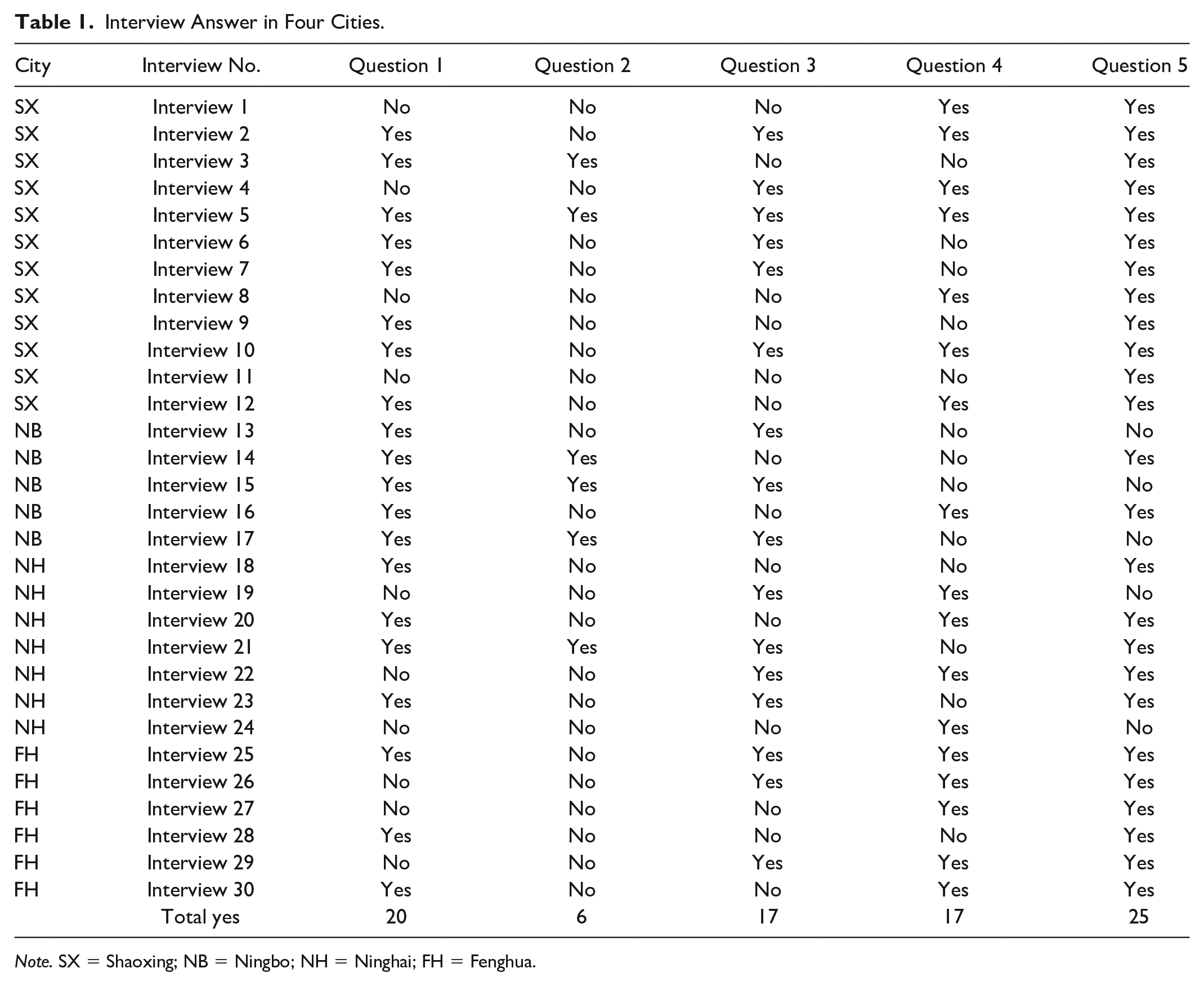
Note. SX = Shaoxing; NB = Ningbo; NH = Ninghai; FH = Fenghua.
With Question 3, several interviewees acknowledged local government response in addressing environmental issues; in Ningbo where the memory of the 2012 protest is still alive, one particular interviewee pointed out that the previous mayor of Ningbo had a history of working for China’s petrochemical industry, with foreseeable conflict of interest. While in Fenghua, several interviewees acknowledged wastewater pollution coming from local paper factories as the main unsolved issue, with one interviewee directly mentioning the local government seemingly accepting the trade-off. On a related issue, Question 4 investigates the perception of governmental action. Although the majority thinks that the government is doing enough, a little less than half thought that governmental commitment should increase. In Shaoxing, lack of compensation due to water and soil pollution was mentioned by a farmer, while in Ningbo, severe air pollution during the winter months due to higher energy needs was mentioned as an unsolved issue. In Question 5, the vast majority of interviewees agreed that overall air, water, and soil quality has improved; however, as 25 interviewees thought the environmental degradation was slowing down (Question 5), only 17 thought that this was because of governmental action (Question 4). Overall, the interviewees seemed well aware of the issues related to environmental degradation, with richer areas like Ningbo and Shaoxing more critical and well informed on local government action.
The governmental action perspective was directly inquired with Green Zhejiang, an NGO which, despite being mostly financed by the provincial government, has acted in monitoring and signaling polluting companies in Zhejiang province. According to Luo KeFang from Green Zhejiang, a particularly worrying situation is present in the Taizhou area 150 km south-east of Hangzhou, where local heavy industries have dumped electronic waste and ashes in the soil with no proper cleaning disposal (Luo KeFang, Personal Interview, April 26, 2015). Often workers in industrial areas live in apartment blocks next to the factories in industrial areas where pollution levels are particularly severe. Luo argues that local governments should subsidize cheaper housing for factory workers far from the factories, but rising cost and transportation time pushed factories and workers to keep the status quo. Green Zhejiang established a pollution monitoring system with an app where the local population can report environmental misconduct. Furthermore, they organize weekly events where Green Zhejiang promotes engagement by the civil society, showing a willingness to build a dialogue among stakeholders. Luo also points out that the environmental commitment was recognized abroad as well, as Zhejiang province was recognized with a Champions of the Earth Award by the United Nations.
Among the 12 best performing cities on the PITI, four are in Zhejiang, with Wenzhou topping the national ranking. According to the PITI report (IPE, 2018), Zhejiang province established a strong provincial platform, with a clear register of polluting and fined companies, while allowing the civil society to get involved. At the national level, the same is possible with the 12369 National Environmental Reporting hotline, which according to figure 1, received 270,000 reports in 2016 and 628,000 in 2017, and 565,000 in the period January to October, 2018, with a growing share or report coming from Wechat.

Complaints received on the national environmental reporting management platform.
Wu Yixiu from Greenpeace China argues that in a case-by-case scenario, there has been a tight collaboration between NGOs and local government. Greenpeace has addressed empowering tasks on behalf of several ministry and governmental bodies, with NGOs collaborating in implementing governmental policy (Wu Yixiu, Personal Interview, September 30, 2014).
Civil society engagement, mainly through online platforms, has been an element pushing MNCs to discipline their suppliers. As the report states (Institute of Public and Environmental Affairs 2019), the increased supply chain oversight by a relatively small number of high scoring brands in the CITI raking has motivated their suppliers to be accountable for their compliance problems.
Figure 2 shows a clear upward trend in regard to supplying chain oversight activity. As MNCs strive for positive advertisement coming from a green supply chain, the CITI raking works as a tool in this direction. By promoting a green supply chain, brands are ranked according to their commitment to transparency, compliance, and corrective actions. Indeed, the CITI ranking has pushed companies like Apple, which heavily relies on brand recognition, to lead the ranking for 5 years in a row, while the top 10 list is entirely comprising large international, non-Chinese brands (IPE, 2019).

Number of facilities that provided public explanations regarding compliance issues.
Discussions, Toward Growing Political Accountability?
The Chinese middle class has grown richer and more educated in the last three decades (Ponzini, 2020), and critics of local government inefficiency or unwillingness to deal with environmental issues are on the rise, together with complaints toward short-sighted MNCs (Guo et al., 2020). Meanwhile, the fast-rising number of environmental NGOs helped Zhejiang civil society to institutionalize demands for a stricter environmental implementation as NGOs have acted by uncovering polluting factories, and indirectly, by exposing local government’s lack of supervision (Luo KeFang, Personal Interview, April 26, 2015).
As a result, protests related to environmental degradation have risen in number ever since the economic opening-up, by rising each year of around 30% from 1995 to 1996, to 120% from 2010 to 2011(Liu, 2014), while the State Environmental Protection Administration reported around 50,000 environmental protests in 2005 (South China Morning Post, 2013). The sharp rise in protests brought in environmental NGOs, which since the mid-1990s have obtained legitimacy from some Chinese policy elites and Western donors, while steadily extending their presence (Matsuzawa, 2012).
Growing pressure from abroad and from inside the country brought the CCP to first acknowledge the environmental problem in the 00s, and then actively implement ad hoc policies in the last decade (Hernandez, 2015; Tan, 2012). This is confirmed by our interviews, suggesting an overall improvement in the air and water quality, while Wu Yixiu confirmed Greenpeace involvement in governmental projects in partnership with Chinese authorities (Wu 2014).
Although the establishment of foreign environmental NGOs together with civil society participation and MNCs growing accountability, our findings fall short in evidencing broader activism in Zhejiang environmental movement, or in China at a large, and this trend is evident in two major protests in Zhejiang, the 2012 “anti-PX” protest in Ningbo (mentioned by two interviewees), or the May 2014 Yuhang protest, where thousands of people gathered in a protest against a planned waste incinerator in a suburb 10 km north-east of Hangzhou (BBC, 2014). These two protests show that mobilization among Chinese civil society happens mostly when community interest is at stake and economic factors like falling property price are threatened (J. Wang et al., 2021), therefore lacking a sense of collective participation toward a sustainable environment. In both the Ningbo and the Yuhang protests, the local government stopped the plan while relocating it to rural areas where mobilization is less likely due to a lack of an informed middle class (Chen, 2017). Accordingly, protests in China have been mostly led by the “Not In My Back Yard” (NIMBY) principle, lacking a genuine national environmental awareness (Zhang and Lin, 2014).
Overall, civil society’s growing oversight above local government and MNCs is building an accountability mechanism that could benefit all parts, thus confirming Hypothesis 1. For instance, the Fuguo case is a clear example of the interaction between stakeholders, in this specific case, after demanding local government intervention against Fuguo for his repeated environmental violations between 2004 and 2009, and citizen groups requested Timberland to improve supervision on its supplier’s environmental record, causing national and international media coverage which damaged Timberland reputation with its customers. Timberland responded by requesting Fuguo to meet with the citizen groups (Tan, 2012). However, Fuguo is located in Shanghai’s industrial area, meaning that civil society leverage on local government or MNCs is higher than that in rural China.
Accordingly, we can then argue that higher environmental accountability is not the result of growing democratization, but rather a trend resulting from a richer middle class aware of pollution health risks. The relation between growing environmental accountability and per capita GDP is confirmed by the Environmental Kuznets Curve (Grossman & Krueger, 1995). Indeed, the relationship between environmental degradation and levels of income is a valid explanation of developing countries’ loose environmental standards.
In this regard, the Zhejiang case follows an environmental trajectory similar to other countries or regions. In Japan, the level of CO decreased markedly from 1970 to 2012 (Wakamatsu et al., 2013), and while using data from the 50 U.S. states for the period 1988 to 1992, Carson found that emissions per capita decrease with increasing per capita income (Carson et al.,1997). Likewise, in the European countries, Canada, and the United States, growth in per capita GDP has been accompanied by decreasing levels of per capita emissions of CO and SO2 for the years 1980 to 1996 (Bouvier, 2004). The Chinese case is no exemption, with unseen economic growth in the early stage of the economic opening up, leaving the ground to slower growth due to several reasons like tighter environmental regulation, rising labor cost, international regulation, and others. However, Chinese provinces highly relaying on manufacturing or with a weak bottom-up feedback mechanism due to a lack of civil society involvement or scares NGO presence are likely to show divergence in this relation. This is confirmed by Zhang in his study of 111 Chinese cities in the period 2004 to 2012. Indeed, his study partially confirms the relation of higher GDP per capita and higher environmental standards (Zheng et al., 2015). Other Chinese provinces have attempted to implement stricter environmental regulations while having half of Zhejiang per capita GDP. The case of Hebei province and its crackdown on polluting coal mining industries is emblematic. While China’s GDP growth slowed from 7.7% in 2013 to about 6% in 2019, Hebei drop in GDP was more acute, from 10% growth in 2013 to just 3% in 2017, after falling in recession in 2016, compared with a much gentler decline in Zhejiang, where economic growth was above 7% in the last 10 years (NBS, 2019). Hebei data suggest that Chinese provinces heavily relying on manufacturing, or GDP per capita below the 44,573 yuan turning point in 2005 prices, might have an adverse outcome from stringent environmental regulation (Yi, Tun and Zhuang, 2008).
Nevertheless, although we have shown growing governmental accountability on environmental issues, more comprehensive accountability on issues such as social inequality or human rights activism is still not on the agenda. Furthermore, according to Kenneth Roth, civil liberties have been shrinking in China in the last decade (Human Rights Watch, 2017). This trend is confirmed by the new regulation on foreign NGOs, which since 2017 must register and obtain approval from the police rather than with the Ministry of Civil Affairs like their domestic counterparts, a measure that has made registration extremely difficult, bringing foreign NGOs into a state of limbo (Zhuang, 2016).
Therefore, growing accountability on other issues like social inequality or human rights is not in place, thus rejecting Hypothesis 2.
This study has attempted to look at environmental policy in Zhejiang province by looking at it from a triparty approach (civil society, MNCs and local government); in this regard, future studies should focus on formal and informal interaction between these institutions. Understanding the feedback mechanism employed by the Chinese government could help civil society and MNCs to better formulate claims and improve funding allocation. The same mechanism could be introduced in nonsensitive issues like financial regulation and social security reforms. Therefore, the study of the Chinese grassroots movement and its relation with policymakers should be the subject of future studies.
This study has to be read in light of some limitations, as issues with sample size, access to data, and language barriers have occurred. The sample size was an issue, as conducting off-record interviews in industrial areas was in some cases undermined by the unwillingness of the respondent to engage in a sensitive topic. Furthermore, in several cases, a linguistic barrier emerged due to interviewees speaking local dialects resulting in the inability of the interviewer to fully understand the answers. Both limitations could have been overcome by using a Chinese interpreter; however, doing so might have undermined the genuineness of the answers, as the topic is still sensitive. Data collected in regard to MNCs and local governments were undermined by the impossibility to have an interview with any of the two parties. Thus, the data were collected indirectly from NGOs studying MNCs like Greenpeace and Green Zhejiang.
Geographic limitations occurred as well, as replicating this study in several other provinces might enlighten different practices across the country and show whether a trend following the Zhejiang model is in place or not. However, financial and time constraints made a geographic study impossible, thus leaving it for further research.
Conclusion
This study has partially confirmed the EKC hypothesis, as Zhejiang growing per capita GDP led to growing environmental regulation without the key element of democracy. Growing public discontent often in the form of protest and public unrest pushed governmental action toward tighter environmental regulation in the attempt to keep public order, and move to a more sustainable economic development. MNCs have moved to Zhejiang due to an educated and richer middle class able to consume higher added value goods, hence partially compensating transition costs. However, polluting industries have moved inland or abroad, in areas where lower per capita GDP often meant looser regulation, de facto defeating the ultimate goal of lowering global emissions. Zhejiang civil society has been pleased with improving air and water quality, while overall GDP per capita kept growing and employment remained high. By following their interest, all the stakeholders promoted a greener agenda with NGOs acting as a joining link.
Overall, Hypothesis 1 was confirmed, as water and air pollution levels are on a downward trend across China, and as shown in our interviews, Zhejiang has been leading the way with civil society and MNCs leading the way. However, the lack of a political feedback mechanism made this transition mainly confrontational, with civil society and the government unwilling to back up. The legitimacy of the CCP was being damaged by growing confrontation, hence the decision to bring NGOs in as a communication tool between the top and the bottom. In this specific case, the green transition was possible because the CCP hegemony was not directly at risk, while moving toward a relaxation of personal freedoms and human rights could directly challenge the CCP hegemony, hence the rejection of Hypothesis 2.
This study has shown that a political feedback mechanism is possible also in a non-democratic country like China. Political threats and economic opportunities pushed the green agenda ahead, making China the world leader in the production of renewable energy and electric vehicles. As the Chinese middle class grows rich and educated, whereas economic growth slows down, a similar feedback mechanism could be replicated in relation to issues where the CCP legitimacy is not questioned like economic or social issues. However, as was not within the goals of this study to test the existence of these mechanisms, we leave these questions for future studies.
