




Abstract
Pro-poor tourism increases net benefits for the poor or directs profits back into the community by employing local staff and manufacturing. Existing studies have provided a theoretical understanding of how pro-poor tourism can produce environmental, economic, social, and cultural impacts. Little research has been conducted on the power dynamics that are specific to pro-poor tourism, especially in developing countries. This study contributes to pro-poor tourism theory from an operation-level perspective by addressing the alignment and coordination of three stakeholders—local governments, tourism enterprises, and community residents—involved in implementing pro-poor tourism in an ethnic, autonomous county in southern China. The results indicate that in the absence of effective cooperation between the three major stakeholders in strategic tourism development aimed at poverty alleviation, substantially greater benefits will not be delivered to the poor. The findings of this study offer important insights into the roles that stakeholders could play at various stages of sustainable development in the long run. This study can also provide useful information to governments for policy replacements and adjustments.
Introduction
Tourism can play a significant part in many countries’ economies and livelihoods. In many developing countries, tourism is one of the fundamental pillars (Boonsiritomachai & Phonthanukitithaworn, 2019). Tourism is a major contributor to economic development in many small island developing states, often making it the only industry in these regions to consistently demonstrate growth in recent years. It has long been recognized that tourism can contribute significantly to poverty reduction. The importance of tourism for poverty reduction is attracting substantial interest from multilateral institutions, tourism bodies, donors, and other organizations world over. Tourism is a means to promote poverty reduction by both international organizations and financially underdeveloped countries because it has the potential to create employment opportunities and foster local economic development (Binns & Nel, 2002; Hall, 2007; Li et al., 2018; Liu & Wu, 2019). The past decade has witnessed a remarkable number of studies demonstrating that tourism can assist low-income people with food, housing, medical expenses, and other costs (Binns & Nel, 2002; Hall, 2007).
Pro-poor tourism has become a universal call to action to reduce poverty (Sofield et al., 2004). At the local level, pro-poor tourism can play a significant role in livelihood security and poverty reduction. However, it is often difficult to identify specifically what contributions pro-poor tourism makes, or could make, to accelerate national poverty reduction efforts (Oviedo-García et al., 2019). There is a growing interest in tourism that aids economic growth via pro-poor tourism in developing countries (Truong et al., 2014). Although China is the world’s second largest economy and has significantly contributed to global economic growth, the size of poverty-stricken areas in rural China is substantial, and residents’ income levels are below the national poverty line. Since the 1990s, the Chinese government has promoted pro-poor tourism to exert a strong influence on poverty alleviation (Beeton, 2006; Mitchell, 2010). This new philosophy is anchored in the hope of generating net benefits for the poor through a successful poverty alleviation strategy, but its implementation faces barriers and challenges in the local context among various stakeholders, particularly those at macro and micro levels who can influence the planning and decision-making processes, such as the government and the private sector. Being a systematic social project, pro-poor tourism requires close collaboration among various stakeholders in the operation processes (Suntikul et al., 2009). Stakeholders include civil society, businesses, and government, as well as the poor themselves who serve as producers and day-to-day decision-makers. Government, civil society organizations, the community, for-profit entities, and the poor play critical roles in pro-poor tourism. For successful development of pro-poor tourism initiatives, excellent cooperation and communication between all stakeholders (government policy-makers, tourism practitioners, and community residents) involved in the tourism system are prerequisites. For example, tourism poverty alleviation relies mainly on government policy support and financial allocation (Butler et al., 2013). Private enterprises play a proactive role in the sustainable use of local tourism resources and serve as an important bridge connecting local governments, tourism markets, and community residents (Shah & Batley, 2009; Zeng, 2018). The residents in the community are the target beneficiaries of pro-poor tourism plans (Moyo & Tichaawa, 2017; Muganda et al., 2013). Clear communication and coordination among a range of stakeholders in pro-poor tourism are crucial for reducing the cost of implementing portfolio strategies and fostering knowledge integration (Reed, 1997). All potential stakeholders and partners should be treated appropriately and equally with respect to decision-making situations (Ryan, 2002). Multiple stakeholders play important roles in promoting pro-tourism in different stages. However, the conflicting interests of different stakeholder groups because of their different backgrounds and value positions are unavoidable (Wang & Yotsumoto, 2019).
Previous studies have demonstrated that not all tourism poverty alleviation initiatives have the same direct socioeconomic benefits for local communities and sustainable development (Chok et al., 2007). For example, the implementing difficulties of tourism policies as well as the unclear powers and responsibilities of tourism development stakeholders could affect the smooth implementation of pro-poor tourism (Gascón, 2015; Luo & Bao, 2019; Saito, 2017). How to coordinate the main relationship of tourism poverty alleviation stakeholders and effectively integrate limited social resources needs to be addressed. Therefore, the objective of this study is to examine the roles of major stakeholders (local governments, tourism enterprises, and community residents) and ascertain the difficulties and problems encountered in China’s efforts to alleviate poverty through tourism.
Literature Review
That tourism can be used as a tool to reduce poverty in developing countries is a commonly accepted notion (Luo & Bao, 2019). Most previous studies have demonstrated that strong engagement and cooperation among stakeholders should be an integral part of any destination’s tourism development plan to achieve the best results (Rendón & Bidwell, 2015; Zhao & Ritchie, 2007). It has been argued that stakeholders in poverty alleviation through tourism can be divided into governments, private sectors, the poor, tourists, civil society, and aid donors. (Ashley & Jones, 2001; Roe & Urquhart, 2001). To achieve a successful outcome, effective communication with stakeholders on pro-poor tourism is essential (Tolkach et al., 2012). A critical aspect of pro-poor tourism planning is to identify the major stakeholders and understand their points of view, goals, and motivations. Previous studies have identified a broad range of stakeholders, such as local governments, tourism enterprises, and community residents (see Table 1). These studies argue that providing a space for stakeholders to construct their own knowledge as they explore their identities in relation to what pro-poor tourism means can contribute to creating a more sustainable tourist destination (Rendón & Bidwell, 2015).
Some Case Studies of Multiple Subjects Participate in Tourism Poverty Alleviation.

Note. NGOs = nongovernmental organizations.
Role of Stakeholders in Tourism Development
Stakeholders have their own interests, views, opinions, and knowledge, and each stakeholder has a role in defining and determining pro-poor tourism’s success (Borodako et al., 2015). First, it is true that governments of all states and localities have a complete set of local interests (Ruhanen, 2013). However, the local government sector has traditionally played a significant role in pro-poor tourism in its overall achievement. This role includes facilitating linkages between the various sectors and implementing partnerships to draft pro-poor tourism plans. (Bramwell & Lane, 2011). Tourism poverty alleviation relies mainly on government aid, which increases pressure on government and government finances in many developing countries (Butler et al., 2013). Insufficient financial resources and/or a lack of incentives among different government branches to coordinate make designing and implementing pro-poor tourism in developing countries difficult. Donaldson (2007) indicated that the impact tourism has on poverty reduction depends on the level of cooperation between central government agencies and provincial governments. Blake et al. (2008), in a study from Brazil, argued that governments play an important regulatory role in pro-poor tourism by reconciling various interests based on tax income from companies and citizens. Truong (2013) found that the government has played different roles in pro-poor tourism, such as operator, entrepreneur, regulator, planner, promoter, coordinator, and educator in developing pro-poor tourism in Vietnam. However, the challenges faced by many developing countries make it difficult for them to address the investment gap for implementing pro-poor tourism (Marquardt, 2018; Sharpley & Ussi, 2014).
Second, private enterprises can be actively engaged in pro-poor partnerships. Most travel and tourism businesses belong to the private sector. For example, hotel owners, tour operators, transportation providers, and tour wholesalers work in the private sector. Private sector tourism enterprises play a crucial role in capital investment, tourism’s product development and promotion, and the planning of promotional activities and events, making pro-poor tourism commercially viable and sustainable (Ashley & Jones, 2001; Ashley & Roe, 2001; Lamers et al., 2014). The design of pro-poor tourism needs to incorporate local, private tourism enterprises because they provide employment opportunities that help reduce poverty and promote economic and social stability within communities (Koens & Thomas, 2016; Liang & Bao, 2018; Rogerson, 2005). Public sector travel and tourism organizations work with private sector organizations to provide facilities and services for travelers in destinations (Davis & Morais, 2004; Harrison & Schipani, 2007). Scheyvens and Russell (2012) examined tourism poverty alleviation in Fiji and indicated that private tourism enterprises contribute to the creation of more employment for poor people and help reduce poverty by raising wages or providing greater income stability. They argued that the private sector could be promoted more effectively to reduce poverty. Medina-Muñoz et al. (2016) further pointed out that the contribution of tourism enterprises to poverty alleviation is related to their corporate social responsibility.
Third, tourism is considered a contributor to poverty alleviation by more local people. Looking after the interest of local people can help and sustain a more successful pro-poor tourism (Bowden, 2005; Saito et al., 2018). A successful strategy of poverty reduction must have core measures to promote rapid and sustained economic growth that enhances the ability of the poor to participate in and enjoy the benefits from growth (Ranasinghe & Nawarathna, 2019). Pro-poor tourism is highly dependent on the degree of participation by the poor in tourism activities by acquiring the right and power to gather resources to meet their needs (Ashley et al., 2001; Telfer & Sharpley, 2007). Pro-poor tourism improves the livelihoods of local communities and can generate considerable economic opportunities for local people (Mograbi & Rogerson, 2007; Soliman, 2015). Yang and Hung (2014) indicated that pro-poor tourism plays an important role in balanced sustainable development and generates benefits for the poor. Lor et al. (2019) compared pro-poor tourism projects in two ethnic minority villages in Guizhou, China. Their study found that successful tourism poverty alleviation can deliver tangible benefits to local residents in the long term.
Method
In this study, the ethnographic research method was carried out. The major qualitative approach such as grounded theory was used to complete primary data collection. As a widely applied systematic research method, the grounded theory can be used to develop and construct theory from data (Nunkoo & Ramkissoon, 2016; Papathanassis & Knolle, 2011). Researchers conducted field investigations from July 2018 to August 2019. Structured and semi-structured interviews were completed with a diverse range of managerial and nonmanagerial employees from different departments in the public sector as well as with local government organizations, tourism business operators, and residents. The research team also conducted observations of the daily life of residents for a few weeks. Through in-depth field investigations, a comprehensive assessment of the poverty reduction mechanism within Liannan Yao Autonomous County was developed.
Results
In poverty-stricken areas with weak economic foundations, the creation of tourism products and market management requires the coordinated efforts of multiple stakeholders such as local governments, tourism companies, and community residents. Once the tourism products and markets are formed, relevant stakeholders, including the enterprises and residents related to the tourism market, will benefit. In a sense, the tourism market has certain public product attributes; thus, different levels of “free riders” will be observed in the tourism development process. Olson (1968) argued that rational individuals pursuing personal interests will not act to benefit the common good or the group unless (a) there are a small number of individuals in the group, or (b) they are forced, or (c) other factors influence them to achieve collaborative goals. Olson’s theory of collective action reasserts that in the local practice of tourism poverty alleviation, system design must be appropriate, considering the effect of “free rider” behavior on the sustainable development of tourism. The purpose of tourism poverty alleviation is not to eliminate all free riders. Notably, tourism poverty alleviation is a free rider opportunity for the poor. Both local governments and tourism companies must transfer part of their economic benefits to the poor; thus, the reduction of poverty in tourism is not a purely economic act but a combination of economic, political, and social behavior. This requires that, in the practical strategies for pro-poor tourism, stakeholders must be considerate of and effectively linked to the action logic of other stakeholders. The pro-poor tourism represents a multifaced business, combining various stakeholders from the public sector to those in private business. To get these two or three parties to focus on a common vision and to have tremendous economic positive outcomes in pro-poor tourism, a long-term collaboration should be established. Collaboration between various stakeholders allows for more successful tourism planning, management, marketing, product development, training, and education. However, there has been little in-depth analysis on what stakeholders can effectively do to achieve pro-poor tourism.
Active Leadership and the Functional Dilemma of Local Governments
The successful development of pro-poor tourism projects requires the support and guidance of governments. Especially in the early days of tourism, governments must take on the tasks of committing resources to improve tourism facilities, training tourism industry personnel, and increasing the earning powers of the tourism system. Ashley et al. (2001) argued that antipoverty tourism development strategies can be developed by the government, that is, a local government authority could do the following: (a) consult with local residents before making decisions, (b) stimulate private sectors to practice poverty alleviation projects, (c) modify regulations that hinder poor people’s employment or entrepreneurship, (d) integrate poverty alleviation with tourism and rural law strategies, (e) stimulate tourism to alleviate poverty, and (f) eliminate other obstacles. In Liannan Yao Autonomous County, a mountainous area with inconvenient transportation, external tourism businesses are not willing to develop tourism in the area. In a less market-oriented economy, a lack of governmental guidance may make it more difficult to achieve a high outcome on pro-poor tourism. Government-led pro-poor tourism could be an effective choice for developing areas. Pro-poor tourism is not an isolated system and is intricately linked to the external environment by many factors: political, economic, legal, social, and environmental (Sharpley & Telfer, 2015). However, in Liannan Yao Autonomous County, although local governments actively led the development of tourism, they encountered problems such as foreign investment promotion and direct or indirect taxation incentives.
There are two major concerns. First is the local government’s limited financial investment in poverty alleviation projects. The development of tourism in poverty-stricken areas requires a large amount of capital investment, and the time between the construction of facilities and return on investment is long. The economic and social development of Yao Autonomous County was lagging behind, with the sources of local fiscal revenue being limited. Local governments strive to acquire national policy support and continue to identify new business leads and markets, with the hope of creating a favorable policy environment to incentivize the private sector’s investment in pro-poor tourism. Second, government functions restrict local governments’ tourism poverty alleviation activities. Tourism is characterized by marketization, specialization, and capitalization. Government-led tourism poverty alleviation projects must follow the regulations of the tourism market; otherwise, it is difficult to promote the poorest part of a tourist destination to benefit from pro-poor tourism. The government of Yao Autonomous County planned to establish a tourism company to coordinate the development and operation of tourism resources within the county to guarantee that the local poor profit from tourism poverty alleviation. However, insufficient financial support and specialized management capability has led to the nonestablishment of an appropriate tourism infrastructure in that territory. In the local practice of pro-poor tourism, the main task of local governments is to promote regulatory stability, provide policy guidance, and supervise law implementation. However, investing heavily in building new structures and renovating and converting existing ones relies on tourism-related businesses and their main activities.
Dilemma of Tourism Enterprises
Among all stakeholders involved in pro-poor tourism development, tourism enterprises constitute the powerful engine in pro-poor tourism. Tourism enterprises use tourism resources in poverty-stricken, rural areas to obtain development opportunities as an impetus for the economic growth of poor areas and poverty reduction. In recent years, Liannan Yao Autonomous County’s tourism increased significantly, and some local enterprises endeavored to invest in tourism development projects. Enterprises participating in pro-poor tourism strategies provide a creative channel to reduce poverty in less economically developed areas and help form a diversified group of tourism poverty alleviation participants. However, in the early stage of tourism development, tourism enterprises have to deal with substantial control and management dilemmas because of the large capital investment required, the small number of tourists, and the slow return on capital.
In the tourism development of Liannan Yao Autonomous County, Youling Village is regarded as a key area for a development plan. However, the search for investors with suitable reserves has proven unproductive. In 2014, Mr. Tang, a villager in Youling who was engaged in doing business abroad, returned to his hometown to start his business and establish the Youling Folk Tourism Company. Tang’s original intention was to recognize the current development opportunities of rural tourism and take advantage of tourism development to help the villagers increase their income to above the poverty level and inherit the development of Yao culture. Due to limited funds, he invited friends and relatives to invest in and operate the company in the form of a shareholding system. He also encouraged the village committee, which held a collective land trust, to invest as a shareholder. In 2015, the operation of the Youling Folk Tourism Company officially began. The main tourism projects were Yao song and dance, Yao cuisine, and a farming experience. The price of an admission ticket for each performance was 50 yuan (about US$7.0). When the Youling Folk Tourism Company was established, investors proposed the idea of dividends for the villagers. In the company’s operation and management, the decision-makers had the responsibility of assuring poverty alleviation for community residents by providing them jobs in the community, purchasing their families’ agricultural products and by-products, and establishing sales platforms for them at tourism attractions. However, these small-scale enterprises’ economic driving capacity for community residents was weak. After 4 years of management, the company had not recovered its investment costs. The number of tourists who visited Youling village was relatively limited (approximately 20,000 annual visitors) because of the scarcity of well-designed tourism facilities and competitive tourism products. The Youling Folk Tourism Company had problems obtaining sufficient operating funds and paying employees’ salaries. Faced with their own difficulties, tourism enterprises expect local governments to fund infrastructure construction, such as roads and parking lots, and repair residences, which can significantly reduce the investment cost of tourism enterprises. However, due to the small scale of the Youling Folk Tourism Company, which has not yet attained the 3A-level tourist scenic spot status recognized by China’s tourism administration, it did not receive the support of the local government.
In the implementation of pro-poor tourism, the balance of interests among local governments, tourism enterprises, and community residents exists in the construction of tourism facilities and the development of tourism products. Studies in developing countries have shown that public investment in infrastructure to fulfill people’s needs is relatively inadequate (Shah & Batley, 2009). In addition, local governments expect to invest in infrastructure through tourism companies as the impetus for creating conditions for lasting economic and social benefits. Tourism companies, however, want the relevant government to implement favorable policies that will reduce their investment burden. Community residents hope to increase their income to a level above the current official poverty line through pro-poor tourism projects implemented by the government and enterprises. Thus, by acknowledging that conflicting interests need to be balanced, governments, tourism enterprises, and community residents can manage the pro-poor tourism program to increase benefits to the local economy and achieve sustainable community development and poverty alleviation.
Cultural Rationality and Participation Strategy of Community Residents
Residents in a community will benefit from tourism poverty alleviation, but they also play a notable role in the promotion of tourism development. Murphy (1985) argued that the rights of community residents, and thus their views and perceptions, are often ignored. Residents also experience a lower level of participation in the tourism decision-making stage. For community residents, restricted by economic ability, labor skills, cultural cognition, and other factors, participation in tourism development is relatively low and mostly passive. It is difficult for them to truly participate in high-level activities related to planning, decision making, and management of tourism development. Effective means to maintain, coordinate, and preserve the ecosystem of tourism communities are to focus on the participation of community residents in tourism development, accept ideas and attitudes of community residents toward tourism development, and reduce the negative emotions of community residents on tourism development.
Residents’ participation is vital to pro-poor tourism. Their involvement in pro-poor tourism projects can affect a sense of bonding and belonging, pave the way to social interactions, strengthen regional pride, and raise local pride. The participation level of residents in pro-poor tourism differs based on area, community participation forms, and content. Mowforth and Ian (1998) divided community residents’ participation into six types: passive participation, consultative participation, purchase participation, functional participation, interactive participation, and spontaneous participation. Based on the pro-poor tourism case of the Youling Folk Tourism Company in Yao Autonomous County, the community residents who participated in tourism poverty alleviation remained mostly in the stage of passive participation. Community residents received a limited income from tourism, which had a negative effect on their enthusiasm to participate in tourism development. Furthermore, the development behavior of tourism enterprises competed with community residents for limited living resources, leading to conflicts between tourism enterprises and community residents. The local government of Liannan Yao Autonomous County failed to empower the community residents and did not give them an active role in the process of tourism development. In the early stage of tourism development in Youling Village, villagers had high expectations for tourism development and anticipated external tourism investment to be the impetus for the village’s economic growth. Typically, Youling’s village committee participates in decisions on tourism development, collective land, and housing. However, in the past few years, the Youling Folk Tourism Company has not been profitable; thus, the village committee has not profited from it. Many residents expressed dissatisfaction and disappointment with the current tourism development.
Community residents are passively involved in tourism development, but they do have decision-making ability. When tourism revenue is unpredictable, they participate strategically (e.g., boycotts) to increase their benefits from the tourism industry and prevent damage to their interests. The tourism participation behavior of community residents is influenced by economic and cultural rationality. Butler et al. (2013) explored tourism poverty alleviation in Scotland’s Glasgow Govan district and showed that countermeasures and actions of poverty reduction strategies have been embedded in the social development policies of local governments. However, the local communities considered the term “poor” discriminatory. Marshall Sahlins, an anthropologist from the United States, criticized the utilitarian interpretation of culture and emphasized the importance of cultural rationality (also known as symbolic or rational) in human behavior (Sahlins, 2013). In Salins’s view, cultural rationality is a logic that opposes economic rationality. The cultural order of each group regulates and guides people’s practical behavior. In ethnic groups with different cultures, cultural rationality is more obvious. For example, in the development and utilization of land and houses, the cultural rationality of the Yao residents in Yuoling Village is particularly evident. In 2018, the Youling Folk Tourism Company planned to rent the villagers’ fields to develop agriculture experience projects, and they paid much higher than the local rental prices. Unexpectedly, community residents were not willing to rent the land for tourism. Based on the culture of the Yao people, land is not just a natural resource but a source of history and family memories. The Yao people possess a strong ancestral concept. In their view, although ancestors enter another world, they must return to their village home to visit their children. In the villagers’ view, the land was inherited from the ancestors. If the land and the house are gone, the ancestors will not find their homeland. Therefore, many people preferred abandoning the fields than renting them for tourism development. The same scenario also exists in the use of village houses. The Youling Folk Tourism Company mobilized villagers to establish guest houses within their homes; however, the villagers were reluctant to accept tourists into their homes, fearing it would disturb the life of the ancestors. Thus, the cultural rationality of the villagers affected their tourism participation behavior.
Conclusion
Pro-poor tourism leads to increased net benefits for the poor and involves a wide range of stakeholders in the operation process. For the poor to profit from the tourism development process, proper coordination of the interests of multiple stakeholders and role clarity of each stakeholder are key. The results demonstrate that various stakeholders such as governments, tourism enterprises, and community residents play different roles in pro-poor tourism because of their interests, characteristics, and circumstances. Tourism is usually considered to positively contribute to economic growth, particularly with the rise of “pro-poor” tourism development strategies. However, the design and implementation of pro-poor tourism have proved to be difficult and controversial, for example, the theoretical and practical issues that arise from measuring pro-poor tourism benefits and sustainability (see Figure 1).
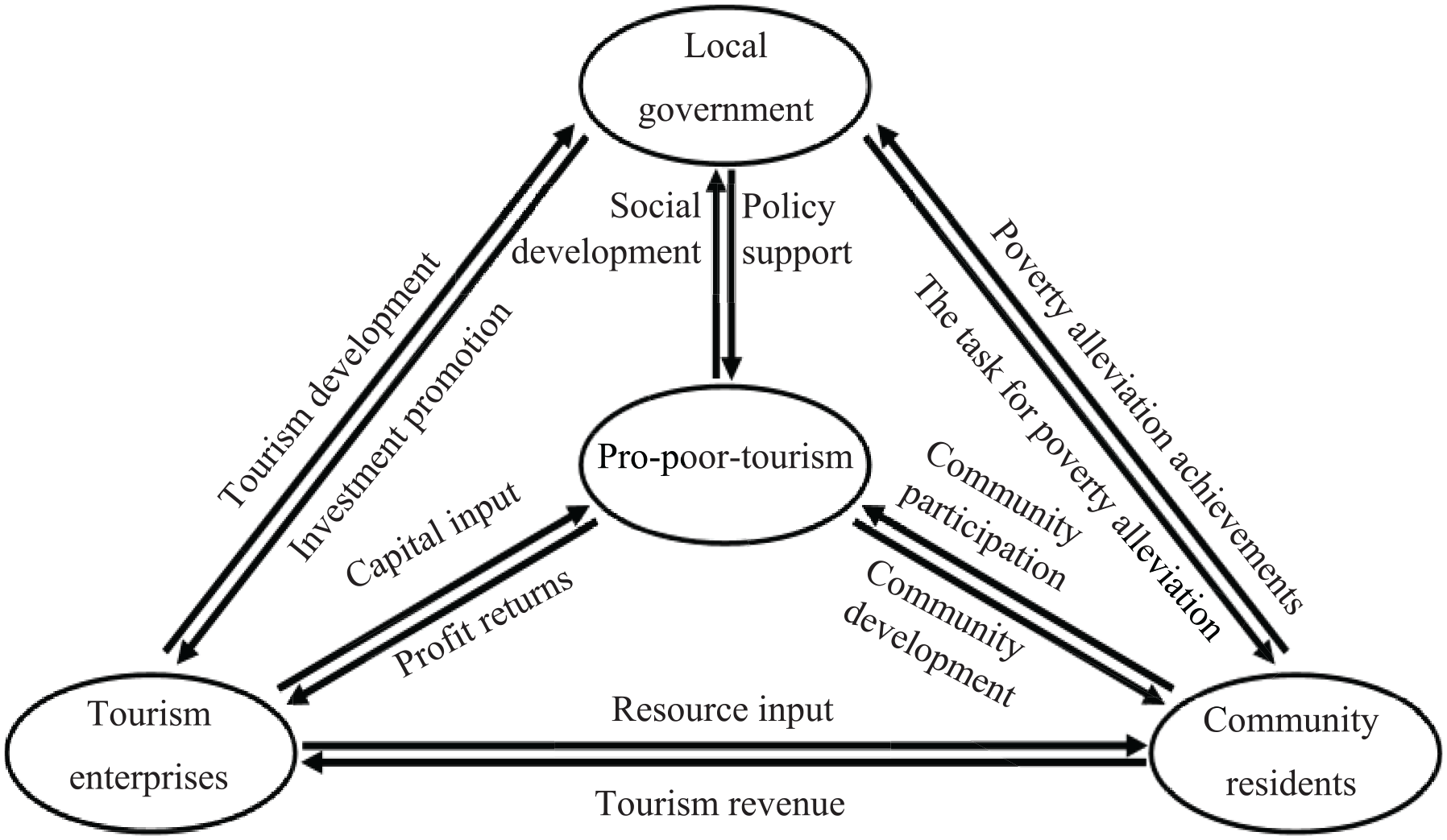
The operation mechanism diagram of tourism poverty alleviation in Liannan Country.
Theoretical Implications
This exploratory case study provides a theoretical evaluation on the short- and medium-term benefits of pro-poor tourism. Liannan Yao Autonomous County, a population center of the Yao people, is in the north of Guangdong province, China. This area is covered by undulating hills, and many Yao villages are nestled among the seemingly endless stretch of tall and precipitous mountain peaks. Their rustic mountain villages, mysterious folk customs, and attractive multicolored traditional dress showcase the unique charm of the Yao culture (see Figure 2).

The location map of the case study.
Tourism improves local community development and helps reduce poverty, and the local government of Liannan Yao Autonomous County intends harnessing tourism more effectively to promote local economic development. Over the past years, it has achieved remarkable progress in economic and social development with the visiting number of tourists, and tourism revenue has increased annually. In 2018, the number of tourists who visited Liannan Yao Autonomous County increased to 3.093 million; the comprehensive tourism income was US$116.09 million, and employment opportunities were provided for nearly 16,000 people (see Figure 3). However, the potential for further economic development of the entire area is severely restricted by the insufficient roadway capacity and poor traffic conditions. Liannan Yao Autonomous County has long been the focus of poverty alleviation of the Guangdong Provincial Government. The government has focused primarily on the tourism development of many villages that have a strong historical and cultural atmosphere. The traditional residential buildings throughout Liannan Yao Autonomous County have remained relatively intact, and the local residents among these villages have retained their culture, tradition, social values, and spirituality.

The growth of the number of tourists and income from tourism by 7 years in Liannan Yao Autonomous County.
Managerial Implications
This study also provides managerial guidelines for those who are responsible for the promotion of pro-poor tourism. First, local governments are active promoters of pro-poor tourism. However, local governments must have a systematic mechanism for determining long-term funding needs. The link between tourism and poverty alleviation is not very clear. Tourism can be a means to alleviate poverty in a country, but the measure of its effectiveness is complicated. China’s pro-poor tourism policy has focused on the leading role of government but ignored the greater role of tourism enterprises and community residents in the economic activities of pro-poor tourism. Second, tourism enterprises are the driving force that promote the development of pro-poor tourism projects; however, they are restricted by policies and resources, which may affect their investment incentives. Effective and frequent communication between local governments and tourism companies should be developed to increase return on investment. Third, community residents are one of the target beneficiaries of pro-poor tourism plans and the owners of local tourism resources, who have the prerogative to decide whether to participate and how to participate in pro-poor tourism. Community residents are not only economically minded people, but they also make decisions in the context of a cultural order and cultural rationality. Thus, the cultural rationality of community residents must be considered in the local practical experience to promote their voluntary and conscious participation in pro-poor tourism.
There is no distinction between the main interests and the subordinates when promoting pro-poor tourism: Each has their duties and functions that form an organic whole in the interaction. It is necessary to fully understand the realistic demands of different stakeholders and effectively link the distinct roles of local governments, tourism enterprises, and community residents. By working together all stakeholders can promote the successful development of pro-poor tourism, making the benefits from tourism development reach the poor and the related stakeholders.
Limitations and Suggestions for Further Research
This study has several limitations. First, the study focused only on problems faced in the early stage of pro-poor tourism projects. Although the early stage of poverty reduction in tourism plans is related to the success of subsequent development, the situation may differ during the maturity stages of poverty alleviation strategies. To determine the various problems encountered in tourism poverty alleviation by comparing the development stage and maturity stage, further research is warranted. Second, this study investigated a representative type of tourism poverty alleviation practiced in China’s poverty-stricken areas. Further research should conduct a wide-range, cross-regional comparative study and present the universal regulations on poverty alleviation in different countries or cultures to gain a holistic understanding of pro-poor tourism.
Footnotes
Declaration of Conflicting Interests
The author(s) declared no potential conflicts of interest with respect to the research, authorship, and/or publication of this article.
Funding
The author(s) disclosed receipt of the following financial support for the research, authorship, and/or publication of this article: This work was supported by The National Social Science Fund of China (Grant Numbers: 17ZDA165 and 19BJY212) and the Foshan Social Planning Project (Grant number 2021-QN06).
