



Abstract
This study investigates the relationship between personality types among second language (L2) learners through a bibliometric analysis. Personality traits, particularly the Big Five, are recognized as key predictors of L2 success. However, despite numerous empirical findings, the strength and nature of these correlations often show significant inconsistencies. Utilizing CitNetExplorer and VOSviewer, this study analyzes 161 research articles sourced from the Web of Science database. The analysis highlights major contributors, organizations, and countries in this field, emphasizing the impactful work of highly cited scholars, as well as leading research regions. The findings indicate that Openness, Conscientiousness, and possibly Agreeableness are significantly correlated with L2 achievement, while Neuroticism tends to show marginal or no correlation. These general trends are complicated by methodological inconsistencies in measures of L2 achievement and personality assessment tools. This study advocates standardized protocols for cross-cultural research and suggests further exploration using alternative personality measures. Additionally, personalizing teaching strategies based on learners’ personality types may enhance L2 outcomes.
Introduction
Contemporary SLA research has increasingly investigated the role of individual differences in L2 learners (Wang et al., 2021; Xu et al., 2022), identifying multiple influential factors spanning demographic variables (age, gender), psychological constructs (motivation, attitude), and cognitive approaches (learning strategies) that significantly impact both L2 learning outcomes (Yu et al., 2022; Zafar & Meenakshi, 2012) and pedagogical practices (Wang et al., 2024; Xu & Wang, 2024). This growing body of evidence suggests that a nuanced understanding of learner variability can substantially enhance the efficacy of second language instruction (Mercer et al., 2012). Particularly noteworthy are personality traits, which have emerged as robust predictors of L2 achievement, with their predictive validity being empirically validated and theoretically grounded across multiple studies (Vedel & Poropat, 2017).
The research trajectory, as illustrated in Figure 1, reveals a sustained scholarly focus on the personality-SLA nexus since 2008, exhibiting consistent growth that culminated in peak research output in 2023. The apparent decline in 2024 publications reflects temporal limitations in database indexing rather than diminished academic interest. This decade-long proliferation of research has prompted systematic reviews and meta-analytic syntheses (Chen et al., 2021), yet a conspicuous gap remains in comprehensive bibliometric examinations of this literature.

Research trend of the correlation between L2 learners’ personality traits and SLA.
To address this methodological gap, the present study employs an integrative bibliometric approach utilizing both VOSviewer and CitNetExplorer analytical tools. This dual-method design enables: (1) systematic mapping of the intellectual structure of personality-SLA research; (2) identification of key scholarly networks and developmental trends; (3) quantification of the field’s conceptual and empirical evolution. Through this multidimensional analysis, we aim to provide both a macroscopic overview and microscopic examination of the extant literature, thereby establishing a robust foundation for future investigations in this domain.
Drawing upon the foundational theoretical constructs of the Big Five Personality Model (Five Factor Model, FFM), extant research has established statistically significant correlations between second language learners’ personality dimensions and second language acquisition (SLA) efficacy. As the predominant paradigm in personality psychology, the FFM (encompassing openness, conscientiousness, extraversion, agreeableness, and neuroticism) has been extensively operationalized in SLA investigations (Angelovska et al., 2021; Costa & McCrae, 1985, 2008; Šafranj & Zivlak, 2019). Empirical analyses have substantiated the relationship between these pentatonic traits and L2 academic achievement (Zafar & Meenakshi, 2012), though the precise mechanistic pathways warrant further systematic exploration.
Contemporary SLA scholarship reveals considerable heterogeneity in how Big Five personality dimensions mediate learners’ linguistic performance. Despite a substantial corpus of skill-oriented empirical studies, scholarly consensus remains elusive. Illustrative of this divergence, Dewaele and Furnham (2000) demonstrated that extraverted learners exhibit heightened propensity for language production, attributable to their enhanced socio-affective communicative capacities; conversely, seminal works by Ehrman and Oxford (1995) and Gan (2011) failed to identify significant associations between personality constructs and L2 oral proficiency. Given such empirical contradictions, a systematic synthesis of personality-SLA correlations becomes methodologically imperative.
Bibliometric approaches offer a robust analytical framework to address this epistemological gap through multidimensional cluster analyses – including but not limited to: identification of core academic contributors, institutional networks, geopolitical distributions, keyword co-occurrence patterns, and seminal literature sources. The present study therefore proposes to employ advanced bibliometric techniques to quantitatively synthesize existing research, with the ultimate objective of elucidating the complex association matrix between personality constructs and SLA outcomes in second language learners.
Correlations between Personality and Second Language Learning
More and more studies have used bibliometric methods to map the intellectual landscape of various academic fields, among them language teaching. Earlier bibliometric research in fields such as educational technology (Shen & Ho, 2020), educational leadership (Hallinger & Kovačević, 2019), and language pedagogy (Barrot, 2021) has demonstrated that such methods allow researchers to: (1) rapidly comprehend the knowledge structure of the discipline; (2) refine the delineation of research topics; and (3) strengthen the empirical foundation of teaching practices. The results of these investigations are that bibliometric studies, by revealing key publications, central contributors, and thematic evolution, provide both sweeping overviews and detailed insights that are indispensable to advancing research agendas and informing educational practices.
In second language acquisition (SLA) research, there is a significant lack of comprehensive bibliometric studies that focus particularly on the role of personality traits in learning a second language (L2). Therefore, the present study aims to bridge this gap by applying combined bibliometric tools, that is, VOSviewer and CitNetExplorer, to systematically map the field and reveal the key players, conceptual clusters, and future research directions.
Existing scholarship has extensively investigated the interplay between second language learners’ personality traits and SLA; however, the empirical findings remain markedly inconsistent (Cao & Meng, 2020; Pathan et al., 2021; Pourfeiz, 2015; Xu, 2025). In light of this fragmented research landscape, the present study employs CitNetExplorer as an analytical tool, with the overarching objective of elucidating the underlying mechanisms through which individual personality characteristics influence second language learning outcomes. The specific research questions guiding this inquiry are as follows:
RQ1: What is the nature and magnitude of the correlation between second language learners’ personality traits and SLA proficiency?
To clarify, several prior sources of empirical and theoretical research make this inquiry possible. For instance, the importance of individual differences such as personality traits as predictors of L2 success has been highlighted by Gardner and Lambert (1972) and Dörnyei (2005). Thereafter, the Big Five Personality Model (Costa & McCrae, 1985, 2008), namely, openness, conscientiousness, extraversion, agreeableness, and neuroticism, should be utilized in SLA contexts as a framework to observe the individual differences between people. From an empirical standpoint, the traits of Openness and Conscientiousness are positively correlated with L2 achievement, whereas Neuroticism has very little or even no correlation with L2 success (Zhang et al., 2019). Those are rather general trends; yet, there is still a lot of heterogeneity in their findings. Kiany (1998), for example, found that nine studies on extraversion and SLA yielded two positive, three negative, and four null associations. Likewise, inconsistencies in the measurement of both personality and L2 achievement have generated divergent results (Dewaele, 2012). Generally speaking, measures of L2 achievement include standardized language tests, courses. Further, bibliometric methodologies have been extensively applied across educational research domains, encompassing diverse subfields such as educational technology (Shen & Ho, 2020), educational leadership (Hallinger & Kovačević, 2019), and language pedagogy (Barrot, 2021). Given the paucity of extant studies leveraging an integrated VOSviewer and CitNetExplorer approach to examine the nexus between SLA and personality traits, this study innovatively applies VOSviewer for bibliometric mapping and further posits:
RQ2: What are the salient patterns pertaining to leading authors, institutional affiliations, geographic distribution, keyword co-occurrence networks, seminal literature, and pivotal references within this research domain?
Materials and Methods
Using CitNetExplorer, we conducted a qualitative analysis of our first research question. On December 2, 2024, we searched Web of Science core collection for the term “Personality” along with keywords language* OR EFL* OR ESL* OR SLA* as headings. This search yielded 450 results. We then imported these results into Endnote 20 to check for and remove any duplicates. We conducted this task by clicking on “Library” in the command bar and then selecting “Find Duplicates.” The software compared the entries and identified duplicates, which enabled us to choose which records to retain. Any records we chose not to retain were moved to the recycle bin. Next, we carefully reviewed the remaining results and excluded those that were not relevant, ultimately narrowing it down to 161 final entries (see Figure 2). We followed a four-step process for this decision-making:
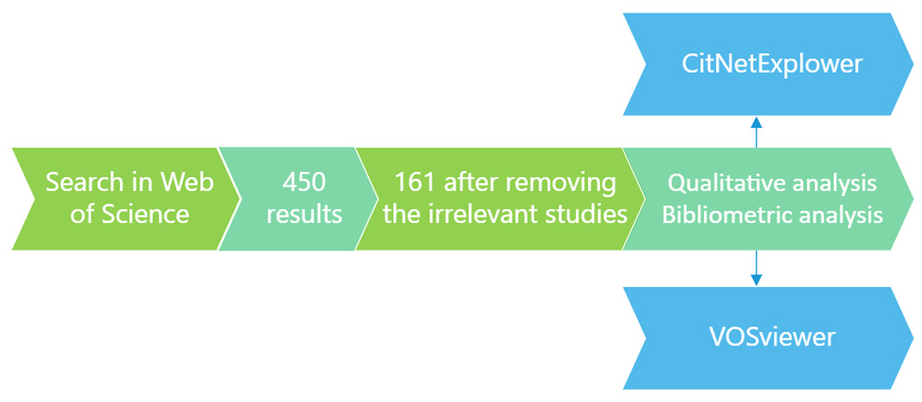
Research process.
Title Review: We first examined the titles to see if they related to our study. If a title seemed irrelevant, we removed it right away; Abstract Review: For titles that appeared relevant, we then read the abstracts to further assess their relevance; Conclusion Review: If both the title and abstract were promising, we moved on to read the conclusions to ensure they aligned with our research focus; Consensus Check: In cases where we couldn’t reach an agreement, a third reviewer was engaged to adjudicate the result.
Our inter-rater reliability was quite strong (k = 0.88), indicating a reasonable agreement among reviewers. We chose not to exclude documents labeled as “early access,” as there were no errors in the system. The final collection (n = 161) included a variety of publications: 84 research articles, 21 conference papers, 15 conference abstracts, 14 editorial pieces, 10 early interviews, 8 review articles, 4 letters, 3 book reviews, 1 news item, and 1 book chapter. Note that some of these categories may overlap, which is why the total count might not equal 161.
VOSviewer was used to conduct a systematic bibliometric analysis to answer the second research question. The study fully included all the 161 studies’ data, including all the “early access” literatures. After verification, there were no systematic errors (see Figure 2). This study mainly conducts the analysis from the following dimensions:
Firstly, the cooperative relationships at the author, institution and national levels were examined through co-occurrence network analysis; Secondly, the co-word analysis method was adopted to explore the association network between the author’s keywords and the supplementary keywords of the system. Meanwhile, based on citation analysis, the citation situations of literature, journals, authors, institutions and countries were systematically sorted out.
It is particularly worth noting that through literature coupling analysis, we have revealed the knowledge correlations based on common references among different literatures, journals, authors, institutions and countries. And by adopting the co-citation analysis method, the knowledge flow patterns among references, journals and authors were deeply explored. This multi-dimensional analysis method provides systematic empirical basis for us to fully grasp the development trend of this research field.
Results
An important goal of this study is to apply Bradford’s Law (Yang et al., 2016; Yu et al., 2023), systematically examines the distribution characteristics of high-impact literature exploring personality traits and SLA. The key points of analysis include: (1) The distribution of core author groups, institutions and countries; (2) High-frequency keywords; (3) Classic literature and authoritative journals; (4) The intrinsic correlation mechanism between personality traits and SLA.
The citation network constructed based on CitNetExplorer included a total of 217 literatures (from 1972 to 2024), forming 924 citation relationships. The total amount of literature exceeds the initial search results. This is because the citation network analysis method can automatically track and incorporate the foundational and highly influential key literature in the field (van Eck & Waltman, 2017). Among them:
“Prospective literature” refers to pioneering works that cite a specific number of subsequent studies in the current network; “Follow-up literature” refers to the subsequent research results that have been cited by a certain number of cutting-edge studies.
Through cluster analysis technology, CitNetExplorer integrates the citation network into five distinctive knowledge communities (see Figure 3), and this classification method effectively reveals the historical evolution trajectory and contemporary development trend of this research field.

Citation networks of 100 publications.
The analysis results of this study provide multi-dimensional and detailed data references for readers, scholars and practitioners. In terms of parameter Settings, we set the minimum clustering size to 10 and adjusted the resolution parameter to 1. Under this condition, 22 studies were not classified into any clusters. The research focus is on the first cluster, which has the following significant characteristics:
(1) The largest volume of literature (including the most research literature and citation relationships);
(2) High-impact literature collection (the number of literatures with citation frequency > 10 is the largest);
(3) The proportion of core literature is prominent (including the largest share among the top 100 highly cited literatures, see Figure 3 for details).
To systematically contextualize the research topic and examine its academic significance, we have synthesized three key dimensions of scholarly evidence: (1) foundational literature establishing the field’s theoretical framework, (2) the four most highly-cited landmark studies, and (3) recent cutting-edge research advancements (see Table 1 for complete data).
Studies with the Top 10 Citation Scores in the First Cluster.
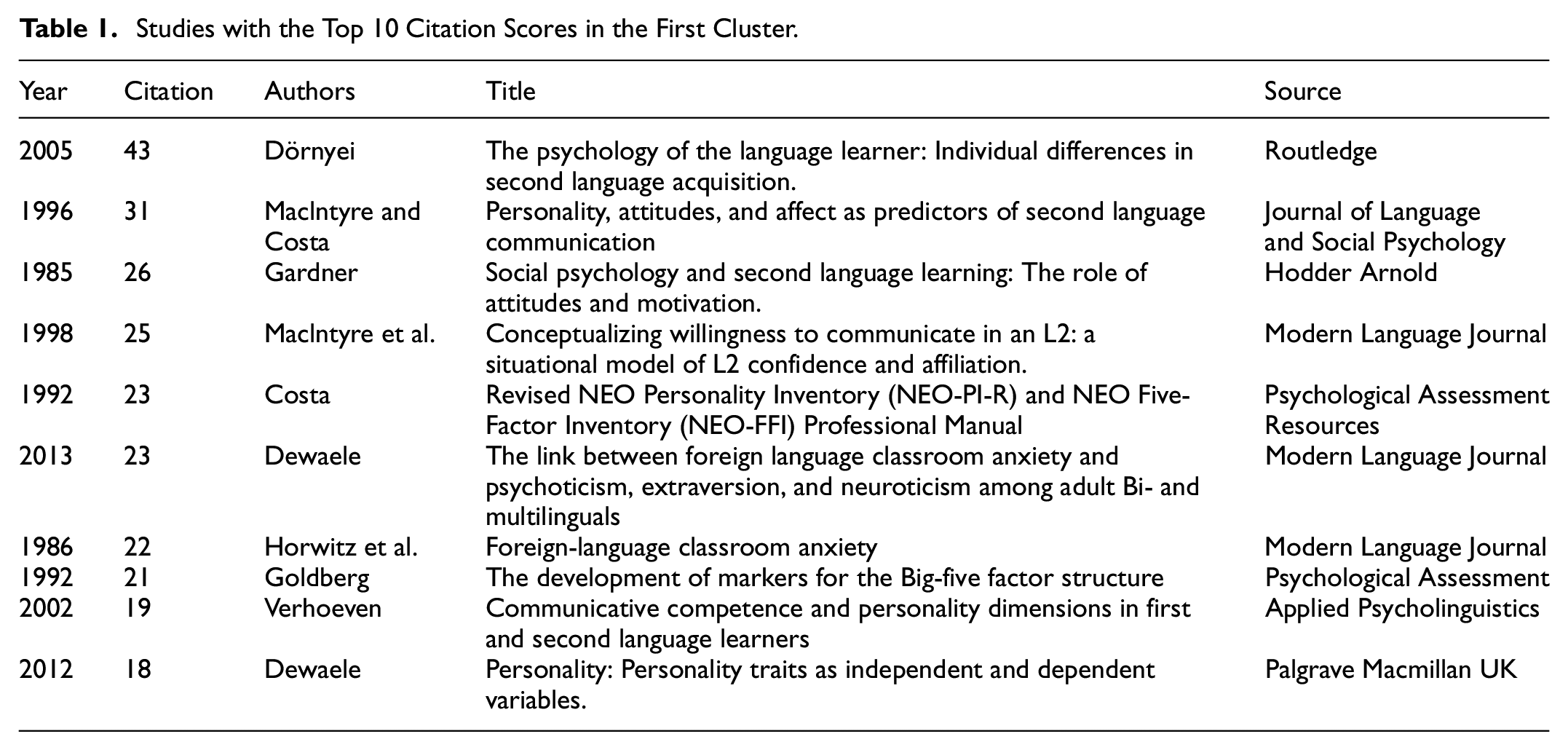
The data in Table 1 shows that the empirical study with the highest citation frequency (Dörnyei, 2005) confirmed a significant correlation between individual difference variables and the effectiveness of SLA. To clarify the knowledge structure, central studies can be grouped as follows:
(1) Motivation and Individual Differences:
Gardner (1985) and Dörnyei (2005) emphasize motivation and broad personality factors.
(2) Affective and Social Variables:
MacIntyre and Charos (1996), Horwitz et al. (1986), and Dewaele (2013) focus on anxiety, willingness to communicate, and the classroom environment.
(3) Personality Measurement Tools:
Costa and McCrae (1992) and Goldberg (1992) provide the main personality assessment frameworks used in SLA research.
This organization highlights how research clusters around motivational, affective, and methodological approaches, providing a clearer knowledge map for future researchers. The related information is summarized in Table 2.
A summary of the Major Findings from the First Cluster.

More than mere enumeration, a closer examination of the citation network of the field identifies at least two prevailing schools of thought and numerous interconnected strands of research within the discipline:
Early on, the “Individual Differences and Motivation” paradigm, represented by seminal studies like Gardner (1985), Gardner and Lambert (1972), and Dörnyei (2005), underscores the multifaceted relationship among personality traits, motivational aspects, attitudes, and achievement outcomes. The above studies, frequently referred to in tandem and comprising the essential foundation of the first significant cluster of the network (Figure 3), demonstrated that personality traits such as motivation and openness to experience are robust predictors of L2 achievement consistently. This tradition of research is marked by its emphasis on motivational models (the dichotomy of “integrative” and “instrumental”), self-efficacy, and affective dimensions.
Second, the “Affective and Social-Psychological Factors” tradition, comprising the research of MacIntyre and Charos (1996), Horwitz et al. (1986), and Dewaele (2013), investigates the influence of anxiety, need to communicate, and social context. These studies, which also form a densely connected citation cluster, tend to examine how negative affect (particularly neuroticism and anxiety) can be an obstacle to language learning, whereas positive qualities such as extraversion and agreeableness can facilitate communicative capacity and classroom involvement. These clusters are connected: citation coupling and co-citation analyses show that the work on personality measurement (e.g., Costa & McCrae, 1992; Goldberg, 1992) bridges the two fields, supplying methodological rigor and standardized tests for assessing personality traits. Current work (e.g., Kim & Hwang, 2024) shows a direction towards more intricate, network-based psychological tests and integration of non-traditional personality models (like MBTI), demonstrating the field’s dynamism. In total, the bibliometric mapping explains that the research area is defined by (1) an “individual differences” tradition, aiming to consolidate personality with motivational and cognitive variables, and (2) a “social-affective” tradition, emphasizing context, anxiety, and interpersonal dynamics. New methodology development along with the extension of cross-cultural studies are contemporary trends, as reflected in the increasing variety of cited literature and geographical location of key studies.
Moreover, this study found that the correlation between the personality characteristics of second language learners and the effectiveness of language acquisition has a solid theoretical basis and empirical support. Among them, the personality measurement tool developed by the landmark study (Costa & McCrae, 1992), which ranks fifth in citation frequency, has become the standard assessment system in this field due to its universality. The Five-Factor personality model established in this study encompasses five dimensions: Openness, Conscientiousness, Extraversion, Agreeableness and Neuroticism, provides a key theoretical framework for subsequent studies.
Take the trait of openness as an example. Its operational definition includes three core elements: intellectual curiosity, vivid imagination, and preference for novelty (Costa & McCrae, 1992; McCrae & Costa, 1987). Empirical studies have proved that this trait has significant predictive power for SLA: Zhang et al. (2019) found in a sample of Chinese middle schools that open-ended traits were strongly positively correlated with interest in English learning (β = .31, p < .01). This finding confirms the mediating mechanism by which personality traits affect the effectiveness of language acquisition by influencing learning motivation.
The pioneering research of Gardner and Lambert (1972) has been widely cited in the academic circle due to their outstanding academic contributions, laying a robust theoretical foundation to understand SLA and personality traits. As the pioneering scholars who were among the earliest to systematically study individual differences in language learning, they established the core elements influencing second language communication ability through a series of empirical works (Macintyre & Charos, 1996). Including learners’ communicative willingness, intrinsic motivation, self-efficacy and opportunities for contact with the target language (MacIntyre & Charos, 1996). Subsequent studies have further confirmed that agreeableness traits have a significant positive correlation with second language learning outcomes: Learners with this trait usually exhibit a stronger sense of cooperation, can view the language learning environment with a more open mind, and actively seek communication opportunities with target language users. These behavioral characteristics jointly promote the development of second language ability (Öz, 2014).
Among the most influential studies, the empirical research that ranked second and third in terms of citation frequency also confirmed the significant association between agreeableness traits and SLA in the Big Five personality model. These studies have found that individuals with agreeableness traits—manifested as kindness, friendliness and compassion—tend to establish more positive interactive relationships with the target language group (MacIntyre & Charos, 1996). This trait not only prompts learners to hold a more open attitude towards the target language culture, but also significantly enhances language learning motivation by increasing opportunities for cross-cultural contact (Gardner, 1985). These foundational research results provide important references for subsequent studies. Among them, Pourfeiz (2015)’s research among English learners in Turkish universities continued this research trajectory and once again verified the significant positive correlation between agreeableness traits and foreign language performance.
On the other hand, the second most-cited studies indicate that traits like anxiety and emotional instability may contribute to academic stress and reduce L2 input effectiveness (MacIntyre & Charos, 1996). Neuroticism, which is closely associated with these negative affective factors, has been consistently shown to demonstrate negligible or non-existent correlation with L2 achievement across multiple studies (e.g., Cao & Meng, 2020; Ghapanchi et al., 2011; Öz et al., 2015; Ożańska-Ponikwia & Dewaele, 2012). Notably, the most influential studies examining personality effects on SLA predominantly emerged during the second half of the 20th century. These foundational works employed diverse empirical methodologies to investigate relationships between various personality dimensions and language learning outcomes. While some theoretical propositions have since been challenged or refined, they collectively established a robust conceptual framework that continues to inform contemporary research.
However, despite a large number of empirical studies, this field still faces the prominent problem of inconsistent research results. Take Kiany (1998)’s integrated analysis of nine studies as an example. Regarding the relationship between extraversion and SLA: two studies showed a positive correlation, three showed a negative correlation, and four did not find a significant association. This contradictory phenomenon also exists in the research of the other four dimensions of the Big Five Personality model. What is more worthy of attention is that currently few scholars have conducted systematic integration and analysis of the literature in this field. The influential review study published by Dewaele (2012) is an exception. This study deeply explored the relationship between personality traits and second language learning through qualitative analysis methods and particularly emphasized the significant uncertainties existing in the conclusions of existing studies: “The fact that so few significant relationships between personality traits and success in the second or foreign language (L2/FL) have been identified has puzzled researchers. This is due to two main reasons: first, the nature of the dependent variable, namely the wide variety of measures of “success” in the L2...” (p. 42). The unclear relationship between personality traits and SLA has persisted, indicating a need for further bibliometric analysis to address these gaps. A recent study attempted to use psychological networks to analyze the connection between personality traits and L2 acquisition (Kim & Hwang, 2024). While this study aimed to challenge previous research models, it ultimately reached conclusions similar to those of earlier empirical studies. However, the researchers did identify different connection patterns among variables in the Big Five model, which could inspire future investigations.
In bibliometric analysis, VOSviewer, as an effective tool for constructing citation networks, can systematically identify core authors, institutions, country distribution, keyword clustering, important literature, journal sources and reference networks in the research field. This tool forms methodological complementarity with CitNetExplorer: VOSviewer focuses on network analysis at the group level, while CitNetExplorer is good at clustering literature at the individual level (van Eck & Waltman, 2017). This study comprehensively utilized the co-occurrence analysis, citation analysis, literature coupling and co-citation analysis functions of VOSviewer to conduct multi-dimensional verification and expansion of the qualitative analysis results of CitNetExplorer. It should be noted that due to the limited sample size of the literature, co-occurrence analysis was not conducted in this study.
Furthermore, we performed a bibliometric analysis according to the collected data (n = 161). VOSviewer processed the data files from Web of Science, selecting co-occurrence as the analysis type. This enabled identification of the top 30 keywords based on occurrence frequency (see Table 3).
Top 10 Keywords According to Occurrences.

This study adopts co-occurrence analysis as the research method and takes three types of keywords as the analysis objects: all keywords, author keywords, and keywords plus terms (corresponding to the first, second, and third clusters in Figure 4). Through this comprehensive co-occurrence network analysis, we have successfully constructed a series of intuitive and clear visualization maps. These maps not only effectively present the intrinsic connections of the research topics, but also provide important data support for subsequent research. The analysis results show that using multi-dimensional keyword sets for co-occurrence analysis can reveal the knowledge structure characteristics of the research field more comprehensively.

Co-occurrence of all keywords, author keywords, and keywords.
According to the citation ranking, we selected literature, source, author, organization, and country as the units of analysis, obtaining the results shown in Table 4.
Top 10 Documents, Sources, Authors, Organizations, and Countries Based on Citations.
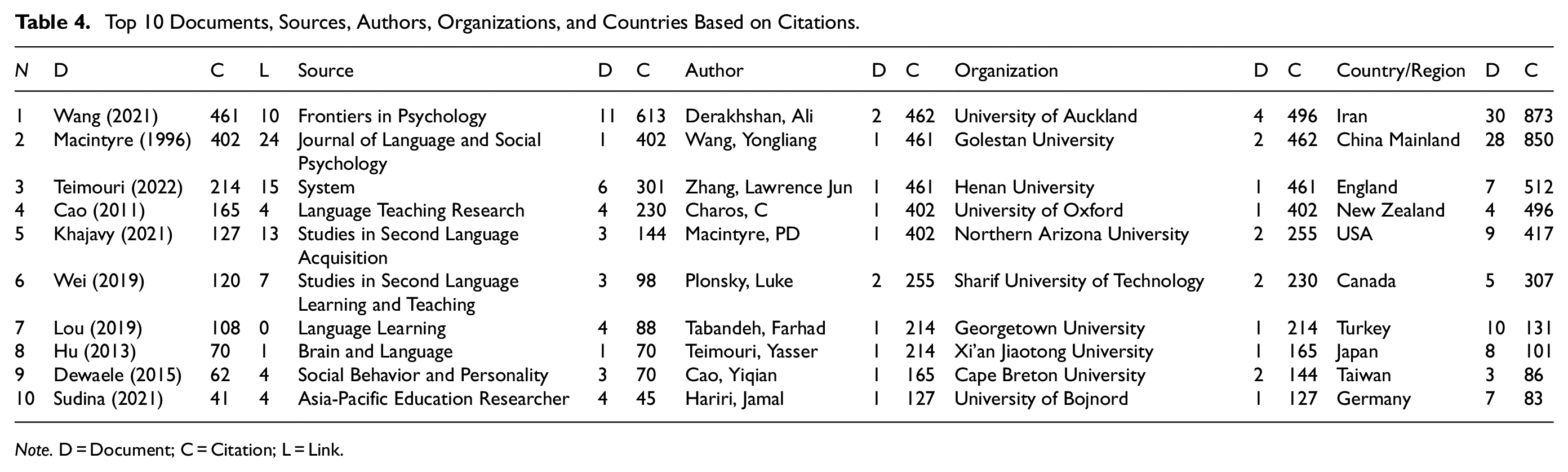
Note. D = Document; C = Citation; L = Link.
This study adopted the bibliographic coupling analysis method, taking literature, sources, authors, institutions and countries as the analysis units. Through the statistics of citation frequency, the top 10 high-impact objects in each category were screened out. The analysis results show that the rankings among different units are highly consistent. To further verify the research conclusions, we simultaneously conducted a co-citation analysis, focusing on three types of objects: cited references, cited journals, and cited authors. Similarly, the top 10 in each category were extracted based on citation frequency (Table 5). This analysis result forms a mutually corroborating relationship with the bibliographic coupling analysis.
Top 10 Cited References, Cited Sources, and Cited Authors Based on Citations.

Note. C = Citation; L = Link.
Discussion
Correlation Between Personality Traits and L2 Learning
As the early research has elaborated on the strong connections between personal characteristics of L2 learners and their language acquisition thus providing a good theoretical basis for this field, the influential works by Gardner and Lambert (1972) and Dörnyei (2005) emphasized the importance of individual differences, particularly personality traits as predictors of L2 success. In terms of L2 learning, the primary empirical support for the above comes from numerous comparative studies, through which personality traits defined by the Big Five Model (Costa & McCrae, 1985, 2008) became crucial in second language learning. However, there is still a challenge in this area, which is the inconsistency in research findings.
The bibliometric analysis is significant in demonstrating that these landmark publications are not isolated; rather, they are firmly rooted in intellectual networks that underpin the theoretical model of the discipline. Clustering evidence in CitNetExplorer and co-citation analysis in VOSviewer indicates that Dörnyei and Gardner’s publications are usually cited together with research targeting motivation and affect, which indicates an integrated tradition concerning “individual differences.” Conversely, MacIntyre’s, Horwitz’s, and Dewaele’s scholarship are all concerned with the constructs of anxiety and communication and therefore form a parallel scholarly tradition with its own characteristic foundational texts. The integrative research, including that on personality tests (Costa & McCrae, 2008; Goldberg, 1992), provides the methodological standards bridging these intellectual landscapes.
This networked approach reveals that the discipline is not a set of unrelated findings, but rather an ongoing conversation among theoretical traditions in convergence. Additionally, it brings out newer developments: for instance, the embrace of psychological network analysis (Kim & Hwang, 2024) and the increasing prevalence of alternative personality typologies indicate a move towards more methodological pluralism and interdisciplinarity. The bibliometric view therefore not only cumulates extant studies but also brings out intellectual currents, mainstream paradigms, and new pathways that govern research on personality and SLA.
Correlates of the Big Five with L2 achievement show that Openness to Experience, Conscientiousness, Extraversion, and Agreeableness are positively associated with L2 success. Surprisingly, Neuroticism is virtually unrelated. Cohen et al. (2020) found that Openness to Experience (pooled r = .23) and Conscientiousness (pooled r = .18) have the strongest associations with L2 success, being followed only by extraversion and agreeableness at the pooled METS of 0.12 and 0.10 respectively. The greatest deterrent to learning a second language is no other than Neuroticism, with a pooled r = −.04, and it is unclear whether it has a relationship with L2 performance, probably because it is associated with anxiety and emotional instability, which have hindered language learning (Cao & Meng, 2020; MacIntyre & Charos, 1996).
These findings suggest that learners who are open-minded, responsible, outgoing, and cooperative are more likely to succeed in L2 acquisition. However, there is a clear need for ongoing research into these correlations, especially given the increasing volume of studies published in recent years. While the meta-analysis by Chen et al. (2021) covered literature from 1980 to 2020, the surge in empirical studies since then highlights the importance of timely reviews to capture new trends and developments.
Inconsistencies and Methodological Challenges
There is broad empirical agreement among psychologists about how personality traits affect L2 learning. However, the antagonist research findings reflect the argument among researchers such as Dewaele (2012) and Kiany (1998), who indicate that the metrics employed in measuring L2 achievement have been on different bases for these discrepancies. There are three broad measures of success in SLA: that is, language testing, course grades, and self-perceived proficiency. Defining L2 achievement in different ways yields different conclusions in studies across various studies.
In a more detailed exploration of the prominent studies revealed by our bibliometric review, it is apparent that the dependent variable (DV) selected differs importantly and influences findings and interpretation:
(1) Standardized Language Test Scores:
This is the most prevalent DV in the canonical research (e.g., Dörnyei, 2005; Gardner, 1985; MacIntyre & Charos, 1996). Such scores, most frequently obtained from externally validated proficiency measures, are used to provide an objective measure of L2 achievement. Studies utilizing this DV most frequently find stronger and more stable correlations between personality traits—such as Openness, Conscientiousness, and Agreeableness—and language learning performance.
(2) Course Evaluations or Academic Achievement:
Many important studies (e.g., Pourfeiz, 2015; Zafar & Meenakshi, 2012) take grades achieved on language courses as their dependent measure, reflecting students' consistent performance over a specific time. While grades give a wider view of accomplishments, they might be influenced by factors that go beyond language skills, such as classroom attendance or evaluation practices used by instructors, which would account for some differences observed in the reported correlations.
(3) Self-Assessment or Self-Perceived Competence:
Much of the research (e.g., Dewaele, 2013; Kim & Hwang, 2024) uses learner self-reported proficiency or self-perceived confidence in using the language as the DV. Such instruments access affective and motivational dimensions but are subject to personal bias and cultural response sets. Studies founded on self-perceived proficiency find weaker or less consistent relationships between personality traits and L2 success, particularly for Neuroticism and Extraversion. Willingness to Communicate and Language Use Behavior: A line of research (particularly MacIntyre & Charos, 1996; MacIntyre et al., 1998) targets behavioral dependent variables (DVs), including willingness to communicate (WTC) and actual second language (L2) use in social situations. These dependent variables correlate highly with extraversion and social-affective personality dimensions, making this area of research distinct from research using exclusively achievement-oriented DVs.
To this end, course grades and standardized test scores represent the most popular dependent variables in the traditional and highly cited research in the discipline, constituting the empirical core of the "individual differences" research tradition. Although less typical as main dependent variables, self-rated ability and communicative behavior have gained salience in recent research investigating the affective and social aspects of second language acquisition. The change in dependent variables not only creates differences between studies but also reflects the increasing sophistication of conceptualizations of language learning success in the research literature. This dialogue offers the motivation for more methodological standardization and openness in upcoming studies by describing the most common dependent variables and how their selection pertains to empirical findings and theory.
In addition, the instruments for assessing personality traits vary greatly. Well-known examples of such instruments are NEO-FFI, EPQ, BFI, and IPIP. These differences certainly affect outcomes, given that each focuses on a different aspect of personality. For instance, the latest research has been characterized by Pang et al. (2024), using MBTI (Myers-Briggs Type Indicator), which is common among younger learners. The research study by Pang aimed to derive a link between the factor of Extraversion (as per the MBTI test) and the strategy preferences of English students, which opened a new avenue of research on the potential influence of personality types on learning strategies. The MBTI’s very specific manner of building personality traits is very promising for future research regarding the interplay of personality and learning strategies.
Contributions of Bibliometric Analysis
The bibliometric analysis performed in this study unravels the research scene on personality traits vis-a-vis their correlations with L2 acquisition. Howard Gardner, Jean-Marc Dewaele, and Peter MacIntyre emerged as key actors in this field, while the University of Auckland, the University of Oxford, and Henan University had prestigious names to be associated with high contributions. This analysis also showed countries like Iran, China, the United States, New Zealand, and Canada as leading nations in research on the issue, with overall global interest in comprehending how personality would impinge upon L2 learning.
Notable journals such as Frontiers in Psychology, Journal of Language and Social Psychology, System, Language Teaching Research, and Language Learning have been recognized as the most popular publication outlets for this line of inquiry. For researchers and practitioners interested in the relationship between personality traits and L2, resources such as these could be an effective starting point.
The findings in this research have important significance for both researchers and educators. Researchers will find in this research the need for ensuring methodology to eliminate discrepancies in available literature because it points out the necessity for a standard method of making measures of personality traits and L2 achievement more comparable across studies to reveal much clearer patterns. Moreover, it is indicated that longitudinal studies may clarify personality traits influencing L2 learning over time and through stages of language acquisition. This information can also be valuable for the educator as far as understanding the role personality traits should play in individualized teaching. For example, learners with high Openness to Experience may well be inspired by exploratory and creative activities, such as cultural immersion projects. Students high in Agreeableness would find teaming learning environments more valuable. It would be beneficial for educators to use devices such as the MBTI to obtain more specific insights into students’ personality types and learning preferences in order to provide a more individualized learning environment for students.
In summary, the bibliometric analysis shows that research on personality and SLA is active but fragmented, with inconsistent findings largely due to varied dependent variables and assessment tools. Despite much empirical work, no single personality trait consistently predicts L2 achievement. However, two main research trends are evident: one focused on motivation and individual differences, and another on social-affective factors like anxiety and willingness to communicate.
Based on these findings, future research should:
(1) Use standardized measures for both personality and L2 achievement to allow better comparability;
(2) Bridge motivational and social-affective perspectives in study designs;
(3) Expand research to new learner groups and cultural contexts.
These steps can help move the field toward greater consensus and practical relevance.
Conclusions and Limitations
This study adopted the bibliometric method and systematically investigated the correlation between the personality characteristics of second language learners and language learning outcomes through two analysis tools, VOSviewer and CitNetExplorer. The qualitative analysis results of CitNetExplorer show that there is a significant association between specific personality dimensions and the effect of SLA. However, it should be pointed out that there are obvious differences in the conclusions of the existing empirical research. Although there have been review studies attempting to establish theoretical models, the dynamic development characteristics of this field indicate that the related mechanisms still need to be explored in depth.
In terms of research methods, this study conducted a systematic citation network analysis using VOSviewer, which specifically included: identification of core authors, construction of institutional cooperation networks, analysis of highly cited literature, assessment of journal influence, measurement of research contribution in countries/regions, and analysis of keyword co-occurrence networks. Through these analyses, the study fulfills several key functions for the research community: (1) It enables scholars to quickly grasp the knowledge structure of the domain by visually mapping the major contributors, influential works, and thematic clusters within the field of personality and second language learning; (2) By identifying research gaps, trending topics, and underexplored connections, the findings help researchers optimize the design of future research topics and methodologies; (3) The systematic mapping of intellectual structures and empirical evidence provides educators and practitioners with a scientific foundation for enhancing teaching practices, particularly by informing the development of more individualized and evidence-based pedagogical strategies. These analytical results can provide the following values for the academic circle: (1) Quickly grasp the knowledge structure of the domain; (2) Optimize the design of research topics; (3) Enhance the scientific nature of teaching practice. Though this bibliometric approach has presented much-needed insights, it, however, has its limitations. First, it uses only data from the Web of Science for analysis, which may miss a lot of relevant research indexed by other databases. Second, an overstress on quantitative information might cause the omission of some qualitative insights, which would enrich our understanding of the field. Future research should, however, bring in multi-data sources, using the mixed-method approach for a more holistic view of personality and L2 learning. As popular tools like the MBTI increase, future research should explore how alternative personality models influence L2 acquisition. Personality traits, effects on other individual difference variables (motivations, learning strategies, and cultural background) could also be included to better understand the holistic L2 success. Lastly, a cross-cultural study on the role of personality across educational contexts would address current cultural biases.
In the future, researchers can delve deeper into the relationship between second language learners’ personality traits and their language acquisition. It’s also important for researchers to consider how other characteristics may impact empirical analyses. Factors such as the gender distribution of participants, the education levels in their country or region, the educational background of the schools, and whether the students are language majors or possess diverse language backgrounds should be taken into account. Moreover, we believe that future researchers should pay attention to the varying measures of L2 achievement used in studies, which typically fall into three categories: “language tests,”“course grades,” and “self-perceived proficiency/performance.” Additionally, differences in personality assessment tools—such as the “NEO-FFI,”“EPQ,”“BFI,”“IPIP,” and others—may introduce errors in the results. Researchers should evaluate whether these errors are within acceptable limits. With the emergence of new personality measurement tools, there is also an opportunity for researchers to conduct empirical studies that assess whether findings align or conflict with previous theoretical or experimental results. From a practical standpoint, we hope that future researchers and language educators will develop tailored teaching methods and strategies that cater to students’ varying personality traits. This approach can help address the diverse needs, preferences, and strengths of foreign language learners, ultimately enhancing teaching effectiveness.
Footnotes

Funding
The author(s) received no financial support for the research, authorship, and/or publication of this article.
Declaration of Conflicting Interests
The author(s) declared no potential conflicts of interest concerning the research, authorship, and/or publication of this article.
Data Availability Statement
Data sharing is not applicable to this article as no datasets were generated or analyzed during the current study.