




Abstract
Citizen science research has been rapidly expanding in the past years and has become a popular approach in youth education. We investigated key drivers of youth participation in a citizen social science school project and the effects of participation on scientific and topic-related (i.e., political) interest and efficacy. Findings suggest that females, more politically and scientifically interested and more scientifically efficacious adolescents were more motivated to learn from the project. Science efficacy was also positively related to external reward motivation (i.e., winning an award). Both learning and external reward motivation increased the likelihood of participation. Pre- and post-measurement further indicated that participation in the project slightly increased science interest, but not science efficacy. However, it did increase both political interest and efficacy. Furthermore, our data revealed a decrease in science efficacy and interest in those who did not participate in the project, indicating an increasing gap in adolescents’ scientific involvement.
Introduction
In citizen science projects, lay citizens cooperate with professional scientific actors (e.g., researchers from academic institutions) and engage in different steps of the scientific process. They contribute to data collection, help analyzing or interpreting the data, or even become involved in the development of research questions and designs (Bonney et al., 2009). Participation in citizen science may involve promising educational outcomes, which is why an increasing number of citizen science projects are conducted with young people, mostly in or in cooperation with schools (Ballard et al., 2017; Kountoupes & Oberhauser, 2008; Mueller et al., 2012). In such projects, young people engage in free-choice and out-of-classroom learning activities, which is essential to support the development of an informed, scientific citizenry (Falk & Storksdieck, 2009; Irwin, 1995).
Due to promising educational effects, youth citizen science has recently gained wide attention from educators and government organizations (Ballard et al., 2017; Koomen et al., 2016, 2018). For example, the White Paper on Citizen Science for Europe states that educational programs should “stress collaboration between schools and scientific institutions” (Socientize, 2014, p. 24) and that “schools are considered primary targets for the introduction and promotion of Citizen Science” (Socientize, 2014, p. 31). The goal is to foster citizen engagement at an early stage and encourage young people’s curiosity, criticism, self-learning, and self-expression.
Despite the increasing importance of citizen science in science education, we identify three important research gaps. First, we lack evidence on citizen social science, as most of the existing citizen science projects deal with natural science questions (Bonney et al., 2014). This is surprising, for citizen social science projects would allow citizens to engage with important everyday life issues in a systematic, scientific way (Corti & Fielding, 2016; Heiss & Matthes, 2017). Recent exceptions include Binder et al. (2021), who were interested in the nature of youth political participation offers and asked young citizen scientists to identify and sample political participation offers in their environments. Furthermore, Paul and Palfinger (2020) explored patterns in the human papillomavirus vaccination discourse and asked volunteers to code press releases. Second, existing studies on predictors and outcomes of citizen science participation are predominantly conducted with adults (e.g., Crall et al., 2013; Land-Zandstra et al., 2016; Price & Lee, 2013) and already active citizen scientists (e.g., Nov et al., 2011; Raddick et al., 2010; Rotman et al., 2012). Finally, research on youth participation in school contexts is scarce and research on the predictors and outcomes-related non-participation is absent.
In this study, we contribute to fill these research gaps. We develop and test a framework of the predictors and attitudinal outcomes of citizen science participation (and non-participation) in a citizen social science project. To this end, we observe whether or not young people participate in a quasi-experimental setting and how their scientific and political attitudes changed over the course of the project.
Literature Review
Positive educational outcomes have been described as a key goal of citizen science projects (Bonney et al., 2009; Brossard et al., 2005; Koomen et al., 2018; Price & Lee, 2013). Citizen science projects may be conceptualized as contributory, collaborative, or co-creative projects (Bonney et al., 2009). In contributory projects, volunteers contribute to the data collection only, in collaborative projects they may also engage in data analysis or interpretation, and in co-created projects, volunteers are involved in all stages of the research process (Bonney et al., 2009). There is reason to believe that a stronger cooperation between citizens and scientists may be more successful to stimulate learning outcomes (Koomen et al., 2018; Nicosia et al., 2014). Yet, research on predictors of citizen science participation and effects is still scarce (Kelemen-Finan et al., 2018; Mueller et al., 2012; Phillips et al., 2018).
All existing studies on the predictors focus on already active citizen scientists and explore their motivations. For example, past research has shown that learning motivations, altruism, collective motivations, and social interaction are important motivators for existing citizen science volunteers (Land-Zandstra et al., 2016; Nov et al., 2011; Price & Lee, 2013; Rotman et al., 2012). However, results on the hierarchy of these motivators are inconsistent. Furthermore, external motivators, such as competitive incentives, have been found to stimulate participation especially in fields of research, which can hardly appeal to intrinsic motivations (e.g., Prestopnik et al., 2017). Samples of already active citizen scientists, however, are uninformative in terms of how participants differ from those who do not participate. This is especially important in a school context in which some students may opt out from participation.
Existing research on learning effects suggests that participation in citizen science increases learning outcomes which are related to the investigated topic specifically, but does have little impact on science-related outcomes (Land-Zandstra et al., 2016). For example, Brossard et al. (2005) found positive effects on knowledge about bird biology, but did not find effects on participants’ understanding of the scientific process and attitudes toward science or the environment. In line with this, Druschke and Seltzer (2012) found only weak statistical support for knowledge effects and no effect on science attitudes in a project on bee ecology. Price and Lee (2013) found positive effects of participation in an astronomy-related project on scientific attitudes, including questions on both general science and astronomy-related attitudes. Their results showed that the positive effect was stronger for those with high levels of social activity in the project. However, their data also indicated a negative change in the evaluation of participants’ knowledge, indicating a decrease in science efficacy. Additional qualitative interviews suggested that this change was due to the increased appreciation of the volunteers about what they still have to learn about science.
Nicosia et al. (2014) conducted a school-based citizen science project, in which students investigated the people’s willingness to pay for ecosystem restoration services. A pre- and post-test procedure showed that participation increased students’ understanding of scientific content and scientific investigation. However, the project was implemented in one class only, over the period of 1 year and involved all steps of the research process, including the development of a research design, the collection of data, and even writing a research manuscript. Most existing citizen science projects are of contributory nature (Bonney et al., 2009; Tauginienė et al., 2020). Hence, it is important to study how school-related contributory projects affect young people’s involvement in science and the topic under study.
Research Context: YAPES
In the project Young Adults’ Political Experience Sampling (YAPES), Austrian high school students collected data on how and what kind of political topics young people encounter in their everyday lives. Following most existing projects, we have adopted a contributory design in which the involved students collected their own data and shared them with the researchers using their smartphones. We provided briefing materials to the teachers and handouts for the students to make sure the students were well-informed about the project and their tasks. Three key components distinguish our approach from traditional social science approaches, such as traditional experience sampling (Binder et al., 2021): First, and most importantly, we fully informed the students about the underlying research question and the purpose of the project. Second, we asked them to take an active role in the research project and collect data about their environment rather than their personal thinking or behavior. 1 Third, the results of their data collection were immediately published on the project website and were later presented at the “Citizen Science Award” event. Thus, the students were highly aware of what happened with their data and how we used them in the analysis. These aspects of our projects go far beyond traditional social science methods, including experience sampling approaches, in which the actual purpose of the study is hidden (e.g., research questions), the participants remain largely passive and merely provide data about themselves rather than collect data from their environment, and usually do not receive any further information on data analysis or interpretation.
The students shared a picture of each political encounter (e.g., an overloaded school bus) and explained why the specific political issue is important to young people’s lives. The textual description ensured that the project team could contextualize the visual information and validate the quality of the data collection. Students from 25 school classes collected 1,768 observations, providing a comprehensive sample of political youth issues. The students participated individually in the project, sharing their data via WhatsApp or Email with the project team. 2 For examples of the observations, see Figure 1. Due to feasibility reasons, the time frame was set to 1 week for each class. After the data collection, the project team categorized the observations in terms of issues (education, migration, public infrastructure, etc.) and places (media or real life). The results were prominently presented on the project website to ensure that the students would have access to the results of their data collection. Furthermore, the results were also presented at a “Citizen Science Award” event, which was organized by the Austrian ministry of science and assembled representatives from politics and education. 3 All students from the three most actively participating classes were invited to this event and received citizen science awards (certificates and monetary rewards for the class funds).

Examples from the data collection.
As citizen science projects commonly use competitive elements to increase participation (Newman et al., 2012; Prestopnik et al., 2017), we announced an award for the top three classes that submitted the highest average number of posts per student. The winning classes attended a “Citizen Science Award” event in Vienna, received a certificate, and up to EUR 1,500 for their class funds (e.g., to organize a school trip).
Theoretical Framework
In this section, we develop our theoretical model of predictors and outcomes of youth participation in citizen science. Past research has found support for a reciprocal relationship between young people’s scientific attitudes and their scientific engagement (Lau & Roeser, 2002). We follow Phillips et al. (2018) and measure three key aspects of attitudes: interest, efficacy, and motivation. Based on intrinsic motivation theory (Deci & Ryan, 1985) and self-efficacy theory (Bandura, 1997), we theorize that both interest and efficacy may first stimulate students’ learning motivation and hence project participation. Efficacy can be defined as “beliefs in one’s capabilities to organize and execute the courses of action required to produce given attainments” (Bandura, 1997, p. 3). In our research context, we assess political and science efficacy as the perceived competence and knowledge to contribute to and engage in political activities and scientific research, respectively (Niemi et al., 1991; Pajares, 2006). Independent from political and scientific attitudes, external reward motivation—defined as the extent to which students participate to win one of the announced citizen science awards—may play a significant role in stimulating citizen science participation. Finally, we assume that participation itself positively affects interest and efficacy.
Predictors of Participation
First, we are interested in the predictors of participation in the citizen science project. In doing so, we look at three key concepts in behavioral science: interest, efficacy, and motivation. These concepts are directly and indirectly related to political participation. While interest describes a cognitive and emotional involvement with an issue, self-efficacy describes one’s belief that behavioral goals are attainable (Bandura, 2006; Hidi & Renninger, 2006). The presence of these two conditions are important prerequisites for many types of behaviors and can also stimulate more concrete intrinsic and goal-oriented motivations to take political actions (Renninger et al., 2018).
Most ideally, students participate in a citizen science project because they are intrinsically motivated to gain new insights and new knowledge (i.e., to learn). According to intrinsic motivation theories, intrinsic motivation emerges as an “ongoing cycle of finding optimal challenges and interesting activities that provide stimulation and then working to master those activities and challenges” (Deci & Ryan, 2010, p. 868). However, we have also announced citizen science awards for the top three classes to stimulate initial participation by “pitting teams against teams” (Newman et al., 2012, p. 302). Such competitive incentives are increasingly applied in citizen science projects (Binder et al., 2021; for example, Prestopnik et al., 2017). We are aware that such rewards are a contentious issue in educational research and may even undermine intrinsic motivations by the experience of external control (Deci et al., 2001). However, rewards can also boost the motivation to reach certain goals and thus the likelihood and intensity of corresponding actions (Hidi, 2016). Thus, competitive incentives have been proven to be effective in stimulating citizen activities which would have not been performed otherwise (Newman et al., 2012).
There is evidence that scientific and political interest may increase young people’s intrinsic motivation to learn (Deci & Ryan, 2010). Interest in fact plays a key role in “intrinsically motivated behavior in that people naturally approach activities that interest them” (Deci & Ryan, 1985, p. 43). This is because interest is always content-specific and the relation to the content is based on experiential modes which combine positive cognitive and affective qualities (Krapp & Prenzel, 2011). Because of these positive qualities, interest comprises an intrinsic character and encourages self-intentional behavior, which is compatible with preferred values and ideals. As a result, “an interest is associated with a pronounced readiness to acquire domain-specific knowledge” (Krapp & Prenzel, 2011, p. 31). Thus, content-specific interest is an important prerequisite to become motivated to learn for the sake of learning (Krapp, 1999; Krapp & Prenzel, 2011). In line with this reasoning, past research has shown that individuals with greater interest in science and the topic under study may be more likely to engage in citizen science (e.g., Land-Zandstra et al., 2016). This finding corroborates similar studies investigating informal learning (e.g., Falk & Storksdieck, 2009). We thus theorize that students who are intrinsically interested are more likely to develop stronger learning motivations.
Furthermore, individuals’ self-efficacy is an important predictor of students’ intrinsic motivation to learn (Pajares, 2008; Zimmerman et al., 1992). In fact, the intrinsic motivation to perform task-specific behaviors may only maintain if young people feel that they can master the involved challenges (Deci & Ryan, 2010). In other words, only if they believe in their skills to attain scientific achievements, they may become motivated to learn and perform a corresponding behavior (Bandura, 2006; Britner & Pajares, 2006). For example, highly efficacious adolescents are more likely to set challenging goals, mobilize more effort, and are more persistent in achieving their goals (Zimmerman et al., 1992). In line with this, research has shown that science efficacy is positively related to adolescents’ science achievement in school (Kupermintz, 2002; Lau & Roeser, 2002). Translated to project participation, students may only develop a learning motivation if they perceive themselves skilled enough to complete the tasks involved in the project, such as collecting and sharing valuable data. In other words, students need to feel competent that they can judge and evaluate politics (i.e., the topic of the project) and science more generally.
Learning motivation may then, in turn, lead to higher levels of participation in the project. Motivations in general play a key role in developing goals and engage in effortful activities to achieve these goals (Deci et al., 2001; Krapp, 1999). If students are motivated to learn, they may seek to apply learning strategies to reach these goals and thus engage in related project activities. It follows:
Furthermore, goals may also be influenced by external incentives. In this project and as common in citizen science projects, we had announced competitive awards for the top three classes contributing to the project (i.e., the classes that would contribute the most data). The announced awards were supposed to stimulate extrinsic motivations to engage in the project and drive engagement beyond initial levels of scientific and political involvement (Hidi, 2016; Newman et al., 2012). Hence, students may have also developed reward motivations, that is, they became motivated to fulfill the tasks, not to learn, but to win the award. There is strong reason to assume that strong goals of receiving rewards may increase the likelihood of and intensity with which the students may engage in the citizen science activities (Hidi, 2016; Newman et al., 2012). However, we lack insights on how political and science interest and efficacy are related to reward motivation. One may assume that the more politically and scientifically interested and efficacious adolescents are, the less they participate due to reward motivations. However, the available body of knowledge does not allow to formulate a hypothesis on this. We thus propose a research question:
Attitudinal Effects
In addition, we are interested in the attitudinal effects of participation. Although interest and efficacy are both comparably stable dispositions, short-term effects are still plausible. This is because young people perform both behavioral and cognitive activities and engage in informal and experiential learning (T. B. Phillips et al., 2019). Such high effort engagement can stimulate interest and increase the perceived attainability of political or science-related goals (Kolb, 2014; Zoldosova & Prokop, 2006). Fostering young people’s scientific and political attitudes is an important prerequisite to increase their overall engagement. We measured pre- and post-levels of participants’ interest and efficacy levels—two key indicators for citizen science learning outcomes (Bonney et al., 2016; Phillips et al., 2018). As we assume certain groups to be more likely to participate in the project, we also theorize that the effects of the project differ. Based on previous findings in the field of learning and attitude change (Brossard et al., 2005; Land-Zandstra et al., 2016; Price & Lee, 2013), we posit that participation in the project may exert positive effects on scientific and political interest.
By participating in the project, the students search and process political content in a systematic way. In doing so, they are likely to develop situational interest at certain stages which may persist over time (Hidi & Renninger, 2006). Moreover, students engaged in “hands on” activities outside the classroom. Such activities were found to have great potential to stimulate interest (Swarat et al., 2012). We thus expect that those who participate report higher levels of scientific and political interest in the post-test after the project than in the pre-questionnaire. We also assume that participation will positively affect their science efficacy. Efficacy is related to perceived knowledge and skills (Bandura, 2006; Britner & Pajares, 2006). As participants actively and successfully engage in collecting scientific data by themselves, they might develop a feeling that they can really contribute to scientific processes and hence increase their perceived competence related to science (Britner & Pajares, 2006). The same holds true for political efficacy, defined as a feeling of having the skills and knowledge necessary to engage in politics (Niemi et al., 1991). Active participants can be expected to learn about political issues by screening their political environment. This learning process may increase their level of perceived knowledge and may hence increase their feelings of competence:
Finally, we are interested in how the scientific and political attitudes of those who did not participate in the project develop throughout the project implementation. There is no reason to believe that their interest and efficacy levels will increase. In fact, it is also possible that non-participation has a negative effect on their attitudes, caused by reactance (Brehm & Brehm, 1981) and cognitive dissonance (Festinger, 2001). For example, adolescents who did not participate may legitimize this decision by reporting lower interest in science and politics. Moreover, triggered by social comparison, they might even report lower efficacy levels, because they have observed their classmates actively participating in the project, while they remained inactive by themselves. Due to the lack of empirical evidence with regard to non-participating, we pose a research question:
Method
Data Collection
Pre- and post-survey questionnaires were sent along with the project instruction material to the teachers who applied for participating in the project. The questionnaires were completed under teacher observation at the starting point of the project and directly after the 1-week time frame of participation. To link the pre- and post-questionnaires in the analysis, the students provided a confidential personalized code in each questionnaire, which consisted of letters and numbers (e.g., first letters of parents’ first names). The questionnaire included questions on students’ demographics, scientific and political attitudes, and motivations. The project was implemented in October 2015.
A total of N = 529 students completed the paper-and-pencil questionnaires. However, some cases were dropped in the statistical analysis due to missing values. For example, students might have omitted single questions or responded in a non-identifiable way, such as unclear markings or multiple markings in a single-choice question. The number of observations also dropped because we included pre- and post-test variables, as some students might have participated in the first panel, but not in the second. The final sample size of students who completed the pre- and post-survey questions was N = 443. Participants came from 24 different school classes. The majority of the students were female (64%), for which we identify three potential reasons. First, school classes with higher rates of female students might have been more motivated to participate in the project, because females are often more likely to engage in volunteer activity (van Goethem et al., 2012). Second, male students are still overrepresented in STEM-oriented schools, which might have been less likely to participate in this social science project. Third, female students are more likely to enter and graduate from college-bound high schools in Austria (Statistik Austria, 2020). Most of them belonged to college-bound high schools, providing degrees, which qualify for university applications, where some students went to vocational schools and part-time vocational schools. In Austria, students attend part-time vocational schools if they start working (apprenticeship) directly after compulsory school. The subjects are tailored to their apprenticeship. Vocational schools, in contrast, provide 3 years of full-time education after compulsory schools, aiming at developing both working skills and general education. College-bound schools provide 4 to 5 years of education. The strong representation of college-bound schools may be explained by the fact that only graduates of these schools are eligible to directly apply for university. Hence, such schools may be more interested in an early cooperation with scientific institutions.
Measures
To measure participants’ science interest, science efficacy, political interest, and political efficacy, we used Likert-type 7-point scales. We conducted a factor analysis to test the discriminant validity of our interest and efficacy items, using parallel analysis and principal axis factoring with oblimin rotation. The results show support for the suggested four-factor solution. All items yielded acceptable loadings (between 0.64 and 0.91) and the eigenvalues for each factor was between 1.41 and 2.61. Political and science interest and efficacy variables were measured again in the post-questionnaire. Thus, possible attitudinal changes over time could be examined. Students’ learning motivation was measured in the pre-questionnaire and students’ reward motivation in the post-questionnaire. All key variables with item and descriptive information are listed in Table 1. Reliability scores indicate acceptable reliability.
Variable Description.

Note. ρ = Spearman–Brown coefficient; α = Cronbach’s alpha.
Statistical Analysis
In this section, we report the results on the predictors of project participation and the results on potential attitude changes through participation. To investigate the predictors of project participation, we ran hierarchical linear and binary logistic regression analyses, allowing the intercepts to vary randomly across school classes (Gelman & Hill, 2007). We analyze how interest and efficacy relate to learning and external reward motivations and how these motivations in turn predict project participation. To do so, we ran mediation analyses (Tingley et al., 2014). To trace changes in scientific and political attitudes in participants and non-participants over time, we ran repeated measures analyses (Field et al., 2012). It should be noted that we of course rely on observational data, which do not allow robust causal conclusions. This is especially true for the path model.
Results
Predictors of Participation
Table 2 shows the intercorrelations among the investigated predictor variables, indicating only weak to moderate correlations. Running regression models with and without the random intercept for school classes revealed that the level of participation between school classes varies significantly, χ2(1) = 86.54, p < .001. We hence proceeded with the multilevel regression analysis, accounting for differences between classes. To test our hypotheses, we ran three regression models, predicting learning motivations, reward motivations, and project participation. Table 3 shows the results for the three models. Model 1 shows the results for the dependent variable learning motivation. A look at the demographic variables reveals that students from college-bound schools were actually less motivated to learn from the project as compared to students from part-time vocational schools (reference group). We also found support that female students were more motivated to learn from the project as compared to male students (b = −0.68, p < .001).
Intercorrelations (Pearson) Among Independent Variables.

p < .05. **p < .01. ***p < .001.
Linear (Model 1 and 2) and Binary Logistic (Model 3) Regressions With Random Intercepts Predicting Learning Motivation, Reward Motivation, and Project Participation.

Note. aNote that school type is a group-level predictor. Part-time vocational school is the reference group.
*p < .05. **p < .01. ***p < .001.
In line with H1a and H1b, both science interest (b = 0.12, p < .05) and science efficacy (b = 0.26, p < .001) predicted motivation to learn. Furthermore, and in line with H2a, we found a positive relation between political interest and learning motivation. By contrast, we did not find a significant relation between political efficacy and learning motivation (hinting to a rejection of H2b). Additional analysis (not shown in Table 3) indicated that the coefficients of science efficacy, science interest, and political interest all remained significant when controlling for reward motivation.
Model 2 shows the results for the dependent variable reward motivation. With regard to our research question, whether scientific or political variables predict reward motivation, we found that only science efficacy significantly predicted reward motivation (b = 0.31, p < .001). This relation also remained significant when controlling for learning motivation (not shown in Table 3). The results also show no significant relationship between demographic variables and reward motivation.
Model 3 shows the results for the dependent variable project participation. Note that the coefficients represent logistic regression coefficients. As expected, we found that both learning motivation (b = 0.27, p < .01) and reward motivation (b = 0.24, p < .001) were positively related to project participation. We also found a positive direct effect of political interest on project participation (b = 0.25, p < .05). Furthermore, students from college-bound school types were more likely to participate (b = 2.52, p < .05) and male students were less likely to participate (b = −1.46, p < .001).
To fully test the hypothesized mediation logic in H1a and H1b, we performed multilevel mediation analysis based on the regression models in Table 3. Indirect effects were estimated using quasi-Bayesian Monte Carlo simulation with 5,000 simulations (Tingley et al., 2014). We used the four interest and efficacy variables as independent variables, learning and reward motivation as mediator variables, and participation as the outcome variable. As we are using a binary outcome variable, the resulting coefficients are indicators of change in the probability for participation (Tingley et al., 2014). We found support that political interest (lower confidence interval [CI] = 0.001, upper CI = 0.010), science interest (lower CI = 0.001, upper CI = 0.010), and science efficacy (lower CI = 0.003, upper CI = 0.019) were significantly and positively related to political participation via learning motivation (H1a, H1b, and H2a supported). We did not find a significant indirect relation between political efficacy and participation via learning motivation (H2b rejected). With regard to our research question, we only found an indirect relation between science efficacy and participation via reward motivation (lower CI = 0.004, upper CI = 0.020). Finally, we only found significant total and direct effects for political interest. The estimated proportion of the total effect of political interest which was mediated via learning motivation was 15%. The path model is shown in Figure 2.

Mediation model.
Change in Attitudes
To measure within subject change, we used multilevel repeated-measure analysis (Field et al., 2012). Graphical results are shown in Figure 3. Note that the graphs primarily aim to visualize the direction of the effects for within-subject changes over time. Between-subject differences only represent the correlation between participation and the measured attitude for the given time points. Within-subject confidence intervals are shown to infer within-subject changes over time and between-subject confidence intervals are shown to infer differences between participants and non-participants (Hope, 2013).
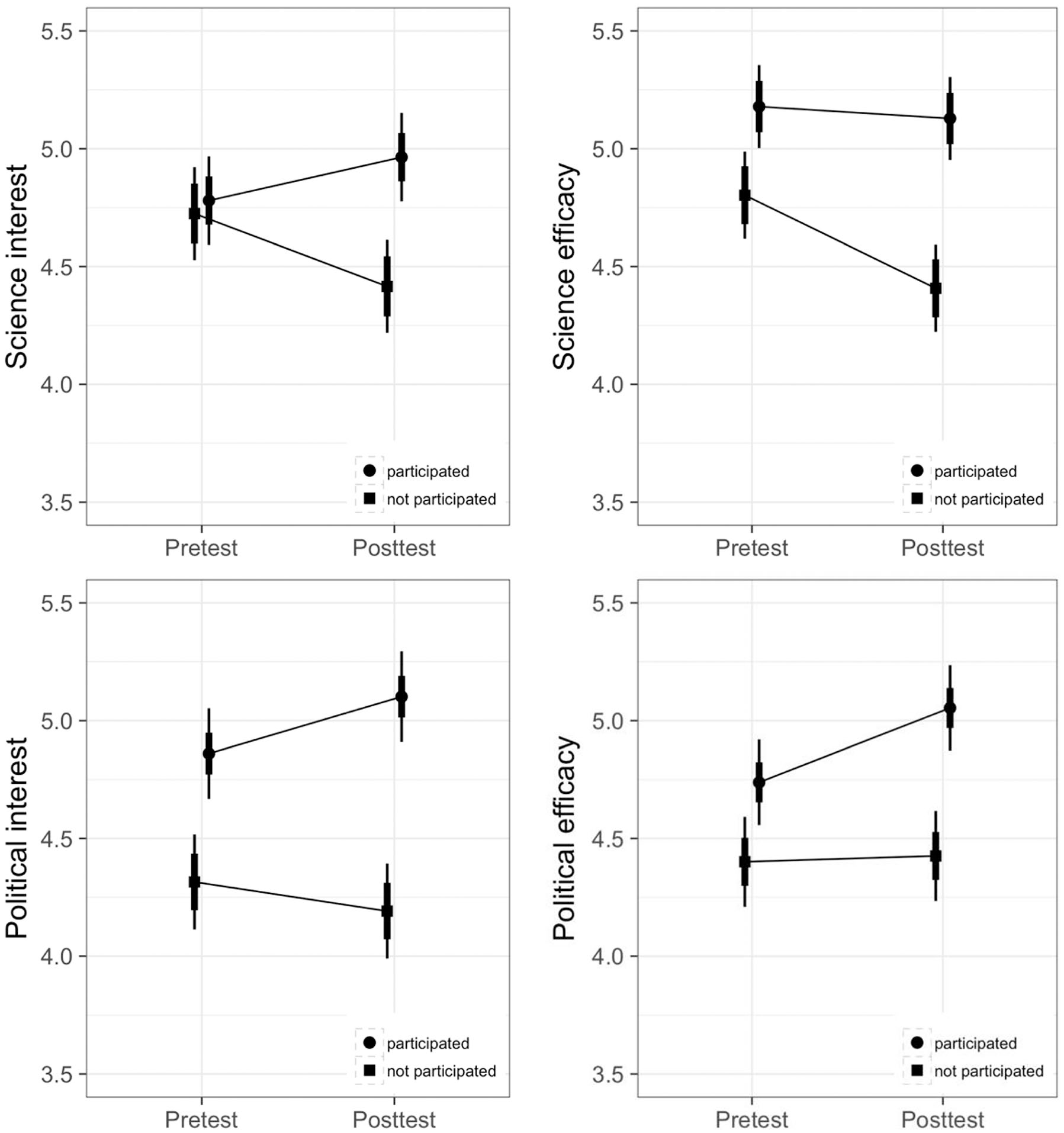
Effects of participation and non-participation in the project on science interest, science efficacy, political interest, and political efficacy.
The analysis revealed no main effect of time on science interest, b = −0.05, t(449) = −0.84 p = .40. The interaction of participation and time, however, was highly significant, b = 0.49, t(448) = 4.23, p = .001. Splitting up the data into participants and non-participants revealed a significant positive change in science interest for those who had participated in the project, b = 0.18, t(235) = 2.50, p < .05. These findings provided support for H3a. Further analysis revealed a significant negative effect of non-participating on science interest, b = −0.31, t(213) = −3.34, p <.001. Figure 3 shows changes of the correlation between participation and science interest over time as well as the within-subject change in science interest.
We found a significant negative main effect of time on science efficacy, b = −0.21, t(445) = −3.61, p < .001. Again, the interaction of participation and time was highly significant, b = 0.34, t(444) = 2.92, p = .01. Against our expectations, however, we did not find a positive effect for actively participating in the project, b = −0.05, t(233) = −0.65, p = .52. Hence, we reject H3b. For non-participants, however, we found a significant negative effect of time, b = −0.39, t(211) = −4.46, p <.001.
We did not find a main effect of time on political interest, b = 0.07, t(449) = 1.27, p = .21. However, the interaction effect of participation and time on political interest was highly significant, b = 0.37, t(448) = 3.46, p < .001. Splitting up the data into participants and non-participants revealed that active participation had a positive effect on political interest, b = 0.24, t(235) = 3.80, p < .001. This finding supports H4a. We did not find a significant effect for those who had not participated in the project, b = −0.12, t(217) = −1.44, p = .15.
We found a positive main effect of time on political efficacy, b = 0.18, t(446) = 3.72, p < .001. The interaction of participation and time had a significant effect on political efficacy, b = 0.29, t(445) = 3.07, p < .01. For participants, time had a positive effect on political efficacy, b = 0.32, t(235) = 5.17, p < .001. This supports H4b. For non-participants, we found no effect on political efficacy, b = 0.02, t(212) = 0.34, p = .74.
Discussion
Citizen Science has been recently discussed as a promising and innovative approach in youth education (e.g., Ballard et al., 2017; Bonney et al., 2014; Koomen et al., 2018; Phillips et al., 2018). This study tested predictors and attitudinal effects of participating in a youth citizen social science project. We find that certain groups of students were more likely to participate and that active participation may indeed have positive effects on students’ scientific attitudes. The more alarming findings of this study, however, suggest that non-participation may have negative effects on students’ scientific attitudes.
In terms of predictors of participation, the study indicated that those with higher political and science interest as well as science efficacy were significantly more likely to participate in the citizen science project via learning motivation. We did not find a significant indirect relation between political efficacy and participation via learning motivation. The reason might be that the goal of the project was to make a contribution to scientific research rather than to a political change. Furthermore, we found that only science efficacy was positively related to participation via reward motivation. This finding indicates that providing a competitive award may not necessarily stimulate citizen science participation independently from prior scientific involvement. Young people who already feel scientifically empowered may still be more likely to participate, because they may perceive higher chances to succeed (Bandura, 2006). Interestingly, we found strong evidence that female students were more motivated to learn and more likely to participate in the project. This result is in line with past research, showing that females are more intrinsically motivated and self-determined to succeed in education and to participate in voluntary activity (Karniol, 2003; van Goethem et al., 2012).
In line with previous findings, participation in the project significantly increased efficacy related to the topic (politics) in our sample, but did not increase science efficacy (Brossard et al., 2005; Druschke & Seltzer, 2012; Price & Lee, 2013). In our case, this might be related to the fact that the students only contributed to the data collection, which is only a small part of the scientific process. However, results also indicate that those who participated in the project developed a higher interest in both science and politics. As our mediation analysis indicated, interest is a key antecedent of learning motivation and may hence be an important driver for future science participation. Interestingly, we found negative scientific outcomes for those who did not participate in the project. Both science interest and efficacy dropped significantly among those who did not participate in the project. One reason for this drop might be that non-participants observed their classmates making successful science experiences, while they did not make any of such experiences themselves. However, individuals define their efficacy levels in relation to other people (see Pajares, 2006). Thus, as non-participants have seen their classmates to potentially increase their efficacy through active participation, they may have reported even lower efficacy levels themselves. Furthermore, and in line with cognitive dissonance theory and psychological reactance, non-participants may have tried to legitimize their opting out by reporting lower levels of science interest.
As Figure 3 shows, the correlations between participating in the project and political and scientific attitudes became stronger over time. This indicates that the gaps in scientific and political involvement between those who participated and those who did not became larger. The potential negative effects on science interest and efficacy for those who did not participate are of critical concern, as lower levels of both efficacy and interest in science may decrease young people’s engagement with scientific topics. Taken together, we find some evidence for a “Matthew effect,” indicating that project-based activities in school may not compensate for socialization at home. That is, the volunteer-based self-selection process may lead to a situation in which individuals with high initial levels of involvement may further increase their involvement through active participation. Others, with initial low involvement, may choose not to participate and may hence not be affected or even decrease their initial involvement through not participating.
In general, our research supports the notion that including citizens might be an important new approach to advance science enthusiasm and literacy in school. However, low threshold active participation may be a prerequisite to leverage the potential of citizen science in educational endeavors. For example, more collaboratively oriented projects, in which researchers actually visit schools, provide instructions, and accompany the project, may be more suited to avoid increasing gaps (Crall et al., 2013). For instance, Nicosia et al. (2014) conducted a project in which students were involved in all steps of the research process. Their findings suggest significant main effects on the understanding of scientific research and investigation, which might also be related to the fact that the entire class was involved at least to some degree in the research project.
Based on our findings, researchers and teachers who implement citizen science projects with students are advised to choose topics that strongly relate to the lives of young people and speak to existing interests. For example, we know that environmental issues or animal protection are important issues for young people (Binder et al., 2021). These topics may provide a fruitful foundation to conduct participatory social research and design citizen science projects which attract many young people. For example, young people could collect data on environmental movements on social media, sample opportunities for environmental protection in their local environments, or monitor political discussions around this issue (see Kythreotis et al., 2019; Paul & Palfinger, 2020). Moreover, it seems to be important to create strategies that lead to broad participation among young people, to avoid growing gaps. For example, by providing a broad range of activities students can choose from and integrate these activities in daily schoolwork. Only if young people actively participate, citizen science projects may function as an equalizer and increase future engagement with science on a broader level.
Limitations
Some limitations should be noted. First of all, the findings presented here are limited to the specific context and our sample. We have investigated the predictors and effects of participation within the scope of a social science research project specifically related to politics. Moreover, our findings are limited to the sample we used, which was composed of high school students in Austria. In fact, students from college-bound high schools and females were overrepresented in our study, probably due to the self-selection process, in which school classes could voluntarily sign up for participation. Second, our data remain observational and do not provide robust causal evidence. This is especially true for the path model, which partly relies on mere correlational observations. Third, the observed effects were rather small, similar to others studies which look at the effects of civic educational initiatives (see Manning & Edwards, 2014). This might be due to the fact that our project was comparably short and there is reason to believe that longer projects might produce larger effects (Nicosia et al., 2014). Related to this, our pre- and post-measurements indicate that initial differences in interest and efficacy between participants and non-participants are striking. Thus, one could also argue that we have observed natural dynamics for these groups which might even have occurred independently from project activities. However, this scenario seems unlikely, considering the short period of time in which we have observed these changes.
Conclusion
This study indicates that while citizen science participation exerted positive effects on young people’s attitudes and thus their future motivation to engage in (social) science-related activities, the effects of non-participation were somewhat alarming. Non-participants did not only start out with much lower science interest and efficacy levels. In fact, they decreased their interest and efficacy levels in the course of the project. As a consequence, we have observed a widening gap in interest and efficacy levels between participants and non-participants. The future challenge for implementing citizen science in science education may hence be to specifically encourage groups of students which possess less initial scientific involvement. One way is to implement curriculum-based citizen science projects, which by definition require the participation of the whole class. Such curriculum-based projects may be crucial to create an initial involvement among students and may be later combined with or extended to participation in large-scale citizen science projects.
Footnotes
Declaration of Conflicting Interests
The author(s) declared the following potential conflicts of interest with respect to the research, authorship, and/or publication of this article: This work was supported by Austrian Federal Ministry of Science, Research and Economy.
Funding
The author(s) received no financial support for the research and/or authorship of this article.
