



Abstract
Migration can affect the physical, mental, emotional, and social wellbeing of individuals and families. This study provides an overview of interventions aimed at improving the wellbeing of young migrants. It identifies knowledge gaps and provides direction for future research. The review process comprises a systematic search of six academic databases, and websites for relevant peer-reviewed and gray literature on the topic. A total of 2,911 records were identified, of which 28 studies met our eligibility criteria for inclusion. Thematic analysis comprised of the description of study characteristics and outcome themes. EPHPP and CASP tools were utilized to assess the methodological quality of studies. The review findings indicate a number of approaches with varying effectivity, however, arts, music, and sports programs showed good results for youth across all migrant groups. Our findings call for further and more high-quality evaluation research, with longitudinal designs that ideally include stakeholder collaboration.
Background
The last 50 years have seen a steady and significant increase in the number of migrants pursuing opportunities in immigrant-receiving Western industrialized countries (Bates-Eamer, 2019; Udah et al., 2019). As of mid-2019, there were an estimated 272 million international migrants worldwide. Of these, 30.9 million (11.4%) were aged 15 to 24 years (United Nations, 2019). Forcibly displaced people, such as refugees and asylum seekers accounted for a total of at least 82.4 million (United Nations High Commissioner for Refugees [UNHCR], 2021) and 86% of this number are hosted in developing countries (UNHCR, 2021). In addition, around half (42%) of forcibly displaced people are under the age of 18 (UNHCR, 2021). These figures show that young people make up a large proportion of the total migrant stock globally.
Research shows that migrant youth experience poorer wellbeing than their non-migrant peers. A cross-sectional follow-up study (1996/97–2012/14) by Kuhn et al. (2020) found that compared with non-migrant youths, international young migrants had higher levels of being overweight/obese (23%/52%) and higher risks of stage 1 or higher hypertension (7%/13%). Furthermore, international young migrants showed above-average levels of depressive symptoms (+0.220 SD, 95% CI [0.098, 0.342]; Kuhn et al., 2020).
The most vulnerable group are those young people who have experienced trauma through war and are forced to leave their homelands (Miller et al., 2006). Betancourt et al. (2017) compared levels of trauma exposure, mental health needs, and service utilization in refugee, immigrant, and non-migrant US youth, and found refugee youth to have significantly more types of trauma exposure than either US-origin youth (p < .001) or other immigrant youth (p = .001). Compared with non-migrant peers, refugee youth had higher rates of community violence exposure, dissociative symptoms, traumatic grief, somatization, and phobic disorder. Interestingly, the group of refugee youth had comparably lower rates of substance abuse and oppositional defiant disorder (ps ranging from .030 to <.001; Betancourt et al., 2017).
Risks and Challenges Faced by Migrant Youth
Regardless of their decision to leave their country of origin, migrant youth face multiple boundaries and challenges as they settle in a new country. For example, in Australia, despite the provision of well-designed settlement services for new entrants, the exclusionary nature of the citizenship laws, and the role of the state (polity) in constructing “otherness” can cause increased vulnerability for many young migrants (Udah, 2019). Hence, depending on the policies and processes supporting these young people, the migration experience can be either an opportunity or a risk to their development (United Nations, 2016).
During their settlement in the host country, young migrants can be confronted with dominant societal ideologies about assimilation and homogenization, putting pressure on them to either mold identities that conform to the norm or face being excluded (Blackledge & Pavlenko, 2001; Piller, 2016). They may experience bullying, discrimination, and racism at school which compounds issues with identity and belonging (Correa-Velez et al., 2010).
Amid these societal and cultural challenges, young people may be dealing with language and educational issues (Paudyal et al., 2018; Ziaian et al., 2018) and family separation. When migrations take place in a stepwise fashion, with one parent moving to the destination country first, and others following at later intervals, children experience disruptions to their caregiver relationships. Firstly, they are separated from the parent that went ahead and, upon their own migration, they are separated from the adults who took the place of that parent in the source country. Thus, family separation and reunification can cause short-term adjustment problems such as anxiety and depression for young migrants (Suârez-Orozco et al., 2002; Suárez-Orozco et al., 2011).
All these pressures can cause high levels of acculturation stress, placing young people at risk of developing symptoms of depression, anxiety disorder, and Post Traumatic Stress Disorder (PTSD; Wong et al., 2009). The impacts can be long-term and transgenerational. Even those with a second- or third-generation migrant background can experience the long-term impacts of acculturation stress, resulting in lower mental health and general wellbeing (Kouider et al., 2014; Nguyen et al., 2011).
Promoting the Wellbeing of Migrant Youth
The wellbeing of young migrants depends on a fine balance of support. Their families, friends, ethnic, and wider community are all valuable sources of resilience and assistance in dealing with issues such as language barriers, lack of employment opportunities, and difficulties accessing further education (Joyce & Liamputtong, 2017). Such support structures not only help young people to cope with these issues, but they also strengthen their social capital and enhance their wellbeing (Joyce & Liamputtong, 2017). However, while family support can be a positive influence on this group’s wellbeing, conversely, changing family dynamics poses a threat to their successful settlement (McMichael et al., 2011). Providing timely and effective wellbeing interventions for young migrants is therefore of the utmost importance in helping them to negotiate the challenges of settlement and to flourish in the new country.
Looking at the concept of wellbeing from a whole-of-body-and-mind experience and guided by the World Health Organisation (2014) definition of mental health, we define wellbeing as a good balance between mental, physical, emotional, and spiritual health. To have arrived at optimal wellbeing, a person is not only free from disease, but their basic human needs are also met, and they have the skills to behave in ways that promote their wellbeing. Wellbeing is the cornerstone of a fruitful and productive life, where people can maximize their potential and make meaningful contributions to society (World Health Organisation, 2014). Some of the established wellbeing indicators as they relate to migrant youth include, but are not limited to, employment, education, the standard of living, health, social cohesion, safety, and crime (Harttgen & Klasen, 2009).
Theoretical Framework—Capabilities Approach
Although migrant youth wellbeing is an important area of interest for migration and policy research, it is still under-theorized. One exception is Nussbaum’s (2011) capabilities approach, a new theoretical framework for assessing the wellbeing of individuals. According to Nussbaum (2011), wellbeing is understood in terms of migrant youth capabilities, that is, their real opportunities based on their personal and social circumstances. Assessing migrant youth wellbeing is, therefore, based on what they are able to do or be (Nussbaum, 2001, 2011); for example, being alive, being healthy, moving, reading, writing, and taking part in community life. Nussbaum’s capabilities approach is important when considering the dignity of human life, here, the kind of life young migrants can pursue and effectively are able to lead (Robeyns, 2016). This implies that the wellbeing of migrant youth depends both on what they do and can be in the present as well as in the future and how the latter is influenced by the former (Domínguez-Serrano et al., 2019)., In accordance with Nussbaum (2011), we argue that the freedom to achieve wellbeing is of primary importance.
The capabilities approach is a framework to better understand migrant youth conceptualizations of wellbeing. It tells us what information, that is, relevant capabilities necessary to have a good life, we should examine in order to judge the progress of migrant youths’ life and settlement (Robeyns, 2016). As Nussbaum (2001) argues, governments should improve everyone’s quality of life by supporting the following core human capabilities: enabling people to live a standard-length human life; ensuring bodily health and integrity; providing education; emotional development; critical reflection; social interaction; co-existence; recreational activities; and political participation.
The Rationale for This Review
As we write this review, the world is grappling with the coronavirus pandemic, and the ramifications are manyfold for migrants and refugees. While the full scale of the virus and its impacts are still unknown, we have already witnessed strict restrictions on the movement of people across borders; magnified inequality for marginalized groups as a result; and an increase in racism and discrimination for groups who are considered to be potential carriers of the virus. The pandemic adds a further layer of complexity to the wellbeing of young migrants and refugees and makes this review and its outline for future research highly relevant.
This systematic review seeks to provide a comprehensive overview of the recent and relevant literature on effective and evaluated wellbeing promotion interventions for migrant youth, to guide practice in this area. Our broad search across diverse groups of youth migrants was aimed at gaining an understanding, not only of the range of wellbeing interventions being offered, but also of those interventions that target particular groups in order to highlight whether any groups might be missing out. This review is warranted for at least two reasons. Firstly, a large proportion of existing reviews are conceptual and descriptive, with a focus limited to specific migrant issues, populations, or settings (Barrie & Mendes, 2011; Botfield et al., 2016; Connor et al., 2014; Demazure et al., 2018; Ehntholt & Yule, 2006; Nocon et al., 2017; Streitwieser et al., 2019; Sullivan & Simonson, 2016; Tyrer & Fazel, 2014; Vossoughi et al., 2018). Secondly, there are few rigorously designed and executed systematic reviews that include a transparently reported study quality appraisal (Borsch et al., 2019; Botfield et al., 2018; D’Abreu et al., 2019; Nakeyar et al., 2018; van Os et al., 2018).
Defining Migrant Youths
This review adopted the United Nation’s definition of youth (“without prejudice to other definitions by Member States”), being those aged between 15 and 24 years; meaning that anyone under the age of 15 was classified as a child. The broad category of “migrant youth” was deliberately chosen to include studies that focused on a variety of migrants, including those that migrated voluntarily and for economic reasons; political or forced migrants such as refugees and asylum seekers; and other forcibly removed migrants from countries in crises that do not fit the definition of refugee or asylum seeker status. Thus, first- and subsequent-generation young migrant people are included in this review.
Economic migrant youth are those who move or cross borders voluntarily to seek new opportunities, for example, to earn money, study, or join the family. This group of migrant youth has a choice whether they remain in the receiving country or return to their native country (Cortes, 2004). In contrast, refugees and asylum seekers are political or forced migrants who have a well-founded fear of being persecuted based on race, religion, nationality, ethnicity, or membership of a particular social or political group, and are afraid to return home (Bates-Eamer, 2019; United Nations High Commissioner for Refugees, 2010). The distinguishing factor between asylum seekers and refugees is that a refugee’s claim has been recognized under the 1951 refugee convention whereas an asylum seeker is under investigation to prove their claim (Amnesty International, 2020).
Forcefully displaced migrant youth feel compelled to leave their country because of poverty, political unrest, gang violence, natural disasters, environmental degradation, nuclear accidents, global pandemics, or other serious circumstances that exist in their home country (Bates-Eamer, 2019; Martin, 2017). There is a significant gap in the laws and policies concerning such migrants from countries in crisis because they do not quite fit the definition of refugees, hence are subject to limited protection (Galli, 2020; Martin, 2017). Amnesty International (2021) pledges that regardless of migrant status on arrival in the receiving country, any migrant must be entitled to have all their human rights respected and protected.
Across the different groups of migrant youth, all share similar challenges associated with acculturation (Bean et al., 2007). Cultural differences and language barriers expose migrant youth to racism, xenophobia, and discrimination (Amnesty International, 2021), as well as other forms of traumatic events such as abuse or community violence (Bean et al., 2007). Regardless of social background, a study of children of highly skilled African migrants found that race is constantly on the children’s and parents’ minds as they navigate life in a new country, with some parents reporting feeling overwhelmed and unprepared in supporting their children to deal with racial slurs, micro-aggressions (jokes, comments, and nicknames) and racial exotification (hair-touching and invasive questions about their bodies; Gatwiri & Anderson, 2020). Initially, migrant youth are likely to experience culture shock and loneliness on their arrival in the receiving country. Some of their short-term problems may include finding accommodation and employment, overcoming communication barriers, coping with different weather conditions, and dealing with transportation issues (Bansel et al., 2016). In the longer term, these young people may be subject to stereotyping, discrimination, and abuse at work or in society at large (Bansel et al., 2016).
Regardless of migrant status, all youth carry a fundamental hope for a better future for themselves and their families. They share similar aspirations with most young people in their receiving country, such as getting a secure and decent job; studying at a good university; getting a car; finding a partner; buying a home; and eventually having a family (Bansel et al., 2016). As migrant youth bring along intrinsic capabilities, wellbeing promotion support must build on these capabilities as well as young migrants’ perceptions of wellbeing (Nussbaum, 2001).
Methodology
This review aimed to provide an overview of the range and effectiveness of wellbeing promotion programs and interventions provided to young migrants who are destined to settle either in developed or developing countries, and the methodological quality of the studies reviewed. In conducting this review, we sought to know which groups, if any, missed out on receiving wellbeing promotion support during migration and/or settlement. To ascertain whether a new systematic review on migrant wellbeing interventions was warranted, we (a) conducted a scoping search on existing literature reviews and (b) searched the PROSPERO database for any planned reviews on this topic. Once we established the gap in the literature, we worked to reach a consensus on a research protocol and then registered it (PROSPERO CRD42019135119) before proceeding with the review. The review was guided by the following questions: What are the characteristics of existing wellbeing promotion programs for migrant youth? What are the reported outcomes of these programs? What is the methodological quality of the studies?
Inclusion/Exclusion Criteria
We included peer-reviewed and gray literature papers that focused on migrant youth, aged 12 to 24 years, published in the English language between 2000 and 2019. The studies must have either tested or evaluated the effectiveness of interventions or programs aimed at improving migrant youths’ physical and mental health or social, emotional, or economic wellbeing. We excluded conceptual, descriptive, or non-evaluative papers; papers that exclusively focused on early childhood, pre-school, and primary school children or adults; and papers that were concerned with the period before leaving the home country or internal migration.
Search Strategy
An experienced librarian in the field of the social sciences assisted in establishing a sound search strategy. The following databases were searched: Informit, ProQuest, Scopus, Emerald Insight, Sage, Wiley, and Google Scholar. The search string consisted of some or all of the following terms and was tailored to the specific requirements of individual databases/search engines: young OR “child and youth” OR adolesc* OR “unaccompanied minors” AND migrant* OR refugee* OR asylum* AND wellbeing OR well-being AND intervention* OR program* OR course* OR support OR development OR “skills development” OR group*.
Data Management and Study Selection
Author One (MH) exported all results from the database searches into the referencing management software program, Endnote. Additionally, entries from gray literature searches and reference list checks were created in Endnote and then duplicates removed. All steps of this process were documented in an Excel spreadsheet to ensure transparency and replicability. The initial screening of titles, and in some cases abstracts, to determine relevance was conducted by three co-authors (AA, MH, and NP). One author (MH) determined eligibility against the inclusion criteria; this was cross-checked by two authors (AA and NP) and any queries and disagreements were discussed amongst all three until consensus was reached.
Data Extraction and Analysis
One author (MH) extracted the data on study characteristics using a pre-designed data collection form. A second author (NP) cross-checked all reported outcomes and discussed any disagreements with Author One until consensus was achieved. Study characteristics were described and presented in tabular form (Supplemental Appendix C). Reported outcomes were thematically analyzed and presented in narrative form.
Study Quality Appraisal
The methodological quality of the included intervention studies was independently assessed by two authors (MH and NP) using two different tools according to the study type. Results were compared and discussed until consensus was achieved. Quantitative research studies were assessed with the Effective Public Health Practice Project (EPHPP, 2009) Quality Assessment Tool for Quantitative Studies. The EPHPP tool consists of eight components of rating: selection bias, study design, confounders, blinding, data collection methods, withdrawals and dropouts, intervention integrity, and analyses.
Qualitative research studies were subjected to the Critical Appraisal Skills Programme (CASP, 2018) Qualitative Research Checklist. The CASP tool assesses the applicability, reliability, and validity of published qualitative research according to a series of 10 questions concerned with the aim of the research, methodology, research design, recruitment strategy, data collection, relationships between researcher and participants, ethical considerations, data analysis, findings, and the value of the research. Studies that used mixed methods were assessed with both tools, respective to their quantitative and qualitative components.
Both quantitative and qualitative studies underwent a rigorous quality appraisal because their results are complementary. While the EPHPP tool seeks to establish the effectiveness, or the cause and effect of interventions as a basis for practice recommendations, the CASP tool assists in gaining insights and understandings that can extend or enhance the effectiveness of results and/or point to future effectiveness studies (Hannes, 2011).
Results
Our database and additional searches returned a total of 2,911 records. After the removal of 473 duplicates and 1,833 irrelevant items, we accessed the full texts of 605 papers to determine their eligibility for inclusion in our review. Of these 605 papers, 584 were excluded for the following reasons: (n = 265) conceptual, descriptive, non-evaluative papers; (n = 232) wrong age/migrant group; (n = 1) concerned with the period before leaving home country; and (n = 86) other. The manual searching of reference lists of relevant papers resulted in another 7 studies, bringing the total of included peer-reviewed studies to 28 (Figure 1).

PRISMA flow diagram.
Characteristics of the Wellbeing Promotion Studies
Of the 28 studies meeting our inclusion criteria, 17 were published between 2011 and 2019, and 11 from 2000 to 2010. The majority of studies reported on programs provided in developed countries and originated from Australia (n = 8), USA (n = 6), UK (n = 3), and one each (n = 1) from Iran, Germany, Sweden, Canada, and India. Two studies were collaborations between Uganda and Germany (n = 1) and Uganda and Italy (n = 1). Included studies covered a range of designs, including 3 randomized controlled trials (RCTs), 1 non-randomized controlled trial (CT), 1 cohort-analytic study, 10 case-control studies, 12 cohort studies, and 1 case study. These studies reported school, community, hospital, or refugee settlement-based interventions aimed at the improvement of psychosocial functioning; classroom behavior; school performance; acculturation and integration in general; career education; and the economic empowerment of young people with a migrant or refugee background. None of the studies reported on collaborations with stakeholders during the design stage of their interventions.
Approaches and Reported Outcomes
The types of outcomes described center around improving young migrants’ psychological and emotional wellbeing, economic empowerment, and education and employment outcomes. These outcomes are organized by the different approaches employed including music, writing, arts, and sports programs; empowerment and skills training; psychological therapies; and combinations of strategies and services.
Music, writing, arts, and sports
Eight (n = 8) studies assessed programs that utilized either music, the arts, writing, or sport to support young migrants in their acculturation and settlement. An extra-curricular music and arts therapy program was provided over 7 months to newly arrived immigrants and refugees in Australia. Participants reported an increased feeling of belonging to communities of practice within the school and the wider Australian community, as well as to a global music community (Marsh, 2012). A similar result was achieved by a music practice intervention comprising guitar lessons, singing, participant performances, and group discussions, provided to youth in a refugee camp in Greece over 5 weeks. Participants reported an increased sense of wellbeing and emotional expression, improved social relations, self-knowledge, positive self-identification, and a sense of agency (Millar & Warwick, 2019).
A school-based, expressive arts and learning program in Australia, called HEAL, that included arts and music therapy activities as well as lessons on self- and cultural identity, showed positive effects on the internal and external behavior of adolescents with a refugee background. While the results included moderate effect sizes for the reduction of behavioral difficulties, emotional symptoms, hyperactivity, and peer problems, authors suggested significant effect sizes were possible if a larger sample was used (Quinlan et al., 2016).
Another music therapy intervention in Australia, aimed at improving classroom behavior, resulted in significant changes over time for externalizing behavior concerning hyperactivity and aggression, but not for adaptive skills or school problems in general. Findings or trends regarding internalizing behavior, such as anxiety, depression, and somatization, were non-significant (Baker & Jones, 2006). While a 1-year drama therapy program in Canada reported no improvements in self-esteem or emotional and behavioral symptoms, participants in the intervention group did score lower mean levels of perceived impairment in terms of friendships, home life, and leisure activities. However, both the intervention and control groups showed significant increases in mathematics performance and improved oral French expression, which may be linked to the students’ self-reported perception of decreased impairment, which in turn improved their learning ability in these two domains (Rousseau et al., 2007).
A brief “writing for recovery” intervention in Iran showed positive short-term results in the processing of grief with a significant decrease in the total score of Traumatic Grief Inventory for Children (TGIC) symptoms in the treatment group, while the scores in the control group increased slightly (Kalantari et al., 2012). An Australian holistic sport-for-development program impacted positively on young refugees’ health and wellbeing. The study showed effectiveness in promoting cross-cultural relationships and building peer and prosocial relationships and behavior. Results included higher levels of other-group orientation; lower scores on peer problems; and significantly higher scores on pro-social behavior in participants of the treatment groups, with particular reference to boys (Nathan et al., 2013).
The “Advancing Adolescents program” in Jordan which included sessions of fitness, arts and crafts, vocational skills, technical skills, language skills, First Aid, and the design of community development project plans to build social capital, sustained positive effects on human insecurity for both groups over 11 months. Other results included medium to small effect sizes on distress and perceived stress. No program impacts were found for prosocial behavior or posttraumatic stress reactions, however, beneficial impacts were stronger for youth with exposure to four trauma events or more (Panter-Brick et al., 2018).
Empowerment and skills training
Empowerment may be viewed as a process that provides an enabling environment to young people with migrant and refugee backgrounds, to increase their access to education, work, and social opportunities so they can determine and advance their own futures (Asylum Seeker Resource Centre, n. d.; United Nations Social Development Network, 2012). Five studies (n = 5) were concerned with empowerment/skills training programs, provided either at schools, community halls, youth centers, or refugee camps. Three of them focused on young people only (Al-Rousan et al., 2018; Hughes & Scott, 2013; Yankey & Biswas, 2012), while one aimed at empowerment of the whole family (Stark et al., 2018).
In terms of social and economic empowerment, a 4-year study that assessed the effects of a full university tuition and a monthly living stipend for youth located in a Jordanian refugee camp provoked measurable positive effects on feelings of peace, security, and wellbeing; improvements in academic access; financial resources; and the psychosocial health of their family and community (Al-Rousan et al., 2018). In contrast, a larger-scale social empowerment program to reduce girls’ economic vulnerability, provided in a refugee camp in Ethiopia, found no difference between both groups in any of the domains 10 months after the intervention. Over the 10-month program, the girls met weekly to discuss varying topics, including interpersonal disagreement resolution, reproductive health, gender norms, safety planning, and money management. The intervention did not keep girls in school; nor did it influence girls who were not in school to return to education, work for pay, or to not engage in transactional sexual exploitation (Stark et al., 2018). The authors concluded that stand-alone social empowerment programs may not be adequate in reducing economic vulnerability for adolescent girls and suggested to either simultaneously implement such interventions with economic empowerment programs or allow for additional measures that address broader structural barriers (Stark et al., 2018).
A life skills training program in India, by Yankey and Biswas (2012), to enable young migrants to better resolve conflicts, showed positive results on stress experienced in varying life situations. For example, cognitive life skills, such as creative and critical thinking, significantly contributed to reducing stress related to school. However, improved social skills, such as effective communication and empathy, were better predictors not only of reduced school stress but also of future stress and leisure stress. Decision-making and critical thinking were significant predictors of reduced self-stress (Yankey & Biswas, 2012). A Thai program aimed at promoting positive family skills and interaction for young people showed positive results in the reduction of externalizing behavior and attention problems and a significant increase in protective psychosocial factors, however, no significant effects on their internalizing problems were reported. At the 6-months follow-up, caregivers reported maintained improvement on attention and externalizing problems, and the young people reported maintained improvement on externalizing problems and protective factors, however, young females showed significantly more internalizing problems than young males (Annan et al., 2017). A small study by Hughes and Scott (2013) assessed the usefulness of a career education intervention for refugee or humanitarian entrant students in Australia. The intervention improved their job interview skills and contributed to a better understanding of how to get a job, including knowledge of resources to assist with varying career concerns. Despite a trend toward, the career intervention did not significantly influence vocational identity or career choice certainty (Hughes & Scott, 2013).
Psychological therapies
Seven studies (n = 7) examined the effects of varying types of psychotherapeutic interventions. These interventions comprised targeted therapies such as cognitive behavioral therapy (CBT), eye movement desensitization reprograming (EMDR), and narrative exposure therapy (NET).
Findings across the three studies on the FRIENDS program in Australia, that utilized CBT, revealed consistent results (Barrett et al., 2000, 2001, 2003). Internalizing symptoms, including anxiety levels, decreased; and greater levels of self-esteem, improved outlook for their future, and lower levels of hopelessness were reported for participants in the treatment groups. These outcomes were sustained at 6-month follow-up (Barrett et al., 2000, 2001, 2003). Another trauma intervention in the UK, based on CBT sessions, resulted in a significant decrease in overall PTSD symptom severity and intrusive PTSD symptoms, and significant improvements in students’ overall behavior and emotional symptoms. However, post-treatment improvements were not maintained at 2-month follow-up (Ehntholt et al., 2005).
Based in a psychiatric hospital unit in Sweden, a trauma focusing therapy that comprised EMDR was combined with conversational therapy for adolescents and play therapy for children younger than 13 years. The authors reported increased levels of functioning that correlated with reduced posttraumatic stress systems (that are not specific to the disorder) and depression symptoms. However, the same results were not found for the symptoms specifically related to PTSD (Oras et al., 2004). Positive results were reported in both studies that assessed the effectiveness of KIDNET, a Narrative Exposure Therapy to reduce symptoms of PTSD and better process events and their consequences, applied to a small sample of Somali children residing in a refugee camp in Uganda. PTSD symptoms were either reduced to a third of the original score, were considered borderline, or reduced to zero. Symptoms of avoidance, intrusion, or hyperarousal were also reduced to zero in the case study of one individual (Onyut et al., 2005; Schauer et al., 2004).
A combination of strategies/services
Eight studies (n = 8) reported on programs or services that provided a range of strategies to improve the mental and psychosocial health of young refugees. A US school-based mental health service that offered help with relationship-building, outreach services, comprehensive clinical and case management services, CBT, relaxation techniques, supportive therapy, and psychoeducation, was evaluated over 3 years. Researchers linked positive results with greater quantities of strategies applied (Beehler et al., 2012). For example, greater quantities of CBT and supportive therapy increased functioning, and greater quantities of coordinating services decreased symptoms of PTSD. In addition, trauma-focused CBT (TF-CBT) services were associated with both improved functioning and decreased PTSD symptoms (Beehler et al., 2012). The SHIFA Project, a multi-tiered program that provided broad-based prevention and community resilience building to the community and parents; more targeted, school-based prevention and stress-reduction interventions to an identified at-risk group; and intensive intervention for those with significant psychological distress, reported overall improvements in mental health and resources across all tiers. Young people with higher mental health needs were appropriately matched with higher intensity services. Significant improvements in symptoms of depression and PTSD were reported in top tier participants, correlating with the stabilization of resource hardships. This US program was assessed over 1 year (Ellis et al., 2013). Similarly, a UK mental health service that provided a range of strategies including family work (with or without the child); individual therapy (psychodynamic, supportive); and group work (for the children/adolescents or parents) with additional in-home and crisis intervention work, reported positive results on the hyperactivity score in all refugee children in the treatment group (Fazel et al., 2009). Albeit Fazel et al. (2009) investigated children and young people between the ages 5 and 18 and we included their study because 57% of participants were aged between 10 and 18. The study design controlled for age and gender confounders which enabled us to focus on the findings associated with our age range of interest. Those 10- to 18-year old’s who displayed a wide range of emotional and behavioral problems, and were directly seen and treated by the service, also showed improved scores in peer problems. This service was assessed over 1 year (Fazel et al., 2009). A group-based mental health intervention for unaccompanied minors (UMs) in Finland that offered psychoeducation; information on wellbeing; coping resources; the tree of the future exercise; and topics identified by participants, such as sleep, pain, intimate relationships, emotions, and anger, found no effect of the intervention on the mental health of participants. However, the authors noted that engagement with the immediate social environment and taking part in daily activities was associated with improved wellbeing (Garoff et al., 2019). A Norwegian group-based intervention, aimed at improving participants’ feelings of safety and stabilization, anxiety and stress management, emotion regulation skills and trauma education, reported significantly improved long-term life satisfaction and hope for the future (Meyer DeMott et al., 2017). A 12-week psychosocial support program in Germany, that offered a combination of individual, family, and group sessions on trauma- and grief focusing therapy; verbalizing techniques; relaxation techniques; painting; playing and acting; and fantasy journeys, discussions, and psychoeducation about trauma and trauma reactions, showed significant improvement in psychosocial functioning, reduction in posttraumatic, anxiety and depressive symptoms, and reduction in PTSD diagnoses. No change was recorded in the number of patients with PTSD that had a high rate of comorbid symptoms (depression and anxiety) as well as a history of severe traumatization (Möhlen et al., 2005). A manualized group intervention in Sweden, based on TF-CBT and varying other strategies, for example, EMDR, sleep hygiene, relaxation, breath control, drawing, writing, and self-regulation reported significant decreases in PTSD and depression symptoms (Sarkadi et al., 2017). An intervention based on mindfulness exercises, yoga, meditation, and psychoeducation reported medium effects on the reduction of negative affect and the improvement of positive affect, and large effects on the reduction of symptoms of depression. Participants who completed the training incorporated the new mindfulness exercises into their repertoire of coping strategies (Van der Gucht et al., 2019).
The Methodological Quality of the Included Studies
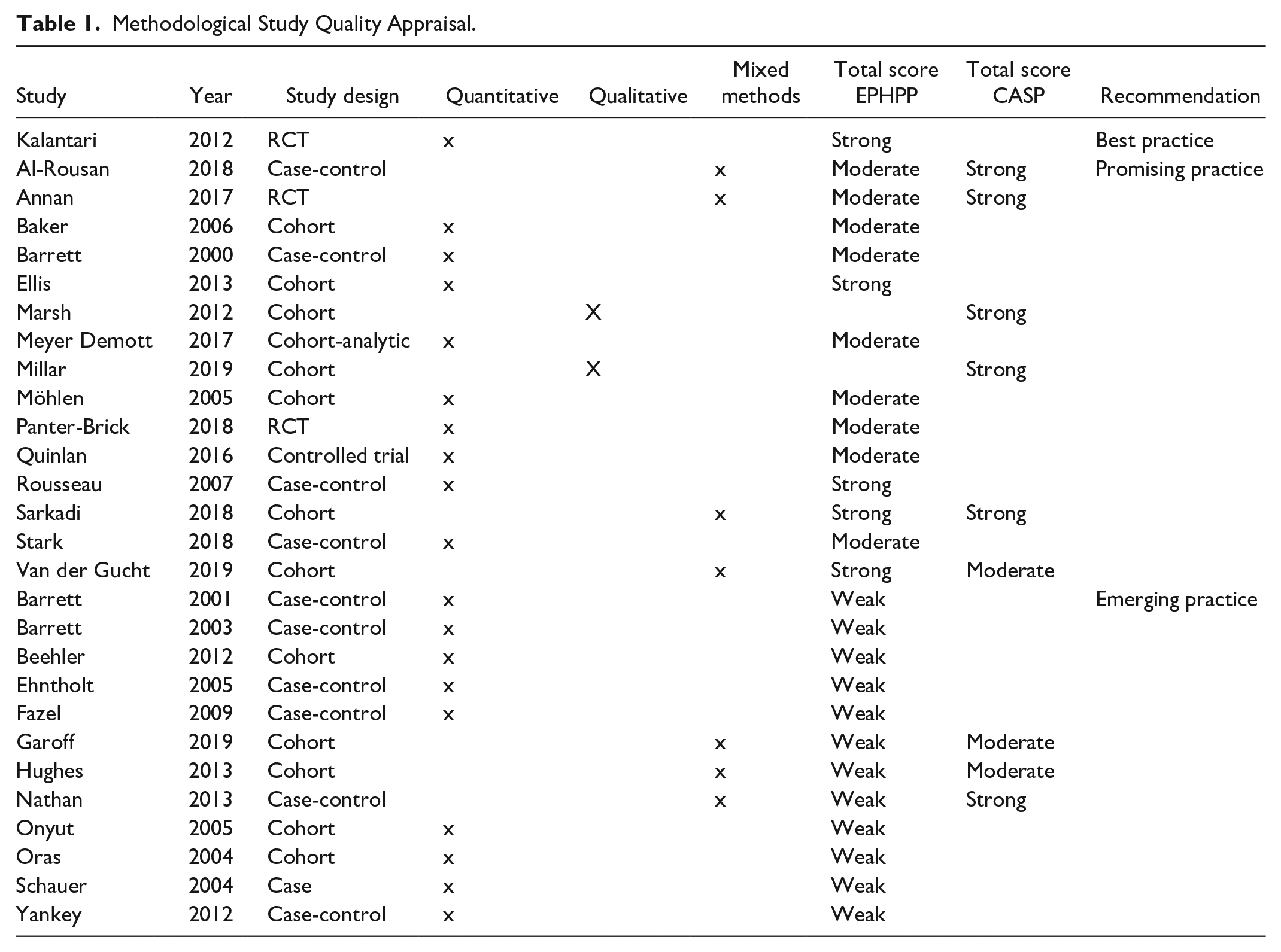
Of the 28 studies, 19 used quantitative methods; 2 used qualitative methods, and 7 were mixed-methods studies. As previously mentioned, quantitative studies were scored with the EPHPP tool, qualitative studies with the CASP tool and studies that employed mixed methods were scored with both tools (Table 1).
Methodological Study Quality Appraisal.
Quantitative studies
The assessment of quantitative research studies (n = 19) with the EPHPP tool resulted in three studies scoring “strong” (Ellis et al., 2013; Kalantari et al., 2012; Rousseau et al., 2007), seven “moderate” (Baker & Jones, 2006; Barrett et al., 2000; Meyer DeMott et al., 2017; Möhlen et al., 2005; Panter-Brick et al., 2018; Quinlan et al., 2016; Stark et al., 2018), and nine scoring “weak” (Barrett et al., 2001, 2003; Beehler et al., 2012; Ehntholt et al., 2005; Fazel et al., 2009; Onyut et al., 2005; Oras et al., 2004; Schauer et al., 2004; Yankey & Biswas, 2012). The scores were evaluated according to the EPPHP global rating scale of “strong” = no weak ratings, “moderate” = one weak rating, and “weak” = two or more weak ratings.
Amongst the studies that achieved a moderate overall score, the areas where they performed well included: a description of whether confounders were being controlled in the design or analysis of the study; the reliability and validity of the data collection tools; and the strength of the study design in terms of bias, for example, the existence of a control group and the allocation of participants to both groups. The areas that rated lowly in almost half of the papers in this category (n = 9) were: (a) whether assessors were described as blinded to which participants were allocated to the treatment and control group, and study participants were not aware of the research question (Barrett et al., 2003; Beehler et al., 2012; Fazel et al., 2009; Meyer DeMott et al., 2017; Möhlen et al., 2005; Onyut et al., 2005; Oras et al., 2004; Quinlan et al., 2016; Stark et al., 2018); and (b) whether there was discussion of the numbers and reasons for dropouts and withdrawals (Baker & Jones, 2006; Barrett et al., 2000, 2001, 2003; Beehler et al., 2012; Ehntholt et al., 2005; Panter-Brick et al., 2018; Yankey & Biswas, 2012; Supplemental Appendix A).
Qualitative studies
The assessment of the two (n = 2) qualitative research studies revealed very good overall results with both studies rated as “strong” (Marsh, 2012; Millar & Warwick, 2019). This score was achieved by having 8 and 9 “yes” scores, respectively, out of a possible 10 (Supplemental Appendix B).
Mixed methods studies
The assessment of the mixed methods studies (n = 7) with the EPHPP and CASP tools resulted in one study scoring “strong” across both domains (Sarkadi et al., 2017). One study scored “strong” on its quantitative and moderate on its qualitative part (Van der Gucht et al., 2019). Two studies scored “strong” on their qualitative and moderately on their quantitative part (Al-Rousan et al., 2018; Annan et al., 2017). Nathan et al. (2013) scored “strong” on their qualitative part and, while they received a “weak” overall score for their quantitative part, they did demonstrate strength in the domains of selection bias, study design, and data collection methods. Two studies (Garoff et al., 2019; Hughes & Scott, 2013) were rated as “moderate” in their qualitative part and “weak” in their quantitative part. However, within that overall “weak” score for the quantitative part, Hughes and Scott (2013) demonstrated strength in data collection domain and Garoff et al. (2019) scored “strong” in the four domains of study design, data collection, confounders, and withdrawal/dropouts (Supplemental Appendices A and B).
Table 1 provides an overview of the results of our study quality appraisal and recommendations for practice. In alignment with the “Canadian Hierarchy of Promising Practices Evidence,” we categorized included studies into the three areas: best practice (RCTs with high EPHPP scores), promising practice (all other study designs that scored moderate to strong across both tools), and emerging practice for those with weak scores (Bainbridge et al., 2018; The Homeless Hub, 2019).
Discussion
This systematic review sets out to examine interventions from around the globe, aimed at improving the wellbeing of migrant youth. The included studies were reviewed for evidence of intervention effectiveness and identification of groups that may miss out on receiving wellbeing support. The studies were also subjected to a quality appraisal process to provide transparent information on the strengths and limitations of their study designs.
Most studies occurred in developed countries and were published during the last decade. The interventions involved expressive arts therapies, writing therapy, a sports program, empowerment and skills training, psychological therapies, and multimodal approaches to support the wellbeing of migrant youth during their migration and integration in receiving countries. The interventions varied in effectiveness. One writing for recovery therapy program, was identified as best practice (Kalantari et al., 2012), while further 15 studies were considered as promising practice (Al-Rousan et al., 2018; Annan et al., 2017; Baker & Jones, 2006; Barrett et al., 2000; Ellis et al., 2013; Marsh, 2012; Meyer DeMott et al., 2017; Millar & Warwick, 2019; Möhlen et al., 2005; Panter-Brick et al., 2018; Quinlan et al., 2016; Rousseau et al., 2017; Sarkadi et al., 2017; Stark et al., 2018; Van der Gucht et al., 2019). The remaining 12 studies are deemed emerging practice (Barrett et al., 2001, 2003; Beehler et al., 2012; Ehntholt et al., 2005; Fazel et al., 2009; Garoff et al., 2019; Hughes & Scott, 2013; Nathan et al., 2013; Onyut et al., 2005; Oras et al., 2004; Schauer et al., 2004; Yankey & Biswas, 2012).
While all the studies reported some wellbeing outcomes for migrant youth, the evidence indicates that music, arts, and sports intervention programs are beneficial for all youth, especially for young people with exposure to traumatic events. These programs promote a sense of belonging, agency, emotional expression (Baker & Jones, 2006; Ehntholt et al., 2005; Marsh, 2012; Millar & Warwick, 2019; Nathan et al., 2013; Panter-Brick et al., 2018; Quinlan et al., 2016), and academic performance (Rousseau et al., 2007). Consistent with Martha Nussbaum’s (2011) capabilities approach, the provision of such interventions affords migrant youth personal agency over their lives as they are encouraged to express themselves through these mediums. Positive outcomes such as behavioral changes, feelings of belonging, increased life satisfaction and hope, build the foundation for improved wellbeing as perceived by the participants.
Despite recognition that families are an important support for young people in the migration process (Lipič et al., 2018), we only found six studies that included families, caregivers, and the community as participants in their intervention design (Annan et al., 2017; Ellis et al., 2013; Fazel et al., 2009; Möhlen et al., 2005; Sarkadi et al., 2017; Stark et al., 2018). The programs provided a range of support strategies, including family education on trauma; psychosocial support; skills development as a method of prevention or to build resilience in parents; and the promotion of positive parenting skills, communication, and interaction. These strategies are good examples of a holistic approach to easing the challenges young migrants face. There remains a need for more interventions of this nature.
Considering that language acquisition has been acknowledged as a key driver for the social and economic integration of migrants, and employment uptake is associated with increased migrant self-sufficiency and wellbeing (Haque, 2010), we found few studies that focused on these areas (Hughes & Scott, 2013; Rousseau et al., 2007). This is an important gap in the literature and, as per Joyce and Liamputtong (2017), we argue that young migrants need to be supported when dealing with problems such as language barriers, finding employment, or accessing further education.
The majority of included studies (86%) focused either on refugees or asylum-seeking migrant youth. Among those, four studies concentrated on UMs (Garoff et al., 2019; Meyer DeMott et al., 2017; Sarkadi et al., 2017; Van der Gucht et al., 2019). The remaining four studies (14%) focused on combinations of immigrant and refugee youths (Marsh, 2012; Rousseau et al., 2007), migrants and displaced youths (Annan et al., 2017), and first and second generation migrant youths (Beehler et al., 2012). These findings indicate an important gap in the wellbeing interventions for unaccompanied migrant youths and those young people that migrate for reasons related to family reunion, work, study, or lifestyle. However, the focus on UMs may increase as this particularly vulnerable group of young people grows in numbers (Ustymenko, 2020).
Also, the studies reviewed did not explicitly report any collaboratively co-designed activities with communities, institutions, and services including young migrants and refugees that are affected by the programs offered (Graham et al., 2018). We do acknowledge that the consultation of young migrants and refugees severely affected by war and trauma may not always be practical. At the same time, for those young migrants that are removed from immediate dangers and stress and have settled in a place of safety such as the host country, stakeholder consultation may be a feasible strategy to incorporate the needs of those affected by the research.
This review also highlighted the role and treatment of control groups in the program designs. Only 5 of the 16 studies that utilized a control group ensured that these participants gained access to the intervention, either after a short waiting period or when the treatment group had finished. While not being considered for the intervention at all, participants in control groups were seen to have suffered from significant increases in anxiety symptoms (Barrett et al., 2000), decreased self-esteem, a greater sense of hopelessness (Barrett et al., 2001), and increased scores in grief symptoms (Kalantari et al., 2012). In line with Nussbaum’s (2011) theory, migrant youth in those control groups that missed out on the interventions were being deprived of their opportunity to utilize their capabilities to improve their mental and emotional wellbeing. Given the challenging circumstances that some migrant youth face, including their mental health, missing out on an intervention would appear to be of ethical concern. These findings highlight the sensitive nature of humanitarian research and raise ethical and moral considerations that need to be addressed during the design of any research study (Street & Luoma, 2002).
Limitations and Future Directions
A strength of this study is its broad scope and the knowledge it provides about the diverse range of interventions that can be helpful for migrant youth. However, this strength also represents a limitation as it difficult to provide a meta-analysis and draw firm conclusions about how the differing interventions might work in different contexts. There remains a need for more research incorporating longitudinal and rigorous evaluation designs. Future interventions should also ideally embrace the UNHCR (2009)recommendation that the integration of migrants and refugees should be a collaborative process of participatory and community development approaches, “engaging local communities, institutions, and refugees alike in the design, implementation, and evaluation of integration policies and programs” (UNHCR, 2009). In other words, when designing a research project, researchers, and knowledge users should work in collaboration to achieve outcomes that benefit the study population and, possibly, society at large. All parties involved should be viewed as experts who bring knowledge and skills of equal value to the research team (Graham et al., 2018).
Even though limited conclusions can be drawn on the most effective intervention for young migrants and refugees, the findings suggest that the music, arts, and sports programs have more beneficial impacts on young migrants and refugees, offering opportunity for further research on “best practice” and effective intervention to enhance outcomes and improve the wellbeing of young migrants and refugees. The review also calls for mixed-methods research that takes advantage of quantitative and qualitative methods while acknowledging and avoiding the limitations of existing methods (Sykes et al., 2018).
Conclusion
The review sought to provide examples of existing evaluated interventions which help migrant youth in their migration, integration, and acculturation experience. The included interventions applied different approaches, however, arts, music, and sports programs showed good results for youth across all migrant groups. Best practice evidence in this field is scarce, although there is plenty of emerging and promising research available. Also, it has become evident that there is a gap in the literature concerning long-term effectiveness assessments of wellbeing interventions for migrant youth. Groups that could be seen to be missing out, and who should be considered in future interventions, include the control group participants in RCT’s that had no access to the intervention, and young people who migrate for reasons related to family reunion, work, study, or lifestyle.
Supplemental Material
sj-docx-1-sgo-10.1177_21582440211046942 – Supplemental material for Interventions Targeting the Wellbeing of Migrant Youths: A Systematic Review of the Literature
Supplemental material, sj-docx-1-sgo-10.1177_21582440211046942 for Interventions Targeting the Wellbeing of Migrant Youths: A Systematic Review of the Literature by Marion Heyeres, Nirukshi Perera, Hyacinth Udah, Akpene Attakey, Mary Whiteside and Komla Tsey in SAGE Open
Supplemental Material
sj-docx-2-sgo-10.1177_21582440211046942 – Supplemental material for Interventions Targeting the Wellbeing of Migrant Youths: A Systematic Review of the Literature
Supplemental material, sj-docx-2-sgo-10.1177_21582440211046942 for Interventions Targeting the Wellbeing of Migrant Youths: A Systematic Review of the Literature by Marion Heyeres, Nirukshi Perera, Hyacinth Udah, Akpene Attakey, Mary Whiteside and Komla Tsey in SAGE Open
Supplemental Material
sj-docx-3-sgo-10.1177_21582440211046942 – Supplemental material for Interventions Targeting the Wellbeing of Migrant Youths: A Systematic Review of the Literature
Supplemental material, sj-docx-3-sgo-10.1177_21582440211046942 for Interventions Targeting the Wellbeing of Migrant Youths: A Systematic Review of the Literature by Marion Heyeres, Nirukshi Perera, Hyacinth Udah, Akpene Attakey, Mary Whiteside and Komla Tsey in SAGE Open
Footnotes
Acknowledgements
We would like to acknowledge Ms Brenda Carter, JCU Librarian for her support. However, it was supported by in-kind support from James Cook University, La Trobe University, and Curtin University.
Declaration of Conflicting Interests
The author(s) declared no potential conflicts of interest with respect to the research, authorship, and/or publication of this article.
Funding
The author(s) received no financial support for the research, authorship, and/or publication of this article.
Ethical statement
Not applicable, as no human participants were involved.

Supplemental Material
Supplemental material for this article is available online.
References
Supplementary Material
Please find the following supplemental material available below.
For Open Access articles published under a Creative Commons License, all supplemental material carries the same license as the article it is associated with.
For non-Open Access articles published, all supplemental material carries a non-exclusive license, and permission requests for re-use of supplemental material or any part of supplemental material shall be sent directly to the copyright owner as specified in the copyright notice associated with the article.
