




Abstract
The widespread use of social media has promoted extensive academic research on this channel. The present study conducts a systematic analysis of extant research on social media use among young people in China. This systematic literature review aims to identify and bridge gaps in topics, theories, variables, and conceptual frameworks in studies of social media usage among young people in China. The study aims to develop a cause–effect framework that shows the causal relationships among research structures. The PRISMA method is used to review 20 articles drawn from the Scopus and Google Scholar databases. From the analysis, 10 major research topics, eight theories or models, and a complete framework of causal relations emerge. It is recommended that future research on social media should include a greater diversity of types of social media, investigate a wider range of research topics, and adopt different theories or models. Researchers should also implement a more complete and detailed systematic method for reviewing literature on social media research in China.
Introduction
As one of the most popular communication tools in contemporary society, social media is used around the world and has become an important part of individuals’ daily lives. Social media comprises a set of internet applications based on Web 2.0 that allow users to create and exchange information (Kaplan & Haenlein, 2010). It is gradually changing traditional ways of life through its uses in communication and entertainment, and its influence is especially strong on younger people (Ainin et al., 2015; Kirschner & Karpinski, 2010; Sahharon et al., 2018; Vasalou et al., 2010). Social media is no longer limited to simple social communication and has penetrated into almost every aspect of social life, including business. For example, social media has created new models of network marketing (Y. Chen et al., 2011; Hanna et al., 2011; Sajid, 2016), provided online operating platforms (Culnan et al., 2010; Drury, 2008; Ramanathan et al., 2017), implemented brand image management strategies (Bruhn et al., 2012; Gökerik et al., 2018; Jermsittiparsert et al., 2019; Jin, 2012; Laroche et al., 2013), and organized online business and innovation learning (Greenhow et al., 2011). A statistically significant relationship between the use of online shopping mobile applications and social media has been reported, and online shopping is highly correlated with social media among people in China in the context of trust (S. F. A. Hossain et al., 2020). Scholars have also found that intention to use social media strongly affects social commerce intention (M. A. Hossain & Kim, 2020).
Social media has become an important auxiliary tool for students in contexts such as online teaching (Moran et al., 2011; Seaman & Tinti-Kane, 2013), group discussions (B. Chen & Bryer, 2012; Cheston et al., 2013), academic communication (Al-Rahmi et al., 2014; Guy, 2012), and online workshops (Sarker et al., 2016). There is evidence that effective Twitter usage in educational agencies is influenced by public participation and cooperation (Y. Wang, 2016). One study reported that students used Facebook to conduct class-related interactions in the form of social presence, which helped to improve their test performance (Al-Dheleai et al., 2020). Social media has even played a role in influencing people’s political awareness (Pasek et al., 2006; Reuter & Szakonyi, 2015), in strengthening political engagement (Kaur & Verma, 2018; Loader et al., 2014; Rainie et al., 2016), and in improving political efficacy (Heiss & Matthes, 2016; Velasquez & LaRose, 2015).
In the medical field, social media has been used to improve communication between nurses and patients (Mariano et al., 2018), promote Chinese urologists’ practices (Long et al., 2017), and provide online consultations for patients (Smailhodzic et al., 2016). The emergence of video applications has further encouraged the development and use of social media. Provincial health committees in China have started to operate official accounts on TikTok to propagate public health knowledge, significantly raising basic health awareness in China (Zhu et al., 2020). In enterprises, too, social media has been shown to have an indirect effect on knowledge-sharing motivation through the mediation effect of self-efficacy among employees (X. Zhang et al., 2020). Zaremohzzabieh et al. (2016) has stated that young entrepreneurs adopted Information and Communications Technology (ICT) in terms of social media to manage their enterprises in rural areas of Malaysia.
The number of mobile internet users in China reached 897 million by the end of March 2020, according to the China Internet Network Information Center (2020). Social media has made the internet more accessible and enriched people’s cultural and entertainment lives. For instance, people can use social media to consolidate relationships, shop online, obtain information, study, or relieve stress (China Internet Network Information Center, 2020). With future innovations in ICT, the impact of social media on people’s lives will be even greater, perhaps entering the realm of online government affairs, cloud festival celebrations, and more. For instance, it was expounded that e-government services have already been adopted in telecentres in Malaysia (Kamarudin et al., 2021). This study’s focus on research into social media use among young people in China reflects the significance of these developments.
Problem Statement
This study systematically reviews social media use among young people in China and establishes a causal relationship design as a review framework. This will be used to identify and fill gaps in the literature regarding topics, theories, variables, and conceptual frameworks for understanding social media use among young people in China, thus providing an analysis of the relationships among the conceptual frameworks proposed in previous studies. This systematic review aims to provide solid foundations for future academic studies in this area, offering a mind map for future research and stimulating new research perspectives. It will also serve as a useful reference for Chinese authorities in making decisions about media control and youth mental health education.
Systematic Review Framework for Social Media Research
A systematic review is a comprehensive, synthesizing, and integrated research procedure that uses a set of replicable methods to locate, search for, and review research or related literature. The purpose of a systematic review is to use a qualitative, quantitative, or mixed methods approach to study a variety of different designs and concepts (Wong et al., 2013). A systematic review provides a lot of information for reproduction (Pluye & Hong, 2014) and is particularly appropriate for delineating the evolution of concepts.
The general research question in this present study is this: What are the themes, theories, and conceptual frameworks and their relationships among previous studies of social media use among young people in China? The purpose of the study is to develop a cause–effect framework that reveals the causal relationships among the research structures previously employed. The main purpose of this research is to conduct a deep exploration and analysis of Chinese young people’s use of social media to obtain a more comprehensive understanding of Chinese youth, and to synthesize extant research on youth in China.
Method
As a method of review, this study adopted the Preferred Reporting Items for Systematic Reviews and Meta-Analyses (PRISMA), and it selected Google Scholar and Scopus as the databases to be searched. This section sets out the four elements of the methodology employed: publication standards (Moher et al., 2009), resources used, the systematic literature review process, and the data analytic strategy.
PRISMA
This literature review adopted the PRISMA guidelines proposed as a basis for conducting systematic reviews in the social sciences (Moher et al., 2009). PRISMA is noted for three key advantages: (a) clarification of research questions, (b) precise screening metrics (inclusion and exclusion criteria), and (c) time-limited searching of the appropriate databases (Sierra-Correa & Cantera Kintz, 2015). Thus, PRISMA permits a rigorous search for scientific research and coded information relevant to social media use among young people in China. Figure 1 sets out the retrieval process used.

Flow diagram of this review study.
Resources
This study selected two well-known databases: Google Scholar and Scopus. Google Scholar is a free and open search engine that is available without subscription. It can directly index full text or metadata, covering a wide range of publishing formats and subject areas. Google Scholar includes academic journals, books, conference papers, abstracts, technical reports, preprints, and other forms of literature, and it contains about 318 million documents from around the world. It is compatible with bibliography management tools such as RefWorks, RefMan, EndNote, and BibTeX. Scopus covers 36,377 journals and 11,678 publishers worldwide and can only be accessed through institutional subscription. It covers a range of literature types (book series, academic journals, and conference proceedings) and subject areas (social sciences, life sciences, health sciences, natural sciences, environmental sciences, agriculture, and biological sciences), providing an intelligent visual tool for conducting systematic literature reviews. This review chose these two databases to take advantage of their different strengths, and this choice is fundamental to the quality of the results.
Systematic Review Process
Identification
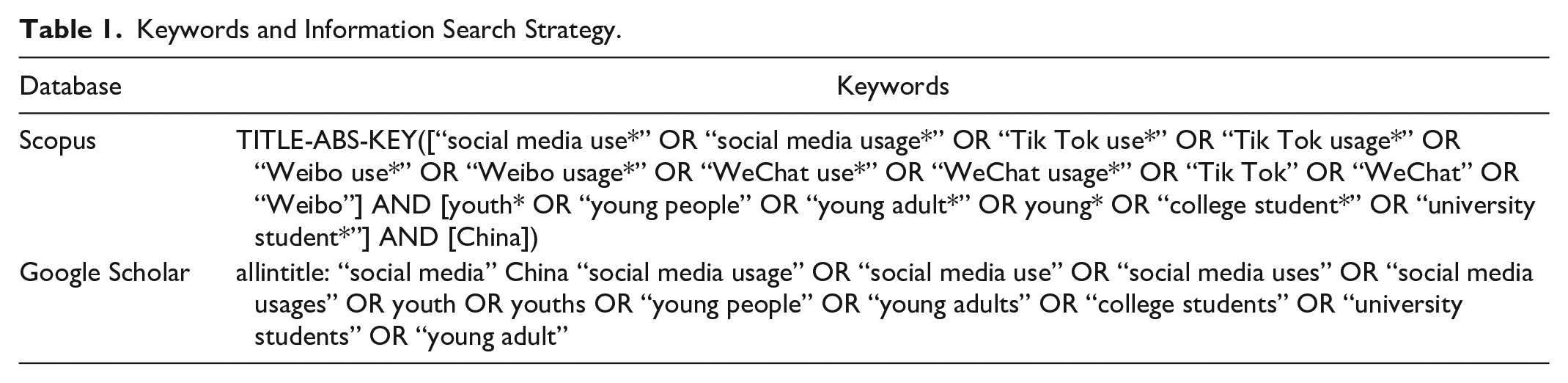
The first stage of the systematic review process took place in February 2020 and consisted primarily of identifying keywords for information search. Previous studies, thesauruses, dictionaries, and synonyms of keywords suggested by databases provided a feasible list of keywords related to social media use, young people, and China (see Table 1). This first stage of the process retrieved 122 items of literature from Scopus, 58 from Google Scholar, and 105 from other sources. After manual deletion of irrelevant documents and removal of duplicates, 156 valid documents remained (see Figure 1).
Keywords and Information Search Strategy.
Screening (inclusion and exclusion criteria)
The second stage of the systematic review process consisted of screening in accordance with the inclusion and exclusion criteria (see Table 2). First, the timeline was controlled from 2015 to 2019, giving a total period of 5 years. Second, only research articles in journals were selected for inclusion; review articles, books, preprints, serials, theses, and conference proceedings were excluded. The third criterion was language. To overcome the language barrier and reduce the distortion of meaning caused by translation, only English publications were included. Fourth, given the present study’s focus on social media use among young people in China, only articles with “China” and “youth” as research objects were included. Finally, in line with the cause–effect framework of this review, only articles using quantitative research methods were selected.
Inclusion and Exclusion Criteria.

Eligibility
Eligibility is the process by which the author manually includes or excludes literature items in light of particular criteria in accordance with the research question and the study objectives. In this case, all the retrieved articles were reviewed carefully, and only those that fully met the criteria were included. First, a total of 129 duplicates and articles unrelated to the research question were deleted, and the remaining 156 related articles entered the eligibility process. After application of the inclusion and exclusion criteria, followed by manual screening of titles, abstracts, and full texts, 20 articles were retained for the qualitative synthesis (see Figure 1).
Quality appraisal
The quality of the remaining 20 articles was appraised based on a critical appraisal tool—the Appraisal tool for Cross-Sectional Studies (AXIS tool) (Downes et al., 2016). Each article was ranked as three categories: high, medium, or low quality to assess the quality (Goldsmith et al., 2007). Because all 20 articles reached the threshold of medium quality level, these 20 articles were confirmed to be retained.
Data Analytic Strategy
The 20 articles were assessed and reviewed, and the data collected are analyzed and discussed in what follows. Data extraction consisted of three steps: (a) reading the article’s title, (b) reading the abstract, and (c) reading the whole article in depth to determine the data content in relation to the current research question. This part of the review focused on matching the data with specific research questions. A systematic literature review can incorporate different types of research designs (qualitative, quantitative, or mixed methods); the present study took a qualitative approach to the literature and data (Whittemore & Knafl, 2005), using content analysis to identify the themes, theories/models, variables, and research frameworks. This allowed a cause–effect framework to be developed for structural analysis of the research theories/models and conceptual frameworks employed in previous studies.
Results
The review found that most authors had chosen to focus on the social media platforms WeChat, Weibo, and QQ. Of the 20 articles reviewed, nine selected WeChat (Y. Chen, 2017; Y. Chen et al., 2019; Pang, 2016, 2018b, 2018d; Wen et al., 2016; Xu et al., 2016; R. Zhang et al., 2019; Zhou, 2019), one selected both WeChat and O2O life services apps (Zhou, 2019), and four articles selected Weibo (Hwang & Choi, 2016; Pang, 2018a; H. Wang & Shi, 2018; J. Zhang et al., 2016). Five articles did not choose any specific social media types but took social media directly as their research object (Z. Chen & Chan, 2017; Gan et al., 2017; Huang et al., 2016; Jalali, 2018; Pang, 2018c); however, in two of these, WeChat, Weibo, and QQ were mentioned as typical cases of social media (Jalali, 2018; Pang, 2018c). In addition, two articles selected WeChat and Weibo for comparative study (Gan, 2016; Hou et al., 2018) (see Table 3).
Characteristics of the Articles Selected for Analysis.

The review identified 10 main topics related to social media use among young people in China: gratification from using social media, political participation or engagement by using social media, motivation for using social media, styles/patterns/behaviors of social media use, effects on social life from using social media, perceived/subjective well-being, social media usage preferences, quality of sleep, quality of friendships through social media, and participation in public affairs. Several articles covered two topics, such that a total of four articles focused on the topic of gratification from using social media (Y. Chen, 2017; Gan, 2016; Pang, 2016, 2018a), six considered political participation or engagement (Y. Chen, 2017; Z. Chen & Chan, 2017; Gan et al., 2017; Pang, 2018a, 2018b; H. Wang & Shi, 2018), and three concentrated on the topic of motivations for using social media (Y. Chen et al., 2019; Z. Chen & Chan, 2017; Hwang & Choi, 2016). Six articles focused on styles, patterns, or behaviors of social media use (Y. Chen et al., 2019; Gan et al., 2017; Huang et al., 2016; Jalali, 2018; Xu et al., 2016; Zhou, 2019), four on the effects on social life of using social media (Jalali, 2018; Pang, 2018c; J. Zhang et al., 2016; R. Zhang et al., 2019), and two on perceived/subjective well-being (Pang, 2018d; Wen et al., 2016). The topics of usage preferences (Hou et al., 2018), quality of sleep (Xu et al., 2016), quality of friendships through social media (Pang, 2018d), and participation in public affairs (Huang et al., 2016) were each the focus of a single study (see Table 3).
Given the cause–effect relationships analytic strategy of this present study, only articles which used a quantitative research method were selected (see Table 2). Regarding publication date, seven of the articles were published in 2016, three in 2017, seven in 2018, and three in 2019.
In the selected studies on social media use among young people in China, various theories and models were adopted to study the relationships between social media and users’ psychology, attitude, behavior, consciousness, and social influence, including the influence of social media use on users’ political participation (Y. Chen, 2017; Gan et al., 2017; Pang, 2018b; H. Wang & Shi, 2018).
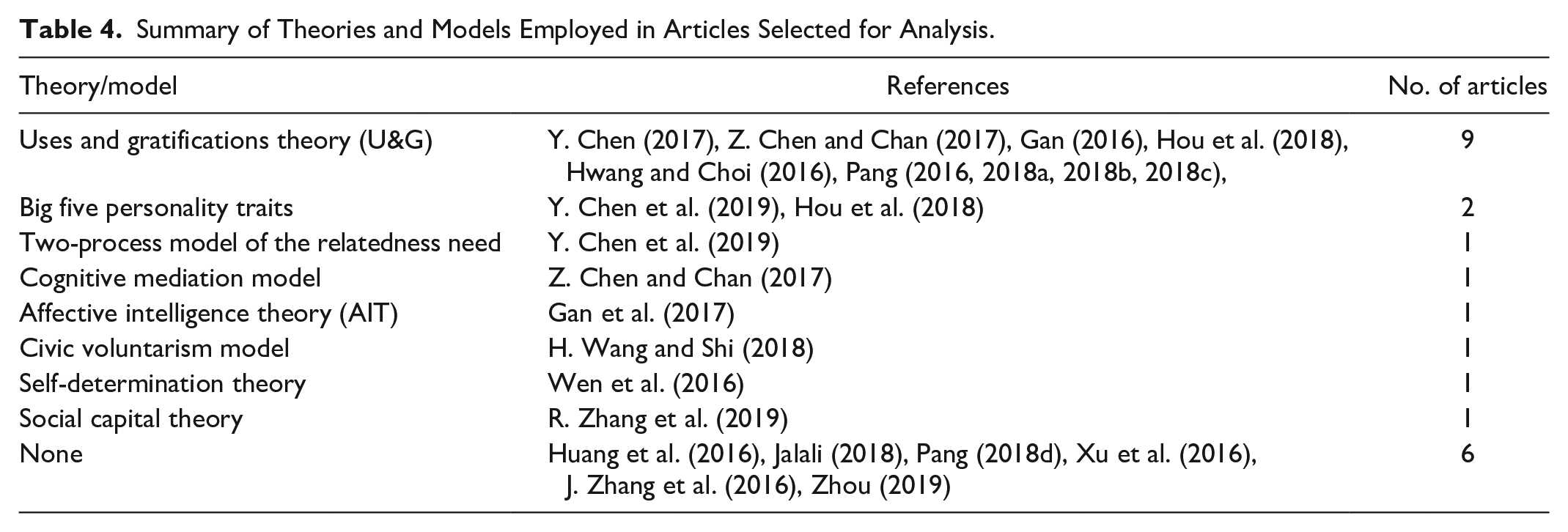
Table 4 summarizes eight theories or models employed in the 20 articles. Uses and gratifications theory (U&G) was used in nine articles (Y. Chen, 2017; Z. Chen & Chan, 2017; Gan, 2016; Hou et al., 2018; Hwang & Choi, 2016; Pang, 2016, 2018a, 2018b, 2018c). The big five personality traits were used in two articles (Y. Chen et al., 2019; Hou et al., 2018), the two-process model of the relatedness need was used in one article (Y. Chen et al., 2019), and one article used the cognitive mediation model (CMM) (Z. Chen & Chan, 2017). Similarly, affective intelligence theory (AIT) (Gan et al., 2017), the civic voluntarism model (H. Wang & Shi, 2018), self-determination theory (SDT) (Wen et al., 2016), and social capital theory (R. Zhang et al., 2019) were used in one article each. Six articles made use of no theories or models (Huang et al., 2016; Jalali, 2018; Pang, 2018d; Xu et al., 2016; J. Zhang et al., 2016; Zhou, 2019). These findings indicate gaps that future research could bridge, especially concerning social media types, research topics, and research theories or models.
Summary of Theories and Models Employed in Articles Selected for Analysis.
Discussion
Theories and Models
As mentioned above, a variety of theories and/or models have been used in studies on social media use among young people in China. The analysis shows that these theories and models are derived mainly from three disciplines: psychological theories, sociological theories, and communication theories.
Psychological theories
The big five personality traits is a psychological trait theory of the dimensions of human personality and psyche: “openness to experience, conscientiousness, extraversion, agreeableness and neuroticism” (Digman, 1990, p. 430). As these five traits have a significant impact on the behavior and intention of social media users, they are often included as factors for measuring styles or patterns of social media use (Y. Chen et al., 2019; Hou et al., 2018).
The two-process model of the relatedness need is a branch of the two-process model of psychological needs (Sheldon, 2011; Sheldon & Schüler, 2011) that proposes a difference between the pre-motivational procedures that result in behavioral intention (the target-setting stage) and the procedures of post-intentional volition that result in action (the target-chasing stage) (Schwarzer, 2015). As a result, the model is often used to investigate respondents’ early motivation, needs or requirements, behavioral intentions, and actual behaviors (Y. Chen et al., 2019).
AIT was the first political theory of emotion (Marcus, 1988; Marcus & Mackuen, 1993). Claiming that emotions have a very significant impact on logic and ideological views, AIT explored how emotions influence people’s political activities. It has deepened our understanding of how individuals make political choices and take political actions, and has been used to predict people’s political behaviors, including changes in their loyalty to political candidates, regulations, and parties. AIT covers three dimensions: (a) people’s subconscious emotion-oriented assessments, (b) the two distinct affective systems which impact differently on individuals’ consciousness and actions, and (c) the two kinds of dependence systems, namely dependence on habit and dependence on exact thinking (Cakir, 2017; Marcus et al., 2019). Since anxiety is one of the typical emotions, AIT has been widely used to examine the influence of anxiety on political activities, including how it promotes political learning and how it promotes more prudent political judgments (Albertson & Gadarian, 2015; Brader, 2006; Groenendyk, 2016; Marcus et al., 2000). In one study of social media use among young people in China, researchers used AIT to identify the relationship between the use of social media and political emotion and participation (Gan et al., 2017).
SDT was first introduced by Edward Deci and Richard Ryan in their study of the intrinsic motivations of human behaviors. SDT is a motivational theory that focuses on people’s needs for growth and achievement (Deci & Ryan, 1985). It is a theory of motivation and personality that takes account of individuals’ intrinsic growth trends and psychological requirements, particularly regarding the motivation for decisions in situations where there is no external impact or intervention. It is concerned with the extent to which human behaviors are self-motivated and self-determined (Deci & Ryan, 2012; Ryan & Deci, 2000, 2017). Deci and Ryan advocated three prominent intrinsic needs for self-determination: competence, autonomy, and social relations (relatedness). The three needs were considered to be prevalent, inherent, and psychological and regarded as stimulating behaviors that are necessary to good mental health and well-being (Ryan & Deci, 2000). This theory has been used to study motivations and subjective well-being for using WeChat (Wen et al., 2016).
Sociological theories
The civic voluntarism model was developed in a study of voluntarism in American politics (Verba et al., 1995). The model is used principally to detect the influencing factors on civic participation in elections, social movements, and different forms of political participation (Burns et al., 2001). It has four constituent parts: (a) resources (supply techniques, methods, and competences to active political participation, such as communication skills, time, and money), which mainly come from high socioeconomic status, especially a high level of education; (b) psychological political engagement, which means the positive attitude of citizens toward political engagement, including political interest, political efficacy, political belief, and political trust; (c) recruitment by friends or colleagues, and the environment as factors affecting enthusiasm and degree of political involvement; and (d) issue engagement, in terms of people being more attentive to and motivated by certain political issues that are closely related to their personal benefits, moral values, or political opinions (Barkan, 2004). Several researchers have employed this model to examine the extent to which social media use affects college students’ political participation or engagement (H. Wang & Shi, 2018).
Social capital theory is commonly used to study social relations or public relations (Dodd, 2016; Luoma-aho, 2018). Although it is a metaphorical form of capital, social capital is an important investment, and it consists of trusted networks and social relationships. Social capital theory shows how social relationships are significant resources that can result in the cumulation and exploitation of human capital. It probes how individuals and organizations can benefit beyond the primal circumstance once social relationships are formed, and it identifies ways in which social capital can effectively transfer and promote other forms of capital income (Luoma-aho, 2016). Social capital theory has been used to study the influence of social media use on social relationships and bridging social capital (R. Zhang et al., 2019).
Communication theories
UGT is an approach that aims to understand why and how people energetically hunt for particular media to meet particular needs (Severin & Tankard, 1997). UGT was first developed in the field of mass communications in the 1940s by researchers who were studying radio listeners (Lazarsfeld, 1940). It focuses on audiences and is regarded as a development of needs and motivation theory (West & Turner, 2010). Hence, it is very popular in social media research, and many scholars have used it to study motivations, needs, and gratifications for using social media (Y. Chen, 2017; Z. Chen & Chan, 2017; Gan, 2016; Hou et al., 2018; Hwang & Choi, 2016; Pang, 2016, 2018a, 2018b, 2018c).
The CMM was proposed by Eveland (1998, 2000) as an integration of UGT, news information-processing research, and developments in cognitive and educational psychology (Eveland, 2001). CMM suggests that the influence on knowledge acquisition of individuals’ different kinds of motivations for using news media is mediated by two types of information-processing: news attention, which is the concentration of spiritual endeavors (Chaffee & Schleuder, 1986), and news elaboration, “the process of connecting new information with other pieces of information stored in memory, including prior knowledge, personal experiences, or the connection of two new bits of information together in new ways” (Eveland, 2001, p. 573). Motivations include surveillance gratification, anticipated interaction, guidance, and need for cognition (Eveland, 2001; Ho et al., 2013). Scholars have used this theory to determine the impact of motivations for social media usage on political knowledge acquisition and political participation in China (Chen et al., 2017).
Conceptual Frameworks
According to Mohammed, Ferzandi, and Hamilton, different research constructs are based on a causal framework that includes predictors, moderators, mediators, and outputs. In other words, a framework contains exogenous variables, moderating variables, mediating variables, and endogenous variables (Mohammed et al., 2010). Baron and Kenny explained that predictors cause outputs (that is, exogenous variables lead to endogenous variables) and that the causal relationships between exogenous variables and endogenous variables are explained by mediating variables and impacted by moderating variables (Baron & Kenny, 1986).
As social media use behaviors have different reasons and results, researchers have developed different research constructs according to their research fields and topics. The present study has adopted a cause–effect framework to probe the interrelationships among different conceptual constructs in the literature (see Figure 2). Researchers have focused on different topics and priorities, and the same concept may appear in the research framework in the form of different variables. For example, personality traits were regarded as an exogenous variable in one article (Hou et al., 2018) but as a moderating variable in another (Y. Chen et al., 2019).
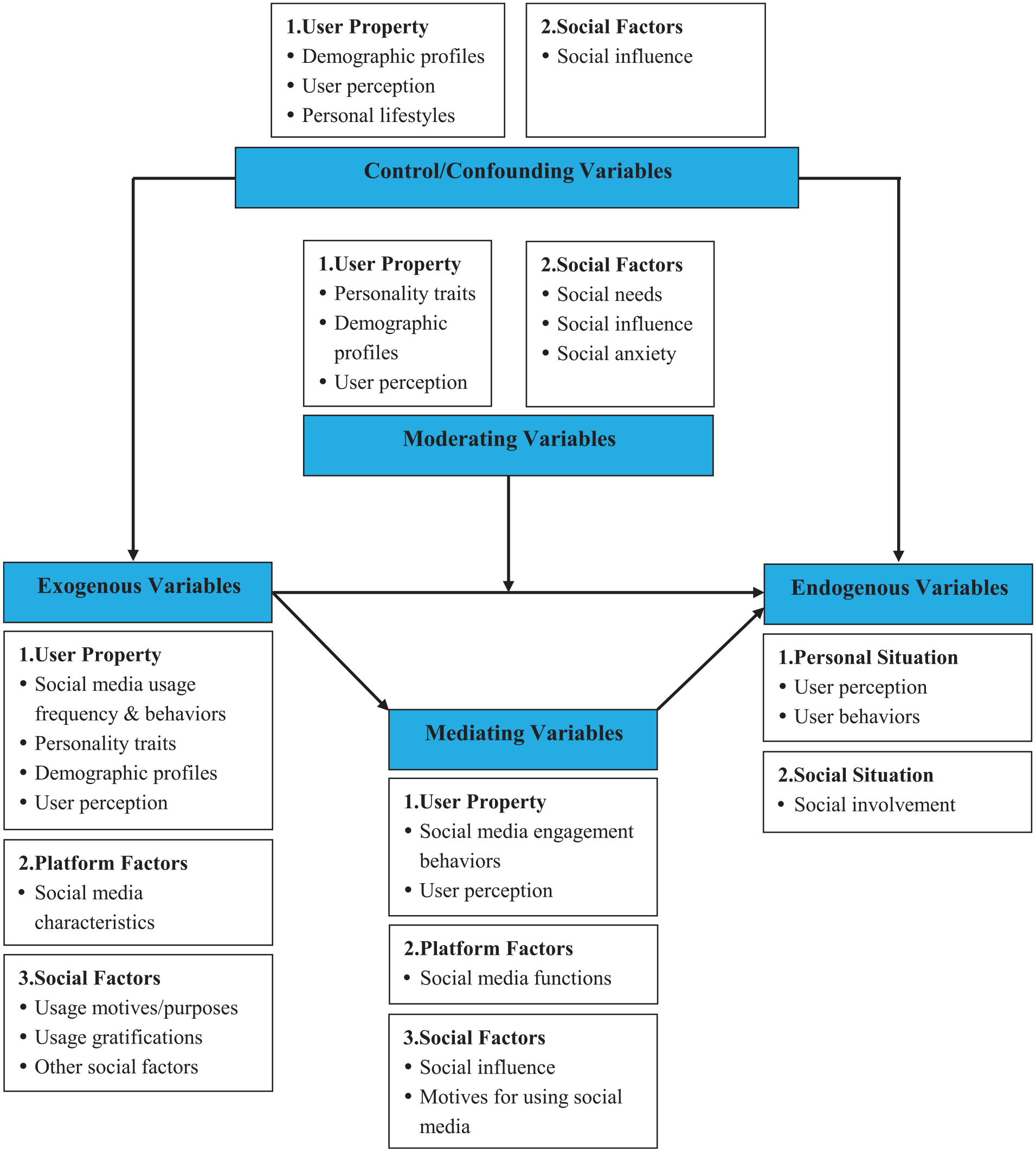
Conceptual framework for research on social media use among young people in China.
Exogenous variables
In this cause–effect framework, exogenous variables are the predictive factors of the output results. In the 20 eligible articles on social media use among young people in China, the exogenous variables are user properties, platform factors, and social factors (see Table 5).
Attributes of Variables Employed in Articles Selected for Analysis.

User properties are important exogenous variables in research on social media use among young people in China. A total of 11 studies used frequency of social media use and user behaviors as an exogenous variable. Some examined the relationship between WeChat use and political engagement (Y. Chen, 2017; Huang et al., 2016; Pang, 2018b; H. Wang & Shi, 2018), while others investigated how social media usage intensity affected user gratification or life satisfaction (Gan, 2016). A number of studies also found that social media use was significantly associated with users’ subjective well-being (Wen et al., 2016); one study indicated that undergraduates who used WeChat had better quality of sleep in terms of subjective quality, sleep latency, use of sleeping medication, daytime dysfunction, and global PSQI than those who did not use WeChat (Xu et al., 2016). Moreover, personality traits were often used as exogenous variables to predict different outcomes of social media use, given that different personality traits (such as extraversion, introversion, neuroticism, extraversion, and openness) result in different behaviors, attitudes, and perceptions in the adoption of social media. A positive relationship was found between neuroticism, loneliness, external locus of control, and excessive use of WeChat, and the relationship between agreeableness and excessive WeChat use was negative (Hwang & Choi, 2016).
Demographic profile is another important aspect of user properties. Nine of the articles took demographic profiles, especially gender, age, and education level, as exogenous variables (Y. Chen, 2017; Gan, 2016; Gan et al., 2017; Hou et al., 2018; Hwang & Choi, 2016; Pang, 2018a, 2018d; Xu et al., 2016; R. Zhang et al., 2019). For instance, Hwang and Choi (2016) showed that there were great differences between female and male users in motivations for using Weibo, with female users using it more frequently and widely than male users. Similarly, Pang (2018d) found that males used WeChat more often than females. Pang (2018a) revealed a significant relationship between educational level and active Weibo usage, with users with lower levels of education tending to use Weibo more often to seek information than those with higher levels of education. User perception, another aspect of user properties, was also taken as an exogenous variable, and users perceived a wide variety of emotions, feelings, and attitudes with social media platforms. One study examined how perceived loneliness influenced intention to use Weibo or WeChat, finding that individuals with higher perceived loneliness preferred to use Weibo more frequently than WeChat (Hou et al., 2018). Another study found that users perceived affective ties to WeChat, and that their emotional attachment to WeChat was significantly associated with subjective well-being and motivation to use WeChat (Wen et al., 2016).
Platform factors have also been adopted as exogenous variables in social media research. Platform factors include social media types, social media scales, and social media functions. The various types of social media in China (including WeChat, Weibo, QQ, TikTok, and Kuaishou) have different functions and sizes, which influences the behaviors and consciousness of their users. One study found that different social media types affected young adults’ participation in public affairs in China, although social media network size was not associated with their engagement in public affairs in light of environmental, educational, or political issues (Huang et al., 2016).
Social factors, the motivation and purpose factors related to society in using social media as well as social gratification factors, are generally regarded as exogenous variables in social media research. Numerous social notions, such as information-seeking, relatedness need, entertainment and amusement, social utility, engagement in public affairs, social support, sociability, and relationship maintenance, have been considered as motivations or purposes for using social media (Y. Chen, 2017; Y. Chen et al., 2019; Z. Chen & Chan, 2017; Huang et al., 2016; Pang, 2018a, 2018b, 2018d; J. Zhang et al., 2016). Y. Chen (2017), for example, found evidence that use of WeChat for entertainment and recognition needs and for browsing news and information about particular political issues was positively associated with political engagement through WeChat. J. Zhang et al. (2016) clarified that using Weibo for the purposes of joining discussions and caring about society had a negative relationship with depression. Gratification obtained from using social media has also been used as an exogenous variable and found to be a prominent motivation for social media usage among undergraduate students in China (Pang, 2018c). Other social factors, including social interaction, political interest, socialization, and social influence, have been taken as exogenous variables. Hou et al. (2018) found a negative relationship between social support, social interaction, agreeableness, and excessive use of WeChat, and WeChat users with higher levels of political interest were found to be more positive in online political affairs (Pang, 2018b).
Moderating variables
The role of moderating variables is described in research as interaction. A moderating variable can be either categorical or continuous, which influences the direction and/or strength of the relationship between exogenous and endogenous variables (Cohen et al., 2003). The moderating variables in studies on social media use among young people in China were from two categories: user properties and social factors.
User properties included personality traits, demographic profiles, and user perceptions. Scholars have examined how these factors affect the relationship between input variables and outcome variables in social media. One study used three types of personality traits (openness, neuroticism, and extraversion) as moderating variables to examine the relationship between relatedness need frustration and passive engagement of WeChat users (Y. Chen et al., 2019). Pang (2016) analyzed the moderating effect of demographic profiles on the relationship between gratification from using WeChat and WeChat use behaviors; the findings show that female users used WeChat more frequently and spent more time on the platform, whereas male users regarded it as a method of interpersonal communication and tended to make more intensive use of it for shorter periods. Another study found that user perception moderated the influence of WeChat use on bridging the social capital of users (R. Zhang et al., 2019).
Social factors have also been considered as moderating variables, and they include social needs, social anxiety, and social influence. Y. Chen (2017) found that the relationship between WeChat use and political engagement through WeChat was moderated by social needs regarding browsing news and information on WeChat. Gan et al. (2017) proposed that the influence of social media usage on civic and political participation among young people in China was moderated by political affect, which is a form of social influence. Another study analyzed social anxiety as a moderating variable affecting the impact of WeChat interaction on quality of friendships and on users’ well-being (Pang, 2018d).
Mediating variables
Mediating variables, the third type of variable in the conceptual framework, are used to interpret the nature and mechanism of relationships between exogenous and endogenous variables (Mackinnon, 2008). The articles reviewed in this study used three types of mediating variables: user properties, platform factors, and social factors.
User properties combined social media engagement behaviors and user perceptions. One study found that users’ active or passive engagement in WeChat had a mediating effect on the influence of relatedness need frustration toward relatedness need satisfaction, clarifying that relatedness need frustration has a positive correlation with passive engagement in WeChat (Y. Chen et al., 2019). Regarding user perception, H. Wang and Shi (2018) used a sense of belonging to an online community as a mediating variable in their analysis of the relationship between Weibo usage and political participation among undergraduates in China.
Platform factors are functions of social media. Z. Chen and Chan (2017) examined how motivations for using social media influenced the political participation of university students; they found that social media functions, especially communicating functions, could mediate this influence.
Social factors were included in two forms: motives for using social media and social influence. For example, WeChat usage motivations have been used as a mediating variable to examine the impact of intensity of WeChat use on subjective well-being (Wen et al., 2016). Other studies have employed social influence as a mediating variable. H. Wang and Shi (2018) used political interest, online mobilization, and civic virtue as mediators to identify the relationship between Weibo usage and online political participation. They found that Weibo use could nurture political interest and civic virtue and improve the likelihood of being politically mobilized, and that there was a positive and significant correlation between the mediating variables and online political participation. Similarly, Gan et al. (2017) adopted political affect as a mediating variable to study how social media usage affects the political participation of university students.
Control/confounding variables
In research, unseen factors may distort the relationship under study and the results. These factors are known as confounding variables, and they can influence both exogenous and endogenous variables. It is therefore advisable to control for confounding variables (Spector, 1981). In the articles under review here, there were two types of control or confounding variables: user properties and social factors.
User properties included demographic profiles, user perceptions, and personal lifestyle. A number of scholars controlled for demographic variables such as gender, age, family socioeconomic status, level of education, and personal monthly income (Huang et al., 2016; Pang, 2018b, 2018d; H. Wang & Shi, 2018; Zhou, 2019). Huang et al. (2016) controlled for five demographic factors in their research to determine whether social media use affects the participation in public affairs of young people in China. Regarding user perceptions, another study took life satisfaction as a confounding variable in an exploration of the correlation between motivations for using Weibo and civic or political engagement among young Chinese people (Pang, 2018a). Another study controlled for personal lifestyle (in the form of daily average sleeping hours) as a confounding variable to estimate how use of Weibo influenced social support and depression among college students in China (R. Zhang et al., 2019).
Social factors, including social trust, news exposure, and political efficacy, were controlled for as confounding variables in some studies (Huang et al., 2016; Pang, 2018a). Huang et al. (2016) controlled for news exposure and three types of political efficacy in their exploration of the influence of social media use on the involvement in public affairs of young Chinese people. Pang (2018a) treated social trust as a control variable in a study of how Weibo motivates civic and political participation by young Chinese people.
Endogenous variables
Endogenous variables are the outcomes in the cause–effect framework, namely, the expected results under the joint influence of exogenous, moderating, and mediating variables. Among the articles reviewed, there were two main types of endogenous variables: personal situation and social situation.
Personal situation covers user perceptions and user behaviors. User perceptions include gratification, satisfaction, well-being, depression, and frustration perceived by users as resulting from their use of social media. A number of studies have used these constructs as endogenous variables. One such study focused on the correlation between WeChat use and perceived well-being, although the results indicated that WeChat use did not predict the well-being of college students (Pang, 2018d). However, a different study found that WeChat usage intensity was significantly associated with the subjective well-being of university students (Wen et al., 2016). Gan (2016) analyzed whether users experienced more gratification from using WeChat or Weibo, finding that they preferred to use Weibo to obtain information and hedonic gratification, whereas WeChat usage catered more to their affective responses and social gratification. Depression was used as an endogenous variable in a study of how Weibo use influences college students’ depression (J. Zhang et al., 2016). User behaviors, too, have featured significantly as endogenous variables in social media research. Numerous studies have adopted social media usage or continuous usage behaviors as outcomes (Hou et al., 2018; Pang, 2016, 2018c; Zhou, 2019). In particular, a study in the medical research field used sleep quality as an endogenous variable to investigate how WeChat influences undergraduates’ quality of sleep (Xu et al., 2016).
Social situation includes factors such as social life, social support, social capital, political participation, and engagement in public affairs. Many studies have taken these factors as endogenous variables in investigating the effect of social media. Among the articles reviewed here, six used political participation or engagement as the outcomes of social media use (Y. Chen, 2017; Z. Chen & Chan, 2017; Gan et al., 2017; Pang, 2018a, 2018b; H. Wang & Shi, 2018). Motivation for using social media has also featured, as in Hwang and Choi’s (2016) exploration of the effect of gender on motivations for using social media. Scholars have also investigated the impact of WeChat use on bridging social capital among college students in China (R. Zhang et al., 2019) and on social support (J. Zhang et al., 2016). Engagement in public affairs has also been adopted as an endogenous variable to study its association with social media use (Huang et al., 2016).
Table 5 summarizes the different types of variable (exogenous, moderating, mediating, confounding, and endogenous) analyzed in this study regarding the cause–effect conceptual framework.
Limitations and Recommendations
There are a number of gaps in our understanding of how social media influences young people in China, and the present review identifies specific areas of research where further attention is required. First, the studies reviewed here focused on WeChat and Weibo, making the scope of social media research too narrow. There is a wide range of social media in China today, including the short video applications TikTok, Kuaishou, and Douyu. In future studies, researchers should aim to fill this research gap by focusing on these emerging social media.
Second, only eight theories have been adopted in previous studies, with an overemphasis on using UGT to study motivations for and gratification from using social media. This review identifies a lack of attention to the technology acceptance model, the theory of planned behavior, innovation diffusion theory, media system dependency theory, the theory of reasoned action, and social loafing theory, among others. In future studies, there is great potential to enrich the literature by widening its theoretical range.
Third, the research topics in these studies were relatively unitary. Future researchers could attempt to address this gap by expanding the range of topics under study to include, for instance, social media addiction and dependency, social media as a cohesive force in enterprises, and the influence of social media on health awareness, academic performance, purchase intention, cyber security awareness, and positive relationships.
Fourth, although the PRISMA method is suitable for studying social media, a more comprehensive systematic review method would be beneficial. The current review study has focused on research on social media use among young people in China over a relatively short period (2015–2019), considering only empirical articles that adopted a quantitative approach and that were available in the Scopus or Google Scholar databases. Future studies should aim to broaden these parameters to achieve a more comprehensive review.
Finally, some of the data in the articles reviewed here are quickly becoming out of date. One study mentioned that the number of monthly active WeChat users was 806 million in 2016 (Xu et al., 2016), but as of 2019 the number of global WeChat monthly active users had reached 1.11 billion (Yang et al., 2020). Likewise, findings have been inconsistent, with some studies indicating that female users used WeChat more frequently (Pang, 2016) but others showing that male users were more likely to use it (Pang, 2018d). Thus, the generalizability of these studies is limited. China covers a vast area, making it difficult to conduct empirical studies that involve different target respondent groups across the country; nonetheless, future studies should aim for greater coverage.
Conclusion
This study adopted the PRISMA systematic review method for an in-depth review of 20 articles in terms of the main types of social media studied, relevant research topics, theories and models used, and research frameworks constructed to study social media use among young people in China. The variables used in the articles were grouped into a cause–effect framework and divided into five types: exogenous, moderating, mediating, confounding/control, and endogenous variables. Remarkably, the user property and social factors appear in four variables: exogenous, mediating, moderating, and confounding/control variables. This finding reveals that social media use by Chinese youths is related to their personality traits and social activities. The platform factor appears in two variables: exogenous and mediating variables. Therefore, previous studies have also highlighted the features and functions of social media platforms as important factors affecting the use of social media by young people in China. The endogenous variable mainly manifests in users’ perceptions of and use behavior related to social media, which indicates that users’ social media usage behavior has been a key focus of prior studies. Tables and figures summarizing the framework are provided as a reference for future research.
A number of recommendations for future research follow from this review. First, more types of social media should be included, not only WeChat and Weibo. Second, a wider range of theories or models should be used. Third, new research topics on social media should be encouraged and the research field should be broadened. Fourth, a more complete and specific systematic review method is needed to review social media research adequately in the future. Finally, empirical research on social media involving different respondent groups across China is required.
Footnotes
Acknowledgements
The authors would like to acknowledge the Research Management Centre, Universiti Putra Malaysia.
Declaration of Conflicting Interests
The author(s) declared no potential conflicts of interest with respect to the research, authorship, and/or publication of this article.
Funding
The author(s) disclosed receipt of the following financial support for the research and/or authorship of this article: This research was partially funded by the Research Management Centre, Universiti Putra Malaysia (Grant No. UPM/700-1/2/GPB/2017).
Ethical Approval
This article does not contain any studies with human participants or animals performed by any of the authors.
