




Abstract
This study aims to find out the strategic priorities of the technical factors to have sustainable low carbon industry. For this purpose, a hybrid multi-criteria decision-making (MCDM) is proposed that contains three different stages. First, the economic criteria required for sustainable development and the technical needs of the low carbon industry are defined by making a comprehensive literature review. After that, economic criteria are weighted by using the fuzzy decision-making trial and evaluation laboratory (DEMATEL) methodology. Finally, technical factors are ranked with the help of the fuzzy technique for order preference by similarity to ideal solution (TOPSIS) approach. Moreover, another analysis is also performed by considering fuzzy Vise Kriterijumska Optimizacija I Kompromisno Resenje (VIKOR) to evaluate the consistency of the analysis results. The main motivation of this study is to define the primary technical factors to minimize carbon emission problem by proposing a hybrid MCDM model. The findings indicate that research and development for renewable sources has the greatest importance for low-carbon industry. In addition, the analysis results of fuzzy TOPSIS and fuzzy VIKOR are quite similar. This situation demonstrates the consistency and coherency of the ranking results. Hence, it is recommended that countries should mainly give importance to the research and development investments so that the costs of renewable energy problems can be minimized. This situation can attract the attentions of the companies to invest in these projects. In this way, it will be possible to use a cleaner energy in industrial production.
Keywords
Introduction
All countries aim to achieve economic development. Some actions are taken by countries to achieve this goal. Increasing investments and improving industrial production are examples of actions that can be taken in this process. However, another important issue in this process is to ensure sustainability in economic development (Khan et al., 2020). In this context, countries should also pay attention to environmental issues while aiming for economic growth. Otherwise, the problems caused by environmental pollution will harm the country both socially and economically. For example, the carbon emission that occurs during the production process causes serious environmental pollution (G. Hu et al., 2020). This situation reduces the quality of life in the country as it threatens the health of living things. However, when factors such as increasing health care costs and loss of workforce are taken into account, carbon emission creates problems for the economy of countries. It is of vital importance to take action to solve this problem (Iqbal et al., 2020). Otherwise, since the economic growth of the countries will also cause environmental pollution, it will not be possible for economic development to be sustainable.
Especially in the last years, globalization is specifically related to the environmental changes in the production. Global production complies with several regulations that reflect the environmental awareness. Global economies could also handle the self-regulation for the environmental commitment because of the expectations of multinational owners and customers (Christmann & Taylor, 2001). At the country level, the environmental regulations can motivate the investors who are sensitive to the sustainable development with environmental incentives (Panayotou, 2000). On the other side, some parties could fear from the globalization due to the damages and costs on the sustainable economies (Rzepka, 2017). According to them, international trade could trigger the competition with the low cost. In this framework, the firms facing the competitive pricing could dismiss the sustainable regulations by aiming to reduce operational expenses. As a result, the right conditions of environmental development such as democracy, regulations, and other externalities should be redefined for international trade and they should minimize the climate and emission problems (Frankel, 2003).
Sometimes, the priorities of global actors may conflict with the environment. In this condition, the governance of policies should be at the forefront for managing the sustainable development of global economy regularly. Accordingly, policy makers reach a consensus by listening the institutions, societies, and other parties to design the most appropriate rules regarding the ecological stability (Newell, 2013). These developments bring greening global political economy on the agenda. In this framework, the economy widely turns into the environmental and social concerns (Zeng et al., 2020). In addition, technological, and technical developments contribute to the production potential of the countries (Na & Chonghua, 2020). However, it increases the difficulty to manage the industrial pollution problem. Technical factors should be illustrated in detail to analyze the potential of low-carbon industry. For this purpose, one of the most important technical factors is the efficiency of production. Efficient production aims to the achievement of green energy policies and decrease the possibility of market failure (Hao et al., 2020). Research and development (R&D) activities are also frequently attempted for increasing the technical facilities of the sustainable development with emission reduction policies (Adedoyin et al., 2020).
Benchmarking of green energy-based production is another important technical determinant of sustainable development (Sangroya et al., 2020). In addition, increase in foreign direct investment leads to the more products and services by global investing behaviors. Because of this situation, commercial energy consumption will rise dramatically, and the environmental issues will be on the agenda of countries more frequently (Ghajarkhosravi et al., 2020). Employment rate gives accurate results of energy consumption and environmental issues of global economies (Kontokosta et al., 2020). Moreover, technological developments could get the energy consumptions more sustainable with low-carbon levels. Macroeconomic effects of tax is used for managing the carbon emissions by the governments. Hence, tax policies could be handled for the efficient use of energy sources (Bhowmik et al., 2020).
This study focuses on the technical factors required for low carbon emission in industrial production. To achieve this goal, a model including three different stages is presented. In the first stage, technical factors of low-carbon industry and economic criteria for sustainable development of global economy are identified by making a literature evaluation. In the second stage, economic criteria are weighted with the help of fuzzy DEMATEL approach. The main reason of selecting this approach is that impact relation map between the items can be created (Estiri et al., 2020; Li, et al., 2020a). This issue provides an opportunity to define causal relationship for these factors (Chandra, 2020). After that, technical factors regarding the low carbon emission in industrial production are ranked by using fuzzy TOPSIS methodology. In the analysis process of this approach, the distances to both positive and negative ideal solutions can be used (Chowdhury et al., 2021; Mathew et al., 2020; Zhan et al., 2020). Hence, the analysis results can be more explanatory. In this stage, these factors are also analyzed by considering fuzzy VIKOR approach to make a comparative evaluation.
There are many different novelties of this study. First, a list of technical factors of low-carbon industry and economic criteria for sustainable development of global economy is generated. It is believed that these factors pave the way for both sector officials and academicians. In this framework, economic factors are considered to find the optimal technical factors to reduce carbon emission problem. Thus, it is thought that more appropriate results can be achieved. In addition, another contribution of this study is that a hybrid MCDM model is proposed. Owing to this issue, an analysis is performed for both weighting the criteria and ranking the alternatives (S. K. Hu et al., 2014; Zhao et al., 2019). The main advantage of this situation is that more objective results can be achieved (F. H. Chen et al., 2011; Kabak & Dağdeviren, 2014). Finally, with respect to the ranking the alternatives, both fuzzy TOPSIS and fuzzy VIKOR methods are taken into consideration. Hence, it can be possible to check the coherency and effectiveness of the analysis results.
There are five different sections in this study. The second part includes the literature evaluation. Third, theoretical information about fuzzy DEMATEL, fuzzy TOPSIS and fuzzy VIKOR models are given. The fourth section is related to the analysis of technical factors of low-carbon industry and economic criteria for sustainable development of global economy. In the final stage, strategy recommendations will be shared.
Literature Review
In the recent literature, it is defined that the topic of sustainability in energy industry is frequently considered together with the key items of the emission and globalization. The emission issues of sustainable energy industry are studied by different authors with the aim of discussing the sustainable development of low-carbon industry. Regarding the energy consumption, Ike et al. (2020) assessed the renewable energy usage, energy prices and trade in G7 economies. The results show that renewable energy consumption and pricing have negative effects on the carbon emission. Zheng et al. (2020) focused on the energy conversion and emission in unconventional machining to understand the possible impacts of energy consumption. The findings indicate the research direction of energy-saving and low-carbon of contemporary machining for sustainable manufacturing methods. Another important topic is to use of energy-mix that could decrease the emission for sustainable growth. Su et al. (2020) studied the evolution of energy systems in the European Zone for the sustainable development. According to the results, it is identified that the different policies should be used for electricity generation with low-carbon emission and encourage the incentives toward to the promotion of new policies. Van Fan et al. (2020) benchmarked the emission-cost nexus performance of pyrolysis and give information on the sustainable use of biomass. It is determined that demand increment has an important role on the emission.
Managerial issues of sustainable development in low-carbon industry are also indicated in recent studies. Anser et al. (2020) analyzed the role of sustainability in the water, energy, and food sources. In addition, the elasticity of sources is measured to understand the ecological costs of their production. It is concluded that the environmental sustainability could be successful by using the efficient managerial policies for the selected resources. Sarkodie et al. (2020) conceptualized the climate change and possible effects of fossil energies on the environmental issues. They highlighted that use of renewable energies reduce the emissions strongly by increasing human capital and pollution policies. Financial debates are also handled in the sustainable development of low-cost industry. Gong et al. (2019) undermined the new resources and energy efficiency that lead to the sustainable consumption. Moreover, they also discussed the importance of the investment costs on the emission reduction policies to make a financial decision. Kayani et al. (2020) revealed the relationship between financial development and consumption of renewable energy and carbon emission levels at the country level. It is recommended that renewable energy consumption rises the financial growth and sustainable development with the low carbon emissions.
There are also several studies of sustainable development that highlight the globalization in the energy industry with low-carbon emission. Within this framework, emerging economies are studied by some researches. For instance, Sethi et al. (2020) measured the effects of globalization, other economic indicators and use of energy on the sustainable energy policies in India. The findings gave a prominent result that the right policies of carbon emission could affect the economy and global growth positively. Q. Wang and Jiang (2020) proposed a model to define the relationship between labor and investment on carbon emissions. The results are discussed for the sustainable policies of selected emerging economies. Savona and Ciarli (2019) reviewed the literature to focus on the structural changes affecting emissions and energy intensity. Global sustainable strategies are compared based on emission intensity among the developed and less developed economies. Global effects of sustainable development in low-carbon industry are also discussed for the European countries. Vögele et al. (2020) examined the energy intensive industry for the location problem of productions and it is identified that the energy costs and other incentives could be a reason of sustainable growth of best location selection for these countries. Harris et al. (2020) examined the greenhouse gas emissions accounting methods based on production and consumption for illustrating the carbon scenario of 10 European cities. Consumption-based emission policies are more likely for the sustainable economic growth and global efficiency improvements for these countries. Akadiri et al. (2019) studied on the long run environmental sustainability in Europe by examining the relationship between renewables and other growth determinants of European countries. Obtained results are generalized for clarifying the emission mitigation policies in the European zone. Especially, non-governmental organizations boost these pressures regarding the environmental responsivity for multinational companies and their global supply chains (Christmann & Taylor, 2002). Hence, the policy circles could be diversified by considering all parties of environmental issues (Gallagher, 2009). Similarly, mass production due to the global demand needs for the energy at the large amount. Therefore, dynamic control process should be applied for recycling energy sources and reduction the costs.
However, the researches on the technical factors of sustainable development are extremely limited for low-carbon industry. Sarkar and Sarkar (2020) proposed a smart sustainable multi-stage biofuel production system to reduce energy consumption. It is aimed to provide a sustainable smart production system with less emission and energy sources. Wu et al. (2016) highlighted the importance of technical innovation in the automobile industry that could reduce the fuel and emission. The findings indicated that innovative engines are efficient in the energy consumption and emission levels. As seen in the literature review, there are numerous studies on economic background of sustainable development for the different group of countries. In addition, several studies are available for the global energy industries with specific findings of policy recommendations. However, there is no study on the sustainable development of global economies with low-carbon industries by using both the technical and the economic determinants of global sustainable energy industry with low-carbon policies. This study contributes to the literature by proposing a hybrid fuzzy MCDM model for the sustainable development of global economies with emission reduction policies. Within this context, a set of technical and economic factor are identified with the supported literature. After that, economic criteria are weighted with the help of fuzzy DEMATEL. In addition, technical issues are ranked by considering fuzzy TOPSIS methodology. Furthermore, another evaluation is also performed with fuzzy VIKOR method to evaluate the coherency and consistency of the analysis results.
Method
Fuzzy DEMATEL
DEMATEL is mainly used to weight different criteria according to their significance. In addition, causality analysis between the items can also be identified with this approach by generating impact-relation map (Dinçer & Yüksel, 2019; Lin et al., 2018). This situation is accepted the main superiority of DEMATEL in comparison with other methods in the literature. In the first stage, the evaluations of the experts regarding the criteria are obtained (Zhang et al., 2020). Next, these evaluations are converted into the triangular fuzzy numbers as demonstrated in Table 1.
Linguistic Variables of the Impact-Relationship Degrees.

Source. P. Zhou et al. (2020).
Moreover, the initial direct relation matrix is generated in the second step. For this purpose, Equations 1 and 2 are taken into consideration (Qiu et al., 2020):


In addition, this matrix is normalized by using Equations 3 to 5:
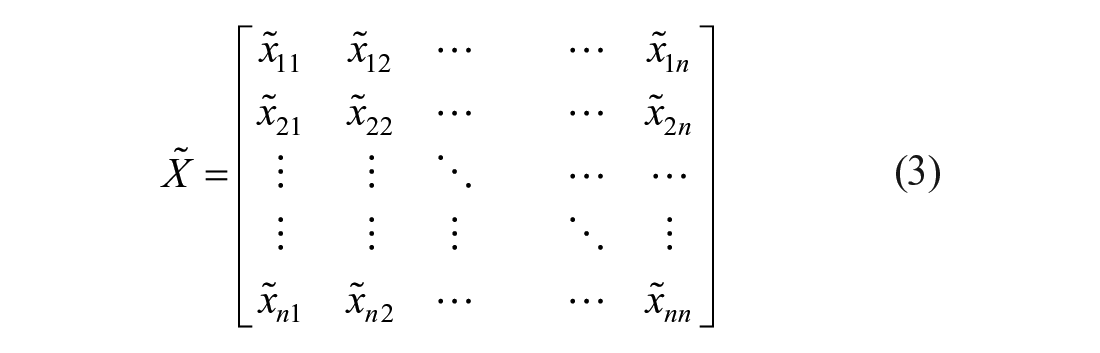


Later, the total influence fuzzy matrix is generated as in Equations 6 to 12:
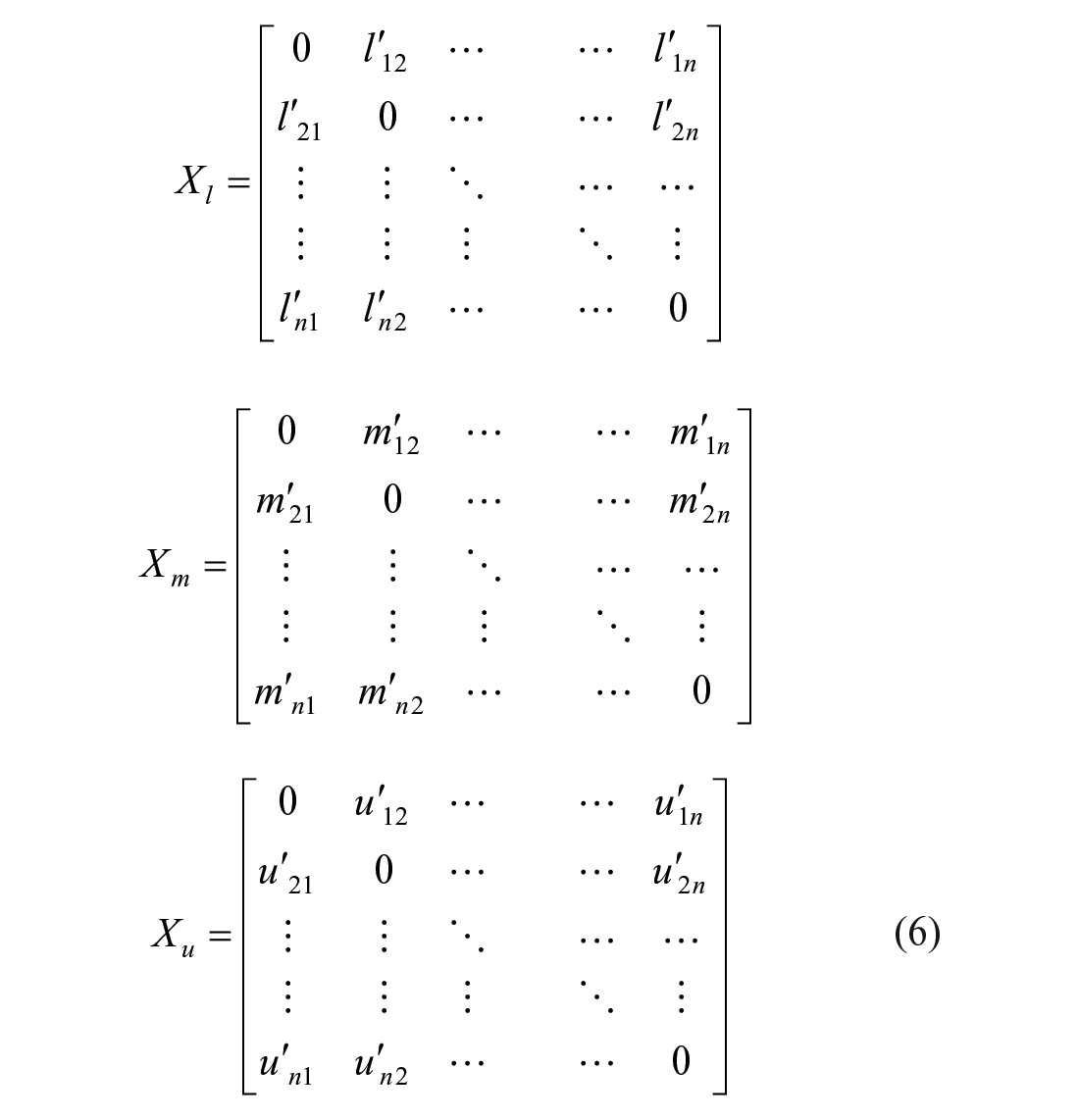

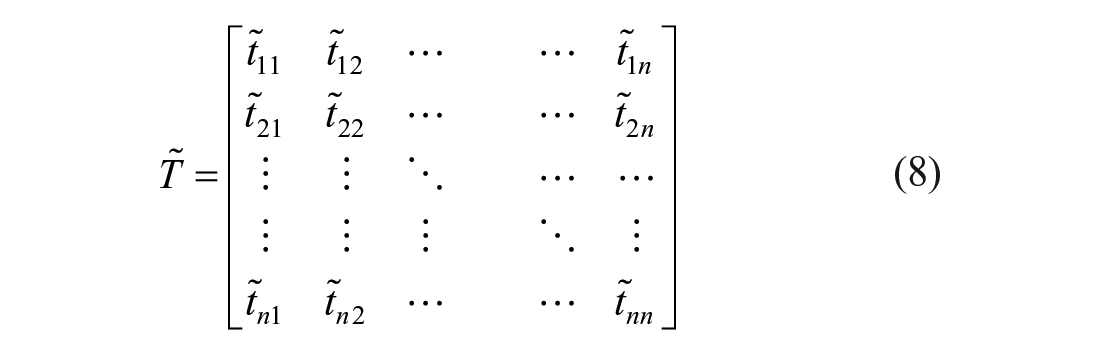


In the next step, the defuzzified total influence matrix is generated with the help of Equations 13 to 21 (Li et al., 2020b):


Fuzzy TOPSIS
In this study, the performance of technical factors on the economic criteria of sustainability development are evaluated with fuzzy TOPSIS method. It mainly aims to rank the alternatives according to the similarity results to the ideal solutions (Memari et al., 2019; Rashidi & Cullinane, 2019). This method has several advantages by considering the positive and negative results to the ideal solution at the same time (Akram et al., 2019; Dinçer et al., 2019). First, the linguistic scales are converted into triangular fuzzy numbers which are shown in Table 2.
Linguistic Terms and Fuzzy Numbers for Alternatives.

Source. S. Wang et al. (2019).
After that, the average values of the expert evaluations are calculated as in Equation 22:

In this equation,

C1 . . . Cn

The computation process of fuzzy TOPSIS is applied by using fuzzy decision matrix. First, the normalization procedure is employed by considering Equations 25 and 26.


In the following step, the positive and negative results to ideal solution are computed respectively with Equations 27 to 31:


A+ is the results of positive ideal solution and A– is the results of negative ideal solution under the fuzzy environment. However, Di– is the values of negative ideal distances and Di+ is the values from positive ideal solution. At the final step, the values of closeness coefficient

Fuzzy VIKOR
VIKOR methodology is used to rank different alternatives according to their importance. In the analysis process, first, the decision matrix of the problem is defined as in Equation 33 (T. Y. Chen, 2018). In this equation, A gives information about the alternatives (Ren et al., 2017). In addition, the criteria are demonstrated as C. On the other side, X represents the evaluations of the experts (Liang et al., 2019; Qi et al., 2020):
C1 C2 C3 . . . Cn

Next, triangular fuzzy numbers stated in Table 2 are considered. After that, fuzzy decision matrix should be calculated as in Equation 34 (Jun et al., 2021):

Later, the fuzzy best and the worst values are identified by using Equation 35:

The next step includes the calculation of mean group utility and maximal regret. Within this framework, Equations 36 and 37 are considered (Shi et al., 2019):


Moreover, the value of

Finally, Equation 39 is used to satisfy the acceptable advantage condition:

Furthermore, acceptable stability in decision making gives information about the second condition. If it is not satisfied, the composition of the first and second alternatives are taken into consideration.
Empirical Analysis
This study aims to identify the significant technical factors for low carbon industry by considering the economic criteria for sustainable development of global economy. For this purpose, this proposed model includes three different stages. First, technical factors of low-carbon industry and economic criteria for sustainable development of global economy are identified. In the second stage, economic criteria are weighted by using fuzzy DEMATEL approach. In addition, fuzzy TOPSIS method is applied for measuring the performance of technical factors and evaluating the ranking results among them. Furthermore, alternatives are also ranked by using fuzzy VIKOR approach to make a comparative evaluation.
In the analysis process of this study, the hybrid MCDM model is proposed. In other words, both criteria and alternatives are analyzed with different MCDM methods (Chand et al., 2020). There are many non-hybrid models in the literature. In these studies, the MCDM approach was used only to rank the alternatives. However, no method was taken into consideration in the calculation of criterion weights (F. Zhou et al., 2018). In this process, criterion weights were either accepted as equal to each other or determined subjectively by the researchers (Debnath et al., 2017). In this hybrid method, an analysis was performed with the DEMATEL method to determine the criterion weights (Dinçer & Yüksel, 2018). Since objective calculations are included in both stages of the analysis process, it will be possible to reach more accurate and effective results with the hybrid model (Liou et al., 2017).
Defining the Criteria and Alternatives (Stage 1)
A set of technical factors of low carbon industry and economic criteria of sustainable development of global economy is given in Tables 3 and 4, respectively. These items are selected by considering the supported references.
Technical Factors of Low-Carbon Industry.

Economic Criteria for Sustainable Development of Global Economy.

Table 3 described five criteria with supported literature. These factors are efficiency of production (Technical Factor 1), periodical control of process (Technical Factor 2), improvement of recycling management (Technical Factor 3), research and development for renewable sources (Technical Factor 4), and developing requirements with benchmarking (Technical Factor 5). Thus, it is aimed to determine the technical factors of low-carbon industry according to the fuzzy MCDM technique.
Table 4 defined five economic criteria of sustainable development of global economy. They are stated as increasing foreign direct investments (Economic Criterion 1), decreasing unemployment (Economic Criterion 2), investments on the high-tech projects (Economic Criterion 3), ease of tax payments for efficient business (Economic Criterion 4), development of financial markets (Economic Criterion 5) by using related references. Linguistic evaluations for the criteria and factors are collected from the expert team by reaching a consensus. In this process, three different experts made evaluations. These people consist of both academicians and top-level managers in big energy companies. These people have at least 24 years of experience. Analysis results are given at the following stages.
Weighting the Economic Criteria With Fuzzy DEMATEL (Stage 2)
In this process, first, linguistic evaluations are obtained from the experts by considering the influence levels in Table 1. The details of them are demonstrated in the appendix part (Table A1). After that, direct relation matrix is created by using these evaluations. Equations 1 and 2 are taken into consideration in this process and it is given in Table A2. In the following stage, normalization process is implemented by using Equations 3 to 5 and new matrix is given in Table A3. Next, the total influence fuzzy matrix is generated with the help of Equations 6 to 12 and it is shown in Table A4. Later, the defuzzified total influence matrix is created by using Equations 13 to 21. Table A5 gives information about the details of this matrix. Finally, the weights of the criteria can be calculated, and the details are given in Table 5.
The Values of

Table 5 indicates that investments on the high-tech projects (Economic Criterion 3) is the most important factor with the highest weight (0.207). In addition, ease of tax payments for efficient business (Economic Criterion 4) and development of financial markets (Economic Criterion 5) also play a key role in this respect. On the other hand, increasing foreign direct investments (Economic Criterion 1) and decreasing unemployment (Economic Criterion 2) have lower weights by comparing the others.
Ranking of the Technical Factors With Fuzzy TOPSIS and Fuzzy VIKOR (Stage 3)
The experts are used five-point linguistic scales that are “Worst,” “Poor,” “Fair, “Good,” and “Best” to rank the technical factors. The linguistic evaluations of technical factors with respect to the economic criteria are represented in Table A6. In this context, the values in Table 2 are taken into consideration. Linguistic evaluations are modified into five scales of the triangular fuzzy numbers. The fuzzy decision matrix is generated by considering Equation 24 and the details can be seen in Table A7. The computation process of fuzzy TOPSIS is applied properly and the values of
Performance Results of Technical Factors With Fuzzy Technique for Order Preference by Similarity to Ideal Solution.
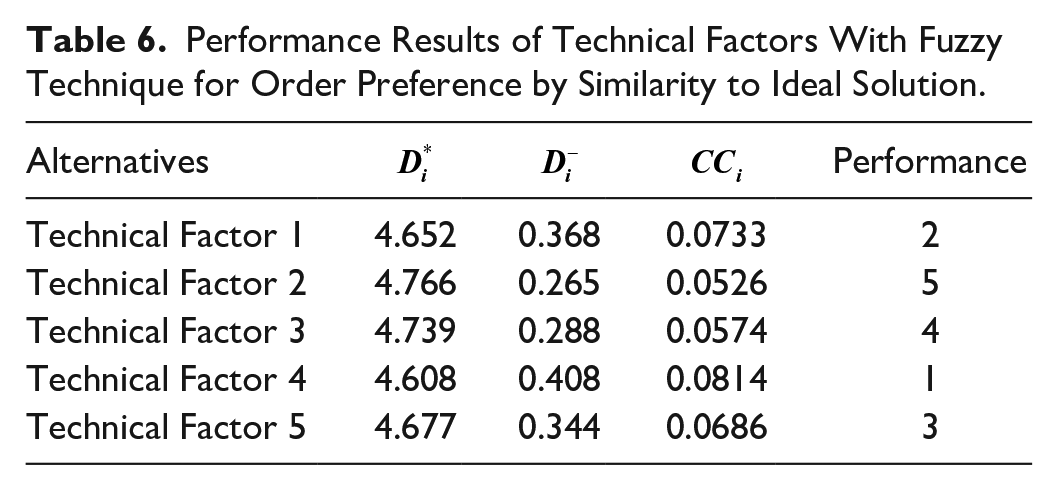
According to the overall results, research and development for renewable sources (Technical Factor 4) has the best performance for low-carbon industry when the economic criteria are considered for sustainable development of global economy. However, periodical control of process (Technical Factor 2) has the last rank in the technical factors of low carbon industry. Fuzzy VIKOR method is also applied for ranking the technical factors with respect to the economic criteria and the results are compared for the robustness check. The values of Si, Ri, and Qi as well as the ranking results are given in Table 7.
Performance Results of Technical Factors With fuzzy VIKOR.
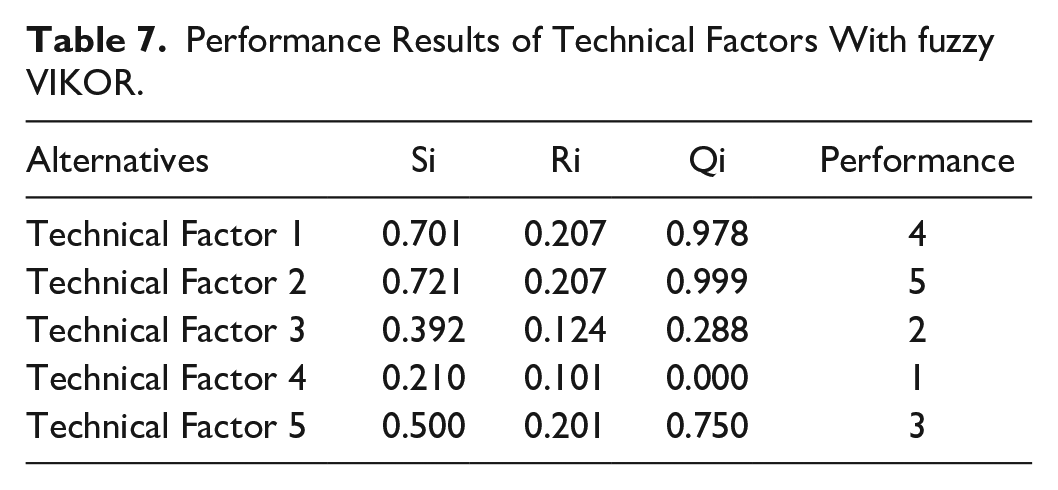
By considering both Tables 6 and 7, it can be understood that analysis results of fuzzy TOPSIS and fuzzy VIKOR are quite similar. This situation indicates the coherency of the analysis results.
Discussion and Conclusion
In this study, it is aimed to determine the significant technical factors to reduce the carbon emission in industrial production. In this context, hybrid MCDM model has been proposed to achieve this purpose. This model consists of three different stages. First, the economic criteria required for sustainable development and the technical needs of the low carbon industry are listed. In this process, while determining the technical issues that have priority for the reduction of carbon emissions, the criteria required for sustainable economic development have been taken into consideration. In the second stage of the analysis process, economic criteria are weighted with the fuzzy DEMATEL approach. In the last stage, technical factors are listed with the help of the fuzzy TOPSIS method. In addition, another evaluation is also performed by using fuzzy VIKOR to analyze the consistency of the analysis results.
It is identified that investments on the high-tech projects has the greatest importance. In addition, ease of tax payments for efficient business and development of financial markets are found as other significant issues in this framework. However, it is identified that increasing foreign direct investments and decreasing unemployment have lower weights in comparison with others. Moreover, with respect to the ranking results, it is determined that research and development for renewable sources has the best performance for low-carbon industry. Similarly, improvement of recycling management and developing requirements with benchmarking are other important technical factors of low-carbon industry. Nonetheless, efficiency of production and periodical control of process take place on the last ranks. Furthermore, the analysis results of fuzzy TOPSIS and fuzzy VIKOR are quite similar. This situation gives information about the consistency and coherency of the ranking results.
Considering the analysis results obtained, it is understood that research and development on renewable energy sources should be increased. Owing to the use of renewable energy sources, the carbon emission problem is minimized. However, the biggest disadvantage of these investment alternatives is that the initial costs are very high. This situation causes investors not to show interest in this field. The use of fossil fuels is much lower than renewable energy alternatives. As can be seen, cost considerations constitute an important obstacle in solving the carbon emission problem. With the help of the investments in research and development, it is possible to reduce the cost of renewable energy projects. This will contribute to the preference of these alternatives by companies. In this way, it will be possible to use a cleaner energy in industrial production.
Many researchers in the literature supported this view. For instance, Q. Wang et al. (2020) focused on the energy efficiency in G20 economies. They used panel cointegration test and concluded that there is a strong relationship between research and development investments and the effectiveness of the renewable energy projects. Moreover, Wiser and Millstein (2020) tried to evaluate the wind energy projects in the United States. In this study, an analysis has been conducted by using regression methodology and it is identified that cost of these energy projects should be minimized with the help of effective research and development works. In addition, Jin et al. (2019) conducted a study regarding the solar energy investments in China. For this purpose, a survey analysis is made with 760 respondents. They claimed that high initial cost is a strong barrier for the improvement of the renewable energy projects. Hence, technological developments should be conducted to reduce these costs. On the other side, in the literature, there are also some different views to overcome carbon emission problem. For example, some studies also suggested carbon capture technologies to minimize this problem (Finney et al., 2019; Siagian et al., 2019). In addition, Xue et al. (2019) and Li et al. (2020c) claimed that recycling can reduce fossil fuel dependence, so carbon emission problem can be reduced.
The main limitation of this study is focusing on only the technical factors of low carbon industry. In the following studies, cost issues can be taken into consideration. Therefore, the ways to reduce cost to achieve low carbon industry can be identified. In addition, carbon emission problem is a very significant issue for the countries because it negatively affects the social and economic development. Hence, the evaluations can be made to show negative impacts of coal energy on the health expenditures. Similarly, different methodologies can be considered in the following studies. Within this scope, analytic hierarchy process (AHP) and analytic network process (ANP) can be considered in the evaluation process.
Footnotes
Appendix
Weighted Matrix.

| Technical factors/economic criteria | Economic Criterion 1 | Economic Criterion 2 | Economic Criterion 3 | Economic Criterion 4 | Economic Criterion 5 | ||||||||||
|---|---|---|---|---|---|---|---|---|---|---|---|---|---|---|---|
| Technical Factor 1 | 0.03 | 0.05 | 0.08 | 0.05 | 0.08 | 0.10 | 0.07 | 0.09 | 0.09 | 0.08 | 0.11 | 0.11 | — | 0.04 | 0.07 |
| Technical Factor 2 | 0.03 | 0.05 | 0.08 | 0.03 | 0.05 | 0.08 | 0.05 | 0.07 | 0.09 | — | 0.03 | 0.05 | — | 0.04 | 0.07 |
| Technical Factor 3 | 0.03 | 0.05 | 0.08 | 0.03 | 0.05 | 0.08 | 0.05 | 0.07 | 0.09 | 0.03 | 0.05 | 0.08 | — | 0.04 | 0.07 |
| Technical Factor 4 | 0.05 | 0.08 | 0.10 | 0.05 | 0.08 | 0.10 | 0.07 | 0.09 | 0.09 | 0.05 | 0.08 | 0.11 | 0.04 | 0.07 | 0.11 |
| Technical Factor 5 | 0.05 | 0.08 | 0.10 | 0.03 | 0.05 | 0.08 | 0.05 | 0.07 | 0.09 | 0.03 | 0.05 | 0.08 | 0.04 | 0.07 | 0.11 |
Declaration of Conflicting Interests
The author(s) declared no potential conflicts of interest with respect to the research, authorship, and/or publication of this article.
Funding
The author(s) disclosed receipt of the following financial support for the research, authorship, and/or publication of this article: National Social Science Foundation of China [grant number 20FJYB025]; Science and Technology Innovation Team of Innovative Talent Promotion Plan in Shaanxi Province [grant number 2021TD-35]; ‘Thousand People Plan’ specially invited expert for young professionals in Shaanxi Province; Shaanxi Province Philosophy and Social Sciences Major Theoretical and Practical Issues Research Project [grant number 2021ND0028]; The New Style Think Tank of Shaanxi Universities [grant number ACNM-202201]; Shaanxi Philosophy and Social Sciences Fund [grant number 2020D036]; Sub-project of Class A Strategic Leading Science and Technology Project of Chinese Academy of Sciences [grant number XDA23060304]
