




Abstract
This study examined the effect of mood on predictive sentence processing by older adults. A self-paced reading task was implemented among a group of younger adults and older adults to measure their performance in online sentence processing. Half of the sentences were highly predictable, whereas the other half were lowly predictable. Music was used to induce positive or negative mood. Results show that in the positive mood condition, highly predictable sentences were processed more efficiently than lowly predictable sentences in both older and younger adults, but no significant age difference was found in the effect of predictability. In the negative mood condition, younger adults processed highly predictable sentences more efficiently than lowly predictable sentences, but there was no significant difference in reading times between the different types of sentences in older adults. The findings suggest that predictive sentence processing might be inhibited by negative mood in older adults. Practical implications of the findings are discussed.
Introduction
Predictive sentence processing is the process of using contextual clues to predict upcoming information in sentence comprehension. There is plenty of evidence showing that contextual clues can facilitate sentence processing by enabling us to predict the upcoming words (e.g., Altmann & Steedman, 1988; Mitchell et al., 1992). Predictive processing becomes especially important for senior adults, given their decline in sensory processing abilities (Federmeier & Kutas, 2005), as well as cognitive abilities such as (WM) working memory (Craik & Salthouse, 2000). As world knowledge and vocabulary have been found to be relatively intact or even improve despite the age-related decline in cognitive abilities (e.g., Salthouse, 1996), older adults are inclined to take advantage of their world knowledge and experience to draw inferences about upcoming words (Burke & Yee, 1984; Light et al., 1991), disambiguate word meanings (Balota & Duchek, 1988; Burke & Harrold, 1993; Hopkins et al., 1995), and improve word identification (Wingfield et al., 1994).
Numerous studies have investigated the age-related changes in predictive processing during sentence comprehension (DeDe, 2015; Federmeier & Kutas, 2005; Wlotko et al., 2012), but these studies have produced mixed results. Some have found that older adults tended to rely more on their world knowledge or experience to predict the upcoming information during sentence processing than younger adults (e.g., DeDe, 2015), whereas others have found that they were less efficient in making predictions due to the lack of working memory resources (Federmeier & Kutas, 2005; Wlotko et al., 2012). The inconsistency might be attributed to the lack of consideration of individual differences such as affective states. Prior research has found that mood modulated language production (Hinojosa et al., 2017; Out et al., 2020; van der Aar, 2017). Although some studies have explored the influence of individual differences in WM on predictive sentence processing (e.g., Federmeier & Kutas, 2005), few studies have examined how individual differences in affective state might also influence this process. Studies of the role of mood in sentence processing can have great practical implications. If there is a close relationship between older adults’ mood states and their performance in sentence comprehension, mood manipulation might serve as a potentially important intervention strategy for reducing the age-related decline in language comprehension.
Mood and Sentence Processing
Affect has a pervasive influence on various cognitive activities, including reasoning, problem solving, or analyzing (Bohn-Gettler & Rapp, 2011; Egidi & Nusbaum, 2012; Havas et al., 2007). Language processing is the means by which the words in an utterance are combined to yield an interpretation of the sentence. As a complex process involving word perception, reasoning, and syntactic analysis memory (Just & Carpenter, 1987; Morrow & Bower, 1990), sentence processing is also influenced by the affective states that listeners or readers are in (Chwilla et al., 2011; Vissers et al., 2010). Several studies have explored the influence of positive or negative mood on sentence comprehension (Chwilla et al., 2011; Van Berkum et al., 2013; Vissers et al., 2010), and found that positive mood facilitated sentence comprehension, whereas negative mood inhibited this process. Chwilla et al. (2011) used event-related potentials (ERPs) to explore the effect of positive and negative emotions on sentence comprehension, particularly semantic processing as represented by the N400 effect. N400 is an ERP component elicited in response to meaningful stimuli such as words. It is a negative-going potential which peaks around 400 ms post-stimulus onset. N400 is typically regarded as an index of lexical-semantic processing in previous studies of language comprehension (Kutas & Federmeier, 2011). Chwilla et al. (2011) induced different mood states (happy vs. sad) by presenting film clips from a happy movie or a sad movie. After mood induction, participants were instructed to read high and low cloze-probability sentences (e.g., the pillows are stuffed with feathers/books) which were presented in serial visual presentation mode at the center of a PC monitor. ERPs were recorded during their reading. They have found that the N400 effect for the positive mood condition was widely bilaterally distributed, whereas the N400 effect for the negative mood condition was mainly restricted to the right hemisphere, which suggests that happy people adopt both a predictive and an integration strategy, and sad people mainly exploit an integration strategy and refrain from making predictions. In Vissers et al.’s (2010) study, participants were placed in a positive or negative mood condition using movie clips before they read syntactically anomalous sentences “De dochter die over haar ouders spraken” (The daughter who about her parents talked [plural]), or syntactically correct sentences “De ouders die over hun dochter spraken” (The parents who about their daughter talked [plural]). The sentences were visually presented at the center of the PC screen, and EEG (electroencephalogram) was recorded simultaneously. The authors have found a broadly distributed P600 effect for the happy mood condition and a strong reduction in P600 effect for the sad mood condition, which could reflect reduced syntactic processing in the negative mood condition and a possibility of an increase in syntactic processing in the positive mood condition.
Prior studies have demonstrated that positive mood enhances the efficiency of sentence processing, whereas negative mood has a deleterious effect. However, most of these studies focused on younger adults who have no particular difficulty in sentence comprehension. It is not clear whether their findings can be generalized to the aging population. As older adults usually have some deficits in cognitive functions due to age-related changes in brain structure and functions, they may differ from younger adults in the sensitivity to different mood conditions during sentence processing. Streubel and Kunzmann (2011) pointed out that mood is a factor that deserves more attention in aging research. Rojas et al. (2017) also emphasized the possible influence of emotions on the understanding of language during old age. Although several studies have examined how older adults produce language with emotional content (Carstensen & Mikels, 2005; Castro & James, 2014), how mood affects sentence comprehension by older adults has not yet been fully explored. The purpose of the present study was to examine how positive and negative mood might influence sentence comprehension by older adults. Specifically, this study intends to investigate the effect of mood on older adults’ prediction of upcoming words in sentence comprehension using a self-paced reading task. The self-paced reading task was chosen as the experimental approach for the present study because it has several advantages compared with other methods such as ERPs (see a review by Marsden et al., 2018). First, compared with ERPs, self-paced reading tasks allow participants to read at a more natural and comfortable pace for comprehension. As an online reading paradigm (Jegerski, 2014; Witzel et al., 2012), a self-paced reading task gives readers greater control over exposure times (as in natural reading) (Marsden et al., 2018), and therefore, it allows for more accurate measure of reading times (RTs). Second, self-paced reading tasks are cost-effective and easy to administer (Wu & Ma, 2020).
Hypothesis Development
According to the interactive model of sentence processing, information is processed in two ways in sentence comprehension: One is bottom-up and the other is top-down (e.g., Gough & Tunmer, 1986). In bottom-up processing, small chunks of information are constantly integrated to create more general meaning. Top-down processing involves the use of conceptual knowledge or experience to predict the upcoming information. Thus, bottom-up processing is data-driven and top-down processing is context-driven. Both approaches can be adopted to interpret the meaning of sentences. Previous studies have found that positive mood promotes top-down or heuristic processing, whereas negative mood facilitates bottom-up processing, with neutral mood falling in between the two extremes (Clore & Huntsinger, 2007; Edwards & Weary, 1993). Accordingly, people in different mood states tend to adopt different approaches to sentence processing. Positive mood may promote the use of predictive strategies whereas negative mood may enhance the adoption of analytical strategies in sentence processing.
As basic perceptual processes such as visual or auditory perception degrade across adulthood, the quality of bottom-up perceptual inputs decreases, making sentence processing more difficult for older adults. To compensate for the age-related decline in perceptual and cognitive functions, older adults tend to rely more on top-down or heuristic processing than younger adults (Klaczynski, 2000, 2001), as top-down processing is relatively less costly than bottom-up processing (Moskowitz et al., 1999). Given the age-related decline in WM, older adults are more inclined to adopt top-down processing strategies in sentence comprehension. As positive mood strengthens top-down processing, older adults might benefit more from a positive mood than younger adults. Positive mood has been found to improve participants’ performance in many cognitive tasks involving working memory, association memory, and categorical learning (Madan et al., 2019; Nadler et al., 2010; Yang et al., 2013). Therefore, they are more likely to facilitate WM-intensive activities such as language processing. More importantly, positive mood loosens the control of deliberate, analytic, and effortful processing, thereby increasing the impact of memory-based low-cost operations (Bar, 2009; Kahneman, 2011). Thus, older adults are more prone to benefit from positive mood. As negative mood fosters a bottom-up processing style which is cognitively more costly, it might result in disruptions for older adults. Previous studies have shown that older adults displayed greater disfluency and made more mistakes when they were required to describe negative-valenced materials compared with positive-valenced materials (Carstensen & Mikels, 2005; Castroa & James, 2014). These studies suggest that negative mood might influence older adults’ performance in language use in a negative way. Younger adults who have relatively sufficient cognitive resources may be less disrupted by negative mood and the corresponding bottom-up processing style. In other words, younger adults may not be as sensitive as older adults to the variation of mood conditions. Therefore, we hypothesize that mood has a stronger effect on the performance of older adults than younger adults. Specifically, positive mood may have a greater facilitative effect on predictive sentence processing by older adults, whereas negative mood may have a greater deleterious effect on their performance.
Method
The study adopts a 2 (mood: positive/negative) × 2 (age: old/young) × 2 (sentence predictability: highly predictable/lowly predictable) experimental design. Age is a between-subjects variable. Sentence predictability and mood are within-subjects variables. The dependent variables are comprehension accuracy and reading times.
Participants
Thirty older adults (Mage = 65.9, SD = 4.2) and thirty younger adults (Mage = 19.7, SD = 1.8) were recruited through posters to participate in the experiment. All of them were native speakers of Chinese. The Chinese Mini-Mental State Examination (C-MMSE) was implemented to evaluate the cognitive status of older participants (Katzman et al., 1988). All participants scored more than 26 points, which suggests that they were all cognitively healthy. None of the participants reported to have any history of neurological disorders, depression, or use of antidepressants. The two age groups did not differ significantly in years of education or gender ratio (ps >.05). All participants provided informed consent for their participation in the experiment.
Measures
We used Brandenburg Concerto No. 3 to induce positive mood because it has proved to be effective in inducing positive mood (e.g., Rowe et al., 2007). For the negative mood conditions, we used Russian Under the Mongolian Yoke due to its frequent application in prior research (e.g., Clark et al., 2001; Heatherton et al., 1998; Richell & Anderson, 2004; Willner et al., 1998; Wood et al., 1990). Self-Assessment Manikin Picture Scale (Lang, 1980) was used to measure valence. The Self-Assessment Manikin Scale is a non-verbal pictorial assessment technique that directly measures the valence, arousal, and dominance associated with a person’s affective reaction to various stimuli. The scale is composed of three items which measure valence, arousal, and dominance, respectively. The current study only used valence in the analysis. The valence item shows a smiling manikin at one end and an unhappy manikin at the other. The scale was implemented by the experimenter before mood induction, after mood induction, and after the experiment. Participants were instructed to mark the manikin which could best reflect their emotions and feelings at that moment.
The experimental stimuli were two types of Mandarin sentences with subject–verb–object structures, namely, highly predictable sentences and lowly predictable sentences. As shown in Table 1, for highly predictable sentences, the object (jiaoshou “professor”) was consistent with what we can predict from the precedent context (xuesheng qingjiaole yiwei zhishiyuanbode “The student consulted a knowledgeable”), as it is common for students to seek advice from professors. For lowly predictable sentences, the object (nongmin “farmer”) does not meet with our prediction as it is uncommon and rare for students to ask farmers for advice. Sentences were all segmented into seven regions and the critical region was the sentential object. We first designed 24 pairs of experimental sentences which included 24 highly predictable sentences and 24 lowly predictable ones. As shown in Table 1, the highly predictable and lowly predictable sentences were matched in all lexical items except for the critical words. The 24 sentence pairs were divided into two sets: Set A and Set B. Each set contained 12 sentence pairs including 12 highly predictable and 12 lowly predictable sentences which were matched in lexical items except for critical words. Two sets of experimental sentences were generated, including Set 1 (12 highly predictable sentences from Set A and 12 lowly predictable sentences from Set B), and Set 2 (12 lowly predictable sentences from Set A and 12 highly predictable sentences from Set B). All sentences are of the same syntactic structure and length. Thirty-six fillers which were of various length and structures were also implemented, including 18 fillers for each type of sentence. All experimental sentences were followed by yes-or-no questions which tested participants’ comprehension of the sentences. For example, for the highly predictable sentence listed in Table 1, the comprehension question is xuesheng qingjiaole jiaoshou ma? (“Did the student consult the professor?”). Sentences were all pseudo-randomized before presented to participants. The experiment was programmed using E-prime, and the experimental stimuli were presented on a 14-inch monitor screen with a font size of 25 points.
Sample Experimental Sentences.

Note. The underlined words represent the critical regions. a = experimental sentence; b = glossed sentence; c = English equivalence.
In developing experimental sentences, we administered a survey among 38 adults, instructing them to rate the sentences in terms of predictability. Highly predictable sentences contained the words with the highest predictability, and lowly predictable sentences contained the words with the lowest predictability. The target words in the two conditions were matched for lexical frequency (t = 0.02, p = .98), number of strokes (t = 0.95, p = .34), and valence rating (t = −1.40, p = .19).
Procedure
Participants first completed the mood induction. The order of mood induction was counterbalanced between participants. Mood induction followed the positive–negative order for half of the participants and negative–positive order for the other half. Participants were asked to rate their mood before induction and immediately after induction. They were then instructed to perform a self-paced reading task. The sentences were presented one word at a time and participants pressed the spacebar to indicate that they had finished reading the word on the screen. After they finished reading the entire sentence, a comprehension question showed up on the screen, testing their comprehension of the sentence. Participants needed to respond to the question quickly with a press of the button (“1” for YES and “0” for NO). Participants completed five practice trials before the experiment. After completing the reading task, they were asked to rate their mood again to check whether they were in the intended mood state during the experiment. The reading task took about 20 min.
Data Analysis
In the present research, mixed-effects modeling was used to estimate the effects of experimental factors, using the lme4 package (Bates et al., 2014) in R (R Development Core Team, 2014). Linear mixed-effects models were used to analyze valence ratings and RTs, and a logistic model was adopted to analyze the accuracy of sentence comprehension. Predictors in the models were the between-subjects factor age (old, young), within-subjects factors mood (positive, negative), predictability (highly predictable, lowly predictable), and all interactions. Random intercepts were included for subjects and items. Tukey’s HSD tests were performed using the lsmeans package (Lenth, 2015) for the post hoc pairwise comparisons reported in this study. The p values were estimated with Satterthwaite’s approximation. Residuals of the linear models were inspected for normality and homogeneity of variance. RTs were log-transformed before analysis to meet model assumptions.
Results
Mood Induction
Participants rated their mood before induction (Time 1), after induction (Time 2), and after the experiment (Time 3). The results of mood induction were presented in Figure 1. A mixed-effects model was constructed with valence rating as the dependent variable. Fixed effects included time (before induction, after induction, after experiment), mood (positive, negative), and group (old, young). Age group is a between-subjects variable, and time and mood are two within-subjects variables. Random intercepts were included for subjects. The results revealed a significant effect of time, β = −1.40, SE = 0.26, t = −5.42, p < .05, and a significant interaction effect between time and mood, β = 2.36, SE = 0.36, t = 6.48, p < .05. The main effect of group and the interaction between group and other variables were not significant, which indicates that the effect of mood induction did not differ between the two groups (ps > .1). Pairwise comparison showed that there was a significant difference in valence ratings between Time 1 and Time 2 for the positive mood condition (p < .05). Participants rated their mood significantly more positive after the induction with the positive-valenced music. However, the difference in valence ratings between Time 2 and Time 3 was not significant (p = .101), which shows that participants’ mood condition was relatively stable throughout the experiment. For the negative mood induction, pairwise comparison showed that there was a significant difference in mood ratings between Time 1 and Time 2 (p < .05), indicating that participants rated their valence significantly lower after their exposure to the negative-valenced music. There was no significant difference in ratings between Time 2 and Time 3 (p = .172), which shows that participants were in a sustained negative affective state throughout the experiment. The results above suggest the mood induction was successful in placing the participants in the intended affective states.

Mood rating across the experiment by group.
Accuracy
In this study, comprehension accuracy was analyzed to find out how well participants comprehended the full sentences. Results of logit mixed-effects modeling revealed a significant effect of group, β = 1.79, SE = 0.28, z = 6.30, p < .05, and a significant effect of mood, β = 0.37, SE = 0.16, z = 2.24, p < .05. Younger adults comprehended sentences more accurately than older adults (p < .05). Participants comprehended sentences more accurately in positive mood conditions than in negative mood conditions. The effect of predictability was not significant (β = −0.47, SE = 0.25, z = −1.86, p = .062). No significant effect was found in the interaction between mood and group (β = −0.37, SE = 0.35, z = −1.06, (p = .288), between group and predictability (β = −0.70, SE = 0.39, z = −1.78, (p = .075), between mood and predictability (β = 0.01, SE = 0.30, z = 0.04, (p = .963), and the three-way interaction between mood, predictability, and group (β = 0.30, SE = 0.49, z = 0.60,(p = .546). The findings above indicate that there was no significant age-related difference in the influence of positive or negative mood on participants’ comprehension of the full sentences.
RTs
The critical regions of the experimental sentences are the sentential objects. We analyzed the RTs of the critical regions to explore whether there was a differential effect of mood on predictive processing by older and younger adults. The average RTs for critical regions were presented in Figure 2.
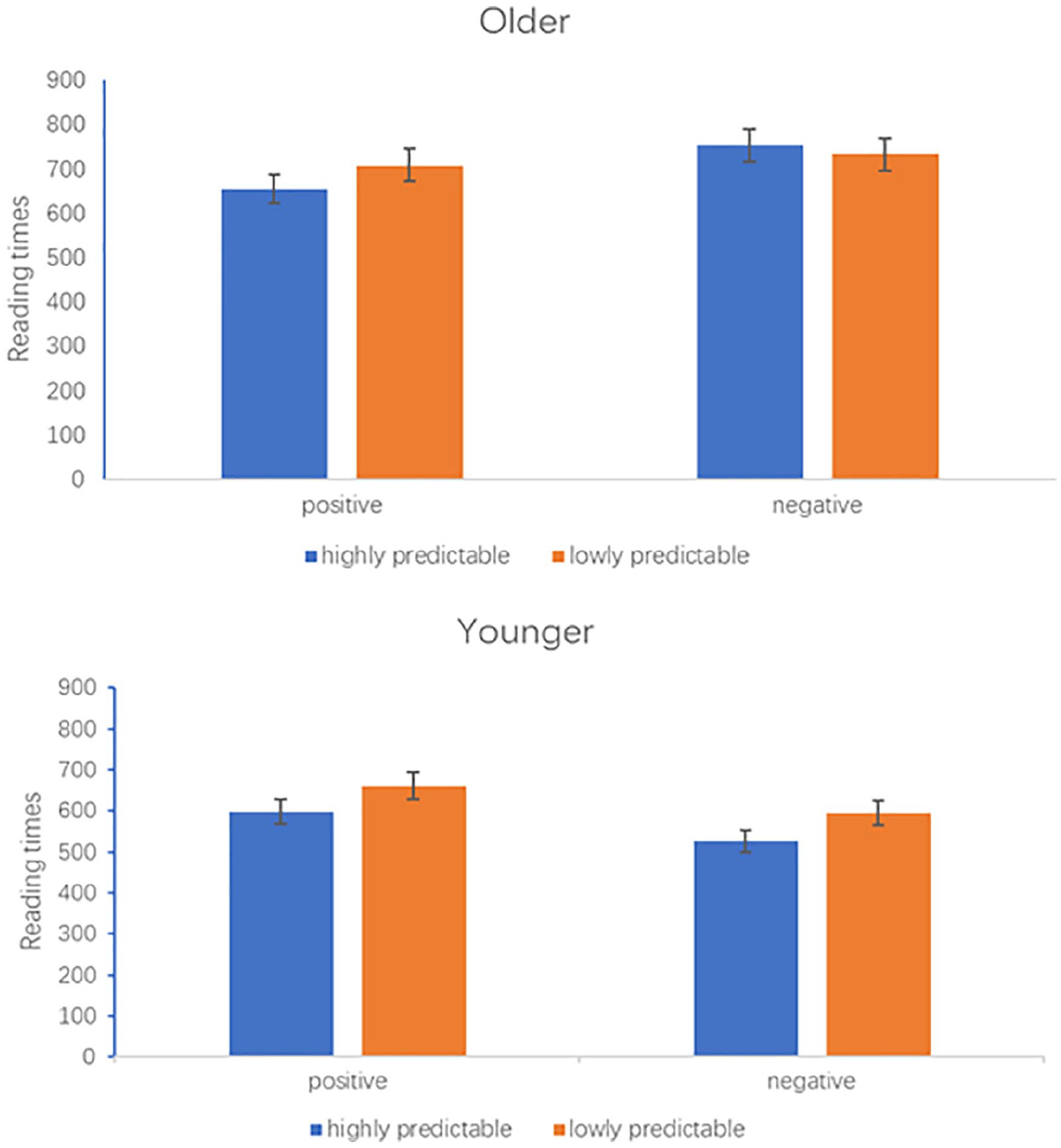
Reading times by mood and sentence predictability (ms).
The results of linear mixed-effects modeling revealed a significant effect of group, β = −0.32, SE = 0.05, t = −6.77, p < .05; a significant effect of mood, β = −0.17, SE = 0.03, t = −6.83, p < .05; a significant interaction between group and predictability, β = 0.18, SE = 0.05, t = 3.21, p < .05; a significant interaction between group and mood, β = 0.25, SE = 0.04, t = 6.18, p < .05; a significant interaction between predictability and mood, β = 0.13, SE = 0.05, t = 2.47, p < .05; and a significant three-way interaction between mood, group, and predictability, β = −0.17, SE = 0.07, t = −2.53, p < .05.
In the positive mood condition, both groups processed highly predictable sentences faster than lowly predictable sentences (ps < .05). No significant interaction effect was found between group and predictability, indicating that there was no significant difference between the two groups in the effect of predictability. In the negative mood condition, the interaction effect between group and predictability was statistically significant (p < .05). Pairwise comparison showed that younger adults processed highly predictable sentences faster than lowly predictable sentences (p < .05), but there was no significant difference in RTs between the two types of sentences in the older group.
Discussion
The goal of the present study was to explore the effect of mood on predictive sentence processing by older adults. It was hypothesized that older adults are more sensitive to mood manipulation in sentence processing than younger adults. Specifically, positive mood may have a stronger facilitative effect on predictive sentence processing by older adults, whereas negative mood may have a stronger inhibitive effect on their performance. A self-paced reading task was administered to test this hypothesis. The present study found that in the positive mood condition, both younger and older adults processed highly predictable sentences more efficiently than lowly predictable sentences, and the effect of predictability did not differ between the two age groups, which suggests that older adults relied on contextual information to make predictions to the same extent as younger adults in predictive sentence processing. This finding shows that positive mood facilitates predictive processing in older adults. The finding underscores the importance of affective states in sentence processing by older adults. Given the decline in sensory processing abilities in the aging population, the ability to make predictions becomes especially important, as it could be used to compensate for the decline in the quality of sensory inputs. Positive mood which facilitates prediction during sentence comprehension improves sentence comprehension in both younger and older adults. The findings agree with the prior studies which have found that positive emotions improved participants’ performance in various cognitive tasks involving working memory (Yang et al., 2013), association memory (Madan et al., 2019), and categorical learning (Nadler et al., 2010). This study, together with the prior research, provides evidence for the facilitative role of positive mood in cognitive activities including language comprehension.
Noticeably, although older adults matched younger adults in the ability to predict upcoming words in the present study, they did not seem to benefit more from positive mood than younger adults, which is not entirely consistent with our hypothesis. A possible reason is that the effect of positive mood might be inhibited due to the age-related decline in cognitive functions (especially working memory) in older adults. Moods can load up cognitive resources as the network of mood-related information is increasingly activated (Mackie & Worth, 1989; Seibert & Ellis, 1991), which may increase the cognitive burden for older adults, making it rather difficult for them to predict upcoming information in a highly efficient way. This might explain why older adults did not outperform younger adults in the present study. Future studies are needed to explore how mood and general cognitive abilities jointly influence predictive sentence processing by older adults.
In the negative condition, younger adults processed highly predictable sentences more efficiently than lowly predictable sentences, whereas there was no significant difference between the two types of sentences in older adults, which indicates that older adults could not use contextual clues to make predictions as younger adults did. In other words, negative mood was found to inhibit predictive processing among older adults. The findings support our hypothesis that negative mood impedes predictive processing in older adults, and were consistent with the previous studies which have revealed a deleterious effect of negative mood on language production in older adults (e.g., Carstensen & Mikels, 2005; Castro & James, 2014). The current study further demonstrated that negative mood also hinders language comprehension, and might be a universal constraint to the use of language for communication. This might be because negative mood triggers a strong bottom-up processing style, which is too effortful and cognitively costly for older adults. This is supported by Mackie and Worth’s (1989) proposition that mood is cognitively costly and older adults need to allocate extra cognitive resources to control and adjust negative mood. Another possible explanation is that negative mood requires more attentional resources, and thus results in more disruption for older adults in sentence comprehension. Studies on language comprehension have shown that in comprehending sentences with negative emotional content, participants performed significantly more slowly than they did in reading neutral-valenced materials (Carretié et al., 2008; Kuchinke et al., 2005). This suggests that negative mood is potentially disrupting for language comprehension.
The present study shows that younger adults could make use of contextual clues in both positive and negative mood conditions, which is not consistent with Chwilla et al.’s (2011) study. Chwilla et al. found that sentence processing was impeded by negative mood condition in younger adults. A possible reason for the discrepancy is the different measures used in the two studies. Chwilla et al. have adopted the ERP technique to explore the effect of mood on sentence processing. In EEG studies, N400 was typically used as the dependent variable to index the online processing of lexical-semantic information or world-knowledge integration. However, in self-pace reading tasks, RTs may be the by-product of different processes such as orthographic, lexical-semantic, and syntactic processes, and it is usually difficult to disentangle these processes. While Chwilla et al. have found that negative mood inhibits lexical-semantic processing in young adults, the present study shows that negative mood does not affect RTs. Participants might be compensating for their lexical-semantic deficits with other processes. In other words, the behavioral evidence from our study suggests that participants’ performance was not influenced by negative mood, but previous EEG studies revealed an underlying influence of negative mood on semantic processing at the electrophysiological level. This might explain why participants in our study were less affected by negative mood than those in Chwilla et al.’s study.
The findings of this study have important practical implications. Given the crucial role of mood in sentence processing, we suggest that mood manipulation be used as a useful approach to preventing or reducing the age-related decline in language comprehension. Our findings suggest that the elicitation of positive mood might be conducive to the preservation of language comprehension in older adults and thus, positive mood might be a useful starting point in designing a training plan to reduce the age-related decline in language comprehension. As negative mood can have a detrimental effect on language comprehension, an effective training program should avoid the visual or auditory elements which might induce negative mood in older adults. In recent years, there have been surging interests in the therapeutic potential of mood manipulation in the prevention and treatment of cognitive decline (Charles & Carstensen, 2010), and various approaches have been developed to increase positive affect (e.g., Murphy et al., 2015). These approaches might prove to be beneficial to the prevention and intervention of age-related decline in language comprehension. However, more research is needed to clarify the influence of mood manipulation before it can be universally employed in the prevention and intervention of the age-related decline in language comprehension.
This study is not without limitation. A major limitation of the present study is that the cognitive functioning of participants was only assessed through MMSE, a crude measure which is not sufficient to identify and detect the individual differences in working memory. Individual differences in working memory play a major role in predictive processing. As healthy older adults may differ greatly in their cognitive resources due to individual differences in cognitive reserve, it is necessary to assess working memory in the sample. Therefore, future studies should include working memory tests to evaluate participants’ working memory. Another limitation of this study is that we did not include a neutral mood condition. This is because we were more interested in relative mood effects than absolute effects. However, this practice might reduce the generalization of the present research. As the effect of mood on sentence processing may not be linear (Wang et al., 2016), further research is needed to provide a more comprehensive picture about the relationships between different types of mood (positive, neutral, negative) and language comprehension in the aging population.
Conclusion
In conclusion, this study shows that mood plays a critical role in language comprehension by older adults. Negative mood was found to hinder sentence comprehension by inhibiting the use of predictive strategies in older adults. In the positive mood condition, older adults can use predictive strategies in the same effective way as younger adults. The findings suggest that older adults are sensitive to mood manipulation in sentence comprehension, which underscores the increasing significance of affective states in language communication with advancing age. In this way, the present study provides important insights into the interaction between affect and language-related activities in healthy aging.
Footnotes
Declaration of Conflicting Interests
The author(s) declared no potential conflicts of interest with respect to the research, authorship, and/or publication of this article.
Funding
The author(s) disclosed receipt of the following financial support for the research and/or authorship of this article: This study is supported by the Beijing Social Science Foundation (20YYC020).
