




Abstract
The prohibition of aquaculture is an important policy instrument for water quality protection. However, there are lack of observations on the complex interactions between stakeholders in the limiting or closing of fisheries and the internal cooperative mechanism that balances the restoration of water bodies and the livelihoods of fishermen. Using evolutionary game theory and modeling, this article analyzes the complex mutual feedback strategy between local government and the affected fishermen in regard to water body restoration and livelihood security under fishing prohibition. The results show that (a) the performance evaluation mechanism of environmental protection, including rewards and punishments, can provide direct political traction and indirect material guarantees for local governments to perform their duties and allow water body restoration and the transition of fishermen to alternative livelihoods. (b) Whether the local government actively promotes aquaculture closures is restricted by the improvement in the aquatic environment, the aquaculture development under the existing livelihood, and the industrial economic benefits of the new livelihood. And the capacity of them contribute to the overall development of the local government. The development of the net income of both parties in the negotiation will shape the direction of a series of public policies that focus on aquaculture closures.
Introduction
Water bodies represent both an objective natural comprehensive landscape and a strategic resource of economic and social value that supports national security and the well-being of people (H. Wang, 2016). The water body not only encompasses the natural or artificial river, lake, reservoir, sea, swamp, glacier, snow, groundwater, and atmospheric water but also includes the dissolved matter, suspended matter, sediment, and aquatic organisms in the water. Together, these elements constitute the spatial basis and material conditions for the benign interaction between and the succession of the ecological environment and the social economy. With the incorporation of “ecological civilization” into The Constitution of the People’s Republic of China (2018), the concept that “lucid waters and lush mountains are invaluable assets” has become increasingly popular (Xi, 2017). In the process of achieving the two centenary goals, the Communist Party of China and the state have attached great importance to water body restoration. Between the Third Plenary Session of the 18th Central Committee and the Fourth Plenary Session of the 19th Central Committee of the Communist Party of China, the construction of an ecological civilization and the improvement of river and lake systems have been emphasized many times. The Water Pollution Prevention and Control Plan (2015) and The State’s Opinions on the Protection of Key River Basins (e.g., in 2019, general secretary Xi Jinping delivered a speech at the Symposium on Ecological Protection and High-Quality Development in the Yellow River Basin) have illustrated that aquatic environmental protection and water pollution prevention and control rise to the level of necessity. It has placed these concepts in an elevated position that is related to the realization of the Chinese dream of the great rejuvenation of the Chinese nation. Whether the national water culture can be continuously strengthened and the pollution sources can be gradually eliminated is related to the modernization and capacity of the environmental management system.
China has an extensive aquaculture. Since the founding of the People’s Republic of China 70 years ago, an industrial pattern has been developed that focuses on aquaculture and fishing, conservation, and processing in a comprehensive manner. In 2018, the total output of aquatic products was 64.58 million tons, accounting for more than 40% of the global total fish output; the total economic output of fisheries is 2,586.447 billion yuan. The strong history of aquaculture development has globally integrated “Chinese wisdom” to ensure the supply of agricultural products and national food security and increase the welfare and livelihood quality of fishermen. However, the high marginal benefit production of the aquaculture is also eroding the marginal carrying capacity of the water body. In large-scale, high-density, rapid-yield feeding aquaculture, active phosphate and inorganic nitrogen become the primary pollution indicators in the water body. There is limited capacity for self-purification given the feed, drugs (malachite green, nitro furan, chloramphenicol, etc.), excreta, biological corpses, and other vectors. Excessive and illegal fishing in the forms of “no household limit” and “electric fishing explosion” has resulted in a serious decline in rare and unique species. And the biodiversity index has continued to decline. Irrational aquaculture production behavior has become an important trigger for the increasing deterioration and vulnerability of the ecological environment of fisheries in China (Cui et al., 2018; C. Wang et al., 2017). Implementing periodic, permanent, or river basin–specific prohibitions on breeding and capture and implementing water body restoration help to improve water quality and the diversity of aquatic communities. It will further promote better fisheries and optimize the overall national ecological environmental security barrier system (Peng et al., 2019; Tang, 2017; H. Wang, Shi, et al., 2019; H. Wang & Wang, 2017; J. Xu et al., 2020).
In addition to the restoration of water bodies and the well-being of people, the effective implementation of aquaculture closures should be considered. Fishing activities that are irrational but have a high rate of return are the challenge in the balance between water protection and fishermen livelihoods. The prosperity of fisheries brings considerable regional economic and social benefit to local government leaders and provides a good livelihood for the fishermen. All of these together aggravate the uncertainty of decision-making and the behavior of frontline management and fishermen groups (Shi & Wang, 2014). To avoid a bias toward either water protection or fishermen livelihoods in the management of aquaculture closures, it is necessary to begin with the behavioral strategies of both sides to explore the cooperative mechanism of joint action in the complex interaction between management and fishermen. To date, the available research has primarily focused on the following aspects. First, there has been a focus on the quality and cycling of water at different spatial scales as well as a series of complex natural attributes that interact with other physical and chemical elements of the natural environment and ecosystem. Based on these natural attributes, some studies have further discussed the scientific methodology and engineering technology of water pollution control, ecological restoration, and environmental monitoring (Chartres & Varma, 2012; Ferrantea et al., 2015; Marcelo et al., 2013; Marín & Andreo, 2015; Newton et al., 2014). From the human perspective, other studies have examined legislation and policy and conducted comparative analyses of practical experiences at home and abroad (UN, 2015). Second, concern regarding the connections and mechanisms of governance across regional and ecological environments has highlighted the political, legal, responsibility, and role dilemmas of subject governance by multiple administrations (Gong, Yao, et al., 2020; Gong, Zhang, et al., 2020). These mechanisms include the government, private enterprises, and the public in the environmental regulations related to carbon limitation and emission reduction, solid waste recovery, air pollution prevention and control, and sewage treatment, as well as the interactive and cooperative strategies of financial subsidies, cost controls, and benefits distribution (J. Guo et al., 2019; Wang et al., 2019; Wu & Wang, 2019; Xiao et al., 2020). Third, against the deterioration of aquatic environmental quality and the safe operation of the national strategic water delivery project, there has been study of the sustainable development of the inland nonvoluntary supplement and fishermen retirement and of offshore fishermen. These studies have included discussions focusing on the recovery of livelihood capital, construction of alternative livelihoods, and reconstruction of fishing communities. Compensation, resettlement, public services, medical issues, education, and adaptation to non-fishing enterprises are also discussed (Chen & Wang, 2007). Fourth, the supporting theories of ecological environmental governance mechanisms have been widely used in the existing research, including multicenter governance theory, collective action theory, symbiosis theory, and cooperative game theory (Chu et al., 2018). Fifth, several aquaculture closure policies have been implemented in the United States, Canada, Brazil, Philippines, Vietnam, Indonesia, and Northern Europe (Blanchard et al., 2017; Food and Agriculture Organization of the United Nations, 2014). These policies were designed to control water usage and regulate aquaculture development in an attempt to improve water quality and biodiversity. Previous studies have demonstrated that these policies substantially alleviate aquaculture pollutions (Kincaid & Rose, 2014), while these intervention policies do not provide alternative livelihood opportunities for the affected fishermen (Morgan et al., 2016). The economic downturn could lead to large-scale monetary impacts on the livelihood quality of those affected fishermen and communities, especially in underdeveloped areas (Kincaid & Rose, 2014).
Unfortunately, there are few dynamic game and equilibrium stability analyses of the interaction between government and fishermen in regard to water restoration and livelihood security. The existing studies have not fully explained the internal cooperative mechanism of the complex interaction between the stakeholders in limiting or closing an aquaculture farm and balancing aquatic restoration with livelihoods. In the face of the increasing trends for water conservation and fishing prohibition, the existing knowledge system is insufficient to provide more comprehensive intellectual support for the construction of an ecological civilization.
Therefore, this article aims to build a dynamic evolutionary game model (DEGM) of local government and affected fishermen regarding water body restoration and livelihood security in the context of non-fishing governance. This article focuses on a model that deduces and explains the complex mutual feedback mechanism formed during the dynamic adjustment of different limited strategies by rational subjects. It will also explore how this complex mutual feedback mechanism encourages local governments to fulfill their responsibility for the protection of the aquatic environment and realization of a “win-win situation” for the sustainable development of the livelihood rights of fishermen.
Methods
Preliminary Settings
Setting 1: In the DEGM, the main stakeholders consist of local government (at the county level) and the affected fishermen. Due to the principles of territoriality and decentralization, local governments not only are the executors of water restoration, focusing on the political will of higher authorities and the central government and subject to their performance appraisal, but also are the recipients of demands from the fishermen, facing the pressure of public opinion and social stability. The term “fishermen” refers to the collection of groups affected by the restoration of water bodies within the jurisdiction of the local government who operate fisheries that are actually or potentially harmful to the aquatic environment over the long term. There is no collusion, corruption, or illegal acts by either of the two parties. Fishermen do not seek to bribe local officials to maximize their own interests. The behavior of local government in regard to water body protection is carried out within a framework of laws and regulations at all levels.
Setting 2: There are two goals in the behavior space of the local government. One goal is to actively perform water body restoration and implement the aquaculture closures. Another goal is to consider the economic benefits of local fisheries and adopt the strategy of delay, but there is no dereliction of duty. Assuming that the probability of local governments choosing to actively implement the policy is
Setting 3: In response to the aquaculture closures, the fishermen’s strategy set also includes two options: taking the initiative to adapt or passively delaying. Active adaptation assumes that the fishermen withdraw from the existing water use rights periodically or permanently in accordance with instructions from the administration, relinquish aquaculture, and seek alternative livelihoods, and there is no ecological environmental risk in the new plan. Procrastination indicates that the fishermen resist relinquishing the current aquaculture. The probability of fishermen choosing the active adaptation strategy is
Setting 4: There are two elements of the local government’s payment function: the benefits and costs of aquaculture closures. The benefits can be transformed into economic and social benefits based on awards from higher authorities and the central government as well as the improvement in ecosystem services. It will strengthen the marginal contribution of non-fishery industries and livelihoods to the local economy and society. In terms of costs, there are engineering and technical expenditures for water restoration, monetary compensation to fishermen for changing livelihoods, fines from higher authorities and the central government, and the loss of local financial marginal income from the aquaculture.
Setting 5: The payment function of the fishermen in the model also includes two elements: benefits and costs. The benefits includes production compensation, alternative livelihood income, and transfer compensation. The costs can be divided into three aspects: the loss of the livelihood, the expenditure associated with implementing an alternative livelihood, and fines for water pollution. This article stipulates that there is no fraud or obvious opportunism between the local government and fishermen.
Determination of Parameters and Payment Matrix of the DEGM
Local government
Fishermen
µ1 and µ2: These parameters represent the influence coefficients of the fishermen’s active adaptation or passive delay strategy, respectively, on the level of compensation given by the local government. When the local government knows that fishermen have adopted an active adaptation strategy, they will reduce the amount of compensation to the fishermen. Local government will take the initiative to raise µ1 and µ2, which satisfies
When fishermen choose the active adaptation strategy, they must bear the loss caused by the change in part or all of their livelihood:
Payment Matrix Between Local Government and Fishermen.

Analysis of Equilibrium and Stability Strategy
The Solution of the Equilibrium Point in the Control of the Aquaculture Closures
Based on the above settings, the benefits of active implementation by the local government


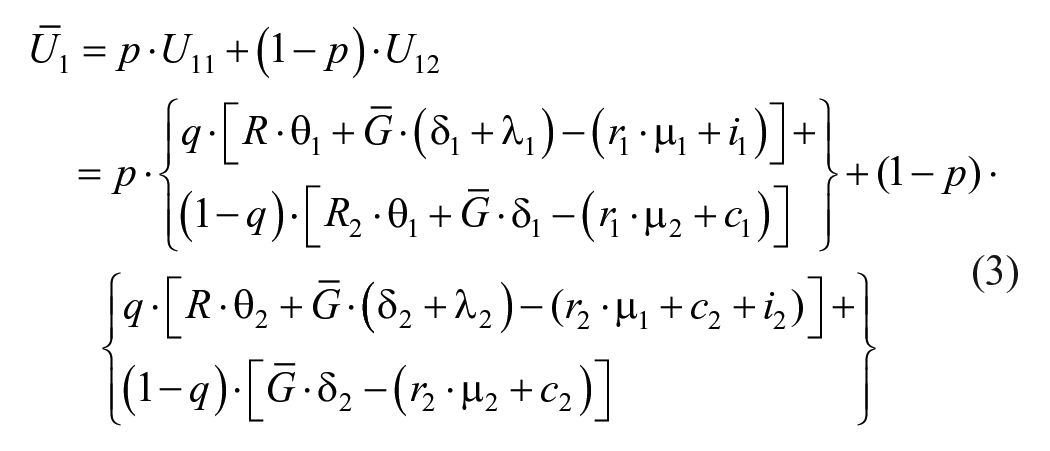
The benefits of the fishermen’s active adaptation



Based on the expected reality, the ideal outcome of the stakeholder interaction should be the greatest benefits for both sides, that is, the local government should actively promote the aquaculture closures to achieve water protection, and the fishermen should actively adapt to obtain livelihood security. Therefore, the dynamic replication equation of the local government’s active implementation strategy is as follows:

It is stipulated that the four benefit outcomes for the local government in the payment matrix are

The dynamic replication equation of fishermen adopting an active adaptation strategy is as follows:

Similar to the local government, the four benefit outcomes of fishermen in the matrix are
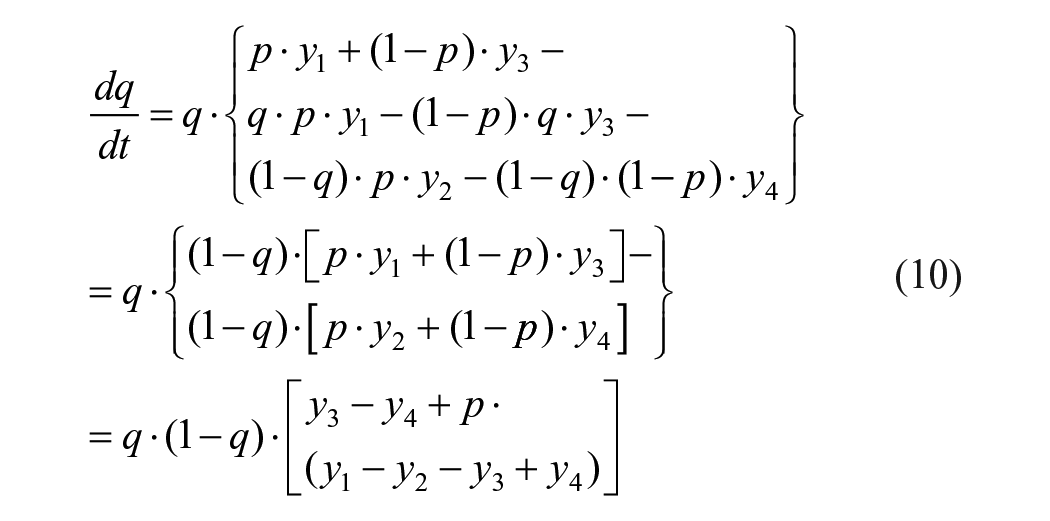
The differential equations determined by

Five local equilibrium points
Stability Analysis of the Equilibrium Point
According to the dynamic replication system of the evolutionary game composed of the differential equations determined by

Furthermore,

The determinant is then

The trace of matrix is

If the interaction result
Jacobian Matrix Analysis of the Evolutionary Game System.

From the perspective of higher authorities and the central government (or a purer spectator perspective), the optimal evolutionary result is that the local government makes full efforts to promote the management of the aquaculture closures to achieve water body restoration, and the fishermen also take the initiative to adapt to livelihood changes and achieve the sustainability of alternative livelihoods. The evolutionary strategy of both sides will continue to the equilibrium point
In contrast, under the conditions of complete irrationality, the ESS of the final evolutionary game tends toward point
ESS of the Evolutionary Game System Under the Premise of Ideal Presupposition.

Note. ESS = evolutionary stable strategy.
The two sides are shown in the dynamic phase diagram (Figure 1). The

Dynamic negotiation phases between local government and fishermen.
Assignment Simulation and Parameter Discussion
To intuitively analyze which path the dynamic game will evolve along, this study simulated the payment function, observed the convergence direction of the stable equilibrium of the interaction, and discussed some key parameters.
The area of the quadrilateral

When the area
For intuitive comparison, each scenario is divided into two types of simulation scenario: a small variance in the benefits value (Simulation 1) and a large variance in the benefits value (Simulation 2), which are primarily reflected in the scale partition between the maximum value and other payments. Each simulation use value was randomly selected based on the size order in Table 4, and the specific value determined in scenario 1 is the global use value. After simulation, the average area
Potential Size Relationships of the Payment Functions.

Simulation of Convergence Direction of Stable Equilibrium in Different Situations.

In Scenario 4, when
When
Conclusion
The optimal strategic situation of balancing the protection of the aquatic environment and the development rights and interests of the fishermen was analyzed by constructing a DEGM of local governments and fishermen groups in regard to water body restoration and livelihood security. This article draws the following conclusions and provides the following insights. (q) A package of ecological protection performance evaluation mechanisms including rewards and punishments by higher authorities and the central government is necessary. The government’s responsibility for environmental governance including water body restoration plays a leading political role. More importantly, the internal economic regulation function of the evaluation mechanism is an exogenous variable that local governments rely on in the process of aquaculture closure governance. This mechanism directly constitutes an incentive for local governments to actively promote the management of the aquaculture closures (B. Wang, 2013) and indirectly serves as an initial material source of security for the affected fishermen to transition to an eco-friendly livelihood. (b) To balance water body restoration and livelihood security under the aquaculture closures, we should consider not only the improvement of the aquatic environment but also the path of aquaculture development based on the fishermen’s existing livelihood and their comprehensive contribution to the regional economy and society; policymakers should also accurately measure the effect of disrupting local financial revenue. When the closure of the existing aquaculture has a significant impact on overall local development, the improvement in the aquatic ecosystem service function lags in its ability to counteract the impact, and when the industrial economic benefits of the new livelihood plan are weak, the local government tends to be passive. (c) The uncertainty of the expected stable income of the alternative livelihood seriously restricts the willingness of fishermen to cooperate in the management of the aquaculture closures. Cash compensation can be used to trigger fishermen cooperation in the management of the aquaculture closures, but it cannot provide an absolute guarantee of the sustainability of the alternative livelihood, nor can it fundamentally eliminate the potential social, economic, and environmental risks of the new plan. For example, to guarantee the water safe of Danjiangkou Reservoir (a drinking-water source of the South-to-North Water Diversion Project, China), all aquaculture facilities were to be dismantled by 2014 as the government required. Although cash compensation had an effect on promoting aquaculture closures, only 39.7% of rear-facilities were removed by the end of 2015. This is because the local economic system is unable to provide effective substitute industries which could generate higher profits than aquaculture in the near future. Affected communities and fishermen are most at risk of falling into poverty (C. Wang et al., 2017). It is very important to mobilize resources and cultivate a new livelihood model with a capacity for high compensation to enhance the fishermen’s desire to cooperate and to reduce the risk related to the aquaculture closures. (d) A local government that has been passively implementing the aquaculture closures objectively intensifies the determination of the fishermen to continue their behavior and benefit from the existing livelihood. When non-cooperative fishermen face a high penalty for operating the existing aquaculture that is far greater than the initial investment for the reconstruction of a new livelihood or the clean transformation of the original livelihood, the fishermen are more inclined to be responsive to the measures. (e) Preventing loss and increasing gain is the core path for the success of the aquaculture closures (Zhong & et, 2015). Water body restoration, livelihood change, and industrial transformation need to enhance the sense of access of local governance subjects and the affected fishermen and simultaneously substantially reduce the actual and potential expenditures. A weak net income does not guarantee cooperation between the two sides of the interaction. The development of net income should be the direction of a series of public policies focusing on the aquaculture closures.
The above theoretical analysis has reference value for promoting the cooperation between local governments and fishermen in the actual aquaculture closures. Of course, some aspects of this study require additional work. First, to facilitate the analysis, the water body being restored will be treated as a single entity without considering the mutual feedback among the many administrative bodies in the basin. Second, the payment matrix and parameter setting of DEGM need to be modified by combining them with empirical studies. Third, the estimation of benefits of water quality improvement and fish stock replenishment is committed to be addressed in case researches.
Footnotes
Declaration of Conflicting Interests
The author(s) declared no potential conflicts of interest with respect to the research, authorship, and/or publication of this article.
Funding
The author(s) received no financial support for the research, authorship, and/or publication of this article.
Ethical Approval
This article does not contain any studies with human participants or animals performed by any of the authors.
Informed Consent
Informed consent was obtained from all individual participants included in the study.
