




Abstract
This study investigates the impact of mobile social apps (MSAPs) on consumers’ online purchase attitude (COPA) with the mediating effect of trust (TRF) and technological factors (TF) drawing on IS theory—technology acceptance model—from the context of China. The article is compiled based on 600 responses obtained from online shoppers and analyzed using structural equation modeling. The study confirmed that MSAPs—Wechat, Weibo, and Virtual community apps—are positively correlated with consumers’ online purchase attitude. It revealed that TRF (i.e., perceived trust and risk) and TF (i.e., perceived ease of use and usefulness) positively mediate the nexus between MSAPs and COPA. The study states multidimensional insights for strategic management to explicitly focus on evolving MSAPs together with TF and TRF mechanisms to reinforce COPA in a widespread and dynamic way in today’s digital and competitive era. In addition, several implications for managers are proposed together with suggestions for scholars to conduct longitudinal studies in the global arena.
Keywords
Introduction
The scope of mobile devices (m-device) into practice is rapidly flourishing because of widespread acceptability and usage worldwide (Waheed & Yang, 2018). M-device plays an important role in pursuing competitive advantages and sustainability in marketing operations to generate the utmost profit and to survive in today’s competitive environment (Baumgartner & Ebner, 2010; Dangelico et al., 2017; Howes et al., 2017; Paulraj, 2011). Research on sustainability by adopting evolving ICTs like m-device is on the initial stage where experts have posited a substantial significance of such devices into business practices. Waheed et al. (2020) suggested that firms’ sustainability might be achieved by focusing on all operational aspects. In the marketing perspective, numerous innovative tools and tactics have become the focusing point of the experts across the world. Such researchers are striving to reveal the significance of thriving mobile features like social applications in marketing communications to survive in the present modern age (e.g., El-Gohary, 2012; Kannan, 2017; Mathews et al., 2016; Thaler & Tucker, 2013).
In marketing perspective, organizations must understand the buying attitude of the consumers and the factors that may influence on such attitude, especially online purchase attitude since consumers’ buying attitude is shifting toward online shopping from traditional ways (Constantinides, 2004; Huseynov & Özkan Yıldırım, 2019; Perea Monsuwé et al., 2004; Van der Heijden et al., 2003). Consumers’ online purchase attitude is defined as a buying intention to purchase a product or service using internet-based networks (Van der Heijden et al., 2003). In the past research, the attitude of the consumers is transforming from conventional to emerging tools as it is reported that nearly 51% of worlds’ population is using internet technologies, while 1.7 billion internet users buy products and services online (internet World Stat, 2017). Likewise, 721 million are Chinese internet users which represent 21.1% share of world internet users (China internet Users, 2016). Furthermore, it is reported that nearly 466.7 million Chinese people purchase products or services online (Statista, 2017b). As the attitude toward online is astonishingly growing because of the accessibility of reliable, ease of use, and secure online platforms (Constantinides, 2004; Van der Heijden et al., 2003). Such hip of internet users and online shopping yields several opportunities for businesses to reinforce consumers’ behavior using such flourishing mediums of IS and ICTs. Over the past decades, several academic scholars and practitioners have focused on emerging IS and ICTs methods to ensure the benefits in a range of business activities (Rondan-Cataluña et al., 2015).
The experts have identified numerous factors that influence consumers’ online buying attitude, for example, security, e-store contents, fraud issues, ease of usefulness, ease of use, payment process, and other related risks (H. Chen, Beaudoin, & Hong, 2017; Koong et al., 2008; Van der Heijden et al., 2003). However, still research is required, especially in terms of social apps and consumers’ online purchase attitude as diverse scholars suggested deep research of such theme (Floh & Madlberger, 2013; Harwit, 2017; Van der Heijden et al., 2003; Venkatesh et al., 2012). In the past, most of the work on social apps have been done in developed nations, including the United States, the United Kingdom, and rest of the developed economies (Logan, 2017; Thelwall et al., 2017). Second, the experts have been evaluated the influence of distinct social apps and social media tools other than consumers’ attitudes in varied contexts and perspectives across the world. Third, most of the past work considered specific social apps to examine the influence within different aspects of the consumers (Thelwall et al., 2017; Tiago & Veríssimo, 2014). Furthermore, literature is witnessed that most work on social applications has been conducted with direct effect without consideration of mediation-moderation factors over the past (Hudson & Thal, 2013; Mansour, 2016; Thelwall et al., 2017). It is noteworthy to reveal the influence of mobile social apps (MSAPs) with respect to consumers’ purchase attitude (COPA) with mediating factors TRF (i.e., perceived trust and risk) and TF (i.e., perceived ease of use and usefulness) that got far less attention. COPA is slightly different than purchase intention as COPA has been defined by the experts as the idea of the individual toward particular product or service before making an online purchase decision (Van der Heijden et al., 2003). COPA additionally defined as a buying intent to purchase a product or service using internet-based networks (Van der Heijden et al., 2003). In the past, most studies considered COPA as a mediator to disclose the influence toward consumers’ intention (Van der Heijden et al., 2003). However, no know study used COPA particularly related to SNSs within the developing nations like China for such consideration. This study aims to contribute to the respective literature with additional empirical evidence from developing nations based on information system theory—technology acceptance model—adopting mediation model between the MSAPs and COPA. MSAPs have been independently tested over the past decades where most of the work conducted considering diverse domains other than COPA. Such studies summarized that MSAPs play critical role in business success which also help to create long-run and dynamic relationships with customers. A few applications, that is, Wechat, Weibo, and virtual community apps are most famous within Chinese market. Therefore, understanding how such apps might be helpful for the organizations to attain customer’s utmost attention in the interesting phenomena. Moreover, most of the past work on social apps have been done in developed nations whereby the experts have been evaluated the influence of distinct social apps and social media tools other than consumers’ attitude in varied contexts and perspectives across the world (Logan, 2017; Thelwall et al., 2017) This study further attempts to fill the literature gap furnishing important insights from the business-to-consumer (B2C) perspective by revealing the impact of renowned mobile social apps such as Wechat, Weibo, and Virtual community apps from a developing country like China that was ignored in the existing literature.
First, an objective of this study is to explore the impact of MSAPs by integrating three social applications such as Wechat, Waibo, and Virtual Community on consumers’ online purchase attitude (COPA). Second, the goal is to examine the mediating effect of trust factors (TRF) using two attributes of TRF—perceived trust (TS) and risk (PR)—on COPA. Third, the objective is to explore the mediating effect of TF—perceived ease of use (PEU) and usefulness (PU)—on COPA. Furthermore, the study is organized as follows. Theoretical background, research framework, and formation of hypotheses are proposed in the next section. Subsequently, the methodologies, that is, sampling procedure, measures of constructs, and statistical techniques are reported. Thereafter, discussion and results are accordingly laid down. The final section is based on implications, shortcomings, conclusions, and lines for future opportunities both for academics and practitioners.
Literature Review and Hypotheses
In the past, several studies were suggested the applications of flourishing IS and ICTs across the nations (Rondan-Cataluña et al., 2015). The experts have been proposed and validated distinct theories and models concerning the acceptability, utilization, adoption, and behavioral intentions of the individuals (Hew et al., 2015; Rondan-Cataluña et al., 2015). For instant, E. S.-T. Wang and Chou (2016) examined the impact of social networking apps on consumers’ continuous usage, Logan (2017) considered mobiles apps in gratification sought, Tiago and Veríssimo (2014) worked adopting social media in advertising perspective, Mansour (2016) adopted mobile apps with respect to information sharing in library perspective, Aldahdouh et al. (2020) evaluated impact of social media on higher education commission, Raut and Patil (2016) explored the impact of social media on educational perspective, and Ahmad et al. (2019) explored the role of social media on political participation. Despite, different models and theories were proposed by experts since 1970s, including technology acceptance model by Davis (1986), technology acceptance model (TAM2) by Venkatesh and Davis (2000), and technology acceptance model (TAM3) by Venkatesh and Bala (2008), respectively.
The main focus to propose and test such models was to ensure whether people accept or refuse acceptance of ICTs (Rondan-Cataluña et al., 2015). In marketing domain, researchers studied several multi-dimensional models relayed on such theories to ensure the importance of ICTs in marketing communications, including Coviello et al. (2001) and El-Gohary (2012). Coviello et al. (2001) developed a five-dimensional model of contemporary marketing practices for MC, that is, e-marketing, transactional marketing, network marketing, database marketing, and interaction marketing, respectively. Likewise, academics and practitioners attempted to comprehend the outcomes of numerous ICT methods like m-devices and affirmed the positive influence on organizational performance, especially in marketing communications, for example., social applications marketing, social media marketing, social-network-sites marketing, mobile marketing, internet marketing, email marketing, viral campaigns marketing, database marketing, digital ads marketing, and remainder online blogs which might be used for product promotions (Coviello et al., 2001; El-Gohary, 2012; Kannan, 2017; Tiago & Veríssimo, 2014).
Despite, scholars suggested that research on m-devices in distinct domains is still in the infancy stage consequently more work is required to affirm antecedents in marketing communications to validate the findings within unlike perspectives worldwide (El-Gohary, 2012; Tiago & Veríssimo, 2014). Moreover, the technology acceptance model (TAM) is a theory of information system that encourages the researchers to further inquire about the insights regarding adoption and usage of technology in different business operations (Van der Heijden et al., 2003). The current study particularly based on TAM as most of the past studies developed their studies drawing of IS theory like TAM to furnish interesting implications across the globe (Chau et al., 2000). The study of Van der Heijden et al. (2003) also based on TAM theory of IS to understand the insights regarding technology and consumers’ attitude and intention. TAM was introduced by Davis (1986) which endorses to understand the attitude, intention, and belief in the social perspectives using two important streams, that is, perceived usefulness (PU) and perceived ease of use (PEU).
In the past, PEU and PU have confirmed as the most relevant mechanisms in terms of online systems. Moreover, researchers further argued that TAM is an essential IS theory which plays crucial role to accept new and innovative technologies, therefore, endorses the scholarships to expand work in distinct contexts and dimensions across the nations (Ashfaq et al., 2019, 2020; Chau et al., 2000; Siyal et al., 2019). Therefore, based on the above literature and theoretical support, this study strives to contribute to the respective literature by investigating the impact of MSAPs, TRF, and TF on COPA from the context of China as following presented in Figure 1 and subsequently described.

Research framework.
MSAPs and COPA
The social apps marketing is defined as a promotional tool using varied social applications, especially well-known MSAPs that have extensively studied by researchers, for example, Whatsapp, Facebook, Facebook Messenger, Snapchat, Tumblr, Instagram, Weibo, Line, LinkedIn, Viber, and virtual communities (Harwit, 2017; Koh et al., 2003; Logan, 2017; Thelwall et al., 2017; E. S.-T. Wang & Chou, 2016). Nowadays, individuals are tremendously using m-devices with the integration of varied applications for different objectives, including entertainment, education, and social communications with friends and family (Logan, 2017). In China, likely 1.40 billion people are using m-devices (Statista, 2017a) which refers to an enormous market consequently such extensive use creates more opportunities for policy-makers to adopt such means for the dissemination of product information. As earlier described that most of the past work on social apps have been done in developed nations whereby the experts have been evaluated the influence of distinct social apps and social media tools other than consumers’ attitude in varied contexts and perspectives across the world (Logan, 2017; Thelwall et al., 2017). Although some experts have considered the work related to social applications with respect to gratifications, education, library sciences, advertising, consumers’ attitude, consumers’ behavior, and consumers’ intention across the world (Logan, 2017; Mansour, 2016; Tiago & Veríssimo, 2014; E. S.-T. Wang & Chou, 2016).
Nonetheless, experts recommended that still research is required, especially empirical work in terms of social apps and consumers’ online purchase attitude that got a little concentration over the past decades (Floh & Madlberger, 2013; Harwit, 2017; Van der Heijden et al., 2003; Venkatesh et al., 2012). Some other scholars have recommended more research on social apps to reveal further antecedents and outcomes of SAMs across the nations (e.g., Logan, 2017; E. S.-T. Wang & Chou, 2016). Besides, the related theories such as TPB by Ajzen (1991) and TRA by Ajzen and Fishbein (1980) encourage the researchers to investigate the behavioral intention of the distinct consumers concerning to the acceptability and use of IS and ICTs. Technology acceptance model (TAM) is a theory of information system that encourages the researchers to further inquire about the insights regarding the adoption and usage of technology in different business operations (Van der Heijden et al., 2003). Hence, based on the above significance and motivations, we currently proposed the following hypothesis to ensure the significance of MSAPs from the Chinese market.
Mediations Factors (TS, PR, PEU, and PU) Between MSAPs and COPA
As the experts were advocated that technology factor is a prime driver for all business activities where trust factors over such platform is an important concern undertaking by online users, especially buying a particular product or service using the internet technologies (Koong et al., 2008; Waheed & Jianhua, 2018). There are diverse studies that have been worked on TRF and TF in distinct dimensions to unveil the influence of such critical factors across the nations such as Van der Heijden et al. (2003), Z. Yang et al. (2019) and Koong et al. (2008). TF is further divided into two core parts, that is, perceived ease of use and perceived usefulness which ensure to comprehend the individuals’ characteristics with respect to usefulness and ease of usage toward particular online platforms. Similarly, TRF also categorized into two important streams, that is, trust over online sites and perceived risk toward such platforms. In the past, studies have been explored the impact of such factors independently within distinct aspects and contexts (e.g., Belanche et al., 2012; Van der Heijden et al., 2003). Furthermore, researchers believed that TRF is an incredibly important element that must be developed among consumers to motivate them toward a particular online store to sell a product or service online in a dynamic manner (Mayer et al., 1995). Understanding trust into an inter-organizational perspective was not highly prioritized by researchers, especially for its empirical outcomes (Van der Heijden et al. (2003). Therefore, researchers have developed certain scales to examine the effect of such factors on internet shopping expressly for empirical work (Cheung & Lee, 2000; Jarvenpaa et al., 2000).
Over the past decades, researchers and practitioners have considered trust factor and technology factors in the related studies in different ways to ensure the influence on varied contextualization across the world (Mansour, 2016; Van der Heijden et al., 2003). Most work was conducted without consideration of these factors as the mediations (Van der Heijden et al., 2003). It is worth mentioning to conduct deep analysis considering TF and TRF factors as the mediators in IS-related studies. On present instant, this study attempts to conduct multi-dimensional nexus of each factor of TF—perceived usefulness (PEU) and perceived ease of use (PU)—along with TRF factor—trust (TS) and perceived risk (PR)—as the mediators between the relationships of MSAPs and COPA that gear far less attention in the existing and related literature. The intention is to understand the correlation of such factors toward COPA independently to ensure the significance of TS, PR, PEU, and PU, respectively in reinforcing consumer’s attitude within the domain of China. In the past, studies have considered such factors to reveal the direct influence toward distinct contexts and dimensions but no known study considered these factors as mediations. Based on the above-précised discussion regarding TRF (e.g., TS and PR) and TF (e.g., PEU and PU), we currently assumed the following relationships.
Research Methodologies
Data Collection and Sampling Procedure
The study is quantitative in nature and data were gathered by means of simple random sampling of the questionnaires toward 800 Chinese online shoppers, especially students of all levels studying in distinct universities of China for understanding their online attitude with respect to distinct tools of social media, technology, and trust perspectives. Aside, 600 questionnaires (n = 600) were finally utilized for statistical analysis after the extraction of inadequately filled and erroneous documents. Moreover, data were collected with the support of professors, colleagues, and other students together with personal meetings and online survey tools. The questionnaires were developed in English though also statements were translated into the Chinese language for better clarity and understanding of the respondents. We carried out the questionnaire with both languages for the easiness of the respondents. All the constructs/items and statements were pre-tested and initially validated to avoid any biases using the following method.
A simple random method of sampling was used to target a small size from such a large Chinese population because of its accuracy and ease of use as well as a suitable representation of the larger population (Olken & Rotem, 1995; Starnes et al., 2010). The researchers advocated that simple random sampling is an easier tool to represent the large population whereby results might be used for generalization (Olken & Rotem, 1995; Waheed & Jianhua, 2018). In addition, several researchers have used this technique in the related studies to collect data using random sampling (e.g., J. V. Chen, Su, & Quyet, 2017; Logan, 2017; Mansour, 2016; Michaelidou et al., 2011; Thelwall et al., 2017; Waheed & Jianhua, 2018).
As 600 respondents were considered to accomplish the present work that seems an adequate and justifiable as most of the past IS, ICTs, and consumer-related studies have adopted the sample between the range of 200 and 1,000 to compile the their work (e.g., Ashfaq et al., 2019; Mansour, 2016; Siyal et al., 2019; Thelwall et al., 2017; E.S.-T. Wang & Chou, 2016; Wei et al., 2006). The students were targeted owing to certain reasons such as Compeau et al. (2012) and Schuster et al. (2016) recommended that student sample is appropriate and enormously used by distinguished scholars in IS and ICTs studies which can be used to form the generalizable statements. Compeau et al. (2012) analyzed several published studies from 1990 to 2010 and recommended that students are more open and active in the adoption of ICTs. Leong et al. (2013) argued that student sample is more productive to represent the whole population. Similarly, experts stated that students are more attached with the acceptability of IT and arrive from multiple regions having varied religions, races, cultures, social classes, social values, and backgrounds (Hew et al., 2015; Schuster et al., 2016). Based on such literature support, we believe it is reasonable to justify the selection of students’ samples to symbolize the remainder population.
The questionnaires were based on two main sections, that is, core part related to the proposed investigation and assessed using the 5-point Likert-type scale for all latent variables, ranged from strongly disagree to strongly agree, adapted from previous related IS and ICTs studies (e.g., El-Gohary, 2012; Loureiro & Kaufmann, 2017). The second part consisted of respondents’ demographic profiles based on six attributes and assessed using nominal and ordinal scales, adapted from Van der Heijden et al. (2003). Initially in SPSS software, strongly disagree was coded as 1, disagree as 2, neutral as 3, agree as 4, and strongly agree was coded as 5, respectively. Likewise, 1–5 digits were used for nominal and ordinal scales to record demographic information of the target consumers.
Pre-Testing of Constructs/Scales
A pilot study was conducted to ensure the feasibility of constructs/items before stepping to the next stage. Sixty online shoppers were requested to respond from main universities reside in Beijing, China (n = 60). Cronbach’s alpha values were adopted as a decisional tool where Podsakoff et al. (2003) recommended such values must higher than .7. Hence, all MSAPs are above .7 except a few items found below than suggested criteria such as Facebook at (α = .231), Facebook messenger at (α = .202), and Whatsapp at (α = .192). Such items were removed in further data collection because of weak reliability and unacceptability among Chinese consumers.
Measures of Constructs
Three types of variables were carried such as social apps marketing as independent variable, trust factor and technological factor as the mediation variables, while consumers’ online purchase attitude as the dependent variables. First, MSAP was measured using three items, that is, Wechat marketing, Weibo marketing, and marketing using virtual communities adapted from Harwit (2017), Logan (2017), and Koh et al. (2003). COPA was adopted from Van der Heijden et al. (2003) whereby TF and TRF were measured in two ways. TRF was measured using two determinants—TS and PR—adopted from Jarvenpaa et al. (2000). TF was measured using two dimensions—PEU and PU—adapted from Chau et al. (2000) respectively. It is worth mentioning, a minor adaptation of the words’ replacement is involved on present instant as such technique inspired from the previous studies where experts advocated that minor adaptation might be used for more suitability and understandability of the statements (DeVellis, 1991; Van der Heijden et al., 2003). The measurement items for each latent variable are shown in Appendix.
Data Analysis Tools and Techniques
SPSS together with additional tools—MS Excel and ADANCO—software were utilized to analyze the data, where items for each construct were coded in SPSS from 1 to 5 digits, as earlier explained. The following statistical analysis techniques were applied. First, descriptive statistics analysis techniques were carried out to generate the description of demographic profiles of target respondents, that is, age, education, gender, and marital status (see Table 1). Second, Pearson’s correlation analysis technique was used to calculate the interrelationships among constructs/items. The interpretation criteria for such technique stands between −1 to +1 and can be analyzed comparing “r” values (Taylor, 1990). According to Taylor (1990), higher values suggest greater positive influence, while smaller values indicate lower relationships (see Table 2). Third, discriminate validity for constructs was applied to reveal the “degree of differentiation” among variables. Deng et al. (2014) recommended that DV can be ensured by “square root of AVEs and correlation between variable” (see Table 3). Fourth, exploratory factor analysis (EFA) method was employed before confirmatory factor analysis and analyzed based on factor loadings. Fifth, CFA was employed to calculate convergent validity and reliability of the data where reliability of the constructs/items is determined through composite reliability and CV estimated through factor loading and average extracted variance.
Descriptive Statistics.

Note. n = 600.
Remainder technical/professional education.
Pearson’s Correlation Matrix.

Note. MSAPs = mobile social apps; COPA = consumers’ online purchase attitude; TS = trust in online store; PR = perceived risks; PEU = perceived ease of use; PU = perceived usefulness.
Discriminate Validity.
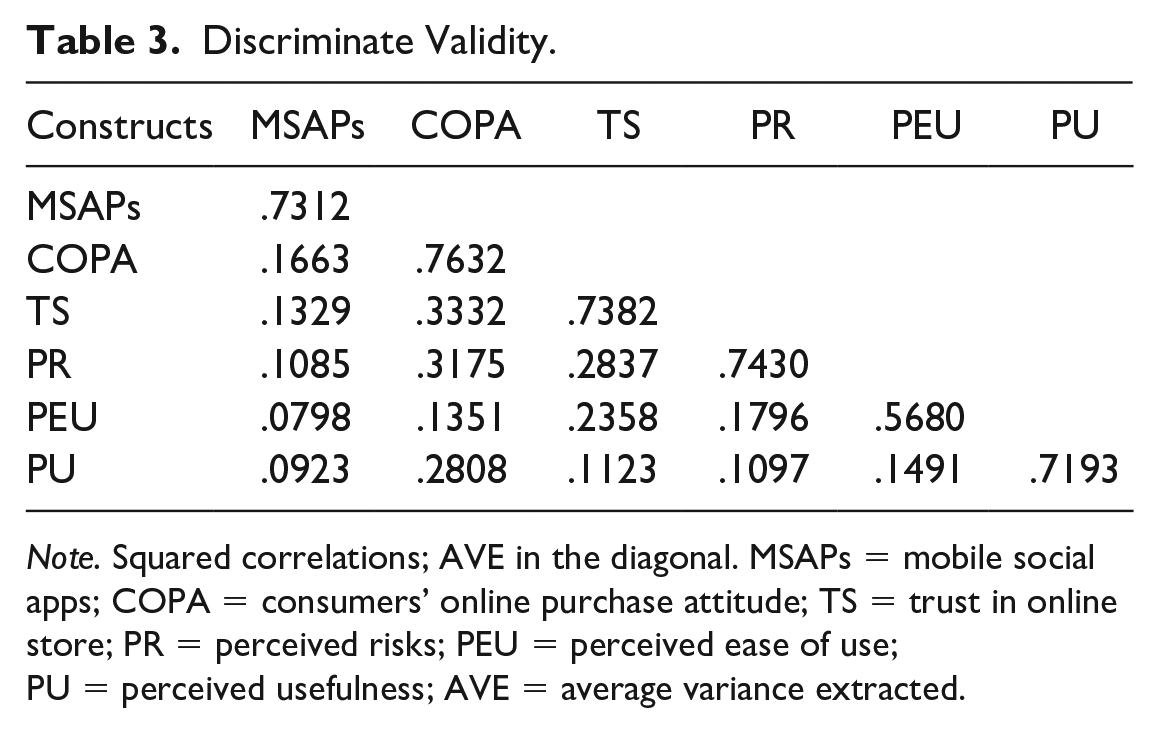
Note. Squared correlations; AVE in the diagonal. MSAPs = mobile social apps; COPA = consumers’ online purchase attitude; TS = trust in online store; PR = perceived risks; PEU = perceived ease of use; PU = perceived usefulness; AVE = average variance extracted.
The output values for CR must be >.7, FL >.5, and AVEs >.5, as suggested by Fornell and Larcker (1981), Kline (2005), and Podsakoff et al. (2003). Sixth, structural equation modeling (SEM) was applied to affirm the overall paths relationships, interrelationships, and hypotheses testing where SEM techniques are inspired from previous related studies, including Burghy et al. (2012), Behnam and Cagliano (2016), and Ashfaq et al. (2019). Finally, multidimensional path analysis was applied to assure the interrelationships of the constructs based on SEM. The model fit value was evaluated using standardized root mean squared residual (SRMR) where experts suggested the best criteria for SRMR is must be <.08 (Hu & Bentler, 1999). The current SRMR value if .0789 which indicates accurate fitness.
Data Analysis and Results
Descriptive Statistics
Table 1 illustrates the profiles of target consumers based on six characteristics. The results indicated the higher ratio of male respondents (58%) relatively than female respondents (42%) in the present instant. The respondents’ information concerning remainder attributes is reported as follows.
Pearson’s Correlations Analysis
Correlation analysis applied to estimate the relationships among IVs, DV, and moderators. The output values after correlation analysis must be evaluated within the range of −1 to +1, respectively (Taylor, 1990). Furthermore, the Taylor (1990) has been described that higher positive values indicate higher connection between two variables. Whereas, lower positive values show poor connection and negative values represent negative correlations between latent variables. The results are reported as follow.
Discriminate Validity
Table 3 demonstrates discriminate validity for the main constructs that are estimated by comparing the square root of AVEs and correlations between following variables as suggested criteria by Deng et al. (2014) and Fornell and Larcker (1981). We examined discriminate validity using criterion of Fornell and Larcker (1981) where such technique is inspired from previous related studies (e.g., Ashfaq et al., 2019; Waheed & Yang, 2018). Such experts suggested that the bold values must be greater than the values being presented under those bold values to assure the existence of validity as reported on following Table 3.
Common Method Biased (CMB), Exploratory Factor Analysis (EFA), and Confirmatory Factor Analysis (CFA)
EFA and CMB analysis was applied before moving to CFA to measure the internal consistency of the adopted scales. First, EFA was used to classify underlying items of the construct whereby a few items were reduced using Varimax rotation and principal component analysis as per suggested criteria of the experts (Floyd & Widaman, 1995; Hair et al., 2006; G. Wang & Netemeyer, 2004). A total of 28 items were initially adopted for all latent variables and three items were discarded—Snapchat, Instagram, and Weibo—because of eigenvalue value <1.0 and factor loadings <0.5 as per recommended rule (Floyd & Widaman, 1995; Hair et al., 2006; G. Wang & Netemeyer, 2004). Second, CMB was applied to further assure the accuracy of the data using the common latent factor (CLF) method of Podsakoff et al. (2003) and results affirmed the standard loadings values <0.2—with CLF and without CLF—which confirmed an absence of CMB on the present instant. Furthermore, CFA applied to assess the convergent validity and reliability using AVEs, loadings, and CR values. Table 4 shows the values for mean, standard deviation (SD), leadings (FL), composite reliability (CR), and average variance extracted (AVEs). The output values for FL, CR, and AVEs are normal as per the advised criteria (e.g., Fornell & Larcker, 1981; Kline, 2005; Podsakoff et al., 2003). As earlier described, such experts stated that values of FL and AVEs must >.5, while CR must >.7.
Factor Analysis.
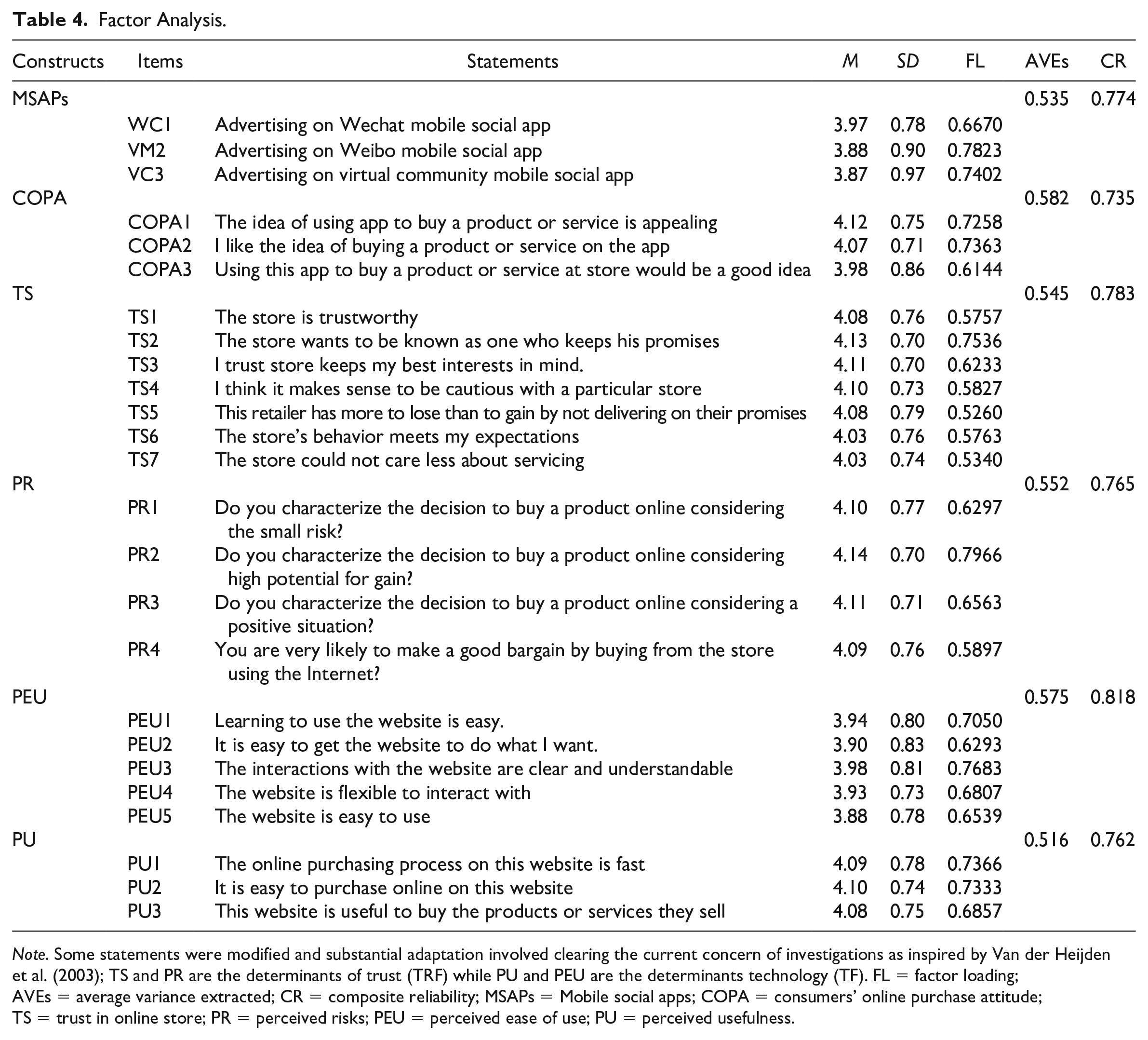
Note. Some statements were modified and substantial adaptation involved clearing the current concern of investigations as inspired by Van der Heijden et al. (2003); TS and PR are the determinants of trust (TRF) while PU and PEU are the determinants technology (TF). FL = factor loading; AVEs = average variance extracted; CR = composite reliability; MSAPs = Mobile social apps; COPA = consumers’ online purchase attitude; TS = trust in online store; PR = perceived risks; PEU = perceived ease of use; PU = perceived usefulness.
Structural Equation Modeling (SEM) and Effect Overview
Table 5 and Figure 2 indicate the summary of SEM results that applied to ensure the overall effect of proposed relationships in hypotheses and remainder interrelationships among independent variables and dependent variables. The model fit values for this model are estimated using standardized root mean squared residual (SRMR) where Hu and Bentler (1999) suggested the best criteria and recommended that values of SRMR must be <.08. The current SRMR value if .078 which intimates accurate fitness (see Table 5).
Main Paths Relationships Using SEM.

Note. H6–H9 show the mediation relationships of TS, PR, PEU, and PU between MSAPs and COPA. SEM = structural equation modeling; ES = expected signs; DE = direct effect; IDE = indirect effect/mediation; MSAPs = Mobile social apps; COPA = consumers’ online purchase attitude; TS = trust in online store; PR = perceived risks; PU = perceived usefulness; PEU = perceived ease of use; SRMR = standardized root mean squared residual. SRMR = 0.078.
Significant at .001.
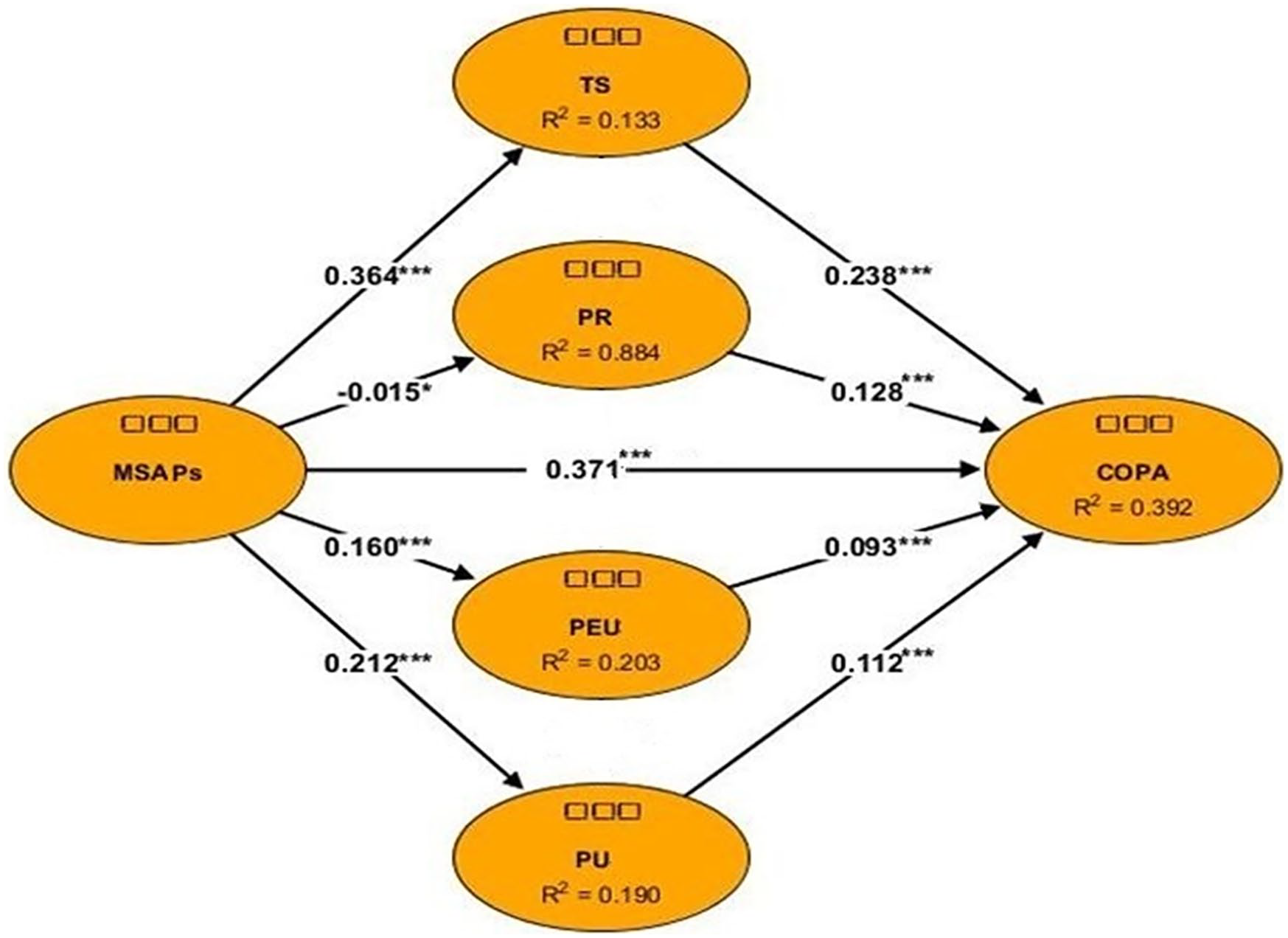
Structure model.
Nevertheless, the following Figure 2 depicts the summary of all additional paths along with inter-correlations among independent variables, that is, MSAPs, mediating variables, that is, TS, PR, PEU, and PU as well as dependent variable, that is, COPA. The main paths of the research are reported in Table 5 and also shown in the following Figure 2.
The additional nexus of each latent variable is examined and reported to understand the interrelationships and paths based on beta coefficients. In such an analysis, a single interrelationship—MSAPs → PR at β = −.015—shows an adverse association though such particular value did not affect the main proposed relationships of this study. The mediation influence were examined between MSAPs and COPA such as TS → COPA at β = .238, PR → COPA at β = .126, PEU → COPA at β = .093, and PU → COPA at β = .112, respectively. In addition, the study ensures the positive interrelationships of remainders factors such as MSAPs → TS at β = .364, MSAPs → PEU at β = .160, and MSAPs → PU at β = .190, respectively.
Discussion and Implications
As the role of m-devices into practices is accelerating that creates several innovative opportunities for marketers to reach a particular target market in a more productive and dynamic way in today’s digital era. Nowadays, m-device has become part and parcel device for every human consequently a number of world’s population is using m-devices for a distinct purpose, including in developing nations (Waheed & Yang, 2018). This study is one of the pioneer studies which ensured the significance of m-devices into practices particularly for B2C to get advantages from such devices and promote products by dissemination of the information anytime and anywhere. As earlier addressed, certain hypotheses were intended and inquired using structural equation modeling statistical tool such as follows.
Hypothesis 1 was based on whether MSAPs has a positive effect on COPA. The findings brought out a positive association between MSAPs and COPA at (β = .371***). Therefore, hypothesis one is supported (H1) because of a positive beta value. Our findings are similar to some of the previous studies in which researchers confirmed the positive linkage of diverse social apps on unlike forms of consumers’ behavior in distinctive contextualization and dimensions (e.g., Harwit, 2017; Koh et al., 2003; Logan, 2017; Thelwall et al., 2017; E. S.-T. Wang & Chou, 2016). Second, Hypothesis 2 was proposed that TS has a positive mediating effect between MSAPs and COPA. The findings brought out a positive association of TS between MSAPs and COPA at (β = .238***) therefore hypothesis two is supported (H2). Hypothesis 3 was proposed that PR has a positive mediating effect between MSAPs and COPA. The findings brought out a positive association of PR between the nexus of MSAPs and COPA at (β = .128***). Based on the positive effect and significant level, hypothesis three is supported (H3). Hypothesis 4 was proposed PEU has a positive mediating effect between MSAPs and COPA. The findings produced a positive association of PEU between MSAPs and COPA at (β = .093***). Hence, hypothesis four is supported (H4) owing to a positive value. Finally, hypothesis 5 was proposed that PU has a positive mediating effect between MSAPs and COPA. The findings affirmed a positive connection of PU between MSAPs and COPA at (β = .112***). Consequently, hypothesis five is also supported (H5) because of positive value. The current results are consistent with previous related studies of IS and ICTs in which academic scholars and practitioners have concluded the importance of social apps and advised the essentiality of social apps and media in terms of marketing and consumers’ perspectives across the world (e.g., Aldahdouh et al., 2020; Eastlick et al., 2006; Howard et al., 2014; Hsiao et al., 2016; Mansour, 2016; Tiago & Veríssimo, 2014; Xu et al., 2015). For instant, above reported studies clearly have been addressed the importance of social apps in different perspectives of the world which eventually support the results of current study. Our study also confirmed the positive nexus of MSAPs to appeal consumers’ attitudes in today’s modern world. Likewise, the description of the remainder hypotheses is illustrated in above Figure 2 and Table 5. Besides, this study provides several implications both for theoretical and managerial furnishing multidimensional insights about MSAP, TS, PR, PEU, and PU as follows.
Theoretical and Managerial Implications
First, in theoretical standpoints, this study adds to the related literature of IS and ICTs with respect to MSAPs by exploring the positive nexus on COPA particularly their online attitude with an additional empirical evidence from developing nation. This study spotlights important insights examining the positive influence of TF and TRF to appeal consumers’ paramount intention. This study yields empirical evidence in the concerned literature from the contextualization of China.
Second, in a managerial standpoint, this study furnishes several insights for marketing managers especially of developing countries to embrace MSAPs methods along with TF and TRF factors to stimulate COPA in today’s modern era. With such considerations, the concerned management is encouraged with the following suggestions. First, as sustainability is an essential part for the organizations to survive in a fiercely competitive environment where m-device can be a source of sustainability (Baumgartner & Ebner, 2010; Behnam & Cagliano, 2016; Linnenluecke & Griffiths, 2013; Montiel et al., 2017; Schrettle et al., 2014). To sustain relationships with customers and consumers, marketers are suggested to engage those consumers using prosperous and potential social methods such as Wechat, Weibo, and virtual community apps. Second, consumers have become more elegant consequently managers should catch such marketing plans which are more acceptable for the individuals. A large number of consumers are using m-devices and varied internet-based tools, including social apps on electronic gadgets. Hence, marketing managers must reshape promotional campaigns acknowledging the dominated scenario in the market to encourage COPA propagating product information. Third, literature is witnessed about the current hip of internet users and social apps users, therefore, marketers are advised to target consumers through such prominent social apps.
Marketers are further advised to consider those factors about consumers are highly mindful like technological factors—perceived usefulness and perceived ease of use—along with trust factors—trust factor and risk factors—which are observed as the influencing factors on consumers’ attitude. Therefore, marketers are suggested to incorporate such policies which may enhance the easiness and usefulness in technological platforms because these factors may influence COPA. Likewise, marketers are advised to build trust of the consumers by ensuring them secure policy as consumers often hesitate to shop product online because of security threat, fraud issues, and privacy concerns (H. Chen, Beaudoin, & Hong, 2017; Eastlick et al., 2006; Koong et al., 2008; Tsai et al., 2011; Van der Heijden et al., 2003). Finally, marketers are suggested to reach the Chinese consumers to reinforce their COPA pursuing innovative mechanisms like MSAPs using the internet as consumers are practicing such mediums in their daily lives.
Conclusion, Limitations, and Future Opportunities
M-device in business activities has achieved enormous attention of academic scholars and practitioners where such researchers are emphasizing to sustain consumers’ behavior toward firms’ products by connecting and triggering through revolutionary means of marketing communication such as MSAPs. In this regard, marketing campaigns using distinct MSAPs can urge organizational promotional strategies as the substantial number of individuals are attached to such platforms in the present digital era. It is concluded, marketers are encouraged to adopt all these tools along with technological and trust factors to endorse consumers’ attitude to pursuit sustainability in advertising campaigns and fostering relationships in today’s competitive situation.
Besides, this study has several weaknesses that can be admitted in the future. First, the findings are limited to a single developing nation with a sample of six hundred respondents. Therefore, a future study might be extended to ensure and validate the findings toward other nations across the globe along with a broad sample. Another limitation of this study is from B2C, while a future work can be expanded from B2B to contribute to the relevant literature with additional empirical evidence. This study adopted students’ sample consequently in the future rest of the consumers’ sample with a large number can be utilized for generalization and validations of the findings. The final recommendation is to reveal the impact of MSAPs toward other nations in distinct ways, contexts, and dimensions as experts argued that yet research is on its infancy stage and demanded to link additional insights concerning emerging IS and ICTs platforms like MSAPs globally.
Footnotes
Appendix

| Personal profiles (demographic) | |
|---|---|
| PF1 | Age of respondents |
| PF2 | Gender of the respondents |
| PF3 | Marital status |
| PF4 | Level of education |
| PF5 | Since using Internet |
| Mobile Social Apps (MSAPs) Harwit (2017), Logan (2017), and Koh et al. (2003) |
|
| WC1 | Advertising on Wechat mobile social app |
| VM2 | Advertising on Weibo mobile social app |
| VC3 | Advertising on virtual community mobile social app |
| Consumers ‘ online purchase attitude (COPA) Jarvenpaa et al. (2000) and Van der Heijden et al. (2003) |
|
| COPA1 | The idea of using app to buy a product of service is appealing |
| COPA2 | I like the idea of buying a product or service on app |
| COPA3 | Using this app to buy a product or service at store would be a good idea |
| Trust factor (Trust on store) Jarvenpaa et al. (2000) |
|
| TS1 | The store is trustworthy |
| TS2 | The store wants to be known as one who keeps his promises |
| TS3 | I trust store keeps my best interests in mind. |
| TS4 | I think it makes sense to be cautious with particular store |
| TS5 | This retailer has more to lose than to gain by not delivering on their promises |
| TS6 | The store’s behavior meets my expectations |
| TS7 | The store could not care less about servicing |
| Trust factor (Perceived risk) Jarvenpaa et al. (2000) |
|
| PR1 | Do you characterize the decision to buy a product online considering small risk? |
| PR2 | Do you characterize the decision to buy a product online considering high potential for gain? |
| PR3 | Do you characterize the decision to buy a product online considering a positive situation? |
| PR4 | You are very likely to make a good bargain by buying from the store using the Internet? |
| Technology factor (Perceived ease of use) Chau et al. (2000) |
|
| PEU1 | Learning to use the website is easy. |
| PEU2 | It is easy to get the website to do what I want. |
| PEU3 | The interactions with the website are clear and understandable |
| PEU4 | The website is flexible to interact with |
| PEU5 | The website is easy to use |
| Technology factor (Perceived usefulness) Chau et al. (2000) |
|
| PU1 | The online purchasing process on this website is fast |
| PU2 | It is easy to purchase online on this website |
| PU3 | This website is useful to buy the products or services they sell |
Declaration of Conflicting Interests
The author(s) declared no potential conflicts of interest with respect to the research, authorship, and/or publication of this article.
Funding
The author(s) disclosed receipt of the following financial support for the research, authorship, and/or publication of this article: This research was funded by Guangdong 13th-Five-Year-Plan Philosophical and Social Science Fund (#GD20CGL28); Natural Science Foundation of Guangdong – Guangdong Basic and Applied Basic Research Foundation (#2021A1515011894); National Natural Science Foundation of China (#71572115); Major Program of Social Science Foundation of Guangdong (#2016WZDXM005); Natural Science Foundation of SZU (#836).
