




Abstract
Despite the existing extensive research on stance markers such as hedges, boosters, and self-mention in academic writing, few studies, however, examined the co-occurrence of these stance markers to help authors project their identities in writing. In this study, we examine how self-mention with boosters and hedges are used by writers of different groups to manifest authorial presence and what functions they realize in research writing. Two self-compiled corpora were constructed to compare the discursive practice between Chinese PhD students and journal article writers from four disciplines in hard applied and hard pure science. In general, student writers use fewer self-mention with boosters but more self-mention with hedges than expert writers. An examination of the rhetorical functions of these devices shows that both expert and student writers employ most self-mention with boosters for presenting research findings, but students are more inclined to invest self-mention with boosters than expert writers when describing research procedures or elaborating arguments. Meanwhile, self-mention with hedges are mostly used for elaborating arguments, but compared with expert writers, students seem to overly obscure their presence in this function.
Introduction
Successful academic writing, at least in part, lies in the writer’s ability to invest disciplinarily recognized identity to present his or her claims and findings in a way that readers feel plausible and suasive (Hyland, 2001; Lancaster, 2016; Tang & John, 1999). The most visible and prominent presence of authorial identity is the first-person pronoun as it is perceived as “a significant means of promoting a competent scholarly identity and gaining acceptance for one’s idea” (Hyland, 2002, p. 1110). Studies show the use of first-person pronoun has undergone a dramatic increase in research writing in the past 50 years. Particularly, we is identified as the most commonly used self-reference among all, suggesting the collaborative and multiauthor culture in scientific studies (Hyland & Jiang, 2016, 2017).
However, in spite of the extensive examination of how authors use first-person pronouns across various disciplines and of how novice writers and published scholars employ this device differently (e.g., Hyland, 2001, 2002; Leedham & Fernandez-Parra, 2017), few studies have tapped into the extent to which one can use first-person pronoun with other linguistic devices to fine-tune the power of authorial identity, and the nuanced disciplinary disparity of discourse practice in the use of first-person pronoun.
This study aims to bridge this gap in metadiscourse research by comparing how self-mention we and its determiner our with hedges and boosters are used by Chinese PhD students and expert writers across four scientific disciplines, exploring how writer groups distinguish from each other in constructing authorial identity and in promoting the plausibility and value of the writers’ contribution (Hyland, 2015). To be specific, we focus on the rhetorical functions, grammatical forms, and nuanced disciplinary diversity in the prose. The findings could shed light on how the authorial presence is practiced in both novice and expert writers’ research writing, as the genre-specific practice of stance taking, particularly the construction of authorial identity, is of pedagogical importance because nonnative speakers are found problematic in investing community-approved self-presence (Hyland, 2001; Kuo, 1999).
First-Person Pronoun and Its Functions in Academic Writing
Central to successful academic argument is the writers’ competence in strengthening their credibility and signposting their novel contribution to their research field (Hyland, 2002; Mur-Dueñas, 2007). As the most prominent and obvious authorial presence, first-person pronouns serve to signal the author’s visibility explicitly and their willingness to take the responsibilities for the research roles in claims and actions (Hyland, 2002; Hyland & Jiang, 2018). This high-stake yet credit-gaining nature suggests that writers not only present authorial selves when interacting with readers by pulling them along with the arguments but also, perhaps more importantly, it involves presenting their appropriate presence as competent community insiders (Hyland, 2002; Millán, 2010). This means that writers must use a recognized manner of developing research claims and strategically employ rhetorical strategies in addressing, appealing, and persuading the readers.
Research into first-person pronouns has mainly focused on the comparison among the writers from different groups (e.g., student writers and expert writers), different first languages or disciplines in academic prose (Hyland, 2001, 2002; Martínez, 2005; Tang & John, 1999). A major area highlighted in the research into first-person pronouns is the identification of its rhetorical functions in academic writing to explore how writers employ rhetorical strategies to present their authorial presence and promote their novel contributions to disciplines (Hyland, 2002; Kuo, 1999; Mur-Dueñas, 2007; Tang & John, 1999).
Kuo (1999) identified 12 functions of first-person pronouns in scientific journal articles; Tang and John (1999) classified six functions for the first-person pronoun “I” from low-risk to high-risk continuum of authorial presence; Hyland (2002) further developed a five-function classification of exclusive first-person pronoun to explore the low-risk and high-risk writer roles strategically adopted by expert writers and student writers. Mur-Dueñas (2007) identified eight rhetorical functions of explicit we in scientific writing to present authorial selves. These functions, however, somewhat overlap with each other depending on the genres examined (Walková, 2019), and the roles adopted by writers in different genres and generic sections can vary (Martínez, 2005; Taylor & Goodall, 2019).
Studies have found student writers realize different rhetorical functions using first-person pronouns compared with senior writers (Henderson & Barr, 2010; Hyland, 2002; Tang & John, 1999). When the most powerful rhetorical function is involved, novice writers are inclined to strategically avoid using first-person pronouns by expressing impersonality instead of claiming their originality. Tang and John (1999) set up a continuum of six functions of first-person pronoun from low-risk to high-risk in academic writing, namely, “I” as representative, “I” as guide, “I” as architect, “I” as recounter of research process, “I” as opinion holder, and “I” as originator. They found that student writers use considerably less first-person pronouns and avoid its most powerful function, which is possibly attributed to the insecurity students hold “about the validity of their claims, seeing themselves to be at one of the lowest rungs of the academic ladder” (Tang & John, 1999, p. s34).
Drawing on Tang and John’s (1999) classification, Hyland (2002) developed five exclusive first-person pronoun functions: expressing self-benefits, stating a goal/purpose, explaining a procedure, elaborating an argument, and stating results/claims. Hyland (2002) notes that Hong Kong students are more likely to downplay their authorial self by avoiding using first-person pronouns in riskier functions compared with expert writers, possibly affected by their home cultures.
Henderson and Barr’s (2010) study provides evidential supports to previous findings. Similarly, the L2 student writers are inclined to use first-person pronouns to guide the organization structure of the texts rather than interpreting and analyzing claims. They explained that this might be a natural developmental process for the tuning from novice to experience writers, indicating the challenges and difficulties L2 students encounter in appropriately projecting their authorial selves in a disciplinarily accepted way.
Possible explanations for the students’ avoidance of the high-stake functions may reside in disciplinary conventions, which could influence the use of first-person pronouns and the functions they perform (Çandarli et al., 2015; Cao & Hu, 2014; Hyland, 2001, 2012; Millán, 2010). First-person pronouns can vary depending on the discursive conventions of each discipline. Particularly, they are more frequently used in soft disciplines rather than in hard disciplines (Hyland, 2001, 2012). However, in a recent study, Hyland and Jiang (2018) identified that self-mention pronouns had undergone dramatic rise in sociology, biology, and electrical engineering but declined in applied linguistics over the past 50 years. As the dichotomy between hard and soft field is not always consistent, caution is thus suggested when making generalizations along the discipline lines (Harwood, 2005; Millán, 2010).
Thus, a close scrutiny of first-person pronouns used by student writers and expert writers from disciplinary and pragmatic perspectives may provide student writers with useful insights into the “novice-expert continuum of membership” (Henderson & Barr, 2010, p. 247) in a specific academic community.
Self-Mention With Hedging and Boosting: Seeking Acceptance From the Readers
To appropriately invest authorial presence as a competent insider and promote their novel contributions, the writers must craft a persuasive argument for the plausibility of their research entities and subject knowledge. Apart from using self-mention pronouns individually, the writers need to draw on a wide range of choices of words to pull the readers in and build negotiation with claims, originality, and significance of their research in discursive conventions of particular community (Hyland, 2004; Lancaster, 2014). This pragmatic consideration of word choices is expected to persuade the readers of the value of the study and the propositions to seek acceptance from the readers.
Although studies have extensively examined the functions of first-person pronouns in academic writing, the extent to which first-person pronouns in collocation with other lexical devices, particularly hedges or boosters, can fine-tune the function of authorial commitment is largely neglected in teaching and research. Hedges are “words or phrases whose job is to make things fuzzier” (Lakoff, 1972, p. 195), allowing authors not only to be less committed to the statements they issue but also to present the propositions as opinions rather than facts by offering a negotiable dialogue with the academic community (Hyland, 1996). Boosters, on the other hand, express certainty, seeking to assert claims and shut down different voices (Hyland, 1999). Hedges and boosters are central rhetorical devices in science discourse, and are perceived as “two sides of the same coin” (Hu & Cao, 2011, p. 43) when expressing uncertainty and certainty about a proposition respectively to gain communal approval of knowledge claims (Hu & Cao, 2011; Hyland, 1999; Lancaster, 2016).
Hewings and Coffin (2007) note that although the use of first-person pronouns can indicate writers’ commitment to claims, verbs such as think or believe occurring after the first-person pronouns indicate subjectivity and space for disagreement. Similarly, Hu and Cao (2015) also note that boosters with self-mention can help authors position themselves as “privileged knowers in their disciplinary community” (p. 20). Walková (2019) further contends that the choice of hedges or boosters co-occurring with self-mention can affect the power of authorial presence as they could “decrease or increase, respectively, the author’s self-mention” (p. 64). As words occurring with self-mentions could achieve particular effects, the linguistic choices around self-mention pronouns must be taken into account (Harwood, 2005).
Thus, an in-depth examination of first-person pronouns with hedges/boosters can offer new insights into how writers decrease or increase the power of author’s self-mention in the unfolding texts. As argued above, the present study sets out to explore the variation in the use of first-person pronoun we and its determiner our with hedges/boosters in research papers between PhD students and expert writers. To be specific, we address the following questions and take into account disciplinary and professional status in the interpretation of our findings:
Method
Corpus and Analysis
Two self-compiled corpora were compared in the present study: the student writer (SW) corpus and journal writer (JW) corpus. The SW corpus includes 160 research papers submitted in an academic English writing course by PhD students from four scientific fields: physics (P), life science (LS), material science (MS), and computer science (CS). These four disciplines were chosen because this study aims to understand students’ writing practice in scientific fields, and the selected disciplines broadly represent distinct “intellectual clusters” in terms of the nature of their subject matters (Becher, 1994) whereby physics and life science are hard pure disciplines while material and computer science are hard applied ones. This course is a compulsory course that doctoral students of various disciplines need to take.
With the approval of my research project, two members of the project introduced the research topic, aims, and data collection procedures to the PhD students in their own classes. All texts were collected after the students signed the consent form. All PhD students are novice writers in academic writing, and they have no experience in publication. The novice writers composed the papers based on their experimental data, but they were also instructed to aim at international publication. Given the crucial trend of collaborative research and co-authorship in science (Hyland & Jiang, 2019), students were allowed to report on their research groups’ work with other members as co-authors. Considering that many journal article writers come from an international background, we decided to choose journal articles written by authors from an English-speaking context for the JW corpus to minimize other potential variables. The journal article authors were identified by their names and affiliations in Anglophone countries. Eventually, 10 papers were selected from each of the two leading journals in the four disciplines between 2012 and 2015. The two corpora are summarized in Table 1, and are considered as comparable in terms of communicative purposes and IMRaD generic structure (Introduction, Methods, Results, and Discussion and conclusion).
Corpus Characteristics of SW and JW Corpora.

Note. SW = student writer; JW = journal writer.
We searched the collocations with we and our within the span of five words in the corpora using AntConc (Anthony, 2014) and then identified in the list of collocations the hedges and boosters used with self-mention by drawing on Hyland’s (2005) list of metadiscursive devices (see Appendix). Each concordance line was then manually examined with reference to a wider context to ensure that the items were performing an authorial presence function. The two authors worked independently and achieved a 95% inter-rater reliability after having resolved disagreement. In addition, due to the different corpus sizes, the raw frequency of the items was normalized by 100,000 words to facilitate comparison across corpora, and log-likelihood tests were then used to determine statistical significances.
Following Hyland’s (2002) research, we see self-mention we and its determiner our as explicit reference to the authors. Even though self-mention can co-occur with a variety of verbs, we only examined its co-occurrence with hedges or boosters (see Table 2) because the present study focuses on how the authors construct community-approved dialogues with readers via investing personal attitude toward research claims and entities.
Self-Mention Collocations.

Note. P = physics; LS = life science; SW = student writer; JW = journal writer.
Identifying Self-Mention Functions
Taking Hyland’s (2002) classification on the writer’s purposes of using first-person pronouns as a starting point for “its clarity and focus on reader-exclusive pronouns” (Walková, 2019, p. 62), we modified and removed some categories during the data coding process.
First, similar to Hyland (2002), we did not identify any cases of expressing self-benefits in the JW corpus. Although this function can be an important feature of student writing, particularly, of thesis and dissertations, expressing self-benefits is also very rare in the SW corpus as the students are required to target at the writing styles and languages of published journal articles. Therefore, this category was removed following Hyland’s (2002) practice. Moreover, although stating results and claims are grouped as one category in Hyland’s (2002) taxonomy, we feel it is necessary to treat results and claims as two separate categories because results are obtained through experiments and are therefore somewhat self-evident, but claims such as the interpretation of findings are more subjective. Thomas and Hawes (1994) also noted the distinction between verbs that refer to “real-world activity of finding or observing X” (p. 133) and verbs that represent the “discourse activity of writing” (p. 134). For instance, in Extract 1, the authors state the result they obtained by implementing a method, and no justification is needed. In Extract 2, however, the data discussed by the authors can be subject to other interpretations: (1) Indeed, by implementing the Berry phase method in our DFT calculations, (2) Indeed,
We also found the writers sometimes refer to their previous research to show to readers that they have contributed to the disciplinary community and thus are competent members in this community (Hyland, 2001; Mur-Dueñas, 2007). Therefore, the present study identifies the following functions from the least to the most powerful authorial presence as shown in Figure 1.
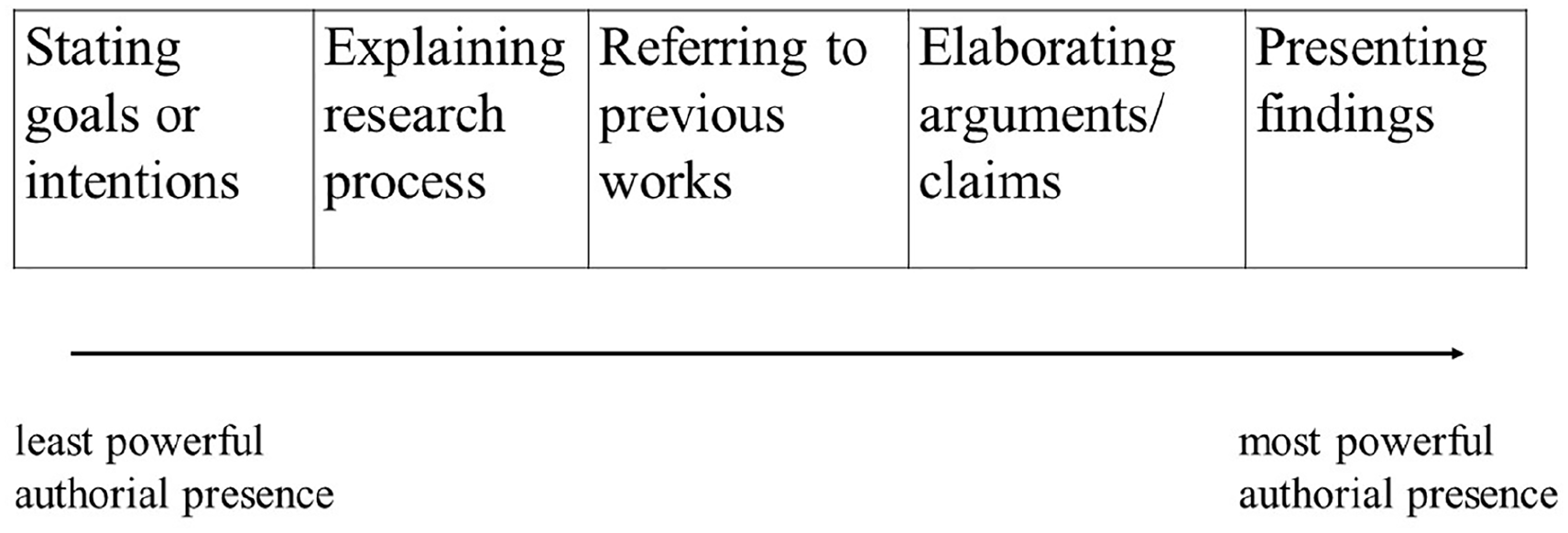
Self-mention functional continuum.
Modified Categories Employed in the Present Study
Stating goals or intentions
This function involves introducing the focus of the authors’ research, and sometimes using signposts, such as Extracts 3 and 4: (3) In this section, (4) In this article,
Explaining research process
In this function, the authors describe the steps taken when they conducted their research, as in Extracts 5 and 6: (5) To explain the symmetry of the curves in Fig. 4 (b), (6) To verify the curve direction of GDP-FtsZ,
Referring to previous works
In this function, authors would mention what they did in their previous research. See Extracts 7 and 8:
Elaborating arguments/claims
This function focuses on original interpretations of findings or articulation of claims, and thus involves offering further support for claims or expressing opinions or attitudes toward known facts or claims (Tang & John, 1999). It is perceived as a powerful authorial role as the writers construct ownership of claims in their writing (Hyland, 2002; Taylor & Goodall, 2019) as shown, respectively, in Extracts 9 and 10: (9) By treating MIS theory as an UV completion,
Presenting findings
As in Extracts 11 and 12, authors use this function to present the results and findings obtained in their research. It is considered the most powerful authorial role: (12) Finally,
Self-Mention Used With Hedges and Boosters: Overall Results
Generally, we identified 357.2 cases per 100,000 words of self-mention we and our used in the corpus of expert writers and 544.5 cases per 100,000 words in SWs’ corpus. When turning to the collocational level, as we can see in Table 3, the two groups of writers share similar patterns in the use of self-mentions with hedges and boosters. More than 40 cases per 100,000 words of self-mention are used with boosters by the two writer groups, while only about 20 cases per 100,000 words are used with hedges.
Self-Mention With Boosters and Hedges in the Corpora (per 100,000 Words).

p < 0.05.
Note. JW = journal writer; SW = student writer.
The similar pattern suggests that the PhD students may be aware of the rhetoric conventions to invest certainty in their claims, constructing negotiation dialogues and introducing research procedures with potential readers. However, when we closely examine the data, we find that student writers significantly use more self-mention with hedges than expert writers (p < .05), which may be attributed to the difference in the writing guidelines the two groups of writers receive (Can & Cangır, 2019). Another reason is that student writers might feel less comfortable to project themselves into the writing, thus resorting to hedges to balance the intrusion caused by self-mention.
We can also see from Table 3 that expert writers use considerably more self-mention with boosters than with hedges, which accounts for nearly 2 times in terms of proportions (13% vs. 6%). This finding provides evidential support to Poole et al.’s (2019) study, which argues that the frequency of boosters indicating certainty and confirmation increased in scientific papers while hedging expressions indexing doubt and uncertainty decreased over the 40 years. While the discrepancy is not prominent in student writing, boosters are used slightly more than hedging expressions (7.9% vs. 5.2%).
Note that even though the difference in the two groups’ use of self-mention with boosters failed to reach statistical significance, we can still see that student writers are less inclined to use boosting devices to further enhance their presence in writing. These results are consistent with findings in previous research claiming that student writers are reluctant to adopt a clear and authoritative stance in their writing (Hyland, 2002).
The lack of boosting in PhD students’ research writing may be attributed to Chinese culture. Speculatively, this is perhaps impacted by a deep-rooted Confucianism among Chinese (Hu & Cao, 2011; Tweed & Lehman, 2002). Given the context that traditional Chinese cultural practices value a belief that truth is self-evident and argument is unnecessary (Bodde, 1991), thus student writers see little need to assert the propositions or convict the claims. This can be illustrated in the following examples. In Extract 13, the expert writers highlighted the certainty of their finding by the booster “clearly,” and thus projecting a more assertive authorial role in front of the readers. In comparison, the student in Extract 14 objectively observes the finding, thus neutralizing his or her authorial stance: (14) From the above results,
Self-Mention Used With Hedges and Boosters: Disciplinary Variation
Generally, both groups of writers use more self-mention boosters than self-mention hedges (JW: 47.9 vs. 21.9 cases, SW: 43.3 vs. 28.3 cases per 100,000 words), revealing “the disciplinary norm of producing or reporting knowledge” (Parry, 1998, p. 273) in hard science, in which authors seem more assertive, convicting to research findings rather than being tentative and cautious in projecting their positions in the reporting and interpretation of research data. Hard science, however, is not monolithic, as Hyland (2001) noted that the norms of academic writing can be highly discipline-specific.
Table 4 shows that boosting and hedging devices used with we/our are more frequently employed by the writer groups in hard pure than hard applied disciplines, indicating that writers in hard pure knowledge fields may provide a more authorial interpretation on propositions in scientific prose than those in applied fields (Wang & Jiang, 2018). Considering that disparities are also observed within the hard pure and the hard applied sciences, arguably these disciplines should be viewed “along a continuum” (Gardner et al., 2018, p. 4) in terms of their sanction of authorial commitment. This finding further provides evidence of a more nuanced discipline divide rather than traditional broad dichotomy between soft and hard disciplines (Hyland, 2002; Mansourizadeh & Ahmad, 2011).
Overall Distribution of Self-Mention Boosters and Hedges Across Disciplines (per 100,000 Words).

p < 0.05; ***p < 0.001.
Note. JW = journal writer; SW = student writer; CS = computer science; MS = material science; LS = life science; P = physics.
In addition, we find that both writer groups share a similar disciplinary pattern of self-mention with boosters and hedges: Physics is the most powerful in promoting authorial claims or presenting authorial modesty, followed by life science and computer science, whereas material science might appear the least powerful in signaling authorial identity in research paper. This similar frequency of distribution indicates that novice writers are also aware of the interactive characteristics in research writing and thus, follow the rules of projecting their roles either tentatively or assertively when presenting scientific claims or interpretations. By doing so, the student writers may better establish themselves as authorities in their disciplines (Hu & Cao, 2015), as illustrated in Extracts 15 and 16:
The similar distribution, however, does not suggest that students understand or employ boosting or hedging devices with self-mention in the same way as expert writers do. A close look at Table 4 above shows that the discrepancy in material science and physics demonstrates statistical significance in the use of self-mention boosters between the two writer groups. It is noteworthy that physics writers tend to employ the most self-mention with boosters, whereas material science writers tend to employ the fewest. The student–expert discrepancy observed in these two disciplines might result from the lack of discipline-specific instructions in the students’ academic writing courses. Physics observes the “tacit convention” in disciplinary knowledge construction (Gerholm, 1990, p. 267), “based on a process of accretion of knowledge” (Becher, 1987, p. 269), and thus, writers in this field report knowledge with an assumption of confidence and a validity of method (Parry, 1998).
Material science and engineering, on the other hand, is highly object-centered. Ding (2001) argues that engineers work closely with objects and that they place objects as the grammatical subjects to highlight this close relationship. This object-centered nature of engineering means that the material science writers are less likely to use personal presence with epistemic markers, which would foreground the role of the writers rather than the objects. The Extracts 17 and 18 are very common in the material science corpus. Nevertheless, in recent decades, there has been an increase in the use of first-person pronouns and boosters in engineering (Hyland & Jiang, 2018). It is thus likely that material science has also witnessed a change in the writing norms. These tacit conventions, however, are hardly explained in the classroom. Therefore, while students have a general awareness of strategically intruding into their writing, they still lack in-depth understanding of the identity projection practices in their disciplines, which results in the underuse of self-mention with boosters in physics and material science:
Rhetorical Functions of Self-Mention With Hedges and Boosters: Fine-Tuning the Power of Authorial Identity
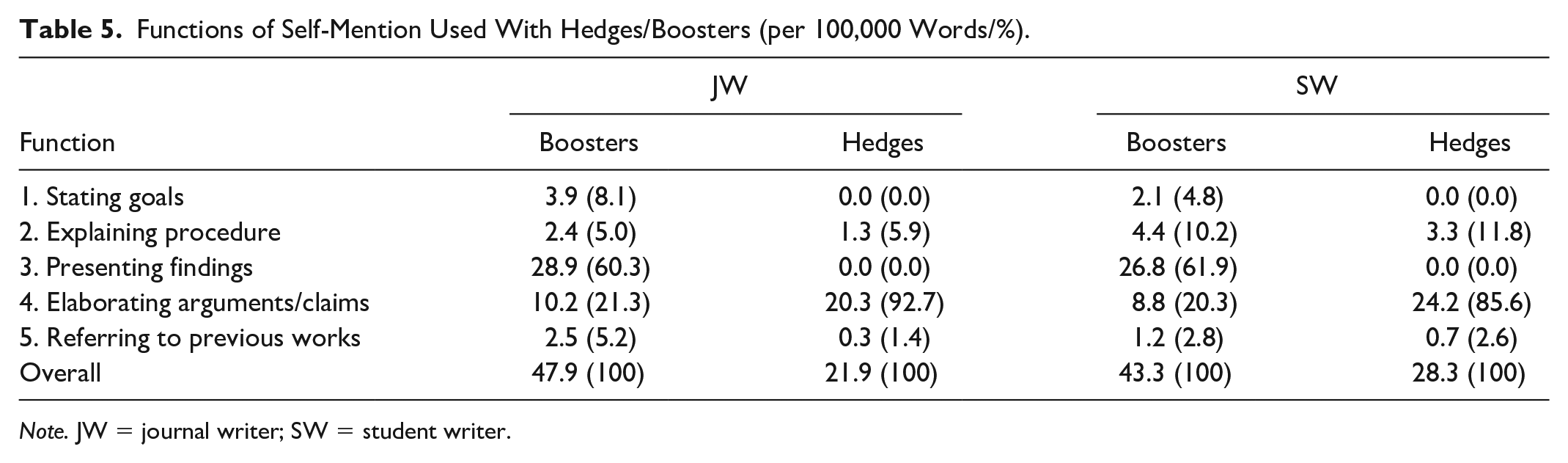
The frequency and percentage of rhetorical functions of hedges and boosters used with self-mentions are displayed in Table 5. We found that most self-mention boosters are used when writers present their findings (see Table 5). This pattern is consistent in both the JW and the SW corpora (account for 60.3% and 61.9% in JW and SW, respectively). This finding further provides evidential support to previous studies, which reveal that the result and discussion section is the most prominent part where writers report research results by asserting new knowledge to established knowledge, thus adding to extant information rather than persuading the reader about a new perspective (Crosthwaite et al., 2017; Hyland, 2005; Wang & Jiang, 2018). The following Extracts 19 and 20 illustrate the writers investing their convictions using boosting with self-mention when reporting results: (19) When we compare the default case of 25 rays to the case of 625 rays,
Functions of Self-Mention Used With Hedges/Boosters (per 100,000 Words/%).
Note. JW = journal writer; SW = student writer.
Turning to the specific rhetorical functions, the majority of boosters with we/our are used to present findings. In contrast, most self-mentions with hedges are used for elaborating arguments in both writer groups (account for 92.7% and 85.6% in JW and SW, respectively). Elaborating arguments, as one of the high-risk functions, is found to be seldom used by L2 student writers (Henderson & Barr, 2010; Hyland, 2002). However, the present study presents a contradictory result. This might be attributed to the varieties in disciplines and genres of academic practice. Similar to expert writers, the PhD students invest the major proportion of hedges with self-mentions in a negotiable and open manner to interpret existing propositions or making knowledge claims.
In Extracts 21 and 22, we see writers using self-mention with hedges to elaborate arguments. Unlike presenting results, elaborating arguments or presenting opinions requires more subjectivity. Hedges enable writers to present their claims as “provisional and subject to current objections and future revisions” (Hyland & Jiang, 2018, p. 26). Hewings and Coffin (2007) also contend that the use of hedging verbs with first-person pronouns allows writers to highlight the personal nature of their opinions. However, despite the similar percentages, the normalized frequency of self-mention with hedges in the SW corpus is significantly more than that in the JW corpus (28.3 cases vs. 21.9 cases per 100,000 words, p < .05). This difference suggests that as novice in the field, student writers are less confident than expert writers in taking credits for their opinions: (21) [. . .] because (22) So at last,
Despite the similar pattern between the two writer groups, we found that expert writers use more proportion of self-mention boosters in describing research goals (8.1%) than explaining procedure (5.0%) while the opposite is true for the novice writers (4.8% and 10.2%, respectively). Because stating a purpose requires the author’s certainty and explicitness of textual signposting (Walková, 2019), the writers may feel a strong need to present with confidence and build up rationales for their studies when introducing research topics, as shown in the Extracts 23 and 24. As the academic market has become highly competitive, expert writers face the pressure to use “communicatively attractive and dynamic” discourse to engage the readers (Seoane, 2013, p. 89). By stating goals in a logical and confident manner, expert writers are more likely to create this dynamic discourse required by the competitive market, thus, claiming their contributions to the knowledge field. Student writers, on the other hand, are less troubled by this pressure because their papers are written mainly for their instructors rather than for the large audience on the academic market: (23) However, (24) Specifically,
Another significant student–expert disparity lies in stating research procedures in the methodology section, which is perceived as the writer presenting formulaic process, where the writers present the adopted materials and methods and this inclusive presentation expects writers to produce a “checklist” of actions in a chronological order rather than in an evaluative manner (Swales, 1990). However, in general, student writers invest considerably large proportion of self-mention hedges (11.8% vs. 5.9%) and boosters (10.2% vs. 5.0%) than the expert writers in describing research process. As Hyland (2002) notes, “the ability to plan and carry out a viable and appropriate research methodology” (p. 1101) is highly valued in student papers, and that students, knowing the importance of the methodology section, are willing to invest their presence in describing methods. Therefore, compared with stating goals, students are more inclined to establish themselves as a competent member of the disciplinary community when describing methods, which can be realized using self-mention with boosters to highlight their certainty over the chosen method (Extract 25), as well as using self-mention with hedges to demonstrate their knowledge of alternative methods (Extract 26): (25) In the problem of USD, (26) Genes can be sequenced to calculate their difference with or without stimulation, phenotypes can be measured in various ways, here
Another interesting finding is that self-mention is never used with hedges by writers of both groups when they state their goals or present findings. For stating goals, one possible explanation is that this function is hardly risky (Hyland, 2002; Tang & John, 1999). Another explanation is that writers in these functions assume “an external role” (Tang & John, 1999, p. s32). Therefore, it is unnecessary for writers to use self-mention with hedges. It is also likely that the use of self-mention hedges can actually harm the authors’ credibility because hedging goals indicate an unclear focus in the research, and hedging findings will lead readers to doubt the writer/researcher’s competence as a member of the academic community. In Extract 27, for instance, if we replace found with seemed to find, the reported findings will be perceived as less reliable and rigorous, thus undermining the writers’ credibility and authority:
Collocations of Self-Mention With Hedges and Boosters: Tentativeness and Conviction
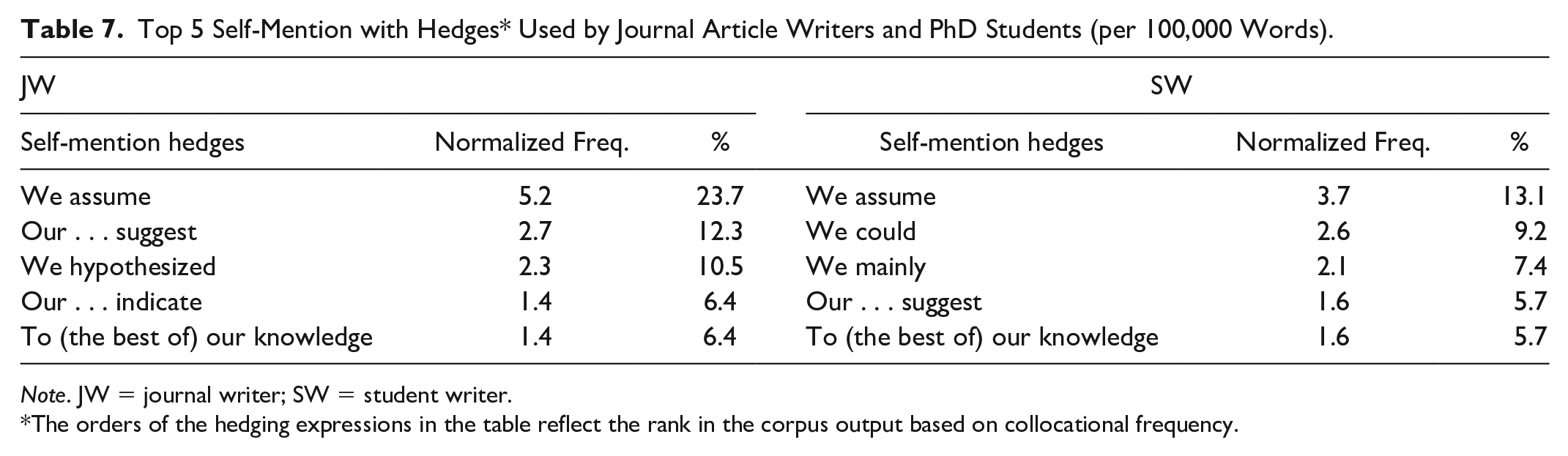
Tuning to the word choices with self-mentions in the corpora, we identified the Top 5 frequently used self-mention with boosters (Table 6) and with hedges (Table 7) in the two corpora.
Top 5 Self-Mention With Boosters* Used by Journal Article Writers and PhD Students (per 100,000 Words).

Note. JW = journal writer; SW = student writer.
The orders of the booster expressions in the table reflect the rank in the corpus output based on collocational frequency.
Top 5 Self-Mention with Hedges* Used by Journal Article Writers and PhD Students (per 100,000 Words).
Note. JW = journal writer; SW = student writer.
The orders of the hedging expressions in the table reflect the rank in the corpus output based on collocational frequency.
As seen from Table 6, find and show are frequently used in both corpora, and this supports Hyland’s (2005) argument that authors in hard knowledge fields are normally less dependent on building knowledge on their personal interpretations but relying on scientific facts to speak for themselves. As seen in Extracts 28 and 29, by the use of find and show, the writers “validate their knowledge claims by signalling that they are factual statements rather than interpretations” (Hu & Cao, 2011, p. 2803): (28) As shown in Fig. 6, (29) In Fig. 1c,
It is interesting that we find/ (have) found accounts for 59.1% of the proportion, far exceeding the second most frequently used collocation we show (ed)/have shown (10.9%) in the SW corpus, indicating the novice writers are more inclined to use limited linguistic devices to report research finding as shown in Extract 30: (30) According to the definition,
As shown in Table 6, expert writers use a larger proportion of we demonstrate/ed structure in reporting research findings than student writers (23.8% vs. 6.5%), whereas the latter group also use we must to claim a strong judgment (6%). The lexical verb demonstrate strengthens the assertiveness on the factivity of research findings, as in Extracts 31 and 32, promoting the authors’ powerful presences when they establish their commitments in the texts: (31) Notably, (32) Furthermore, kinetic control over the NO dosage is feasible and here
However, the collocation we must is rare in journal articles. A close look at the data shows that most cases of the structure we must were used by the student writers in introduction and methodology sections where they intended to introduce a research gap or claim the obligation by “reporting methodological requirements and/or procedural decisions” (Poole et al., 2019, p. 6), thus presenting a very urgent need to conduct further research (Extract 33) or requirement for certain procedure (Extract 34). As shown in Extract 33, we must is used to bridge the research gap, demonstrating the students’ research significance, whereas in Extract 34, student writers emphasize the necessity to adopt certain research methods. However, modal verb must in both contexts sound too strong and decisive to the readers.
This inappropriate use of we must structure may be attributed to the novice writers’ unfamiliarity with projecting strongly assertive persona when presenting research gaps and value. These students invest authorial voice which disciplinary readers may find less familiar and persuasive. A recent chronological examination of studies over the past 50 years found that scientific research writers were less likely to use the modal verb must in methodological contexts (Poole et al., 2019). Therefore, expert writers remain more neutral when they indicate a gap for research, as shown in Extract 35: (33) The long-term developments of the wireless transmission technologies and hardware implements gradually come across the bottlenecks and (34) In the problem of USD, (35) Clinical studies of intrapleural fibrinolytic therapy have consistently shown subsequent production of large effusions, the mechanism(s) of which are unknown.
Table 7 represents Top 5 frequently used self-presence with hedges. While we assume is the most popular choice of hedging in both corpora (23.7% and 13.1% in JW and SW, respectively), student writers hardly use self-presence with suggest/ hypothesize as expert writer do. In fact, there is only one token of we hypothesize in the SW corpus, while it occupies 10.5% of the hedges used with self-mention in the JW corpus. In fact, it is a common practice in the JW corpus to use self-mention with hypothesize and suggest to demonstrate research findings or make claims as in Extracts 36 and 37, which exhibit the authors’ powerful role in promoting their distinctive contribution and highlighting the source of epistemic commentary: (36) In our study, (37) Indeed,
However, it is interesting to note that the novice writers are inclined to use modal verb could (9.2%) and epistemic adverb mainly (7.4%) with we in the data. It coincides with the finding in Crosthwaite et al.’s (2017) study that mainly, as one of the hedging devices, is commonly used by L2 writer as it presents a common reporting behavior of limiting the applicability of what is being discussed, as seen in Extract 38. Nevertheless, it is less powerful in crafting authorial identity than suggest or hypothesize to introduce research claims and present commentary marks.
The other preferred collocation, we could, in the SW corpus is mainly used to report research behavior rather than presenting claims and making propositions. The novice writers commonly use we could to introduce another choice of method in data coding (Extract 39), or report the competence of researchers as observers of the study conducted (Extract 40) rather than conveying the author’s judgment with full commitments on propositional information: (38) Genes can be sequenced to calculate their difference with or without stimulation, phenotypes can be measured in various ways, here (39) We already have several tuning parameters in the baseline system. (40) Two bands indicated that Cre gene had been inserted into the vectors. Mostly, when we operated agarose gel electrophoresis with the integrated vector,
Conclusion and Implications
This study has investigated the use of hedges and boosters with self-presence we and our in research papers, exploring their rhetorical functions and lexical collocations in the writing in four disciplines produced by Chinese PhD students and expert writers. We set out to compare how the novice writers and expert writers differ from each other in using these linguistic devices because these are a highly prominent aspect of a writer’s identity construction and signal the way that how competent disciplinary members strategically situate themselves in the reader–writer interactions. Overall, we find that PhD students use significantly more self-mention pronoun we/our with hedges than expert writers do. Compared with experienced writers, novice writers employ considerably less proportions of we/our with boosters in the prose (7.9% vs. 13% in SW and JW, respectively).
We have seen a more complex disciplinary diversity between the PhD students and expert writers in the expression of self-presence we/our with hedges and boosters. The novice writers use significantly fewer we/our with boosters (p < .05) in material science and physics whereas the disparity becomes inconsiderable in the use of hedging with we/our collocations, although the frequency made by students is slightly higher. This further corroborates the challenges that the students encounter when investing their authorial presence in knowledge claims in an appropriate way as informed insiders. More importantly, the disciplinary disparity suggests that the rhetorical practice of the authorial identity construction is not monolithic in academic writing but sensitive to the construction of academic knowledge and disciplinary persuasion (Hyland & Jiang, 2018).
Students’ less adequate mastery of self-presence with hedges and boosters is also seen in the structuring of the methodology sections. They invest a higher proportion of these linguistic devices in illustrating research procedures compared with expert writers. The novice writer, perceiving methodology as an essential part in research writing, inappropriately project their presence by illustrating the necessity of research procedure, introducing research measurement rather than following the formulaic procedure as expert writers. In addition, student writers exhibit a limited range of linguistic choices by a preference for we find/ (have) found when present findings. The use of we must when emphasizing the research gap and obligations in research methodology suggests an inappropriate way to increase the power of authorial identity. When it comes to the interpretation of arguments, a powerful function in presenting authorial identity, the novice writers commonly skimp on this chance to increase their self-presence and instead take a risk-free strategy by hedging on the limitations of research behavior and competence in conducting research with the common practice of mainly and could.
In this study, we hope to have clearly demonstrated how self-mention we and our used with hedges and boosters in novice writer and expert writer’s research writing to affect the power of authorial presence. This study contributes to metadiscourse research by revealing how various metadiscursive resources establish authorial stance in tandem. However, as this study only covers part of the rhetorical collocations used with self-mentions, it would be of value for future studies to explore the lexico-grammatical profile (O’keeffe et al., 2007) of self-mention we and our, as well as other metadiscoursive devices, to yield more in-depth understanding of how diverse linguistic and metadiscursive resources interact to achieve particular discoursal functions.
Our findings can provide useful insights to the teaching of English academic writing to the students from similar backgrounds. EAP teachers are supposed to develop PhD students’ understanding and practice of disciplinary conventions and metadiscursive resources to further allow the students to grasp the ability to demonstrate insider disciplinary competence (Jiang & Hyland, 2020). By showing the rhetorical functions of the combinations of self-mention and hedges/boosters, the findings in this study indicate that English for Academic Purposes (EAP) instructors can develop analytic exercises of article excerpts to sensitize students’ understanding of how authorial stance is crafted. In addition, as the linguistic forms of hedges and boosters used by students differ from those used by expert writers, teachers can draw students’ attention to the wide range of available lexical resources by offering a contrastive list of the frequently used hedges and boosters by the two writer groups.
Footnotes
Appendix
Declaration of Conflicting Interests
The author(s) declared no potential conflicts of interest with respect to the research, authorship, and/or publication of this article.
Funding
The author(s) disclosed receipt of the following financial support for the research, authorship, and/or publication of this article: The work described in this paper was supported by the National Office for Philosophy and Social Sciences of China under grant number 20BYY111.
