




Abstract
Examining EFL (English as a foreign language) teachers’ beliefs and cognition has become an essential area of research as teachers are seen as active decision makers. This study addresses teachers’ beliefs as specific to the strategies they employ when providing corrective feedback to students’ writing. Drawing on Ellis’s typology of written corrective feedback and Borg’s teacher cognition theory, this survey study investigated university EFL lecturers’ self-reported strategy use in the provision of feedback to students’ written compositions. A total of 254 respondents completed this survey from universities in Thailand, China, and Vietnam. The findings showed that the teachers provided different types of strategies, namely, high-demand (e.g., students’ response to feedback required), low-demand (e.g., correcting all errors), and no-demand feedback in relation to their students’ proficiency levels. Their choices of high-demand feedback strategies seemed to be associated with their pre- and in-service professional training experiences as well as contextual factors including local cultural influence and limited resources; whereas their uses of no-demand and low-demand feedback strategies seemed to be associated with their prior language learning experiences and classroom teaching practice. This study also revealed an inconsistency between teachers’ cognition about provision of feedback and their reported feedback strategy use. Pedagogical implications and directions for future research were also proposed.
Introduction
Written corrective feedback (WCF) has received an increasing amount of attention in the fields of second language (L2) writing and L2 acquisition (Bitchener & Storch, 2016; Papi et al., 2020). Provision of WCF has clear and direct relevance for language teachers as teachers are able to exert some type of control over students’ written accuracy (Kang & Han, 2015; Leeman, 2007). In particular, language teachers are concerned about the frequency of error correction, optimal conditions for corrective feedback (CF) provision, and efficacy of responding to learner errors (Vasquez & Harvey, 2010). Although a large number of WCF studies have focused on teachers’ feedback strategies at secondary school level, lecturers’ provision of feedback to students’ written assignments in higher education remains underexplored (Hyland, 2013a; Ruan, 2014; Yoshida, 2008). This study, thus, aims to investigate university lecturers’ self-reported strategy use in giving feedback to students’ written assignments in three relatively less investigated Asian countries: China, Vietnam, and Thailand. It is hypothesized that university lecturers employ very different feedback strategies from secondary school teachers in these Asian countries for the following reasons:
First of all, the assumptions behind the wide use of direct error-focused feedback strategies in Asian countries have been challenged in the higher education context for years. Previous research in this context focused on EFL (English as a foreign language) teachers’ feedback practice at primary and secondary school level (e.g., Lee, 2004, 2008b; Furneaux et al., 2007), suggesting that the direct feedback strategy targeting grammatical errors was widely employed in Hong Kong, Vietnam, Thailand, and China even though its effectiveness was questioned by some researchers (e.g., Mao & Crosthwaite, 2019; Shintani & Ellis, 2013). The EFL teachers’ cultural background was proposed as one of the main barriers for them to adopt indirect or metalinguistic strategies that demand students to study teachers’ comments, identify, and revise their errors. However, in higher education, many recent studies targeting adult learners in Asian countries (e.g., Hyland, 2004; Jackson & Chen, 2018; Tran, 2007) have challenged the stereotypical view of Asian learners being passive, shy, and less motivated by providing empirical evidence to show that Asian learners can actively engage with feedback from both teachers and peers (Man et al., 2017). Therefore, it can be assumed that university students in the Asian context could have the willingness to engage with teacher feedback on their written assignments.
Moreover, previous research has shown that Asian students’ relatively low language proficiency at secondary school level may be another barrier for teachers’ employment of more indirect feedback strategies (e.g., Lee, 2004, 2008b; Paran et al., 2007). It can be assumed that tertiary students, on the contrary, are more proficient English users given the years of English instruction they have received. The majority of Asian language students should have had at least 6 years English instruction prior to university study (Nunan, 2003). Tertiary students should have the capacity to process indirect and metalinguistic feedback from teachers. For example, Yoshida’s (2008) study reported that language teachers in Japan employed elicitation and metalinguistic feedback strategies and left opportunities for students to reflect on the errors due to confidence in their learners to work out correct forms independently.
Finally, pedagogical purposes for written assignments vary at secondary and university levels. Secondary students and teachers are pushed to prepare for the essay tasks specified in the national university entrance exam whereas university students do not have the immediate pressure from external exams. As Ruan (2014) pointed out, EFL university students in Asia tended to focus on development of ideas rather than grammatical accuracy in their writing. Similarly, in a study investigating university students’ interpretations of tutors’ written feedback in Hong Kong, Hyland (2013b) concluded that students paid attention to the feedback with a focus on both language accuracy and the role of writing in the learning process. Hyland (2013a) further maintained that faculty staff were less reluctant to provide feedback on the quality of written language; instead, they were more willing to comment on argument patterns specified within each discipline in students’ assignments, which may be because they perceived themselves as content experts rather than language teachers.
Therefore, university lecturers in Asian countries may provide WCF differently from elementary and secondary teachers given that tertiary students have higher English proficiency levels and are more willing to engage with teacher feedback that focuses on argument quality rather than grammatical accuracy.
Literature Review
Written Corrective Feedback
As this study investigates teachers’ feedback on students’ written assignments and the reasons underlying their feedback strategies, this section reviews relevant research on WCF and teacher cognition in relation to feedback practice. WCF, known as negative evidence or error correction, has been researched extensively in the fields of second language acquisition (SLA) and L2 writing (Bitchener & Storch, 2016; Ferris et al., 2013; Kang & Han, 2015; Shintani & Ellis, 2013). The empirical studies over the last two decades on the effectiveness and value of CF have indicated two distinctively different conclusions: no short-term or long-term effects (e.g., Truscott, 1999, 2007) and clear benefits. Despite Truscott’s argument that WCF should have no place in language learning programs, abundant empirical evidence has shown a positive correlation between WCF strategies and L2 learners’ progress in their language proficiency; for instance, beneficial effects on learners’ uptake of corrections either in the short term or long term (Bitchener, 2008; Bitchener & Storch, 2016; Ferris, 2006; Leeman, 2007; Russell & Spada, 2006). A number of meta-analytic studies on WCF have also confirmed its beneficial effects on grammar learning and written accuracy (Kang & Han, 2016; Russell & Spada, 2006). For example, the most recent meta-analysis by Kang and Han (2015) yielded a moderate effect size, pointing to a substantive effect of WCF on L2 written accuracy, and its effectiveness may be mediated by factors such as learners’ language proficiency, the setting, and the genre of the writing task.
Most of the WCF studies, of quantitative, quasi-experimental, or classroom-based design, reveal that focused WCF (correction provided for specific error types) seems to be more effective than unfocused WCF (correction for all errors identified; Bitchener & Knoch, 2010; Bitchener & Storch, 2016; Ellis et al., 2008; Sheen, 2007), that indirect WCF (errors being marked but with no provision of correct forms) appears to be more valuable for long-term learning than direct WCF (errors being marked and correct forms provided; Ferris, 2006), that explicit WCF (marked with codes or metalinguistic explanation) may be more useful than implicit WCF (unlabeled errors; Bitchener, 2008; Bitchener & Knoch, 2010; Ellis et al., 2008; Ferris, 2006; Sheen, 2007). However, despite the usefulness of WCF, it has been argued that its efficacy can be confounded by other variables. These variables include the nature of information provided, learner’s proficiency level, ability of the learner to relate it to other linguistic knowledge, and complexity of the linguistic focus (Bitchener & Storch, 2016; Kang & Han, 2015). For instance, indirect feedback seemed more likely to have long-term positive effects on written accuracy (Li, 2010), but direct feedback was claimed to work more effectively for beginning level learners (Ferris, 2002), though there lacked empirical evidence to support these claims (Kang & Han, 2015). To summarize, the classification of direct and indirect feedback strategies matches with the current debates on transforming feedback practice from a cognitive approach to a more socio-constructivist approach. For example, Nash and Winstone (2017) argued that students’ sense of responsibilities in the feedback process and ownership of their learning may increase the level of engagement with the feedback. Therefore, in comparison with direct feedback strategies, a higher level of demand from indirect or metalinguistic feedback practice may better create a responsibility-sharing culture between feedback givers and receivers (Winstone & Carless, 2019).
Teacher Cognition and Teacher’s WCF practices
Language teacher cognition (Borg, 2003) in WCF practice refers to the unobservable cognitive dimensions of what teachers know, believe in, and think of when giving feedback to students’ written assignments. Teachers’ beliefs play an important role in their choices of instructional practice (Couper, 2019) and therefore, guide their thoughts and behaviors in the feedback practice (Borg, 2006). Teachers’ schooling experiences as language learner, their professional training, classroom practices as novice teachers, and contextual factors such as exam, time, curriculum, and colleagues’ pressures influence their beliefs and behavior (Borg, 2003). Research on teacher cognition indicates that extrinsic factors determine teachers’ pedagogical practices adopted in the classroom. These factors include instructional structure prevalent in the school, the pressure of conforming to an imposed model, the learners’ reaction to different approaches, and the complexities of classroom life (Guenette & Lyster, 2013). In general, teachers’ WCF practice is informed by their espoused beliefs in teaching.
Previous research exploring perception and practice of WCF from teachers’ perspective, mostly drawn on cross-sectional studies based on surveys and interviews (Bitchener & Storch, 2016), reveals that L2 teachers rely overwhelmingly on direct correction when providing CF on writing to their learners (Guenette & Lyster, 2013). These teacher feedback studies, conducted in both tertiary settings and high school contexts, with both in-service and pre-service teachers, found that L2 teachers predominantly used direct corrections and that they tended to correct errors comprehensively rather than selectively (Ferris, 2006; Furneaux et al., 2007; Guenette & Lyster, 2013; Lee, 2004, 2008; Montgomery & Baker, 2007). Lee (2004) reported that more than half of the errors identified by secondary school EFL teachers were corrected directly, and the only other feedback strategy used was using error codes (indirect feedback). In another study on Cantonese-speaking secondary school EFL teachers’ error correction practices, Lee (2008) found that direct correction techniques were used more than 70% of the time. Similarly, Furneaux and her colleagues (2007) examined secondary school ESL teachers’ feedback practices in five countries and found that teachers mostly used direct corrections of learner errors.
In the case of pre-service teachers, a similar pattern was also reported. Guenette and Lyster (2013) explored the WCF practice of pre-service ESL teachers who acted as tutors in a high school for one semester. They analyzed the WCF types the teachers used, the error types they chose to focus on, and the factors underlying their choices. The results showed that these pre-service teachers also overused direct corrections at the expense of indirect feedback strategies, with 71% of the learner errors being corrected through the use of direct correction strategies. The tutors reported in the interviews that they felt that they could correct more errors through direct corrections with advanced tutees, and they directly corrected what they felt was difficult for students with lower proficiency levels. Time constraint was also a determining factor because the tutors considered providing direct corrections less time consuming. The value and usefulness of direct WCF has been argued by SLA researchers that this type of WCF seems to be more useful because it efficiently provides clear information about targeted structure (Bitchener & Knoch, 2010; Ferris et al., 2013).
Although the direct feedback appears to be more popular over indirect and high-demanding feedback approaches among both pre- and in-service teachers, evidence from a few longitudinal studies suggests that teacher’s feedback behaviors and beliefs are also changeable (Bitchener & Storch, 2016). For example, Min (2013) conducted an action research study in Taiwan, using teacher commentary on students’ written assignments together with teacher’s reflective journal entries. It was found that the teacher’s beliefs in providing WCF changed over one semester, revealing the teacher WCF practice as a dynamic process. Hyland and Hyland’s (2006) study examined teachers’ WCF decision-making processes and found that teachers’ feedback practice was influenced by their pedagogical goals, perceived roles of the teacher, and their conceptualizations of their students. They identified the feedback practice as a reciprocal activity in which teachers’ actions were influenced by students’ actions.
To our knowledge, much of the WCF research is descriptive and experimental in nature, focusing on the effects of WCF on improving learners’ accuracy in their L2 (Guenette & Lyster, 2013). Some WCF studies have compared the effectiveness of different types of WCF and identified the most beneficial type for language learners in specific ESL or EFL contexts. Very little research has investigated how teachers respond to students’ writing and what justifies their pedagogical choices (Guenette & Lyster, 2013). Also, most survey studies on teachers’ WCF practice have been based on a relatively small sample size in an individual country or region (e.g., Canada, Hong Kong, or Taiwan), but none has collected data across a number of Asian countries. Thus we intend to fill this gap by investigating university EFL lecturers’ self-reported strategy use and reasons in giving feedback to students’ written assignments in three Asian countries including China, Vietnam, and Thailand. The following research questions are raised:
Method
Context and Participants
The researchers contacted 12 national universities, three in Vietnam, six in South China, and four in Thailand. The administrators in these universities invited professors and lecturers in both language centers and English departments to complete the survey on a university online website based on their teaching practice in the current semester. In total, 27 participants’ answers to the survey items were excluded from further analysis because more than 50% of their responses were not provided. A total of 254 EFL in-service tertiary teachers’ surveys were included in this study: Thailand (60), China (62), Vietnam (104), and 28 respondents did not indicate their teaching location.
The teachers reported that they had worked as an EFL teacher for slightly more than 4 years, with 163 (65.6%) of them having more than 5 years of teaching experience. Among them, 36 participants considered themselves as English native speakers, 202 considered themselves as English non-native speakers, and 16 preferred not to identify themselves as either. The male and female respondents accounted for 35.7% and 59.1%, respectively, while 5.5% correspondents did not indicate their gender. In relation to their educational background, 62 (24%) of them claimed to have a bachelor’s degree, 122 (48%) had a master’s degree, and 31 (12%) reported having a PhD in the field of either linguistics or applied linguistics. With respect to students’ proficiency level in writing, the mean reported by these EFL teachers was 2.76 (SD = 1.58). Based on the survey instrument, which defined 2 as 5.0 and 3 as 5.5 in International English Language Testing System (IELTS), the writing proficiency level of their students was between band 5.0 and 5.5 in IELTS (see Table 1).
Participant Information.

NS = native speaker; NNS = non-native speaker.
Instrument
This study employed a questionnaire survey (see Supplementary Appendix 1) that consisted of four components: (a) respondents’ demographic information, (b) common mistakes or weaknesses in their students’ writing, (c) the feedback strategies they employed, and (d) an open-ended question that asked participants to suggest their preferred feedback approaches and the underlying reasons. To elaborate on the survey, because students’ performance and reaction are influential factors in shaping teachers’ cognition in giving feedback, the frequency of common mistakes in Asian EFL learners’ writing is measured by the marking/scoring framework from the new Test of English as a Foreign Language (TOEFL; Cumming et al., 2005) on a 6-point Likert-type scale (6 = almost every time; 1 = never). This marking framework included six categories: text length, lexical sophistication, syntactic complexity, grammatical accuracy, quality of argument structures, and orientations to source evidence. It was employed in this study particularly because it was implemented in one of the largest English tests for EFL learners, and it also overlapped with some widely accepted theoretical frameworks (Ellis, 2008). It was also widely used as an analytical instrument in L2 writing studies (Shi et al., 2020).
As for the third part of the survey, to depict the common practice of providing feedback to students’ writing in Asia, this study drew on Ellis’s (2009) comprehensive review on the typology of WCF, which divided the CF into two broad categories: (a) strategies for providing WCF and (b) students’ response to feedback. Regarding the first category, it included (a) direct WCF (gives the correct form directly), (b) indirect WCF (indicates an error without correcting it), (c) metalinguistic WCF (provides metalinguistic clues, such as using error code and giving brief descriptions), (d) the focus of the feedback (correct all or select some typical errors), (e) electronic feedback (teachers provide electronic resources for students to study in relation to their errors), and (f) reformulation (rework the entire piece of writing without changing the content). In total, 12 types of feedback approaches were presented in the survey on a 6-point Likert-type scale (6 = almost every time; 1 = never). Prior to analysis, the missing data were replaced by the median of that variable.
To identify teacher beliefs underlying their preference for feedback types, this study employed a framework drawing on previous empirical studies in language classroom context (Gorsuch, 2000), teacher cognition (Borg, 2006), and L2 acquisition (Evans et al., 2010). The proposed eight factors that may influence EFL teachers’ preferences of certain feedback types were derived from Borg’s (2006) teacher cognition theory, including (a) the requirements from curriculum, (b) high-stakes tests, (c) regulations in the organization, (d) training experiences, (e) learning experiences as a language student, (f) beliefs in language development, (g) teaching experiences, and (h) common practices in the context.
Data Collection and Coding
The data from the survey were analyzed quantitatively and qualitatively. Some of the data entries were removed from further statistical analysis based on two criteria: (a) any data entry with a standard deviation of zero and (b) any participants who spend less than 160 s to complete this 32-item survey. In total, 254 data entries were selected for further analysis. A reliability analysis was conducted afterward. Descriptive data were collected to rank the proposed six categories of error/mistake types, 12 types of feedback and responses to feedback given by EFL teachers to their Asian EFL learners, and eight reasons for preferring certain types of feedback. To understand the common practices of feedback strategies and reasons behind these, Exploratory Factor Analyses (EFA) were conducted to identify the underlying factors behind the 12 types of feedback and eight reasons. Moreover, a MANOVA with Tukey’s Honest Significant Difference (HSD) post hoc test was conducted to explore the relationships between the identified feedback strategies and students’ various writing proficiency levels.
The data collected through the open responses in the survey were used to substantiate and explain the quantitative outcomes. In regard to the analysis of the factors underlying teachers’ preferences for certain feedback strategies, the initial coding system was developed based on Borg’s (2003) teacher cognition framework in the first round of coding: contextual factors, schooling, classroom teaching practices, and professional training experiences. Two researchers coded the data inductively and independently. But because direct and indirect feedback approaches were mentioned frequently in the participants’ comments, in the second and third round of coding, these two codes were added (see Table 2). For example, in table 2, “DC” suggests that the practice of direct feedback strategies is influenced by contextual factors. The codes were then used to code the data, and excerpts containing these codes were taken from the data. Disagreements between the researchers were resolved by discussing and consulting with senior colleagues. In the initial stage of coding, the disagreements lay in three areas. First of all, the difference between in-service training experiences and organization regulations was small in the school system of this region, as both of them reflected the expectations from school management teams. It was agreed that the code of professional training experience would only be assigned to the quotes when the respondents clearly indicated the involvement of the school management team. Second, some participants’ comments on personal teaching experiences overlapped with those on students’ weaknesses, such as low level of motivation and engagement. Those two codes were combined and renamed as “about students: capability to interpret error codes, motivation to study, misunderstanding and confusions.” Third, when a comment could be labeled with multiple codes, it was decided that no more than two codes would be assigned to one comment.
Coding Categories.

Quantitative Results
The reliability of this survey was accepted at these levels: for the six items of “common errors and mistakes” (r = .83, n = 254), for the 12 “feedback strategies” items (r = .64, n = 222), and for the nine items in “reasons behind the selection of feedback strategies” (r = .73, n = 252). In response to the first research question regarding the common practices in EFL teachers’ provision of WCF to these reported mistakes/errors, Table 3 presents the descriptive data of the most common mistakes and errors in students’ writing from the perceptions of the EFL teachers, among which, grammatical accuracy, quality of argument structure, and syntactic complexity are considered the three most frequent mistakes, and the text length is the least frequent mistake.
Common Errors and Mistakes.

Table 4 reports the descriptive data for all the feedback strategies. At the individual strategy level, the EFL teachers seem to prefer using a combination of direct and indirect feedback strategies; for example, in the top five most frequently used feedback strategies, three of them relate to correcting mistakes for students, while two of them refer to a more indirect approach, such as giving students opportunities to identify and correct them by themselves.
Description of Feedback Strategies.

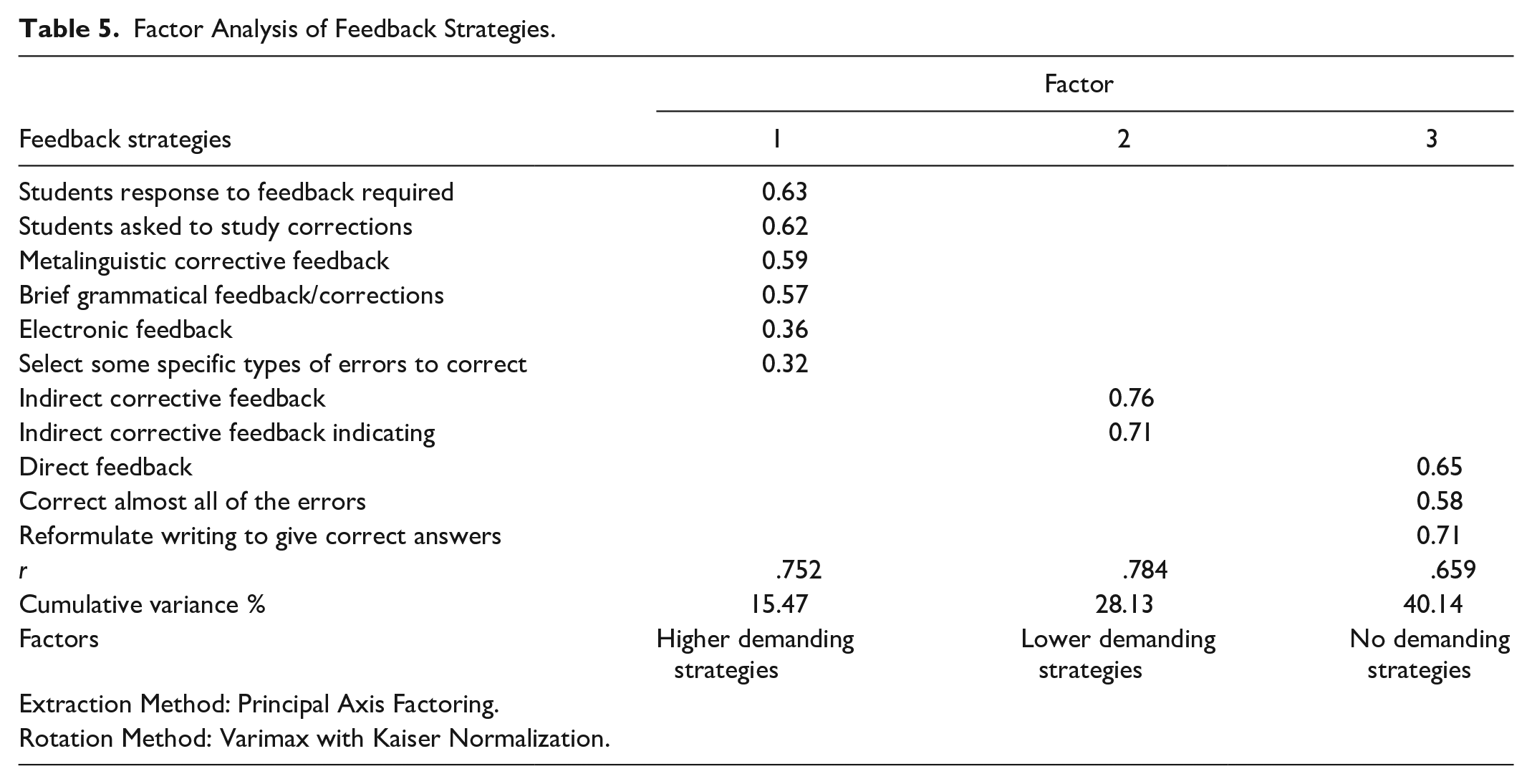
Aiming at understanding the pattern behind the 12 investigated feedback strategies, an Exploratory Factor Analysis (Principle Axis Factoring with the rotation method of Varimax) was conducted. This study borrowed the survey items/questions/typology from three established instruments; therefore, we use EFA first, instead of PCA (Principal Component Analysis). Table 5 shows that the results appear to be consistent with the findings in Table 4 to some extent. Three factors are identified based on the level of students’ expected effort to respond to the feedback (Eigenvalue = 1.332): (a) high-demand strategies (r = .75, variance explained = 15.47%), (b) low-demand strategies (r = .78, variance explained = 28.13%), and (c) no-demand strategies (r = .65, variance explained = 40.14%). In more detail, the high-demand strategies refer to those strategies that require a higher level of input, such as interpreting the feedback, identifying and correcting mistakes, and providing evidence that they study these mistakes. The low-demand strategies are associated with highlighting the locations of the mistakes without giving students the correct answers. In addition, no-demand strategies expect a minimal level of input from students, and the correct answers are usually provided by the EFL teachers. Surprisingly, in relation to the popularity among the three new defined strategies, Table 6 reports the mean and standard deviation. It suggests that high-demand strategies (M = 23.5, SD = 6.2) have been adopted much more frequently than low-demand (M = 8.8, SD = 2.7) and no-demand (M = 13.7, SD = 3.6) strategies.
Factor Analysis of Feedback Strategies.
Frequency of High-, Low-, and No-Demand Strategies.

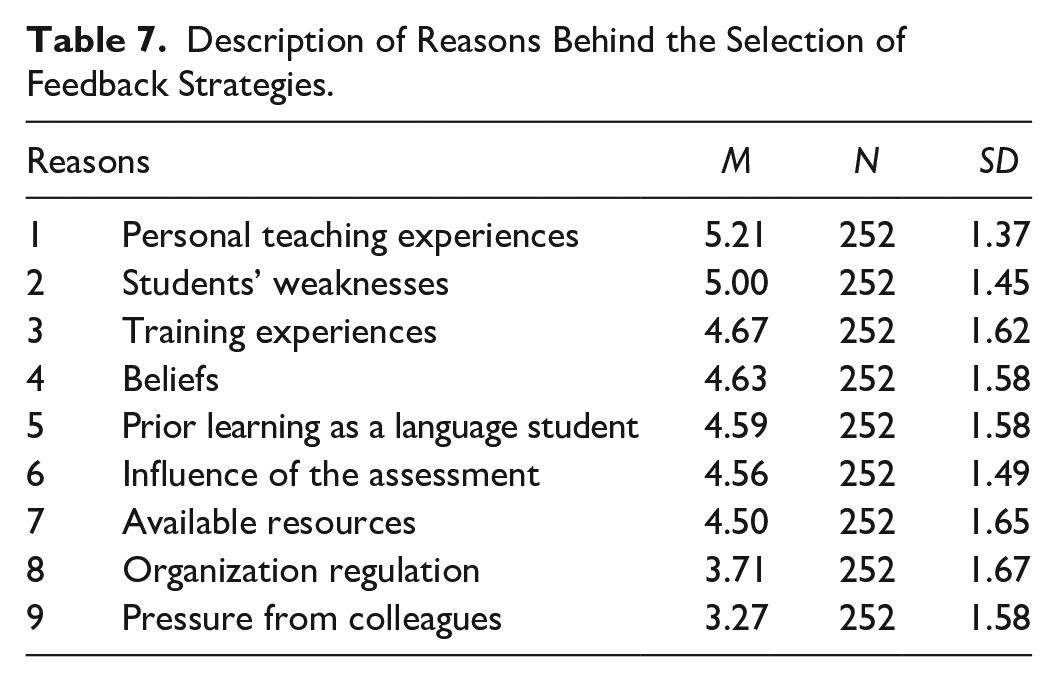
Finally, the reasons behind the EFL teachers’ choices of different feedback strategies are reported in Table 7, which shows that the EFL teachers choose their feedback strategies based on their classroom teaching experiences and observations of students’ weaknesses, but they are less likely to follow other colleagues’ practices or department regulations.
Description of Reasons Behind the Selection of Feedback Strategies.
A MANOVA test was conducted to explore the relationships between three identified feedback strategies (high-demand, low-demand, and no-demand) and three reported EFL students’ writing performance (low level, middle level, and high level). Table 8 reports the descriptive statistics of the two variables. The Multivariate test suggests that there is a statistically significant difference in EFL university teachers’ selections of feedback strategies based on their students’ writing proficiency level, F(6, 406) = 4.23, p < .0005; Wilks’s = .89, partial η2 = .059). EFL students’ writing proficiency level has a statistically significant effect on their teachers’ selection of high-demand (F = 6.31; p < .0005; partial η2 = .058) and no-demand feedback strategies (F = 6.098; p < .0005; partial η2 = .056). To be more specific, Table 9 reports mean scores for the frequency of use of high-demand feedback strategies, which are statistically significantly different between students with low and high writing proficiency (p < .0005), and middle and high writing proficiency (p < .0005), but not between students with middle and low writing proficiency (p = .79). In relation to the use of no-demand feedback strategies, teachers report to use them more frequently on the students with low rather than middle writing proficiency (p < .005). There are no significant differences among the students with different levels of writing proficiency in the use of low-demand feedback strategies.
Descriptive Statistics of Writing Proficiency and Identified Feedback Strategies.

Multiple Comparisons.

The mean difference is significant at the .05 level.
Qualitative Results
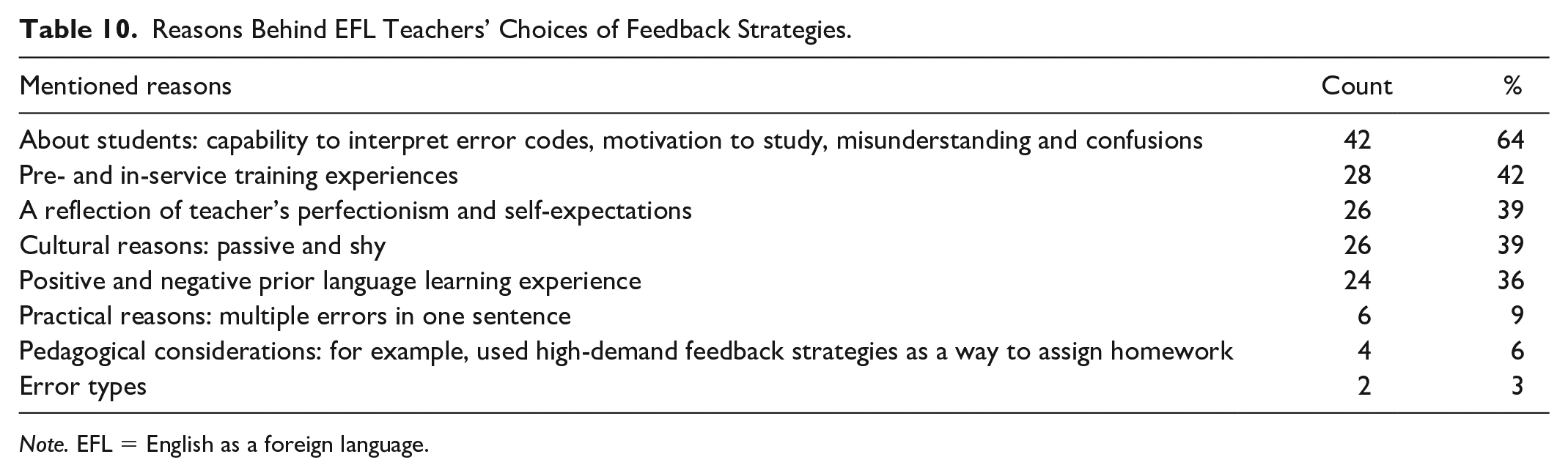
The answers to the second and third research questions came from the qualitative results. In general, 66 out of 254 respondents provided qualitative data to answer the open-ended question in the survey. On average, each entry contains 32 English words with a standard deviation of 27.8. In relation to the various reasons behind EFL teachers’ use of high-, low-, and no-demand feedback strategies, the qualitative data provide some insights. The main factors that influenced teachers’ choices of feedback strategies are summarized in Table 10, and the results appear to align with the survey results. Many respondents mentioned more than one reason behind their choices of feedback strategies, among which student-related factors were the most frequently mentioned, followed by their professional training experiences.
Reasons Behind EFL Teachers’ Choices of Feedback Strategies.
Note. EFL = English as a foreign language.
For direct strategies (no- and low-demand strategies), 42 teachers (64% of the respondents), commented that students may lack the capability to interpret their error codes (indirect feedback strategies). Moreover, they did not seem to be confident that their students would be motivated to find out the correct grammar rules and use metalinguistic knowledge to correct the mistakes by themselves. As a result, the respondents tried to avoid using indirect feedback in the classroom practice. In addition, in practice, some teachers complained that students rarely studied the error codes or improved their writing based on the indirect feedback; instead, the students asked their teachers to clarify those error codes during consultation time. As two teachers reported, Generally, I gave feedback on my students’ writing by showing them the correct version directly. I don’t prefer the indirect feedback such as using error code or just indicating the mistakes because my students’ English competency is quite low and they have low motivation to learn English. They don’t understand what I mean by using the error code or by highlighting where the mistakes are. I often use direct correction when giving feedback on language aspects of students’ work. Although I do agree with the value of using error codes, very often when the students see these codes, they will still keep asking you how to correct specific grammar or vocabulary errors.
As a result of the poor capability of understanding teachers’ comments and low motivation to engage with received feedback, teachers expressed their concerns on providing indirect feedback, as they believed that their students can become confused about teachers’ comments, misunderstand the error codes, and make more mistakes in the subsequent drafts. As can be seen in this excerpt, It is more useful for students to know what problems are in their writing, especially the low level students. They tend not to understand the correct grammar points. The general feedback might make them confused about what the problems in their writing are.
Moreover, 26 teachers (approximately 40% of the respondents) commented that highlighting every mistake and providing correct answers for students were a reflection of their perfectionism, and they believed that direct error correction and comprehensive feedback would assist students in their writing process, as can be seen in the following comment: Most of the time I gave comprehensive feedback or error corrections because I was mainly driven by my perfectionism. It is quite time-consuming but I sort of believe it is my responsibility to help students gain progress in their writing.
Also, 24 respondents (36% of the participants) reported that they chose direct feedback due to prior language learning experience. When they were students, they preferred the teachers to correct their errors because they could see what types of errors they had made and also figure out how they could be corrected. As a result, they employed the direct feedback strategy to help their students for the reason that they could resonate with the students’ learning experience. As one teacher said, As a prior second language learner, I preferred getting the direct corrective feedback from my English teachers. This method could help me understand what mistakes/errors I’d just made, including how and why.
For indirect and high-demand strategies, first, the majority of the teachers expected their students to study their mistakes and correct them by themselves. Interestingly, none of the respondents seemed to be very confident about their students’ ability and motivation to apply metalinguistic knowledge to correct the mistakes by themselves. In their comments, the verbs such as “would like,” “hope,” “believe,” and “can” indicate that studying feedback and comments may be wishful thinking from EFL teachers rather than being based on observations of students. For instance, one teacher reported, I have used error codes because I believe that my students need to learn from their mistakes. Giving errors symbols, the students will have to think how to correct their sentences with a hint of what seems to be incorrect.
Nearly half of the teachers (28 out of 66 participants) admitted that their pre- and in-service training experiences seemed to support their choices of feedback strategies. They commented that their feedback practice was informed by research in the field: A professor did research finding that if you correct all errors, students do not make improvement and if you do nothing it is the same. It is better to pick a few and work on these.
Apart from EFL teachers’ doubts regarding students’ capability of interpreting indirect feedback and motivation to study them, a small number of the respondents (six out of 66) reported some practical reasons underlying their use of indirect feedback strategies, such as multiple errors in one sentence, which made it impossible for them to use error codes unless the teachers reformulate the students’ writing. As some teachers commented, I actually prefer indirect correction, such as using a marking guide but, in practice, there is usually more than one error in one sentence. Isolating all the errors and inappropriate words is actually quite difficult for me and the students.
Moreover, cultural role was found to impact on some teachers’ feedback choices. In total, 26 participants (40% of the respondents) mentioned that indirect feedback strategies were chosen as a face-saving strategy in the context of Asian language learners: Due to the passive and shy nature of Thai students, making direct correction sometimes damages their confidence and their positive attitude towards learning a foreign language. Therefore, I need to find the best method that suits the student’s level and the situation.
Finally, four participants (6% of the respondents) commented that they used high-demand feedback strategies as a way to assign homework for tertiary students; in other words, asking students to study indirect feedback and submit subsequent drafts were treated as out-of-class work: Practical issues such as time and the pragmatic idea that students will look more at the paper in class rather than the computer after class, thus forcing them to do correction as you hand the essay/report back, will help them improve for the next assignment.
Two respondents (3% of the participants) claimed that they employed both direct and indirect feedback strategies depending on error types. It seems that the direct feedback strategy was used for simple grammatical errors while indirect feedback strategy was employed for errors in content or idea development.
Discussion
In response to the first question, the statistical analysis from the quantitative part of the survey has revealed that high-demand and indirect CF strategies seem to be the preferred feedback practices among this group of teacher participants. The qualitative responses to the open-ended questions provided some insights into the reasons underlying the teachers’ choice of feedback types. Although the current study relied only on self-reported teachers’ WCF strategy use whereas previous study also examined teachers’ feedback in their students’ essays (Furneaux et al., 2007; Guenette & Lyster, 2013; Lee, 2004, 2008), this survey study involving university lecturers still yielded different findings from those conducted at the secondary school level where no-demand and direct CF strategies were reported as the most frequently used strategies.
To answer the second and third research questions, the findings from the current study suggest that combined feedback approaches employed by the teachers reflect competing influences from three factors: (a) EFL teachers’ language learning experiences and their observation of their students’ language proficiency as well as capability of working on teacher feedback, which encourage EFL teachers to adopt more directive and no-demand feedback strategies; (b) EFL teachers’ professional training experiences and their beliefs in language development, which support the adoption of high-demand and indirect feedback strategies; and (c) contextual factors seem to require a wide range of feedback strategies, such as organization regulations, available resources, and cultural influences. Finally, EFL teachers’ use of feedback strategies may depend on the nature of students’ errors and weaknesses in their writing.
The teachers in the current study reported a predominant use of indirect correction and high-demand feedback strategy, depicting an interesting picture in the field of L2 writing, as previous studies reported that direct correction accounted for 70% of the CF in Lee’s (2004) study, more than 50% as observed by Furneaux et al. (2007), and 70% as flagged by the pre-service teachers in Guenette and Lyster’s (2013) study. This could be explained by the different sample used in this study. Former studies primarily involved pre-university EFL teachers, while the respondents of this study were tertiary-level EFL instructors working with language students who had longer years of English instruction, a higher level of maturity, learning autonomy, and motivation (Jackson & Chen, 2018).
The combined feedback strategies seem to reflect competing influences from teachers’ prior learning and training experience, professional knowledge, their beliefs in WCF, and actual practices in teaching L2 writing. One inconsistency can be observed between the teachers’ professional training experience and language learning history. Most teachers in their open responses admitted that they understood from professional training that indirect feedback strategies can be more beneficial in the long term. However, this belief seemed to be in contrast to their language learning experiences and their students’ expectations for direct corrections to be provided. Also, the influence from contextual factors appeared to be very complicated. On one hand, the teachers preferred to employ high-demand and indirect strategies mainly because of (a) limited resources, such as time constraint and markers available; and (b) face-saving strategies as the local culture was unlikely to tolerate frank and straight criticisms (Borg, 2003).
On the other hand, some teachers were concerned about students’ low language proficiency and lack of metalinguistic knowledge to interpret teachers’ indirect feedback (Ferris, 2002; Guenette & Lyster, 2013; Lee, 2008). As a result of these competing reasons, they reported that they had to compromise by introducing more direct-, low-, and no-demand feedback. Indeed, feedback strategies do not seem to be a one-way decision as both qualitative and quantitative analysis appeared to show that students play a significant role in teachers’ decisions on, and practice in, feedback provision, confirming that feedback practice is a dynamic reciprocal activity in which teachers’ actions are influenced by their students’ reactions to their feedback (Hyland & Hyland, 2006; Min, 2013).
More specifically, students’ linguistic weakness and classroom observation were rated as the top two reasons for teachers’ choice of feedback strategies in this study. If the students were seen as being able and motivated to learn from the teacher’s feedback and make corrections accordingly, high-demand and indirect strategies were reported to be more likely to be effective. To increase their motivation level for further study and in using teacher feedback, the concepts of learning ownership and self-regulation would be of relevance (Nash & Winstone, 2017). High-demanding strategies such as indirect or metalinguistic feedback practice may have the potential to help students claim ownership by creating a responsibility-sharing culture between feedback givers and receivers (Winstone & Carless, 2019).
These inconsistencies among the sources of developing teacher cognitions arguably reflect Nunan’s (2003) findings in his investigation of the government’s role in English education in the Asia-Pacific region. He demonstrated ample evidence of “confusion and inconsistency” in the government’s involvement in English education at various levels in a large number of areas, among which, various ages of initial instruction, insufficient trained and skilled teachers, disjunction between curriculum rhetoric and pedagogical reality apparently contributing to the inconsistency among the sources of developing teacher cognitions to some extent. It was also confirmed in teacher cognition research that teachers’ prior language learning experiences and initial conceptualizations of language teaching continued to play an influential role in their later professional lives (Borg, 2003). In relation to teachers’ feedback practice, provision of WCF can be intrinsically challenging for language teachers irrespective of their training, experience, geographical location, and classroom context (Guenette & Lyster, 2013) because cognitive and behavioral changes are distinct from each other (Borg, 2003). As can also be seen from this study, although some teachers understood that indirect feedback strategies would be more useful based on their professional training, this cognitive change did not result in their behavioral change in providing feedback to students due to various individual, contextual, and cultural factors.
Conclusion
In conclusion, the university EFL teachers in the three Asian countries, that is, China, Vietnam, and Thailand, reported grammatical accuracy, argument structure, and syntactic complexity as the top three common errors and mistakes in their students’ writing. They also reported the use of a more balanced approach to providing CF to their students with high-demand and indirect feedback strategies being used more frequently. This seemed inconsistent with the findings from previous research conducted in Hong Kong and Canada with in-service and pre-service secondary school teachers. The teachers tended to provide different types of strategies, namely, high-demand, low-demand, and no-demand feedback in relation to their students’ proficiency levels. This study also revealed inconsistent and contrasting results between teachers’ cognition about provision of feedback and their reported feedback strategy use. This study has contributed to the WCF research field in that it investigated teachers’ feedback strategy use at the tertiary level across three Asian countries. It employed the teacher cognition framework to explore teacher’s reported strategy use. It identified the influence of individual and contextual factors on teachers’ feedback practice, including teachers’ prior learning experience, professional training, cultural background, and their perceptions of students’ proficiency level and metalinguistic knowledge.
A number of limitations in this study should also be addressed. The study was of a cross-sectional design that used only self-report surveys. It would have been better to triangulate the survey findings with teachers’ actual provision of CF to students’ written work to find out if the self-reported strategy use is consistent or inconsistent with their actual feedback practice. Also, only one third of the participants responded to the open-ended question in the survey, which could have caused bias of the findings.
Future research on teacher feedback practice should employ a longitudinal design to examine teachers’ actual feedback strategy use as evident in their students’ writings. Because teachers’ feedback practice has been identified as a reciprocal and dynamic process (Hyland & Hyland, 2006; Min, 2013), it might be useful to use introspective methods such as stimulated-recall interview or reflective methods of journal entry to explore teacher cognition of feedback practice. Also, future research could be informed by sociocultural theory, in particular, activity theory to explore the reciprocal relationship among the teacher, the feedback provided, and the students’ uptake of teacher feedback in their language development process (Bitchener & Storch, 2016; Lee, 2014).
Supplemental Material
Appendix1_-_survey – Supplemental material for Written Corrective Feedback Strategies Employed by University English Lecturers: A Teacher Cognition Perspective
Supplemental material, Appendix1_-_survey for Written Corrective Feedback Strategies Employed by University English Lecturers: A Teacher Cognition Perspective by Wei Wei and Yiqian (Katherine) Cao in SAGE Open
Footnotes
Declaration of Conflicting Interests
The author(s) declared no potential conflicts of interest with respect to the research, authorship, and/or publication of this article.
Funding
The author(s) received no financial support for the research, authorship, and/or publication of this article.

Supplemental Material
Supplemental material for this article is available online.
References
Supplementary Material
Please find the following supplemental material available below.
For Open Access articles published under a Creative Commons License, all supplemental material carries the same license as the article it is associated with.
For non-Open Access articles published, all supplemental material carries a non-exclusive license, and permission requests for re-use of supplemental material or any part of supplemental material shall be sent directly to the copyright owner as specified in the copyright notice associated with the article.
