




Abstract
The current study explored the multiple effects of social media use and its moderation mechanism between intimate family environment and self-esteem in adolescents. In all, 1,040 males and 1,201 females below age 25 have participated in this study. Hypothesis and research questions were proposed and examined by statistical analysis, consisting of statistical description, Pearson’s correlation analysis, independent-samples t test, multiple linear regression, simple-slope analysis, and moderation plot. Supportive social media use was identified as a moderator among all participants. Gender differences were found to exist in this moderation mechanism. Male adolescents tended to use social media as a habit, while female adolescents preferred to use social media for seeking support. The habitual social media use moderated the association between intimate family environment and self-esteem in male adolescents; the supportive social media use moderated the same procedure in female adolescents; however, both moderations were only found to be significant in the group of high habitual or supportive social media use, respectively.
Introduction
Research Report on Internet Behavior of Chinese Teenagers in 2015 showed that about 287 million Chinese adolescents use the internet (China Internet Network Information Center [CNNIC], 2016), of whom most common activity on the internet was using social media. Balancing life online and offline has gradually become an important subjective matter (Internet Society, 2019). An unhealthy manner of social media use could lead to a lot of problems such as worsen family relationship, low self-esteem, and deviant behavior.
Social Media Use, Family Environment, and Self-Esteem
Uses and gratifications theory could guide our viewpoint to the angle that social media could act as a gratification, and individuals are attracted to use social media to satisfy their social and psychological needs (Ruggiero, 2000). Wang et al. (2012) examined the four categories of needs of social media use (emotional, cognitive, social, and habitual) co-working with the interpersonal social environment to affect self-development. Raacke and Raacke (2008) listed the causes of uses and gratifications for having social media accounts which included “to keep in touch with old friends,” “to keep in touch with current friends,” “to post/look at pictures,” “to make new friends,” “to learn about events,” “to feel connected,” and so forth. Most of those behaviors reflected the socio-psychological needs of social media users which might influence adolescents’ self-development. Hökby et al. (2016) conducted a large longitudinal study on adolescents and showed problematic internet use had a direct effect on mental health over time. Therefore, this present study focuses on the socio-psychological needs of social media use in adolescents’ family environment, and they are also closely related to self-esteem (Mahmoudi, 2012; Mogonea & Mogonea, 2014).
In another work of the authors, we evaluated a series of social media use needs-relevant items in a psychometric way and divided them into three types—compensatory, supportive, and habitual. Social compensation through social media use refers to people who experience difficulties using social media to compensate for the deficits they encounter in the real world (Poley & Luo, 2012). The compensation need of social media use could trace back to the online social comparison (B. K. Johnson & Knobloch-Westerwick, 2014). Social comparison, as the process of evaluating personal abilities and attitudes in relation to those of others (Wood, 1996), plays a significant role in self-image and subjective well-being. In addition, individuals’ social media use in their adolescent stage correlated with the perception of self-esteem (G. M. Johnson, 2011). When they are exposed to the overwhelming information on social media, it would influence their self-esteem via social comparison (Niu et al., 2018) and may have quite different outcomes on their social compensation need.
Social media has become a free space for adolescents to express their depression, anxiety, or difficulties, where they could seek social support. On the positive side, social media creates unprecedented opportunities for those in need of social support in real life to be satisfied online (Notredame et al., 2018). Quinones and Griffiths (2017) found that releasing emotional expression and capturing social resources were the primary driving forces for intensive social media use. The socio-psychological needs for social support would lead individuals to more frequent social media use for expanding their social networks online, through maintaining old interpersonal relationships and building new ones, with the hope that their friends or followers on social media may provide social and psychological support when they are in need (Indian & Grieve, 2014; Wohn & Larose, 2014).
In this information era, social media use has been an indispensable activity in our daily life (Kitamura, 2013). Adolescents post and update their status during the daytime; check and browse what happened at night before sleeping. Thus, habitual social media use (H-SMU) could be identified as a type of socio-psychological needs of adolescents who use social media as a habit. Those who habitually use social media may experience mild feelings of loss when isolated from social media. This habitual need is often operationally measured as the screen time or frequency of using social media (Valkenburg et al., 2017). But in this study, we try to define H-SMU as a descriptive variable of behavioral tendency instead of screen time or frequency of social media use. Similarly, the supportive social media use (S-SMU) and compensatory social media use (C-SMU) mentioned above are the description of behavioral inclination related to social support and compensation.
Many studies have concluded that the family environment (the relationship among family members) had strong effects on adolescents’ experiences and development (Balistreri & Alvirahammond, 2014). Vandewater et al. (2005) found that family conflict could lead to children viewing more violent content on media as a reflection of family tensions. A poor family relationship could lead to similar problems in social media use. Intensively and frequently social media use was found to be negatively correlated to adolescents’ perception of the quality of family relationships (Mesch, 2003). Mesch (2006) further verified this concept in another study, which showed that social media overuse reduced family togetherness and intimacy, which resulted in low perception of family cohesion.
Schwartz (2012) found that adolescents’ positive feelings were associated with H-SMU or S-SMU, such as photo tagging, friend requests, status updates, and private messages; these behaviors could help maintain a social connection to promote the self-esteem of adolescents. In the meantime, social feedbacks from social media (e.g., followers, “likes,” or the thought of “they own what I never had,”) may encourage social comparison (Fox & Vendemia, 2016), through which individuals compare themselves with others for purposes of self-evaluation, self-improvement, and self-enhancement (Wood, 1989), if they are in a similar social environment. As a result, family environment could also be considered comparable by adolescents. This comparison may affect how adolescents assessing information in their family environment, further affecting their self-esteem perception. As described previously, unhealthy social media use can worsen family relationships, while poor family relationship and lack of family cohesion tend to lead to low self-esteem and problematic behaviors among adolescents (Cooper et al., 1983; Gordon et al., 1982). All these evidences imply that social media use may moderate the association between different family environment and adolescent self-esteem (Franco & Levitt, 1998). But it is still unclear how specific social media use moderates the relationship between family environment (intimacy or conflict) and adolescent self-esteem. Study of Fosco et al. (2012) revealed that positive family dynamics was a more robust predictor of youth outcomes than the expressions of negativity in the family (Fosco et al., 2012), and family cohesion is generally considered as a protective factor and family conflict is generally considered as a risk factor (Xu et al., 2017). Based on these concepts, the current study decided to use the more robust side—“intimacy” to predict adolescent self-esteem—and here rose our first research question:
Gender Difference
The influence of social media use would gradually permeate people’s well-being. Viner et al. (2019) explored the mediating role of cyberbullying, sleep, and physical activity in the associations between the frequency of social media use and mental health and well-being in adolescents in a longitudinal study; they found that cyberbullying and inadequate sleep could be the main causes of the harmful effects of frequent social media use on the mental health and well-being in girls, while among boys such mediation effects were much less significant. Even though previous studies offered findings that digital technology use and adolescent well-being were negatively correlated, the effect was small (Orben & Przybylski, 2019a, 2019b); in addition, they used panel data in another study to disentangle the between-person and within-person relations linking adolescent social media use and well-being, and found that social media use was not a strong predictor to life satisfaction across the adolescent population; most effects were tiny, varied substantively from results of different analytic methods and were possibly contingent on gender (Orben et al., 2019). Social media predicted tenuous decreases in life satisfaction and in mean satisfaction in males; while for females, social media was a predictor of slightly decreased life satisfaction across all domains (school work, school, mean, life, friends, family), except satisfaction with appearance (Orben et al., 2019). According to those findings, it is necessary to consider possible gender differences in social media use among adolescents. This current study suggests that explaining gender differences in the social media use through the individual behavioral inclination instead of physical measurement (screen time and frequency) even though there would be the risk of subjectifying; previous studies seldom explored the intermingled association between social media use and self-esteem with family environment and gender difference as background; thus, we assumed that three types of social media use (habitual, supportive, and compensatory) could moderate the relationship between intimate family environment and adolescents’ self-esteem in different genders.
At the early stages of social media, the theory of self-disclosure pointed out that women had more self-disclosure online, whereas men spent more time in habitually searching and browsing online (Jackson et al., 2001). Empirical studies also found that women had more online self-presentation (Metzler & Scheithauer, 2017); the attractiveness of online body image correlated with self-objectification (Niu et al., 2020; Wu et al., 2019; Zheng et al., 2019), which could have a possible link to self-esteem; females showed a more prominent concern pattern than that of males (Lindsey, 2015). In the family, from kids’ perspective, Ito (2013) elucidated the gender differences among family members spending time together with new media—mothers were often described as “clueless” or “hopeless” outside the domain of communication technologies and fathers as being the ones who play or tinker with technology alongside their kids. These pioneer studies suggested that gender differences might exist in the individual perception of self-development and family relationship. Social media, as interactive internet-based applications (Kaplan & Haenlein, 2010; Obar & Wildman, 2015) and a lively component of the internet, could share similar features regarding gender differences. On the contrary, gender differences may also play a role in the association of supportive and compensatory socio-psychological needs among adolescents who experience less family harmony (Hood et al., 2018; Nowland et al., 2018). Therefore, we proposed a hypothesis and the second research question:
Method
Participants
According to CNNIC (2020), students are the largest group of internet users. Thus, 2,292 participants were recruited from three colleges and one middle-high school in Shaanxi Province, China; they were asked to finish an investigation about their demands on social media use, self-evaluation of self-esteem, and family environment. As CNNIC (2016) defined adolescent online users as internet users who were below 25 years old, we removed the participants, whose ages were greater than 25, from data analysis. At last, we obtained 2,241 (97.77%) valid questionnaires. In all, 1,040 were males, and 1,201 were females (Mage = 18.25; SD = 3.50). A total of 805 participants were below 18, and 1,436 participants were 18 years old or above. All the investigation procedures were under the control of two tutoring assistants in case the participants had any questions. This study had oral informed consent of the participants and was approved by the ethics committee of the corresponding author’s affiliation.
Measurements
Three types of social media use in socio-psychological needs
We evaluated the items of social media use in socio-paychological needs before data analysis. The items used a 5-point Likert-type type scale from 1 = completely non-conformity with me to 5 = completely consistent with me. All samples were systematically and randomly divided into two groups (approximately 50%): Sample A (n = 1,138) was used for exploratory factor analysis (EFA); Sample B (n = 1,103) was used for confirmatory factor analysis (CFA). At last, the three-factor structure in EFA and CFA both had acceptable goodness-of-fit, and each factor had five items. We ran CFA again on all samples (N = 2,241) and found similar and well goodness-of-fit: normed fit index (NFI) = .931 > .900; relative fit index (RFI) = .911 > .900; incremental fit index (IFI) = .939 > .900; Tucker–Lewis index (TLI) = .920 > .900; comparative fit index (CFI) = .938 > .900; and root mean square error of approximation (RMSEA) = .060 < .080. The values of NFI, RFI, IFI, TLI, and CFI greater than .90, and RMSEA less than .08 indicate adequate model fit (Kline, 2013). Cronbach’s α of internal consistency of the three factors were Cronbach’s αhabitual = .807; Cronbach’s αsupportive = .729; Cronbach’s αcompensatory = .799. Methodologists recommended that a value of Cronbach’s α greater than .70 was acceptable (Cortina, 1993). In our scale, the higher the total score of each factor, the more demand to use social media in a particular type. Some sample items were as follows: “Using social media is my daily habit” for H-SMU; “I use social media to interact with my classmates and friends about my learning and living” for S-SMU; and “Compared with the offline interaction, the atmosphere of which on social media is much more friendly” for C-SMU.
Family Environment Scale (FES)
The FES was a self-reported questionnaire designed to measure the social and environmental characteristics of a family (Moos & Moos, 1987). We used the subscale of “Cohesion” of FES, which consisted of nine items and was translated into Chinese by Fei et al. (1999). The “cohesion” subscale belongs to the family relationship dimension, which describes the degree of commitment, help, and support that family members provide one another, such as “family members really help and support one another” (Brinson, 1989; Moos & Moos, 1987). The options of answer were “yes = 1” or “no = 0.” We selected this subscale in the current study because it can reflect the degree of family intimacy, the meaning of which is more suitable in Chinese context. The coefficient of its reliability (KR-20) was .747. Values of KR-20 are not held to the same standard in statistics, but one rule of thumb states that values greater than or equal to .70 are acceptable (Oruç, 2015). In this subscale, the higher total score of the nine items represented more intimate family environment.
Rosenberg Self-Esteem Scale (RSES)
The RSES scale was a 10-item scale assessing the individual general self-esteem (Rosenberg, 1965), which was scored as a 4-point Likert-type measure ranging from 1 (strongly disagree) to 4 (strongly agree). Examples of items are “On the whole, I am satisfied with myself” and “I am able to do things as well as most other people.” We totalized all the 10 items to get the total score of self-esteem. The higher the score, the higher level of one’s self-esteem. RSES was a well-established measure with strong evidence of reliability and validity (Blascovich & Tomaka, 1991). The Cronbach’s α in this study was .818; methodologists recommended that this coefficient greater than .70 was acceptable (Cortina, 1993).
Results
Statistical Description and Correlation Analysis
Table 1 showed the statistical description and Pearson’s correlation analysis of the variables used in this study. All the variables were significantly correlated with each other except for the correlation between intimate family environment and H-SMU.
Statistical Description and Correlation Analysis (N = 2,241).

p < .01 (two-tailed).
Analysis of Independent-Samples t Test
As we proposed that gender differences might exist in this study, the independent-samples t test was used to observe if there were latent gender differences before grouping males and females. Table 2 showed that there were latent gender differences on the IFE, C-SMU, H-SMU, and Self-esteem (p < .05).
The Independent-Samples t Test With No Gender Grouping (N = 2,241).

p < .05 (two-tailed).
Multiple Linear Regression and the Moderating Effect
We took a backward selection approach to observe if there was a moderating effect of social media use between intimate family environment and self-esteem (Table 3). All interaction terms were introduced simultaneously and the nonsignificant interaction term with the largest p value was dropped at each step, we chose to drop only one term at each step because dropping one interaction term might result in one of the other interaction terms changing from nonsignificant to significant. This procedure helped us identify which interaction terms would be significant at last.
Multiple Linear Regression to Observe Gender Differences and Moderating Effects (N = 2,241).

Note. The independent variable was self-esteem (SES). IFE = intimate family environment; S-SMU = supportive social media use; C-SMU = compensatory social media use; H-SMU = habitual social media use.
p < .05 (two-tailed).
Model 1 comprised all the variables and interaction terms. In this step, we found IFE × S-SMU was significantly positive (β = .427; p < .05) to SES; IFE × H-SMU, the interaction which had the largest p value, would be dropped. Similarly, in Model 2, IFE × C-SMU, the interaction with the largest p value was removed. At last, we found only one significant interaction, IFE × S-SMU (β = .432; p < .05), as shown in Model 3. Therefore, we confirmed that S-SMU moderated the relationship between intimate family environment and self-esteem; then we used a moderation plot from simple-slope analysis to show how it moderated the relationship (Figure 1). In addition, the main effect of IFE was negative to SES; the interaction term, IFE × S-SMU, was positive to SES. Thus, overall, S-SMU negatively moderated the relationship between IFE and SES.
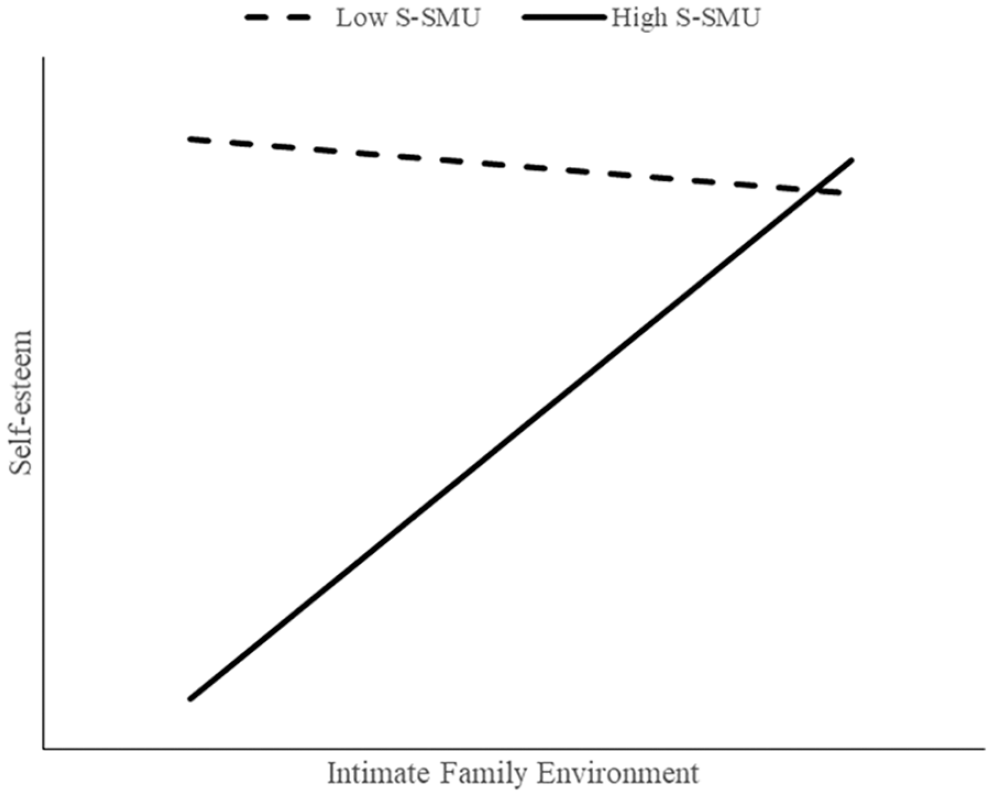
The supportive social media use moderated the relationship between intimate family environment and self-esteem with no gender grouping.
The results of the simple-slope analysis showed the moderating effect with no gender grouping. As shown in Figure 1, for adolescents who had high S-SMU, high family intimacy led to higher self-esteem; on the contrary, for adolescents who had low S-SMU, high family intimacy led to decreased self-esteem. IFE was a significant predictor to SES only when conditioned at the high S-SMU group (B = .205; 95% confidence interval [CI] [.122, .289]; p < .05); however, in the low S-SMU group, the effect of IFE was not significant (B = –.018; 95% CI [–.099, .063]; p > .05).
Gender Difference
As observed in Table 2, gender differences existed in the IFE, C-SMU, H-SMU, and SES. Furthermore, a significant interaction, IFE × S-SMU, was also identified in Table 3. Therefore, we grouped samples into males and females to explore the different moderation mechanisms of social media use in the association between intimate family environment and self-esteem among different genders. Table 4 showed the male adolescent’s model; Table 5 showed the female’s.
Multiple Linear Regression and Moderating Effects in Male Adolescents (N = 1,040).

Note. The independent variable was self-esteem (SES). IFE = intimate family environment; H-SMU = habitual social media use; S-SMU = supportive social media use; C-SMU = compensatory social media use.
p < .05 (two-tailed).
Multiple Linear Regression and Moderating Effects in Female Adolescents (N = 1,201).

Note. The independent variable was self-esteem (SES). IFE = intimate family environment; S-SMU = supportive social media use; C-SMU = compensatory social media use; H-SMU = habitual social media use.
p < .05 (two-tailed).
For the male group, the last step of backward selection (Table 4: Model 3) revealed a significant interaction of IFE × H-SMU (β = .336, p < .05). Although the main effect of IFE was negative, it is nonsignificant (β = –.183, p > .05). In the meantime, as long as the interaction term, IFE × H-SMU, was positive to SES, it would not hinder us from analyzing the moderating effect: H-SMU negatively moderated the relationship between IFE and SES.
The results of the simple-slope analysis revealed the moderating effect of H-SMU on self-esteem in the male group. In the high H-SMU male group, IFE positively significantly predicted SE (B = .209; 95% CI [.080, .338]; p < .05), however, in the case of low H-SMU, the effect of IFE was negative but not significant (B = –.004; 95% CI [–.134, .125]; p > .05), as shown in Figure 2.

The habitual social media use moderated the relationship between intimate family environment and self-esteem in male adolescents.
For the female group, at the final step of backward selection (Table 5: Model 3), a significant interaction of IFE × S-SMU (β = .507, p < .05) was found. In the meantime, the main effect of IFE was negative and significant (β = –.337, p < .05). Thus, the moderating effect here was S-SMU negatively moderated the relationship between IFE and SES.
IFE was a significant predictor to SES only when conditioned at high S-SMU in female group (B = .193; 95% CI [.089, .297]; p < .05); however, it was not significant when conditioned at low S-SMU (B = –.044; 95% CI [–.146, .058]; p > .05). Figure 3 depicted that for female adolescents of high S-SMU, higher family intimacy led to higher self-esteem; on the contrary, for female adolescents of low S-SMU, high family intimacy led to reducing self-esteem.

The supportive social media use moderated the relationship between intimate family environment and self-esteem in female adolescents.
In summary, the socio-psychological needs of social media use between male and female adolescents are different. In an intimate family environment, male adolescents were more affected by H-SMU, which moderated the relationship between family intimacy and self-esteem; but was only effective among the high habitual social media users. Female adolescents were more related to S-SMU, which moderated the relationship between family intimacy and self-esteem, but was only effective among the high supportive social media users.
Discussion
Family is the elementary social unit responsible for the socialization of adolescents (Tallman et al., 2014). Our study demonstrated that when moderated by social media use, intimate family environment did not always lead to better self-esteem. In this study, the negative main effect of family intimacy and its positive interaction with S-SMU together indicated that if adolescents desired more social and psychological support on social media, it would lead to less intimate family relationship, and less family intimacy would cause lower self-esteem (Ni & Shao, 2019). The adolescent who lives in a more intimate family environment might have higher self-esteem, but this correlation was only effective when conditioned at high S-SMU. This correlation, “great get higher” could be explained by social enhancement (“Rich Get Richer”) (Zywica & Danowski, 2008), and social meida acts as a tool for getting social support. On the contrary, “little get more” could be reflected by the group of low S-SMU, which could be connectted with “Poor Get Richer” (Zywica & Danowski, 2008); but in our study, this correlation was nonsignificant. In addition, family intimacy was always critical to foster adolescent self-esteem; there might be other appealing but negative factors influencing adolescents, even those factors that appear to be not harmful; the demand of S-SMU was a good example for this phenomenon.
Gender differences were uncovered when we analyzed data by independent-samples t test. The gender differences in the IFE, H-SMU, C-SMU, and SES were significant. Thus, to observe gender differences more clearly, we regrouped samples based on gender and constructed the models for males and females, respectively. For male adolescents, a positive interaction between family intimacy and H-SMU was observed. For female adolescents, only a significant positive interaction was found between family intimacy and S-SMU.
This study found that different gender had different socio-psychological needs from social media use. Male adolescents tended to use social media as a habit. Although it is normal for adolescents to use social media as a habit in their daily life, male adolescents should be more aware of the downside of overusing social media because H-SMU could negatively moderate the relationship between family intimacy and self-esteem. Over use of social media could lead to problematic behavior and negatively influence adolescent well-being, one of the worst consequences of excessive accumulation of H-SMU could be in addiction (Ni et al., 2009), which can lead to low self-esteem (Naseri et al., 2015). Osatuyi and Turel (2018) found more definite evidence to support that habit could explain the experience of momentary social media addiction symptoms. Limayem et al. (2007) had developed a model suggesting that continued information system usage was not only a consequence of intention, but also of habit.
Female adolescents tended to use social media for seeking support. It could mean that female adolescents might need more social and psychological support even though they live in an intimate family environment. Previous studies have revealed the benefits of S-SMU among female. A study in married women found that couple’s intimacy and perceived social support can decrease sexual distress (Alimoradi et al., 2019); Frison and Eggermont (2015) found that girls who actively use Facebook could benefit from perceive online social support, as it negatively predicted girls’ depressed mood. However, teen girls also reported that social media would cause stress; those girls with high reliance on Facebook for emotional support had more negative school outcomes (Thompson & Lougheed, 2012). Our study also discovered the negative influence of S-SMU among female adolescents. The interaction between family intimacy and S-SMU was significant to predict female adolescent’s self-esteem. However, this moderation mechanism was only significant in the high S-SMU group. It would be better for female adolescents not overly depending on social support from social media because “the rich get richer” but “the poor get poorer.”
In summary, intimate family environment generally promotes adolescent self-esteem; thus, parents should be encouraged to maintain a close relationship with their children, meantime, they should also be aware of the possible negative impact of social media use, and pay close attention to their social media activities to protect them from being victims of cyberbullying, or in some cases, stop them from inappropriate social media use, such as addictive use or cyberbullying. Social media companies also need to provide more supports to parents so that they would have enough tools to protect their children from being exposed to harmful social media contents and be able to identify their inappropriate social media use in time.
Limitations
This study only concerns the association between intimate family environment and adolescent self-esteem, and the moderating effect of social media use; whether such mechanism would exist in other family environment (e.g., conflict) was not studied. Participants in this study were all recruited in one province of China; such a sample may not perfectly represent all adolescents across China, which may affect the generalizability of our results, and it should be further validated in different cultures and communities. In addition, our data are cross-sectional; therefore causal inferences cannot be drawn; longitudinal data are essential for future research.
Conclusion
The current study explored the effects of H-SMU, S-SMU, C-SMU, and their moderation mechanism between intimate family environment and self-esteem in adolescents and the gender differences among them. Male adolescents tended to use social media as a habit which moderated the association between intimate family environment and their self-esteem, while female adolescents preferred to use social media for seeking support and the S-SMU moderated the same pathway in female adolescents. However, moderating effects were only found to be significant in the high score group of H-SMU in male and S-SMU in female.
Footnotes
Declaration of Conflicting Interests
The author(s) declared no potential conflicts of interest with respect to the research, authorship, and/or publication of this article.
Funding
The author(s) disclosed receipt of the following financial support for the research, authorship, and/or publication of this article: This study was sponsored by Shaanxi Provincial Department of Science & Technology, China (2019KRM193).
