




Abstract
Stimulated by the uses-and-gratification approach, this study examined the joint relation of several consumer characteristics to news interest. In total, 1,546 German-speaking participants rated their interest in 15 major news categories and several personal characteristics, including gender, age, the Big Five personality traits, self-esteem, as well as general positive and negative affect. Regression analyses examined the amount of interindividual variance in news interest that can be explained by this set of consumer characteristics. Overall, the amount of explained variance differed remarkably across news categories, ranging from 4% for entertainment-related news to 25% for news about technology. The most powerful explaining variables were participants’ gender, age, openness to experiences, and their amount of general positive affect. The results suggest that news interest should be defined and operationalized as a concept with multiple facets covering a huge range of content. Also, the results are important for media producers and journalists with respect to the conflict between increased need gratification of consumers and information filtering via personalized news content.
Introduction
News consumption plays an important role in our daily life as news provides information about events often being not directly accessible to us. Due to the increasing supply of news content, individual preferences and interests play a key role when it comes to news selection (Prior, 2005). Although there is a substantial history of research on news selection and framing from a journalist’s perspective (e.g., Bohle, 1986; Brosius & Eps, 1995; Donsbach, 2004; Helfer & Aelst, 2016), research with a focus on the relation between consumer characteristics and news interest is rather sparse. In general, previous research neglected two aspects, which are outlined in the next sections.
On one hand, most previous studies focused on the link between a specific information interest and a single consumer characteristic, such as political orientation (Garrett, 2009), consumers’ mood state (Biswas et al., 1994), as well as gender and self-esteem (Knobloch-Westerwick et al., 2006). Up to now, only few studies investigated the joint relation of several consumer characteristics to interest in specific media content. For example, Kraaykamp and Van Eijck (2005) conducted a large-scale study in which they examined the relationship between the Big Five personality traits and Dutch participants’ interest in different types of book content, cultural offers, and television preferences. The results indicated that consumers’ interest in specific media content is not determined by a single personal characteristic but by several factors which simultaneously contribute to media preferences. However, this study did not specifically address news. The remaining question is how different consumer characteristics jointly contribute to individual news interests.
On the other hand, the range of news content is considerable, but previous studies often had a rather narrow focus on a specific field of interest. Besides the fact that the focus of most studies is tailored to a specific topic, conceptual aspects additionally limit the scope: Although news content is often implicitly understood and operationalized in terms of information communication, entertainment aspects are primarily associated with other formats (cf., Kaspar et al., 2016). A similar distinction is made when talking about hard news (e.g., political or economic topics) versus soft news (e.g., human interest stories) (Lehman-Wilzig & Seletzky, 2010). As a consequence, such differentiation shrinks the range of potential news content considered in research. However, a review of the existing literature (Billsus & Pazzani, 2000; Lehman-Wilzig & Seletzky, 2010; Li & Jain, 1998; Whitney & Becker, 1982) and leading German newspapers and journals (Frankfurter Allgemeine Zeitung, Süddeutsche Zeitung, Zeit, Focus, Bild, Spiegel) revealed 15 prominent news categories: economy, entertainment, health, sports, technology, politics, science, environment, nutrition, crime, accidents and disasters, fashion, traveling, culture, and career. Hence, the focal research question of this study was whether consumer characteristics are differentially related to different news categories or whether news interest should be understood as a more global and homogeneous construct.
This study made a first step to fill the empirical gap and to answer this question being relevant for practice as well. Specifically, we examined how several consumer characteristics, which had been partially investigated in isolation beforehand, are related to consumers’ interest in different news categories. Here, we focus on individual interest which is defined as a “relatively enduring predisposition to reengage with particular classes of content over time” (Hidi & Renninger, 2006, p. 115). Individual interest is distinguished from (and a potential consequence of) situational interest defined as “focused attention and the affective reaction that is triggered in the moment by environmental stimuli, which may or may not last over time” (Hidi & Renninger, 2006, p. 113). This understanding of individual interest is compatible with the central idea of the uses-and-gratification approach (U&G) emphasizing that consumers play an active role in the context of media selection processes. The U&G model generally assumes that media consumers have specific expectations about how their psychological and societal needs can be fulfilled by mass media. These expectations lead to specific media preferences and uses, so that the desired gratifications may be obtained at the end (cf., Katz et al., 1973). In this sense, individual interest in specific news content reflects the gratification sought by the consumers (cf., Rayburn & Palmgreen, 1984). This core idea of the U&G model served as the driving theoretical concept for this study. With respect to the empirical base, some authors have already examined the relation between individual characteristics and interests in specific topics, but they did not examine whether high interest in a topic went along with high interest to consume corresponding news. Nonetheless, their results gave first hints for the effects that can be expected in the context of news consumption, as outlined in the next sections.
The Role of Gender
Knobloch-Westerwick et al. (2006) and Knobloch-Westerwick and Alter (2007) found that women preferred reading about topics labeled as social and interpersonal. In contrast, men spent more time on topics characterized by achievement and performance aspects. This effect was found for German and American participants. Also, women reported more preventive behaviors with respect to nutrition and a higher interest in health programs in general than men did (Stock et al., 2001). Women also showed a higher fashion consciousness (Seock & Bailey, 2008). In contrast, women often showed a reduced interest in SMET disciplines (science, mathematics, engineering, and technology), while multiple reasons for this phenomenon are heavily discussed (Weber & Custer, 2005). Finally, a comprehensive meta-analysis revealed that women, compared with men, are generally more risk averse and try to avoid risky situations (Byrnes et al., 1999). This may lead to higher interest in risk-related topics. Given these gender effects, we hypothesized:
We did not find empirical research that suggests gender effects with respect to the remaining news categories. We exploratively examined gender effects in these cases.
The Role of Age
Personal needs change with age, reflected by changes in media preferences. Supported by empirical evidence on the behavioral level (Mather & Carstensen, 2005) and neuronal level (Carstensen, 2006), the Socioemotional Selectivity Theory predicts a preference for emotion regulation with increasing age and, as a consequence, less interest in negatively valenced media content in general. Moreover, Carstensen and Mikels (2005) argued that “when people perceive time as expansive, as they typically do in youth, they tend to focus on preparing for the future. They value novelty and invest time and energy in acquiring information and expanding their horizons” (p. 117), whereas the motivation to expand new horizons and to acquire information about new societal trends decreases with increasing age. Correspondingly, people’s openness to new experiences was found to decrease with age across cultures (McCrae et al., 1999). Hence, we hypothesized that consumers’ interest in unequivocally negative news categories (i.e., crime, accidents and disasters) as well as news addressing trends and growth needs (i.e., fashion, traveling, and career) decreases with age:
The Role of Personality Traits
In terms of the U&G model, individuals’ interest in specific media content is driven by their needs and motives. Hence, it seems reasonable to attract attention to the Big Five personality traits, because they show significant correlations with a variety of specific motives (Olson & Weber, 2004) and interests (Larson et al., 2002). The Big Five personality traits encompass extraversion, neuroticism, openness to experiences, agreeableness, and conscientiousness. These traits are labeled as the basic dimensions of personality but cover a large range of personality facets (Costa & McCrae, 1992), although some criticisms of the proposed model have been discussed (e.g., Eysenck, 1992). Expert ratings indicated significant differences in the relative importance of behavioral, cognitive, and affective components of these five traits (Pytlik Zillig et al., 2002). Thereby, the Big Five seem to be “substantially and about equally heritable” (Loehlin et al., 1998, p. 431), while up to 50% of the individual variance in personality can be explained by genetic influences, depending on the sample type (twin, family, and adoption studies), as shown by recent meta-analyses (e.g., Vukasović & Bratko, 2015). Also, while phenotypic sex differences in the Big Five have been reported several times, sex apparently does not moderate estimates of heritability (cf., South et al., 2018; Vukasović & Bratko, 2015).
With respect to media selection motives, Kraaykamp and Van Eijck (2005) found some correlations between the Big Five and people’s interest in different types of book content, cultural offers, and television preferences. Similarly, Weaver (2003) found some correlations between specific television viewing motives and neuroticism and extraversion. However, with respect to people’s interest in specific news categories, research is sparse. At least, Mondak and Halperin (2008) observed a positive correlation between extraversion and the amount of news consumption via newspapers and television, and a positive correlation between conscientiousness and the amount of television news viewing. Gerber et al. (2011) also reported positive correlations between the Big Five (except neuroticism) and the amount of news consumption. Thus, we examined in an exploratory fashion:
In fact, an a priori justification of the direction of a specific correlation was hardly possible due to the current lack of empirical results and specific theoretical concepts in this research area. In most cases, one could find arguments for both a negative or positive correlation. For example, one might assume that individuals high in neuroticism tend to avoid negatively valenced news to avert potential states of negative affect, but one might also assume that individuals high in neuroticism show a high interest in such news to feel more prepared to actively avert potential risks.
The Role of Self-Esteem
Previous media research most often considered consumers’ self-esteem as a dependent variable (e.g., Aubrey, 2007; Vogel et al., 2014), but from the perspective of the U&G model, trait self-esteem might also operate as an important determinant of media selection processes. McQuail (2010) postulated that one central need driving media selection is the need for social interaction and integration, which can be satisfied by the consumption of appropriate media content. In this context, Leary et al. (1995) found that the self-esteem system monitors others’ reactions and alerts the individual when social exclusion may occur. For example, trait self-esteem showed a highly negative correlation with the feeling of being socially excluded, whereby the authors emphasized that “the relationship between perceived exclusion and trait self-esteem is probably reciprocal” (p. 527). Hence, trait self-esteem might be related to specific news interests. Indeed, in two rare studies, Knobloch-Westerwick et al. (2006) and Knobloch-Westerwick and Alter (2007) found that participants characterized by lower trait self-esteem spent more time reading news stories about topics addressing social and interpersonal aspects, whereas participants with higher self-esteem read longer about topics addressing achievement and performance aspects. Given this result pattern, we hypothesized that consumers with a lower trait self-esteem tend to gather information considered useful for their social inclusion, namely culture and politics, whereas they show a reduced interest in information about achievement/performance-related issues they usually tend to actively avoid, namely economy and sports:
The Role of General Affect
From a mood management perspective, the U&G model postulates a central role of emotion regulation effects produced by media consumption (cf., Nabi et al., 2006). Most previous studies focused on the relationship between one’s current mood state and preferences for specific media content (e.g., Biswas et al., 1994; Kaspar, Gameiro, & König, 2015; Knobloch-Westerwick, 2007). In contrast, this study focused on recipients’ general positive and negative affective state and its relation to news interest. We accordingly examined in an exploratory fashion:
Method
Participants and Procedure
In total, 1,546 participants with a minimum age of 18 years (1,161 females; Mage = 26.79, SDage = 8.12, rangeage = 18–67) were included in the statistical analyses as they completed the study. The survey language was German. The participants were recruited by using a combination of convenience and snowball sampling: We contacted potential participants through university mailing lists and Facebook and asked them to take part in the study. We also asked them to further disseminate the link to their peers and to request them to further disseminate the link. Participation to the study was voluntary and no incentives were provided. We did not collect identifying data to guarantee the anonymity of the participants. At the start of the study, they were informed that all data will be processed only for research purposes and that they remain anonymous. Participants were informed that completion of the study is considered to indicate informed consent but that they can prematurely stop the study at any point in time. In the latter case, their data were deleted from the final data set before running the analyses. Following the guidelines of the German Research Association (DFG), an ethical approval was not required for this study because the survey did not provoke high emotional or physical stress, did not pose any threats or risks to the participants, and information about the study’s objectives were provided beforehand (http://www.dfg.de/foerderung/faq/geistes_sozialwissenschaften/index.html). Participants initially rated their interest in 15 different news categories (dependent variables in the regression models). Afterward, they filled out several instruments measuring the Big Five personality traits, self-esteem, general positive and negative affect, age, and gender (independent variables). The presented sequence of items was randomized within the individual instruments.
Measures
News interest
Participants rated their general interest in each of the 15 news categories on a 5-point scale (1 = not at all interested, 5 = very interested). News was not limited to a specific medium used for consumption. Instead, we explicitly introduced the concept of news in terms of a wide range of topics which are distributed through television, radio, internet, and newspapers.
The Big Five Inventory (BFI-K)
We used the BFI-K (Rammstedt & John, 2005) to measure the Big Five personality traits. The BFI-K is a standardized and economic instrument designed for applied settings and characterized by good psychometric properties. The factorial structure of the instrument has been validated in both homogeneous student samples as well as larger heterogeneous samples (Kovaleva et al., 2013). The instrument comprises 21 Likert-type items (1 = disagree strongly, 5 = agree strongly) in German language measuring extraversion (Cronbach’s α = .83), neuroticism (α = .78), conscientiousness (α = .70), openness to experience (α = .70), and agreeableness (α = .66). Personality traits are measured by four to five items each. The present range of the scales’ internal consistencies has already been found in previous studies. For example, Steiner et al. (2012) observed similar alpha reliabilities for neuroticism (α = .83) and agreeableness (α = .69).
Self-esteem
To measure trait self-esteem, we used the German version of Rosenberg’s Self-Esteem Scale (von Collani & Herzberg, 2003). This scale comprises ten 4-point Likert-type items (0 = disagree strongly, 3 = agree strongly). The internal consistency of the scale was a bit higher in this study (α = .91) than in original validation studies (max. α = .86, cf., von Collani & Herzberg, 2003).
General positive and negative affect
We used the German version of the Positive and Negative Affect Schedule (PANAS; Krohne et al., 1996). This is a standardized scale measuring general and context-free negative affect (10 items, α = .85) and positive affect (10 items, α = .86) by emotion-laden adjectives. Participants rated the extent to which they generally experience each of the corresponding feelings (1 = not at all, 5 = extremely). Observed internal consistencies of the two scales are comparable to the English original scales (cf., Watson et al., 1988).
Results
The joint relation of the set of consumer characteristics (gender, age, Big Five, self-esteem, general positive and negative affect) to news interest was analyzed by a multiple regression analysis for each of the 15 news categories. As shown in Table 1, most independent variables were significantly correlated with each other, while self-esteem showed the highest correlations with neuroticism (r = −.62) as well as negative affect (r = −.53) and positive affect (r = .54).
Descriptive Statistics and Bivariate Correlations Among All Independent Variables of the Regression Model.

p < .10. *p < .05. **p < .01. ***p < .001.
The results of the regression analyses are depicted in Table 2. Most assumptions of the linear regression models were fulfilled (cf., Poole & O’Farrell, 1971), but heteroscedasticity was indicated for some models, so that significance testing for regression coefficients was based on the robust HC3 estimator in these cases, as suggested by Hayes and Cai (2007). In the case of homoscedasticity, the standard ordinary least squares (OLS) estimator was preferred (Long & Ervin, 2000). Although visual inspection plots for all models did not indicate noticeable heteroscedasticity, violation of homoscedasticity was assumed when both the modified Breusch-Pagan test and White’s test indicated a significant deviation from homoscedasticity (significance level α < .05).
Results of the Multiple Regression Analyses.
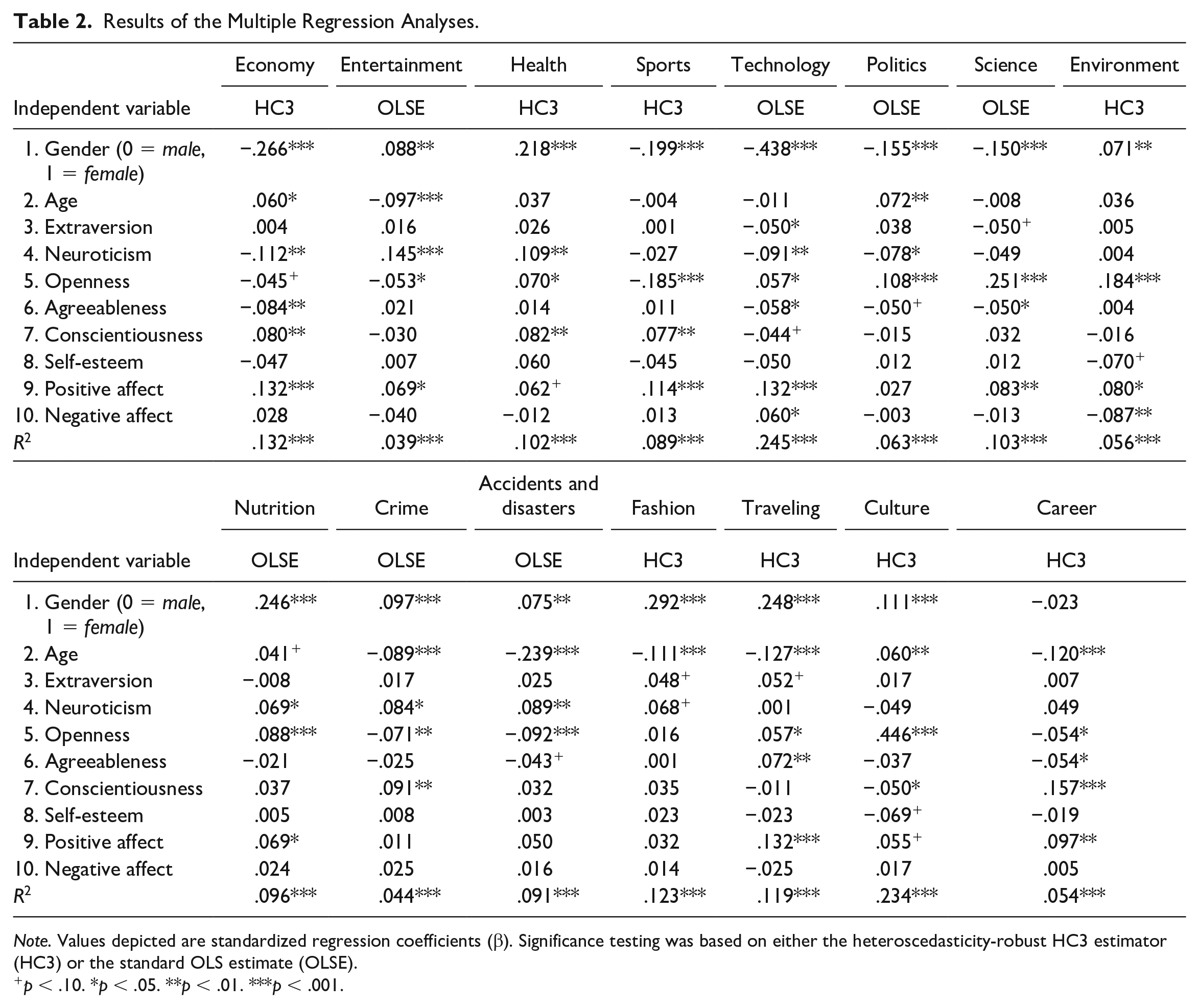
Note. Values depicted are standardized regression coefficients (β). Significance testing was based on either the heteroscedasticity-robust HC3 estimator (HC3) or the standard OLS estimate (OLSE).
p < .10. *p < .05. **p < .01. ***p < .001.
Overall, the explained variance in news interest by the set of consumer characteristics was statistically significant for all news categories. However, the amount of explained variance differed remarkably across categories with only 4% in the category of entertainment-related news but 23% for news about culture and 25% for news about technology. With respect to the significance of each individual consumer characteristic, we found mixed results.
First, gender was significantly related to news interest in all categories, except career-related news. As expected, men, compared with women, reported a higher interest in news about economy, sports, technology, and science (H1a). They also reported a higher interest in news about politics. In contrast, and as expected, women reported a higher interest in news related to health and nutrition, fashion, crime, as well as accidents and disasters (H1b). In addition, they reported a higher interest in news related to entertainment, environment, traveling, and culture. Importantly, participants’ gender was the most powerful independent variable for many news categories, as indicated by the standardized regression coefficients (see Table 2).
Second, as expected, participants’ age showed a negative relationship to their interest in news about crime, accidents and disasters, fashion, traveling, and career (H2). Moreover, age showed a positive relation to news about economy, politics, and culture, but a negative relationship to entertainment-related news.
Third, the relationships between the Big Five personality traits and different facets of news interest were mixed (RQ1). Overall, extraversion was a weak independent variable, only showing some small relations to news interests that missed the significance level. Extraversion only showed a significant negative relation to interest in technology-related news. Neuroticism was significantly negatively related to news about economy, technology, and politics, but neuroticism was positively related to news about entertainment, health, nutrition, crime, as well as accidents and disasters. Openness was negatively related to participants’ interest in news about entertainment, sports, crime, career, as well as accidents and disasters, but openness was positively related to interest in news about health, technology, politics, science, environment, nutrition, traveling, and culture. Thereby, the positive relation to interest in science and culture was particularly strong. Agreeableness mainly showed negative relations to participants’ interest in news about economy, technology, science, and career. Only one positive relation could be observed regarding news about traveling. In contrast, news interest and conscientiousness were mainly positively related, as it was the case for news about economy, health, sports, crime, and career. Conscientiousness was negatively related to news about culture. To sum up, the Big Five showed many and partially substantial relations to news interest.
Fourth, trait self-esteem was a rather weak independent variable across all 15 news categories. In contrast to H3a, participants with a lower (vs. higher) self-esteem did not report a significantly increased interest in news about culture and politics. Moreover, the expected positive relation between self-esteem and achievement/performance-related topics, namely economy and sports (H3b), was not found.
Finally, with respect to RQ2, we found a clear result pattern: Positive affect was always positively related to news interest, with significant regression coefficients regarding news about economy, entertainment, sports, technology, science, environment, nutrition, traveling, and career. In contrast, negative affect only showed a positive relation to news about technology, and a negative relation to news about the environment.
Discussion
We examined the relation between several consumer characteristics and people’s interest in 15 different news categories. We found that participants’ gender showed the strongest relation to their interest in many news categories (H1). Men reported more interest in news about economy, technology, science, politics, and sports. In contrast, women were more interested in news about health, nutrition, fashion, crime, accidents and disasters, entertainment, environment, traveling, and culture. Although each of these categories is very broad and covers a huge range of subthemes in general, it appears that men have higher interest in news categories characterized by competition aspects. Men’s higher propensity to enjoy competition has been extensively discussed in the literature (e.g., Gneezy & Rustichini, 2004) and it is discussed in the light of socialization, whereby this gender bias does not appear to be universal but contingent on environmental factors (e.g., Gneezy et al., 2009). In Western culture, men opt to compete more often than women (Gneezy et al., 2009). In this sense, the present results found for a sample of German-speaking participants in Europe are limited regarding their generalizability to other cultural environments. Nonetheless, gender apparently plays a central role when it comes to news preferences.
Age also showed significant relations to news interest (H2), but the direction of the relation depended on the specific news category. In accordance with the core assumption of the Socioemotional Selectivity Theory (Mather & Carstensen, 2005), increasing age was associated with a positivity bias, indicated by a decreased interest in crime as well as accidents and disasters. Also, and in accordance with the Socioemotional Selectivity Theory, increasing age was negatively related to participants’ interest in news that addresses the exploration of new horizons and information about new societal trends, namely fashion, traveling, and career. In addition, age was positively related to interest in economy, politics, and culture. However, and surprisingly, participants’ interest in entertainment-related news was negatively related to their age. While such news may be light and thus conducive to a positive mood, a substantial amount of this type of news is about celebrities and popular culture (cf., Gow et al., 2012). Such issues are likely to be of less interest to older people. To conclude, people do not show a generalized positivity bias with increasing age, but the configuration of their interests apparently changes with age.
The Big Five personality traits were differently influential (RQ1): While extraversion showed a relatively weak relation to news interest across all categories, neuroticism, openness, agreeableness, and conscientiousness showed more pronounced relations with varying signs across categories. Neuroticism was negatively related to news about economy, technology, and politics, but neuroticism was positively related to news about entertainment, health, nutrition, crime, as well as accidents and disasters. Hence, participants high in neuroticism reported to be less interested in news that primarily addresses societal topics on a large scale, but they were more inclined to consume news about topics that may have a more direct utility for the individual consumer. In this context, the positive relation between neuroticism and interest in news about crime as well as accidents and disasters may indicate that individuals high in neuroticism want to feel prepared to actively avert potential risks. Openness showed a negative relation to participants’ interest in news about entertainment, sports, crime, career, as well as accidents and disasters, but openness was positively related to interest in news about health, technology, politics, science, environment, nutrition, traveling, and culture. Overall, openness was the most powerful independent variable besides participants’ age, gender, and amount of general positive affect. Agreeableness was mainly negatively related to news interest. This was the case for news about economy, technology, science, and career. Only one positive relation could be observed regarding news about traveling. On a more general level, it seems that increasing agreeableness is negatively associated with the interest in domains usually characterized by competitive processes. This motivational tendency is in line with the definition of agreeableness as being trusting, sympathetic, and selfless (McCrae & Costa, 2003). Finally, conscientiousness showed a positive relation to interest in news about economy, health, sports, crime, and career, but a negative relation to news about culture. These results match well with previous findings according to which conscientiousness is positively related to different facets of health behavior (Chuah et al., 2006), job performance (Barrick & Mount, 1991), but negatively related to deviant behavior (Farhadi et al., 2012) and interest in modern art, as one part of culture (Furnham, Chamorro-Premuzic, 2004). To sum up, the present results regarding the Big Five personality traits complement previous research that has already uncovered correlations between these traits and different domains of vocational interests (Larson et al., 2002). Apparently, news interests are also strongly linked to the Big Five personality traits.
Self-esteem, in contrast, was a weak independent variable across all 15 news categories (H3). Participants with a lower (vs. higher) self-esteem reported an increased interest in news about culture only by trend and they did not report a significantly increased interest in politics. Also, the expected positive relation between self-esteem and achievement/performance-related topics, namely economy and sports, was not found. Thus, our data do not support the findings of Knobloch-Westerwick et al. (2006) and Knobloch-Westerwick and Alter (2007) who found that participants characterized by low trait self-esteem spent more time reading news stories covering social and interpersonal topics, whereas participants characterized by high self-esteem read longer about topics addressing achievement and performance aspects. This difference might be explained by methodological differences, as Knobloch-Westerwick et al. (2006) and Knobloch-Westerwick and Alter (2007) examined the real exposure time to self-selected news articles, whereas we asked participants to report their general interest in news belonging to different categories. A potential moderating role of the sample type is also conceivable: Although Knobloch-Westerwick et al. (2006) exclusively examined German university students, the link to the present online study was broadly disseminated across numerous social networking sites and German mailing lists. This procedure may have led to a more heterogeneous sample, although the mean score and standard deviation of the self-esteem ratings (same instrument) was comparable across samples (Knobloch-Westerwick et al., 2006; M = 2.21, SD = 0.46; present study: M = 2.16, SD = 0.58). Future research might address the role of self-esteem in more detail by examining potential moderators and the effect of situational factors. However, we can resume that self-esteem, when being examined in combination with further consumer characteristics, seems to be a relatively weak contributor to news interest.
In contrast, participants’ amount of general positive affect showed a strong relation to interest in many news categories (RQ2). Thereby, positive affect was always positively related to interest in news about economy, entertainment, sports, technology, science, environment, nutrition, traveling, and career. Negative affect only showed a positive relation to news about technology and a negative relation to news about the environment. In a nutshell, these results may indicate a significant role of emotion regulation effects associated with news consumption, as already suggested by studies that focused on the relationship between one’s current mood state and preferences for specific media content (e.g., Biswas et al., 1994; Kaspar, Gameiro, & König, 2015; Knobloch-Westerwick, 2007).
Limitations and Implications for Future Research and Practice
In this study, consumer characteristics explained a significant amount of interindividual variance in people’s general news interest. However, the amount of explained variance in news interest differed remarkably across categories, ranging from only 4% for entertainment-related news to 23% for news about culture and 25% for news about technology. This result suggests, on one hand, that news interest should be defined and operationalized as a concept with multiple facets that covers a huge range of qualitatively different content. On the other hand, it indicates that people’s news interest in some domains may be more susceptible to situational factors not considered here, whereas other domain-specific interests can be fairly explained by a rather small set of relatively stable and time-invariant consumer characteristics. For example, one’s interest in news about health and politics may be strongly influenced by the current global pandemic due to the outbreak of the novel coronavirus (SARS-CoV-2) (cf., Cucinotta & Vanelli, 2020). It is conceivable that such a dramatic event of high personal relevance attenuates the role of other consumer characteristics. Also, the amount of health-related news in mass media has recently changed dramatically due to the global pandemic, so that salient news coverage may act as a moderator of the relationship between consumer characteristics and news interest in terms of agenda setting effects (cf., Wanta & Ghanem, 2007). Another line of research emphasizes the significant role of the framing of a news story on consumers’ news interest (Kaspar et al., 2016), the role of the motivational valence of a news article’s content and the effect of color cues on news interest (Kaspar et al., 2017), and the effect of font type on news interest (Kaspar, Wehlitz, et al., 2015). However, these studies did not consider individual differences in consumers’ characteristics. Thus, to get a more complete picture, future studies should expand the focus on potential moderators, including situational factors, consumers’ cultural background, news framing, news valence, and visual properties of news presentation.
What do the present results mean for research focusing on the U&G approach? First of all, as highlighted by Kaspar and Müller-Jensen (2019), we must recognize that U&G “is not a homogeneous theory but rather a collective term for many theoretical models varying in complexity and conceptual nuances” (p. 1). Twenty years ago, Ruggiero (2000) already provided a comprehensive overview of the historical development of the U&G approach and suggested that future models must include concepts associated with new media and forms of computer-mediated communication in the digital age, such as interactivity and asynchroneity in the communication process. Similarly, Rubin (2009) emphasized the role of changes in technology for the development of contemporary U&G models. In contrast, this study focused on a classic form of mass media (news) not characterized by high interactivity or asynchronous interpersonal communication processes. Nonetheless, the present results indicate at least three implications for theory development: First, the U&G approach stresses the notion of an active audience selecting media content to fulfill certain needs. Given that news is not a unidimensional but multifaceted concept covering very different types of content, the societal and personal needs underlying the specific news preferences may vary a lot. Hence, U&G research should not only consider technological constraints of specific media but also nuances of the media format and its content. Second, although the role of individual predispositions for media use have already been examined and discussed in the context of U&G research (cf., Rubin, 2009), the role of rather situation-invariant personality traits has been neglected so far. Indeed, U&G models usually focus on needs and motives as well as associated gratifications sought (cf., Rayburn & Palmgreen, 1984), while an elaborated link to personality is still missing; current research in the field of personality aims to address this issue (e.g., Dweck, 2017). Third, from a methodological viewpoint, research on U&G is based on the assumption that media users can provide accurate self-reports of their needs and motives driving media selection. Many studies in this field apply interview and survey techniques to detect those motives influencing media choice (e.g., Park et al., 2009). However, given that personality traits as well as affect showed relationships to news preferences in this study, the question arises to what extent users can be aware of the influence of these factors on media selection, whereby a causal influence also remains to be shown. For example, Reinecke (2017) pointed out that, while the U&G approach assumes that media selection processes are rational and consciousness, “mood management theory assumes that media users may but do not necessarily have to be cognizant of the motivational processes driving their selective exposure to media content” (p. 2). In the light of the present results, it seems fruitful to overcome this speculative distinction to broaden the perspective to all those processes and variables that may affect media selection.
Another aspect to be mentioned is the fact that this study was solely based on participants’ reports about their news interest. In general, there is a long controversy about the (in)consistency between attitudes and behavior (e.g., Gross & Niman, 1975; Liska, 1974). With respect to media use, the examination of real behavior outside the laboratory is a challenging task. Weaver et al. (1993) examined the relationship between personality and movie preferences and have already concluded that while the data at hand demonstrate that personality and attitudes toward particular media content themes are interrelated, evidence that actual media use behaviors (e.g., medium and content selection, time spent consuming) are consistent with the observed personality-preference patterns remains a promising avenue for future research. (p. 313)
Many studies in the field are actually based on self-reports (e.g., Kraaykamp & Van Eijck, 2005), but tracking of media selection and consumption processes has already successfully applied (e.g., Knobloch-Westerwick & Alter, 2007), whereby people’s awareness of behavioral tracking usually elicit information privacy concerns and affect use motivation (e.g., Kaspar, 2020; Ketelaar & Van Balen, 2018). However, Jones-Jang et al. (2020) recently found promising results when comparing self-reported and logged data of smartphone use over 7 days. Effect sizes of correlations based on self-report data tended to be smaller compared to effect sizes based on logged data. The authors concluded that “this could mean that extant survey results have not erroneously inflated communication findings” (Jones-Jang et al., 2020, p. 1). Nonetheless, with respect to research on news preferences and selection processes, methods that allow the collection of valid data and, at the same time, preserve the privacy of media users as best as possible would be highly desirable.
Research on news interest would also benefit from a validated catalog of criteria that helps to categorize news topics. Although this study referred to categories already used in previous research as well as in current media, the typology appears to be a bit arbitrary and some of the categories are rather broad, reducing their discriminatory power. A promising avenue for future research might be a combination of an analysis of news content and an analysis of the cognitive framework consumers use to classify and process news content, similar to the methodology applied in research on framing effects (cf., Entman, 1993).
Also, it should be noted that media producers may tailor news agendas to individual consumers on the basis of few personal and demographic data. The present results indicate that this might be possible, at least for some news categories. This possibility emphasizes the need for transparency in news production and dissemination processes and indicates the critical potential of echo chambers encircling individual consumers. Although consumers’ selective exposure to specific news content is not a new phenomenon (cf., Cotton & Hieser, 1980), the emergence of so-called filter bubbles and echo chambers is a highly relevant phenomenon in the era of online news (e.g., Flaxman et al., 2016; Garrett, 2009). Kaspar and Müller-Jensen (2019) recently emphasized that with respect to Facebook as an information source, the variety of perceived information is not only reduced due to users’ own selective seeking behavior, because “prioritized information is selectively assigned to the users’ individual news feed by Facebook’s algorithms” (p. 10). In fact, this critical role of algorithms is not limited to Facebook as it is a general attribute of current search engines and social media. In offline media, the agenda of a newspaper or television program is set by human producers and journalists. This also leads to a selective arrangement of the presented news, but such rather traditional media do not adjust content to each individual consumer but only to a larger group of potential recipients sharing similar interests and characteristics. Hence, the risk of creating filter bubbles is omnipresent but appears to be higher in the context of computer-mediated news. However, in more positive terms, a better knowledge about information preferences of individual consumers may also help to create more interesting news offers and, as a consequence, to better satisfy personal needs and to increase perceived gratification in terms of the U&G approach. In this sense, producers and journalists should be very sensitive toward this conflict between need gratification and information filtering by means of agenda setting processes.
Footnotes
Author Contributions
K.K. and L.A.M.F. developed the study concept. K.K. and L.A.M.F. contributed to the study design. Data collection was performed by L.A.M.F. The data analysis and interpretation was performed by K.K. and L.A.M.F. K.K. wrote and revised the manuscript. L.A.M.F. approved the manuscript for submission.
Ethics Statement
All procedures performed in this online study were in accordance with the ethical guidelines of the German Psychological Society (DGPs) and with the 1964 Helsinki declaration. According to the guidelines of the German Research Association (DFG), no ethical approval was needed because the research did not pose any threats or risks to the respondents, it was not associated with high physical or emotional stress, and the respondents were informed about the objectives of the study beforehand ( ). At the beginning of the study, the participants were informed that the data of this study will be used for research purposes only and that all data are collected anonymously. Thus, no identifying information was collected and completion of the survey was considered to indicate consent. Participants who prematurely stopped the survey were not included in the analyses and all of their data were deleted from the data set.
Data Availability
The data are available on request from the authors.
Declaration of Conflicting Interests
The author(s) declared no potential conflicts of interest with respect to the research, authorship, and/or publication of this article.
Funding
The author(s) received no financial support for the research, authorship, and/or publication of this article.