




Abstract
Universities play a vital role in innovation ecosystems. Besides, their role is being transformed and reinforced due to the interdisciplinary nature of modern innovations and inter-sectoral collaboration in the process of implementing cross-industry projects. The article’s main objective is to reveal the emerging new goals, functions, and goals of university as knowledge integrator and consolidator within cross-industry ecosystem. The article introduces the approaches to the implementation of the cross-industry ecosystem integrator functions as an “entry point” for the creation of new ideas, competencies, technological solutions, and projects for the development and testing of new technologies. The research results are useful for academics and policy makers in emerging economies to adopt and consider, so as to improve the contribution of the universities to the country’s economic and innovation development.
Keywords
Introduction
The emergence and development of new markets, industries, products, and professions in the modern world is proceeding rapidly. The main catalyst for these processes is the transformation of the economy, which brings results at the intersection of industries, using multidisciplinary knowledge, establishing cross-industry processes, developing infrastructure, digital platforms, and creating new market formats and models for the interaction of market participants on their base.
The ever-increasing complexity of products leads to the fact that innovative processes of enterprises are dependent on external knowledge (Chesbrough, 2003; Chesbrough et al., 2006; von Hippel, 1988, 2001) and interaction with a variety of market participants. “The boundaries of firms and their corporate hierarchies are breaking down under the impact of the forces of interface standards, lowered transaction costs and increasingly modular production” (Foss, 2019). The key strategic direction in these conditions should be the interaction of different economic sectors through the creation of new business models and end to end digital processes based on the intersections of industries and through cross-border cooperation. This interaction is called cross-industrial innovation. First, the term “multi-cross-industry innovation” was introduced by the authors (Khan et al., 2013). They suggested that “multi-cross-industry innovation” is a process of creating new products, services, or their combinations by combining key knowledge elements from at least three different industries and considered the process as a fundamentally new way to successfully develop and create innovative businesses. We note also that the term “ecosystem” is quite complex and has been used in a different sense. It is often used as a metaphor for a network and network external factors, for a particular market or market niche, to reflect the complementarity of physical, human, and intellectual assets, or even spillover effects arising from joint activities (Gamidullaeva et al., 2020). The fundamental idea of this concept is that, in an unstable and turbulent environment, economic agents are building their strategies and creating competitive advantages based on resource sharing, network externalities (external effects), and knowledge “flows” (spillover effects). This requires the development of new theories and approaches that reflect real trends, one of which is the theory of ecosystems. In an economic sense, an ecosystem consists of exogenously defined components, the environment, and agents acting endogenously together as a system associated with capitalizing on the relationship (Acs et al., 2016). Similar to natural processes, various kinds of companies, multinational enterprises, small and medium firms, and households coexist and develop within their own ecosystem : Such ecosystems can be formed on a variety of unifying principles (from geographic and political to industrial and environmental), as well as at different levels—from local (within organizations, companies, clusters, science parks) to global, that is, wherever stable relationships and a joint vision of the participants arise. (Smorodinskaya, 2014, p. 28)
An ecosystem cannot be rigidly connected to a specific business or industry, but combines interconnected enterprises from many industries that together create differentiated offers and receive additional value (Khan et al., 2013). For example, Apple leads an ecosystem that includes at least four industries—personal computers, consumer electronics, information and communications, and, more recently, music and television.
We agree with authors who criticize the inconsistent use and vague wording of the term “ecosystem” in scientific research (Brown & Mason, 2017). Often, there is a substitution of concepts: An ecosystem is represented by cluster formations (network innovative ecosystems of a special class) or a triple helix model based on a university–business–state partnership (Etzkowitz and Leydesdorff, 2000). Alongside the triple helix is the quadruple helix theory (Carayannis & Grigoroudis, 2016), which identifies relations between various stakeholders (civil society, media, and the culture-based public) and integrates top-down policies and grassroots innovations.
According to Bruns et al. (2017), the “ecosystem” metaphor reflects a tendency in scientific studies to describe the well-known phenomenon of agglomeration effects of regions (urban, regional, and national ecosystems), industries (agriculture, chemical industry, manufacturing, mass media, and financial ecosystems), associations of firms (business ecosystems, entrepreneurial ecosystems), or activities (services, innovations, and digital ecosystems). As a result, today we have “business ecosystems” (Moore, 1993), “innovation ecosystems” (Adner, 2006), “digital ecosystems” (Sussan & Acs, 2017), “university ecosystems” (Hayter, 2017; Meoli et al., 2017), or “financial ecosystems” (Cumming et al., 2017; Ghio et al., 2017).
The idea of cross-industry ecosystems is a collaboration of actors from various industries in the implementation of cross-industry projects. Therefore, one of the main tasks of the ecosystem is the transfer and exchange of knowledge between economic entities. In this sense, the concept of “cross-industry ecosystem” is most closely related to the term “innovation ecosystem.” In turn, a complete definition of the innovation ecosystem was formulated in a recent work by the authors (Granstranda & Holgerssonb, 2020): “the evolving set of actors, activities, and artifacts, and the institutions and relations, including complementary and substitute relations that are important for the innovative performance of an actor or a population of actors.” At the same time, the use of the new term “cross-industry ecosystem” is especially relevant today in view of the need to focus on the interdisciplinary nature of modern innovations and knowledge as a consequence of inter-sectoral collaboration. This thesis was confirmed by N. Farhadi (2019) in his book “Cross-Industry Ecosystems,” where the author develops the theoretical and methodological foundations of the new concept, emphasizing the growing complexity of inter-sectoral economic growth. The main features of cross-industry projects include the following: “blurring” of territorial borders, interdisciplinary knowledge and inter-sectoral technologies, subprojects in several (at least two) sectors at different levels, involvement and use of infrastructure and resource base of various regions, and unlimited implementation of the project in time (one project initiates the implementation of others). A cross-industry ecosystem approach allows for developing the innovation perspective through the self-organizational principles, when all participating actors, regardless of their size and field of activity, benefit from networking and collaboration. Cross-industry ecosystem can be described as a dynamic system, characterized by interactions among a huge amount and diversity of stakeholders—universities, enterprises, public institutions, society, and so on. Many authors highlight that their interaction is based on the principle of self-organization (De Toni et al., 2012; Gamidullaeva, 2019; Gamidullaeva & Tolstykh, 2017; Gamidullaeva et al., 2017; Jucevičius & Grumadaitė, 2014; Laihonen, 2006; Shmeleva, 2019; Tolstykh, Gamidullaeva, & Shmeleva, 2020; Tolstykh, Gamidullaeva, Shmeleva, Lapygin, 2020; Tolstykh, Shmeleva, & Gamidullaeva, 2020; and others).
This article is an attempt to further develop the concept of a cross-industry ecosystem as a dynamic complex nonhierarchical model in terms of studying the changing processes of creating and transferring new knowledge. The authors argue that universities should play a key role in these processes.
Traditionally, the role of universities has been to educate students and implement basic research, which often had positive spillover effects for the industry, as well as stimulating regional economic growth (Etzkowitz & Leydesdorff, 2000; Trippl, Sinozic, & Lawton Smith, 2015). University project technology transfer offices are extensively researched and best practices carefully analyzed (Phan & Siegel, 2006; Youtie and Shapira, 2008). However, most of the recommendations do not work in every ecosystem; it all depends on the maturity and development of the existing ecosystem. We believe that more attention should be paid to the role that universities can play in strengthening and developing the ecosystem as a whole (Vasin et al., 2018).
A university can act as an ecosystem integrator, applying its intellectual, reputational, and financial capital to create and maintain a strong ecosystem (Heaton et al., 2019). For this, it is also necessary to take into account the ecosystem’s ability for self-organization.
The article’s main objective is to reveal emerging new roles of university as an integrator of cross-industry ecosystem in the age of digital transformation of industries and services. The remainder of this article is organized as follows.
First, we outline the role of universities in ecosystems to acknowledge the previous research on the issue and then we present a self-organization of cross-industry ecosystem framework that we will use to analyze this role in more detail. Self-organization approach takes into account the complex dynamic nature of the system and is based on promoting the productive self-organization rather than imposing the top-bottom linear solutions.
We then apply this perspective to the case study of the university, “MISIS” (Moscow, Russia), engaging with local economies for launching new industries, fostering entrepreneurship, and strengthening cross-industry ecosystem. The article concludes with a brief summary and discussion, plus suggestions for future scholarship.
The contribution of this article is the revealing of main features, functions, and emerging goals of universities in knowledge integration and consolidation within the cross-industry ecosystem. The research results are useful for academic researchers and policy makers in emerging economies to adopt and consider, so as to improve the contribution of the universities to the country’s economic and innovation development.
Theoretical Background
Ecosystems and the University
The universities face a number of challenges due to the increasing complexity of innovation processes.
First, the share of international and interdisciplinary knowledge is constantly increasing, which creates problems for traditional areas of academic research, and which often depends on individual researchers and their scientific schools. Interdisciplinary innovations make new higher demands on their organization and management.
Second, increasing organizational and coordination complexity implies the use of systemic innovative approaches.
Third, the exchange of innovative knowledge is moving toward the complexity of cooperation and knowledge models (e.g., innovation clusters, multifactor centers led by universities or industry, and public–private partnerships between the government, industry, and universities).
Thus, due to economic transformation, the role of universities in the innovation ecosystem as a traditional center of knowledge creation is changing, and inter-sectoral innovation networks should be organized.
The increasing complexity of interactions between different stakeholders in the process of innovation lead to the fact that universities have to balance between solving traditional and new problems and, as a result, the organizational model of universities is in transition in many countries (Guerrero et al., 2016; Miller et al., 2014). The organization of close interaction with the environment and with all stakeholders is a key element of the University 4.0 concept (Dewar, 2017). The interaction of enterprises with universities provides them with access to knowledge and opportunities for research at a high-quality level (Hussler et al., 2010; von Raesfeld et al., 2012), as well as for innovative development (Dahlander & Gann, 2010; Estrada et al., 2016; Galán-Muros & Plewa, 2016). Various studies are conducted to identify the conditions for effective collaboration between enterprises and universities (Bruneel et al., 2010; Mueller, 2006; Organization for Economic Cooperation and Development [OECD], 2019). At the same time, the report of the OECD (OECD, 2019) identifies the main formal and informal channels for such interaction.
Formal channels include the following: research collaborations (Perkmann & Walsh, 2007), operations with intellectual property (e.g., selling licenses, patents), scientific mobility (Rosli et al., 2018), spin-off organizations in the university environment, and university graduates employed in industry (Balconi & Laboranti, 2006). Informal channels include publishing research results (Perkmann & Walsh, 2007), conferences and networking (Steinmo & Rasmussen, 2018), geographic or territorial vicinity (OECD, 2019), technology sharing (research centers, laboratories; Claussen, 2019), and ongoing training for business employees (OECD, 2019).
It is important to emphasize that knowledge spillover in all directions between all actors of the ecosystem. In this way, universities can help organize the free knowledge flows in an ecosystem through the formal and informal channels described above. A good example is Kendall Square in Cambridge around Massachusetts Institute of Technology (MIT). This is an example of a dynamic innovation ecosystem around a major university. MIT has actively used university-owned land to support partnerships between universities and industrial enterprises and to take its unique advantages, helping to develop an internationally significant cluster of biological and pharmaceutical sciences (Heaton et al., 2019). Thus, at the stage of ecosystem development, universities help it achieve its maturity and unite and strengthen relations between all actors.
Meanwhile, in cross-industry ecosystems, there is the problem of harmonizing and coordinating the interests of all participants and, accordingly, maintenance of self-organizing processes is increasing.
In this context, it is expedient to take the perspective of the quadruple helix approach as a network of relationships. By studying the interdependencies of the ecosystem actors, resources, and activities from a self-organizational perspective, we aim at enhancing our understanding of the relationships between actors in the quadruple helix model.
In addition, the development of a complex nonhierarchical ecosystem gains substantial importance. The key aspect is stimulating relations and interactions between the ecosystem actors in nonhierarchical ways and facilitating the self-organization of its actors. Cross-industry and innovation ecosystems can be characterized by a combination of top-down and bottom-up initiatives (Jucevičius & Grumadaitė, 2014) that stimulate networking and innovation development. The approach of complexity theory toward cross-industry ecosystem means that responses to environment are emerging from spontaneous bottom-up interaction without a central control (Jucevičius & Grumadaitė, 2014).
In previous works, we pointed out that the main limiting point of network models is that horizontal synergistic interaction between participants is subject to vertical management from above. The management system can be either a state structure or a large enterprise, building network relations with other enterprises for their interests. Elements of the management vertical initially violate the principles of harmonization and balanced development of individual participants as the interests and priorities of the governing body (governmental, business, and societal or any other structures) do not always coincide with the interests of other participants (Tolstykh, Gamidullaeva, & Shmeleva, 2020).
In this way, the article aims to contribute to the literature on the innovation ecosystem and quadruple helix model by offering a novel view on self-organizing perspective. We conclude that, to fully understand the complexity of the cross-industry ecosystem model, we need to address the challenge of organizing and maintenance of spontaneous bottom-up interaction without a central control. With this aim, we suggest that the universities play the role of ecosystem integrator and consolidator. Meanwhile, the existing literature in the research field is inconclusive with regard to identification of the new roles and functions of universities in the cross-industry collaboration and knowledge creation processes.
Self-Organization of Cross-Industry Ecosystem Framework
The study of the cross-industry ecosystem as a system of integrating knowledge is based on the methodology of a systematic approach and self-organization law.
First, ecosystems belong to the class of nonlinear systems. Nonlinear systems are those in which the linearity of the statistical characteristic is violated in at least one link or there is a violation of the link dynamics equations. Nonlinearity predetermines the uncertainty of system behavior at any time interval. Most processes in the ecosystem and in its links with other systems reaction are currently undergoing crisis development, which is a consequence of the system reaction to external and internal challenges. Moreover, it is obvious that complex systems cannot impose their development paths. We should strive to understand trends to manage them. The problem of managing both ecosystem actors and the ecosystem is to create an infrastructure for self-directed development.
Second, ecosystems often are established spontaneously, as a reaction to digital transformations processes of all market participants. Hence, we can diagnose the so-called chaos as the second postulate of the synergetic approach. A chaotic state contains uncertainty, probability, and randomness, which are described using the concepts of information and entropy. The collaborative ecosystem links are formed at different levels through chaos. Furthermore, it is interesting to note that, at times of ecosystem instability, even small fluctuations that occur inside the ecosystem can generate large macro processes. That is, the actions of each ecosystem actor can significantly affect macroeconomic processes.
The assessment of knowledge creation (intellectualization) in the ecosystem should reflect the economic return on investment in the development of digital technologies and human resources, and increase the level of intellectual potential. The effect of system intellectualization occurs when technologies stimulate the transfer of knowledge and business innovations, and lead to increased productivity within the company, in the supply chain and between industries, and to the sustainable development of each of the participants in digital cross-industry interaction along the entire added chain cost.
For the creation of dissipative structures from a systemic perspective, certain conditions must be met:
Dissipative structures can be formed only in open systems. An inflow of energy is possible, compensating for the losses and ensuring the existence of ordered states. Due to this, along with the production of entropy, there is a flow of “negative entropy” from the outside. One of the main properties of complex self-organizing systems is the accelerated production of entropy, that is, when a new ordered structure arises, the rate of knowledge entropy production increases sharply;
Dissipative structures arise in systems consisting of a large number elements. The ordered movement in such systems is always cooperative and integrated as a large number of objects are involved in it;
Dissipative structures arise only in nonlinear systems. Self-organization exists under special internal and external conditions of the system and the environment. Dissipative structures are stable formations, but their stability is determined by the stability of the sources of incoming energy and depends on the time of their existence;
If, as a result of self-organization, several competing dissipative structures arise, then one of them that produces entropy with the highest rate survives. Thus, by calculating the entropy of an ecosystem, we can predict the rate of change. And this, in turn, will make it possible to assess with the greatest probability the sustainability of the ecosystem as a complex self-organizing system;
The creation of ecosystems as new ordered structures occurs according to the bifurcation scenario (Preobrazhensky & Tolstykh, 2004).
At the time of crisis transformations, a bifurcation point arises. There can be many possible development strategies from this point, but nevertheless, a certain predetermination of the processes of deployment exists, which performs the present not only through the past, but also the future state in accordance with the upcoming order.
The distinctive features of ecosystems as complex self-organizing systems include the following:
Coherence (interconnectedness): they behave as a whole;
Deviations occurring in the system, instead of decaying, can intensify, and the system evolves in the direction of “spontaneous” self-organization;
Chaos is a constructive mechanism of self-organization complex systems as the birth of a new one is associated with a violation of the usual system ordering;
Evolution contains both deterministic and stochastic elements, representing a mixture of necessity and risks;
Nonequilibrium as the initial state is a source of the system self-movement;
Time is an internal characteristic of a system that expresses the irreversibility of processes in a system.
From our point of view, the ecosystem is not only the ability to respond and reflect technological and digital challenges, but also to create intelligent technical environments that minimize negative consequences and create optimal conditions for the implementation of projects at any level. In accordance with the principles of ecosystem, we will understand the actor’s cognition as the mechanisms for achieving strategic goals by actors based on the processes of new knowledge formation, their transfer and exchange, and on the theory of self-organization, information, and digital technologies.
However, the technological environment surrounding the actor can be simpler (“the whole is less than a part”) and, in creating a cognitive mechanism, can appear as a synergistic effect. Such an effect is possible in cases of subsequent collective actions, when the intellectual environment leads to the generation of knowledge, ideas, and the implementation of creative and effective solutions. The knowledge management becomes a priority in ensuring the effectiveness of cross-industry interaction, creating an ecosystem, and a unified business environment, predetermining the need for the formation of new cross-professional competencies (Tolstykh & Shkarupeta, 2019). The development of a knowledge management mechanism in the context of a cross-industry ecosystem formation will optimally manage the economic, social, and technological processes of ecosystem actors to achieve high socioeconomic efficiency, as well as measure the effects of the cross-industry transformation through intellectualization.
The main indicator of the ecosystem development is proposed to consider knowledge, which plays the role of system “energy” source (Figure 1).

Cross-industry ecosystem model.
The ecosystem management system can be considered as a system with two closed control loops. One of the loops is the usual feedback, providing the traditional management process: input-output-input. Feedback compares the input and output parameters, being a standard response to the challenges of micro and macro environments.
The other loop performs self-customization. As a rule, a particular criterion of the quality of the system’s work (in this case, the quality of the cross-industry project) is laid down in the self-organizing system for the external conditions of the system. The system itself chooses a structure in which a given quality criterion of the entire system is satisfied. A self-organizing system must have an analyzer or quality optimizer. The optimizer is designed to find and implement the highest possible quality in a given system. This function is the main aim of the university as an ecosystem actor.
The source of the ecosystem’s intellectual “energy” is the knowledge generated by universities. University education has always been a reflection of the processes taking place in society. Hence, the universities have to become the bridgehead of the cross-industry ecosystem for innovation in technology, research, and management.
The law of self-organization and self-preservation for the ecosystem works when the sum of the potentials of the system significantly exceeds the total effects of the micro and macro environment. The basis for implementing preventive measures for the ecosystem is the constant work to increase the amount of knowledge accumulated by ecosystem actors; the constant processing and transformation of information into knowledge; the generation of new information, knowledge, and creative ideas; and the training of competitive specialists.
Next, we move on to the detailed description of the formation principles and performance criteria of cross-industry ecosystems. This is necessary for a deeper understanding of the role, functions, and tasks of universities in the cross-industry ecosystem.
Indicators for Measuring a Cross-Industry Ecosystem
The ecosystem actors are large industrial enterprises, technoparks, engineering structures, start-ups, venture funds and financial institutions, universities and research organizations, various business structures, and government authorities. The key roles of actors in the ecosystem are as follows:
Pacemaker—is an actor who initiates an idea, project, or process that inspires ecosystem unification in a given period of time. These functions in the industrial ecosystem can be performed by digital platforms, new technologies, materials, innovative projects, and start-ups.
Integrator—is an actor who unites other actors for an idea or project and analyzes and evaluates the necessary competencies of actors and the degree of their economic security for other participants. This task can be performed by universities, research organizations, project offices, and digital platforms that accumulate knowledge, competencies, and international experience.
Developers—actors involved in the development and prototyping of new technologies, materials, and processes. This role can be implemented by technoparks, start-ups, engineering companies, and research structures.
Implementers—actors implementing new projects and processes on their site;
Promoters—actors providing promotion of implemented projects and conversion of past projects’ experience into new projects and project commer-cialization.
In effectiveness of the cross-industry ecosystem, a significant role should be given to the “integrator,” namely, to ensure the creativity, innovativeness, and balance of the effects and interests of a variety of the ecosystem’s actors based on the creation and transfer of new knowledge. Universities can take up such a role in the cross-industry ecosystem.
Key performance indicators (KPIs) are used to assess whether and how well the objectives of each ecosystem actor are met and what they can do to improve.
KPIs reflects the requirements of the ecosystem and its type. Currently, there are many different approaches to KPIs’ building (Bosch, 2009; Chapin et al., 1996; Cokins, 2009; Government Accountability Office, 2011; Iansiti & Richards, 2006; Parmenter, 2010; Rapport et al., 1998; Santos et al., 2012).
The literature indicates that KPI for industrial ecosystems is a thin area. A wide range of literature exist although formulation of KPIs is insufficient (Fotrousi et al., 2014).
The considered research on ecosystem KPI mostly addresses measurements of satisfaction, performance indicators, and freedom from risks. Meanwhile, a broader understanding of KPI would help to use them for decision-support.
The following blocks of indicators were used to assess the KPIs of ecosystem actors:
Business processes: ✓Compliance of processes in the organization with the principles of lean production; ✓Compliance of processes in the organization with the principles of quality management; ✓Project-oriented organizational structure; ✓Technological level of business processes.
Relations with partners and clients: ✓Existence of long-term partnerships with suppliers; ✓The presence of long-term partnerships with customers; ✓Level of customer loyalty; ✓Speed of response to changing client requests.
Digital maturity: ✓Level of digital competence of personnel; ✓Level of digitalization of enterprise management processes; ✓Level of digitalization of business processes; ✓Number of completed digital projects.
Innovative susceptibility: ✓Financial level of the organization’s readiness for implementation; ✓Management efficiency; ✓Level of legal protection of all processes of the enterprise; ✓Time of implementation of an innovative project from its initiation to launch; ✓Level of qualifications and intellectual potential of the personnel; ✓Innovative motivation of personnel.
For each KPI value, a score is correlated depending on the result of the indicator.
The KPI assessment as a whole (taking into account all its blocks, namely, business processes relations with partners and clients, digital maturity, and innovation susceptibility) is proposed to be determined in the following sequence.
Calculate the relative scores of KPI indicators for each of the evaluation blocks, using the following formula:

where Оi is the relative estimate of the ith block, Ni is the number of KPIs in the block, and ni is the point in accordance with the zones of values of threshold values of KPI of the ith block.
Determine the weights Bi of each block. It is proposed to use a scale from 1 to 5, where 1 is the least significant and 5 is the most significant. The total value of the weights must be 5.
Calculate the integral evaluation as a weighted average of the components. The closer it is to 1, the higher the KPI level. A score below 0.5 indicates insufficient ecosystem maturity of the actor.
The methodology for assessing ecosystem performance based on KPIs consists of the following stages:
Allocation of actors making up m groups of the ecosystem.
Determination of a complete list of KPI indicators.
For each ith actor Pi, i = 1, . . ., m, the values of the jth indicator are determined, j = 1, . . ., n, and the matrix hij is formed.
For each group of factors, a standard is formed with the maximum values of indicators,
Furthermore, the indicators of the ith actor are normalized, where j = 1, . . ., n, i = 1, . . ., m.

Setting the weight coefficients wj for n indicators is carried out based on the analysis of the matrix of paired comparisons:

The integral coefficient of competitiveness of the ith actor is calculated as the arithmetic average of the weighted 1 of the normalized performance indicators:

University as an Integrator (Seizing) Within Cross-Industry Ecosystem
As the actor in the cross-industry ecosystem, the university should change its role from a highly specialized university to an innovative university in the new economy.
The aim of the university is to increase the amount of knowledge accumulated by the ecosystem, process and transfer the information into knowledge, and generate new information and knowledge. Thus, the influence of the university on other actors in the ecosystem is to transfer knowledge along the following chains:
University—cross-industry project—production—economics;
University—cross-industry project—science—innovations—economics.
The roles of universities in the cross-industry ecosystem can be represented as a scheme (Figure 2) containing the following tasks:
Define and formulate a vision of the ecosystem as a whole;
Evaluate the role of each actor, predict ecosystem development, and develop strategies;
Form a community of actors, finding them according to the maturity level of KPI.
Find existing projects for inclusion in the ecosystem as subprojects in new cross-sectoral projects;
Integrate knowledge on technologies, competencies, and best practices, and bring them to ecosystem actors;
Initiate new ideas and technology projects in the interests of the ecosystem actors;
Provide ecosystem services to other communities.

The role of universities in the cross-industry ecosystem.
The Objectives of the University as an Ecosystem Integrator
The university creates the space for resources and actors to more consistently and systematically align as a means of addressing regional problems/needs (Celuch et al., 2017). Thus, universities have a great impact in their host regions. They function as key institutions by communicating with the actors of their ecosystem, providing innovation, and sharing resources, knowledge, competences. It is advisable for universities to create the necessary support structures, play a leading role in partnership with public and private authorities, and, more importantly, show their ability to provide a leading role in developing the necessary partnerships.
By “integrator” we have in mind universities that are able to address a set of ever-changing in demand market preferences and exert considerable control over an ecosystem.
The main objectives of the university as an integrator in the ecosystem should be the following:
Holistic systematic view of all processes taking place in the world, studying the phenomena of science and society on the basis of interdisciplinary, the ability to define complex systems and work with them, and system engineering;
Learning in communication as the main feature of digital education;
Joint distributed activity and cooperation of all ecosystems’ actors based on the integration, reproduction, and processing of knowledge;
Personalization of educational activities, taking into account the cognitive, intellectual level of the student;
Multilingualism and multiculturalism;
Interdisciplinary communication skills;
Customer focus on both individual and corporate clients;
Process orientation and ability to work in projects:
Ability to work in high uncertainty and quick change of task, management of complex automated systems, and work with artificial intelligence;
Practical orientation (Tolstykh et al., 2017).
Universities, Cross-Industry Ecosystem, and Self-Organization: A Case of National University of Science and Technology (NUST) MISIS (Russia)
We will now take a closer look at a case study that demonstrates the integrating role that the university plays within a cross-industry ecosystem from a self-organizing perspective.
To analyze the complex interorganizational relationships of the ecosystem and the corresponding governance requirements at the university, we decided to use a case study approach (Eisenhart, 1989; Yin, 2003).
Our research began with a review of the academic literature and other documentation related to the formation and development of various cross-industry ecosystems in Russia. We decided to dwell in detail on the experience of one of the largest universities in our country—NUST MISIS. This university has achieved a great success as an innovation center.
In this article, the case study method is used to illustrate one crucial aspect of cross-industry relations, namely, the role of the university as an integrator of knowledge in the ecosystem. This allowed us to conceptualize this aspect within the emerging theory of cross-industry ecosystems.
Participants in the NUST MISIS Cross-Industry Ecosystem
NUST MISIS plays the role of integrator in the discussed ecosystem, and the domain of the ecosystem is the projects aimed at sustainable development in the raw materials and processing sectors:
Project 1. Development of a new generation of flexible and high-performance catalytic reactor systems based on structured catalysts (adsorbents) for the complex processing of natural and associated gases, as well as biogas using various processes;
Project 2. Development of technologies for the production and use of composite binders for the construction of transport and hydraulic structures, using large-tonnage waste from mining and processing of mineral raw materials;
Project 3. Development of an integrated innovative technology for the extraction and processing of mineral raw materials, with underground waste isolation for solving state scientific and technological problems of energy and environmental security (Tolstykh, Shmeleva, et al., 2020).
NUST MISIS, which takes an active part in innovative projects through the system of interaction and partnership with enterprises of various industries and scales, includes the following main actors (see Tables 1 to 3).
Characteristics of the Ecosystem Actors—“Developers.”
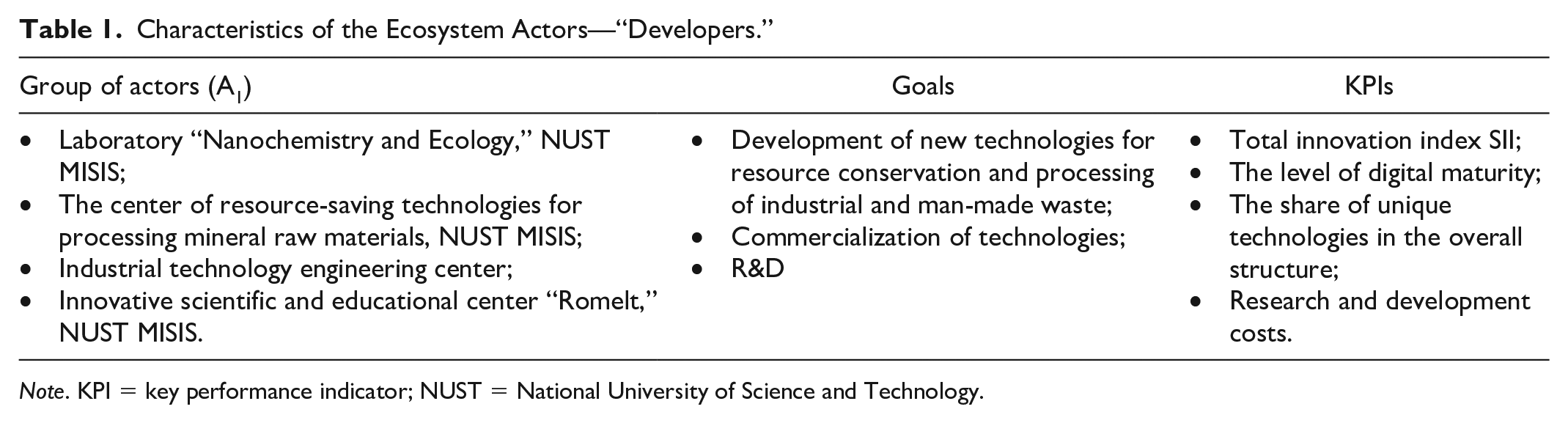
Note. KPI = key performance indicator; NUST = National University of Science and Technology.
Characteristics of the Ecosystem Actors—“Implementers.”

Note. KPI = key performance indicator.
Characteristics of the Ecosystem Actors—“Promoters.”

Note. KPI = key performance indicator.
This ecosystem integrates the industries shown in Figure 3.

Structure of a cross-industry ecosystem.
The strategic direction of the presented cross-industry ecosystem is project cooperation of enterprises through the creation of new business models and end-to-end digital processes through both traditional intersections of industries and through cross-border cooperation. Within the framework of this direction, MISIS University has formed a combination of fundamental and applied science with access to the real sector of the economy on the basis of the following strategic academic units (SAU) of NUST MISIS:
SAU 1. Metamaterials and post-silicon electronics and materials design.
SAU 2. Autonomous energy and energy efficiency.
SAU 3. Materials and technologies to increase the duration and quality of life.
SAU 4. Industrial design and technologies for reindustrialization of the economy.
SAU 5. Green technologies for resource conservation.
Functions, Features, and Principles of Forming a Cross-Industry Ecosystem Based on NUST MISIS: New Models for the Implementation of Educational Programs
The mechanism of interaction between actors within an ecosystem is based on the theory of complex adaptive systems. Complex adaptive systems have the following basic features:
Represent an open system that exchanges matter, energy, and information with the environment;
Demonstrate the ability to accumulate and use useful experience;
Are capable of adaptive activity due to which useful abilities increase and useless abilities decrease.
An ecosystem is an integration mechanism between generating new knowledge and using it to create shared value between actors. An effective mechanism for redistributing value within an ecosystem is based on the diffusion of innovations, knowledge spillovers, and externalities. Knowledge spillover is a process aimed at developing interactions between exchange participants, simplifying decision-making, and stimulating innovation through the evolution of collaboration between actors. Within an ecosystem, several projects can be implemented simultaneously and each actor of the ecosystem has the opportunity to participate simultaneously in different projects in different roles. The mechanism of interaction between ecosystem actors and the assessment of the potential of the ecosystem actor for compliance with a particular role in the initiated project is described in detail by the authors in Tolstykh, Gamidullaeva, and Shmeleva (2020).
The mechanism of interaction between actors is implemented through cross-validation as a new self-tuning circuit within the ecosystem. To assess the effectiveness of interaction processes, the system potential method was used (Pushnoi, 2017).
The university as an ecosystem integrator should provide functions such as generating ideas, organizing access to the technological potential of the best centers of excellence in the relevant industries, creating resource support for the innovation process (analytical, predictive, infrastructural, and investment and financial), and building human resources for high-tech businesses and industries (Preobrazhensky et al., 2017).
As an integrator of the cross-industry ecosystem, NUST MISiS is the “entry point” for the formation of new ideas, competencies, technological solutions, and initiating projects for development, using the following functions:
Consolidation. Development of strategies and programs for the formation of a digital economy, development, and production—operation and development of innovative systems within the framework of a closed production process.
Innovation and research. Initiation, development, and promotion of innovative full-cycle solutions: – At the stage of planning and designing products (digital factory); – At the stages of production planning (smart factory); – At stages of operation and maintenance (virtual factory).
Congress, exhibition, and marketing activities in the framework of exhibits of intelligent solutions, with the presentation of innovative complexes, technologies, and products for participants in inter-sectoral interactions, the promotion of advanced technologies and business models, and international and national events in the digital industry, including forums, competitions (e.g., hackathons), as well as events aimed at attracting investors and demonstrating opportunities.
The management and educational system of professional and national competencies and fundamentally new forms of forming the competencies for digital ecosystems and custom-made innovative, inter-sectoral, and interterritorial projects based on the principles of interdisciplinarity, cognitiveness, and project-oriented work, allowing the usage of all the possibilities of fully accessible digital capabilities and industry interaction. Figure 4 shows the structure of NUST MISIS, providing the implementation of the above functions.
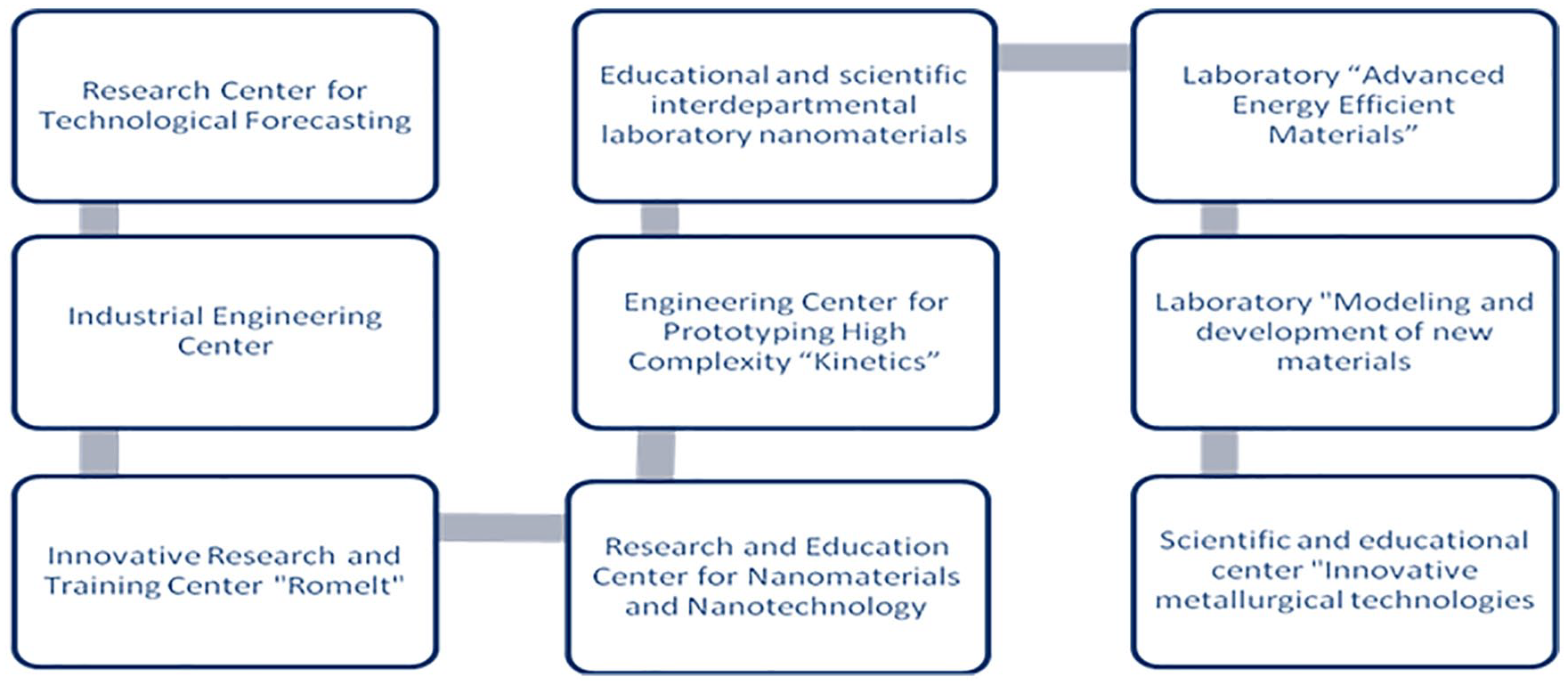
The structure of NUST MISIS as an integrator of the cross-industry ecosystem.
The elements of educational models implemented at the university are flexible, allowing them to be formed modularly and assembled according to the mosaic principle for individual or corporate needs of customers—projects implemented within the framework of a cross-industry ecosystem. The trends of globalization and digitalization make it necessary to avoid unification in the educational programs, especially in the cross-industry ecosystem. This is possible through the following educational components (Tolstykh et al., 2017):
Modularity of distributed courses;
Active use of network programs, gamification, trainings, cases, and mini hackathons;
Deliver research seminars and classes in small groups;
Mobility and educational programs with international universities;
Unique courses that have no analogues in other universities or in a small number of universities;
The possibility of completing additional courses in related programs;
Obtaining skills on modern research equipment with subsequent certification and confirmation of qualifications.
Programs in English;
Preparation and defense of the thesis as an end-to-end interdisciplinary project (based on the Conceive Design, Implement, Operate [CDIO] principle—the standard of engineering training).
Options for implementation of these principles in educational programs differ from each other in the goals and level of the program’s uniqueness, individualization, and selection of students for a particular educational program (see Table 4).
Comparative Analysis of the Proposed Models.
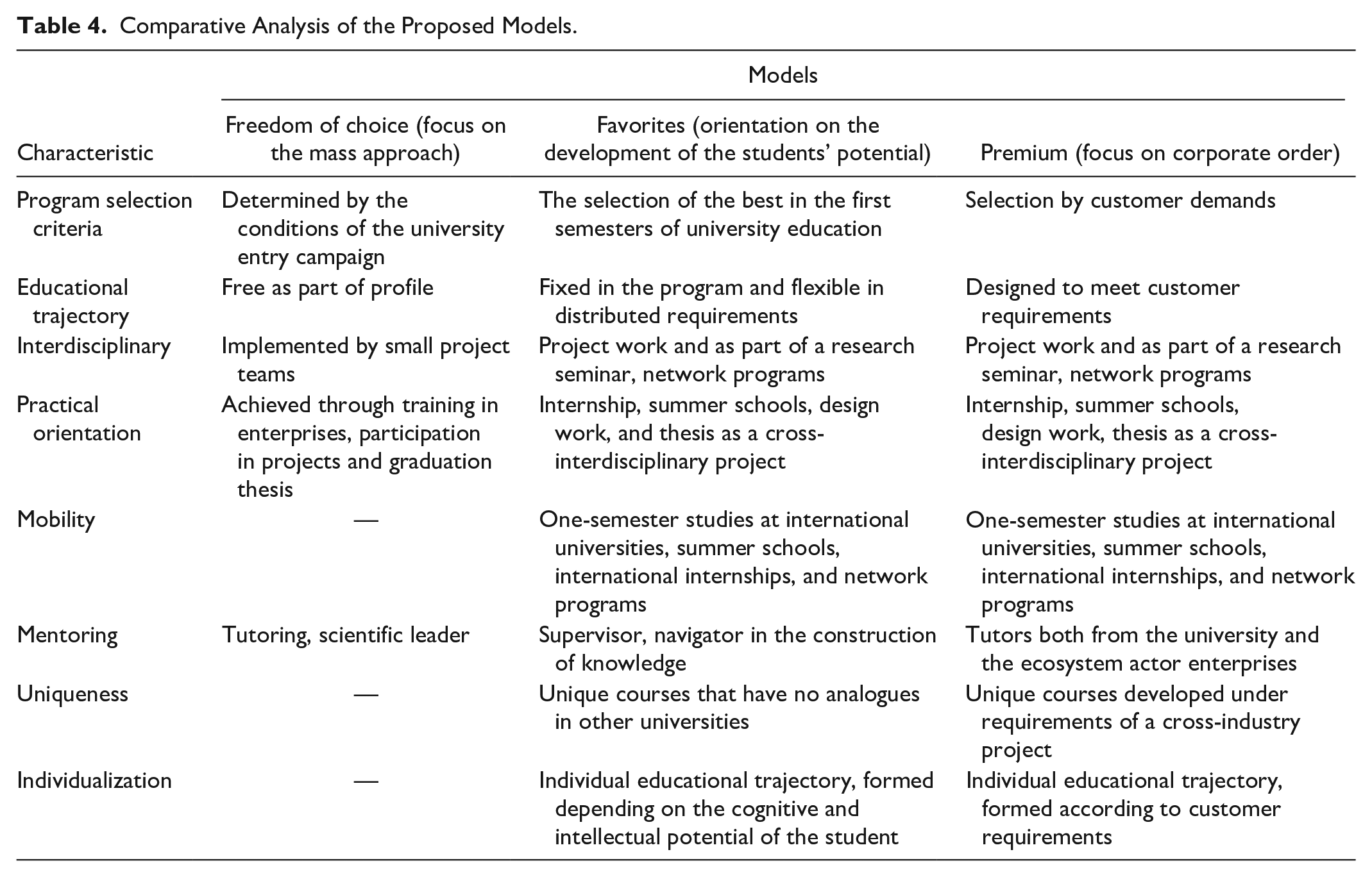
The concept of educational programs for the cross-industry ecosystem faces the so-called “restart” problem, which implies “disassembling” and “assembling” educational modules, staff, and management approaches of the university. The university should take the main strategic decisions as an ecosystem integrator on its own, taking responsibility for all possible risks, including reputational. For this, the university needs to constantly adjust its research vectors, finding its own guidelines that will remain relevant and in demand for all actors in the ecosystem. The risks can be minimized by the presence of stakeholders acting as guarantor and customer of a particular education model. But the most important thing is to “restart,” that is, to realize one’s identity and independence in making strategic decisions.
The above analysis made it possible to identify the main functions of universities in a cross-industry ecosystem.
The formation of human resources for high-tech businesses and industries: (a) Introducing an interdisciplinary approach into training programs and teaching methods. Interdisciplinary curricula and project training serve to combine the exact sciences and the humanities with the aim of introducing technological development into the context of human activity. (b) Increased focus on project learning as a key component of training programs. It is imperative to combine theoretical education with solving the real problems of individual enterprises. Students in multidisciplinary groups solve these problems under the guidance of teachers or representatives of business. (c) The development of entrepreneurial skills and thinking through additional modules, special projects, or mentoring. Implementation of special projects in which students work in multidisciplinary teams to solve a task on time. The ideas of self-organization, teamwork, and training based on a project approach are extremely important. Large-scale implementation of digital competencies (knowledge, skills) in training programs.
The joint production of knowledge for the cross-industry projects implementation is a driver of innovation. New knowledge should reflect cutting-edge research in a specific field that enterprises and other interested parties can get through global challenges. The knowledge created must be transferred to interested parties in an appropriate form. (a) Promotion of interdisciplinary research, which requires systemic competencies and partnerships. Accordingly, the creation of interdisciplinary networks is a key organizational task of any innovative university. (b) Specialization. Each university has its own development priorities (research area where there are strengths), depending on the region features. In general, regional research priorities are connected with the areas of science that have economic and social significance, both in terms of their application and implementation of end-to-end technologies. (c) A significant increase in revenues from external research and their share in industry, as well as experience in conducting applied joint research, is a key factor in the development of the ecosystem.
Engaging with external concerned parties to share knowledge is the next important function of universities in cross-industry ecosystems. Universities should foster collaborative interdisciplinary innovation with other actors. Knowledge sharing and collaboration with external partners and the university plays a key role in this exchange.
Discussion and Conclusion
Active information and technological development in the world poses new challenges for all sectors. One of them is the transformation of interaction processes between economic agents and the construction of cross-industry ecosystems with high economic efficiency.
Breakthrough innovations and cross-industry impacts have become the standard in many processes. At the same time, integration within the framework, by which various systems interact with each other and create value from various data streams, is critical. Cross-industry interaction implies that each participant invests in the development of the digital ecosystem and makes the most of it. At the same time, companies, in addition to a direct increase in productivity, receive advantages along the entire value chain. The mechanisms responsible for this are complex and constantly evolving (Tolstykh & Shkarupeta, 2019).
The effect of cross-industry projects is manifest when technologies stimulate the transfer of knowledge in the business environment and lead to increased productivity within the company in the supply chain and between industries, and to the sustainable development of each of the participants in cross-industry interaction.
In previous studies in the framework of national innovation systems theory, the role of universities looks relatively passive and limited, and regional agglomeration is naturally explained, namely, the dissemination of knowledge from university research. However, it is increasingly recognized that the interaction between universities, industry, and the state in the framework of the triple helix should be coordinated (Etzkowitz and Leydesdorff, 2000; Gunasekara, 2006). This indicates the growing importance of researching the role of the university, embedded in the ecosystem, as a knowledge integrator and consolidator. This aspect is poorly studied in the literature.
The authors in the article analyzed the role of the university within the cross-industry ecosystem as an integrator of knowledge, as well as the goals, objectives, and functions of the university from the standpoint of the effectiveness breakthrough development strategies both for individual ecosystem actors and within the framework of cross-industry interaction.
Using the example of NUST MISIS, the approaches to implementation of the cross-industry ecosystem integrator functions as an “entry point” are given for generating new ideas, competencies, technological solutions, and initiating projects for the development and testing of new technologies and products. New formats for creating the necessary competencies for the cross-industry ecosystem and on the order of innovative inter-sectoral and interterritorial projects based on the principles of interdisciplinarity, cognitiveness, and project orientation, allowing to use the opportunities of cross-industry interaction are presented.
The theoretical significance of this article includes cross-industry ecosystems theory development in terms of understanding of creating and sharing knowledge processes. The practical significance of the research allows using certain states and results in the practice of university management, as well as in the development of program documents and strategies for the socioeconomic development of the country and individual regions.
The proposed KPIs for assessing the effectiveness of the university playing the role of an integrator formed the basis of cross-validation of ecosystem actors based on the method of analytic hierarchy process (AHP). The results of the implementation of this mechanism are described by the authors in the article, Tolstykh, Gamidullaeva, and Shmeleva (2020).
The main task of the integrator is to maintain a favorable environment for all actors in the ecosystem. In previous studies, the authors proposed to assess the ecosystem using the entropy approach as the category of ecosystem entropy allows to describe and analyze the qualitative properties of the internal environment of the ecosystem. The entropy approach to ecosystem assessment is described and tested in the article by the authors (Tolstykh, Gamidullaeva, Shmeleva, Lapygin, 2020).
The article’s main objective was to reveal emerging new roles of university in the age of digital transformation of industries and services. The contribution of this article is in the revealing of main features, functions, and emerging goals of universities in knowledge integration and consolidation within the cross-industry ecosystem. The research results are useful for academics and policy makers in emerging economies to adopt and consider, so as to improve the contribution of the universities to the country’s economic and innovation development.
Future Research Directions
This article creates the basis for future investigations in terms of conceptualization and theoretical justification of the impact of universities’ activities within the cross-industry ecosystems on economic development of regional and national economy. To evaluate the influence of cross-industry ecosystem development on the regional economic efficiency, spillover effects can be precisely defined, identified, and estimated. Moreover, by using KPIs, it is reasonable for future research to assess the contribution of the university serving as integrator and knowledge creator to the development results of cross-industry ecosystem. It can help, then, to reveal those factors that make significant contributions to raising the effectiveness of cross-industry ecosystem development as a whole.
Footnotes
Authors’ Note
An ethics statement for animal and human studies is not applicable.
Declaration of Conflicting Interests
The author(s) declared no potential conflicts of interest with respect to the research, authorship, and/or publication of this article.
Funding
The author(s) disclosed receipt of the following financial support for the research, authorship, and/or publication of this article: The study was supported by RFBR grant nos 20-010-00470 and 18-010-00204.
