




Abstract
In the same way that it is difficult for individuals to develop a way of evaluating themselves, it is also difficult for organizations and their employees to develop a perfect way of evaluating the performances of their personnel. As such, research on this is still actively being carried out at present, and the personnel performance evaluation methods continue to evolve from the methods that have been developed through research. Discussed in this article are measures of improving personnel performance evaluation. The existing performance evaluation theories and pitfalls are discussed and presented, and the public organizations in South Korea are analyzed to derive practical improvement measures and to improve the personnel performance evaluation methods they are currently employing. The five factors of effectiveness can be considered to encompass the emotional and cognitive responses of the employee, and to cover both the human and the impersonal aspects of evaluation as well as tool usability. Based on the results of the study, a personnel performance evaluation improvement plan was formulated, as presented in this article. It is hoped that this study will be able to make several academic contributions and that the proposed personnel performance evaluation improvement measures will prove useful.
Keywords
Introduction
South Korean enterprises and organizations have shifted from the seniority-based personnel management system, which was used as an organizational control tool, to a performance-oriented personnel management system, which focuses on meritocracy. The core of the performance-oriented personnel system is personnel evaluation that differentiates individual abilities and performances. For an organization’s employees to recognize and accept a personnel evaluation system, it should be conducted fairly, based on trust between the organization and its members.
The ultimate goal of properly measuring the value of an organization’s human resources is to improve the organization’s performance by enhancing the value of its human resources. Thus, enterprises and organizations should recognize that the first step in improving the value of their human resources is to identify the performance objectives. Since recently, however, the personnel evaluation systems of many organizations have often ended up with assessment regardless of the capabilities or performances of the employees, and the operational results of the assessment system deviate from the organization’s intentions. This has also been the cause of complaints by both the bosses and their subordinates, which has been a decisive factor in the reduction of an organization’s operational efficiency. There have always been various problems regarding the reliability and validity of personnel evaluation results, and the need for more specific and practical research is increasing. Particularly in South Korea, the following serious problems exist.
First, there is a lack of connectivity among personnel evaluation, management strategies, and organizational goals. In other words, the organization’s personnel have a low sense of organizational goals and focus on their tangible tasks for their own evaluation. Second, the personnel evaluation system has strengthened the human resource control function by providing bases for wage setting, but the aspect of fostering human resources has been overlooked. Third, personnel evaluation according to the principle of superiority and relativism has adopted a closed-door and secrecy policy, which has led employees to develop strong dissatisfaction with personnel assessment. Fourth, South Korea’s culture of seniority is deeply rooted, and the evaluation by age and seniority has resulted in the same treatment of employees who work hard and those who do not. The result is a breakdown, leading to conservative, dependent behaviors and mindsets on the part of the employees. The purpose of personnel evaluation is to establish control by evaluating the value of the existing employees relative to their priority ranks and to reflect the results of such evaluation in the employee promotions and bonuses. It is actively being utilized as a non-control tool that uses the goals of the organization, as the most efficient means of achieving them, through the development of the employee’s abilities, morale, communication, and motivation.
The following are the examples provided in the book Why Do So Many Incompetent Men Become Leaders? written by Professor Tomas Chamorro Premuzic (2019) of Columbia University. In job interviews, the interviewers frequently commit the mistake of considering the applicants with an inflated sense of self-worth as standing out and overlook the competent but understated applicants. Interviewers often confuse confidence with ability, and a vicious circle of hiring self-indulgent people and of promoting them to higher positions is constantly occurring. Self-indulgent people have swollen heads, exuding tremendous self-confidence, and speaking very fluently, but they do not necessarily have the skills needed for the job, and when they become managers, they tend to torment their subordinates. They blame others for their mistakes and take credit for others’ achievements. On the contrary, talented people are usually introverted and critical of themselves and are thus often ousted at every turn. This is a paradoxical phenomenon. Many talented people find themselves attending a send-off for themselves because they are focused not on advancing their careers but on helping their staff perform better.
In South Korean companies and organizations, personnel evaluation is focused on compensation and promotion, and as such, it is closely linked with the meritocratic compensation system. Therefore, it can be said that the personnel evaluation and compensation systems are the two pillars of the merit-based personnel management system. Personnel evaluation plays an important role in human resource management. First, it provides the information necessary for decision-making in terms of hiring, placement, conversion, promotion, development, compensation, and dismissal of human resources. Second, it identifies the employees’ strengths and weaknesses and provides information on the training and development needs of the personnel. Third, it promotes improved organizational performance by providing feedback on the employees’ performance. Fourth, it facilitates communication between bosses and their subordinates by pushing them to discuss the latter’s performance based on their evaluation results. Fifth, it provides reasonable data for fair treatment by objectively basing the employees’ wages, promotions, arrangements, and training on their knowledge base, skills, capabilities, and performance. The framework of personnel performance evaluation is shown in Table 1.
Personnel Performance Evaluation Framework.

Organizations need a personnel evaluation system because it provides the basis for the development of the organizational capacity, provides high-quality data for various corporate innovation programs, and provides the most important basic data for determining how to treat the organization’s employees. In this article, the requirements that need to be met for the operation of an effective and fair personnel evaluation system, and measures for improving such a system, are discussed.
Literature Review
The employment environment, nowadays, is becoming increasingly competitive (Thurston et al., 2012). Organizations are confronted with new challenges concerning their human resource management (Bogaert & Vloeberghs, 2005). Organizations are faced with fast-paced change and the need to ensure ongoing change intervention success (Fuchs & Prouska, 2014). Potential employees not only become more and more diverse with respect to socio-demographic characteristics but also with respect to their needs and expectations (Berman, 2002). Personnel management is vitally important to the maintenance and preservation of the administrative state and its democratic institutions (Stivers & Hummel, 2007). Appraisal of employee performance is among the most controversial management practices (Anisseh et al., 2011). Performance evaluation processes are situated in an organizational context (Miller et al., 2014). The long-term viability of a business organization depends on its ability to evaluate the performance of the employees and to examine the contribution of its personnel in achieving the assessed goals (Grigoroudis & Zopounidis, 2012). The importance of evaluating an Employee Assistance Program (EAP) cannot be overestimated (Sithole & Khorombi, 2009).
Performance evaluation is critically essential for the effective management of the human resource of an organization and the evaluation of staff that helps develop individuals, improve organizational performance, and feed into business planning (Ahmed et al., 2013). Performance appraisals (PAs) are a reality in organizations of all sizes and types (Clausen et al., 2008). Employers worry about whether employees will devote sufficient effort to work, and employees are concerned about whether employers will compensate them appropriately (Fisher et al., 2005). The evaluation results provide the basis for the human resource management department to develop a staff satisfaction promotion strategy (Li & Wang, 2014). Semantic technologies provide to human resource management issues an integrated approach to assess both employee performance and learning outcomes as a result of competence evaluation (Fuchs & Prouska, 2014). Every day more organizations recognize that their people are a source of competitive advantage (Cabrera & Cabrera, 2003). Perceptions of effectiveness are positively related to job attitudes (i.e., job satisfaction, engagement, perceived organizational support; Wilson & Narayan, 2016).
While individual characteristics, such as personality and core self-evaluation, are good predictors of job-related attitudes and performance, they cannot be acted on in a human resource development (HRD) capacity (Thurston et al., 2012). PA has been the focus of considerable research for almost a century (DeNisi & Pritchard, 2006). The sheer scale and speed of the shift of payment system from time-based salaries to performance-related pay (PRP) in the British public services provides a unique opportunity to test the effects of incentive pay schemes (Marsden et al., 2000). PA is a western management concept that is meant to improve individual and, concomitantly, organizational performance (Bai & Bennington, 2005). Employee performance evaluation study finds that although there is clarity around the performance criteria on which public employees in welfare offices are evaluated, the measures are not linked to one of the principal goals of welfare reform—“welfare-to-work”: moving people off welfare and into jobs (Riccucci & Lurie, 2001). The mathematical evaluation shows that the correct evaluation of employees by the system effectively motivates employees in favor of the industry (Kaur & Sood, 2017).
Change is frequently mentioned as a defining quality of the new workplace and, in turn, employment relationships (Chaudhry et al., 2009). Employee compensation moderated the relationship between the types of employee participation and employee retention (Khalid & Nawab, 2018). HRD can play a key role in helping employees foster social capital, leading to employee voice in the organization (Cumberland et al., 2018). Employers every year struggle to find just and fair ways to identify the best performers as it is a quite subjective task (Mittal et al., 2009). Multidimensional constructs of trust and service climate were developed using the literature in the trust and service management domains (Chathoth et al., 2007). An important issue discussed is how employers can ensure the anonymity of employees in surveys used for management and human resources (HR) analytics (Frederiksen, 2017). Strategic compensation theory argues that rewards should be used to encourage employee activities that support organizational goals, but reward strategies often have confounding effects on employee attitudes and behaviors (Howard & Dougherty, 2004).
Employee evaluation is one of the soft topics that play a chief role in the total efficiency of human resource management (Nobari et al., 2019). Research support results in a reform process that minimizes “deadly combinations” and maximizes “powerful connections” rather than simply transplanting personnel practices from the private sector onto the public sector (Huff, 2011). We find that pay knowledge has an independent impact on organizational outcomes, rather than being mediated through pay satisfaction (Sweins et al., 2009). The model for training and managing scientific personnel tends to change (Petroni et al., 2012). The findings of the investigation suggest that sales managers were more likely to make internal attributions for failure when the salesperson had a poor, rather than a good, work history and external attributions when the salesperson had a good, rather than a poor, work history (Dubinsky et al., 1989). Personnel management is rooted in the Tayloristic concept and has to be revisited before it can join the changing conditions and contribute to these fundamental changes (Sluijs et al., 1991). Surveys of government personnel have shown that they are much more likely than their counterparts in business firms to say that it is hard to fire a poor performer, to raise the pay of a good performer, and to base promotion on performance (Jin & Rainey, 2020).
Research Method Design
The purpose of this study was to solve the problems of the existing personnel performance evaluation system. An attempt was made to develop a comprehensive set of questions regarding the effectiveness of the evaluation as recognized by the evaluator. The employee responds to each evaluation item by indicating whether he thinks it is helpful to the employee himself (usefulness), whether the corresponding evaluation score is correct (accuracy), and whether he is satisfied with and accepts the evaluation system (satisfaction). Although this can be conceptually distinguished from those in other organizational behavior studies, the evaluator can recognize similar but distinct aspects within a large framework (evaluation effectiveness) in the personnel evaluation context. If these aspects are relevant, it will be appropriate for an organization to consider all of them when determining the effectiveness of the evaluation. Individual characteristics may be included as a method factor because recognition of the effectiveness of an evaluation item is a subjective judgment of the assessor and is a concept involving attitude. The evaluation effectiveness measurement items consist of evaluation fairness, usefulness, accuracy, and satisfaction with the evaluation.
In this study, personality factors for emotional characteristics were also considered to identify the effects of the method factors. A 5-point Likert-type scale was used for scoring all the items. The advantage of the Likert-type scale is that it can be used relatively easily by many people and shows high reliability by ensuring consistency. In addition, the use of people’s response values directly rather than through a separate evaluator can minimize errors by the evaluator and can make good use of various questions. The measure of evaluation fairness consists of three dimensions: procedural fairness, interaction fairness, and distribution fairness. Evaluation usefulness is primarily about recognition of whether personnel evaluations in the context of usefulness recognition will help evaluators perform higher tasks and demonstrate good performance in the future. Evaluation accuracy pertains to subjective accuracy recognized by the employee. Evaluation satisfaction is presented as satisfaction with the evaluation system. The character elements consist of emotional stability, emotional control, and stress management. These were analyzed by including the method factors that could affect the personnel evaluation effectiveness. When measuring the effectiveness of an evaluation tool from the employee’s perspective, the actual evaluation score received by the employee is likely to affect the relationships among the five aspects of evaluation effectiveness.
If the actual personnel evaluation scores are found to have an effect, these results will suggest that objective evaluation, apart from assessment effectiveness measurement tools, is important in reviewing the appropriateness of the personnel evaluation system rather than the factorial structure of the evaluation effectiveness. In this study, the personnel evaluation score given by the person’s direct supervisor was used as an indicator, as an objective evaluation concept. The evaluation effectiveness factor is shown in Figure 1.

Evaluation effectiveness.
Whether a measure of effectiveness and a conceptual structure could be generalized or applied to all the employees in various organizations was determined. Satisfaction with the assessment plan is primarily satisfaction with the specific support aspects of the organization’s assessment system, and satisfaction with the assessment session can be divided into aspects of the human factors for the evaluation behavior of the evaluators that yield individual evaluation scores. Personnel evaluation was divided into satisfaction with the plan and satisfaction with the personnel evaluation session. These were set for institutional and regression satisfaction and were measured based on the aforementioned 5-point Likert-type scale.
Performance Evaluation Theories
In this article, personnel evaluation theories are presented before the discussion of the personnel evaluation system. First, relative evaluation is a method of assessing job performance by comparing people with other people. The performance of an employee is directly or intentionally compared with those of the other employees. Relative evaluation between individuals can easily and conveniently distinguish performance differences between employees. It can prevent personnel bias, excessive judgment generosity, centralization, and harshness, which are the most common pitfalls of evaluators. The representative relative evaluation theory is that in which employees are ranked by comparing their work performances. The paired comparison involves pairing members to compare their performances with a base score. Forced distribution involves an assessor conducting evaluation in proportions.
Another personnel evaluation theory involves character evaluation or evaluating the characteristics of individual employees. In general, individual characteristics like leadership, human characteristics, task performance, determination, and reliability, including job habits, can be evaluated according to the evaluation objective. A representative character evaluation method involves the use of graphic rating scales. Here, the evaluators evaluate and measure the characteristics of an employee by giving appropriate scores thereto.
Still another personnel evaluation theory involves behavioral evaluation, a method of evaluating and focusing on the specific behavior of an employee. Under such a theory, the critical incidents technique is a method of recording and evaluating the major events that occur in relation to an individual. Essay appraisal is a free way for evaluators to describe their impressions of an employee’s job behavior and performance. Checklist appraisal is a method by which an evaluator checks an employee’s standard behavior related to his or her job attitude, potential ability, and performance. The behaviourally anchored rating scale is a combination of the important event recording method and the graphic recording scale. The behavior observation scale records on forms and evaluates how often managers have experienced various behaviors of their subordinates. The forced-choice method involves evaluating the contents of an employee’s job description items using techniques developed to increase the objectivity of the assessment and to reduce the evaluator’s errors and biases.
The evaluation results theory involves performance-based evaluation based on the actual work performed by a group of employees. The biggest advantage of this theory is that it can reduce subjective errors by using objective and visible performance results. Employees can also be recognized for their acceptability and validity in the evaluation. Management by objective is a goal-oriented evaluation in which both the lower-level and the higher-level employees establish, execute, and evaluate goals simultaneously. The productivity measurement and evaluation system aim to improve the productivity of employees by objectively evaluating their productivity. Therefore, the personnel information feedback on productivity is highlighted.
Performance Evaluation Error
An important task in personnel evaluation is to ensure fairness in the evaluation. There can be bias in personnel performance evaluation due to the various perceptual errors of the evaluators, so evaluation errors should be overcome for fair performance assessment. The evaluation errors that can be committed by the evaluators are as follows. The first is the halo effect error, in which the evaluator is misled by the favorable or unfavorable nature of the employee, and assesses the employees’ characteristics in other areas as favorable or unfavorable based on such. The second is the stereotyping error, in which the evaluator judges the employee based on the social group to which he or she belongs. The third is the leniency and harshness error, in which the evaluator evaluates employees more leniently than they really are, or more harshly. The fourth is the central tendency error, in which the evaluator avoids the extremes of the evaluation scale when evaluating an employee, causing most of the employee evaluation scores to be centered on the evaluation scale. The fifth is the recency error, in which an employee behavior that occurs most recently is made the basis of the evaluation. The sixth is the contrast error, an error resulting from the evaluator’s attempt to compare the employee with himself or with another. The seventh is the attribution error, in which the evaluator attempts to evaluate an employee’s behavior by considering the cause of his action. Here, if the assessor is capable and is committed to the high performance of his staff, the performance evaluation will be very high, but it will be very low if the high performance of the staff is due to mere luck or help from others. The eighth is the bias error, in which the evaluator differentiates his employee evaluations with prejudice.
Research Sample
In this study, the institutions that were analyzed were mainly South Korean public institutions to ensure the representation of South Korea’s public works, taking into account the organizational culture and characteristics. Fifteen public research institutes in South Korea were selected as the sample targets. The analysis was conducted in 2018, and the data of institutions were used. In particular, with regard to the demographic characteristics of the people, 615 were men (74.5%) and 210 were women (25.5%). For the age groups, 38 were in their 20s (4.7%), 331 in their 30s (40.1%), 349 in their 40s (42.3%), and 107 in their 50s (12.9%). A total of 354 employees (42.9%) had been working for 10 to 20 years; 316 (38.3%) had been working for 5 to 10 years; 88 (10.7%) had been working for more than 20 years; and 67 (8.1%) had been working for less than 5 years. The data on the research sample are shown in Table 2.
Data on the Research Sample in This Study.

Empirical Results
In this study, the Cronbach’s α value was derived for each metric constituting the analytical model, and reliability analysis was performed. It was found that the Cronbach’s α coefficient for each metric was at least .591 and at most .907, and based on these results, the reliability of the measurement tool was found not to be problematic. Therefore, the analysis was performed by selecting all the five evaluation effectiveness items as the final metrics. The average analysis results by metric are shown in Table 3.
Average Analysis By Metric.

The analysis results showed that the average value of each metric was above 3.00, and thus above that of the people. A close look at the results of this analysis will reveal that the evaluation usefulness was measured in 12 items and had a 3.20 score, showing above-normal, positive-response figures and that the emotional characteristics were measured in 19 items and had a 3.28 score, showing positive-response figures. Evaluation fairness was measured in 18 items and had a 3.01 score. Evaluation accuracy was measured in 16 items and had a 3.10 score. Evaluation satisfaction was measured in 14 items and had a 3.07 score. Overall, these numbers can be interpreted to mean that many of the people had a positive perception of the evaluation effectiveness.
A relational analysis of each metric was performed. Table 4 shows the results of the correlation analysis that was done to examine the relationships among the five items on evaluation effectiveness. For the five items on evaluation effectiveness presented in this study, the overall significance level was .01, showing that they had statistically significant positive relationships.
Correlation Analysis.

The correlation analysis results showed that the correlation score for evaluation fairness and evaluation satisfaction was .803, that for evaluation accuracy and evaluation satisfaction was .801, and that for evaluation accuracy and emotional characteristics was .770.
In this study, a structural equation model was used to analyze the impact relationship. To determine the validity of the first-established research model, model compliance was reviewed, and the impact relationship was analyzed using a structural model. Conformity evaluation is the process of evaluating how well a structured model fits into the assumptions, and the criteria for determining the model’s suitability can be largely divided into absolute and relative fitted indices. In this study, the conformity of the model was determined by applying both criteria through the design of a structural formula model for the whole factor. The results of the conformity analysis of the analytical model are shown in Table 5.
Conformity Analysis of the Analytical Model.
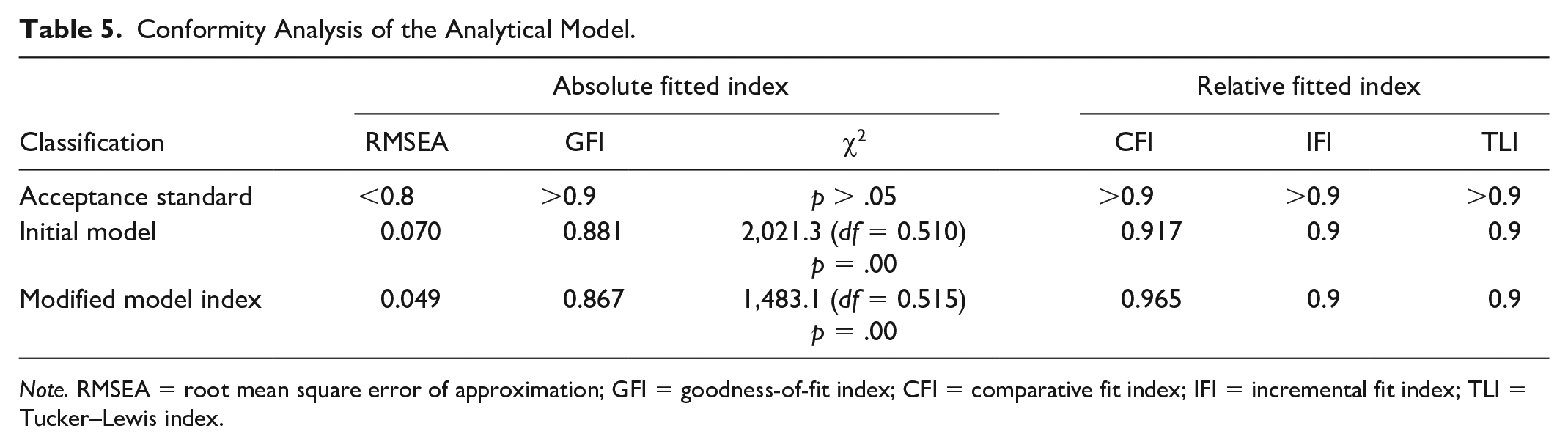
Note. RMSEA = root mean square error of approximation; GFI = goodness-of-fit index; CFI = comparative fit index; IFI = incremental fit index; TLI = Tucker–Lewis index.
First, the conformity analysis of the initial model showed that all the absolute fitted index values were not compliant with the acceptance criteria. The modification index was studied to improve the model conformity, and errors were found, with positive correlations. Therefore, their relationship was correlated, the modifications of the model had resulted in improved model conformity, and the data to be used in the research model and analysis were well matched. Then, the confirmatory factor analysis method was studied to determine the validity of the metrics. A look at the multivariate normality revealed that it must be pre-empted to utilize the confirmation factor analysis method in this study, maximum likelihood, and it was found that multivariate normality was met in the analysis results. The results of the analysis show that the factor loading is a value from 0.501 to 0.870 in relation to the potential of the metric. The construct reliability (CR) and average variance extracted (AVE) values, which show the reliability of the potential variables, also exceeded the 0.7 and 0.5 criteria, respectively, ensuring the reliability and feasibility of the potential variables. Table 6 shows the confirmatory factor analysis results of the analytical model.
Confirmatory Factor Analysis Result of Analytical Model.

Based on the results of the aforementioned analysis, the results of the analysis of the impacts of five factors of evaluation effectiveness (evaluation fairness, evaluation usefulness, evaluation accuracy, evaluation satisfaction, and emotional characteristics) are summarized. Table 7 shows the five impact relationship analysis of factors of evaluation effectiveness.
Five Impact Relationship Analysis for Factors of Evaluation Effectiveness.

The statistical significance and path coefficient of the relationship between the influencing factors specifically look into the following. First, all the impact relationships among the impact factors show statistically significant values at a 0.05 significance level, and all have a positive path direction. Second, “Evaluation accuracy → Evaluation fairness (0.678)” has the highest value among the impact factors. “Evaluation fairness → Evaluation accuracy (0.519),” “Evaluation fairness → Evaluation satisfaction (0.601),” “Evaluation accuracy → Evaluation satisfaction (0.591),” “Evaluation satisfaction → Evaluation fairness (0.515),” “Evaluation satisfaction → Evaluation accuracy (0.580),” and “Emotional characteristics → Evaluation satisfaction (0.580)” had 0.400 values or higher. The lowest value was that of “Evaluation usefulness → Emotional characteristics,” and the path coefficient was 0.104. The factor that had the biggest impact on evaluation fairness was evaluation satisfaction (0.601).
The factor that had the biggest impact on evaluation usefulness was evaluation accuracy (0.283), but its impact was not high (less than 0.400). The factor that had the biggest impact on evaluation accuracy was evaluation fairness (0.678); that which had the biggest impact on evaluation satisfaction was evaluation accuracy (0.580), and that which had the biggest impact on the emotional characteristics was evaluation satisfaction (0.503). The results of the impact analysis of the impact factors are shown in Table 8.
Effect Analysis of Impact Factors.

In the analysis results, the direct effect of evaluation fairness on evaluation effectiveness was 0.610; the indirect effect was 0.388, and the total effect was 0.547. It had the highest value. The direct effect of evaluation accuracy was 0.568, the indirect effect was 0.415, and the total effect was 0.502. They showed relatively high values. The direct effect of the emotional characteristics was 0.259, the indirect effect was 0.191, and the total effect was 0.223. This was the lowest value. Based on these results, it can be said that all the factors had a greater direct effect than indirect effect and that all the factors affecting evaluation effectiveness were reflected. It can also be said that the factors affecting evaluation effectiveness, such as evaluation fairness, evaluation usefulness, evaluation accuracy, evaluation satisfaction, and emotional characteristics, had a mediated effect.
Discussion of the Personnel Evaluation Improvement Plan
The purpose of this article is to study how to improve South Korea’s personnel evaluation system. The personnel improvement plan is discussed based on the analysis results. In this article, we attempted to secure fairness and equity in the personnel evaluation system. The fairness and equity of the personnel evaluation system are very important. In this study, we tried to ensure fairness and equity as well as efficiency of personnel evaluation system. To enhance the reliability of the evaluation scale, the evaluation items must be properly selected. To enhance the reliability by properly selecting the measurement items, the independence of the evaluation items should be maintained, and objective items should be developed using highly discriminative terms. To find objective evaluation items, the qualification requirements for each tier, such as the core competency requirements, should be appropriately utilized. In addition, measures should be actively implemented and reflected on the evaluation items, so that the management vision and goals at the strategic and administrative levels can be formulated and checked for realization.
To enhance the validity of the evaluation items and the predictability of the questions, it is necessary to continuously analyze the relationship between the evaluation results and the management performance to develop evaluation items and methods that are highly correlated with the evaluation performance. To enhance the feasibility of ability evaluation, efforts are needed to find the desirable items for such, and to enhance the feasibility of performance evaluation, a performance evaluation design is needed so that the strategic management objective would be an evaluation item.
To properly adjust the weight of each item, the following efforts are needed. First, most public organizations in South Korea evaluate their employees at a given time, and then use the evaluation results to make decisions on the employees’ promotion, wages, and education and training, raising many questions about the validity of the individual objectives of personnel evaluation. Therefore, it is requested that purpose-based evaluation be introduced to overcome the feasibility problem. In other words, it is necessary to introduce an evaluation system that can differentiate evaluation contents by purpose, for promotion, wages, and education and training. It needs detailed discussion.
Second, it is highly likely that the assessment factors will be very common and one-sided because the assessment factors developed for all the employees must reflect the entire job category to enhance the adequacy of the personnel evaluation in terms of the employees’ segmentation. Therefore, it is necessary to develop differentiated evaluation elements for each job or position and to conduct evaluation based on these so that the characteristics of individual jobs and positions will be well reflected, to enhance the validity of the evaluation. Third, in relation to the evaluation, consultation with the direct evaluator and with the employee in the personnel evaluation process contributes greatly to a more accurate and fair evaluation. In addition, the more accurately the evaluator has been able to describe the components of the evaluation, the more likely the evaluation outcome will be accurate. In cases where the evaluators other than the direct evaluator will attend the personnel evaluation, it is common for there to be no big difference between the evaluation results of the direct evaluator and those of the other evaluators. This can be interpreted to mean that the personnel evaluation by the immediate evaluator will be conducted more accurately and fairly if there are other evaluators, rather than by questioning the needs of the evaluators other than the immediate evaluator.
As personnel evaluation is evaluation by a person, it has limitations even when it is conducted with fairness, objectivity, and sincerity. It is easy for the evaluation to reflect the evaluator’s subjective judgments and prejudices, even if the evaluation is conducted using reasonable evaluation criteria and methods. Therefore, solutions need to be explored through a detailed, fact-based evaluation technique. In addition, evaluation should be conducted objectively and objectively based on the evaluation items by job category, task, and position, and the data should be kept objective. The following personnel evaluation system improvement measures are offered. The first suggested improvement measure shifted from simply rating and ranking to capability-building evaluation. The basic evaluation method should be absolute valuation based on the criteria for the ability of each organization to perform tasks by class or profession, by establishing personnel awards from each organization and setting the requirements for the ability to perform tasks subdivided by class and profession. In addition, the evaluation results should be used as data for the development of employees’ abilities, and should be linked with the ability development program to support the active development of capabilities. In addition, accurate assessment of the achievements and abilities of various professionals can be made to enhance the employees’ understanding and acceptance of evaluation and to systematically support the employees’ ability development through evaluation. The second suggested improvement measure is the site-time evaluation of the image. A new survey table form should be developed so that the evaluators and employees could establish specific work plans and performance development goals, and manage and evaluate performance processes through substantial interviews of each other at the evaluation site. In addition, the evaluation authority of the primary evaluator, who performs the evaluation tasks most closely with the employees, should be substantially strengthened. In addition, it is desirable to strengthen the evaluator training to improve the managers’ ability to manage the related tasks and loads. This is expected to enhance the evaluation’s fairness by institutionalizing the contents and procedures through which the assessor can participate in the evaluation process. Third, it is necessary to shift the recognition of what is intended for the evaluation to realize strategic management, not limited to motivation through performance compensation. Shifting to strategic orientation from short-term performance orientation is desirable. In addition, the evaluation cycle is becoming integrated in the real world, and the evaluation team and individuals are not separated from each other. That is, the evaluator rather than just the supervisor should conduct a systematic evaluation.
Conclusion
This study focused on the responses to and attitudes of employees toward personnel evaluation, departing from the view that the evaluator behavior and statistical figures should be applied when managing individual employee performance, and embracing the view that organizational effectiveness can be ultimately enhanced by utilizing a human resource evaluation system. Evaluation effectiveness from the viewpoint of the employees was suggested due to the desire to improve employee performance, and because the feedback presented in the evaluation interview could be effectively utilized. The five factors of effectiveness can be considered to encompass the emotional and cognitive responses of the employee, and to cover both the human and the impersonal aspects of the evaluation as well as tool usability. In other words, from the employees’ perspective, the various aspects of attitude that work against the personnel evaluation plan were comprehensively measured.
This study is meaningful in that it identified the conceptual structure of evaluation effectiveness and the comprehensive scope of the concept of performance measurement. In this study, the comprehensive conceptual structure and each aspect of it were analyzed to confirm the concept of evaluation effectiveness and to introduce a future research method on this concept as well as the practical use of the organization site. As evaluation from the employees’ viewpoint involves evaluation through self-reporting, the subjectivity and general response characteristics of an individual may serve to distort the conceptual structure of evaluation effectiveness.
The response bias of emotional characteristics was considered in this study. It can be seen that an individual’s emotional characteristics did not distort the evaluation effectiveness factor structure, and even if the effectiveness is measured through self-reporting, it can be seen as an indicator of the organization’s personnel evaluation system. In the evaluation by the employee, it should be considered that effectiveness could not be free from the personnel evaluation scores it received in the past. When the actual personnel evaluation scores are considered together, the factor structure of the evaluation effectiveness may be more clearly derived. The actual personnel evaluation score is not a method bias factor but an evaluation score given by the boss, but it can be seen as a method bias element that works along with each dimension in that individuals are aware of their past personnel evaluation.
Personnel evaluation is assigned a score that includes the evaluator’s errors, and the fact that the actual score affects the evaluation structure of effectiveness suggests that it is effective to use information derived from the personnel evaluation system itself as well as the attitude of individuals in operating the evaluation system. The fact that the personnel evaluation results affect the conceptual structure of evaluation effectiveness also suggests that the past personnel evaluation scores can serve as a leading variable in personnel evaluation effectiveness from the perspective of the employee. It suggests that the perception of the employee may be affected by the distribution of resources or the decision-making of the organization through personnel evaluation. It is also necessary to consider the past personnel evaluation scores in the future research on evaluation effectiveness. The factors affecting evaluation effectiveness presented in this article were consistently correlated, and as such, the existence of higher-order factors can be assumed. This suggests that it is possible to use each evaluation effectiveness aspect individually. The novelty of this article is that we have studied the fairness and the equity of personnel performance evaluation system. In fact, it is natural that people who work sincerely and produce high results receive a good personnel evaluation. However, in some cases, people have not received a fair evaluation in reality, so we have carried out research with the aim of overcoming it. We hope this study will help solve these problems. The future research needs to reveal the extent to which the scope of the evaluation effectiveness concept is best illustrated by the effectiveness of the preceding arguments.
Research Limitation
The limitations of this study are its insufficient initial exploration of the question development as to whether the questions comprehensively measured each dimension of evaluation effectiveness. The future studies may develop aspects other than those presented in this study based on the questions in this study. Interaction fairness is largely divided into factors similar to the distribution process, which can be seen as closely related to the recognition of the employee of the investee by distributing the inputs for evaluation and the performance after evaluation. Some questions about interaction fairness are also related to procedural fairness because they mean interactions involving human treatment. Thus, interaction fairness is effective in ensuring the clarity of the conceptual structure that includes the two factors of distribution and procedural fairness rather than independent factors in relation to the effectiveness of the evaluation perceived by employees. It is also necessary to determine in greater detail whether it overlaps with dimensions other than fairness. The future research will make it clearer to study only those workers who have received personnel evaluation even when the realities validate the method-biased effect.
Footnotes
Declaration of Conflicting Interests
The author(s) declared no potential conflicts of interest with respect to the research, authorship, and/or publication of this article.
Funding
The author(s) received no financial support for the research, authorship, and/or publication of this article.
