




Abstract
Based on the network embedding theory, cluster enterprises embedded in a social network can be divided into those based either on relational or structural embeddings. We use different indicators to measure how the characteristics of embeddedness in networks affect the interregional industry transfer stickiness and choice of transfer mode in China. We measure an enterprise’s network and structure characteristics, and adopt a multiple linear regression using survey data to test the hypotheses. The results indicate that the greater the relationship strength and relationship stability, the stronger the transfer stickiness and the more inclined enterprises are to choosing the partial transfer mode. Similarly, the greater the network density and network centrality, the stronger the transfer stickiness and the more inclined enterprises are to choosing partial transfers. Conversely, the higher the network heterogeneity, the weaker the transfer stickiness, meaning that enterprises tend to choose the overall transfer mode.
Keywords
Introduction
Industrial transfer, which reflects the production flow from developed countries or regions to relatively less developed ones, is an important economic phenomenon occurring between economies at different levels of development (H. Liu et al., 2014). It helps accelerate socioeconomic development, increase tax revenues, introduce new and advanced technologies, and relieve employment pressures in underdeveloped regions. For developed regions in which transfer companies are located, interregional industrial transfer can ease various pressures on enterprises, such as the shortage of resources and an increase in labor prices, thus providing them with valuable opportunities for optimizing the geographical distribution of production activities and seeking new market opportunities (L. Liu, 2019). Resource endowments and economic structures differ vastly across China’s regions. Hence, the Chinese central government has introduced policies to encourage the transfer of industries in the eastern region to the central and western regions.
However, the outlook of China’s interregional industrial transfer is pessimistic. For instance, the marginal industry has not transferred to the western region as expected (Geng, 2015), and the large-scale industrial transfer expected in theory has not materialized. This indicates that companies prefer to stay in their local areas. When most enterprises in a cluster have low transfer tendencies, industries in the eastern region face bottlenecks in development and upgrade at a relatively slow pace. Simultaneously, the provinces in the central and western regions will also experience the ill-effects of “bottom competition,” restricting the growth of industries in these underdeveloped regions. Therefore, it is essential to examine the factors hindering industrial transfer and propose countermeasures to facilitate knowledge transfers.
Previous studies often only highlight the influence of economic costs and other efficiency factors on industrial transfer (Hong & Dai, 2015). A number of studies identify the factors influencing industrial transfer. Indeed, economic activity is embedded in a specific social structure rather than based purely on market behavior, as postulated by traditional viewpoints. Chinese management scholars are also increasingly studying the social network analysis paradigm. However, domestic research on the impact of social networks on industrial transfer is scarce, and systematic research on the issue of industrial transfer using this paradigm is lacking. Some scholars recognize that the cluster network system has an important impact on transfer stickiness. For instance, they have suggested that the personal and geographic relationships among cluster enterprises and the production networks that they establish are the main factors influencing transfer stickiness (Hao, 2003; Wei & Li, 2004). However, only theoretical analysis has been put forward; analysis and empirical research using social network analysis methods from the perspective of network embedding remain limited. Accordingly, to better understand the relationship between these factors and the stickiness of industrial transfer, and how to reduce the adverse effects of transfer stickiness, we address the following two questions:
The answers to these two questions are expected to make three contributions to the literature. First, studying the interregional transfer of industries from a network perspective is of great significance for accelerating the smooth arrival of indigenous and transferred industries as well as for harmonizing the efficiency, resource integration, and structural upgrading goals of developed and less developed areas. Second, research on interregional industrial transfer issues can help the government design and formulate systems to promote the transfer and acceptance of industrial arrivals and guide dislocation development in regional industries. Third, the introduction of social network theory into research on interregional industrial transfers can better explain the causes of stickiness in the industrial transfer process as well as the mechanism for selecting industrial transfer modes, thereby providing a new perspective for the study of industrial transfer.
To answer our research questions, we first review the literature on the stickiness of industry transfer and classify industrial transfer modes. Then, we develop the hypotheses based on the literature on the links among relationship strength and stability, network density, network centrality, and network heterogeneity, on one hand, and transfer stickiness and transfer mode, on the other hand. Thereafter, we present the survey carried out to test our hypotheses. Finally, we explain our empirical results and present the conclusions and limitations of this study.
Theoretical Background and Hypotheses Development
Stickiness of Industrial Transfer
There is no unified and authoritative definition of the stickiness of industrial transfer in the Chinese academic community (Yu et al., 2016). Previous literature has provided the following notion of the stickiness of industrial transfer: the resistance to undertaking an industrial transfer among cluster enterprises and members of the social network in the transfer location. Thus, the stickiness of industrial transfer refers to the tendency of cluster enterprises to become attached to the original location during industrial transfer. Some scholars have also postulated that it refers to the fact that the regional transfer of industries cannot be carried out in accordance with regional economic trends because of various factors, resulting in stickiness. In this study, the concept of stickiness refers to the delay in the outward transfer of industries from the original region, making it difficult for enterprises to relocate, because the integration and expansion of cluster enterprises and local social networks release a “glue” effect.
Classification of the Industrial Transfer Modes of Cluster Enterprises
The current classification of interregional industrial transfer modes in China includes overall transfer and partial transfer, selective transfer and replicative transfer, and group transfer and independent transfer (Samm & Belussi, 2006). Based on the specific migration path of an enterprise, industrial transfers can be divided into investment outside the region, establishment of processing points, establishment of marketing networks, establishment of research and development (R&D) institutions, transfer of production facilities and corporate headquarters, direct transfer of factories, mergers and acquisitions, transfer of commissioned production or production outsourcing, and establishment of external sales networks.
The transfer modes of an enterprise can be classified into two categories according to the degree of transfer or size of the relocation of the organization. The first category includes those companies that transfer all business operations and set up headquarters in the new region (“overall transfer” hereafter). The second category includes companies that transfer some links in the production chain and retain the remaining links of the business and the corporate headquarters in the original area (“partial transfer” hereafter).
Research Model
In existing research on the stickiness of industrial transfer, few scholars have considered the impact of non-economic factors (Ang, 2018). Social network embedding plays a key role in industrial transfer research. Embeddedness theory divides social network embedding into relational embedding and structural embedding. On one hand, many scholars measure the embeddedness of relationships through their closeness, frequency of interaction, degree of trust, sense of identity, degree of reciprocity, and duration. On the other hand, structural embedding concerns the role of an organization throughout the network structure. Freeman (1978) proposed three types of network centrality: intermediate centrality, degree centrality, and near centrality.
The impact of network embedding on China’s regional industrial transfer is twofold. The first is its impact on the stickiness of industrial transfer. Embeddedness plays an important role in the dynamics of business and technical knowledge networks (Balland et al., 2016). The degree to which a firm is involved in, or connected to, other firms in the cluster can moderate the effect of R&D efforts on its innovation results. Indeed, knowledge flows are restricted to a tightly connected community of local producers (Morrison & Rabellotti, 2009). More generally, it has been shown that the deeper the degree of embedding, the more reluctant companies are to transfer industries. Therefore, there is a particularly high stickiness of industrial transfer among local cluster enterprises. Second, network embedding affects the choice of industrial transfer mode. In the study of interregional industrial transfer in China, how the transfer occurs is an important issue. Hence, the impact of the degree of embedding on the transfer pattern is also important. Figure 1 shows the theoretical framework of this study.

Conceptual model of the study.
Relationship characteristics and transfer stickiness
Drawing on the embedding theory proposed by Granovetter (1983), relationship strength and relationship stability are used in this study to measure relationship embedding. This leads to Hypothesis 1 (H1) and Hypothesis 2 (H2), respectively. First, from the perspective of relationship strength, there has been a rapid rise in clustering in recent years due to the agglomeration effect. This centripetal force continuously strengthens the relationships among original cluster enterprises (Stough & Yu, 2016). Companies prefer to incur high costs in developed regions than move to less developed regions with lower factor costs. The operations of enterprises are deeply embedded in social relationship networks, such as those between business leaders and local government officials, and between business leaders and local entrepreneurs. The main reason for companies preferring to incur high costs in developed regions is that less developed regions lack this kind of social relationship network. Enterprises have frequent contact with partners in their original clusters and thus establish close relationships; relocation will mean abandoning these connections as well as the various benefits that agglomeration brings to companies.
Second, from the perspective of relationship stability, because cluster enterprises have a common geographical and cultural background as well as a high degree of division of labor and collaboration, they establish a common code of conduct in their interactions and a good foundation of trust (H. Liu et al., 2014). In these social relationship networks, it is relatively easy for business members to reciprocate trust, thereby reducing the uncertainties regarding reputation and risk of default. The trust and normative mechanisms in the network are likely to restrict enterprises’ opportunistic behaviors (Cai & Nie, 2003). This dependence becomes an important factor hindering the external transfer of enterprises. Therefore, when the relationship between the enterprise and other members of the cluster is more stable, the transfer process becomes more stickiness. Based on this, this study proposes the following hypotheses:
Network structure characteristics and transfer stickiness
Scholars measure the characteristics of structural embeddedness, including network scale, scope, density, centrality, and heterogeneity. The literature has supported that both social cohesion and network range ease knowledge transfer (Reagans & McEvily, 2003). However, there are different views on the stickiness of cluster enterprises at the regional level. As companies strengthen their embeddedness in local social networks, they can obtain more information and resources from them, which in turn allows them to gain competitive advantages that are not available outside the social network. Therefore, if an enterprise leaves the embedded social network, it will inevitably lose a large amount of social capital, not only reducing its original competitive advantage but also risking its survival.
Network density is defined as the proportion of connections between nodes in the network to all other possible connections. For cluster enterprises, the greater the number of organizations in the cluster that establish links with them, the greater the number of associated upstream and downstream companies, financial institutions, and scientific research institutions, and the more disconnected the company’s members need to be when they transfer. Hence, the greater the company’s network density, the greater the number of members the company establishes within the network system, the stronger the relationship between the company and other organizations in a local industrial cluster, and the greater the stickiness of the transfer. Therefore, we propose Hypothesis 3 (H3):
Network centrality refers to the degree to which network nodes are centrally located in the network. Different from previous authors who found that network location has a significant positive impact on knowledge transfer (Wu et al., 2013), this study proposes that the higher the degree of network centrality in a local industrial cluster at the regional level, the greater the stickiness encountered by companies in the transfer process. This hypothesis is supported by the following two arguments. First, companies with abundant funds and relationship strength often occupy a relatively central position in the cluster network (Yang et al., 2011). Other companies and organizations, thus, need to cooperate with these companies in business and innovation and have strong dependence on highly centralized enterprises. Therefore, for a company with a high degree of centrality, the dependence of other companies in the cluster causes great resistance in the relocation process. Second, problems such as low transfer efficiency, high transaction costs, and poor industrial support occur during the transfer of central region companies to the west (Qian, 2019). It is difficult for large businesses in the east to share and spread knowledge and technology to the underdeveloped western regions. Therefore, we propose Hypothesis 4 (H4):
Network heterogeneity refers to the degree of differentiation between connected nodes and the heterogeneity of resources and information available from the network. Firms with a strong heterogeneous network structure often prefer to seek partners in different areas and are no longer limited to the scope of the current cluster. However, the links between companies with strong network heterogeneity and other organizations not only consist of formal long-term relationships but also informal linkages such as procurement and supply, strategic alliances, and R&D cooperation. This type of unstable and accidental connection can prevent redundant links and avoid the duplication of information. Burt (1997) found that networks with relatively weak relationships provide richer information for network members. Although heterogeneous networks are relatively small, they may benefit communicators more (Brunello & Langella, 2016). Hence, when the network heterogeneity of a company is stronger, the stickiness of the local social network is weaker. Therefore, we propose Hypothesis 5 (H5):
Relationship characteristics and transfer mode
From the perspective of relationship strength, the relationships among some members of the cluster are more closer and frequent than others because of the existence of unique kinship and geographical ties in the cluster. Previous studies have pointed out that stronger interorganizational relationships are more conducive to the transfer of information and knowledge among organizations, especially tacit knowledge (Levin & Cross, 2004). Companies should transfer some of the links in the production chain while retaining those links that confer long-term competitive advantages, such as R&D, design, and other activities (Brunello & Langella, 2016). In addition, many links between members may be redundant and may easily produce a certain degree of closure even within a strong relationship network, especially when the external environment changes and the risk of collective lock-in is relatively large. Therefore, even with favorable external conditions, enterprises with strong relationship networks usually consider keeping the core business in the original location as the least risky option.
Consequently, interfirm relationship stability is expressed as the degree of trust and reciprocity among enterprises. Companies choose to transfer partly because of the influence of relationship stability for the following two reasons. First, it is difficult for transferring companies to predict whether they will find partners that will be dependent on them in the new region, and whether their status is equal (Herbes et al., 2017; Rizos et al., 2016). If enterprises and other network members have built mutual trust and recognition, the overall transfer mode means giving up all the established solid relationships, which will incur a huge cost. A wise approach is to choose certain industries for transfer.
Second, a company faces environmental uncertainty due to information asymmetry when it undertakes overall transfers (Huang et al., 2015). From the perspective of a dynamic environment, cluster enterprises face greater environmental uncertainty and risk when they move to new locations because of their familiarity with the original local market and institutional environment. Therefore, we propose Hypothesis 6 (H6) and Hypothesis 7 (H7):
Network structure characteristics and transfer mode
The structural characteristics of regional innovation networks are the main factors affecting the flow of regional knowledge. A majority of China’s existing eastern and western poverty alleviation and counterpart support projects inhibit certain corporate behaviors (Qian, 2019). When a cluster enterprise establishes links with more organizations, the network density of the enterprise increases. The more network relationships it has, the higher the degree of its embedded network and the greater the frequency and breadth of information exchange (Inkpen & Tsang, 2016). A company with a high-density network structure generally does not divert all the activities of the enterprise because once the company leaves the local cluster, it may encounter greater opportunistic behavior or moral hazard in the new regional market. In addition, high-density networks are more likely to develop sharing guidelines and common behavioral patterns (Coleman, 1988). Companies usually do not rashly transfer all businesses but rather prefer to adopt more conservative approaches, such as the partial transfer mode, to achieve balance with the other members of the network. Therefore, we propose Hypothesis 8 (H8):
Previous research shows that the stronger the network centrality, the more likely cluster enterprises will choose selective transfer rather than replicative transfer. From the perspective of organizational learning, there are two main indicators to demonstrate that the greater the degree of network centrality, the more likely companies will choose partial transfers. On one hand, enterprises with high network centrality have strong resource integration capabilities in social network systems (Zhang & Zhang, 2015); hence, to maintain their core position in the local network, enterprises will not generally transfer the entire enterprise. Moreover, the local government’s strong influence in the local network because of the company’s efforts to remain can prevent companies from carrying out overall transfers. On the other hand, over time, there will be information redundancy in a social network with strong centrality and a lack of new information acquisition (Liu et al., 2015). Companies with a high degree of centrality also choose to weaken existing networks, discard redundant resources and information, and find new resources in a new environment outside the cluster. Therefore, we propose Hypothesis 9 (H9):
The stronger the network heterogeneity, the more likely companies will choose overall transfers for the following three reasons. First, the more information sources the company has, the more favorable it is for the company to explore new opportunities in the transfer destination (Song, 2014). Enterprises use their own resource advantages to contact members outside the network to obtain new network resources. This new network resource brings about advantages such as monopoly profits and increases incentives for companies to invest in new social relationships. The monopoly profits formed in this new environment drive companies to reduce their opportunity costs as much as possible and transfer the entire business. Second, when the network in which companies are located is highly heterogeneous, the more complementary each other’s resources are, the wider is the source of knowledge information, meaning that companies can access more novel information (Fu & Zeng, 2008). Third, social cognitive factors in the cluster can prevent cluster enterprises from adopting replicative transfer behaviors. On the contrary, when companies are in a heterogeneous network structure with low awareness, they are more inclined to choose the overall transfer mode. Therefore, we propose Hypothesis 10 (H10):
Examples of Network Embeddedness and Industrial Cluster Transfer Studied.

Note. The author collated the results according to the previous literature.
Research Design and Data Collection
Research Sample
The survey focuses on Shaanxi Province and Gansu Province. Shaanxi Province has five major cities or regions: Xi’an, Baoji, Weinan, Shangluo, and Yangling. Considering that the number of industrial clusters in Gansu Province, except Tianshui, is relatively small, and some clusters are not representative, only the clusters of Tianshui were investigated. Questionnaires were distributed to the senior management and department managers of cluster enterprises, and brief interviews were conducted with the latter. In total, 233 questionnaires were distributed and 209 questionnaires were returned. The final number of valid questionnaires was 183, with an effective response rate of 78.5%.
Regression Model
To investigate the relationship between the characteristics of embeddedness in networks and transfer stickiness, multiple linear regression was performed using SPSS 20.0, a statistical analysis software. We first use the relationship characteristic variables as the independent variables, and transfer stickiness and transfer mode as the dependent variables in the regression equation; in the second step, we use the structural characteristic variables. We analyze the following three ordinary least squares (OLS) regression models:


where
To ensure the reliability and validity of the measurement items, this research uses established scales adopted by domestic and foreign studies and then makes appropriate modifications to them according to the research purpose of the present study. To measure relationship strength through communication frequency and closeness of interaction, we select three items from Granovetter (1983). The measure of relationship stability is the degree of trust and reciprocity among enterprises, following Gancarczyk (2014). The network density measurement uses three items from Srivastava and Gnyawali (2011). Based on Freeman’s (1978) centrality theory and the study of Baum et al. (2000), four items are chosen to measure network centrality. Finally, following previous research (Yamanoi & Cao, 2014), four items are selected to measure network heterogeneity.
For the dependent variables, studies have measured the stickiness of industrial transfer (Ma & Wen, 2015) and drawn lessons to measure shift patterns (Brunello & Langella, 2016). This study selects the establishment time and scale of the company as the control variables, following Brailly et al. (2016). The questionnaire uses a 5-point Likert-type scale to present the question options.
Results
Internal Consistency Reliability, Convergent Validity, and Discriminant Validity
The reliability and validity of key constructs were examined. In Table 2, we evaluated the Cronbach’s alpha as a measure of reliability. The Cronbach’s alpha ranges from .764 to .901, exceeding the cutoff of .60, indicating that the reliability of the key constructs is high. Then, we used confirmatory factor analysis to examine the convergent validity of the constructs by examining both the factor loadings and average variance extracted (AVE). Most factor loadings on each construct are above the threshold value of 0.70. Only one factor loading is below 0.70 but greater than 0.50. Table 2 also shows that all the AVE values are well above the recommended threshold level of 50%.
Reliability Test of Each Variable.
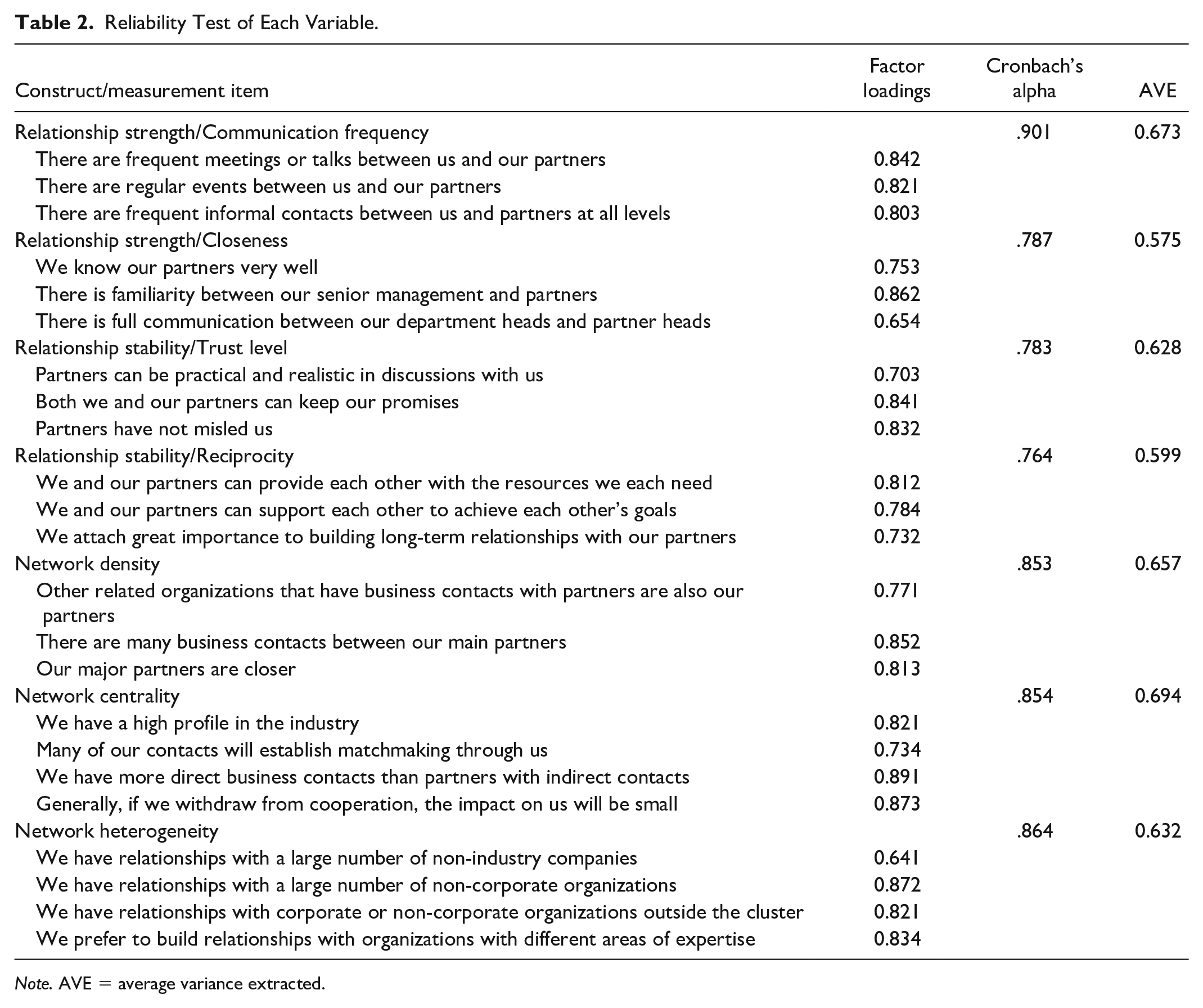
Note. AVE = average variance extracted.
The following potential problems were addressed before conducting the multiple linear regression analysis. First, in Table 3, the square root of AVE for each construct is well greater than the correlations between construct pairs supporting discriminant validity. And Table 3 also presents descriptive statistics and correlations among all hypothesized and control variables. Several key variables are significantly positively correlated with the transfer stickiness and mode of industrial transfer. The correlation coefficients are all between .7 and .8, and are significant at the 1% level. Second, Table 4 presents the tolerances of the 12 group variables in this study are all greater than 0.1, and the average VIF is 3.52 less than 10, suggesting that multicollinearity is not a problem. Third, heteroscedasticity was tested. The standard predicted values were regarded as the horizontal axis and the standard residuals as the vertical axis. The scatter diagrams show that the observations are randomly scattered, indicating there was no heteroscedasticity in each linear regression model. Overall, these analyses do not suggest any evidence of systematic deviation from our general results; we can conclude that the model specification is robust and valid.
Correlations and Discriminant Validity.

Note. **p < 0.01, ***p < 0.001.
Multicollinearity Test.

Note. VIF = variance inflation factor.
Testing of Hypotheses and Discussion of Main Findings
To test the hypotheses, we first use the relationship characteristic variables as the independent variables, and transfer stickiness and transfer mode as the dependent variables in the regression equation; in the second step, we use the structural characteristic variables. Multiple linear regression is performed using SPSS 20.0. In addition, this study uses Durbin–Watson values to test the autocorrelation of each regression model. Table 5 shows the results of the six regression models. The Durbin–Watson statistics indicate that the models have no autocorrelation. Hence, there is no problem of multicollinearity between the independent variables in the model.
Results of Multiple Linear Regression Analysis.

Note. *p < 0.05, **p < 0.01, ***p < 0.001.
As shown in Model 1, the regression coefficient β values of relationship strength and relationship stability are .751 and .595, respectively, both of which are significant at the 1% level. The R2 coefficient is .78 and the adjusted R2 is .775, indicating that the model has a good fit. Relationship strength and relationship stability have a significant positive effect on the dependent variables, while establishment time and firm size have no significant effect. Therefore, H1 and H2 are confirmed: as relationship strength and stability increase, the stickiness of enterprises in the interregional transfer process also increases. This empirical result is in line with the results of Z. Li (2015)—the deeper the company is embedded in the production networks and social networks in the country or region of origin, the lower is the probability of success in industrial transfer. This is because the stronger the relationship between cluster enterprises and their partners, the less willing they are to pay the cost of moving to less developed areas. In other words, they are unwilling to abandon or weaken the social relationships they currently have with government agencies, partners, and other stakeholders.
Model 5 shows that H6a, H6b, H7a, and H7b are confirmed: as communication frequency, closeness, trust, and reciprocity of interfirm interactions increase, companies tend to choose the partial transfer mode. This empirical result is in line with the view of Dyer and Hatch (2006)—some firm resources and capabilities are relation-specific and easily transferable to other buyers and networks. The stronger the relationship between the company and connected members, the less likely the firm is to choose the overall transfer mode. To maintain the original cooperation model, the partners with whom the enterprise has strong relationships and who cooperate with the enterprise must put pressure on the enterprise to prevent it from transferring all at once. Thus, companies must keep some institutions in place to continue these strong relationships. Once these strong relations are broken, the company will make huge losses.
As shown in Model 3, H3, H4, and H5 are confirmed: as the density and centrality of a company’s social network increase, the stickiness of enterprises in the interregional transfer process also increases; the network heterogeneity of the social network in which a company is located also reduces the stickiness of enterprises during interregional transfer. This is because the greater the centrality of the enterprise in the social network structure, the greater the adverse impact on the network system. Once enterprises are ready to transfer to less developed areas, the objects in the cluster network related to the enterprise will be given to it. The shift will impose greater resistance, and internal personnel will also oppose the transfer because they are unwilling to give up the dominant position in the network.
In Model 6, the regression coefficient β values of network density, network centrality, and network heterogeneity are .492, .560, and −.396, respectively, all of which are significant at the 1% level. The R2 coefficient is .798 and the adjusted R2 is .792, indicating that the model has a good fit. H8, H9, and H10 are confirmed: an increase in the density and centrality of the social network structure in which the company is located means enterprises are more likely to choose partial transfers during the interregional transfer process. By contrast, with an improvement in network heterogeneity, companies are more likely to choose overall transfers.
The higher the network centrality of the enterprise, the more revenue it can obtain from the network. Therefore, when interregional industrial transfer is carried out, the enterprise often retains some organizations in the original region to minimize the loss caused by weakening these social network connections. Furthermore, because companies with strong network heterogeneity tend to have richer resources and information and more extensive connections with destination organizations, the uncertainty that enterprises may encounter during the interregional transfer process is also reduced. Therefore, enterprises with strong network heterogeneity are more inclined to choose the overall transfer mode than the partial transfer mode when transferring between regions.
Discussion and Conclusion
Based on previous research, this study divides the types of enterprises embedded into social networks into relational and structural embeddings; measures the relationship characteristics of social networks using relationship strength and relationship stability; and uses network density, network centrality, and network heterogeneity to measure the structural characteristics of social networks. We then study the influence of the social networks in which cluster enterprises are embedded on their stickiness in the interregional transfer process and the mode of transfer. The research data were obtained from survey questionnaires distributed to enterprises, and multiple linear regression was used to verify the following conclusions.
First, the relationship characteristic variables have a positive effect on transfer stickiness. The communication frequency and closeness of the relationship, degree of trust, and degree of reciprocity have a positive effect on transfer stickiness. Compared with relationship stability, relationship strength has a greater positive impact on the stickiness of cluster enterprises in the interregional transfer process. The communication frequency among firms in the cluster has the greatest impact on transfer stickiness, followed by the degree of trust between firms, and then the degrees of reciprocity and closeness.
Second, network relationship characteristic variables have a positive effect on the mode of partial transfer selected by the company. The higher the communication frequency and closeness of inter-firm communication, and the greater the levels of trust and reciprocity as relational stability constructs, the greater the tendency for companies to choose a partial transfer model. The communication frequency among cluster companies has the greatest impact on the selection of partial transfer models, followed by the degree of reciprocity among firms, and finally, the degrees of trust and closeness between firms.
Third, the network structure characteristic variables have different effects on transfer stickiness. From the perspective of structural embedding, network density and network centrality have a positive influence on stickiness in the interregional transfer of firms, whereas network heterogeneity has a negative impact. In the social network structure, compared with network density, the network centrality of the enterprise has a greater positive impact on its stickiness in the interregional transfer process. The effect of network heterogeneity on transfer stickiness is negative, and the degree of negative influence is stronger than the positive effects of network density and network centrality.
Fourth, each network structure characteristic variable has different effects on the transfer mode. With regard to the structural characteristics of variable network density, the higher the centrality, the more inclined a company is to choose a partial transfer; the higher the network heterogeneity, the more inclined a company is to choose an overall transfer. Compared with the network density, the social network centrality of the transferring enterprises will have a greater impact on the selection of partial transfers by the cluster enterprises during the interregional transfer.
In general, this study makes contribution to the literature, as most studies of network embedding theory have been conducted in the west. Hence, one contribution is that our research extends existing theories to China’s emerging economy context. This study’s findings are consistent with previous works that suggest that little is known about using the paradigm of social networks to study the problem of industrial transfer (Li, 2015; Y. Liu, 2016). We use social network analysis methods to explore the stickiness of industrial transfer under different network structures, how the two parties to the industrial transfer choose the appropriate transfer method from the perspective of network embedding, and how the attributes and characteristics of the network affect their behavior.
Although the results reported in this research are compelling, the limitations summarized below suggest areas that may warrant further modification and, thereby, serve as directions for further research. First, the interregional transfer behavior of cluster enterprises is affected not only by their social networks but also by the regional policies of the country, policies of local governments, and human resources in underdeveloped regions. Second, as the companies selected in the study mostly transferred from the Bohai Economic Zone and Pearl River Delta Economic Zone, it is not yet known whether these enterprises are in the interregional transfer process of social networks embedded in companies in China and even worldwide. Hence, future research needs to increase the sample size of the survey. Third, the research object of this study is cluster enterprises. Enterprises’ social networks are measured from the perspective of micro enterprises. Subsequent research could, thus, measure the overall network of the cluster from several aspects, such as its production, innovation, and interpersonal networks.
Footnotes
Declaration of Conflicting Interests
The author(s) declared no potential conflicts of interest with respect to the research, authorship, and/or publication of this article.
Funding
The author(s) disclosed receipt of the following financial support for the research, authorship, and/or publication of this article: This study was supported by Shaanxi’s Soft Science Research Project “Study on the Mode Selection of Shaanxi’s Undertaking Interregional Industrial Transfer Based on Independent Innovation Ability Promotion from the perspective of Knowledge flow between Networks” (Project Number: 2018KRM172); Ministry of Education Humanities and Social Science Project “Study on Interregional Industry Transfer Behavior and Performance under Industrial Organizational Network Paradigm” (Project Number: 14YJA790090); and Ministry of Education’s Foundation for Returning Overseas Students Funding “Inter-regionalization from the perspective of network embedding and matching selection Research on Industrial Transfer.”
