




Abstract
Policy awareness increases the likelihood of policy-congruent behavior. Yet individuals may differ in the extent to which they notice certain policies; thus, psychological factors that explain behavior can have a differing effect on policy-congruent behavior of individuals. We investigated to what extent the relationship between normative, habitual, intentional, and situational factors that explain bottled water purchasing behavior vary regarding individuals’ awareness of policy targeted at reducing bottled water purchasing. We investigated this question in a representative sample of Lithuanian adolescents. Our study indicated that awareness of policy targeted at bottled water purchasing acts as a moderator for adolescents’ normative, habitual, intentional, and situational factors related to their bottled water purchasing. In low, moderate, and high policy awareness groups, habit was the strongest direct predictor of behavior. Normative factors had a strong effect in explaining intentions; in addition, awareness of consequences was directly related with behavior in the high policy awareness group. However, situational factors were insignificant predictors of self-reported behavior. Based on the results of the current study, we suggest that to achieve policy-congruent behavior, policy makers should consider both policy-reinforcing incentives and the level of policy awareness of the targeted group.
Introduction
In 2016, approximately 485 billion of plastic bottles were produced worldwide and the preliminary production forecast for the year 2021 is 583.3 billion bottles (Statista, 2017). Plastic waste accumulation is a pressing concern that needs to be addressed and effort is spent to reduce plastic waste globally. European Union (EU) member states are equipped with policies and strategies that can be followed to tailor local policies that aim to reduce bottled water purchasing (i.e., European Commission [EC], 2018, No. 52018DC0028). Yet to create the background for policy-congruent behavior, one first needs to assure a sufficient level of awareness of these existing policies. To put it simply, one needs to know about existing policies to follow them (Dodson et al., 2012).
Policy awareness, however, is not sufficient to alone produce policy-congruent behavior such as the reduction of bottled water purchasing. Purchasing bottled water or other beverages may also be affected by the features of the packaging (Draskovic, 2010; Orset et al., 2017), socio-economic factors (Heidbreder et al., 2019), or the available infrastructure (Heidbreder et al., 2019). In addition, to achieve lasting behavioral change, psychological factors such as norms, habits, intentions, and one’s immediate situation have to be addressed as well. In the upcoming sections, we will first introduce the concept of policy awareness, which has been identified as a significant predictor of policy-congruent behavior in areas other than pro-environmental behavior (Chua et al., 2018; Knapp & Ferrante, 2012), and has potential in explaining pro-environmental behavior (i.e., bottled water purchasing) among adolescents. Second, we will introduce the theoretical framework that encompasses the psychological factors relevant for pro-environmental behavior (Klöckner & Blöbaum, 2010) and through which we will investigate the role of policy awareness.
Policy Awareness as a Significant Factor Explaining Bottled Water Purchasing
Policy awareness is a complex phenomenon which could be defined as the extent to which individuals notice policies, are informed about specific regulations (e.g., Chua et al., 2018; Zhu et al., 2018), and are equipped with relevant tools that would empower individuals to comply with the policies (Dodson et al., 2012). Kinzig et al. (2013) has pointed out that regulation through official policy acts as both informing and enforcing the desired behavior, yet the manner through which (and if) individual norms and attitudes change to produce lasting behavioral shifts in the desired direction is largely unstudied. Moreover, the effect of policy awareness on behavior is mostly studied in organizational contexts, therefore we take these studies as a starting point for explaining the effect of policy awareness on pro-environmental behavior in a non-organizational context. Recent studies in organizational contexts indicate that awareness of certain policies is a significant factor explaining why individuals comply or do not comply with various types of policies. For example, it has been found that increased awareness of information security policy is associated with stronger adherence (Chua et al., 2018) and policy implementation effectiveness (Knapp & Ferrante, 2012). Likewise, those organizations that were more aware about existing environmental policies were more likely to support policies that lead to innovative pro-environmental practices (Zhu et al., 2018).
While useful in predicting policy-congruent behavior, the relationship between policy awareness and behavior is a complicated one. Some policies are more strictly enforced by law, making policy-congruent behavior not a matter of personal choice. For example, organizations have no choice but to comply with data security policies (Chua et al., 2018). Many of the policies that target environmentally relevant behavior, however, do not carry an injunction, and adherence to them is for the most part voluntary (Lülfs & Hahn, 2013), thus allowing for individually held beliefs to have a more substantial role in shaping behavior. Policy awareness has been shown to increase the likelihood of policy-congruent behavior for voluntarily enforced policies in adolescents (Coppo et al., 2014; Galán et al., 2014; Pentz et al., 1989; Trinidad et al., 2004; World Health Organization, 2004, 2018), therefore increasing policy awareness can be considered an important first step in ensuring policy-congruent behavior (Zhu et al., 2018). However, for policies that do not carry immediate and tangible consequences for not-adherence, one should not assume policy awareness alone is enough to achieve behavioral change, and one should simultaneously look at normative, habitual, situational, and intentional factors affecting behavior as well (Klöckner, 2013; Klöckner & Blöbaum, 2010).
The Comprehensive Action Determination Model (CADM) of Bottled Water Purchasing
The CADM (Klöckner & Blöbaum, 2010) has great potential in explaining bottled water purchasing. CADM was proven to be a robust theoretical framework explaining pro-environmental behaviors, such as sustainable travel mode choice (Klöckner & Blöbaum, 2010; Klöckner & Friedrichsmeier, 2011), recycling (Klöckner & Oppedal, 2011; Ofstad et al., 2017), and the adoption of sustainable heating technology (Sopha & Klöckner, 2011).
The CADM integrates well-established theoretical models such as the Theory of planned behavior (Ajzen, 1991) and the Norm activation model (Schwartz, 1977), and covers habitual and situational factors. In the CADM, normative factors of pro-environmental behavior refer to individuals’ awareness of the necessity of behavior to protect the environment (awareness of need), awareness of the impact of the performed behavior (awareness of consequences), the perceived social pressure to act in a pro-environmental manner (social norm), and the moral obligation to behave pro-environmentally (personal norm). Furthermore, situational factors in the CADM indicate a person’s perceived efficacy to perform pro-environmental behavior (perceived behavioral control) as well as the perceived accesses to behavior which evaluates the perceived opportunity to engage in pro-environmental behavior. Last, habits reflect the extent to which the behavior is determined by automatic behavioral patterns.
In general, CADM (Figure 1) proposes that pro-environmental behavior is predicted by habitual, intentional, and situational factors (Klöckner & Blöbaum, 2010). Habit is predicted by personal norm, situational factors, and intention. Intention is predicted by social norm, personal norm, and perceived behavioral control. Access to behavior is the antecedent of perceived behavioral control. Personal norm is predicted by social norm, awareness of need, awareness of consequences, and perceived behavioral control. However, the relationships among normative, habitual, intentional, and situational factors in the CADM slightly vary across studies. For example, the model can include an additional link between intention and habit (Klöckner, 2013; Klöckner & Oppedal, 2011).
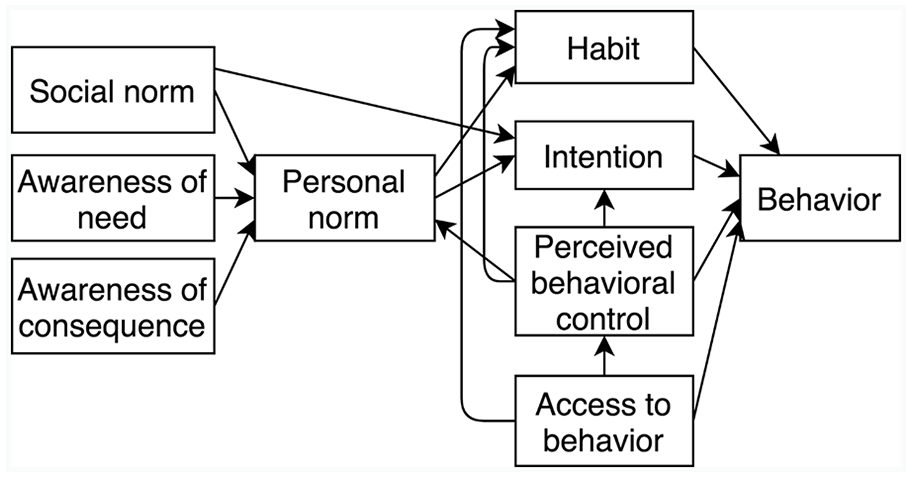
The CADM framework (Klöckner & Blöbaum, 2010).
The Present Study
Based on EU regulations (i.e., EC, 2018, No. 52018DC0028), Lithuania has prepared general plastic reduction strategies and policy guidelines (Ministry of Environment of the Republic of Lithuania [MERL], 2013, No. D1-782; National Environment Protection Policy [NEPP], 2016; Seimas of the Republic of Lithuania [SRL], 2012, No. XI-2375) that are implemented via societal education, public service announcements, environmental campaigns, and formal education, with a strong emphasis on preschoolers, school-aged children, and youth education on the damage of single-use plastics (MERL, 2013, No. D1-782). Specifically, policies targeting young Lithuanians’ bottled water consumption were adopted from EU regulations and are implemented on a national level. National policies can be transferred to municipality- and/or community-level policies, but this is rather optional. Therefore, the extent to which the measures of policies will reach adolescents will depend on the extent to which these policies are adopted in a municipality. Yet, the prevalence of national policies that are adopted on a municipality-level is not known, therefore the question is whether young people notice these policies.
In Lithuania, bottled water purchasing reduction policies are voluntary and do not imply personal consequences for adolescents who do not adhere to these policies. Given the fact that bottled water purchasing does not have immediate negative consequences for bottled water consumers, it is likely that policy awareness among individuals in the population will be distributed unevenly (similarly as in Zhu et al., 2018). It is also likely that psychological factors (i.e., normative, habitual, intentional, and situational), that are important in explaining environmentally relevant behaviors, will have differing effects on behavior across groups of individuals that differ in their awareness of policy targeted at bottled water purchasing. This assumption is based on the fact that in general, policy awareness implies more deliberate decision-making with regard to the behavior that the policy is targeted at. Thus, the level of policy awareness could potentially change the relationships between normative, habitual, intentional, and situational factors, but these mechanisms have not yet been identified. However, it is known that the aforementioned factors reflect the extent to which the decision regarding pro-environmental behavior is implemented deliberately or not. Specifically, deliberate decision-making is related to stronger normative (Eriksson et al., 2008) and intentional (Haustein et al., 2009) as well as weaker habitual (Haustein et al., 2009; Verplanken, 2006) processes of pro-environmental behavior. In addition, policies targeted at the reduction of bottled water consumption usually describe the availability of the aforementioned behavior, whereas in the CADM, the self-reported access to behavior is captured through situational factors. In the context of bottled water purchasing, access to high-quality tap water is a crucial component. However, Lithuania is one of the few countries in Europe which has easy access to high-quality drinking water (MERL, 2016). Hence, the quality of water should not be an obstacle in reducing bottled water purchasing.
To our knowledge, ours is the first study in which the CADM is applied to explore pro-environmental behavior in adolescence, while past studies mainly focused on adults (e.g., Klöckner & Friedrichsmeier, 2011; Ofstad et al., 2017). In addition, we did not find any previous study that investigated the effect of how awareness of bottled water purchasing reduction policy shapes the relationships between psychological factors (i.e., normative, habitual, intentional, and situational) and policy-congruent behavior (i.e., reduction of bottled water purchasing).
Method
Participants
To address research questions, we used a quantitative cross-sectional dataset from a representative survey of Lithuanian adolescents derived through probability sampling. The sample consisted of 508 adolescents whose age varied from 13 to 17 years (Mage = 15.10, SDage = 1.40; 49% were female). Thirty-four percent of adolescents lived in metropolitan areas or big cities (population of 50 000 residents or more), 29% in cities (population of 2,000–50,000 residents), and 37% in towns and villages (population of up to 2,000 residents). The vast majority of adolescents attended junior high school or high school (97%), 2.8% attended occupational schools and one adolescent (0.2%) was in the job market.
Procedure
In each household, one adolescent and one parent (or another legal adult guardian) were interviewed. The sampling strategy ensured that the gender, age, and geographic residency of adolescents were representative of the population. The data were collected through in-person interviews by a survey research firm. The interviewers were trained on the administration of the questionnaire before visiting households. A sampling frame of households from differently sized cities, towns, and villages was constructed using official statistics of population density, ensuring that the Lithuanian population was as closely represented by the data as possible. Households were selected through random route sampling (Brace & Adams, 2006) to create an equal probability of a household being selected. If more than one eligible respondent was present in the household, then the “next birthday” procedure was applied (Kumar, 2013). When household representatives were unavailable, two follow-up visits were made. This procedure was intended to ensure that the data gathered were representative of Lithuanian adolescents. Parental written informed consent was obtained before each interview with the adolescent. Informed consent from adolescents was obtained as well. Participants were informed that they can withdraw their consent to participate in the survey at any point. Confidentiality of data was assured for study participants. The members of the household were informed that the aim of the survey is to better understand pro-environmental behaviors on Lithuanian adolescents and their parents and to determine what behaviors are prevalent and which are not. The interviewer only asked about and recorded demographic data, while participants filled in the rest of the questionnaire on their own, with the interviewers only answering any questions that could arise while doing so. The interviewers did not observe or comment the answers of the participants, making sure that the participants do not feel any social pressure to answer in a socially desirable way.
Indicators of socio-economic background were obtained from the interviews by interviewing an adult representative of the household. The adult form of the questionnaire was filled in by 364 (71%) mothers, 116 fathers (23%), and 28 grandparents or other guardians (6%). The financial situation of the household was evaluated with a self-report item: 3.9% reported that they barely have money for food; 22.4% have enough money for food, but struggle to buy clothes; 47.4% can save some money in addition to everyday goods, but cannot allow themselves some more expensive purchases (e.g., a new TV); 24% reported that they can afford more expensive purchases (e.g., a new TV), but not an apartment or a summer house, and 1.2% of the respondents think they can afford anything they need. Fifty-seven percent of mothers and 47% of fathers had obtained higher education, and 12.7% of mothers and 4.9% of fathers were jobless.
Measures
The research instrument was designed based on the methodology of the Theory of Planned behavior (Fishbein & Ajzen, 2011) and the CADM (e.g., Klöckner & Blöbaum, 2010). We conducted a qualitative pilot study with the aim to test the questionnaire in a sample of adolescents. We had a total of two focus groups, with four participants in one and three participants in the other. Participants were asked to fill in the questionnaire and share their comments and reactions about the items. Participants indicated some items as too complex or too vague and based on these comments, we changed some of the wording of the items. In addition, participants indicated the length of the questionnaire battery as a demotivator for participating, thus we opted to reduce the overall length of the instrument, resulting in some of the scales (not discussed in the present manuscript) being shortened. Bearing in mind the feedback of the respondents and that the variables used in the CADM are straightforward, we opted to utilize single-item measures. Schwartz (1977) has argued that such constructs as personal norms are hard to assess with a multitude of items without being repetitive and superfluous, thus a single-item approach seems appropriate. Single items have been used to assess constructs of a similar framework in the past (Klöckner & Ohms, 2009), and have been suggested as useful in circumstances where constructs have very high face and content validity (Fisher et al., 2016; Hoeppner et al., 2011), as is the case with the CADM. Furthermore, single-item measures were even suggested as an alternative way of measuring such complex constructs as personality traits (Konstabel et al., 2017). In light of the literature highlighting the potential usefulness of single-item measures and based on the feedback of the participants from the pilot study, we opted to conserve questionnaire space to make the questionnaire battery more appealing and less fatiguing to the participants. The adjusted questionnaire was again piloted and the results of the second pilot study confirmed that the items of the questionnaire are understandable and pleasant for adolescents to fill in.
To cover all constructs of the CADM, we followed the design of a previous study on milk purchasing behavior done in a similar framework, which assessed all constructs win one item each (Klöckner & Ohms, 2009). The items of the questionnaire of the present study were as follows: awareness of a need (“Buying bottled water causes many environmental problems”), awareness of consequences (“If I don’t buy bottled water, I contribute to environmental protection”), social norm (“People who are important to me expect that I will not buy bottled water”), personal norm (“I feel morally obligated not to buy bottled water”), perceived behavioral control (“It is completely up to me whether I will use drinking water from a tap, a well, or a spring”), accesses to behavior (“I have access to a tap, a well, or a spring to get high-quality water”), habit (“I am used to buying bottled water”), intention (“I intend not to buy bottled water in the next four weeks”), and behavior (“I bought bottled water in the last four weeks”). The policy awareness item was worded similarly (“During the past four weeks I have noticed that it is encouraged not to purchase bottled water in Lithuania”). All items were rated on a 5-point Likert-type scale from (1) completely disagree to (5) completely agree, except the item for behavior, which was rated from (1) never or almost never to (5) constantly or almost constantly. All measures were presented in Lithuanian.
Similarly to previous studies (Chan & Bishop, 2013; Donald et al., 2014; Poškus & Žukauskienė, 2017; van den Broek et al., 2019), we used self-reported past behavior as an approximation of typical behavior that is likely to occur in the future. Measuring self-reported past behavior as an approximation of future behavior, while not as accurate as measuring actual behavior after a set point of time, is more practical and is a less biased measure compared with other self-report options (Gatersleben, 2018).
Analysis Strategy
We conducted model-based path analyses in Mplus 7.4. (Muthén & Muthén, 1998–2015). We used the robust unweighted least squares (ULSMV) estimator, suitable for the analysis of ordinal variables (Muthén, 1993) and theta parameterization, most appropriate for models where categorical outcomes are predicted by other categorical variables (Muthén & Asparouhov, 2002). We evaluated the model fit by using the Comparative Fit Index (CFI), the Tucker–Lewis Index (TLI), and the Root Mean Square Error of Approximation (RMSEA), following the goodness of fit recommendation provided by Little (2013); namely, CFI/TLI values higher than .90 indicated acceptable fit and values higher than .95 represent very good fit; RMSEA values below .08 indicate acceptable fit and values less than .05 suggested good fit.
Questionnaire Order and Possible Order Effects
The dataset used in the present study is taken from a large representative survey of Lithuanian adolescents and the questionnaire battery contained additional measures that are not discussed in this article. To minimize the possibility of question order effects (Podsakoff et al., 2003), the order of items in each clock of questions was inverted for half of the participants, but the general order of the blocks of questions remained constant for all participants. Demographic questions were presented first, followed by a block of items assessing environmental identity, generic knowledge about climate change, and a measure of general ecological behavior, and a measure of action-based knowledge regarding several pro-environmental behaviors. Following those measures, blocks of CADM variables were interspersed between blocks of variables assessing personality traits, which was done to minimize priming effects and to keep the respondent from automatically filling in answers. Several other scales not discussed here followed afterward. As in all research with a multitude of measures, some possibility of priming effects remains but any such effects should be fairly small as the measures of this article were among the first in the questionnaire battery.
Results
Descriptive statistics and rank correlations of all study variables are presented in Table 1. The skewness and kurtosis of the study variables indicated that all measures approximate the normal distribution sufficiently well. As all study variables were ordinal, we used rank correlation analysis for testing of preliminary associations among them.
Descriptive Statistics of Study Variables and Rank Correlations Among Them.

Note. The median of all variables Mdn = 3.00. CI = confidence interval; S = skewness; K = kurtosis.
p < .05. **p < .01. ***p < .001.
CADM in the General Sample of Adolescents
To address our research questions, we first assessed the CADM in the general sample of adolescents. The CADM structure suggested by Klöckner and Blöbaum (2010) in our sample showed insufficient model fit, χ2(15) = 47.79, CFI = .91, TLI = .83, RMSEA =.07 [.04, .09]. Therefore, we added two additional theory-driven paths—from awareness of consequences to behavior (Haustein et al., 2009) and from intention to habit (Klöckner, 2013; Klöckner & Oppedal, 2011). The CADM with additional path estimation in the general sample yielded an acceptable model fit, χ2(13) = 30.42, CFI = .96, TLI = .90, RMSEA =.05 [.03, .08] (Figure 2). The results indicated that the CADM functioned in the expected way with a few exceptions. Non-significant paths were found between awareness of need and personal norm; social norm and intention; perceived behavioral control and habit; as well as perceived behavioral control and behavior. In addition, few paradoxical relationships were found. First, personal norm not to purchase bottled water was positively related to stronger habit of using bottled water. Second, perceived availability of alternative water sources (access to behavior) was positively related to stronger habit of using bottled water.

Standardized regression coefficients of the CADM model paths in the general adolescent sample (N = 505).
To test the generalizability of the results in the general adolescent sample, we conducted a multiple group analysis by gender and age (junior vs. high school students). To determine whether significant differences between groups exist, we assessed the difference between a fully constrained and a fully unconstrained model; at least two of these three criteria had to be met to indicate a significant difference: Δχ2 significant at p < .05 (Satorra & Bentler, 2001), ΔCFI ≥ .01, and ΔRMSEA ≥ .01 (Chen, 2007). The results of multiple group analyses by gender and age supported the generalizability of the tested model between different gender, Δχ2(17) = 18.77, p = .34, ΔCFI = .005, ΔRMSEA = .01, and age, Δχ2(17) = 22.67, p = .16, ΔCFI = .016, ΔRMSEA = .000, groups.
Moderated CADM in Groups Differing by Policy Awareness
We combined participants into three groups representing their level of policy awareness based on the responses to the corresponding item. We labeled the responses “completely disagree” and “disagree” as low policy awareness; the response “neither agree nor disagree” as moderate policy awareness; and the responses “agree” and “completely agree” as high policy awareness. We chose three versus five policy awareness groups due to the very low number of respondents in the “completely disagree” group. In addition, we tested for differences between the policy awareness groups in terms of gender, age, and socio-economic status (SES) to reject the possibility of confounding variables affecting model-level differences. We found that the groups of low, moderate, and high policy awareness did not differ in terms of gender, χ2(2) = 5.35, p = .07; age, χ2(2) = 1.14, p = .57; subjective income, χ2(8) = 12.71, p = .12; mother (guardian) education, χ2(12) = 8.27, p = .76; mother (guardian) working status, χ2(2) = 3.92, p = .14; and father (guardian) working status, χ2(2) = 1.88, p = .39. We found the only difference for father (male guardian) education, χ2(12) = 25.75, p = .01, namely, the high policy awareness group did not include respondents with father education level lower than high school (while it was equally distributed between low and moderate groups) and most of not higher than high school education was overrepresented in the low policy awareness group (although it was equally distributed between moderate and high groups). However, taking into account that father (male guardian) education was only one of five SES indicators used, it could be concluded that the possibility of confounding in the present study is low.
We compared the means of the CADM variables in three groups of adolescents’ policy awareness (low awareness n = 249, medium awareness n = 176, high awareness n = 82) to test the assumption for moderation analysis. Figure 3 presents a comparison of standardized scores of normative, habitual, intentional, situational factors, and self-reported behavior in three groups. Significant differences among the groups were found in adolescents’ awareness of need, F(2, 503) = 4.294, p = .014, η2 = .017; awareness of consequences, F(2, 504) = 3.081, p = .047, η2 = .012; personal norm, F(2, 504) = 21.540, p < .001, η2 = .079; social norm, F(2, 504) = 15.940, p < .001, η2 = .060; and intention, F(2, 504) = 18.080, p < .001, η2 = .067. A marginal difference among the groups was found in their habit, F(2, 500) = 2.395, p = .092, η2 = .009. Perceived behavioral control, access to behavior, as well as self-reported bottled water purchasing did not vary among the three groups significantly.

Z scores of all CADM variables among groups of different policy awareness.
We conducted a multiple group analysis to test for possible model-level differences in groups differing in adolescents’ policy awareness (Figure 4). We used the same criteria for determining significant differences as presented earlier. A comparison of a fully constrained and unconstrained model indicated that there were significant model-level differences in the three groups varying in their degree of policy awareness, Δχ2(34) = 45.16, p = .10, ΔCFI = .05, ΔRMSEA = .01. Subsequently, we estimated models for all three groups individually to examine the differences among them.

Standardized regression and path coefficients of CADM in groups of low (n = 247), moderate (n = 175), and high (n = 82) policy awareness (presented in that order).
Model estimation in the low policy awareness group indicated that one out of three model fit indices was below the suggested threshold, χ2(13) = 24.83, CFI = .93, TLI = .83, RMSEA =.06 [.02, .10], but overall model fit was acceptable. Model estimation in the moderate policy awareness group yielded an excellent model fit, χ2(13) = 13.84, CFI = .99, TLI = .98, RMSEA =.02 [.00, .08]. Similarly, very good fit indices were found for the model in the high policy awareness group, χ2(13) = 13.56, CFI = .99, TLI = .98, RMSEA =.02 [.00, .11]. The results indicated that in all policy awareness groups, non-significant paths were found between awareness of need and personal norm; social norm and intention; perceived behavioral control and habit; perceived behavioral control and behavior; and access to behavior and behavior.
Model differences among the three groups were further explored using the Wald chi-square test of parameter constraints. We found marginal differences between groups of high and moderate awareness of policy in the paths leading from social norm toward personal norm, χ2(1) = 3.02, p = .08; from perceived behavioral control toward personal norm, χ2(1) = 2.92, p = .09; from access to behavior toward habit, χ2(1) = 3.15, p = .08; and from access to behavior toward behavior, χ2(1) = 3.03, p = .08, while a highly significant difference was found in the path leading from intention to habit, χ2(1) = 5.79, p = .02. A marginal difference was found between groups of low and high awareness of policy in the path leading from intention toward habit, χ2(1) = 3.39, p = .07, and a significant difference was found in the path leading from habit toward behavior, χ2(1) = 4.13, p = .04.
To sum up, the results show not only differences in the investigated variables on the mean level, but on the model, as well as path, level, indicating that the expression of the CADM variables differ for individuals with different degrees of policy awareness and that the interaction among these variables is also different.
Discussion
Given the fact that international and local efforts (e.g., EC, 2018, No. 52018DC0028; MERL, 2013, No. D1-782; NEPP, 2016; SRL, 2012, No. XI-2375) are being made to provide regulations and policies that target bottled water purchasing, it is important to know the extent to which adolescents notice these policies. Such knowledge is crucial if we are to understand how adolescents with differing psychological characteristics operationalized via normative, habitual, intentional, and situational CADM components react to policies that target bottled water purchasing.
The CADM model was found to explain 31% of bottled water purchasing behavior and 40% of intentions to refrain from bottled water in the representative sample of Lithuanian adolescents, which is within the range of what was found through a meta-analytical investigation of the model (Klöckner, 2013). The relationship between normative, habitual, intentional, and situational determinants were mostly consistent with previous studies (e.g., Klöckner & Blöbaum, 2010), with the exception of unusual associations between personal norm and habit as well as access to behavior and habit.
The Role of Policy Awareness in Explaining Adolescent’s Bottled Water Purchasing
Our study indicates that nearly half (49%) of Lithuanian adolescents did not notice policies whatsoever, 35% of adolescents were not sure, and only 16% of adolescents have noticed that there are ongoing efforts aimed at reducing bottled water purchasing. Furthermore, the results suggest that the degree to which adolescents are aware about existing policies targeted at bottled water purchasing significantly moderated the links among their normative, habitual, intentional, and situational factors related to bottled water purchasing. While in the present sample only a few path-level differences were found to be significantly different among policy awareness groups, one can infer a possible trend of normative, habitual, intentional, and situational factors decreasing in relevance when awareness of policy increases. This might be indicative that the more adolescents are aware of existing policies, the more likely they are to engage in policy-congruent behavior despite their individual beliefs, thus treating voluntarily enforced policy as an injunction.
In all policy awareness groups, social norm and awareness of consequences, but not awareness of need toward bottle water purchasing, were significant predictors of adolescents’ personal norm. These findings replicate the results of the initial study of the CADM (Klöckner & Blöbaum, 2010). In addition, in all policy awareness groups, personal norm and social norm were strongly related; yet personal norm, but not social norm, translated into intention. This indicates that in the present sample, social norm contributes no significant variance in predicting intention apart from that through which it predicts personal norm, highlighting that social pressures need to be internalized to effectively shape behavior.
A direct relationship between awareness of consequences and behavior has not been investigated in adult samples (e.g., Klöckner & Friedrichsmeier, 2011; Ofstad et al., 2017), but was found to be significant in a sample of young adults (Haustein et al., 2009). In the present study, the aforementioned path was only significant in the whole sample, while moderation analysis revealed it to be significant only in the group of adolescents with high policy awareness. Path-level analysis did not indicate this path to be significantly different among groups, yet the observed difference of effects is not trivial and could imply that adolescents with high policy awareness might be more sensitive to their policy-incongruent behavior and thus are more persuaded to consume water from alternative sources if they are aware of the outcome of policy-consistent actions.
The results of our study indicate that habit is the strongest predictor of bottled water purchasing, contributing more variance than intention. This suggest that adolescents’ bottled water purchasing largely stems from inertia, relying on automatic patterns of behavior, rather than reasoned action (Fishbein & Ajzen, 2011). However, our study suggests that the relatationship between habit to purchase bottled water and bottled water purchasing tend to weaken when adolescents become more aware of existing policies. In addition, for those who are more aware of existing policies, awareness of consequences increases in its relevant importance when predicting behavior. This implies that awareness of policy also helps adolescents understand the urgency of policy-congruent behaviors and leads to more reasoned actions, rather than automatic ones. These results are in line with past studies in which habit was found to be less important in explaining behavior for individuals with higher awareness toward their behavior (e.g., Eriksson et al., 2008; Lally & Gardner, 2013; Verplanken, 2006).
We found a paradoxical relationship between adolescents’ personal norm and habit, that is, in all policy awareness groups, adolescents’ moral obligation not to purchase bottled water was positvely related to their habit to purchase bottled water. This indicates that even though the adolescents’ moral obligation not to purchase bottled water is expressed, habit persists as a critical obstacle to perform policy-congruent behavior (Klöckner & Matthies, 2004). In addition, this could also imply the observed relationship is due to individuals with highly expressed moral obligation not to purchase bottled water overestimating their habit of doing so. Nevertheless, this path is hard to conclusively explain and merits further investigation in future studies.
In all groups of policy awareness, situational factors such as access to behavior and perceived behavioral control were strongly interrelated. However, situational factors did not contribute unique variance in predicting self-reported behavior. Conversely, studies that analyzed behaviors that people were not performing on a daily basis (non-habitually) found that situational factors were significant predictors (e.g., Klöckner & Blöbaum, 2010; Sopha & Klöckner, 2011). Situational factors were also not related to intentions or habits, with the exception of the high policy awareness group where access to behavior predicted habit significantly, but in an unexpected direction. This paradoxical relationship could point to adolescents who are highly aware of relevant policies overestimating their habit or their perceived behavioral control (or both) possibly because of their perceived guilt of not acting in the most appropriate manner. Nevertheless, future studies are needed to provide more concrete answers as to why this paradoxical relationship was observed. Future studies could assess individual’s felt guilt and control for it when investigating this relationship.
Limitations and Future Directions
In the present study, we investigated the yet relatively unexplored role of policy awareness in predicting adolescents’ pro-environmental behavior (in the present case—bottled water purchasing reduction). Future research should go beyond just policy awareness and investigate what are the best ways of spreading policy awareness and whether individuals perceive policies as compelling to act and necessary as both of these factors might have a role in deciding to act upon voluntarily enforced policies.
As all research, the present study has its limitations. While our sample is in general large and representative of Lithuanian adolescents, it did not allow for the use of instruments that would let us capture latent factors and would allow for the use of latent variable analysis. The present study is cross-sectional and did not allow for the direct observation of actual behaviors, thus subjective self-report measures were used, with past behavior being regarded as a proxy measure of future behavior. In addition, cross-sectional data did not allow us to fully explain some of the more interesting findings of the present study such as the relationship among awareness of consequences and behavior, paradoxical relationships between personal norm and habit, as well as the relationship between access to behavior and habit. Habit, being quite difficult to operationalize, might have possible overlaps with measures of past behavior, thus this issue should also be addressed in future research. We suggest that future research should be done in a longitudinal and/or experimental framework that would enable to see the change dynamics of the relationships among the variables that constitute the CADM. We also suggest future inquiry into the role of policy awareness as a potentially very important moderator for effective behavioral change. Furthermore, within-person and person-oriented approaches could be used in understanding policy-congruent behaviors, as the widely used predictive models might not function equally for all individuals (Fishbein & Ajzen, 2011; Poškus, 2018a, 2018b).
Policy Implications and Practical Recommendations
The recent Intergovernmental Panel on Climate Change (2018) declared that policies and solutions for environmental issues, including plastic bottle use, should be country, context, and target-group specific. It is also important to ensure the equal dissemination of these policies and/or policy-related measures among these targeted groups (Dodson et al., 2012). Policy awareness could be one of the possible indicators that could show whether dissemination of policy across target group is efficient enough (Zhu et al., 2018). Our study indicated that nearly half of the representative sample of the Lithuanian adolescents were not aware of policies related to bottled water purchasing. A simple yet important message to policymakers is that to optimize existing policies, they should first ensure an equal dissemination of information and thereby increase the likelihood that those who are targeted by the policies will be exposed to them and will receive the incentives that come with them. One of the possible routes that could ensure policy awareness targeted at bottled water purchasing is disseminating policies and policy-relevant measures through formal and non-formal education institutions (Pettipas et al., 2016).
Policies aimed at changing behavior that is deeply engrained and is performed automatically requires measures that target habitual processes (e.g., Verplanken & Roy, 2016; Verplanken & Wood, 2006). Our data provide some support for this and thus we recommend policy makers to address ways of forming new habits when designing policies so that the desired behavior becomes the new default habitual behavior. While perceived behavioral control and access to behavior assessed through self-report were not found to be strong contributors in explaining behavior, nevertheless these and other external factors (e.g., the available infrastructure) that make up our environments should be addressed in such a way that empowers desirable behaviors and hinders undesirable behaviors.
Normative factors provide an important background for pro-environmental behavior to occur (Klöckner & Blöbaum, 2010; Schwartz, 1977). Our study shows that normative factors such as social norm and awareness of consequences are significant antecedents of personal norm (i.e., the moral obligation not to purchase bottled water). Initial evidence from experimental studies already indicate that information with behavior-tailored content in places where behavior is likely to occur is an effective means of strengthening the positive social norm toward pro-environmental behavior (Poškus, 2018a). We suggest that informational campaigns could be launched to raise adolescents’ awareness of the consequences of bottled water purchasing, highlighting the damage single-use plastics do to the environment as well as to societal health in general (Hartley et al., 2015), all the while highlighting that positive behavior is both widespread and effective (Cialdini, 2003; Griskevicius et al., 2012; Poškus, 2018a). It needs to be stressed, however, that such environmental education should not induce guilt in youngsters, but rather should foster a feeling of pride if we are to achieve effective behavioral change (Bissing-Olson et al., 2016). One of the increasingly more often suggested means of raising awareness on environmental issues and awareness of need to change one’s behavior is to involve youth in hands-on activities where they can themselves carry out research and collect evidence of, for example, plastic pollution (Hartley et al., 2015), thereby more effectively understanding the direct environmental impact of plastic waste.
In the present study, perceived behavioral control and access to behavior were not significant contributors in explaining bottled water purchasing. It could be that even if adolescents feel that using water from alternative sources depends on them (perceived behavioral control), or that alternative sources of water are available to them (access to behavior), they refuse to turn to alternative water sources because of negative attitudes toward tap water (e.g., they might believe that tap water is of bad quality or using it can harm one’s health) or using tap water would interfere with their self-expression (e.g., they might believe that using tap water signals that one is not trendy or not cool [impression management; Gatersleben & van der Werff, 2018]). Therefore, next to policy awareness and other psychological factors within the CADM approach, one should take into account the peculiarities that come with the target group to encourage to move the individuals of targeted group toward alternative water sources. A deeper investigation of the aforementioned attitudes toward tap water could prove useful in future studies.
Conclusion
Our study indicates that adolescents vary in their policy awareness targeted at bottled water purchasing. Only one fifth of the representative sample of adolescents was highly aware of bottled water purchasing reduction policies. Adolescents’ level of policy awareness moderated the relationship among their normative, habitual, intentional, and situational factors related to bottled water purchasing. In all policy awareness groups, habit was the strongest direct predictor of bottled water purchasing but the effect of habit tended to weaken with the increase of policy awareness. Situational and intention factors were weaker contributors in explaining bottled water purchasing. In all policy awareness groups, normative factors were found to be significant predictors of intention, while in the high policy awareness group awareness of consequences had a significant effect on behavior.
The present study provides initial evidence of the potential that policy awareness has in explaining policy-congruent behavior in adolescence. As we addressed only one specific aspect of policy awareness (i.e., whether individuals in general notice policies), future studies should explore other possible aspects of policy awareness and their role in explaining policy-congruent pro-environmental behavior.
Footnotes
Declaration of Conflicting Interests
The author(s) declared no potential conflicts of interest with respect to the research, authorship, and/or publication of this article.
Funding
The author(s) disclosed receipt of the following financial support for the research, authorship, and/or publication of this article: This project has received funding from European Social Fund (project No 09.3.3-LMT-K-712) under grant agreement with the Research Council of Lithuania (LMTLT) and Grant number 09.3.3-LMT-K-712-01-0017.
