




Abstract
Finding and keeping qualified workers is an evident problem in the hospitality industry in many parts of the Alpine region. Job satisfaction is, therefore, becoming increasingly important for sustainable development of the labor market and in further consequence regions and destinations. Hence, this study aims to examine factors influencing job satisfaction to gain a better understanding. A total of 345 employees were surveyed on aspects of job satisfaction using an online questionnaire. Data analyses show that a positive relationship with the supervisor, adherence to the duty roster, and personal development opportunities are the most important factors for job satisfaction. In contrast, remuneration, task portfolio, working atmosphere, and the infrastructure provided were less important drivers. The findings highlight important areas and directions for further investigation of job satisfaction. For practitioners, the study offers valuable insights into the sustainable and effective promotion of employee job satisfaction.
Introduction
There is relatively high level of employee turnover in the hospitality industry compared with other industries, which leads to enormous additional costs every year (O’Neill et al., 2011; Pranoto, 2011). A low level of job satisfaction is cited as the reason for this high turnover, and this turnover is believed to be caused by stress and work overload due to the rapid growth of the hospitality industry (O’Neill & Davis, 2011). For sustainable development at the company level, job satisfaction is particularly important for preventing staff turnover and promoting employee loyalty (Strenitzerová & Achimský, 2019). Furthermore, job satisfaction has a positive influence on the quality of products, services, customer relations, and satisfaction, as well as company performance (McPhail et al., 2015). According to Hristov and Chirico (2019), employee satisfaction is a useful key performance indicator (KPI) when implementing sustainable strategies. At the regional and destination level, job satisfaction can also be a significant driver of sustainable development. A higher level of job satisfaction results in higher quality services (Hristov and Chirico, 2019; McPhail et al., 2015), which ensures the added value of the region or destination, contributes to higher levels of customer loyalty, and thus provides a secure source of economic prosperity. In addition, this supports a valued labor market for the local population.
Various studies of job satisfaction have been conducted in the hospitality industry. These surveys have often been conducted in individual hotels or resorts (e.g., Glaveli et al., 2019; Ineson et al., 2013; Pelit et al., 2011; Yang, 2010) or in specific regions (e.g., northwest Sweden: Lundberg et al., 2009; Australian snow sports industry: Dickson & Huyton, 2008). This contribution aims to bundle and structure these detailed individual results to form a “big picture” overview of Alpine tourism. Furthermore, it seeks to determine the relative importance of these factor bundles, hereafter referred to as “factors.”
In Alpine tourism, there was a clear shortage of skilled workers, especially in the areas of gastronomy and hotels, in the winter season 2019–2020. More than 80% of the companies surveyed in this research (n = 200) saw the availability and qualifications of employees as decisive competitive factors in Austrian tourism. Approximately, 60% saw these factors as challenges when recruiting workers (Austrian Chamber of Commerce; Wirtschaftskammer Österreich, 2019). Hence, this study sought to identify the key factors of job satisfaction in the Alpine hospitality industry.
Specifically, we focused on the following factors: working hours, salary, professional development, leadership and management, working atmosphere, work itself, and infrastructure. These factors are important for various reasons. First, the Alpine hospitality industry is dominated by family-led, small- and medium-sized companies, which are deeply rooted in their local communities (Peters et al., 2019). As such, the owner-families’ attitudes and characteristics are strongly reflected in their management and leadership styles (Buhalis & Main, 1998; Peters et al., 2019). Second, recent research has shown that low net earnings, stress, overwork, and interpersonal tensions are key drivers of dissatisfaction in the workplace (Deery & Jago, 2015; O’Neill & Davis, 2005; Tan et al., 2020), indicating the importance of working atmosphere, working hours, and monetary compensation in the hospitality industry. Third, employees’ expectations of the workplace and their desire for personal development and a work–life balance (Ann & Blum, 2020; Hristov & Chirico, 2019) are encapsulated by our dimensions of the work itself and professional development. Fourth, the (Alpine) hospitality industry depends on seasonal employment for successful operations, thus hospitality firms frequently offer accommodation, food, leisure activities (e.g., freeskiing passes), and other benefits to their staff (Heimerl et al., 2020). Therefore, we considered the importance of infrastructure as an additional driver of job satisfaction. To date, research on the relative importance of these factors for overall job satisfaction in the Alpine hospitality industry is scarce. This study aimed to answer the following research question:
As such, the factors described above formed the independent variables for this research, with overall satisfaction with the work situation being the dependent variable. The remainder of the article is organized as follows: The section “Literature Review” provides the findings of the literature review, and the section “Method” describes the research method. The results of the study are given in the section “Results,” and the final section includes the discussion of the results and the conclusion.
Literature Review
Theoretical Underpinning
Locke’s (1969) seminal work on the theory of job satisfaction provides the theoretical foundation of this research. Locke (1969) defines job satisfaction as “the pleasurable emotional state resulting from the appraisal of one’s job as achieving or facilitating the achievement of one’s job values” (p. 316). Locke (1969) further notes that “job satisfaction and dissatisfaction are a function of the perceived relationship between what one wants from one’s job and what one perceives it as offering or entailing” (p. 316). This further highlights the interactional nature of job satisfaction, as it results from the interaction of a person with their environment. Given that the hospitality industry is service-oriented and that value is co-created by employees’ interactions with customers and other stakeholders (Peters et al., 2019), this notion is of particular relevance for this study.
Job satisfaction must be distinguished from similar concepts, such as job involvement (i.e., a cognitive state reflecting the degree of job identification; Kanungo, 1982) and organizational commitment (i.e., a more global response to an organization; Modway et al., 1982). However, correlations between these concepts have been noted (e.g., Feinstein et al., 2006; Jaworski et al., 2018). Put simply, job satisfaction can be understood as the extent to which people enjoy their job. In the present study, we followed the notion of Wiener (1982) and Feinstein et al. (2006), who agree that job satisfaction is an attitude toward work-related conditions, facets, or aspects. Overall, job satisfaction can, therefore, be seen as the sum of the evaluations of the elements of which the job is composed (Locke, 1969).
Drivers of Job Satisfaction in the Alpine Hospitality Industry
Research on such aspects or drivers of job satisfaction has been increasingly of interest in hospitality and management research, as satisfied employees report fewer absences, less fluctuation, and lower sickness records and deliver higher levels of service quality (Heimerl et al., 2020). As such, job satisfaction is a prerequisite for a sustainable workplace and the organization as a whole (Hristov & Chirico, 2019; Strenitzerová & Achimský, 2019). We conducted a narrative literature review to analyze the importance of the dimensions of working hours, salary, professional development, leadership, and management, working atmosphere, work itself, and infrastructure as driving forces of job satisfaction in the Alpine hospitality industry. In the following sections, we elaborate on each of these factors in more detail.
Working hours (“Z”)
Ariza-Montes et al. (2019) claim that the hospitality industry may lose motivated workers when it fails to offer good working conditions or to promote the psychological well-being of its employees. Unsatisfactory working conditions lead to work–family conflicts, time pressure, emotional exhaustion, and time stress, which ultimately result in high turnover rates (Deery & Jago, 2015). In addition, the industry is criticized for its irregular and unsocial working hours, including shifts and work at night and weekends (Kusluvan et al., 2010; Ruiz-Palomo et al., 2020; Tan et al., 2020). Employment conditions—including contract types, shifts, and working hours—are, therefore, among the key determinants of job satisfaction (Kusluvan et al., 2010). Compatibility between family life and working hours—or, more generally, the reduction of conflicts between work and leisure time—is clearly conducive to satisfaction (Karatepe & Kilic, 2007; Namasivayam & Zhao, 2007; Xu & Cao, 2019). Likewise, permanent employment contracts also have a satisfaction-enhancing effect (Gallardo et al., 2010; Lillo-Bañuls et al., 2018). Stress and pressure to perform are directly, negatively, and strongly correlated with job satisfaction (Kim & Jogaratnam, 2010). Based on these insights, the following hypothesis was derived:
Salary (“E”)
The hospitality industry is frequently deemed a poor-paying environment with unsatisfactory working conditions (e.g., Deery & Jago, 2015; Kusluvan et al., 2010). A high proportion of low net earnings and the absence of overtime pay frequently force employees to take on second jobs (Ariza-Montes et al., 2019). The importance of compensation for job satisfaction in the hospitality industry has been shown in several studies (Dickson & Huyton, 2008; Gallardo et al., 2010; Ismert & Petrick, 2004; Lillo-Bañuls et al., 2018; Lundberg et al., 2009; Pelit et al., 2011). Regarding possible differences between permanent and seasonal workers in this respect, the results are unclear. Based on the literature, the following hypothesis was derived:
Personnel development (“W”)
Although training was considered less important than feedback and responsibility, all these factors play a significant role in promoting job satisfaction among seasonal workers (Lundberg et al., 2009). For both seasonal and permanently employed workers, the opportunity to develop in the job has been shown to influence job satisfaction (Dickson & Huyton, 2008). According to Kong et al. (2018), training opportunities are proven contributors to job satisfaction. For Lam et al. (2001), promotions are related to job satisfaction. McPhail et al. (2015) demonstrated that continuing vocational training has a positive effect on satisfaction. Kong et al. (2018) also found opportunities for vocational training to be an important factor driver of job satisfaction. Satisfied employees were particularly likely to mention the possibility of a career in the industry in their evaluations on employer-rating portals (Stamolampros et al., 2019). Hence, the following hypothesis was derived:
Working atmosphere (“B”)
According to the literature, working atmosphere—including the relationship among employees, colleagues, and customers—is a major driver of job satisfaction. Stamolampros et al. (2019) found that satisfied employees often mention working climate and company culture in their employer evaluations. Several studies have indicated that relationships with colleagues and customers have a positive effect on job satisfaction (Bufquin et al., 2017; Dickson & Huyton, 2008; Ineson et al., 2013; Ismert & Petrick, 2004; López-Cabarcos et al., 2015; McPhail et al., 2015). A study by Gjerald and Øgaard (2010) demonstrated positive correlations between job satisfaction and the competence of colleagues, as shown by their flexibility and use of initiative. However, exclusion by colleagues leads to lower satisfaction and emotional exhaustion, according to Bedi (2019). This emotional exhaustion is, in turn, negatively correlated with job satisfaction, according to Karatepe et al. (2009). Employees who enjoy an emotional bond with guests and customers may experience an increase in job satisfaction (Gjerald and Øgaard, 2010). In addition, a sense of justice and fairness within the organization has a strong influence on job satisfaction (Nadiri & Tanova, 2010). Internal communication is another critical factor in job satisfaction for seasonal employees (Araslı & Arıcı, 2019). Stamolampros et al. (2019) found that poor employer ratings often went hand-in-hand with unsatisfactory communication in the workplace. Thus, it seems communication, in general, makes a valuable contribution to higher job satisfaction and employer satisfaction. Drawing on the findings of the studies presented, the following hypothesis was derived:
Leadership and management (“F”)
Transformational leadership behavior has a positive effect on job satisfaction (Rothfelder et al., 2012). Furthermore, the ability of managers to communicate objectives, thoughtful decisions, openness to others, self-confidence, and loyalty to personal principles is important for increasing satisfaction (Baquero et al., 2019). Empowerment appears to be another key factor in job satisfaction; if employees are given the opportunity to use their personal skills at work, to be creative, to make their own decisions, and to take responsibility for their actions, this enhances their job satisfaction (Glaveli et al., 2019; McPhail et al., 2015). Lundberg et al. (2009) found that passing on responsibility to employees and providing feedback platforms can have a positive effect on motivation among seasonal workers. Involving employees in decision-making also affects job satisfaction (Kim & Jogaratnam, 2010; Kong et al., 2018). Quality and process management have also been shown to have positive effects (La Del Río-Rama et al., 2017), and this is especially true for HR management. This applies to the recruitment of the most suitable people (Araslı & Arıcı, 2019), practices that promote commitment (Domínguez-Falcón et al., 2016), and integrated HR management (Fabi et al., 2015).
It is argued that job satisfaction is essential for sustainable workplace development and, thus, for the entire organization (Avery & Bergsteiner, 2010; Strenitzerová & Achimský, 2019; Suriyankietkaew & Avery, 2014). The promotion of organizational sustainability is a key consideration at the strategic level for many organizations (Suriyankietkaew & Avery, 2014). “Sustainable leadership” is a widespread approach to management that seeks to balance the needs of people, profits, and the environment to promote the longevity of organizations through appropriate management practices, thereby applying a holistic approach to sustainability (Avery & Bergsteiner, 2010, 2011; Suriyankietkaew & Avery, 2014). By including the triple bottom-line approach, “sustainable leadership” positively affects various aspects in addition to job satisfaction, including ecological or sociocultural concerns (Heimerl et al., 2020). These far-reaching positive effects are particularly important in rural regions, where tourism is a challenge for ecological and sociocultural issues (Sisneros et al., 2019). Based on the insights, the following hypothesis was derived:
Working activity (“T”)
According to Ismert and Petrick (2004), one indicator of general job satisfaction is satisfaction with the challenges of work. Glaveli et al. (2019) considered the importance of more challenging and less monotonous tasks and social aspects in relation to job satisfaction, and they identified a strong effect. Pelit et al. (2011) reached similar conclusions, noting that job enrichment and job rotation contribute to morale and motivation at work and thus have an indirect positive impact on job satisfaction. McPhail et al. (2015) also emphasize that a rich task portfolio is important for employees’ professional development. However, it is not only the circumstances and nature of the specific tasks that are relevant but also the effects of performing these tasks are significant. Workplace performance has both direct and indirect effects on job satisfaction, in the form of a sense of achievement, which represents a kind of intrinsic reward (Prentice et al., 2019). For employees who can identify with the organization and its goals, job satisfaction can be indirectly increased by a higher commitment to achieving these goals (Zopiatis et al., 2014). Support from the organization in the form of a pleasant working environment, the assignment of preferred tasks, and so on has a positive effect on job satisfaction (Kim et al., 2005). In addition, over- and under-qualification has negative effects (Kim & Jogaratnam, 2010; Kim et al., 2005), whereas a fit between training, qualifications, and job profile has a positive effect on job satisfaction (Ge et al., 2019). The following hypothesis was derived from these insights:
Infrastructure (“I”)
The hospitality industry has been criticized for poor working conditions and low wages; and, recent research has highlighted the importance of empowerment strategies (Ruiz-Palomo et al., 2020) and internal marketing activities (Frye et al., 2020) for reducing employee turnover. In a similar vein, Tan et al. (2020) note the value of a positive work environment which goes beyond monetary compensation. Incentives such as gifts, seminars, meals, and events can all increase employees’ motivation (Jaworski et al., 2018). In the Alpine hospitality industry, great importance has therefore been attached to expanding the nonmonetary framework, such as increasing the quality of food, board, lodging, and transfers (Heimerl et al., 2020). This is of particular relevance for Alpine hospitality firms because they largely depend on seasonal workers with diversified social values who only reside in the destination during the season before traveling home again. However, research on the relative influence of infrastructure as a driver of job satisfaction is scarce. Based on the results of the studies presented here, the following hypothesis was derived:
Method
The study sought to examine and compare the importance of the seven factors (see the section “Literature Review”) for overall job satisfaction. A correlation study was conducted in the natural environment of the organization, with minimum interference by the researcher in the normal flow of work (Sekaran, 2003). The setting was not contrived, and the unit of analysis was the individual employees in the organization. With this cross-sectional study, data were collected from employees in the Alpine hospitality industry between December 2019 and April 2020 for an investigation of the importance of individual drivers of job satisfaction.
Data Collection
The data were collected using a questionnaire comprising 36 questions. Responses were indicated using a 5-point Likert-type scale, from 0 to 4, where 0 = no assent and 4 = absolute assent. The questions related to the factors are discussed in the literature review, and they were each derived from the insights of previous studies. Table 1 presents the 36 questions, their assignment to the seven factors, and the studies whose insights primarily served as their bases.
Questions, Factors, and Underlying Studies.
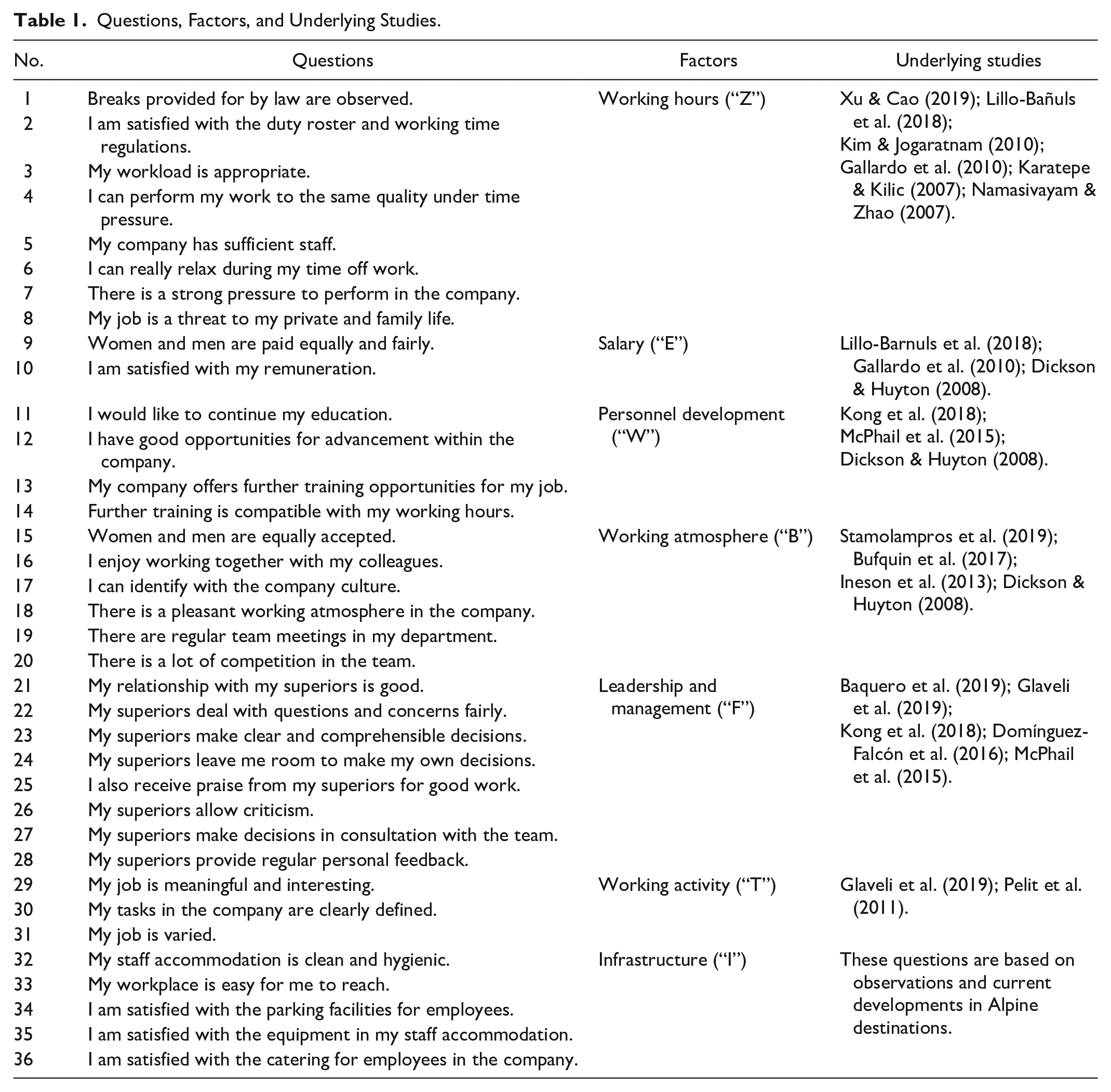
A total of 15 Tyrolean hotels were selected to participate in the study. These hotels voluntarily took part in a pilot-like certification procedure on the subject of job satisfaction, entitled, “Yes, I like working here.” Therefore, it can be assumed that these companies have a high level of awareness of the importance of job satisfaction in the hospitality industry, or they are of the opinion that this is well developed in their own case. It can also be assumed that employee orientation and employee satisfaction are important for the selected hotels. This was confirmed by their willingness to participate in the study, although all the hotels wanted to remain anonymous. Thus, this is an investigation into companies that have exhibited a concern for high employee satisfaction levels.
Only the “skilled workers” (i.e., those employees who had completed relevant vocational training) were surveyed. Managers were excluded from the survey. To maintain the participants’ anonymity, no sociodemographic variables were collected.
After several pretests, the paper-based questionnaires and collecting boxes were handed out to the participating hotels. Each hotel received one collecting box and a copy of the questionnaire for each of their skilled workers. Between five (minimum) and 100 (maximum) questionnaires were issued to each hotel. The participating companies received 504 questionnaires in total. A total of 345 questionnaires were returned, resulting in a response rate of about 68.5%. The response rates from the individual hotels ranged from 51.2% to 96%. All 345 returned questionnaires were used for the data analysis, with unanswered questions being ignored.
Data-Analysis Methods
The analyses for each of the questions (Table 1) were conducted using descriptive statistics. Factor analysis, composite reliability (CR), average variance extracted (AVE), Cronbach’s alpha, and Spearman–Brown coefficient were calculated to evaluate the validity and reliability of the latent constructs. Correlation analysis was also conducted using Spearman’s rank correlation. To assess and compare the importance of the seven factors for job satisfaction, the study involved multiple regression analysis, with overall job satisfaction (i.e., summary construct) as the criterion variable and the individual factors as predictor variables. Based on the findings of the literature review, we assumed that all the factors would have positive influences on overall job satisfaction.
Results
This section first presents the results of the descriptive analyses of the individual questions (Table 2). This is followed by the results of the validity and reliability analysis. Subsequently, the total mean of the factors from the respective individual questions is presented. Finally, the results of the regression analysis are described.
Validity and Reliability of the Latent Constructs.

Notes. Table 2 presents the remaining items from Table 1 (excluded were Nos 4, 7, 8, 19, 20, and 33). FL = factor loadings; CR = composite reliability; AVE = average variance extracted.
Spearman–Brown coefficient was also calculated = .59.
Analyses for the Individual Questions
In the course of the descriptive analysis, it became apparent that a large proportion of the statements had been assessed by the respondents as accurate (i.e., positive).
Ad “Z.”
Regarding working times, many participants stated that both the duty rostering and working time arrangements were by and large satisfactory. Legally prescribed breaks were also being complied with. More than half (53.7%) of the participants stated that the activity had little impact on their private and family lives. More than three quarters (76.6%) also stated that they had the opportunity to recover during their time away from work.
Ad “E.”
Most (76.1%) were satisfied with the remuneration that they received. According to a large proportion of those surveyed, women and men were paid equally and fairly.
Ad “W.”
More than three quarters of the respondents indicated that they would like to continue their education. According to 61.4%, further training opportunities were offered in their respective companies. When asked whether continuing training was compatible with their required working hours, 60% responded that this was the case. Subsequently, around two thirds of the respondents rated the opportunities for career advancement as good.
Ad “B.”
The working atmosphere was perceived as pleasant by 86.3% of the respondents. More than 90% stated that they enjoyed working with their colleagues. Moreover, according to two thirds of the respondents, there was little competition among the employees. A large majority indicated there was no gender discrimination in terms of acceptance of employees. One exception to the predominantly positive results was in response to the question about pressure to perform in the company: 50.2% stated that there was strong pressure in this area, and a further 31.7% partially agreed with this statement.
Ad “F.”
Relationships with superiors were found to be positive by an overwhelming majority of the respondents. Most said that their managers left them sufficient scope to make their own decisions. Furthermore, 71.2% stated that decisions were made in consultation with the team. Most (66.3%) stated that they received regular feedback from their managers.
Ad “T.”
Most respondents considered the job they performed to be meaningful, interesting, and varied. In addition, 82% found the required workload to be appropriate. According to 87.8% of the evaluated questionnaires, tasks in the company were clearly defined.
Ad “I.”
Most participants rated staff accommodations as sufficiently equipped (83.4%) and clean and hygienic (91.8%). However, 11.7% did not answer any of these questions. Most respondents (86.9%) stated that their workplace was easily accessible to them. Parking facilities for employees were considered very satisfactory by 85.6% of respondents.
Validity and Reliability Analysis
For further analysis and comparison of the importance of each factor, the questions were aggregated as latent constructs (factors). Due to insufficient results for the validity and reliability tests, Questions 4, 7, 8, 19, 20, and 33 (Table 1) were excluded. The results of the validity and reliability tests for the latent constructs and the remaining questions are shown in Table 2.
The factor loadings of the latent constructs are within the range of 0.54 to 0.90, which indicates acceptable construct validity for the sample size (Hair et al., 2006). To evaluate the internal consistency and validity of the proposed latent constructs, the CR, and the AVE were calculated. The CR ranged from .71 to .93, suggesting satisfactory reliability (Hair et al., 2014). The AVE was above the recommended minimum of 0.50 for all constructs, indicating acceptable internal consistency of the subscales (Hair et al., 2006; Taber, 2018). For the two-item construct (salary), the Spearman–Brown coefficient was also calculated (Eisinga et al., 2013), and this could also be considered acceptable.
Regression Analysis
The data were tested for compliance with the Gauss-Markov assumptions (e.g., linearity, homoscedasticity), and no violations were found.
Table 3 details the descriptive statistics of the latent constructs (factors). All factors showed relatively high values above the middle of the scale (2.5). Therefore, there were high levels of satisfaction with and influence on the individual variables.
Descriptive Statistics of the Regression Variables.

Table 4 presents the Spearman’s rank correlation matrix. Significant positive correlations were found among all factors.
Correlations.

Correlation is significant at the .01 level (two-tailed).
A significant regression equation was found, F(7, 201) = 5,262.797, p < .001, for the prediction of the overall job satisfaction based on the seven factors (B, E, F, I, T, W, Z). The R2 for the overall model was .995 (adjusted R2 = .994), indicative of a high goodness-of-fit, according to Cohen (1988). Table 5 shows the coefficient, the standard error, and the t test.
Coefficients.a

Note. VIF = variance inflation factor.
Dependent variable: overall job satisfaction.
All factors were found to be significant predictors of job satisfaction (p < .001). The standardized coefficients indicate the relative importance of each factor for job satisfaction.
The results in Table 4 show that leadership and management (“F”) has by far the greatest influence on overall satisfaction. The respondents found to be particularly satisfied were those who enjoyed a positive relationship with their supervisor and whose supervisors took a fair approach to questions and concerns. The employees were moderately satisfied with clear and comprehensible decision-making behavior, opportunities for participation, and praise from superiors, as well as the allowance of criticism, team orientation, and regular feedback. A directive management style clearly prevails. This finding supports the important referenced literature (Baquero et al., 2019; Lundberg et al., 2009; Rothfelder et al., 2012). Thus, H5 is supported.
The second weighted factor concerned the questions on professional development opportunities (“W”). Here, there was a gap between the desire for further training and the satisfaction with the offers, as well as the potential for advancement. Providing support for H3, professional development was positively related to job satisfaction. Hence, this factor is a lever for increasing job satisfaction, which supports the findings of earlier studies (Kong et al., 2018; McPhail et al., 2015; Stamolampros et al., 2019).
Working hours (“Z”) ranked third in the weighting. In support of H1, satisfaction with working hours was found to be positively related to job satisfaction. Employees were particularly satisfied with the adherence to break times and the duty roster. This confirms the findings of Xu and Cao (2019) and Namasivayam and Zhao (2007). In contrast, workload, performance, and time pressure, the impact on personal life, recreational opportunities, and work–life balance were viewed more important than adherence to break times and the duty roster (see Kim & Jogaratnam, 2010).
In fourth place was the factor of infrastructure (“I”) or nonmonetary working conditions. For this dimension, interviewees in all the companies surveyed expressed high levels of satisfaction. This was shown in the following aspects: equipment and cleanliness of staff accommodation, accessibility, parking facilities, and catering. H7 is thus supported.
The factor ranking fifth in relative importance was working atmosphere. The working climate is described as significant in several studies (Bufquin et al., 2017; Dickson & Huyton, 2008; Ineson et al., 2013; Ismert & Petrick, 2004; López-Cabarcos et al., 2015; McPhail et al., 2015). In this study, the respondents were satisfied with gender equality and collegial cooperation in their companies, as well as the possibility of identifying with the company culture and working atmosphere. However, they were less satisfied with the frequency of team meetings and the competitiveness among colleagues in their teams. However, the significance of these results for the companies examined in this study is somewhat weaker than that seen in previous studies. Nevertheless, the results show a positive influence of working atmosphere on job satisfaction and, therefore, H4 is supported.
Factor “T,” regarding participants’ perceptions about the meaningfulness of and level of challenge involved in their work, ranked sixth in importance. Overall, the respondents saw their work as meaningful and interesting, and the tasks as clearly defined and—although somewhat more negative—varied. This confirms the results of previous research (McPhail et al., 2015; Pelit et al., 2011). As the results show a positive relationship between satisfaction with working activities and job satisfaction, H6 is supported.
The smallest contribution to overall satisfaction was found to be pay in this study (Factor “E”). There was only mid-level satisfaction with salary, though a high level of gender-related satisfaction was indicated. Although the influence of salary on job satisfaction was small relative to that of the other factors, the results nevertheless show a positive relationship. Hence, H2 is supported.
Discussion and Conclusion
With regard to intrinsic and extrinsic motivational factors, the results of the comparison are unclear, although intrinsic factors tend to be given greater importance, with leadership and management in first place and pay/compensation placed seventh.
In companies that tend to be employee-oriented, leadership by superiors is especially important to employees. The participants were quite satisfied with this, although they indicated a desire for increased opportunities for participation. This essentially confirms the findings seen in the existing literature. It follows that a more directive management style prevails in these companies. Opportunities for further training and promotion may lead to increases in overall satisfaction. This result also supports previous findings from the literature. Furthermore, the issues of working hours and workload are important but viewed much more negatively. This is somewhat structural in nature, but there is nevertheless the potential for improvement.
The weighting of the other four factors was comparatively clear: infrastructure, working atmosphere, working activity, and then salary. This partially confirms the findings cited in the literature review. However, employees in the companies investigated may have interpreted these factors as almost “self-evident” prerequisites and thus viewed them as satisfactory.
The following practical conclusions can be reached:
The leadership style should err on the side of participation and delegation.
Working hours and workload should be arranged in a sensitive and personalized way.
Training offers in the hotel companies should be expanded.
Working climate, infrastructure, activity, and remuneration should be observed and retained.
This study has some limitations. The study focused on employees in companies with a tendency toward high job satisfaction. It is, therefore, an empirically “elitist” approach to the test. Future research could assume a quartile-wise differentiated population of companies to identify differences between more and less employee-oriented companies. In addition, further differentiation could be made in terms of the duration of employment relationships: What are the differences between year-round and seasonal workers in terms of overall job satisfaction and their bundles of influencing factors? This aspect is discussed several times in the literature on individual influencing factors. Practical experience in Alpine hospitality industry shows that seasonal employees are highly motivated by salary and much more tolerant of diverse working hours. This study was conducted during the winter season, a peak period with a high workload; thus, a survey conducted outside the winter season could produce different results. Future researchers could measure job satisfaction several times throughout the year. Finally, we do not yet know how the hospitality industry will be relaunched after the COVID-19 crisis of 2020–2021 or how the labor market will react. This should be examined in future studies.
