




Abstract
This study’s purpose was to investigate the relationships among learning through experience, learning for stress resistance, learning cognition, learning outcomes, the entrepreneurial mindset, and the discrimination of social information. The main research methods adopted in the study were the partial least squares (PLS) and the Sobel test. We adopted PLS to test the relationships between six variables, including mediating and moderating effects. In addition to PLS, this study used the Sobel test to verify the mediating effects. Large samples may cause a mediating effect testing error when PLS is used; however, the Sobel test can resolve this issue. According to our test results, learning through experience and learning for stress resistance can change students’ learning cognition and improve their learning outcomes. In addition, an entrepreneurial mindset has a mediating effect on the relationship between learning through experience, learning for stress resistance, and learning cognition. That is, for the student, having an entrepreneurial mindset strengthens the effect of learning through experience, as well as learning for stress resistance, and improves learning cognition. However, the discrimination of social information has a moderating effect on the relationship between learning cognition and learning outcomes. That is, a lower discrimination capability with respect to social information changes learning cognition and results in poor learning outcomes.
Introduction
The aim of science education in colleges and universities is to help students understand scientific knowledge and to develop students’ abilities related to the scientific approach to enquiry (Shahali & Halim, 2010). However, certain students also have the desire to learn entrepreneurship skills with respect to scientific knowledge. Therefore, in addition to traditional science education courses, increasingly more institutions of higher learning have developed education programs in science entrepreneurship for science students (Achor & Wilfred-Bonse, 2013).
What is science entrepreneurship? How are the concepts of “entrepreneurship” and “science” integrated in college to help students for learning science entrepreneurship? When Shimasaki (2014) tried to explore biotechnology entrepreneurship, he gave an interesting definition for science entrepreneurship. Science entrepreneurship is the sum of all activities necessary to build an enterprise through the melding of both scientific knowledge and business disciplines. Deveci and Seikkula-Lein (2016) explored the implementation process of entrepreneurship education into science education, they also give the same definition. To help students learn science entrepreneurship, institutions of higher learning usually consist of two course contents that integrate science and entrepreneurship (Elo & Kurtén, 2020). First, researchers such as Lebedeva et al. (2015), Charity et al. (2017), and Deveci and Çepni (2017a) have found that increasing student creativity and innovation capabilities are critical goals in science entrepreneurship. Therefore, colleges should focus on how to use scientific knowledge to develop an innovative scientific enterprise such as biotech, medical, or other high-tech enterprises. Second, students must learn related knowledge regarding business management. In fact, entrepreneurship is required not only in founding a company but also in operating and managing a company. Therefore, knowledge of business management has been deemed necessary learning content (Liu et al., 2017; Sternberg & Krauss, 2014).
To improve the effect of such science entrepreneurship learning, researchers such as Liu et al. (2017) and Aziz and Rowland (2018) have investigated education content designed for science entrepreneurship, such as the science, technology, innovation (STI) model, or developed ways to teach entrepreneurship, which involves teaching knowledge regarding innovation and business management. However, increasingly more colleges and universities are finding the effect of such education disappointing. One reason is that science students are unwilling to study business management. In fact, many students believe that creativity and innovation are the critical factors for success in science entrepreneurship (Sorgo, 2012). Therefore, they disregard studying business management. However, a lack of a thorough understanding of business management will result in poor company operation, and thus, the science entrepreneurship failure rate is high (Almeida, 2017). A second reason is that students are typically ambitious at the beginning of a course in science entrepreneurship learning. However, success in science entrepreneurship requires a substantial amount of professional knowledge regarding innovation, creativity, and business management. Therefore, the learning burden is heavy. Most students find it difficult to bear this large learning burden and fail to fully digest it. In addition, they do not consider such knowledge necessary, particularly business management knowledge. However, because these young entrepreneurs have weak knowledge in these areas, they encounter failure. In fact, entrepreneurship failure also indicates that the learning outcome in connection with entrepreneurship is poor.
Why are students unwilling to learn about business management? Why can they not bear the heavy learning burden? Arpiainen and Tynjälä (2017) note that the main problem is the students’ incorrect learning cognition process. According to Diduck et al. (2012), cognition is defined as an individual’s perspective on, and thinking regarding, a matter. The development of cognition is typically related to growth, the learning process, or even experience. Due to a lack of practical entrepreneurship experience in past growth or learning, most students subjectively judge which knowledge is required in the learning process. As a result, they only learn knowledge that interests them. In addition, even if students know which knowledge is necessary, because they lack experience with learning or working under pressure, most still find it hard to bear the heavy learning burden. Thus, they develop the wrong learning cognition within the science entrepreneurship learning process.
To change cognition, Costa et al. (2017) argue that learning through experience plays an important role. Black et al. (2014) and Kakouris and Georgiadis (2016) note that learning from experience is defined as using a simulation environment to help students understand a real entrepreneurship situation. Through these simulation games and situations, students experience the actual circumstances of science entrepreneurship in a manner that enables them to fully understand which knowledge is required in the science entrepreneurship process. Therefore, learning through experience seems to be a means by which to change students’ cognition. Liu et al. (2017) indicate that it is difficult to help students know which knowledge is necessary under the science entrepreneurship learning process. Therefore, when students develop incorrect cognition during the learning process, although some studies, such as Deveci and Cepni (2017b), assert that good teaching skills can change students’ cognition, the majority of students do not easily change their cognition. However, if simulation experience can be combined with an entrepreneurship education program, the combination can help students become aware of the real operation and management problems related to entrepreneurship, which can change their learning cognition. Related researchers such as Winkler (2014) and Bing and Ji (2015) have also found that learning through experience can drive students’ learning cognition change. Therefore, entrepreneurship education programs that are combined with learning through experience may be necessary.
In addition to learning through experience, teachers can change students’ learning cognition through the process of learning for stress resistance. Learning for stress resistance is defined as designing a process and related approaches to gradually increase the students’ ability to address learning pressure (Amorim et al., 2018). According to Raza et al. (2018), students should possess the capability to overcome the learning pressure they experience in entrepreneurship learning. If the students’ stress resistance is poor, they will find it hard to bear the heavy learning burden of the learning process. Although the relevant literature acknowledges the importance of learning through experience and learning for stress resistance, empirical analyses are lacking regarding the relationships among learning through experience, learning for stress resistance, learning cognition, and learning outcomes.
In addition to their possible positive effects on student learning cognition, the processes of learning through experience and learning for stress resistance may encourage an entrepreneurial mindset, which represents another means by which to improve learning cognition. According to Ventura and Soyuer (2017), an entrepreneurial mindset means being cognitively ready to always look at the world from an entrepreneurial perspective. Nadelson et al. (2018) further explain that the entrepreneurial mindset is an entrepreneurial awareness and way of thinking, and its formation can be divided into three levels. The lower level refers to individuals who lack curiosity and do not engage in creative problem solving when encountering difficulties during the entrepreneurship learning process; the moderate level refers to individuals who may be somewhat curious and may engage in an immoderate level of creative problem solving when encountering difficulties during the entrepreneurship learning process; and the high level refers to individuals who frequently take a positive attitude to overcoming difficulties during the entrepreneurship learning process. Santos et al. (2016) believe that if students have a positive and higher level entrepreneurial mindset, they will more easily change their learning cognition and seek to learn entrepreneurship-related knowledge. Therefore, the entrepreneurial mindset seems to be a mediator. However, previous studies have only investigated the development of entrepreneurial mindsets alone, such as Teerijoki and Murdock (2014); thus, empirical analyses of a mediation effect are lacking. Therefore, whether the entrepreneurial mindset has a mediating effect on the relationships among learning through experience, learning for stress resistance, and learning cognition in science entrepreneurship education requires verification.
In addition, if students cannot discriminate social information, they will be easily influenced and hesitant to continue their study of entrepreneurship. In the end, the learning outcomes of science entrepreneurship may be negatively affected. In fact, social information is defined as a form of public opinion. It is influential and can change people’s thinking and attitudes (Aubé & Rousseau, 2016). Today’s social environment is flooded with public opinion regarding entrepreneurship failure or risk. According to Lei et al. (2017), if social information is internalized and used to enhance an individual’s knowledge, it has a positive effect on entrepreneurship. However, Oftedal et al. (2018) observe that if students cannot discriminate, they can be negatively influenced. Even if learning cognition in entrepreneurship education is positively affected, learning outcomes may still be affected. Therefore, the discrimination of social information seems to be a moderator. However, existing researchers such as Huang and Wang (2013) and Drummond et al. (2018) have only noted how social information shares the experiences of entrepreneurs to enhance entrepreneurship intention, which means that they lack discussion of the problem of discrimination. Therefore, whether the discrimination of such information has a moderating effect on the relationship between learning cognition and learning outcome requires verification.
Based on the above, this study develops a theoretical model, as shown in Figure 1. Accordingly, the purpose of this study seeks to investigate relationships among learning through experience, learning for stress resistance, learning cognition, learning outcomes, the entrepreneurial mindset, and the discrimination of social information. Based on the research purpose, the following questions will be explored.
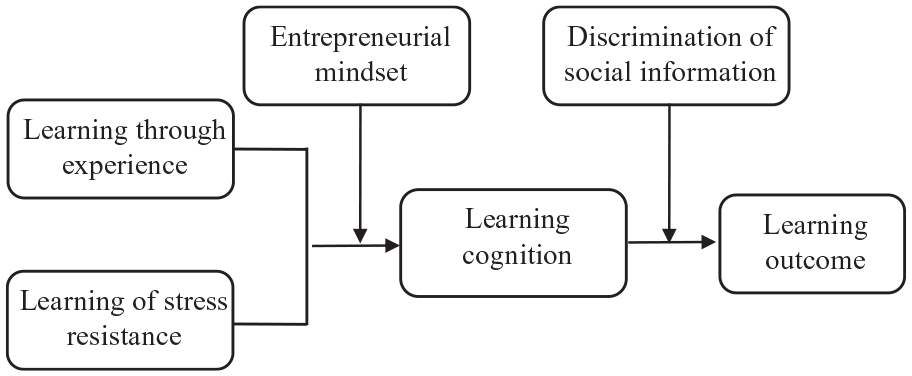
Theoretical model.
Literature Review and Hypotheses Development
Literature Review
Science education is defined as “creative education to foster the future needs of society” (Bayram-Jacobs, 2015). Actually, scientific knowledge is used to establish a convenient life environment and society, which makes it important work in today’s society. Based on the above, we need to foster more scientists. To foster scientists, science education is deemed a critical element. Therefore, from primary school to higher education institutions, science education is ubiquitous. Science education in primary school usually focuses on the learning of basic scientific knowledge (Appleton, 2003); students learn under a fun atmosphere but do not understand how to use this scientific knowledge. In junior and senior high schools, science education focuses on learning scientific principles and concepts (Hastuti et al., 2018). However, different countries may have different learning activities. For example, the Korean science education also adds a curriculum based on science in everyday life, whereas the United States incorporates more scientific experimental courses to ensure that students understand practical scientific knowledge (Choi & Choi, 2016). In higher education, science education focuses on professional education, guiding students to learn advanced scientific knowledge and exploring how to apply this scientific knowledge (Martin, 2019).
However, Engeström (2017) finds that when students finish their science education, they are still confused about how to use their scientific knowledge for life improvement and why they needed to learn scientific knowledge. Students of professional science education have a particularly difficulty time understanding how to plan their career development, and they have difficulty encountering related job positions that require scientific knowledge. Therefore, an increasing number of students in professional science education reflect on their learning as being not meaningful. However, this does not mean that learning scientific knowledge is meaningless. Actually, too much scientific knowledge remains in the academic community, and this scientific knowledge is not widely applied in our lives. That is why when students finish their learning, the learning of scientific knowledge still seems meaningless. Based on the above, if students are encouraged to establish a professional business organization based on scientific knowledge and to further solve or satisfy the future needs of society, this will not only help students understand the meaning and contribution of scientific knowledge but also guide students in understanding its practical value and establishing a convenient environment for both their own life and society. For this reason, promoting science entrepreneurship has recently become an important direction in colleges.
What is science entrepreneurship? According to Lehrer and Asakawa (2004), science entrepreneurship is a simultaneous dedication of scientists to academic science and to commercial profit. Successful science entrepreneurship not only increases national science and technology development but also pushes economic growth and national competitiveness, including that related to our lifestyle conveniences. Therefore, advanced countries such as the United States have discovered the importance of science entrepreneurship and thus positively promote science entrepreneurship (Tobias & Sims, 2006).
To promote science entrepreneurship, universities play a critical role. Specifically, universities can teach more scientific knowledge and thereby increase innovation and creativity capabilities through related education programs. In addition, they can also provide entrepreneurship education resources or programs to guide students in how to start up a new venture. Most important, young students are brave enough to make such attempts and have more innovative ideas and thinking. Therefore, if these students can both maintain a great level of scientific knowledge and have entrepreneurship intentions, they can be easily encouraged to attempt science entrepreneurship. For this reason, some advanced countries, such as the United States, Japan, and Germany, have established a complete entrepreneurship education system to encourage and help their students attempt science entrepreneurship (Lehrer & Asakawa, 2004). In their entrepreneurship education system, in addition to teaching how to combine scientific knowledge, innovation, and creativity to develop entrepreneurship direction, these countries have also designed a related business education course to help students know how to operate and manage a new venture (Rosa & Dawson, 2006).
However, in reality, most students actually resist learning-related business management knowledge. These students believe that innovation and creativity capabilities are critical to entrepreneurship; if these two capabilities can be combined with scientific knowledge, then a new venture with high competitiveness will be established. In addition, if the students engage in a combined business knowledge course, they need to bear a heavy learning pressure. Based on the above information, it is evident why most students have incorrect learning cognition. Is business management knowledge not necessary? Johansson and Karlsson (2009) believe that knowledge of science, innovation, creativity, and business management complement each other in science entrepreneurship, as seen with Mark Zuckerberg, the founder of Facebook. Although he has a vast knowledge of web technology and innovative ideas related to social networking sites, due to his lack of business management knowledge, he initially encountered operation and management challenges.
In light of this difficulty, few researchers have begun to become aware of the problem and have started to explore how to change students’ cognition. For example, Ghobril et al. (2016) explored the case of the Illinois Institute of Technology and further provided an education model to change students’ incorrect cognition, which is called the strategy, structure, and process model. The strategy aspect consists of creating a strong entrepreneurial culture by offering opportunities for student entrepreneurship through hands-on projects in education programs. This means that students will have the chance to simulate real entrepreneurship. The structure aspect refers to the fact that the institute will provide a business incubator, entrepreneurship center, and external experts to support the above strategy, especially the simulation. The process aspect refers to the transition from academic courses to real simulation. Based on the above, the model has a positive effect on changing students’ learning cognition. Students become aware of the importance of business management knowledge and try to bear a heavy learning pressure. Barron and Amorós (2019) also provided an approach to changing students’ cognition. They indicated that science entrepreneurship education programs should invite experts in the business and science fields to validate students’ ideas in the market. Actually, these experts have a deep well of experience, and their opinions and suggestions can help students understand the importance of business management knowledge in addition to scientific knowledge.
However, few researchers have provided suggestions for changing students’ incorrect cognition processes even though problems still exist. First, the current research never reminds students to bear up under a heavy learning pressure. Second, these researchers believe that connecting students with external experts will help students to understand the importance and necessity of business management knowledge. Although connecting students with experts is absolutely a good approach, such experts are usually from industry sectors. In real-life situations, the intention levels of these experts is usually lower due to their heavy workloads. Thus, if colleges extend invitations to them, the majority of experts are unlikely to accept them. Therefore, the concept of attending experts is always a difficult problem. Based on the above, the issue of how to change students’ incorrect learning cognition process remains a gap in the existing studies.
Hypotheses Development
Based on this gap in the existing studies, this study attempts to develop a theoretical model that fills this gap. Based on the theoretical model of Figure 1, this section presents several research hypotheses.
Regarding the relationships among learning through experience, learning for stress resistance, and learning cognition, Black et al. (2014) and Kakouris and Georgiadis (2016) note that learning from experience helps students understand a real-life entrepreneurship situation. When colleges and other institutions of higher learning use simulations to immerse students in the entrepreneurship process, students become aware of the real problems related to entrepreneurship. Zeng and Honig (2016) further indicate that different experiences help students understand what capabilities they require to address problems that occur during the entrepreneurship process. Therefore, a small number of researchers, such as Winkler (2014) and Bing and Ji (2015), believe that learning through experience can drive students’ learning cognition change.
In addition, learning for stress resistance may be another means by which to change student learning cognition. Yu and Jia (2014) indicate that high learning pressure results in a negative student learning cognition. However, Yu and Jia only examine the problem in terms of the general learning process. In entrepreneurship education, students must learn a large body of knowledge. Therefore, they obviously experience substantial learning pressure. To ensure that students can improve their knowledge and address any problem that may occur during future entrepreneurship situations, researchers such as Kingston (2008) and Lackéus and Middleton (2018) believe that colleges or teachers should create a “pressure cooker” with which to educate students, increase their durability under substantial learning pressure, and maintain their positive learning cognition to improve their entrepreneurship knowledge. Therefore, we infer a relationship between learning through experience, learning for stress resistance, and learning cognition in science entrepreneurship education, and we develop the two hypotheses as follows for verification:
Regarding the relationship between learning cognition and learning outcomes, Gedeon (2014) and Hunter and Lean (2018) indicate that if students’ learning cognition in the entrepreneurship education process is positive, they will work harder to learn related knowledge, their learning outcome will be improved, and the improved outcome will reflect on the entrepreneurship outcome. In addition, Padma and Sridhar (2016) indicate that a positive learning cognition will result in positive learning behavior and a positive learning attitude, which will have a positive effect on improving the learning outcome. Therefore, we infer a relationship between learning cognition in science entrepreneurship education and the learning outcomes, and we develop the following hypothesis for verification:
Regarding the mediating effect of the entrepreneurial mindset, Rae and Melton (2017) indicate that the entrepreneurial mindset is developed through effective learning and education. If an entrepreneurial mindset emerges, Costa et al. (2018) argue that it will positively affect learning cognition in entrepreneurship education. More precisely, an entrepreneurial mindset means the student has developed an awareness of entrepreneurship. Therefore, the student understands what knowledge and skills are required for entrepreneurship. Laurikainen et al. (2018) indicate that when colleges or teachers foster students’ entrepreneurial mindset, it has a positive effect on improving students’ learning cognition. In addition, Nadelson et al. (2018) indicate that if students have positive and higher level entrepreneurial mindsets, then learning any necessary knowledge is good not only for changing their incorrect cognition process but also to transcend related knowledge learning, such as business knowledge, to enhance the effect of more meaningful learning activities under the science entrepreneurship learning process. This means that if the entrepreneurship mindset certainly mediates the relationship among learning through experience, learning for stress resistance, and learning cognition, then it will enhance the effect of learning through experience and learning for stress resistance and absolutely change students’ learning cognition and even create a more positive learning effect. Thus, the entrepreneurial mindset may have a mediating effect. Therefore, we propose the following hypothesis for verification:
Regarding the moderating effect of the discrimination of social information, according to Aubé and Rousseau (2016), social information is a form of public opinion, which has an influence on changing people’s thinking and attitudes. In fact, entrepreneurship has become a popular topic in recent years. Thus, we frequently encounter news reports that discuss entrepreneurship. Such reports describe successful cases as well as failures. However, people are easily misled by jaundiced reports and can subsequently spread jaundiced opinions. According to Alcaraz-Rodríguez et al. (2014), if students can discriminate valuable opinions or information and learn from, think about, or even follow such opinions or information, this can strengthen the learning outcome of their entrepreneurship education. However, if students find it hard to discriminate valuable opinions within social information, they will fear becoming or even hesitant to continue seeking to be entrepreneurs. Finally, even if they have a positive learning cognition, due to fear and hesitation, their learning outcomes will be affected, and they will not improve (Wu, 2018). Therefore, we infer that the discrimination of social information functions as a moderator. In science entrepreneurship education, this moderator may affect the relationship between learning cognition and the learning outcome. Thus, we develop the following hypothesis for verification:
Method
Questionnaire Construction, Data Collection, and Sample Profile
To verify the theoretical model, we developed a focused questionnaire. For the variables of the theoretical model, we designed six constructs: learning through experience (LE), learning for stress resistance (SR), learning cognition (LC), learning outcome (LO), entrepreneurial mindset (EM), and discrimination of social information (DS). Each construct was assessed using four items. The constructs, sources of the design elements, and scale items are listed in Table 1. Operationalization is also shown in Table 1. In the data collection, we used 5-point Likert-type scales.
Questionnaire Constructs.

For data collection purposes, Chinese colleges were studied. How did we select these investigation samples? Specifically, in China, to promote and enhance entrepreneurship education, most colleges usually establish an “entrepreneurship education program.” China’s Ministry of Education usually measures the performance of these entrepreneurship education programs every year and announces the top 50 models. We observed the top 50 models of 2019, paying particular attention to how science entrepreneurship was involved in their education program. Therefore, the entrepreneurship programs of these colleges became the main investigation targets. We used simple random sampling to send 10 questionnaires to teachers at the entrepreneurship programs of each college, as these teachers are responsible for the related courses or projects in their science entrepreneurship education programs. We distributed 500 questionnaires and received 263 responses, for a 52.6% response rate. In the sample profile, 13.69% of the respondents had been teachers of science entrepreneurship for less than 1 year, 30.8% had been teachers of science entrepreneurship education for the last 3 years, 17.11% had been teachers of science entrepreneurship for more than 3 years but less than 5 years, 9.13% had been teachers of science entrepreneurship for more than 5 years but less than 7 years, and 28.9% had more than 7 years of experience teaching such courses. In addition, 30.04% of the respondents held the position of professor, 47.91% were associate professors, and 21.67% were assistant professors or senior lecturers.
Normality Tests
To ensure data quality and valid research results, all the samples were tested for normality. This study tested normality through five methods, including mean, standard deviation, variance, skewness, and kurtosis. To avoid a judgment error, the judgment of normality does not depend on a single method, which is why we used five methods. The test results of the mean, standard deviation, variance, skewness, and kurtosis are shown in Table 2. According to binti Yusoff and Wah (2012), value of mean should close median and value of standard deviation and variance should close 0. Test results seem to satisfy requirement; however, we still need to combine the values of skewness and kurtosis to judge the normality. Exactly, the measurement standard of skewness and kurtosis should be between 1 and −1. However, DiStefano and Morgan (2014) indicated that, if values of skewness and kurtosis are ±3 and ±7 when the research framework is path analysis, then that is acceptance range. According to the test results, all the item test results can be deemed to satisfy the requirements for normality.
Normality Test Results.

Research Method
This study adopted the partial least squares (PLS) method to verify the theoretical model and hypotheses. According to Sosik et al. (2009), PLS is a powerful method for evaluating the relationship paths between variables. More precisely, it can generate estimates of standardized regression coefficients for the paths between variables. Therefore, most researchers typically adopt this method to test their theoretical models and hypotheses. In addition, PLS can be used to analyze and test mediating and moderating effects. Therefore, its analysis capability is widely acknowledged. In this study, PLS analysis was performed using SmartPLS 3.0.
Before testing the theoretical model and hypotheses, a questionnaire was first developed to address and measure the needs of this study. In addition, we designed six constructs (factors) for the questionnaire to measure the research questions. Therefore, an explanatory factor analysis (EFA) needed to be used to ensure that the scale items (observed variables) of each construct certainly belong to the same construct. In the EFA, we used the eigenvalue to observe the EFA outcomes. The eigenvalue is a measure of how much of the variance of the observed variables a factor explains (Ledesma & Valero-Mora, 2007). Any factor with an eigenvalue ≥1 explains more variance than a single observed variable (Harman, 1976).
Then, the validity and reliability of the constructs needed to be tested. In testing construct validity, factor loadings and average variance extracted (AVE) values were the primary indices. In establishing reliability, composite reliability (C.R.) and Cronbach’s α were the primary indices. Regarding the requirements of the indices, according to Hasan and Ali (2007) and Hair et al. (2011), all the factor loadings for the same factor should exceed .5, the C.R. should exceed .7, the AVE must exceed .5, and Cronbach’s α should exceed .7. All the test results are shown in Table 3. As shown in the table, all the indices satisfy the requirements of Hasan and Ali (2007) and Hair et al. (2011). Thus, the test results are acceptable. In addition to validity and reliability, the model fit should satisfy the requirement related to the recommendation value. In this study, the standardized root mean square residual (SRMR) was the main index of model fit, and it was lower than .05.
Test Results for Construct Validity and Reliability.

Note. AVE = average variance extracted; C.R. = composite reliability.
In addition to PLS, this study used the Sobel test to test for a mediating effect. According to Hayes (2009), large samples may cause a mediating effect testing error when PLS is used. However, the Sobel test can resolve this issue. To test the mediating effect through the Sobel test, Preacher and Leonardelli have developed a tool that is freely available on the web at http://quantpsy.org/sobel/sobel.htm. Researchers are only required to provide the path coefficient from their PLS calculative results, and the tool calculates and provides more precise results regarding the mediation effect.
Finally, we needed to measure the model’s goodness of fit. According to Andrei et al. (2017), the SRMR is reported to be an approximate measure of model goodness of fit. Therefore, the SRMR was used as the main index of goodness of fit.
Research Results
Before we analyzed and verified our research hypotheses, we tested for EFA, construct validity, and reliability. Regarding the EFA test results, the eigenvalue of LE was 2.776, and its explained variance rate was 69.395%; the eigenvalue of SR was 2.846, and its explained variance rate was 71.145%; the eigenvalue of LC was 2.861, and its explained variance rate was 71.537%; the eigenvalue of LO was 2.689, and its explained variance rate was 67.234%; the eigenvalue of EM was 2.928, and its explained variance rate was 73.208%; and the eigenvalue of DS was 2.949, and its explained variance rate was 73.714%. Regarding the test results of construct validity and reliability, all the test results are shown in Table 3, and all the test results satisfy the necessary requirements.
Next, we tested the research hypotheses. SmartPLS 3.0 was the primary analysis tool. Following the suggestions of Hair et al. (2011), we performed a bootstrapping procedure (with 5,000 subsamples) to test the statistical significance of each path coefficient of the theoretical model using t-tests. In addition, we used PLS to detect the moderating effect of the discrimination of social information on the relationship between learning cognition in science entrepreneurship education and the learning outcomes. For the mediating effect of the entrepreneurial mindset, in addition to testing two paths (i.e., learning through experience × entrepreneurial mindset × learning cognition; learning for stress resistance × entrepreneurial mindset × learning cognition), we also used the Sobel test to verify the mediation effect of the entrepreneurial mindset.
All test results are shown in Figures 2 and 3. As shown in Figure 2, we found that the path coefficient between learning through experience and learning cognition is 6.897, with a p value lower than .01. In addition, the path coefficient between learning for stress resistance and learning cognition was 2.327, with a p value also lower than .05. Therefore, Hypotheses 1a and 1b were supported. For the relationship between learning cognition and learning outcomes, the path coefficient was 5.284, with a p value lower than .01. Thus, Hypothesis 2 was supported.
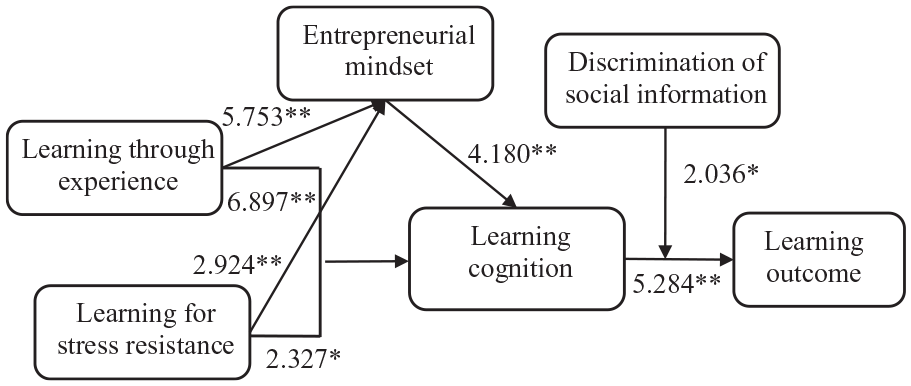
Results of path analysis.
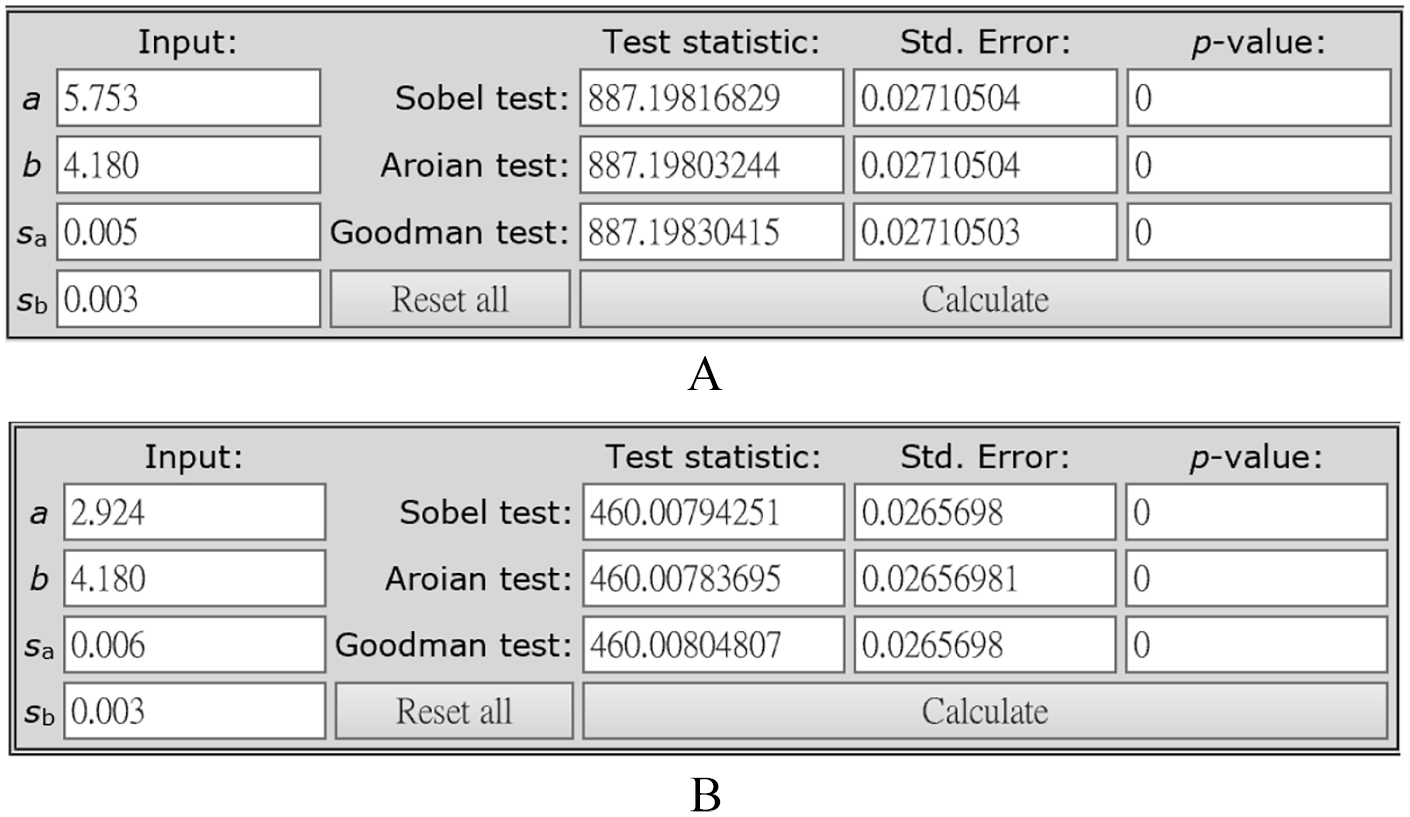
Sobel test results. (A) Learning through experience × entrepreneurial mindset × learning cognition. (B) Learning for stress resistance × entrepreneurial mindset × learning cognition.
Regarding the mediating effect of the entrepreneurial mindset, we first used PLS to verify whether there was such an effect. We sought to verify learning through experience × entrepreneurial mindset × learning cognition and learning for stress resistance × entrepreneurial mindset × learning cognition. The verification results reveal three path coefficients, including 5.753 (learning through experience × entrepreneurial mindset), 4.180 (entrepreneurial mindset × learning cognition), and 2.924 (learning for stress resistance × entrepreneurial mindset). All the p values were lower than .01. Therefore, Hypothesis 3 was supported. However, to ensure the validity of the test results, we applied the Sobel test. As shown in Figure 3, the p values of the paths between learning through experience, learning for stress resistance, entrepreneurial mindset, and learning cognition were lower than .01. Therefore, Hypothesis 3 was supported.
Finally, the path coefficient between discrimination of social information, learning cognition, and learning outcomes was 2.036, with a p value lower than .05. Thus, Hypothesis 4 was supported; that is, the discrimination of social information has a moderating effect.
Regarding the goodness of fit of the model, the SRMR is .048 and is lower than .08. Thus, the model’s fit is also accepted, and satisfies the requirement of SRMR.
Discussion
This section discusses the test results. According to the test results, learning through experience is a necessity. Based on our test results, learning through experience can predict to change students’ learning cognition and improve the learning outcome. Our test results are in fact reasonable. Increasingly more institutions of higher education in various countries, such as China and the United States, are becoming aware of the importance of experience and have designed experiential environments for teaching purposes. A small number of European institutions of higher education have also developed entrepreneurship experience environments. These teaching environments seek to provide a realistic experiential environment through games, service learning, and attending entrepreneurs’ daily planning sessions and have demonstrated a clear positive effect of learning through experience. More students have come to understand the need for entrepreneurship knowledge and have had their learning cognition process changed. Therefore, certain researchers, such as Carayannis et al. (2016) and Sulich et al. (2017), have investigated specific institutions that have implemented experiential teaching for students of science entrepreneurship over a long period. These researchers have found that such learning clearly changes students’ learning cognition and improves learning outcomes. Such students typically exhibit greater entrepreneurship performance. Thus, learning through experience represents a necessary teaching approach.
In addition to the importance of learning through experience, our test results indicate the necessity of learning for stress resistance. Science entrepreneurship education typically involves substantial learning pressure. If students lack the ability to resist such pressure, they may be unable to withstand the heavy knowledge burden of the learning process. In fact, learning pressure has recently begun to receive increased research attention. A number of studies have investigated how to decrease learning pressure, such as Arpiainen and Tynjälä (2017). However, it is frequently impossible to decrease such pressure. Therefore, to help students adapt, they should be made aware of the necessity of such pressure and encouraged to accept it. If resistance to learning stress can be gradually improved through learning, students can learn to bear up under a heavy learning pressure. In these times, students can be required to learn large bodies of knowledge under pressure.
In addition to the relationships among learning through experience, learning for stress resistance, learning cognition, and learning outcomes, our test results reveal that an entrepreneurial mindset mediates the relationships among learning through experience, learning for stress resistance, and learning cognition. In fact, the entrepreneurial mindset is generally viewed as an important factor in entrepreneurship education. Researchers such as Ridley (2016) and Bosman and Fernhaber (2018) indicate that the entrepreneurial mindset can be understood in terms of entrepreneurship intention. According to Pfeifer et al. (2016), if a student has a strong intention to be an entrepreneur, the student will accept any entrepreneurship education and endeavor to learn related knowledge. Therefore, the entrepreneurial mindset is typically regarded as an activator by which to change students’ learning cognition. In this study, an incorrect learning cognition results from a lack of practical experience and large learning pressure. This study demonstrates that teachers or colleges can adopt learning through experience and learning for stress resistance to change students’ learning cognition processes. If one considers the influence and characteristics of the entrepreneurial mindset, it certainly appears possible that such a mindset can mediate the relationships among learning through experience, learning for stress resistance, and learning cognition. However, there is a big challenge regarding the formation of an entrepreneurship mindset. According to Nadelson et al. (2018), the formation of an entrepreneurship mindset usually depends on the knowledge of the faculty members and uses a rich course design to guide the formation of a high-level entrepreneurship mindset. Therefore, in the design of experience-related courses and stress resistance, in addition to colleges needing to ensure that the knowledge of faculty members can guide students to form a positive entrepreneurship mindset, colleges need to ensure that course design is also highlighted. However, this study only explores the mediating effect of the entrepreneurship mindset and lacks an exploration of how to improve the knowledge of faculty members and design a rich course to guide the formation of a high-level entrepreneurship mindset. Therefore, future research can deeply explore the above issues. Specifically, as Nadelson noted, the formation of an entrepreneurship mindset plays a critical role in the entrepreneurship learning process.
Finally, although learning cognition can be changed through learning through experience, learning for stress resistance, and the mediating effect of the entrepreneurial mindset, our test results indicate that if students find it hard to discriminate social information, their learning outcomes will still be affected even if the students maintain a positive learning cognition. As defined in this study, social information resembles public opinion. However, public opinion typically exhibits personal subjective characteristics and involves irrational criticism. In fact, because entrepreneurship has become widespread in today’s society, increasingly more people are interested in cases of failure among young entrepreneurs. Students can obtain valuable suggestions from such cases. However, social information includes subjective and irrational opinions. If students cannot discriminate which opinions are valuable among such subjective and irrational opinions, they may fear or be hesitant to become involved in entrepreneurship. Therefore, although students may have a positive learning cognition and strive to learn more regarding the requirements of entrepreneurship, they will find it difficult to produce a greater learning outcome.
Conclusion
This study’s purpose was to investigate the relationships among learning through experience, learning for stress resistance, learning cognition, learning outcomes, the entrepreneurial mindset, and the discrimination of social information. According to our test results, in addition to learning through experience, learning for stress resistance can change students’ learning cognition in science entrepreneurship education and improve their learning outcomes. We also found that the entrepreneurial mindset mediates the relationships among learning through experience, learning for stress resistance, and learning cognition. Finally, we also found that the discrimination of social information has a moderating effect on the relationship between learning cognition and learning outcomes. That is, even if the learning cognition is positive, if students find it hard to discriminate valuable social information, their learning outcomes will not satisfy their expectations, which will increase the entrepreneurship failure rate.
Our research results have significant academic and practical implications. The literature on science entrepreneurship typically focuses on improving innovation and creativity. A small number of studies have noted the importance of improving learning cognition and the influence of learning through experience and learning for stress resistance on learning cognition improvement. However, empirical analyses are lacking. Therefore, this study contributes to closing that research gap. In addition, the entrepreneurial mindset and the discrimination of social information are generally discussed independently. Although a few studies have noted their influence on learning cognition change and learning outcomes, these studies have failed to verify the existence of this influence. Therefore, this study tried to determine the factors’ mediating and moderating effects. Thus, our test results extend the scope of the literature. Regarding our study’s practical implications, in fact, increasingly more colleges and universities are seeking to improve science entrepreneurship. However, success has been achieved in only a few cases. Although these institutions recognize that students’ learning cognition in science entrepreneurship learning is the primary problem, they remain confused regarding how to improve and change students’ learning cognition processes. Our research results provide valuable suggestions for such institutions and their teachers regarding how to design an effective experiential environment and content for stress resistance learning. In addition, our results can help teachers understand how to improve students’ entrepreneurial mindset to improve their learning cognition, thus improving the success rate of their science entrepreneurship.
Against this backdrop, this study used empirical tests to verify the relationships among learning through experience, learning for stress resistance, learning cognition, and learning outcomes. In addition, we verified the mediating effect of the entrepreneurial mindset and the moderating effect of the discrimination of social information. However, this study has several limitations. First, we use an exclusively Chinese sample. Therefore, our analysis results may only reflect Chinese circumstances. Second, although our research results indicate that learning through experience and learning for stress resistance can change learning cognition and that the entrepreneurial mindset mediates the relationship between these variables, we do not investigate or discuss how to design an experiential environment, how to educate students to resist stress, or how to improve the entrepreneurial mindset. In addition, the constrained knowledge of the faculty members may be due to the lack of a broader consideration of the entrepreneurial mindset. This study lacked the ability to explore and discuss how to solve this issue. However, an increasing number of researchers and colleges have also recently discovered this problem and are aware of its influence. Based on the above information, future research can deeply explore this issue and provide approaches for a solution.
Footnotes
Declaration of Conflicting Interests
The author(s) declared no potential conflicts of interest with respect to the research, authorship, and/or publication of this article.
Funding
The author(s) disclosed receipt of the following financial support for the research, authorship, and/or publication of this article: This work was supported by the Ministry of Education (MOE, in China) project of humanities and social sciences under Grant 18YJAZH006.
