




Abstract
The purpose of this study was to investigate the use and importance of project management (PM) methods in organizing sports events (SEs). Furthermore, the study analyzed differences in usage and importance of PM methods in relation to the type of SE. Finally, reasons for and obstacles to the implementation of PM methods in organizing SEs were identified. To assess the research questions, a quantitative survey (n = 78) and a focus group discussion (n = 5) were carried out. The results showed that PM methods were employed for SEs with higher usage and importance rates in large compared with small SEs. Requirements by event stakeholders, knowledge transfer, confidence building, progress control, and justification as well as opportunities to save money by introducing an improved planning process were identified as the main reasons for using PM in the organization of SEs. This study is the first work to provide an overview of the usage of specific PM methods in organizing SEs.
Introduction
History has revealed how important sports events (SEs) are, recounting the role they have played in the development of society and the many communities on our planet (Masterman, 2009). SEs are different from non-SEs. According to Greenwell et al. (2014), they differ from other events “in the sense that some form of competition involving physical prowess is involved” (p. 7). Furthermore, the emotional component makes SEs unique, and indeed, this characteristic becomes essential for commercial and marketing purposes of events themselves, having considerable economic implications and other impacts. Attending SEs is a popular leisure activity (Crawford, 2004). Their rising popularity is a global phenomenon, resulting in more and bigger events being established worldwide to profit from the associated economic potential (Preuss, 2015). SEs are characterized by their complexity and time restrictions: SEs involve many stakeholders and cannot be easily shifted, especially due to athletes’ competition calendar (Cuskelly et al., 2006; Hall, 2006; Parent & Smith-Swan, 2013). However, in recent times, facing the coronavirus disease (COVID-19) crisis, mega events such as the Tokyo 2020 Olympic Games have been postponed, adding a new challenge to the event industry in general and to event managers in particular. Across all industries, project management (PM) and PM methods are in wide use, and it has been shown that PM methods promote project success (Papke-Shields et al., 2010; White & Fortune, 2002). However, only very limited empirical research has been carried out on using PM in SE (Cserháti & Szabó, 2014; Emery, 2010). To the best of our knowledge, no study has yet elaborated on PM methods used in the planning and staging of SEs. One reason for this might be that many people involved in sports—including those involved in the management of SEs—perform their tasks on a voluntary basis (Allen & Bartle, 2014). Besides, most SEs are manageable in size (Bowdin et al., 2010), and organizers may not feel the need of implementing PM methods. In recent years, the organization of SEs seems to have become some kind of self-evident phenomenon; however, some external circumstances have changed and keep on changing. The lack of residents’ support for SEs (Ma et al., 2013) or the current COVID-19 crisis (Gössling et al., 2020), for example, may increase the need of more thorough PM. Due to uncertainties like these, professional SE management seems to be essential, and applying PM methods is very likely to become more important in the future. Thus, the first aim of this study was to investigate the use and importance of PM methods in the organization of SEs (Research Question 1 [RQ1]). Second, this study identified differences in usage and importance of PM methods depending on the type of SE such as small versus large events or recurring versus one-off events (Research Question 2 [RQ2]). Finally, the study pinpointed reasons for and obstacles hindering the implementation of PM methods in organizing SEs (Research Question 3 [RQ3]).
Literature Review
Characterization of SEs
SEs are generally categorized by their size as mega events and non-mega events, major events, small-scale events, and so on (Fourie & Santana-Gallego, 2011; Gibson et al., 2012; Taks et al., 2015). Common size indicators are the number of visits and the visitor appeal, the number of journalists and extent of media coverage, the total budget and costs, the number of participants and volunteers involved, and the transformative impact; however, scholarly literature offers no common definition or criteria for classifying the size of SEs. Also other aspects may distinguish different types of SEs, including one-off versus recurring events, indoor versus outdoor events, or single-SE versus multi-SEs (Parent & Smith-Swan, 2013).
In an organizational context, SEs can be characterized by their complexity, time restrictions, and their predetermined life cycle from start to finish (Parent & Smith-Swan, 2013). As SEs normally take place in public, the interests of many stakeholders—for example, athletes, officials, volunteers, spectators, authorities, sponsors, residents, and media—need to be considered (Cuskelly et al., 2006; Hall, 2006). In outdoor sports, the dependency on the weather adds further complexity (Moran, 2001). Moreover, most SEs, such as the Olympic Games, World Cups, and International Sports Federation Championships, are held at predefined intervals; they must match athletes’ competition calendar and allocated media slots; therefore, they cannot easily be shifted. However, the recent COVID-19 crisis has shown that even mega events like the Olympic Games or 2020 UEFA European Football Championship may have to be postponed. Previous literature has mentioned further reasons for postponing or canceling SEs, including floods, earthquakes, war, terrorism, strikes, or civil disorder (Rutherford Silvers, 2008). Nevertheless, meeting deadlines is crucial to the success of SEs (Billings et al., 1998; Eastman & Meyer, 1989; Parent & Smith-Swan, 2013). Due to the time-criticalness (Bowdin et al., 2010) and their complexity, SEs are viewed as projects from an organizational perspective.
PM and Project Success
It is well documented that PM and the use of PM methods are common in complex construction, engineering, finance, information technology, manufacturing, research and development, and software development projects (Besner & Hobbs, 2013; Carvalho et al., 2015; Munns & Bjeirmi, 1996; Papke-Shields et al., 2010; White & Fortune, 2002). Richardson et al. (2015) emphasized that a successful project implies a clear definition of the mission and the project team that must be supported by the organization itself throughout all phases. As SEs are projects, typical project phases that derive from traditional PM terminology—for example, initiation, planning, implementation, and closure—apply also for this kind of events (Rutherford Silvers, 2008). Initiatives like the Event Management Body of Knowledge (EMBOK), which has been established over the past years, have revealed the importance of PM in SEs and have been discussed in the literature (Bowdin et al., 2010; Goldblatt, 2014; O’Toole, 2011; Rutherford Silvers, 2004, 2008). In particular, Goldblatt (2014) stated that using a PM system helps to establish a systematic approach in all kinds of events. Similarly, the importance of PM is discussed in the framework of coordination and the efficient, effective management of events (Rutherford Silvers, 2004). However, the experience and maturity of the PM team are considered essential assets for PM and event success.
After interviewing 236 project managers on their use of PM methods, White and Fortune (2002) counted 1,210 different methods, tools, and techniques. In his global PM handbook, Gareis (2006) suggested 61 universal PM methods grouped in six categories: start (e.g., milestone plan, project name), coordination (e.g., meeting minutes, to-do lists), controlling (e.g., progress reports, score cards), resolving project discontinuities (e.g., definition of project discontinuity, cause analysis), close-down (e.g., close-down report, closing cost center), and designing PM process (e.g., kick-off meeting, project workshop). All of the named methods were classified as “can” or “must” methods and recommended for the use in small and large projects, with fewer methods being obligatory for small projects to ensure that management complexity matches project complexity (Gareis, 2006). Empirical research has confirmed that large projects and projects in mature organizations employ more PM methods, although “the most often and the least often used tools are almost invariably the same regardless of project characteristics and contexts” (Besner & Hobbs, 2008, p. 31). Besner and Hobbs (2013) supported their previous findings by claiming that there are “general best practices” for most projects, although the use of some methods differs between project contexts.
In an empirical study covering 136 companies, Papke-Shields et al. (2010) revealed that “deploying formal PM practices will increase project success” (p. 659), regardless of the industry type or organization size. This is in line with the results by Crawford and Pollack (2007), who stated that PM knowledge does not differ between industry sectors. Besner and Hobbs (2006) interviewed 753 PM professionals and concluded that PM methods relating to organizational learning and know-how transfer show “the greatest potential for improving project performance” (p. 46); furthermore, PM methods were found to be more highly valued in large projects for external customers than in smaller, internal projects.
PM-Related Research in the Context of SE
Pielichaty et al. (2017) highlighted the importance of applying PM theories and techniques to the event sector mainly to define the processes and objectives of the project itself. Although SEs are typical projects, and empirical studies for various industries have shown that the use of PM and PM methods contributes to project success, hardly any research exists on PM for SEs. An exception is the work of Muir (1986), who recommended the use of PM for successfully conducting SEs more than 30 years ago. O’Toole (2000) broached this topic again, pointing out that the event industry has become aware of the opportunities and multiple solutions that an PM-based approach can bring. Based on a survey of 178 senior sports managers and 10 structured interviews, Emery (2010) concluded that SE management has evolved from “enthusiastic amateur principles” toward “professional management.” Going more into detail, Parent (2008, 2010) highlighted the importance of PM in the decision-making process in event management, and Parent and Smith-Swan (2013) underlined the crucial role of PM in the SE planning process. Another rare case is the study of Dugalić (2013), which shows the implementation of the critical path method (CPM). However, Dugalić (2013) concluded that PM within SEs is yet to find wide application. Cserháti and Szabó (2014) interviewed representatives from 71 sports associations and once more emphasized that “project management methods and techniques are essential in the definition and planning phases of an event” (p. 623). Finally, Rabadi et al. (2015) highlighted how important being aware of the tools needed to monitor and manage the event is. However, to the best of our knowledge, no (empirical) study has yet elaborated on the PM methods actually used in SEs.
Knowledge Transfer (KT) in SEs
Finally, the theme of KT between events of the same type or between organizers who have managed similar events even in different geographical and/or political contexts has been widely discussed as a crucial part of PM methods applied to SEs (e.g., Halbwirth & Toohey, 2001; Parent et al., 2014; Schenk et al., 2015; Toohey & Halbwirth, 2005). Using the example of the Sydney 2000 Olympic Games, the study of Halbwirth and Toohey (2001) may be considered as the starting point for KT in the context of SEs. Adopting a decent program of knowledge management and transfer does not only produce a general efficiency in the organization but also guarantees future “generations” of events a potential for improvement in organizational performance (Halbwirth & Toohey, 2001). Although KT has become a matter of course for mega events, to our best of knowledge, the role of PM and KT for smaller events has not yet been examined.
Method
Contextual Background of the Study
The present study selected SEs in the Austrian-Italian Alps, as it is a highly developed touristic region, which achieves 80 to 90 million annual overnight stays and regularly hosts all kinds of SEs (Schnitzer et al., 2016). Usually, Tyrol (Austria), South Tyrol, and Trentino (both Italy) host at least 20 recurring SEs and one to two one-off events every year (e.g., 2018 UCI Road World Championships or UBI Biathlon World Championships 2020). Due to this high density of SEs and the highly developed level of tourism, these regions have much experience in managing projects.
Methodical Approach
To answer the questions that this research poses in the most effective way possible, we adopted the Explanatory Sequential Mixed Methods Design (Creswell, 2013) aimed at gaining qualitative data to interpret the results of an initial quantitative survey. In this study, insights from the precedent quantitative online survey were discussed with the focus group using a questionnaire and guided interviews. This mixed research method (Creswell, 2013; Tashakkori & Teddlie, 2003) allowed the authors to combine quantitative and qualitative data analyses in the same study. Considering the strengths and weaknesses of both research methods, this approach is desirable to achieve more consistent results when measuring hypotheses relating to a given phenomenon (Creswell, 2013). The study design and the questionnaire were approved by the Board for Ethical Questions of the Department of Sport Science of the University of Innsbruck.
Questionnaire Development
As no sports-specific PM methods have been described in the literature, we used the list of universal PM methods by Gareis (2006) as a basis for the questionnaire. The first draft was given to the expert panel (Table 1) consisting of three SE and PM specialists, who evaluated Gareis’s (2006) methods with regard to their usage in the SE sector. The main criterion in the selection process was the relevance of the respective items in an SE context. Of the original 61 items suggested by Gareis (2006), 48 were selected for this study, partly rephrased, and/or supplemented with examples to make them clearly understandable for SE professionals (e.g., “project assignment” was changed to “hosting contract”). An overview of Gareis’s (2006) PM methods, including recommendations for usage and the corresponding sports-specific methods as well as the methods we excluded from the questionnaire, is provided as Supplementary Material.
EPM and Their Gender, Age, and Qualifications.

Note. EPM = members of the expert panel; PM = project management; SEs = sports events.
Sample Online Survey
The online questionnaire was administered via the SosciSurvey platform and submitted to 167 organizing committees of SEs in three different geographical areas (Tyrol, South Tyrol, and Trentino). The contacts were selected in consultation with the sports departments of the three regions to include all relevant SEs hosted between 2001 and 2021. A total of 85 complete data sets were obtained between May 5, 2018, and June 29, 2018 (response rate = 51%). About 49% of the events in the sample were categorized as large SEs, whereas the remainder were small SEs based on the event size categorization of Müller and Stettler (1999). Micro-events with a budget below €30,000/event were excluded from the sample; the results showed that all of them implemented less than 50% of the proposed PM methods. The remaining 78 SEs were analyzed. About 72% of all SEs in the sample were single-sport events, 69% were recurring events, and 51% were winter SEs. Chi-square tests and Mann–Whitney U tests were used to identify differences in the use and importance of PM methods between large and small and between one-off and recurring SEs. Differences were considered significant at p < .05. SPSS Statistics Version 23 (IBM, Armonk, NY, USA) was used for all statistical calculations.
Focus Group Interviews
The results gained from the quantitative study were discussed with a panel of SE experts in a focus group. The idea behind the qualitative part of this study was to explore advantages of PM methods for SEs and obstacles to their implementation. A focus group discussion was chosen as an adequate means of gathering various views on a defined topic (Myers, 2013). It was held with five experts in PM for SEs (Table 2) on October 31, 2018. Prior to the discussion, the participants were informed in detail about the results of the online survey. The focus group discussion was led by two moderators and lasted 85 min; it was recorded digitally (with the consent of all participants) and transcribed. To analyze the data, similar themes and subcategories were created based on the categorization process by Mayring and Fenzl (2014), which follows a deductive category development. Three major themes were used to present the data: obstacles to PM for SEs, use and advantages of PM methods, and differences between event types. As the data and thus the basis for the content analysis were in German, the results of the analysis as well as quotes and statements presented in this article were translated into English. To ensure the quality and credibility of the transcription and translation process and the accuracy of the quotations, two researchers fluent in German and English were consulted during the translation process. Exemplary quotes for each category are given in the following section.
Members of the Focus Group Panel (FGE) and Their Gender, Age, and Qualifications.

FGE = members of the focus group; CEO = chief executive officer; COO = chief operating officer.
Results
Use of and Obstacles to PM Methods
The use (in %) of each PM method during the organization of SEs is shown in Figure 1. The most commonly applied methods were budget plan, event logo, and team meeting, whereas subproject assignment, bar chart, and PM software were employed least commonly. Less than one third of all methods were used in at least 80% of all considered events, and 15 of all PM methods were applied in fewer than 50% of the events.

Use of PM methods in SEs (%): Overall and separated rates for large and small projects in descending order (n = 78).
The overall usage rates were in line with the expectations of the Focus Group Experts (FGEs), as the following statement demonstrated: I am not very surprised. (FGE 5)
Only two specific methods and aspects were mentioned separately in the discussion: the unexpectedly low usage of project workshops and the low employment of PM software in SEs, which the experts tried to explain as follows: Project workshop . . . that this is not used more often—here only for one third of all events—that astonishes me. (FGE 4) Everyone works with all different kinds of software every day, but for project management (for SEs) we do not find any suitable solutions. (FGE 2)
Within the further discussion, the FGEs debated the reasons hindering the use of PM methods in the organization of SEs. Several FGEs named cultural peculiarities combined with the great importance of practical knowledge: In Europe it may be different, but when I was in Qatar, there was a project management office for every event. (FGE 3)
The high prevalence of volunteering in the organization of SEs was also discussed; it was likewise seen as an obstacle to using PM methods: Here, many SEs are organized on a part-time basis. (FGE 1) Even in big SEs, like the Four Hills Tournament in Innsbruck, no (event) professionals are involved, even though these are huge events, and all the time something is missing at the end. (FGE 4)
In addition, the FGEs saw a reason for the poor take-up of PM methods in the fact that international sports federations lack PM knowledge and approaches and are sometimes even less prepared in PM matters than local organizers themselves. The FGEs summarized that most project stakeholders or even project rights owners do not apply professional PM, as the following statement showed: Even international event rights holders do not really have a project management office . . . Also they are not very well structured or organized . . . and completely rely on the local organizing committees. (FGE 2)
Importance and Advantages of PM Methods
The importance ratings for the PM methods used in SEs are depicted in Figure 2. About 77% of the suggested PM methods were rated as important or very important for project success (importance ratings > 3.5 on a 5-point Likert-type scale), with budget plan, objectives plan, and event logo receiving the highest importance ratings. Only two PM methods—PM software and special reports—were assigned medium to low importance (importance score ≤ 3.0).
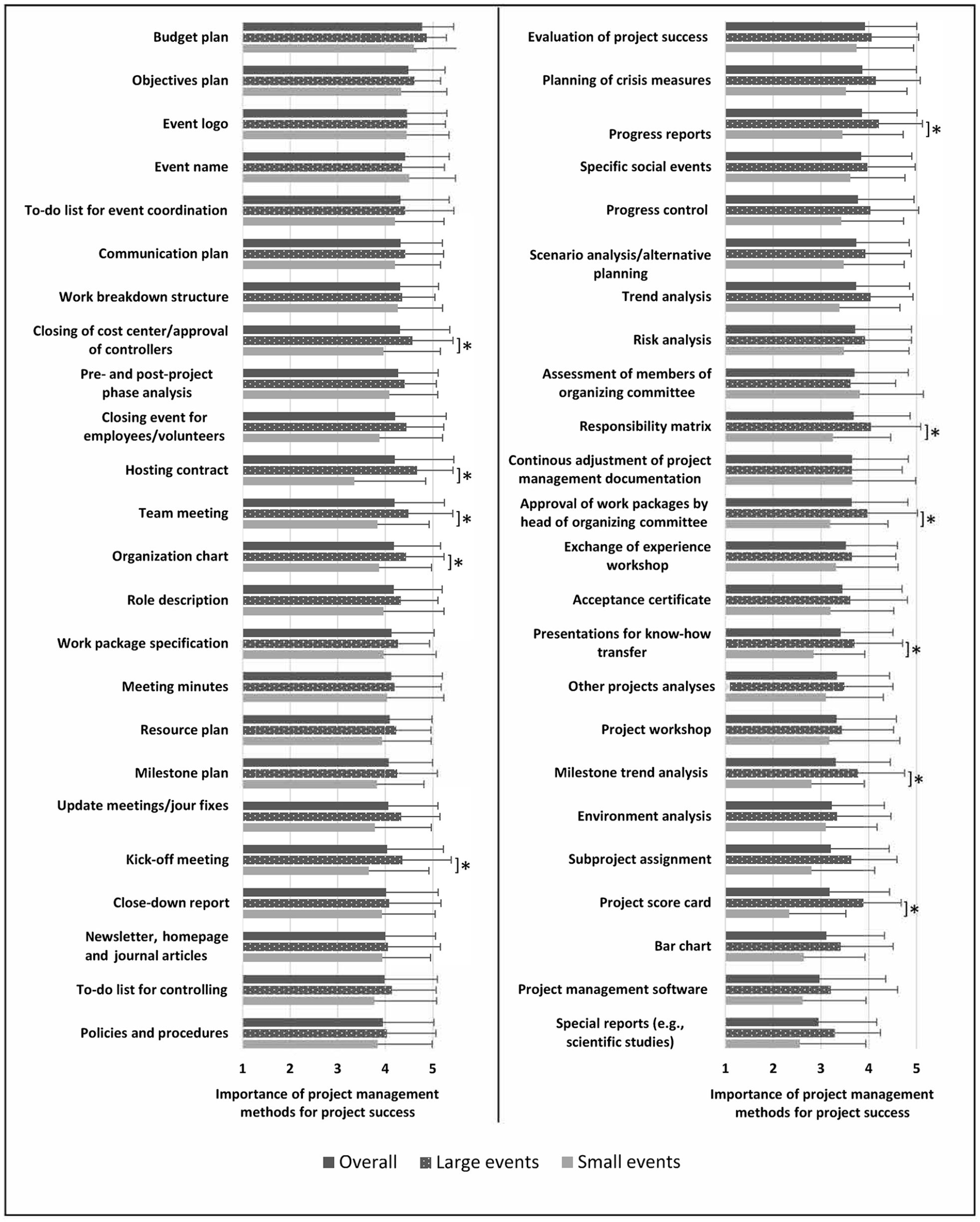
Importance of PM methods in SEs (n = 78) on a Likert-type scale ranging from 1 (unimportant) to 5 (very important).
The focus group discussed several reasons for and advantages of using PM methods in organizing SEs. They pointed out that some PM methods are required by project stakeholders and therefore have to be used: Role description, resource planning, and close-down report are examples for things that need to be delivered for sponsors, supporters, and other stakeholders or event rights holders. (FGE 2)
Implementing PM early in the planning phase helps to create clear internal structures and supports confidence building among stakeholders, as the experts mentioned: If PM can be started relatively early . . . and a basic structure is created before the event begins to grow, then it is much easier for stakeholders to follow. (FGE 3) I think that PM can reduce stress involved. (FGE 4)
Moreover, the FGEs outlined that PM is important for progress control and thus can be used as justification for the PM team: The key element of PM is progress (control). Independent of the event size, it is important to know the status . . . and to set binding milestones. (FGE 3)
Enabling and supporting KT was mentioned as another important benefit of using PM methods for SEs: In 80% of event management in Tyrol, you depend on the same partners, volunteers, and suppliers. That is why KT is enormously important . . . as a benchmark or, even more importantly, as concepts that can be re-used for different events. (FGE 2)
Due to the fact that sports is a public commodity, PM can also help to save money in planning and carrying out SEs: It lies in the nature of sports (events) that many services provided for example by the public sector or sponsors can be used for free or are very inexpensive. (FGE 4)
Differences in Usage and Importance Between Various Types of Events
On average, 29.9 ± 11.5 PM methods were employed in the organization of an SE. Significantly more PM methods were used in large than in small events (p = .002), whereas no such significant differences were found between one-off and recurring SEs (p = .219). Twelve PM methods were used significantly more often for large SEs, namely, close-down report (p = .034), role description (p = .023), resource plan (p = .023), closing events for employees/volunteers (p = .027), milestone plan (p = .040), hosting contract (p = .001), specific social events (p = .002), exchange of experience workshops (p = .007), presentations for know-how transfer (p = .001), special reports (p = .003), project score card (p = .042), and bar chart (p = .018).
As shown in Figure 2, also the importance attributed to various PM methods differed significantly between small and large SEs in some cases. Eleven methods showed significantly higher importance rankings for large events; these are closing of cost center (p = .012), hosting contract (p = .001), team meeting (p = .003), organization chart (p = .024), kick-off meeting (p = .021), progress reports (p = .014), responsibility matrix (p = .024), approval of work packages by head of organizing committee (p = .023), presentations for know-how transfer (p = .039), milestone trend analysis (p = .009), and project score card (p = .001).
The focus group’s first impressions of these results were heterogeneous: For me it is surprising that there are so few differences (between small and large SEs). (FGE 1) For me it is less unsurprising. (FGE 5)
Stakeholders’ demands and differences in the formal use of certain methods were given as reasons for why the sample did not present greater differences between small and large SEs: Even small SEs must deliver certain reports, e.g., close-down reports, for their stakeholders. (FGE 5)
Furthermore, the fact that small SEs mostly rely on the same people every year was discussed. Moreover, two FGEs claimed that the lower complexity of small SEs justifies the reduced employment of PM methods: When you have a small event, mostly the same people stay on board; mostly you have a small team, which does this (organizing the event) every year with the same people. (FGE 3) The larger an event becomes, the more important it is to establish a project manager without operative responsibilities, because otherwise it will be impossible to handle. (FGE 2)
Discussion
PM Methods
Taking the PM methods identified by Gareis (2006) as reference, our study represents some supporting and some contradicting evidence. In the category of methods for project start, budget plan is among Gareis’s (2006) “must” methods. It was also most commonly used and assigned the greatest importance in our study, and also event logo design—a “can” method according to Gareis (2006)—was ranked highly in terms of both usage and importance. Other fundamental PM techniques (O’Toole & Mikolaitis, 2002; Rutherford Silvers, 2008) and “must” methods (Gareis, 2006) such as risk analysis and milestones plans were hardly adopted and not even considered as very relevant in our sample. Within the methods for project coordination, to-do lists for event coordination were widely used (close to 85%) and perceived as very important. The methods for project controlling suggested by Gareis (2006) are key aspects in the literature and some of them appear as “must” methods; however, in our study methods such as project score card, milestone trend analysis, and acceptance certificate showed low percentages in usage and little importance. In some cases, the focus group highlighted the importance of techniques such as progress reports, progress control, exchange of experience workshop, or presentations for know-how transfer; these methods are basic for the preparation of KT and KM processes and thus for the improvement in performance (Halbwirth & Toohey, 2001; Parent & Smith-Swan, 2013). Among the PM process techniques, only team meeting was widely used, whereas the results for kick-off meetings and the adoption of PM software (just over 20%) were less consistent. In adherence to the research questions, these results allowed us to deduce some relevant implications.
Use of PM Methods in SEs (RQ1)
It was found that 29.9 ± 11.5 PM methods (of 48 suggested methods) were used in organizing SEs, generally confirming the findings of Emery (2010) and Cserháti and Szabó (2014), who stated that PM is employed in the organization of SEs. In our sample, the most commonly used methods (usage rate > 85%) were budget plan, event logo, team meeting, articles in newsletters, homepages, and journals as well as event name. Two out of the five methods most widely used in SEs (event logo and articles) are only “can” methods according to Gareis (2006), whereas designated “must” methods, including acceptance certificate, project score card, and PM software, were employed by less than one third of all SEs.
Considering that SEs, independently of their size, mostly take place in public spaces and therefore strongly depend on services delivered by external partners (water, electricity, route safety, parking, public transport, visitor management, safety, etc.), a broad use of risk management and quality-related PM methods could have been expected (Besner & Hobbs, 2008; Parent & Smith-Swan, 2013). In addition, progress control, which is an essential part of risk control, was described in the focus group discussion as a “key element” of PM in organizing SEs. However, just 73% of all SEs used progress reports, and a risk analysis was performed by only 41%. Also, techniques relating to KT (Bowdin et al., 2010; Goldblatt, 2014; O’Toole, 2011; Rutherford Silvers, 2004, 2008)—according to the focus groups, one of the main benefits of PM for SEs—were only partly utilized: Exchange of experience workshops and presentations for know-how transfer were only used in 52.6% and 37.2% of all SEs, respectively.
While PM practices associated with time, scope, and cost are widely used in industrial projects, methods relating to communication are employed least frequently (Papke-Shields et al., 2010). By contrast, SEs made broad use of PM communication methods such as event logo, event name, articles in newsletters, homepages and journals, and communication plan. SEs mostly take place in public areas and naturally have many stakeholders (e.g., athletes, officials, volunteers, spectators, authorities, sponsors, residents, media), who need to be kept informed before and during the event; this might explain the importance of methods relating to communication (Cuskelly et al., 2006; Hall, 2006). Placing a strong focus on communication aspects in SEs, especially during the implementation phase, was also recommended by Cserháti and Szabó (2014). Findings of Carvalho et al. (2015) backed this recommendation by showing that PM can improve the interaction and relationship with project stakeholders. Besner and Hobbs (2013) showed that the actual set of employed PM methods varies between project contexts. However, a set of “general best practices” exists for most projects (Besner & Hobbs, 2013). Methods such as milestone plan, kick-off meeting, or bar chart are the most commonly employed methods in PM regardless of project contexts (Besner & Hobbs, 2008). In the case of SEs, however, these best practice methods seem to be underrepresented, as they were used by less than two thirds of all events.
Importance of PM in SEs (RQ1)
About half of all PM methods were rated as important or very important for project success with importance scores ≥4.0. This was not surprising, as, especially for larger and more complex SEs, the “application of various organizational methods and management tools is vital” (Cserháti & Szabó, 2014, p. 622) for project success. In the sample, the use of PM methods was found to be quite consistent with the importance ratings, as the 10 most widely used methods were all rated as important or very important. Those PM methods with importance scores < 3.0 (PM software and special reports) were also employed only by a minority of all SEs. Although PM software is broadly used for industrial projects (Besner & Hobbs, 2008, 2013) and was also described as a “must” method (Gareis, 2006), there does not seem to be an adequate software tool for event management; this might explain the low usage and importance for SEs.
In general, good accordance between usage and importance was found; thus, it was surprising that certain PM methods—for example, risk analysis, responsibility matrix, or scenario analysis—received quite high importance ratings (≥3.7), but were used in less than half of all SEs. It is paradox that event practitioners are convinced of the benefits of these methods, but do not apply them. This may be explained by lack of time and knowledge or amateurism, as many project managers work on a voluntary basis. The obstacles to the implementation of PM methods for SEs have already been discussed; however, the complications seem to be hard for practitioners to overcome. In addition, one methodological particularity might help to explain some rather counter-intuitive findings: While answering the questions regarding the usage of a certain method was compulsory for completing the survey, rating their importance was optional. Therefore, it is probable that most participants rated only the methods they used in their projects. Comparing the results with previous findings on the use of PM in different sectors revealed that general best practice PM methods (e.g., progress reports or risk analysis) are not as well established for SEs as for other sectors (Besner & Hobbs, 2008, 2013; Carvalho et al., 2015). PM methods relating to communication (e.g., event logo and name, articles, communication plan), however, seem to be more important for SEs compared with other sectors (Papke-Shields et al., 2010), which might be explained by the large number of stakeholders involved in SEs.
Differences Between Types of SEs (RQ2)
The results revealed that small SEs used significantly fewer PM methods than large ones: On average, large SEs employed 33.5 ± 10.3 PM methods, small SEs 26.2 ± 11.6 PM methods. This is consistent with findings from scholarly literature regarding industrial PM (Besner & Hobbs, 2006, 2013; Papke-Shields et al., 2010), indicating that the number of PM methods rises with the number of people involved, budget size, and project duration. Larger projects are also likely to employ more resources from external partners, increasing the necessity for PM methods relating to quality and risk control (Art Gowan & Mathieu, 2005). To maintain an adequate balance between administrative expense and total project budget, Gareis (2006) recommended considerably fewer PM methods for small projects. According to his suggestions of 37 PM methods for large and 32 PM methods for small projects, small and large SEs in our survey should expand the use of PM methods. FGE 1 and FGE 4 explained that small events are often organized on a part-time basis with the same person being responsible for the event every year. This explains why tools for exchanging knowledge such as presentations for know-how transfer or exchange of experience workshops are applied less commonly in small SEs. Organizing SEs is often realized as a “one-man” show, and leadership styles are rather vertical and autocratic (Drouin et al., 2018). Close-down reports, role description, and resource plan were used significantly more often for large SEs. According to FGE 2, these methods have to be delivered mainly for project stakeholders or event rights holders, with larger SEs normally having more stakeholders (Cuskelly et al., 2006; Parent & Smith-Swan, 2013).
The importance ratings showed a pattern similar to that of the usage rates: Large SEs always rated PM methods as more important for project success than small events; the differences were significant for 11 methods. This could be explained by the lower complexity of smaller events and cost-benefit considerations. According to Cserháti and Szabó (2014), the application of various organizational methods and management tools is vital for project success, especially for larger and more complex SEs. Hosting contract, presentations for know-how transfer, and project score card were used significantly more often and rated as significantly more important for large than for small SEs. The fact that not more overlaps were found in significant differences between usage rates and importance ratings could at least partly be due to the study’s methodological particularity that importance ratings were optional while questions regarding usage were obligatory.
Benefits of PM in SEs (RQ3)
The focus group discussed several reasons for and advantages of implementing PM methods for SEs, which can be seen as concrete guidelines for the implementation of PM in practice. These are the following:
Requirements by stakeholders: Especially in the case of large events, certain methods—for example, role description, resource planning, and close-down report—need to be delivered for sponsors, supporters, and other stakeholders or event rights holders, so organizers have no choice but to implement these tools.
Clear internal structures and supporting confidence building among stakeholders: Several FGEs outlined the importance of PM in supporting a clear structure and responsibilities within the organization of SEs. In this context, FGE 3 highlighted that defining responsibilities from the project start creates confidence in the relationship with project stakeholders. Correspondingly, Cserháti and Szabó (2014) underlined how important relationship aspects and “appropriate communication” with project stakeholders are for SE success. Moreover, empirical research has shown that projects with external stakeholders and customers are generally better defined and can be characterized by a greater use of PM tools than internal projects (Besner & Hobbs, 2008, 2013).
Progress control and justification: FGE 3 and FGE 4 stated that progress control is a key benefit of PM in organizing SEs. PM not only helps to keep track of project progress internally but can also be used as justification in conversations with project stakeholders, for example, to justify the demand for further resources. According to Besner and Hobbs (2008), progress report is the most frequently employed single PM method for industrial projects and can definitely be regarded as a key element of PM. Furthermore, Gareis (2006) declared most PM methods relating to project controlling as “must” tools (regardless of project size), thus underlining their importance.
KT: Explaining why KT is such an important aspect of PM, the FGEs stated that many SEs depend mostly on the same partners. They added that know-how acquired during SEs is largely independent of the type of sports and can therefore easily be transferred to the next event. Supporting knowledge management and transfer is crucial for project success in project-based businesses (Ajmal & Koskinen, 2008; Love et al., 2005). In an SE context, Andersen and Vidar Hanstad (2013) discussed the importance of knowledge development and transfer and the link to risk management, which is another relevant PM method. Common PM methods for KT are close-down reports, project presentations, or exchange of experience workshops (Gareis, 2006); they pertain to the second most frequently applied PM toolset category (methods for project closure; Besner & Hobbs, 2013). However, technical mechanisms and tools can support only project-based learning processes; thus, establishing “an organizational culture that facilitates and encourages the creation, sharing and utilization of knowledge” (Ajmal & Koskinen, 2008, p. 13) seems to be more important (Bresnen et al., 2003).
Cost savings and budget planning: Finally, FGE 4 outlined that PM can help SEs to save money by supporting efficient event planning. Many services provided by external partners, especially by the public sector, can be used for free or at cost price. A mandatory requirement, however, is that these services are requested early enough. Also, sources for public funding or sponsors need to be contacted in good time. Regardless of the project context, PM methods relating to planning—for example, budget plan and milestone plan—are among the most commonly employed methods in PM, which underlines their benefit (Besner & Hobbs, 2013).
Obstacles to the Implementation of PM in SEs (RQ3)
The focus group identified three main reasons that might explain the lower usage of best practice PM methods and methods relating to risk management and KT in SEs compared with industrial projects:
High prevalence of volunteerism in SEs;
Cultural peculiarities and high importance of practical knowledge in SEs;
Project stakeholders’ lack of professional PM.
SEs largely depend on volunteers working in various fields, for example, as track marshals, visitor supporters, and paramedics (Cuskelly et al., 2006; Farrell et al., 1998). In the case of most SEs, however, volunteering is not limited to support activities during the event; in fact, these events are organized by volunteers. Mostly, these volunteers do not have the time or knowledge to employ formal PM methods.
The high importance of practical knowledge in the organization of SEs and cultural peculiarities also play a crucial role: The focus group highlighted that most SEs neither value nor desire establishing PM and PM-related methods. The “We have always done it that way, why should we change something?” attitude is still widespread, also among large SEs. What further complicates the establishment of PM is that even international event rights holders lack adequate PM structures. Findings by Thomas and Thomas (2013) on event management in the United Kingdom underlined that the lack of professionalism and formal PM methods and structures is not a phenomenon of SEs in Tyrol or alpine regions, but of event management in general. Apparently, the transformation of SE management from “enthusiastic amateur principles” toward “professional management” (Emery, 2010) is yet to be completed.
As final obstacle to the implementation of PM in SE, the lack in KT needs to be mentioned. While in mega events, KT is part of the hosting contract with event rights holders, KT is not considered a must in smaller events. Consequently, this part of PM is often missing. However, SE organizers should have a thorough knowledge of available PM methods and the opportunity to benefit from adequate KT and management programs (Halbwirth & Toohey, 2001; Parent et al., 2014; Parent & Smith-Swan, 2013; Schenk et al., 2015; Toohey & Halbwirth, 2005).
Limitations of the study and future research suggestions
The fact that the current study included only SEs taking place in Tyrol, South Tyrol, and Trentino and that cultural peculiarities seem to be a relevant obstacle to the implementation of PM methods reduce the generalizability of the results, but also open opportunities for further research. Another gap of our study and opportunity for future development of our work is that we excluded the (“must”) methods. Gareis (2006) suggested for resolving a project discontinuity from the questionnaire due to the feedback of the expert panel. Furthermore, one methodological particularity in the study design might have influenced the results: While the questions regarding the usage of a certain method were compulsory for completing the survey, the importance ratings were optional. It is probable, therefore, that participants rated only the importance of the methods they used in the organization of their SEs, which reduces the sample size of the importance ratings. Finally, further investigations could analyze the types of PM software best suited to events.
Although this study presents several limitations, it provides us with a partial picture of how SEs perceive and apply PM methods. It can serve as an effective exercise for internal analysis, helping event organizers to find the most suitable strategy to pursue a PM process that fits the own event’s characteristics.
Conclusion
The survey showed that PM methods are employed in the organization of SEs and that event coordinators recognize the importance of PM methods for event success with higher usage and importance ratings for larger and more complex events. Applying PM methods, especially those enforcing KT, might help event organizers to save money by improving the quality of the planning process and successful confidence building with project stakeholders and project rights owners; these were identified as the main advantages of PM in organizing SEs.
The high prevalence of volunteering, cultural peculiarities, the great importance of practical knowledge and project stakeholders’ lack in professional PM were found to be the main obstacles to the broader use of PM methods for SEs; this partly contradicts Emery’s (2010) assumption that SE management has already reached a “professional” management level. Consequently, the findings should encourage SE managers and local event policy makers to employ more PM methods and tools in the organization of SEs and to collaborate with event rights holders in a co-creation process as suggested by Näsholm and Blomquist (2015). This may improve the quality of SE planning and realization and may lead to higher satisfaction among stakeholders. In doing so, best practice methods from other sectors can be used as a guideline. Future research should focus on the relationship between the use of PM for SEs and event success with a view to promoting a professional management culture for SEs by providing quantitative evidence of its benefits. A strong focus on PM methods in the education of future sports managers could also help to establish a higher level of professionalism in the organization of SEs.
Supplemental Material
sj-pdf-1-sgo-10.1177_2158244020970940 – Supplemental material for Analyzing Project Management Methods in Organizing Sports Events
Supplemental material, sj-pdf-1-sgo-10.1177_2158244020970940 for Analyzing Project Management Methods in Organizing Sports Events by Martin Schnitzer, Kathrin Kronberger, Filippo Bazzanella and Sebastian Wenger in SAGE Open
Footnotes
Acknowledgements
The authors thank the Vice Rector of Research of the University of Innsbruck–Austria and the whole team of experts who offered inspiring comments on this paper.
Declaration of Conflicting Interests
The author(s) declared no potential conflicts of interest with respect to the research, authorship, and/or publication of this article.
Funding
The author(s) received no financial support for the research, authorship, and/or publication of this article.

Supplemental Material
Supplemental material for this article is available online.
References
Supplementary Material
Please find the following supplemental material available below.
For Open Access articles published under a Creative Commons License, all supplemental material carries the same license as the article it is associated with.
For non-Open Access articles published, all supplemental material carries a non-exclusive license, and permission requests for re-use of supplemental material or any part of supplemental material shall be sent directly to the copyright owner as specified in the copyright notice associated with the article.
