




Abstract
This study had two aims: to attempt to verify the construct validity of the measure of international posture—which refers to attitudes toward the international community—in foreign language education and to explore how international posture structurally relates to personality traits. A total of 163 Japanese undergraduate students participated in the study. To examine the first aim, exploratory factor analysis was conducted, followed by confirmatory factor analysis. Results of the exploratory factor analysis showed that three latent constructs were extracted from 23 items of the measure. Next, confirmatory factor analysis confirmed the constructs with the fit indices except the chi-square score. To investigate the second aim, structural equation modeling was used. It showed that two personality traits—openness to experience and extraversion—were strongly associated with international posture. Furthermore, our study indicated a second-order configuration structured in the verified measure in relation to the two personality traits.
Keywords
Introduction
International posture (IP) is the concept advanced by Yashima (2002, 2009) in an English-as-a-foreign-language context based on Gardner’s influential construct of integrativeness. The IP measurement model developed by Yashima (2002, 2009) was originally derived from studies of intercultural communication and social psychology. Yashima (2002) initially proposed five subscales, including the component of ethnocentrism as a subconstruct, when analyzing her second language (L2) communication model. However, she dropped ethnocentrism because of the weak results of its statistical tests. Afterwards, Yashima and colleagues used the IP measurement model with three or four subscales (Yashima, 2009; Yashima et al., 2004; Yashima & Zenuk-Nishide, 2008). Variation in the number of subscales in the IP measurement model was evident in other studies by Ghonsooly et al. (2012), Mystkowska-Wiertelak and Pietrzykowska (2011), and Peng (2015). Elwood and Monoi (2015) argued that the IP measure has been studied extensively, but its results have been inconclusive. In fact, the study of Elwood and Monoi (2015) demonstrated a different factor structure of the IP measurement model in elementary students of different academic years. Accordingly, it seems necessary to examine the construct validity of the IP measure. Our study applied exploratory as well as confirmatory factor analysis (CFA) to investigate the convergent and discriminant validity of the measure.
Interestingly, Yashima (2009) indicated a second-order configuration structured in the IP measurement model when examining a relationship between IP and the Ideal L2 self. This may suggest that a variable associated with the IP construct is more linked with a second-order IP factor than a first-order IP factor. Hence, this study also sought to explore factor configuration in the IP measurement model when IP is related to other variables. In terms of the research associated with IP in foreign language education, several previous studies documented that IP is related to key variables such as willingness to communicate in L2 (Ghonsooly et al., 2012; Peng, 2015; Yashima, 2002; Yashima et al., 2004), motivation to learn L2 (Ghonsooly et al., 2012; Nishimura, 2013; Yashima et al., 2004), ideal L2 self (Kormos & Csizer, 2008; Nishida, 2013; Peng, 2015; Yashima, 2009), and learning contexts of studying abroad (Yashima & Zenuk-Nishide, 2008).
Although the IP construct has been investigated for over a decade, it is still unknown how IP relates to personality traits other than Openness to Experience (Ghonsooly et al., 2012). The construct of integrativeness in Gardner’s (1985) socioeducational model was shown to affect the development of IP (Yashima, 2009), and several empirical studies have examined relationships between integrativeness and personality traits (Lalonde & Gardner, 1984; MacIntyre & Charos, 1996). The study of MacIntyre and Charos (1996) applied the five personality traits of the Big-Five model (Goldberg, 1992, 1993) to analyze such relationships. However, very little research has been done concerning relationships between IP and those five personality traits. Also, based on an applied linguistics perspective, the literature has called on L2 researchers to engage with and perform personality studies to provide findings relevant to L2 learners (Dörnyei & Ryan, 2015; Rivers & Ross, 2018). Considering this perspective in the literature, it seems important to examine the relationship between IP and the Big-Five personality traits. Our study applied structural equation modeling (SEM) to explore how these personality traits structurally relate to IP according to a first-order and second-order configuration.
Literature Review
IP Measure
Both Gardner’s integrativeness and Yashima’s IP refer to attitudes toward the target community and are thus considered influential in L2 learning by affecting level of learning motivation and L2 proficiency. Integrativeness reflects “the individual’s willingness and interest in social interaction with members of other groups” (Gardner & MacIntyre, 1993, p. 159). The concept of IP, on the other hand, is used to describe a learner’s attitudes toward the international community rather than any specific L2 group, particularly as a construct related to English as foreign language contexts, as well as interest in international vocation, activities, and affairs and the tendency to approach and communicate with people who have different cultural backgrounds (Denies et al., 2015; Yashima, 2002, 2009).
The initial IP measure proposed by Yashima (2002) had five subscales. The first subscale of intercultural friendship orientation was designed to measure the level of “interest in different cultures, willingness to interact with people in foreign countries” (Yashima, 2000, p. 125). The second subscale of approach-avoidance tendency (Yashima, 2002) was founded on work of Gudykunst (1991). Its concept was defined as “an individual’s tendency either to approach or to avoid interaction with people from different cultures” (Yashima, 2002, p. 58). These two subscales are thought to focus an attitude toward different cultural people and interaction with them. The third subscale was interest in international vocation and activities (IIVA; Yashima, 2002), developed based on the work of Tanaka et al. (1991) and Yashima (2000). It was created to examine a degree of interest “in an international career and living overseas” (Yashima, 2002, p. 60). The fourth subscale described interest in foreign affairs (Yashima, 2002) that was adopted from a study of Kitagawa and Minoura (1991, cited in Yashima, 2002). The fifth subscale of ethnocentrism (Yashima, 2002) was used to examine how people are inclined to interpret and assess others’ behaviors through their own assumptions or values (Gudykunst, 1991). The Cronbach’s α ranged from 0.45 to 0.85 for each subscale using a sample of 297 Japanese undergraduate students (Yashima, 2002). As noted earlier, Yashima eliminated the subscale of Ethnocentrism because of its weak reliability (Cronbach’s α = 0.45) and its test–retest reliability result (0.66) (Yashima, 2002).
Later, when studying willingness to communicate in 154 students in a Japanese high school, Yashima et al. (2004) applied only three subscales of the original IP measurement model: approach-avoidance tendency, IIVA, and interest in foreign affairs. Thus, the construct of IP was operationalized through those three subscales pertaining to how people are interested in (a) others coming from different cultural backgrounds and interaction with them, (b) international careers and living abroad, and (c) international news and issues. Yashima et al. (2004) reported Cronbach’s α ranging from 0.62 to 0.73.
Similarly, to investigate the effect of learning context using 165 students in a Japanese high school, Yashima and Zenuk-Nishide (2008) applied the same three subscales of intergroup approach tendency, IIVA, and interest in foreign affairs. The name of approach-avoidance tendency was changed to intergroup approach tendency in their study. They reported a Cronbach’s α of 0.62 to 0.73 in the pretest and 0.70 to 0.82 in the posttest (Yashima & Zenuk-Nishide, 2008).
Yashima (2009) examined a relationship between IP and Ideal L2 Self in a sample of 191 students in a Japanese high school. In addition to the previous three subscales (α = 0.76–0.80), she offered a new subscale of having things to communicate to the world (HTCW; α = 0.78). This subscale was tentatively added to her research to examine to what extent people have ideas, thoughts, and opinions to communicate with others in the world (Yashima, 2009). Yashima (2009) explained that this new subscale was developed based on study findings about students’ comments, showing that having no opinion about a topic made individuals have less desire to communicate. In addition, the names of two subscales were modified—from intergroup approach tendency to intergroup approach-avoidance tendency (IAT), and from interest in foreign affairs to interest in international news (IIN; Yashima, 2009).
Furthermore, Yashima (2009) explored how the four subconstructs are structurally related with each other. Using SEM, Yashima (2009) illustrated that the IP measurement model including the four subscales was structured with a second-order configuration of (a) attitudinal/behavioral propensity and (b) knowledge orientation. The former construct captured the two components of IAT and IIVA as a first order, while the latter construct included the two components of IIN and HTCW as another first order.
More recently, Ghonsooly et al. (2012) investigated relationships between willingness to communicate in L2 and its underlying variables among 158 Iranian undergraduates who did not major in English, employing the four subscales of intercultural friendship orientation, approach-avoidance tendency, IIVA, and interest in foreign affairs. They reported Cronbach’s α ranging from 0.67 to 0.85.
Finally, the number of items in the IP subscales has varied slightly. By focusing on psychometrics of the four-factor measurement model of IP, the study of Elwood and Monoi (2015) illustrated that the measure consisted of two factors when using a sample of fifth-grade elementary students (N = 533) and three factors when using a sample of sixth graders (N = 453). In addition, Peng (2015) reported that five items were removed from the three-factor IP measurement model based on his psychometric testing using 1,013 Chinese undergraduates. The IP model included IAT (5 items), IIVA (4 items), and IIN (3 items), and the subscale Cronbach’s α was 0.70, 0.70, and 0.76, respectively. Furthermore, when investigating the relationship between IP and L2 willingness to communicate in a sample of 111 Polish undergraduates, Mystkowska-Wiertelak and Pietrzykowska (2011) argued that the subscale of HTCW may, in part, limit participants’ response due to their misinterpretation or misunderstanding of question items related to economics or politics.
In sum, since the IP measure was presented in the early 2000s, it has evolved with regard to the number of subscales and subscales’ names. Among the IP subscales, the four subscales of IAT, IIVA, IIN, and HTCW are thought to be a main part of the IP measure, with Cronbach’s alphas ranging from 0.62 to 0.85. Table 1 illustrates a summary of IP subscales described in this study.
A Summary of International Posture Subscales Illustrated in Previous Studies.

Personality Traits in Foreign Language Learning
The heuristic model of variables influencing willingness to communicate in foreign language learning (MacIntyre et al., 1998) was developed through a conceptual investigation. The model indicated that certain personality types affect individual interactions and communications between one ethnolinguistic group and others (MacIntyre et al., 1998). Since integrativeness and IP are defined as attitudes toward the international community, it is thought that a personality trait may relate to the two variables.
A number of empirical studies have addressed the relationship between personality traits and integrativeness as well as IP. For example, using a sample of 88 first-year undergraduates learning French, Lalonde and Gardner (1984) reported that integrativeness was significantly related to nine personality variables: achievement, breadth of interest, complexity, conformity, impulsivity, organization, responsibility, self-esteem, and social desirability. Based on Goldberg’s (1992, 1993) five-factor model, the study of MacIntyre and Charos (1996) revealed that emotional stability had an effect on integrativeness, while other personality traits affected language-related variables such as L2 anxiety, attitudes toward learning situation, and perceived competencies. With regard to IP, the study by Ghonsooly et al. (2012) of 158 Iranian university students indicated that the Big-Five variable of openness to experience was significantly associated with IP, functioning as a main effect in their L2 communication model. However, their study did not analyze the other four Big-Five traits.
This study selected the Big-Five personality model for two reasons. First, according to MacIntyre et al. (1998), personality trait theory has developed focusing on the Big-Five model, which consists of the most fundamental, independent personality aspects: openness to experience, extraversion, agreeableness, conscientiousness, and emotional stability (Goldberg, 1993). Second, the Big-Five model has been applied to examine key variables such as foreign language anxiety (Dewaele, 2013).
Research Questions
This study focused on IP exclusively. It attempted to verify the construct validity of the IP measure and to explore structural relationships between IP and five personality traits. We thereby sought to answer two research questions:
Methods
Sample and Procedures
As discussed above, the IP was designed to examine learners’ attitudes toward international community that were particularly relevant to studying English as a foreign language (Yashima, 2002, 2009). Thus, we sought a research context relevant to internationalization, as well as study of English as a foreign language. Since the Japanese Ministry of Education, Culture, Sports, Science and Technology (MEXT, 2008) has described the significance of advancing internationalization in Japanese higher education, and Japanese universities have engaged in efforts to promote internationalization in students, the research context of Japanese students learning English at a Japanese university had a proper fit for the study.
Specifically, this study employed Japanese undergraduates in the Department of Business Administration at a Japanese university located near Tokyo. These students were required to take an English course for 3 years as part of the foreign language requirement. We distributed an online survey to students who registered for an English course for the first-year course requirement and received 172 respondents. We did not include 9 questionnaires because the respondents had not properly followed the instructions. With that exclusion, 163 questionnaires remained for analysis. Of the 163 participants, 112 (68.7%) were men and 51 (31.3%) were women; the gender ratio reflected that within the business and management concentration. The average age of the participants was 18.38 years (SD = 0.59). One of the authors gave guidance to English instructors in the department on the survey procedures. Then, each instructor distributed the online questionnaire in each class to collect data from the participants.
Measures
IP measures
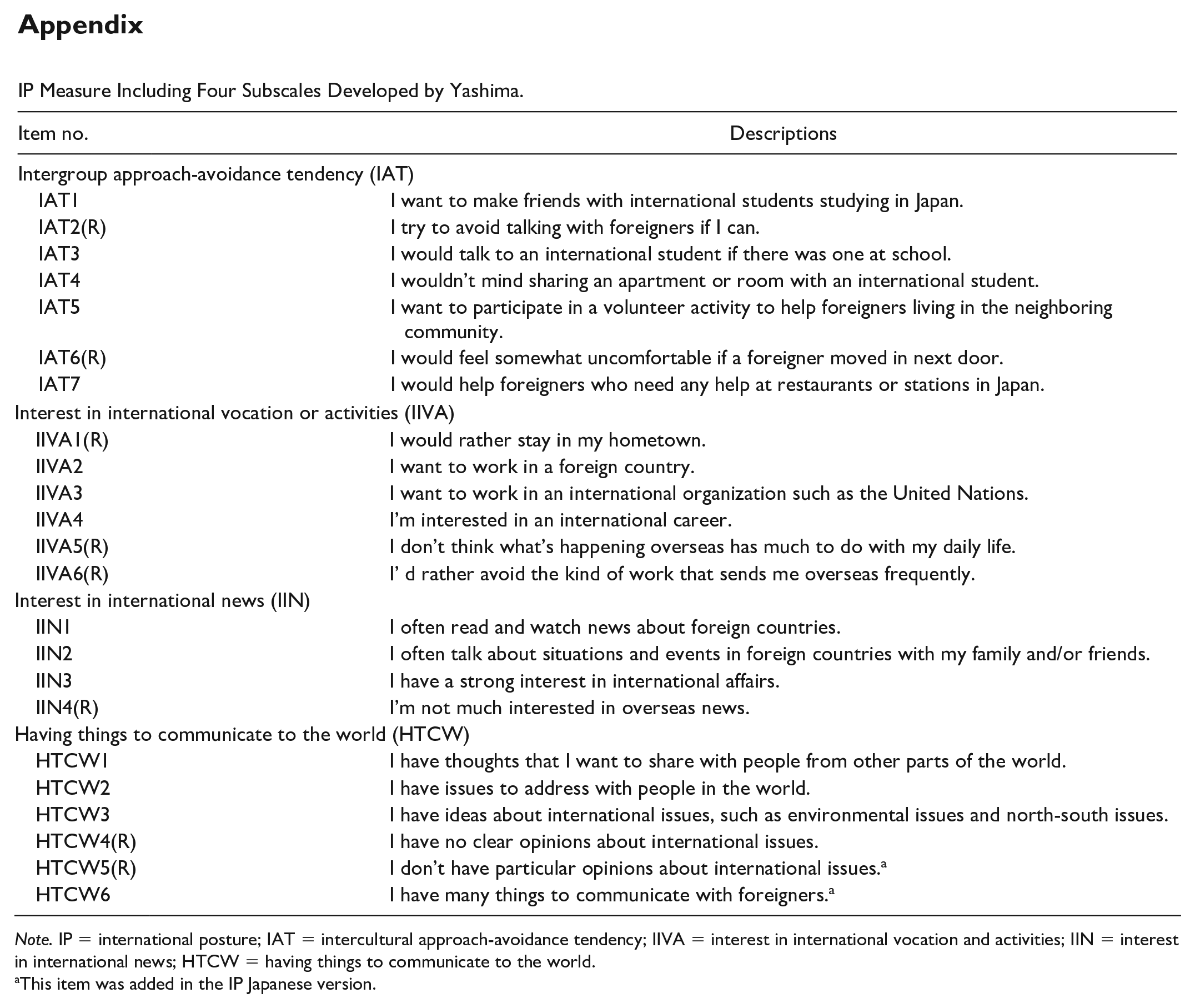
The research internet site of Yashima (n.d.) shows the Japanese version of five subscales relevant to the IP measure, including the subscale of ethnocentrism. As described earlier, the subscale of ethnocentrism did not meet adequate reliability scores (Yashima, 2002), so our study also eliminated it. Thus, this study applied four IP subscales with a total of 23 items: (a) IAT, with seven items; (b) IIVA, six items; (c) IIN, four items; and (d) HTCW, six items. Although the HTCW subscale originally had four items (Yashima, 2009), two items were later added, resulting in six items in the Japanese version (Yashima, n.d.). All items applied a 6-point Likert-type scale. The Appendix lists each item.
Personality trait measures
As described in the literature review, we used the Big-Five paradigm proposed by Goldberg (1992, 1993). To examine students’ disposition in terms of the five modes, we used the shorter version of the Neuroticism-Extraversion-Openness to Experience Five-Factor Inventory (NEO-FFI) proposed by McCrae and Costa (1987, 1997). It consists of 60 items, 12 for each of the five personality traits, with a 7-point Likert-type scale. For this study, we used the Japanese version developed by Wada (1996). The Cronbach’s α of the NEO-FFI employed for this study was 0.86 for openness to experience, 0.83 for extraversion, 0.83 for agreeableness, 0.79 for conscientiousness, and 0.92 for emotional stability.
Results
IP Measure Validation
For exploratory factor analysis (EFA), principal factor analysis was conducted with Promax rotation to extract latent factors of the IP measures for all four subscales (a total of 23 items) based on the 163 responses to the questionnaire. To determine the main factors of EFA, this study used the guideline of eigenvalues >1 and scree plot investigation. For each item analysis, to judge whether an item was maintained or eliminated, we required (a) a factor loading of at least 0.50 as the cutoff point for a 163 sample size, which lies between 100 and 200 (Field, 2013); (b) at least three items per factor (Costello & Osborne, 2005); and (c) elimination of a complex item with cross-loading that is difficult to interpret (Yong & Pearce, 2013). This method of evaluation was previously adopted to investigate latent variables of the Foreign Language Anxiety Classroom Scale (Toyama & Yamazaki, 2018).
The first EFA of 23 items of the IP measure including four subscales generated five factors, as shown on the left side of Table 2. Based on the above criteria for maintaining or eliminating items from the scale, a total of 11 items were excluded: seven items had a low factor loading of <0.50 (IAT5, IAT6, IIVA1, IIVA6, HTCW1, HTCW2, HTCW5); two factors had only two items with a loading factor of >|0.50| (Factor 4: IAT2, HTCW4; Factor 5: IIVA5, IIN4); and one item, IIN4, had cross-loading onto Factors 2 and 5.
Results of Exploratory Factor Analysis With Promax Rotation for the International Posture Measure of 23 Items for the First Factor Analysis and 12 Items for the Second Factor Analysis.

Note. (R) = reversed item; IAT = intercultural approach-avoidance tendency; IIVA = interest in international vocation and activities; IIN = interest in international news; HTCW = having things to communicate to the world.
After eliminating those 11 items, we conducted the second EFA of 12 items. As shown on the right side of Table 2, three factors were dominant. Factor 1 (IAT) of the second EFA had four items from the IAT subscale and one item from the HTCW subscale; Factor 2 (IIN) consisted of three items from the IIN subscale and one item from the HTCW subscale; and Factor 3 (IIVA) was composed of three items from the IIVA subscale. All three factors had a factor loading of >0.50, while cross-loading of those three factors ranged from 0.17 to −0.10 for Factor 1 (IAT), from 0.11 to −0.09 for Factor 2 (IIN), and from 0.17 to −0.16 for Factor 3 (IIVA). Those results indicated initial support for the three factors of IAT, IIN, and IIVA based on convergent and discriminant validity.
To confirm the validity of these three factors extracted from EFA, a CFA was performed on the same sample of 163 participants. As depicted in Table 3, the fit indices fell into an acceptable range, except for the chi-square score (χ2 = 92.93, p < .01; goodness-of-fit index [GFI] = 0.92; comparative fit index [CFI] = 0.95; root mean square error of approximation [RMSEA] = 0.07; standardized root mean square residual [SRMR] = 0.05). To compare the original four-factor model, this study conducted CFA on the same sample. As shown in Table 3, all of the fit indices of the three-factor model were better than those of the original four-factor model. In addition, average variance extracted (AVE) was 0.50 for IAT, 0.50 for IIN, and 0.65 for IIVA, which was higher than the squared correlation among those three variables (R2: IAT and IIVA = 0.35, IAT and IIN = 0.12, IIVA and IIN = 0.19). These results further confirmed the discriminant validity of IAT, IIN, and IIVA (Hair et al., 2010). Finally, the Cronbach’s α coefficients for IAT, IIN, and IIVA were 0.84, 0.79, 0.86, respectively, which indicates acceptable reliability.
Results of Confirmatory Factor Analysis With Fit Indices.

Note. RMSEA = root mean square error of approximation; SRMR = standardized root mean square residual; CFI = comparative fit index; GFI = goodness-of-fit index.
p < .01.
Our first research question concerned the factors that configure the measure of IP. The results of EFA, CFA, and AVE led us to propose that the IP measurement model consists of three factors, with five items for IAT, three items for IIVA, and four items for IIN. In this study, there was no evidence that the items for the HTCW subconstruct converged onto this subconstruct or that HTCW could be discriminated as a latent variable. In the Discussion, we address IP factors and items based on these results.
IP and Personality Traits
Since the IP measure was validated in the previous section, we applied its three dominant factors to investigate the second research question regarding how IP structurally relates to personality traits. In this study, therefore, each of the three components was analyzed in relation to the Big-Five factors through correlational analysis as a first step. Table 4 illustrates the results of correlational analysis. The personality variable of Openness to Experience was significantly related to the three IP factors IAT, IIVA, and IIN. Extraversion was significantly associated with IAT and IIVA; conscientiousness, with IIVA; and agreeableness, with IAT. However, emotional stability did not significantly relate to any of the three factors.
Correlation Matrix and Descriptive Statistics for Three International Posture Variables and the Big-Five Variables.
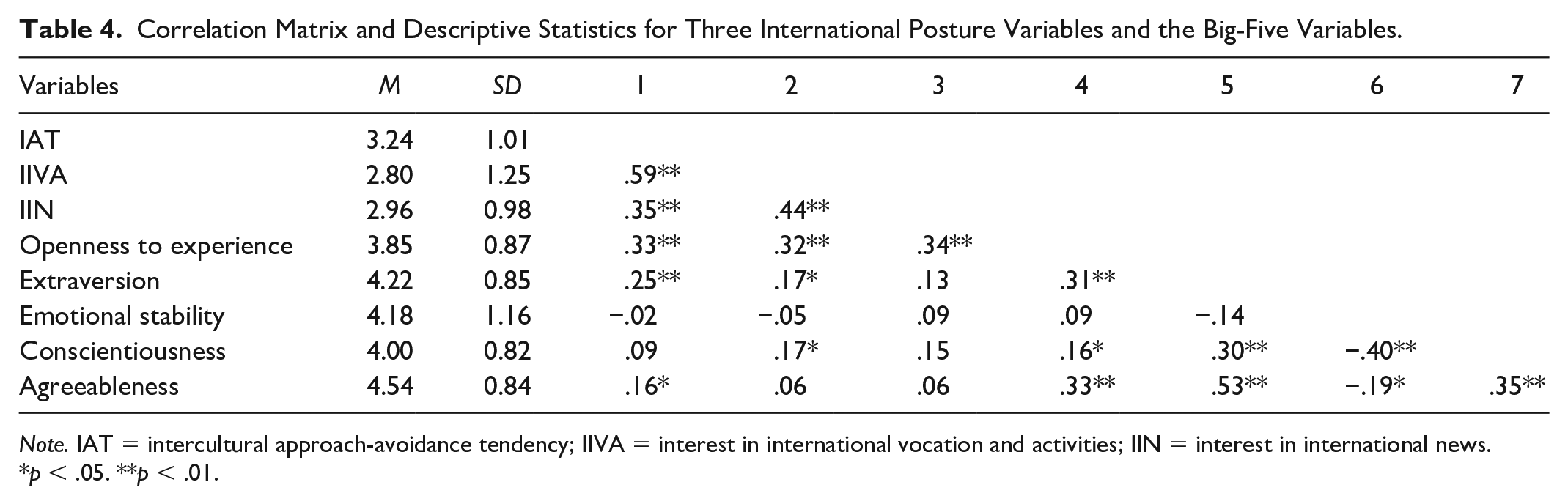
Note. IAT = intercultural approach-avoidance tendency; IIVA = interest in international vocation and activities; IIN = interest in international news.
p < .05. **p < .01.
As a second step using SEM, we entered all of the Big-Five variables as independent variables, with the three IP factors as dependent variables, each of which was placed as a first-order structure. Figure 1 shows the investigated relationships among all variables. Results of the first SEM indicated that openness to experience was significantly related to all three IP factors; extraversion was related to IAT; conscientiousness was related to IIN; and emotional stability was related to IIN. The remaining personality traits were insignificant in SEM. We then eliminated variables with insignificant relations (i.e., agreeableness) and insignificant relational lines (e.g., extraversion to IIVA and IIN) and conducted further SEM analyses until only significant relations remained. After three SEM examinations, the two variables of openness to experience and extraversion remained. Openness to experience was significantly related to all three factors (IAT, IIVA, and IIN), while extraversion was significantly associated with IAT. The fit indices of the final model of IP and personality traits had weak statistics (χ2 = 188.82, p < .01; GFI = 0.86; CFI = 0.88; RMSEA = 0.10; SRMR = 0.17), which did not differ much from the original model as shown in Figure 1 (i.e., all Big-Five variables entered; χ2 = 204.87, p < .01; GFI = 0.86; CFI = 0.87; RMSEA = 0.09; SRMR = 0.14).

Investigated relationships between Big-Five variables and the three IP factors.
As discussed in the introduction, since Yashima (2009) indicated that the IP measurement model has a second-order configuration, we subsequently attempted to make a second-order structure. That is, the group of IAT and IIVA was categorized as an “attitudinal/behavioral propensity,” whereas the group of IIN and HTCW was classified as a “knowledge orientation.” In the CFA conducted in this study, the IP measurement model validated only three factors (IAT, IIVA, and IIN), so that the attitudinal/behavioral propensity of IAT and IIVA could be established as a second order, while IIN remained a first-order configuration as an attitude toward “knowledge orientation.” Results of the SEM using the second-order structure included better statistics of the fit indices (χ2 = 129.16, p < .01; GFI = 0.90; CFI = 0.94; RMSEA = 0.07; SRMR = 0.11). Although the score of SRMR was improved but still over 0.10 and the chi-square test was not significant, the other indices were acceptable. The results were thought to largely support a second-order structure in the IP measurement model. Table 5 summarizes the results of the SEM, with Model 1 representing a first-order structure of all five personality traits; Model 2, a first-order structure of openness to experience and extraversion; and Model 3, a second-order structure of openness to experience and extraversion. Figure 2 presents the second-order structural model with standardized coefficients and R2 and key statistics.
Results of Structural Equation Modeling With Fit Indices.
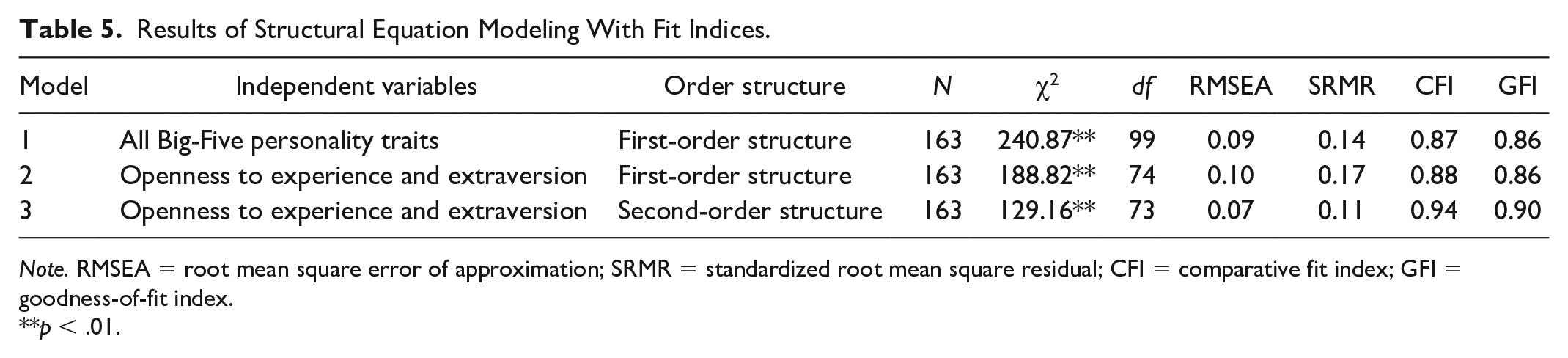
Note. RMSEA = root mean square error of approximation; SRMR = standardized root mean square residual; CFI = comparative fit index; GFI = goodness-of-fit index.
p < .01.

Second-order structural model.
Discussion
Examination of IP Factors and Items
This study first examined the psychometric properties of the IP measurement tool developed by Yashima (2002, 2009) with a sample of undergraduate English-as-a-foreign-language learners. The results of the EFA supported a three-factor structure with IAT, IIVA, and IIN. This finding is consistent with that of Peng (2015).
Among 11 items eliminated as a result of the first EFA, seven items had a factor loading of <0.50 (IAT5, IAT6, IIVA1, IIVA6, HTCW1, HTCW2, and HTCW5). Careful examination of these items revealed that they contained a word or phrase with a questionable relation to the three factors. In the IAT subscale, for example, “I want to participate in a volunteer activity to help foreigners living in the neighboring community” (IAT5) and “I would feel somewhat uncomfortable if a foreigner moved in next door” (IAT6) had low loadings; in other words, these items had a weak relationship with this subconstruct. The observed low loadings of the items could be attributed to the meaning of the term neighborhood, since both items ask about a readiness to interact with foreigners close by. No other items with high loadings on this factor, however, asked about the neighborhood. A relational aspect of neighborhood that may require maintaining good relationships in the community seems to be different from that at school or a restaurant. Particularly, having an interdependent-self culture affects human relationships (Markus & Kitayama, 1991). We would say that some responses to the questions might vary with this contextual distinction.
Next, for the IIVA subscale, “I would rather stay in my hometown” (IIVA1) and “I’d rather avoid the kind of work that sends me overseas frequently” (IIVA6) were weakly associated with this factor. These items imply a choice of being away from home and may be irrelevant to the subconstruct in this global era; participants’ responses may have varied based on their interpretations of the statements. The other items with stronger association to this factor, on the other hand, asked about interest in international jobs.
For the HTCW subscale, low loadings of “I have thoughts that I want to share with people from other parts of the world” (HTCW1) and “I have issues to address with people in the world” (HTCW2) could be attributed to the words people and world. The word people means human beings in general regardless of age, gender, and nationality, and the world can be interpreted to be a huge entity. Respondents might have imagined a crowd of foreigners to whom they would address their ideas. Even if respondents had ideas and opinions about international issues, some might have hesitated to agree with these statements because they were so broad. Accordingly, the complexity within the two questions might have led to variations in answers and contributed to their low loadings.
The results of CFA confirmed the validity of the three subconstructs, excluding the HTCW subscale. This subscale was included in the IP measure by Yashima (2009) to determine “whether or not a person has things to say to an (imagined) international community” (pp. 154–155), rather than whether he or she is interested in relatedness to foreigners, international jobs, or global-based news. Although the purpose of the HTCW subscale differed from that of the other subscales, some question items in the HTCW subscale seemed to be associated with other subconstructs of IP. For example, HTCW6’s “I have many things to communicate with foreigners” could be interpreted as one aspect of IAT. This item is thought to distinguish between one group (domestic) and the other (foreign) and as such it could be interpreted as part of IAT. HTCW3’s “I have ideas about international issues, such as environmental issues and North-South issues” may be presumed to be IIN.
Two Personality Traits Relevant to IP
We investigated the structural relationships between the three subconstructs validated in our study and the personality traits, that is, the Big-Five factors, through SEM analyses. The results showed that Openness to Experience as a Big-Five factor is significantly related to the three IP subconstructs. This finding corroborates the ideas of Gardner (2012), who suggested that integrativeness involves openness to other cultural material and the other language community. It is also in line with Ghonsooly et al. (2012), who indicated that the more students are open to experience, the more they tend to have positive attitudes toward foreigners and interactions with them, and the more they are interested in international news around the world. Since traits describe psychological features of the person, they are very stable over time (McCrae & Costa, 1990). It is suggested that those who score low in openness to experience tend to score low in IP.
Another interesting finding is an association between extraversion and IAT. For extraversion, respondents rate themselves as sociable, talkative, or outgoing on the questionnaire. Those who score high in extraversion generally enjoy being with people and participating in social gatherings. They tend to seek out social stimulation and opportunities to interact with others. Since IAT involves the tendency to approach and communicate with people who have different cultural backgrounds (Yashima, 2009), it is self-evident that extraversion is relevant to IAT. This finding suggests that those who consider themselves extroverted tend to have a desire to interact with foreigners.
In addition, the results of our SEM analyses support Yashima’s (2009) assumption that IP has a second-order construct composed of IAT and IIVA. This finding is in line with her idea that IIN has a knowledge orientation and thus can be distinguished from IAT and IIVA, which have an attitudinal/behavioral inclination. This study raises the possibility that IAT (the tendency to approach and communicate with foreigners) and IIVA (the interest in international vocation or activities) are distinct but related subconstructs and can be distinguished from IIN within the construct of IP.
Implications and Future Study
Our study offers two implications. The first implication concerns how to use the verified IP measure in a language learning context. Whereas aggregation of the 12 items of the three subscales (i.e., five items of IAT, three of IIVA, and four of IIN) can measure the degree of overall IP, results of this study provide an opportunity to examine the degree of three subconstructs within IP. In other words, if researchers want to analyze which IP subconstruct relates to a targeted variable, they can apply each of the three subscales separately. Some subscales may better relate to key variables in the foreign language learning area. For example, past IP studies demonstrated that IP affected willingness to communicate in L2 (Ghonsooly et al., 2012; Peng, 2015; Yashima, 2002; Yashima et al., 2004) and L2 learning motivation (Ghonsooly et al., 2012; Yashima, 2002; Yashima et al., 2004). If a further question concerns to what extent students’ tendency to approach foreigners or interact with them (IAT) affects willingness to communicate in L2, the five items of IAT in our study can be applied independently. If another question asks how students’ IIN or affairs motivates them to learn L2, the four items of IIN can be employed independently. In addition, if a study asks which aspect of IP, attitudinal/behavioral propensity (i.e., IAT and IIVA) or knowledge orientation (IIN), has more impact on willingness to communicate, three subscales will need to be used to answer the research question.
The second implication concerns relationships between personality and the IP constructs. Our study showed that openness to experience has strong connection to the three IP subconstructs and that extraversion is related to IAT. These findings have important implications for developing teaching materials and approaches to improve the IP of those with low levels of openness to experience and extraversion. Since extraversion is not related to IIVA or IIN, educators may be able to increase IP of introverted students using world news relevant to the students’ major or by introducing websites about jobs abroad. To this aim, it is important for educators to understand that personality can affect the IP subconstructs.
As an extension of this second implication, it is also important to find out what other variables affect IP and how such variables can be manipulated to increase IP. As the three subconstructs of IP have a strong relationship with an L2 learning experience (Peng, 2015) and a study abroad experience (Yashima & Zenuk-Nishide, 2008), a successful cultural-exchange experience may improve IP. It is thought that sociocultural factors, such as having a friend or a relative living overseas, can affect IP. Also, sociogeographical factors can be assumed to be related to IP. To wit, Europeans may have high IP since their countries have several neighboring countries, and cross-border movement of people and goods is common.
Limitations
The main limitation of the study is methodological. First, participants were non-English majors who were externally motivated to learn and use English. It is unknown whether convergent and discriminant validity of the four subconstructs of the IP scale, particularly the HTCW, would be the same among English majors. Second, all participants were from Japan, which has its own distinct culture (Hofstede & Hofstede, 2005; Triandis, 1995) that might affect our results. The influence of various cultural backgrounds on responses to the IP questionnaire remains unknown; thus, research in other countries or cross-cultural comparative research on IP measures is desirable.
Conclusion
This study statistically confirmed the validity of the IP scale and its subscales. Future research is now possible using these subscales to investigate relationships among the subconstructs of IP and various learner variables in L2 learning. There is a need for L2 researchers and educators to be aware of the importance of improving IP because its subconstructs—openness to foreigners, interest in international jobs, and interest in world news—are positive characteristics of L2 learners. Using the IP scale to help learners be aware of their strengths is also recommended.
We also showed that two personality traits—openness to experience and extraversion—were strongly associated with IP. Openness to experience, which is related to all three subconstructs of IP, is a positive trait. Encouraging those learners with high openness to experience to employ this positive trait not only in learning but also in career development is valuable. In sum, seeking ways to develop learners’ IP and encourage them to employ this set of positive characteristics in learning is an important issue in L2 research.
Footnotes
Appendix
IP Measure Including Four Subscales Developed by Yashima.
| Item no. | Descriptions |
|---|---|
| Intergroup approach-avoidance tendency (IAT) | |
| IAT1 | I want to make friends with international students studying in Japan. |
| IAT2(R) | I try to avoid talking with foreigners if I can. |
| IAT3 | I would talk to an international student if there was one at school. |
| IAT4 | I wouldn’t mind sharing an apartment or room with an international student. |
| IAT5 | I want to participate in a volunteer activity to help foreigners living in the neighboring community. |
| IAT6(R) | I would feel somewhat uncomfortable if a foreigner moved in next door. |
| IAT7 | I would help foreigners who need any help at restaurants or stations in Japan. |
| Interest in international vocation or activities (IIVA) | |
| IIVA1(R) | I would rather stay in my hometown. |
| IIVA2 | I want to work in a foreign country. |
| IIVA3 | I want to work in an international organization such as the United Nations. |
| IIVA4 | I’m interested in an international career. |
| IIVA5(R) | I don’t think what’s happening overseas has much to do with my daily life. |
| IIVA6(R) | I’ d rather avoid the kind of work that sends me overseas frequently. |
| Interest in international news (IIN) | |
| IIN1 | I often read and watch news about foreign countries. |
| IIN2 | I often talk about situations and events in foreign countries with my family and/or friends. |
| IIN3 | I have a strong interest in international affairs. |
| IIN4(R) | I’m not much interested in overseas news. |
| Having things to communicate to the world (HTCW) | |
| HTCW1 | I have thoughts that I want to share with people from other parts of the world. |
| HTCW2 | I have issues to address with people in the world. |
| HTCW3 | I have ideas about international issues, such as environmental issues and north-south issues. |
| HTCW4(R) | I have no clear opinions about international issues. |
| HTCW5(R) | I don’t have particular opinions about international issues. a |
| HTCW6 | I have many things to communicate with foreigners. a |
Note. IP = international posture; IAT = intercultural approach-avoidance tendency; IIVA = interest in international vocation and activities; IIN = interest in international news; HTCW = having things to communicate to the world.
This item was added in the IP Japanese version.
Declaration of Conflicting Interests
The author(s) declared no potential conflicts of interest with respect to the research, authorship, and/or publication of this article.
Funding
The author(s) disclosed receipt of the following financial support for the research, authorship, and/or publication of this article: This work was supported by JSPS KAKENHI (grant no. JP17K02938).
