




Abstract
The building construction wastes seriously polluted the environment; building construction wastes and the recycling of green packaging materials are the important link of environment protection and sustainable development. The building construction wastes have complicated composition. Some of them can be recycled by simply sorting, but most urban building construction wastes require special separation or reprocessing. Therefore, building an efficient and practical building construction wastes multilevel utilization recycling system to resolve the recycling problems of building construction wastes is meaningful. By systematically analyzing the grading recycling system of building construction wastes, this article uses systems engineering, logistics theory, resources recycling science, management science, and other related methods and knowledge to establish a novel nonlinear programming (LP) intelligence planning analysis model for a complex reverse logistics transportation system composed of three-level recycling parts of the building construction wastes, and applies a practical example to propose the solving method of new models based on genetic algorithms and LINGO software. The presented new model and its detailed solving method can help us find the best recycling scheme from urban building construction wastes, and it has great significance for the sustainable development in building construction enterprises.
Introduction
With the development of building construction engineering, a large number of urban building construction wastes were produced. In China, according to relevant statistics, the urban building construction wastes produced annually have reached more than 40 million tons and they have accounted for about 40% of the whole city garbage. If these urban building construction wastes are not treated reasonably, this will result in serious environmental pollution.
Therefore, it is necessary to classify the urban building construction wastes and then recycle them; it is also important to build a reverse logistics (RL) system and optimize it.
The RL includes the return of the product, material substitution, reuse of wastes, wastes processing, and remanufacturing process. In contrast with the traditional forward logistics, the direction of RL is opposite. The recycling logistics systems of urban building construction wastes belong to the RL system in building construction enterprise.
With the development of the social economy, environmental protection is becoming more and more important. And, each process of logistics may have RL. So, it is necessary to study the intelligence planning analysis problems of the RL system. The RL involves in every stage of enterprise production, sales, and after-sale service. The RL includes the return RL and recycling RL.
Until now there have been many references studying recycling system from urban construction wastes or the RL problem in the construction projects. These references can be classified into three parts:
Among these references, some only focused on the generic description of building wastes or RL, such as Nunes et al. (2009) introduced the concepts of RL and reverse distribution channel networks and to study the Brazilian C&D (Construction and Demolition) wastes case. Pereira Ramos et al. (2014) studied supporting tactical and operational planning decision problems. Niknejad and Petrovic (2014) studied the inventory control and production planning optimizations problem of the integrated RL network. Bouzon et al. (2015) studied the drivers that enable RL practice in an emerging economy. Prakash and Barua (2015) focused on the identification and ranking the solutions of RL adoption in the electronics industry to overcome its barriers. Kinobe et al. (2015) developed an overview of RL at Kiteezi landfill. Kim and Lee (2015) considered network design, capacity planning, and vehicle routing for collection systems in RL. Tavana et al. (2016) considered the problem faced by a company that must outsource RL activities to third-party providers. Marathe et al. (2017) showed that the uncontrolled discharge of untreated urban wastes can contribute to an overall increase in the abundance and diversity of antibiotic resistance genes (ARGs) in the environment. Mantovani et al. (2017) aimed at evaluating the effect of fertilization with urban wastes compost on the soil chemical properties, yield, nutrient, and heavy metal contents. Brina et al. (2018) focused on the place-specific governance structures and socio-technical experiments. Ugwu et al. (2018) assessed the amount of solid wastes generated and the management techniques employed in Nsukka urban. Further detailed studies were absent.
Then, there are some references using a single method to build the model about building wastes or RL, such as Liu et al. (2014) established a system dynamics model on cost–benefit analysis of C&D wastes management. Roghanian and Pazhoheshfar (2014) applied genetic algorithms to study the RL network. Li et al. (2014) established a mathematics strategy model of the location, capacity, and allocation of the construction wastes center, without considering the landfill for the disposal of the urban construction wastes. Haji Vahabzadeh et al. (2015) proposed a fuzzy VIKOR method using interval-valued trapezoidal fuzzy numbers. Choudhary et al. (2015) proposed a quantitative optimization model for forward-RL with carbon-footprint considerations. Moghaddam (2015) developed a fuzzy multi-objective mathematical model to identify and rank the candidate suppliers and find the optimal number of new and refurbished parts and final products in an RL network configuration. Ferri et al. (2015) proposed an RL transportation network involved in the management of municipal solid wastes (MSW). Singh and Rathore (2015) developed a two-warehouse RL model with finite rate of production and remanufacturing. Agrawal et al. (2016) developed a framework for outsourcing decisions in RL using the graph theoretic approach. Further integration researches of many methods were absent.
Also, few studies focused on some integrated sides, such as Schultmann and Sunke (2007) presented an integrated deconstruction—recovery planning approach for deconstruction projects. Hosseini et al. (2015) integrated the fragmented body of knowledge on RL in construction engineering. Demirel et al. (2016) presented a mixed-integer nonlinear programming (MILP) model for network design. Djikanovic and Vujosevi (2016) presented new integrated forward and reverse logistics (IFRL) model. But further systematic researches were absent.
Due to their different emphases, above references mostly consider the sole aspect of the RL, and don’t consider the intelligence planning analysis problems of energy recovery from urban building construction wastes and the RL. By systematically analyzing the grading recycling system of urban building construction wastes, this article uses systems engineering, logistics theory, resources recycling science, management science, and other related methods and knowledge to establish a novel nonlinear programming (LP) intelligence planning analysis model for a complex RL transportation system, and applies a practical example to propose the solving method of new models based on genetic algorithms and LINGO software.
Analyzing the Urban Building Construction Wastes Grading Recycling Pattern
The composition of the building construction wastes is complicated. Some of them can be recycled by simply sorting, but most urban building construction wastes require special separation or reprocessing.
Therefore, building an efficient and practical building construction wastes multilevel utilization recovery system is meaningful. As shown in Figure 1, if these wastes are not treated reasonably, this will result in serious environmental pollution and affect sustainable development. Construction wastes recycled aggregate can produce hundreds of engineering construction materials for wall materials and environmental protection tiles. The urban building construction wastes can be recovered at all levels and different kinds of them can be recovered in different levels. With building construction and reconstruction being carried on, the recycling multistage, multiple use, and reuse mode of urban building construction wastes can greatly improve the utilization rate of recycled resources.
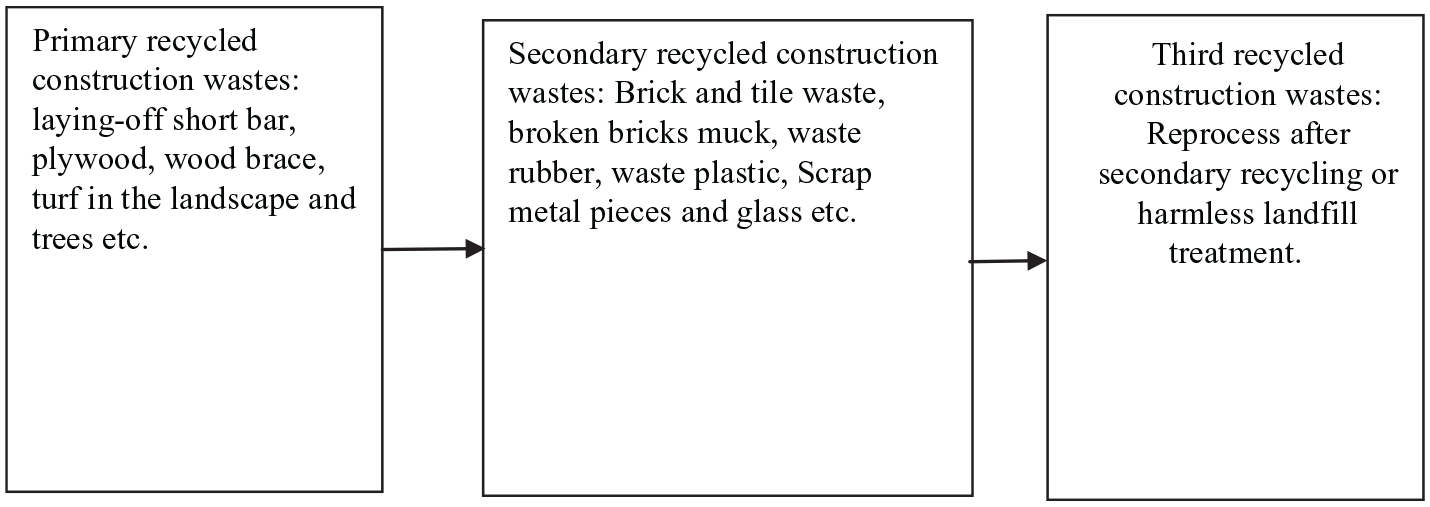
The recycled building construction wastes in reverse logistics system.
The urban building construction wastes recycling method can be divided into four kinds: disassembly recycling, material separation, mixed recycling, and wastes disposal. The operation implementation mode selected in this article is recovery outsourcing and self recycling remanufacturing. In this mode, the logistics service company responsible for the recovery works because they can understand well enough the characteristics of logistics operation. They can promote the effective use of wastes, reduce the consumption of material, reduce production costs, and increase the utilization ratio of the material. As shown in Figure 2, at first, the urban building construction wastes are processed in the primary recovery in the building construction site (CS), and then directly transported to the supplier (S). Second, the other part is transported to the sorting center (SC) uniformity, and the wastes are classified in the sorting center (SC). After sorting, the wastes can be directly transported to the supplier (S). No recyclable wastes can be transported to landfill plant (LP), and the remaining wastes can be transported to the reprocessing plant (RP). The wastes after sorting can be reduced. Finally, the remanufacturing processed material can be transported to the supplier (S).
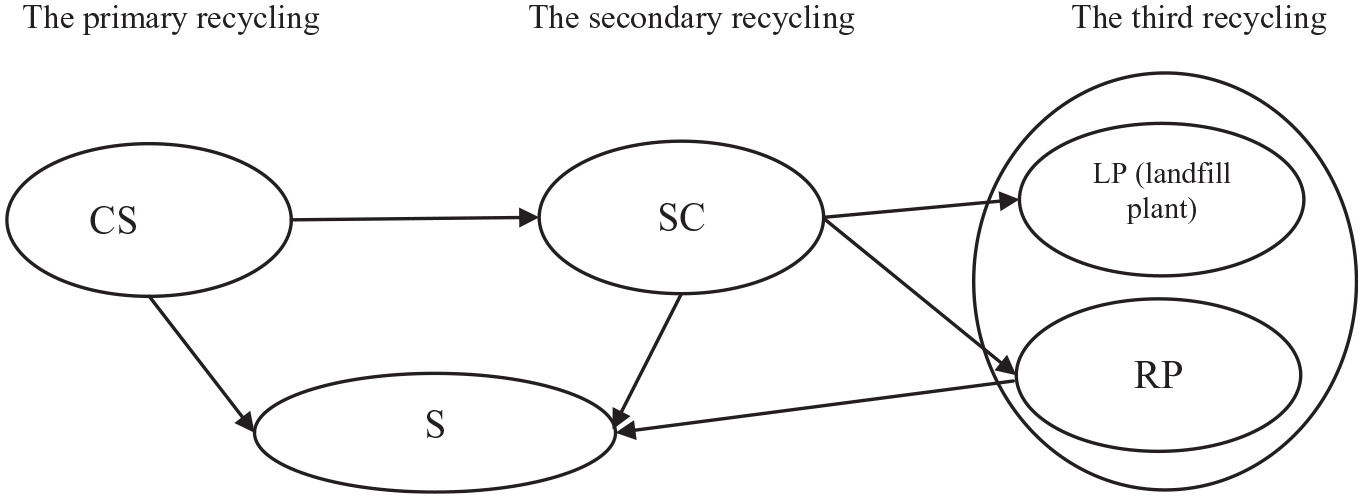
The three-level urban building construction wastes recycling system.
The RL System Model for Environmental Protection and Sustainable Development
As an integral part of remanufacturing, the RL is a necessary means for the implementation of resource conservation and sustainable development to regain the use value of wastes products or defective product. For enterprises, the RL can afford to save resources and energy, and improve the corporate image and customer loyalty effect. A successful RL could help increase the service level of companies and reduce the costs of producing processes. More and more companies want to build their RL system.
Some Assumptions of the New Model
Transports the urban building construction wastes to the SC (sorting center) when inventory reaches the maximum.
CS (building construction site), SC (sorting center), and LP (landfill plant) can handle the urban building construction wastes in time.
The number of the cycles is denoted by t, and the upper bound value of cycles is 50 days, and the inventory value of the remanufacturing wastes is 5 days.
The Model Description
The primary recycling can be completed in 10 days; the second recycling can be finished in 15 days; and three-level recycling can be finished in 25 days.
Primary recycling
Urban building construction wastes are divided into two parts in the CS (building construction site). The first part cannot be used directly, so they are transported from CP (building construction plant) i (I in all) to CS (building construction site) j (J in all). The transportation from site i to SC (sorting center) j is
Second-level recycling
Urban building construction wastes will be sorted in the SC (sorting center). The sorted wastes can be divided into three parts. The first part cannot be reprocessed, so they are transported from SC (sorting center) j to LP (landfill plant) l (L in all). The transportation from SC (sorting center) j to LP (landfill plant) l is
Third-level recycling
Urban building construction wastes after being reprocessed will become remanufactured products. So they are transported from the warehouse of RP (reprocessing plant) k to S g. The transportation from RP k to S g is
The number of RP (reprocessing plant) warehouses is n. The urban building construction wastes will be first transported to the warehouse n, and they are transported to rework. In this process, the unit cost of storage is ek. The inventory of RP k is ZK. The first stage of the transportation is A1. The second stage of the transportation is A2. They correspond to the unit costs c1 and c2, respectively. Some parameters in the new model are shown in the appendix.
The building construction wastes seriously polluted the environment; building construction wastes and the RL of green packaging materials are the important link of environmental protection and sustainable development. Wastes generated by construction activities include scrap, damaged or spoiled materials, temporary and expendable construction materials, and aids that are not included in the finished project, packaging materials, and wastes generated by the workforce. The building construction wastes consists of, but is not limited to, wood, concrete, metal, brick, drywall, roofing, material packaging, plastics, papers, cardboard, and others. The building construction wastes may pollute air, water, and soil, and leave various environmental impacts, and cause health hazards, due to improper handling and transportation. Using the presented three-level RL recycling system and the new model, the harmful effect on the environment by building construction wastes can be minimized.
The New Model
The objective function is to minimize the total cost of some constraint conditions, which include transportation cost, operating cost, and inventory cost. Equation 1 represents the objective function. It needs to set the parameters and, according to the actual situation, the objective function. Equation 2 represents the transportation costs. Equation 3 represents the operating costs. Equation 4 represents the inventory costs. In the light of the actual situation, this article sets some constraint conditions, builds the optimal objective function to minimize the total cost, and makes use of genetic algorithms and LINGO software to solve the programming problem. The new model is shown as follows:

The transportation costs are as follows:
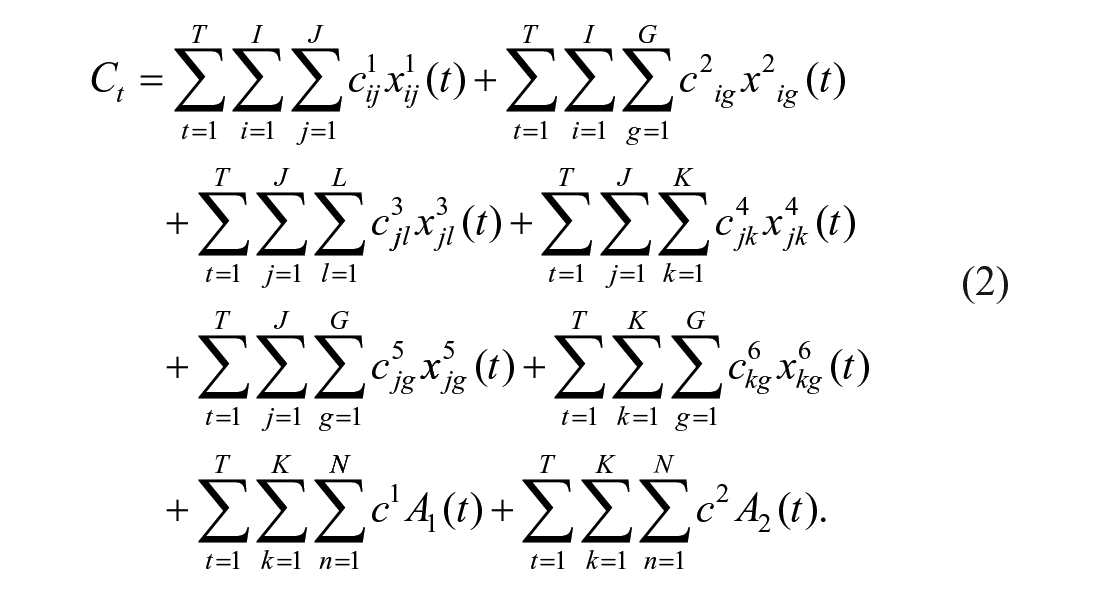
The operating costs are as follows:

The inventory costs are as follows:

s.t.



Case Studies
Taking a building construction company as an example; in this example, the following assumptions are to be made: (a) the construction unit as the main body, all of RL transportation is effective; (b) zero loss in the process of recovery transportation, vehicle type and traffic are the same; the number of vehicles is not restricted, without considering the effect of transit time on the transportation cost; (c) each recovery of the recycle bin follows a given parameter normal distribution; and (d) recycle ability rate, the final wastes rate and all kinds of building materials recovery prices are known.
There are five CP (building construction plant), six SC (sorting center), three LP (landfill plant), four RP (reprocessing plant), and five S (supplier). Recycling quantity to complete a cycle is 2,000 tons. The building construction site of the primary recycling accounted for 10% of the total; the known data are shown as follows:
Capacity 1 = 60 50 20 40 30; Demanding 1 = 25 35 50 35 55;
Capacity 2 = 540 450 180 360 270; Handling = 350 180 150 600 300 220;
Handling 1 = 110 60 90 70 150 120; Filling = 150 350 100;
Handling 2 = 160 110 80 120 90 240; Outputting = 120 100 300 280;
Handling 3 = 60 50 70 30 90 110;
Demand 2 = 150 80 110 60 180; Demand 3 = 100 270 130 240 60;
A1 = 22 20 25 18 31 16; A2 = 33 31 22 23:

Inventory = 10 8 11 13; [W1] = [22 20 25 18 31 16]; [W2] = [33 31 22 23].
This article makes use of genetic algorithms and LINGO software to solve above-presented LP model. The planning calculation process of applying genetic algorithms and LINGO software is shown as Figure 3.

The planning calculating process diagram of applying genetic algorithms and LINGO software.
The genetic algorithm is widely used in various engineering fields. They are based on natural selection and natural genetics. The general form of genetic algorithm uses three major genetic operators: selection, crossover, and mutation. The Genetic algorithm is an efficient method to solve the above presented LP model about recycling logistics of urban building construction wastes. The LINGO software, namely “linear interactive and general optimizer,” is launched by LINDO systems (LINDO Systems Inc.). It can be used to solve the LP, and can also be used to solve some linear and nonlinear equations. Its function is very powerful and it is a very good choice for solving system optimization model.
The recycling logistics system of building construction wastes can be divided into three levels. Using presented three-level RL recycling system and new model, the harmful effect of building construction wastes on the environment can be minimized. The planning schemes of every level can be obtained as follows:
The primary recycling planning scheme: The primary recycling is a process of building construction wastes from the building construction site (CS) to the supplier (S) and from the building construction site (CS) to the sorting center (SC). The obtained primary recycling planning scheme is:

The second recycling planning scheme: The second recycling is a process of building construction wastes from the sorting center (SC) to landfill plant (LP), reprocessing plant, and supplier (S). The obtained second recycled planning scheme is:

The third recycling planning scheme: The third recycling is a process of building construction wastes from reprocessing plant to the warehouse and from the warehouse to the supplier (S). The obtained third recycling planning scheme is:
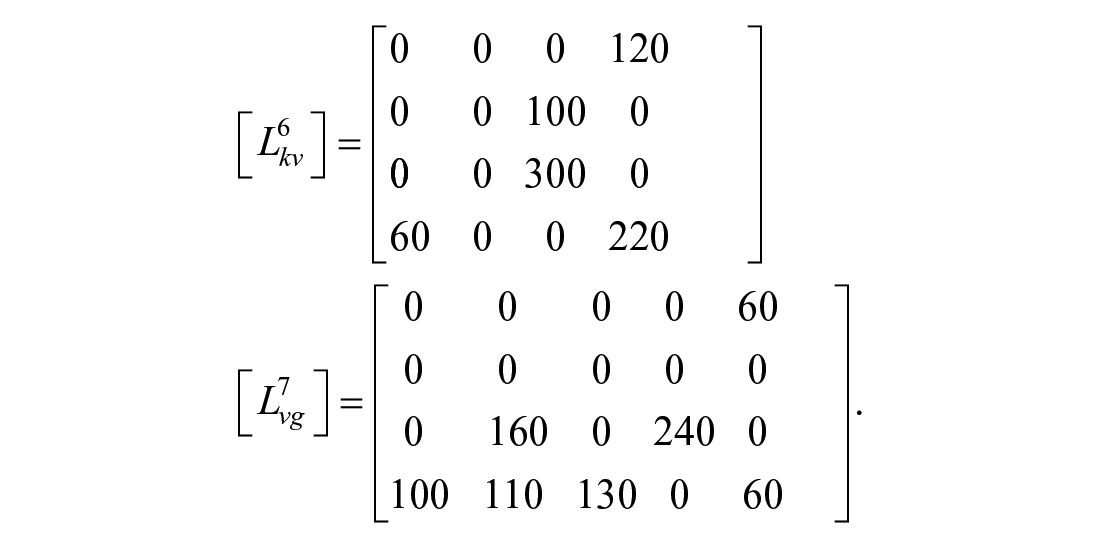
The primary, second, and third recycling planning schemes can also be represented more intuitively in the transport system diagram (Figure 4).

The transport system diagram of the primary, second, and third recycling planning schemes about building construction wastes.
The Lingo operation results are shown as Figure 5. The global optimal solution result is 161,936, that is, the total cost under some constraint conditions is 161,936, including the transportation cost, the operating costs, and the inventory cost. The iteration number is 75, and it has zero contradictory constraints. The scheme satisfying these conditions can be looked as the optimum scheme. The three-level recycling tons of optimal solution result are 596, 611, and 793 tons.

The Lingo operation results diagram of the example.
Discussion
Due to their different emphases, most references consider the sole aspect of the RL; don’t consider the intelligence planning analysis problems of energy recovery from urban building construction wastes and the RL. The advantages of this study include the total cost and the optimum scheme can be easily gotten in some assumption conditions by presented methods and detailed processing steps, which includes transporting the urban building construction wastes to the SC (sorting center) when inventory reaches the maximum, CS (building construction site), SC (sorting center), and LP (landfill plant) can handle the urban building construction wastes timely. The presented new model and its solving method can provide some meaningful reference for intelligence planning research of urban building construction wastes for resource recovery and sustainable environment. However, this article only considers the cost as the main body of the construction company, and it did not consider other subject interests and the game between them. In the actual project, there are many stakeholders, so the problems will be more complex. Therefore, further consideration of the interests of all parties is necessary. The thematic analysis between interest relations will be more conducive to recycling work and achieving win-win.
Conclusion
The RL is typically beneficial to both sides—the environment is cleaner while entrepreneurs reduce costs of materials and penalty fees for pollution or sustainable development. The concept of RL is an integration of social and environmental aspects because people’s well-being and satisfaction and also the protection of the environment are the main ideas of reverse processes.
Some highlights can be summed up as follows: (a) The authors analyzed the composition and characteristics of the construction wastes RL system. (b) This article considered the cost as the main body of the building construction company; by analyzing recycling, sorting and the main way of construction wastes, the authors put forward its grading recycling management pattern. (c) By systematically analyzing the grading recycling system, the authors used hybrid methods, including systems engineering, logistics theory, and recycling science to establish an LP intelligence planning model for environmental protection and sustainable development. (b) The authors applied a practical example to propose the solving method of new models based on genetic algorithms and LINGO software.
Footnotes
Appendix
The Parameters Table of Presented Model.

| The parameter | Description |
|---|---|
| X1(t) | The primary recycling maximum volume of CP (building construction plant). |
| X2(t) | The maximum sorted volume of SC (sorting center). |
| X3(t) | the maximum landfill volume of LP (landfill plant) |
| X4(t) | The maximum requirement of S (supplier). |
| ZK(t) | The maximum inventory of RP (reprocessing plant). |
| R 1j | The operating costs of CS (building construction site). |
| R 2k | The operating costs of RP (reprocessing plant). |
| ek | The inventory unit cost RP (reprocessing plant). |
| W 1 | The operating number of CS (building construction site). |
| W 2 | The operating number of RP (reprocessing plant). |
| Ct | The transportation cost of reverse logistics system for three levels. |
| Cs | The operating costs of reverse logistics system. |
| Ch | The inventory cost of reverse logistics system for RP (reprocessing plant). |
Declaration of Conflicting Interests
The author(s) declared no potential conflicts of interest with respect to the research, authorship, and/or publication of this article.
Funding
The author(s) disclosed receipt of the following financial support for the research, authorship, and/or publication of this article: This work was supported, in part, by National Natural Science Foundation of China (NSFC) (51774228), Shanxi Province Education Department Research Project (12JK0803), and Shanxi Province Natural Science Basic Foundation (2016JM5088).
