




Abstract
There is no education without content. Teaching and learning in schools is devoted to “something,” not to “nothing” or “anything.” The more heterogeneous, multicultural, and multilingual the classroom, the more semantization of educational content within teaching and learning is needed. Therefore, the role of various languages in the classroom is revisited. In this article, we elaborate on the theory of language-sensitive content transformation and introduce the concept of operational isomorphism and its potential in the field of didactics, research on teaching, and learning and teacher education. Using a case study of mathematics teaching, we illustrate, how students can benefit from semantization and instrumentalization practices in the classroom and how these processes take the form of extensional deconstruction and intensional expansion or intensional condensation.
In terms of didactics, language is a tool for introducing educational content. If students are not able to express educational content through language, they cannot think about it and cannot communicate it to others. However, the student’s “knowledge of content” is not only about the language itself, but it is a whole complex of experiences with various symbolic, iconic, and factual tools that determine (and facilitate) human knowledge of the world (Menck, 2000, pp. 58–59). This comprehensive approach to student experiences leads to a broad understanding of language as the universal basis of the human intellect through which people develop and share the content of their experiences. Through language, reality—which is shared intersubjectively—is constituted by a culture that students understand and acquire in school. The result of this process is student knowledge and understanding of the content.
While in the Middle Ages students gained content knowledge more or less by memorizing texts supplied by the teachers, current educational practices are far much more challenging for teachers. They are now expected to present educational content to students in the best way possible and provide conditions for cognitive activation of students and motivation to learn. That is why Shulman asked teachers to have pedagogical content knowledge along with the ability to “know content in a hundred and fifty different ways” (Wilson et al., 1987). This claim is reasonable in practice, but presents a considerable challenge for didactic theory: how do we explain theoretically the process of transforming the content of intersubjective reality from the culture into various forms in order to eventually turn it into a student’s knowledge?
We have addressed this question in our article. In doing so, we were influenced by the current trend toward “restrained teaching” in European didactics (Hopmann, 2007). “Restrained teaching” is where the emphasis moves away from teachers’ teaching closer to students’ learning, while retaining the teacher’s responsibility for teaching, that is, “back to teaching.” This is challenging for teachers as it requires them to understand in depth how students semantize educational content within teaching and learning (Englund, 1997; Schneuwly, 2011; Willbergh, 2011, 2015).
The more variable the student’s initial experience is, the more important semantization practices become. Therefore, the quote from Shulman’s thesis (above) that teachers must know content in many different ways can be seen from a new perspective. The teacher should not only interpret it differently each time but should also understand the different semantization practices of students and, at the same time, be able to support their individual learning processes. The teacher needs this kind of understanding while designing learning tasks and supporting students in dealing with their individual learning barriers.
Teachers can solve these problems intuitively; however, didactics should provide them with the means of thinking through these problems and to exchange these experiences through language. Therefore, we need a theory for content transformation—to explain the ways in which the content of intersubjective reality in teaching is transformed into student’s knowledge (Janík et al., 2019). Therefore, the theory of content transformation should be language-sensitive—it should respect the fact that teaching and learning is to a great extent determined by the language used.
We outline the basis of such a theory in our article and illustrate it through a didactic case study of mathematics teaching. This approach is based on analytic generalization and on replication of theoretical concepts in didactic case studies (Yin, 2014, p. 146): theoretical constructs developed in the first part of this article are then applied to explain authentic cases with the aim of demonstrating their validity and relevance. These constructs include semantization, instrumentalization, extensional deconstruction, intensional expansion, and intensional condensation.
Content Transformation: “The Same” and “The Different”
We will start by stating that students always learn something, and teachers always teach something. This basic proposition postulates that teaching as well as learning is a process that has certain content. In other words, without content, there is no education. The general ability to learn content is a prerequisite for knowing the world, acting in it and surviving. Hence, it is important for teachers to understand the content of education in its broader cultural context (Englund, 1997). From such context, the educational content is elevated and processed into a form that meets general educational aims. Only then does it offer students the best possible learning opportunities. Therefore, the teacher should view content in a way that allows its “movement” (or translation) between the world, human culture, and the student’s mind (Komorek & Kattmann, 2008).
Content cannot be as easily transmitted as something passed from hand to hand. The acquisition of content is best shaped in an activity (including cognitive and emotional activity); then we not only learn it, but also understand it in depth. If the student acquires knowledge of the content, then they can process the content and understand it. The term knowledge of content (or content knowledge) is understood here in the broadest sense, not only as declarative knowledge (i.e., the ability to grasp and interpret content), but also procedural knowledge (i.e., the ability to use content in authentic situations) and contextual knowledge (i.e., the ability to understand why certain content should be used in certain situations).
Teachers select educational content with the aim of making it accessible for intentional learning, but only students themselves can “decide” the content of their knowledge. The teacher should therefore design—and offer to the students—such learning environments and tasks that would motivate them to devote their time and effort to the content. At the same time, there is often a discrepancy between the attractiveness of content for students and its cultural value. The more valuable the content, the more abstract it is, the more demanding its learning, and the more difficult it is to motivate students because it is very distant from their experience and abilities.
In the domain of language education, educational content plays a specific role. Language content—that is, all the meanings carried by the language—is the object of learning or teaching, while being their main carrier. Language is a universal tool for memory preservation, expression, and intersubjective sharing of content (comp. Hjelmslev, 1961) and so it is the basic context for selecting, communicating, and managing content. Therefore, its role is specific not only in the education system, but throughout human culture. From the point of view of social interaction—and so from a teaching perspective—it is essential that symbolic language tools ensure compliance in a subjective meaning. With this term, Weber (1978, pp. 4–7) points to the fact that people in any social relationship with each other need to know what their relationship is about. This would not be possible without symbolic communication. Therefore, it can be rightly claimed that “language bridges the gap between individual nervous systems,” as Bloomfield (1946, p. 15) notes aptly.
Content can change the form in which it exists, while itself remaining relatively unchanged and is still interpreted as the same. This process is called content transformation (Englund, 1997; Janík et al., 2019; Klafki, 2000; Menck, 2000). For example, the grouping of a certain number of objects can be transformed into the content of a number that expresses that quantity; or the visual appearance of a face can be transformed into a portrait drawing or photograph. The transformation of content is a necessary condition for any learning and teaching because it makes content accessible to learning.
When speaking about “the same” content with respect to transformation, we understand what it means, although there are countless differences between transformed forms that could at any time be a pretext for their content differentiation. For example, we do not have to interpret the word “four” as “4,” but as an example of a numeral or a four-letter word. In this sense, learning can be understood as a gradual improvement of the ability to master content transformations between the inner and outer environments, in relation to the desired aims/intentions.
Operational Isomorphism: A Necessary Condition for Teaching and Learning
The term isomorphism is used to refer to the equivalence between different forms of the same content. Isomorphism is a necessary condition for the acquisition or intersubjective sharing of content during its transformation (Hofstedter, 1980, p. 49). Above all, in order to be able to learn or teach any content, an isomorphism must be present among the three basic ways of content existence (Figure 1):
Content in a subjective modality (e.g., the notion of number four, the notion of musical melody);
Content in the objective modality (e.g., existence of multiple clusters of four real objects, the sound of musical melody);
Content in an intersubjective modality (e.g., the shared meaning of the notation “4,” the meaning of the word “four,” the meaning of the symbol of four objects: ////, the meanings of sounds of musical melody, the meanings of musical notation).
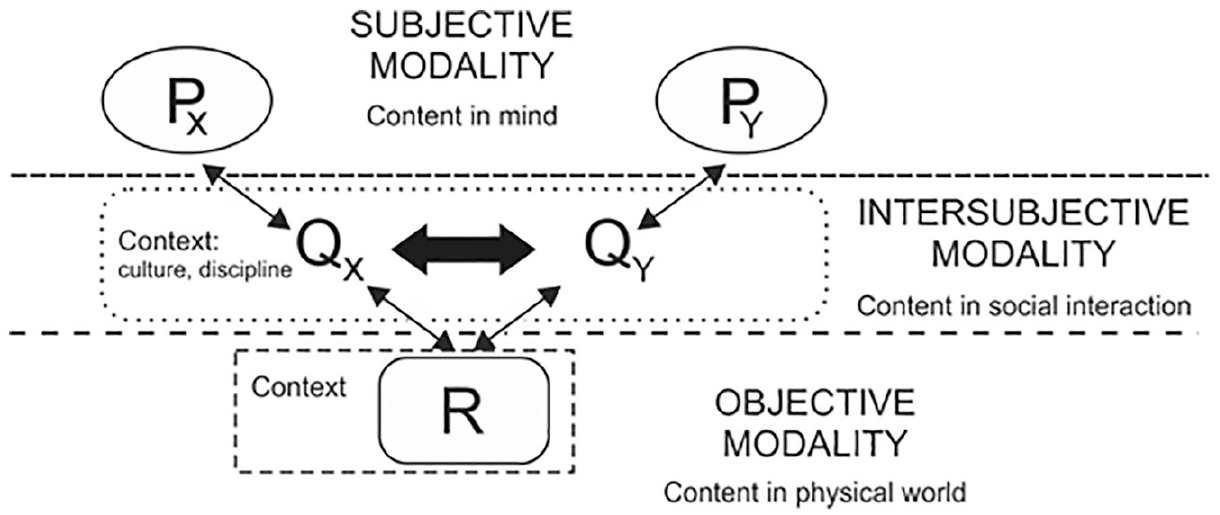
The subjective, intersubjective and objective modality.
The correspondence of content between (internal) subjective consciousness, intersubjective communication and (external) objective existence is called operational isomorphism. This can never be static: it is always dynamic in the flow of action, interaction, communication, perception, and thinking. It underpins the general disposition in individuals to distinguish certain content from everything else (e.g., colors from non-colors), to compare objects with related content within themselves (different colors among colors), and to interchange all objects with the same content (red, yellow, and blue are colors). It is also a disposition necessary for learning. Its basis is the ability to recognize “the same in different.” We can label it the ability to recognize and express unity in diversity.
Content and Meaning: Semantization and Instrumentalization
When a student learns content so that they truly understand it, and can communicate and master it (e.g., playing a musical instrument, speaking in a foreign language), they need to be able to express it in different ways, with different means of expressions. At the same time, they must be able to interpret the content back from the various expressions. In doing so, they develop their understanding of the relationships between the content and its parts.
In this sense, content and meanings can be understood as a structure, in which the whole is the sum of its parts (Peregrin, 1999, p. 77); the content as the whole, and meanings as parts of that whole. Hence, meaning is existentially dependent on the structure. However, meanings cannot be understood other than in the context or contexts of the structure. The context is the whole network of mutual references of which the meaning is part. Content and context are two sides of the same coin (Bohm, 1996, p. 85).
A student who is presented with a meaningful phenomenon (word, sentence, mathematical expression, graphic scheme, product of nature, etc.) should first anticipate that there is some content to be interpreted, despite the fact that it might often be a demanding procedure. The point then is to work back from the anticipated content to understanding the meanings.
The Inhalt/Gehalt distinction (Hopmann, 2007; Klafki, 2000) in the tradition of the German Didaktik, can be used to understand this process. Inhalt is the “substance” which should be interpreted by the student, Gehalt is the structure of meaning which he understands if the interpretation has been successful. In this context, Hopmann explains that “[ . . . ] the connection of matter and meaning [ . . . ] is an emerging experience which is always situated in experience” (Hopmann, 2007, p. 117). That is why this dynamic approach to content requires teachers to pay close attention to the ‘emerging of experience’; in this process, the content is actively shaped and adapted by the student through its expression, formation, and remodeling.
The term semantization is used for the interpretative procedure that leads from (anticipated) content to (subjectively understandable) meanings. It is the experience in which a subject (the student) creates and their own understanding of certain previously unknown content and can express it. However, this process is dependent on the context mediated by culture (Willbergh, 2015). Within the framework of culture, individual disciplines are constituted in which a specific type of experience develops that is typical for a given discipline (field).
Kvasz (2015) uses the term instrumental experience for this “field” type of experience because it is experience that depends not only on the specific field but also on the current state of historical development of symbolic and factual instruments in the relevant field (e.g., the current state of instrumental experience of chemistry or physics in the 21st century is different to the historical state in the 19th century). Therefore, Kvasz’s instrumental experience refers to a certain level of the desired state of content knowledge in a particular field. The formation of instrumental experience depends on the development of the relevant field(s), so it is an intersubjective process in which individuals participate in different ways.
We will call the process of creating instrumental experience on a metaphorical “seam” between the individual and a specific field, instrumentalization of experience. In the learning environment, instrumentalization takes place when the student can semantize the content with an understanding of the specific field. The semantization of educational content in the learning environment will therefore be called instrumentalization only when it can be didactically interpreted in the instrumental context of the disciplines that provide educational content.
Instrumental Isomorphism and Learning Tasks
In distinguishing between semantization and instrumentalization, we have established an important distinction between general didactic terminology and the terminology in specific fields of educational content (for example mathematics). This enables us to define a second type of isomorphism, different from operational isomorphism. We will call it instrumental isomorphism.
As explained above, operational isomorphism refers to the equivalence between three modes of content existence: (a) in internal subjective consciousness and memory, (b) in external objective being, and (c) in intersubjective communication. Operational isomorphism has also been characterized as the ability to recognize and express unity in diversity (understanding the same and the different).
The ability of a person to “unite diversity” is especially demonstrated during any human communication by associating expressions with the same meaning. This can be expressed by the formula E1/C = E2/C (E for expression, C for content). It expresses both diversity and the unity of certain content. In the formula, the diversity is indicated by the difference between E1 and E2 (e.g., ⌂ and house) while the unity results from the same content symbol: C (⌂ = house). Note carefully that the above-mentioned unification of two different terms under the same meaning (and hence the same “unit” content—concept or preconcept) can be expanded. For example, ⌂ = dům = house = Haus = 的房子 = ⌂ = дом = maison = . . .? This transformational series can be enriched and extended indefinitely.
All elements in this series have identical meaning. Hence, we can claim that they are also isomorphic in content. In this case, however, it is not an operational isomorphism; instead of linking “inner” to “external” content, the focus is on the links between “external” expressions. We use communication tools, or instruments, for expressing, communicating, and sharing content. For this reason, we use the term instrumental isomorphism.
Instrumental isomorphism is subject to change in time because the ways of capturing and expressing content have changed in history. Human language and disciplines themselves are emerging, evolving, and transforming, and individual disciplines play a variedly important role in the development of culture during historical development.
Content transformation through instrumental isomorphism is critical from an educational perspective because it brings opportunities for the designing of learning tasks. We will illustrate this again with mathematics. We choose a certain basic quantity, let’s say nine. Nine objects can be objectively collected and counted “outside” in the world. Using the knowledge of intersubjective content of mathematics, we have both a basic notation of this quantity and, even more importantly, differently complex ways of transforming quantity nine through mental operations (in this case mathematical operations). Through a learning task, the transformation changes into a puzzle, a question . . . and becomes a learning task. We can easily illustrate this with content transformations 9, if we express the corresponding “space” with a question mark: 3 * ? = 9 (three times what equals nine), 3? = 9 (three to power what equals nine), etc., indefinitely.
Two-Dimensional Semantics: Extensions and Intensions
When learning content, the student must “move” (or “translate”) between two distinctive domains: the subjective experience (the subjective modality in Figure 1) and the objective content (the objective modality) shared within the culture or within disciplines (the context). The student’s initial pre-understanding is what constitutes the basis for learning. Their source is the student’s natural experience of various phenomena stored in memory which is tied to the real objects that students commonly encounter and know from their own experience. These objects are traditionally called substances. They are objects that can be counted, grouped, and sorted into different levels according to their common or related characteristics (e.g., sorting into species, genera, families, etc. in biology).
Objects-substances are coherent and concrete and can be seen as unites of content; they occupy a certain place in space and therefore can be calculated “one by one.” The meaning or conceptual identification of such objects is called extension in semantics. For example, when a child becomes more familiar with language, they may notice that the same thing can be expressed and described in several different ways; that we can express and describe one and the same extension in a variety of ways, “horizontally.” Extensions anchor our experience “vertically” in real life—they are the link between language and the world. Numbers (quantities) can be considered as a special type of extension (Tichý, 1988).
Semantics distinguishes extensions from intensions where knowledge is demonstrated in the description and definition of objects and their relations. Intensions are different ways of defining, describing, or displaying the same object. Intensions relate to each other and also to extensions, so that one and the same extension can be expressed by several different intensions that are logically and meaningfully related to each other. Given that intensions are semantically and logically linked to the respective extensions, knowledge of their interconnection (declarative knowledge) together with the ability to handle the relevant aspects of the content (procedural knowledge) is considered a comprehensive knowledge of the content.
The concept of differentiating between an extensional (vertical) and intensional (horizontal) perspective when interpreting content—more precisely meanings—was called two-dimensional semantics by Doležel (1998, p. 4), this line of thinking has a complex and inspiring tradition, however, starting with Gottlob Frege (1848–1925) through Rudolf Carnap (1891–1970), Saul Kripke (*1940), Pavel Tichý (1936–1994), and others. Two-dimensional semantics does not consider one perspective as secondary to the other; the focus is on the relationship between them. This relationship creates the necessary conditions for the designing of learning tasks for students.
Illustrative examples have been presented above and can be explained in these terms. What the student has to solve in tasks 3*? = 9 (three times what equals nine) or 3? = 9 (three to power what equals nine) relates both to the sorting and grouping of objects—the “vertical” aspect related to extensions. But the student must also be able to understand the relationships between the different ways of expressing content—the “horizontal” aspect is related to intensions. The difficulty of mastering the content is determined by the complexity of meaning and logical links between different intensions of the same extension. A person who knows different intensions for the same extension and understands their mutual meaning and logical relationships, has greater knowledge of certain content than he who knows nothing about these intensions and their meaning and logical structure.
We have emphasized that with links between extensions and intensions it is necessary to clearly understand their meaning and logical relations, and be able to clarify or justify them. This is the basic condition for successful semantization and instrumentalization and it is the only way to demonstrate a true understanding of the content. In practice, this means being able to describe and explain relationships in the direction “from intensions to extensions,” that is, from language to practice, and in the opposite direction—“from extensions to intensions,” that is, from practice to language, more precisely theory.
The key objective of education is to understand and communicate content, and we need to introduce additional concepts that provide an insight into how this objective can be achieved. We use the term extensional deconstruction to refer to the cognitive movement that the student undertakes in the “vertical” direction (from intensions to extensions). We refer to the “horizontal” movement (i.e., from extension and between intensions) as intensional expansion and intensional condensation. Terminologically, the hypernym here is content transformation. It takes form as the processes of semantization (of content) and instrumentalization (of experience). These in turn are realized through extensional deconstruction and intensional expansion or intensional condensation.
An example of the application of two-dimensional semantics in education (Figure 2) relates to the concept of “Growth” and comes from the research in the field of didactics of biology carried out within the Didactic Reconstruction Model 1 (Riemeier, 2005).

Intensional expansion, intensional condensation and extensional deconstruction.
To explain Figure 2, we first define what we mean by our terms, extensional deconstruction and then move on to intensional condensation and intensional expansion.
Extensional deconstruction is a process that runs from the student’s knowledge of the content of the field (here biology) to natural experience with real phenomena. It is demonstrated by giving concrete examples, demonstrations that illustrate respective knowledge and especially in all ways of practical application of theoretical knowledge.
Intensional condensation is a process that leads to depiction of unity (invariant, common meaning, principle, or regularity) within a plurality and variety. It demonstrates the ability of the student to express and clarify in a dialogue the key term characterizing a complex fact, to propose a definition, principle or rule for describing a complex phenomenon, to combine different knowledge into a logical unit.
Intensional expansion is a process that runs from the student’s natural experience with the world to the knowledge of the content of cultural disciplines (here biology) and shows the student’s ability to view a certain extension from different cognitive aspects. It demonstrates the student’s ability to describe, explain, and manage a particular aspect of the world through a variety of means of expression in one or more different disciplines of culture, both at procedural and declarative levels of knowledge.
When we consider the extensional basis of the example mentioned above (Figure 2), we can deconstruct content into (a) the increment which can be expressed in numerical terms, that is, it is quantifiable and (b) a change in the character of the object. Both of these items are indicative of the possibilities of reification, that is, the concept of “growth” as a specific variable that can be characterized by the distribution of its quantified values (e.g., when comparing plant growth from a field fertilized with organic fertilizers versus a field fertilized with inorganic products). Through such a reification, the term “growth” can be empirically captured and illustrated as a concrete perceptual Gestalt of a particular state. This is expressed in Figure 2.
To sum up, extensional deconstruction lies in the core of operationalization: it goes from knowledge of concepts to the world of practical experience. The key moment deciding on the success of extensional deconstruction is the success of reification, that is, the functionality of the link between action, perception, and conceptual grasp.
So far, we have presented theoretical constructs that capture and explain the dynamic nature of content transformations that take place in the classroom and that constitute changes in a student’s knowledge. In the following text, we use the constructs in a case study of mathematics teaching and learning.
Case Study: Rhythm, Movement, Periodicity Empirical Evidence of Semantization and Instrumentalization in Mathematics Classroom
Below, we aim to illustrate the processes of semantization and instrumentalization through a classroom case study of teaching mathematics in the fourth grade of primary school in the Czech Republic. We have drawn from a complete didactic case study which was published by Jirotková (2017) and followed the 3A procedure within the content-focused approach (Janík et al., 2019). The instructional approach employed in the lesson is based on the Hejný method (H-method; Hejný, 2012; Hejný et al., 2015). 2 H-method is a constructivist method of teaching mathematics focused on building mental schemes of mathematical concepts (Hejný, 2012) that uses conflict and critical discussion to reveal mathematical truths and develops students’ autonomy in mathematics. Within the approach, concepts are developed (in accordance with the Theory of Generic Models; Hejný, 2012) from motivation and isolated models through generic models through abstraction to abstract knowledge.
The principles of genetic constructivism elaborated by Kvasz (2016) will be emphasized in the case study, in particular the principle of epistemic proximity, that is, the emergence of mathematical concepts through the performance of motoric, mental, symbolic, and iconic activities, together with the principle of instrumental anchoring which emphasizes the importance of developing empirical experience and its transformation into instrumental experience, which is essential for mathematics.
Context
The video-recorded lesson took place in mid-May of 2013. The class was led by the teacher Jitka. The H-method had been used in mathematics classes at this school from the first grade. We also used the teacher’s commentary which was available for this particular lesson. 3 During the lesson, students worked with scratch pads. For experienced teachers, this provides an opportunity to continually diagnose the current level of each student’s knowledge and manage their further cognitive steps through appropriate tasks (Hejný, 2014, p. 44).
The activity “clap, stamp” was the content of the first part of the lesson. Students played the activity as a “game” which they had known since their first grade. However, from a didactic point of view, it is also a legitimate teaching methodology, using tools representing (mathematical) content. The mathematical content is the numbers characterized by their character: “be even/odd,” “be divisor/multiple,” and so on. Students are supposed to handle operations with numbers in various forms; in this case, it is the transformation of numbers into the form of movement: clapping and stamping.
Mathematically, the activity is about building concepts of divisibility—multiple and divisor, common multiple, and least common multiple of two natural numbers, division operations, or division with the rest. The game goes as follows: students are divided into two groups: clappers and stampers. The teacher says two numbers, say “clap two, stamp three,” and then starts rhythmically chanting the number series: one, two . . . while moving her hands like a metronome. The clappers clap every second and the stampers stamp every third. The chant ends when someone makes a mistake.
The Game and the Language of Mathematics
The game “clap a, stamp b and count to k” ends with these mathematical questions: How many times did we clap? How many times did we stamp? How many times did we clap and stamp at the same time? These questions can be translated into the language of mathematics as follows: How many multiples of number a, or number b, or common multiples of a and b are in the number series from 1 to k?
Students encounter three types of situations in this activity, namely: stamp on every third, divide into three parts and divide by three. In this way, they can realize the so-called multiplicative triad. (We call three numbers (a, b, c) a multiplicative triad if the relation a ∙ b = c is valid. If we use addition instead of multiplication, we are talking about an additive triad.) This particular multiplicative triad consists of numbers 3, 12, 36: the students know that—by knowing any two of the triad numbers—it is possible to calculate the third number by multiplying or dividing. On the path to this profound discovery, students must first semantize their activity. It means that they interpret their clapping and stamping as a way of counting, through intensional condensation, intensional expansion, and extensional deconstruction. At the same time, the activity is to be instrumentalized, that is, gradually mastered through symbolic tools of the language of mathematics. Thus, their understanding is no longer tied to a particular situation, and they can work with numbers as abstract concepts and with the links between them.
In the first part of the activity, the students gain motoric experience with representation of numbers and numerical operations. In the second part, they are looking for a tool or an instrument to grasp these motoric experiences. Thus, their motoric experience is transformed into instrumental experience which allow them to articulate solutions using mathematical symbols (instrumental isomorphism).
Didactic Objectives
The “clap, stamp” activity pursues several didactic goals, the one of interest in this article being to develop a student’s instrumental experience with mathematical operations and mathematical content through synchronization of rhythms. These are different intensional representations of “the same” content.
Students must synchronize two rhythms; one rhythm is the teacher’s countdown of a series of numbers. That rhythm is synchronized by the students with the rhythm that they created. We can also speak about a rhythm period. In our game, the clapping rhythm has a period of 2 and is of type AB when two elements alternate, clapping and pause. The rhythm with period 3 is in our case type ABB—stamp, pause, pause. Both rhythms are carried by the student’s movement t accompanied acoustically. The student’s realization of the rhythm by moving his or her body is a valuable experience on which the further abstract knowledge can be built, which is then better understood and remembered as evidenced by different researches (e.g., Gruszczyk-Kolczyńska, 1992).
The ability to synchronize the rhythm of stepping, clapping, and speaking the numbers is based on the construction of the notion of a number. Several ways of intensional expansion of the same number are realized simultaneously—acoustic, kinesthetic, visual, and spoken. Later, students find an instrument that can be used to visually represent all these ways of intensional expansion, such as five arrows, five dashes, and so on. Once the representations are drawn, it becomes a visual, static model. The interconnection of these representations with the mathematical character leads to cognitive elevation—creating an abstract knowledge of the number.
Authentic Situation: Excerpts of the Video 4
In H-method teaching, students learn mathematics by solving tasks in different contexts, in different mathematical environments. This concept was introduced into the didactics of mathematics by E. Wittmann (2001) who introduced the term substantial learning environment, which requires that the tasks presented in it allow the students to reveal important mathematical concepts and relationships. The idea was further developed by M. Hejný (2014) who defines the concept of a didactic mathematical environment as follows: a set of interconnected concepts, relationships, processes and situations that allow the designing of tasks: a) that enable students to reveal deep mathematical ideas, b) that include strong motivational potential, c) that are appropriate to students of both primary and lower secondary school and d) the difficulty of which can be adjusted. (p. 13)
The idea is that students work frequently and repeatedly in many different settings. Thus, when solving a given task in a familiar environment, students can concentrate on the mathematical nature of the task and not lose focus by trying to understand the task itself.
Time 0.16: The teacher announces the game “Clap, stamp.” The reaction of the children is wildly positive.
As previously described, the teacher rhythmically counts down a series of numbers and moves her arms side to side at the same time. In terms of student’s perception, it is a rhythm which is acoustic (words) and visual (movement of the hand of the teacher), processual and transitory, the coordination of which is no trivial matter.
In the following section, video observations and analysis are presented to show the various strategies adopted by students when trying to synchronize the rhythms. The coordination of thinking with movement is important for developing intellectual abilities, for example, writing while thinking. Hence, this game has a double impact on intellectual development. For students who have focused only on rhythm and have not paid attention to even, odd numbers or multiples of three, the acquired knowledge is only in action. These students did not instrumentalize their activities in the context of mathematics. For those who focused on numbers as well, the acquired knowledge is in the words of the language of mathematics as well as rhythm. We consider this to be more advanced as the students master the necessary degree of instrumentalization.
Student Autonomy on the Way to Instrumentalization of Experience
Observation: The teacher writes down the number 37 on the blackboard and says, “Question one: How many times did we clap?” (Time 1.59–2.03).
In describing the video and analyzing it, we follow several students and describe their solutions to the question asked by the teacher.
Observation: Martin loudly chants the multiples of 2 while showing the number of claps on his fingers. His neighbor shouts at him to be quiet, and Martin continues quietly. Some are making strokes (Figure 3[A]), some write all numbers, and someone, a clapper, the even numbers where the claps occurred (Figure 3[B]). Someone seeks advice from the others (Time 2.14, Lukáš).

(A) Strokes and (B) even numbers.
It is interesting that although the students knew the game well, and therefore they knew what the first question would be, no one, including those students who were clappers, answered the question immediately. It appears that no one could simultaneously realize their even number rhythm and at the same time count how many even numbers were chanted. The same applies to another question, “how many times did we stamp.” This showed how semantization is difficult and requires concentration in this game.
It was clear that the teacher supported student autonomy. She left it to the students to solve it by using their own instrumentalization strategy, at their own level. Students were given the necessary time to spread the desired knowledge among themselves without her intervention (this teaching strategy lies in the core of the H-method). Presenting a series of appropriate tasks and moderating class discussions on the solution helps support students’ learning.
The solution of the task series “clap a, stamp b” is directed to the “divide” strategy: divide the last spoken number (k) by a and the result is the number of claps. Then divide it (k) by b and the result is the number of stamps. Finally, divide by the number n (a, b), the smallest common multiple of the numbers a, b, and the result shows how many times they simultaneously clapped and stamped. The “divide” strategy was used, as we can see from a later observation, by at least one student (Jovanka). The difficulty of this strategy is indicated by the fact that in the end all students appreciated when the result was verified by the “list relevant numbers” strategy, that is, a strategy at a lower cognitive level that requires no abstraction.
Some students were satisfied with finding a solution to the first task (how many times did we clap) and waited for the rest of the class to finish and further instructions from the teacher. Some continued on, to count how many times the stampers stamped, without any prompting (Figure 4). This suggests that working in a well-known mathematical environment provided opportunities for individualization; faster and more motivated students were occupied because they knew what to do next when they had completed the first task.
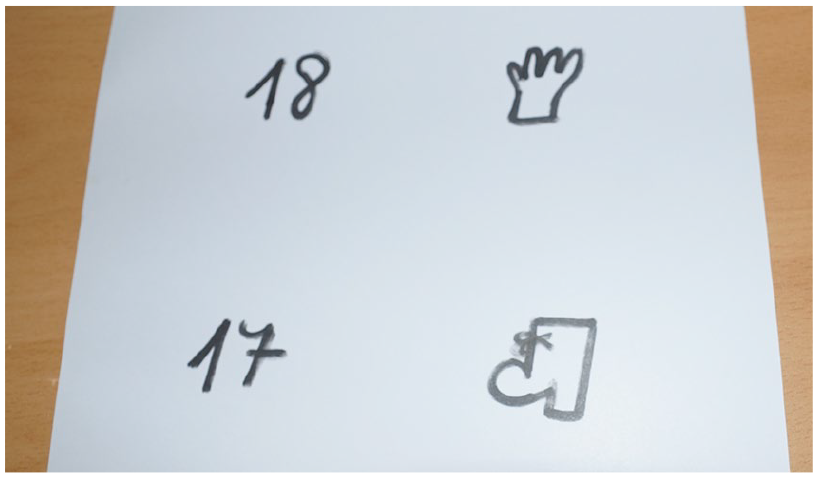
Solution at 3:29.
Strategies Employed: Ways of Content Semantization and Instrumentalization of Student Experience
Bára: On the Way to Mathematical Language
Observation: Bára explains how she calculated the result. She speaks with her back to the teacher and doesn’t even look into the classroom. She is focused and locked in her mind. The teacher repeats the whole procedure after Bára. (Time 7.56).
The teacher may have had two reasons for Bára’s words. Probably, she wanted to make sure that she properly understood what Bára had said. Alternatively, it could be that she wanted to keep the focus on the dynamics of the problem solving process and prevent any misunderstanding resulting from Bára’s inaccurate wording (“. . . and then I counted and reached 6 . . .”). So, she repeated it more clearly: “Bára counted multiples of over 20; she knew she had one ten, and then counted 6 more multiples of over 20. Do I understand that well? And she reached six.”
The teacher spoke Bara’s thoughts out loud. Her aim was probably to clarify Bára’s words, but that does not mean that it became more comprehensible to other students. It might have been more appropriate to ask if and how they understood Bára, and possibly let another student speak his words. Certainly, many teachers have the experience that when they explain something to the students in precise mathematical language, the students do not understand them as well as if their peers had explained it, even though their formulations were full of inaccuracies, demonstrative pronouns, and ballast words. In short, students usually understand each other’s explanations better than when a teacher explains something to them. Teachers strive for mathematical (terminological and logical) accuracy and reflect their own understanding in their explanations, that is, the psyche of an adult. However, students have similar experiences to each other, use the same communication tools that they translate into their own understanding. This is an example of operational isomorphism.
Jovanka and Martin: The Search for Clarity
Observation: Jovanka defends her result which was 18. She does not react to Bára but shows her own way of solving the problem by writing on the board: 37: 2 = 18 (1). Martin also wants to use the board. He does not think that Jovanka’s approach is understandable.
While Jovanka had grasped the situation structurally, she had not linked it to her semantics. However, for Martin and most other students, it was still incomprehensible. Although Martin is very proficient in mathematics, it was apparent that he had not yet instrumentalized his experience and remained linked to the particular situation of clapping. He showed his strategy—enumerating all the even numbers from 2 to 36, making a stroke for each and then counting them. There was a confirmation from the classroom: “Yeah, yeah,” and someone applauded, perhaps as a joy of his own success, of understanding the solution that Martin had deliberately modified to make it illustrative, not the appreciation of Martin himself.
Kačka: From Physical Activity to Its Symbolic Expression
Observation: Kačka explains her solution. But when she shows her product, the teacher herself explains it.
Kačka wrote all the numbers on the scratch pad first, then circled every second number with a smooth ring, every third with a wavy ring, which made flowers at the points where they stamped and clapped at the same time (Figure 5).

Kačka’s solution.
Observation: Martin concludes the episode with unqualified admiration for Kačka with a statement “three in one.” Finally, he applauds and says that Kačka’s solution is the best.
We will explain what Kačka did and why it helped many of the students when the solution is arduous and lengthy at first sight. Kačka conceptualized the whole process and converted all the process rhythms to static and visual. In doing so, she applied intensional condensation together with intensional expansion: she transformed physical activity into the form of a record (condensation) and differentiated within the record (expansion). Hence, there was a permanent graphical record of the course of physical activity—a representation of the content from which it was possible to read answers to still unspoken questions.
E. Gruszczyk-Kolczyńska and E. Zielinska describe the connection between the ability to translate between different systems of representation and the development of thought (Gruszczyk-Kolczyńska & Zielinska, 2015). For Martin, understanding Kačka’s record meant moving from process to structure, and it moved him to a higher level of solution of other issues (see Time 21:23). His ideas were freed from the link to the game and the counting of numbers, and he started to use the structure of the multiplication table, which he then penetrated further with the solution of the next question.
Lukáš: Inspiration Used
Observation: The teacher asks, “How many times did we stamp?” (Time 15.06)
Again, the teacher writes on the board the student’s answers to the question (11, 12) which now appeared very quickly. Lukáš, the author of the answer 11, was asked to share it after he was keen to speak. He happily showed how he had written all the numbers up to 37 on the scratch pad and how he “did it by threes,” so he reached 11 (Figure 6).
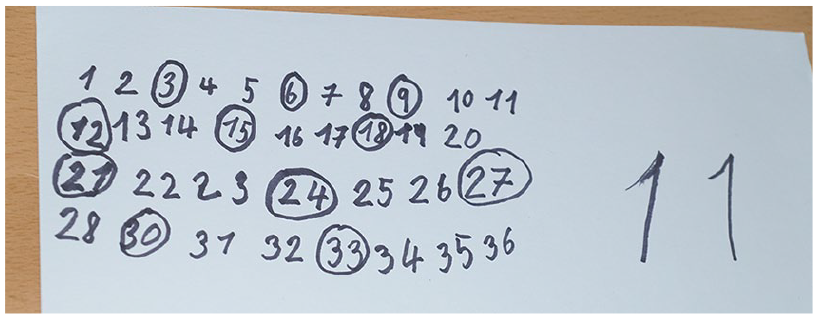
Lukáš’s solution.
Lukáš was inspired by Kačka’s solving strategy, which provided him with instrumental experience. He applied it to the second problem. There was again cognitive osmosis—students take knowledge from other students. This time it was the solving strategy: Convert the clapping/stamping process to a more tangible visual representation and then mark every third number.
After the usual discussion of whether Lukáš was right, Honza took control of Lukáš’s solution. He revealed together with Martin that Lukáš forgot to circle number 36, and thus corrected the result to 12.
On the Way to Instrumentalization: From Creativity to the Understanding of Mathematical Language
Observation: The teacher asks the last question: “How many times has it been clapped and stamped at the same time?” Then writes on the board solutions 6, 5, 30, 29, 4 (Time 19.32).
Only when the students thought through their solutions did the teacher use this question to direct them toward the key finding. Martin came up with a strategy first using the table of multiples: “I was looking at the multiplication table again, and I imagined making a stroke to every even number.” It was clear that Martin was already working with common multiples of 2 and 3 but could not yet instrumentalize his experience: he had not realized the existence of a rule, neither did he formulate a means to express it.
Bára was the first in the class to use the least common multiple of numbers 2 and 3 in her solution: “I simplified it and calculated the multiples of six.” She goes on to say that “there are even numbers within multiples of six and they are also in the multiples of two and three.” At first even Bára did not realize that she had just made a key discovery. It was Martin again with a comment.
Observation: Martin opposes for a moment. It can be seen that he is thinking deeply, and finally admits that Bára is right and that what Bára said is a new discovery for him (Time 27.20).
Astonished, he looked at the table of multiples and he went on to show the solution there (Figure 7). Previously, he had looked for his solutions as even numbers in multiples of three, but he had trouble with the series ending at 30. Now he had discovered that all even multiples of three were under number 6, so all he had to do was count how many there were up to 36.

Multiplication table.
Only now was the road open to the instrumentalization of his newly acquired experience. What remained now was only to label (name) and generalize the newly discovered rule of the least common multiple. Thus, after almost half an hour of heated discussions about solutions, wrong solutions, advocacy, and argumentation, at least two students in the class had discovered for themselves a common multiple of two natural numbers.
Conclusion
The article aimed to introduce and illustrate theoretical constructs for explaining the process of developing students’ experience within the learning environment of a school classroom. The explication was built on the theory of content transformation, which explains the development of students’ subjective experience as the result of intersubjective work with content through cultural (linguistic, iconic, factual) instruments. The central category of the theory is isomorphism, both operational and instrumental, that is, the linguistically and culturally cultivated ability to understand “the same” content “in a different way.”
These theoretical constructs were then illustrated in a case study of mathematics teaching and learning. The case study aimed to demonstrate content transformation and isomorphism in using various interactions and communication tools in a learning environment. To express “the same” “differently” provides students with an opportunity to “make their own way when solving a problem. Using various instruments within one task [ . . . ] leads to a follow-up discussion about their relationship” (Kvasz, 2016, p. 25). The case study showed how this approach stimulated discussions between students and in-depth thinking, rather than a “mechanical” drill of a relevant algorithm.
The theoretical constructs presented here describe, analyze, and explain the processes of semantization of content and instrumentalization of the student’s experience. These begin with sensual and motoric experiences with extensions as the basic support for the development of concepts. (e.g., the number of stamps and claps as a way to understand mathematical content.) Furthermore, the concepts of extensional deconstruction and intensional expansion or intensional condensation are introduced to explain the “movement” or “translation” between the domain of the student’s own experience and the domain of a particular field.
The sensual or motoric experience with extensions would lack any educational or cultural value had it not been intensionally anchored in the instruments of the respective fields (here the least common multiple). As it is, disputes can be rationally solved with the help of specialized (mathematical) language (knowing two numbers from the multiplicative triad one can calculate the third by means of multiplication or division). From a long-term perspective, it is clear that similar insights into working with content in a learning environment bring more general knowledge that transcends barriers between fields, such as problem-solving competence, communicative competence, critical thinking, and so on.
The integration between these three perspectives is a task for teachers in classrooms. The key tool of this integration is the language; but by their pedagogical acting the teachers prove that the student’s “knowledge of content” is not only about the language itself, but it is a whole complex of experience with various symbolic, iconic, and factual tools that determine (and facilitate) human knowledge of the world.
Footnotes
Acknowledgements
The authors with to thank Kay Pearse (CBB Consulting) for her advice on English language editing.
Declaration of Conflicting Interests
The author(s) declared no potential conflicts of interest with respect to the research, authorship, and/or publication of this article.
Funding
The author(s) disclosed receipt of the following financial support for the research, authorship, and/or publication of this article: When writing the paper, the authors were supported by the grant GA20-13038S “On productive culture of teaching and learning” provided by the Czech Science Foundation.
