




Abstract
Although the judgment of time is an important experience embedded in the context of cognitive and emotional appraisal of events, there are few studies concerning perceived time within an ecologically valid context. Watching a cultural event such as a dance performance is a paradigmatic situation in which viewers perceive time differently as a function of performance characteristics and viewers’ personal engagement. We staged two dance pieces that differed in speed of movement performed by a professional female dancer. Fifty-two participants watched both performances in counterbalanced order and rated their impressions, senses of self, and perceptions of space and time. On average, spectator-participants liked the faster dance better than the slower dance and felt more positive afterward. During the fast dance, participants focused more on the dancer’s breathing and less on their own body. Participant’s subjective perceptions were that time seemed to pass more slowly during the slow dance, but participants estimated the faster dance to have lasted longer. Path analyses revealed that paying attention to one’s bodily signals mediated the feeling of time. As typical flow states are characterized by positive feelings during an activity, as well as by a diminished sense of self and time, these results suggest that the participant’s average response reflected a relatively stronger flow state in the fast dance condition. Future studies might be encouraged assessing time perception in a variety of real-life situations. Participants’ responses could then be assessed with different methodological approaches.
The passage of time is felt as constantly changing depending upon the modulations of experience. Therefore, judgments of the same physical duration vary considerably within and across individuals. The notion that subjective time is a function of the self refers to the fact that duration judgments are dependent upon an individual’s momentary affective and cognitive states (Droit-Volet, Fayolle, Lamotte, & Gil, 2013; Wittmann, 2009). Moreover, it has been postulated that the sense of the bodily self contributes considerably to felt passage of time (Craig, 2009; Wittmann, 2013, 2016). Boredom and the feeling of flow are two endpoints of a dimension in which time seems to either stand still or fly (Wittmann, 2015; Zakay, 2014). In uneventful situations, time passage tends to be overestimated as people report it to be slowing down; in contrast, when entertained by activities, people tend to be less aware of time passage and experience it as passing more rapidly (Conti, 2001). These modulations of subjective time vary with modulations of the sense of self. While waiting, with few distractions from the self, time seems to slow down. In contrast, when absorbed in entertaining activities with less self-awareness, time passes more quickly (Wittmann, 2015).
Virtually thousands of experimental studies have assessed the perception of time in the range between milliseconds and seconds using computerized tasks in laboratory settings (e.g., Pütz, Wittmann, & Wackermann, 2012). However, few investigators have studied subjective time within an ecologically valid context employing an extended time range of multiple seconds to several minutes. In studies where longer intervals must be judged, subjects typically conduct a primary nontemporal task and are then later asked to estimate task duration (Brand, Thiabaud, & Dray, 2016). In such retrospective time perception tasks, subjects learn only incidentally, after the primary task has been conducted, that they are to judge the duration of the completed task. In one such retrospective time judgment task, subjects watched three different film clips with identical durations of 45 s evoking fear, amusement, and more neutral reactions, respectively (Pollatos, Laubrock, & Wittmann, 2014). The fear clip was associated with a relative overestimation of time passage, whereas the amusement clip led to a relative underestimation; the latter result was interpreted as being in accordance with the saying, “Time flies when you are having fun.”
Cognitive models of time perception assume that prospective and retrospective time perceptions are governed by different processes (Zakay & Block, 2004). For prospective judgments of time, one attends to present time passage explicitly through an internal interval-timing mechanism (an internal clock), focusing on shorter durations in the milliseconds and seconds range. According to these internal clock models, explicit attention to time and higher arousal levels lead to perceptions of relatively longer duration (Droit-Volet & Wearden, 2015, 2016). For retrospective time judgments, one directs attention to time passage only after the event has terminated, meaning that there was no explicit attention to time during the time period in question. Retrospective time perception is accordingly reconstructed from memory content. When more life events were experienced during a time interval and then retrieved, the longer duration is judged retrospectively (Bailey & Areni, 2006).
Watching a cultural event, such as a concert, a theater play, or a dance, is a paradigmatic event to study time perception, as the experience should affect individual audience members differently, depending on the performance and its effect on each participant’s individual engagement in the experience (Lipps, 1906). Not being engaged while watching a performance leads to recurrent attention to time and to the feeling of time passing slowly. In contrast, we lose track of time when immersed in activity. We are then often surprised about how much time has passed. The experience of losing the sense of time is most pronounced in typical flow experiences, when one is fully immersed in challenging tasks which are accompanied with the feeling of enjoyment—while sporting, working, or playing—but it can also be experienced by participants watching a performance (Csikszentmihalyi, 1997).
In our study, we staged two dance pieces that differed in speed of movement performed by a professional solo dancer. Spectators watched both performances and subsequently rated their impressions concerning the dance and their related states of mind, including their perceptions of time passage. Dance is a prime “stimulus” to study spectators’ mental states and bodily reactions because it has dynamic qualities and can induce empathic reactions (Vatakis, Sgouramani, Gorea, Hatzitaki, & Pollick, 2014). As a kinesthetic art which is directly perceivable in the entire body of the spectator (Hagendoorn, 2004), one can find out details about embodied perception and embodied cognition in a dance audience. In one study using static images of dance postures, the presentation of postures requiring more movement were judged to last longer than the presentation of postures requiring less movement (Nather, Bueno, Bigand, & Droit-Volet, 2011). This finding was replicated for participants viewing artwork. Photographs of dance sculptures (e.g., by Edgar Degas) depicting dance postures with greater implied degrees of movement were correlated positively with longer perceived duration estimates (Nather & Bueno, 2012; Nather, Bueno, & Bigand, 2013). Expertise is an important moderator in judging the duration of such images. Professional dancers who were asked to watch movement sequences presented through a series of static images more accurately and precisely judged time passage in comparison with nondancers (Sgouramani & Vatakis, 2014). All the aforementioned studies with static dance images were conducted as prospective timing tasks in the millisecond-to-second range.
A live dance can induce much stronger effects on a viewer than a recorded dance. It was shown, for example, that motor corticospinal excitability (MCE) in the motor neuronal system was significantly higher after watching a 5-min live-dance sequence than when watching a dance video (Jola & Grosbras, 2013). It was suggested that the higher MCE during the live-dance session was due to the physical presence of the dancer, which affected the motor neuronal system of the spectator more than a dance video. Within the framework of mirror-neuron theory, a live-dance audience may experience kinesthetic empathy in which spectators experience mirror-neuron motor movements (and similar feelings, ideas, and sensual perceptions) within their own bodily perception from having observed the dancer. More specifically, the mirror system integrates movements of others with the observer’s own motor repertoire. Accordingly, the human brain processes movements of others by simulating what is perceived. When viewing movements an observer internally simulates the observed action by employing essentially the same brain regions that are active when moving the own body (Bläsing et al., 2012; Calvo-Merino, Glaser, Grèzes, Passingham, & Haggard, 2005; Hagendoorn, 2004). Thereafter, watching dance movements leads to the activation and focus on bodily processes, important for our theoretical approach of an embodiment of time. In a recent effort by Bachrach, Fontbonne, Joufflineau, and Ulloa (2015), a proof-of-concept study used a slow motion, nonrhythmic, contemporary dance as a dance stimulus. Members of the audience completed questionnaires, and both audience members and dancers had physiological measurements taken to record their breathing and cardiovascular parameters. A synchronization of breathing patterns and muscle tension between dancers and observers demonstrated a physiological synchronization between observers and dancers.
Relating to the emotional and embodied audience reactions to a real dance performance, our investigation compared the effects on audience member’s states of consciousness of two dance pieces performed live on stage with two purposes: (a) to widen an understanding of dance-related effects on states of consciousness, especially with respect to perceived time passage of a whole real dance scenario, and (b) to assess participants’ perceived time passage during a longer duration event, lasting several minutes. In this context, we were especially interested in how participants’ affective and bodily states, induced through dance, might affect subjective perceptions of time passage (Droit-Volet et al., 2013; Wittmann, 2009). Prior research has repeatedly shown how emotions with relatively high bodily arousal lead to overestimates of duration in both short (millisecond and seconds) time ranges (e.g., Gil & Droit-Volet, 2012; Wackermann, Meissner, Tankersley, & Wittmann, 2014) and in slightly longer (multiple seconds) time ranges (Pollatos et al., 2014).
In our study, two solo dance performances differed in speed of movement and involved 5-min durations each, and participant-observers subsequently completed questionnaires regarding the direction of their attention during the performance, their emotional reactions, and their personal sense of self, space, and time. For time measurements, we employed the two most common measures for longer duration, assessing (a) perceived speed of time passage and (b) an estimation of total duration of the performance (Wearden, 2015). We hypothesized that the faster dance speed would elicit a stronger sense of flow in the viewers, measureable as a faster perceived passage of time (Wittmann, 2015).
Method
Participants
A total of 52 individuals formed the audience (24 men, 28 women), aged between 19 and 46 years (M = 26.8, SD = 5.6), with 23 individuals attending the first evening and 29 the second. Subjects were recruited by flyers at the university and word of mouth. Informed consent was obtained by all participants. The study complied with the ethical requirements from the Psychological Department of the University of Freiburg. The spectators sat on the first three rows of the grandstand directly facing the dancer who was positioned 5 m away. Among the viewers, 50% had active dance experience during the last year (e.g., a dance course), 46.2% had experience with body-oriented meditation techniques (Meditation, Yoga, Tai Chi, Feldenkrais), 67.3% engaged in form of sports recreationally, and 15.5% played music or sang on a regular basis. However, no participant conducted any of these body-oriented activities professionally or on an advanced amateur level.
Design and Procedure
Two 5-min live dances were choreographed by three female professional dancers (Mirjam Karvat, Melanie Seeger, and Lisa Klingelhöfer) and performed by Mirjam Karvat (graduate of the London Contemporary Dance School). The dances were staged on two consecutive evenings in the Kammertheater of the E-Werk, Freiburg. The Kammertheater is a medium-sized stage typically used for modern dance projects with a grandstand for up to 100 spectators. The slow-movement piece was inspired by the empirical work of Bachrach and colleagues (2015), who in one recent study based their dance research on Myriam Gourfink’s work. The movements can be described as extremely slow motion without any change in speed. The fast-movement piece consisted of smooth body motions capturing a steady flow. Both dances were based on the same script with a fixed movement sequence but were presented at different speeds. To minimize meaningful motion elements that might influence time perception, there were no repetitions of cyclic elements in the performance of either dance (though there were necessarily more motoric movements within the faster dance). Both dance pieces lasted exactly 5 min, this duration having been selected to provide a considerable-length dance experience that was still short enough not to overburden a lay audience. During the dance, only the dancer was visible, spotlighted on an otherwise dark stage. The two dances were presented in counterbalanced order on two different evenings, namely, on Day 1: fast–slow and on Day 2: slow–fast, and audience members in both performances comprised the participant sample. We deliberately refrained from presenting music to the dance as this would have introduced a strong confounding factor. Some low-volume acoustic cues were, nevertheless, audible, such as the breathing of the dancer.
The order of events on each evening was as follows: First, participants entered the theater and seated themselves on the first three rows. One experimenter (V.D.) welcomed everyone and introduced the main aim of the study, namely, to assess the subjective responses of everyone in the audience to two different dance performances. Participants then received a record form with all the sheets to be filled out (pages turned over) when requested. Participants first signed an informed consent and then filled out a sheet with demographic data and questions pertaining to their prior experience with dance or body-oriented meditation, sports, or music (see below). Then, the first dance was performed after which questions related to this performance were answered. Following this, the second dance was performed after which a new set of the same posttask questionnaires were completed. At the end, after thanking everyone for participation and the collection of the record forms, participants were enumerated for participation with €10.
Instruments
The following instruments were completed immediately after each of the two dance pieces.
Attention and engagement
To assess viewers’ focus of attention and individual engagement, we used German translations of the Individual Engagement and Attention scales by Bachrach et al. (2015). Individuals responded to five statements using a 5-point scale (1 = fully disagree, 2 = disagree, 3 = neutral, 4 = agree, 5 = fully agree). The four statements were “I liked the performance,” “I paid attention to the dancer’s breath,” “I paid attention to my own breathing,” and “I paid attention to the dancers’ muscular tension.” In addition, we created the statement, “I paid attention to my own bodily signals.”
Self-Assessment Manikin (SAM) Scales
The emotional reaction to the dances was assessed using a probed and tested nonverbal pictorial assessment technique, the SAM scales that directly measure (a) positive versus negative valence and (b) arousal level of an individual (Bradley & Lang, 1994). We used the 5-point version of the scale.
Assessment of the sense of self, space, and time
After each of the two dances, participants were asked to indicate their states of consciousness during the dance piece on Visual Analogue Scales (VAS), previously used to retrospectively assess differences in states of consciousness during meditation (Pfeifer, Sarikaya, & Wittmann, 2016) and to assess retrospectively one’s last sexual orgasm (Costa, Petana, Costa, & Wittmann, 2016). Two scales with answer categories ranging from 0 to 6 measured the intensity of awareness of oneself and space. The questions in German were as follows: “How intensively did you perceive yourself?” and “How intensively did you perceive time?” (Figures 1 and 2). Higher scores indicated greater awareness of body and space. For example, the degree of bodily self-awareness during the last sexual encounter correlated positively with finger pressure sensitivity in women (Costa, Pestana, Costa, & Wittmann, 2017). Participants marked their sense of time passage through the questions “How intensively did you perceive time?” and “How fast did time pass for you?” The two subjective time scales were anchored between 0 mm and 100 mm and ranged between 0 mm (intensity: not at all; speed: extremely slowly) to 100 mm (intensity: extremely intensive; speed: extremely fast); see Figures 1 and 2. Finally, participants were asked to indicate how long they thought that the dance had lasted in units of clock time.

Scales for measuring the senses of self and space.
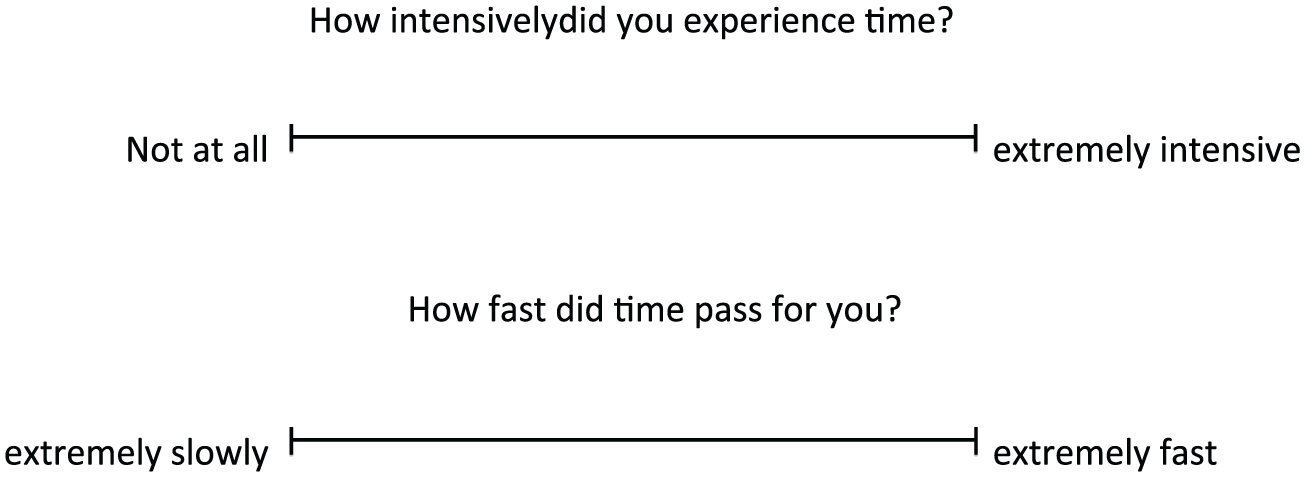
Scales for measuring the sense of time.
Statistical Analyses
The t tests for paired samples were used for testing participant response differences between dance conditions (slow vs. fast). For multiple comparisons, alpha-level adjustments according to the false discovery rate (FDR) method (Benjamini & Hochberg, 1995) were applied with an initial significance levels set to p < .05. In addition, we calculated the effect size using Cohen’s d. Moreover, we chose a path analytic approach for testing possible within-subject mediation effects in our set of variables. The ratio for choosing such an approach was driven by the assumption that the stimuli (fast vs. slow dance) could either have a direct effect on the sense of self, space, and time and/or would be mediated by the viewers’ degree of attention and engagement as well as their emotional responses. We employed this analysis in our setting because we assumed that the dance stimulus which in itself lasted 5 min and thus extended considerably over time would affect the conscious dimensions of self, space, and time through viewers’ attention and engagement. In essence, path analytic models combine several otherwise separate regression analyses in one model when testing for effects between variables (MacKinnon, Fairchild, & Fritz, 2007). In Figure 3, the difference between the fast and slow dance (X) can affect, for one, the time perception variables (Y) in a direct way. The dance pace (X), however, can also affect the behavioral and emotional variables (M), which in turn are known to affect time perception (Y). That would be considered a mediation effect if the dance pace affects time perception via the behavioral and emotional variables. A variable is identified as a mediator M if it carries the influence of an independent variable X to a dependent variable Y. In our model of multiple mediation effects (Figure 3), a i , b i , and c′ are the path coefficients for the respective effects of X → M, M → Y, and X → Y. The path coefficient c′ represents the direct path, whereas the coefficients a i and b i represent the indirect paths. The total effect c represents the initial effect of X on Y when the mediators are not taken into the model. It is the sum of the indirect (a i , b i ) and direct effects (c′). Using a multiple mediation model in a within-subjects design (Figure 3), X represents the stimulus (fast vs. slow dance). However, in this within-subject design, the dance speed difference is actually incorporated in Mdiff and Ydiff captured in the variables Mi and Yi as differences in the observers’ responses for the fast versus slow dance. We employed the multiple mediator approach MEMORE for two-condition within-subject effects proposed by Montoya and Hayes (2017) with a bootstrapping procedure (n = 5,000, confidence intervals set at 95%). The SPSS macro is available at Andrew F. Hayes’s website: http://afhayes.com/spss-sas-and-mplus-macros-and-code.html
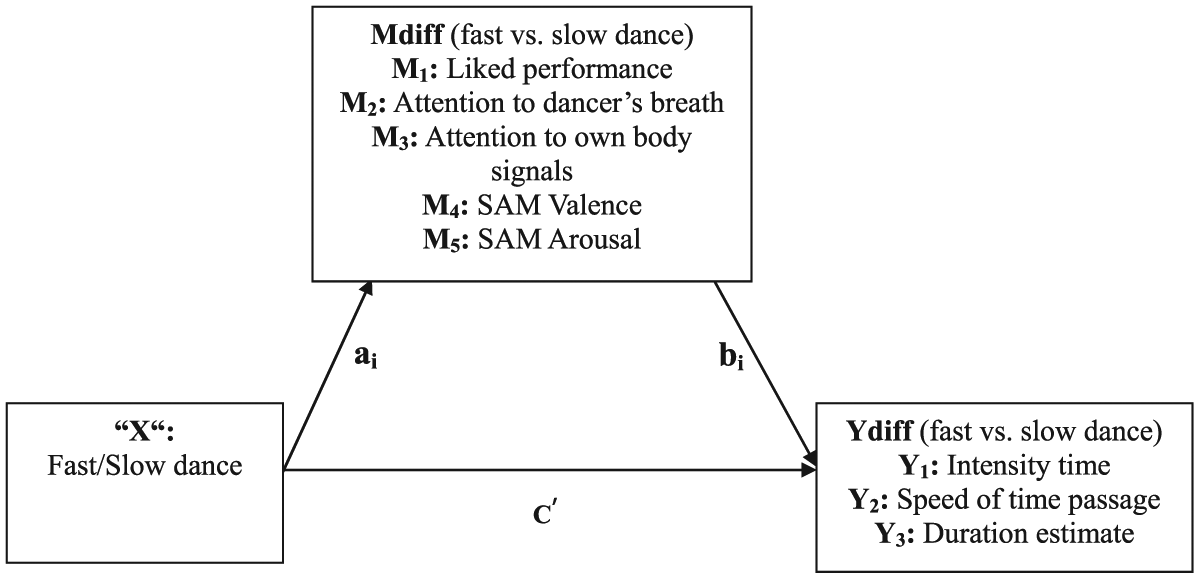
A multiple mediation model in path diagram form depicting a between-participant design, where “X” is the stimulus (fast vs. slow dance), but in fact the within-subject design is incorporated in Mdiff and Ydiff as the dance speed differences captured in the variables Mi and Yi. The path coefficients ai, bi and c’ represent the effects for X → M, M → Y, and X → Y. Mi is the possible mediator and Yi is the dependent variable relating to difference outcomes due to the dance speed difference.
Results
The t tests for independent samples were first conducted to see whether the two measurement times (two performance evenings) lead to differences in viewers’ judgment of the fast and the slow dance depending on the day of performance (Fast Dance Day 1 vs. Fast Dance Day 2; Slow Dance Day 1 vs. Slow Dance Day 2). There were no differences in judgments between the two dance performance times, neither for the fast nor the slow dance (p > .1). Then, differences between the two dance types were analyzed using t tests for dependent variables. Table 1 lists the differences between the fast and slow dance experiences by the 52 viewers. Significant differences (after adjustment with the FDR) can be seen within the three assessment types of (a) engagement and attention, (b) emotional self-assessment, and (c) the sense of self, space, and time. Specifically, the audience, on average, liked the fast dance more than the slow dance (t = 4.48, p = .001, d = 0.626), individuals paid more attention to the dancer’s breath during the fast dance (t = 5.94, p = .001, d = 0.836), but they paid more attention to their own bodily signals during the slow dance (t = –2.35, p = .022, d = –0.328). Regarding self-assessment, fast dance viewing was associated with more positive emotions (valence; t = 2.83, p = .007, d = 0.399) and more personal stimulation (arousal; t = 3.12, p = .003, d = 0.430). As for sense of time, on average, the audience perceived time more intensively during the slow dance (t = –2.65, p = .011, d = –0.368), they perceived time to be slower for the slow dance (t = 4.09, p = .001, d = 0.560), and they overestimated time duration during the fast dance (6.35 min) as compared with the slow dance (5.52 min; t = 2.80, p = .007, d = 0.394).
Mean Dance Condition Differences (Slow vs. Long) as Assessed With Self-Rating Scales.

Note. FDR = false discovery rate.
Significant differences with initial alpha level of .05 adjusted with the FDR for multiple tests marked in bold.
In using the five potential mediation variables Mi that proved to be significantly different following the two dance sessions, separate path analyses for the three time perception indices (Yi: felt intensity of time, subjective passage of time, duration estimate) were calculated (Table 2). There was no direct effect of dance speed on the felt intensity of time. The total effect c between X and Y was attributable to a mediation (a, b) by the variable of “paying attention to one’s own bodily signals” (M3; complete mediation). Similarly, the subjective speed of time passage was not directly influenced by observed dance speed (no direct effect c′). Dance speed only influenced the mediating variable (a, b) of “liking the performance” (M1). For both time perception variables, the significant total effect c was completely explained by the mediating variable effect. The total time duration estimate of the dance performance was unaffected by any of the chosen mediating variables (no indirect effect), meaning that the total effect c was completely explained by the direct effect c′.
Path model effects (t-values, coefficients) for dance condition differences “X” (fast vs. slow), the time perception indices Y1 to Y3 (YDiff: fast vs. slow dance), and the mediating effects M1 to M5 (MDiff: fast vs. slow dance).

Note. SAM = Self-Assessment Manikin. Significant (nonstandardized) coefficients are marked in bold.
p < .05. **p < .01. ***p < .001.
Discussion
Results of our study are summarized as follows: (a) The audience, on average, liked the faster dance better than the slower dance, and the faster dance evoked higher states of positive arousal; (b) during the fast dance, participants focused more on the dancer’s breathing and less on the bodily self; and (c) during the fast dance, time was less intensively experienced and time was perceived to have passed more quickly, but in assessing subjective perceptions of total duration, the faster dance was judged to have lasted longer. Path analyses on the three time perception indices revealed two positive results. For one, paying attention to one’s own bodily signals mediated perceptions of time intensity; this means that in the slow dance, people were more aware of their bodily signals as well as of the passing of time. Second, liking the performance mediated the perceived speed of time passage, while estimated total duration was not mediated by any other variable; this means that viewers who appreciated the fast dance more also felt that time passage was subjectively faster.
The findings of (a) the audience liking the faster dance better and having higher positive emotions and arousal after the fast dance, and (b) perceptions of less time intensity and faster time passage with the fast dance, can be interpreted straightforwardly as examples of the saying “Time flies when you are having fun.” Mirror neuron theory would predict that smooth motions in the fast dance evoked a sense of pleasant flow for viewers, leading to their reports of these different experiences in the fast versus slow dance conditions. The sense of flow is characterized by both a positive feeling during an activity and a diminished consciousness of self and time (Csikszentmihalyi, 1997). The slow dance, in contrast, seemed to evoke states of consciousness typically found in boredom conditions when viewers paid more attention to the bodily self, experienced relatively more unpleasantness, were more aware of time, and judged time to have passed more slowly (Wittmann, 2016; Zakay, 2014). When enjoying a stage performance less, participants experienced their own bodily sensations more and were more aware of time. Thus, on average, these two dance pieces were associated with predicted, distinguishable audience reactions. Of course, we cannot know if people in the slow dance were actually bored, but self-reports after the slow dance as compared with those following the fast dance showed a group tendency that can be interpreted in that way. In further studies, an explicit question on “boredom” might be employed.
One result seems, at first glance, not to fit into the overall picture. Although viewing the fast dance was associated with reports of reduced perceptions of time intensity, and faster perceptions of time passage, this condition was also associated with judgments of longer total dance duration. Other recent empirical work has shown the same paradoxical dissociation between the sense of time passage and estimates of total elapsed time (Droit-Volet & Wearden, 2016; Wearden, 2015; Weiner, Wittmann, Bertschy, & Giersch, 2016). It has therefore been suggested that the feeling of time passing and estimates of duration are dependent upon different processes. Thus, one may simultaneously have an impression of faster time passage and, when asked to judge time duration of the very same event, overestimate its actual clock time. Droit-Volet and Wearden (2015) suggested that perceptions of the speed of time passing increase with increasing arousal levels, and this association fits our finding. According to internal clock models of subjective time, greater arousal level then leads in turn to longer duration estimates, a finding which we too confirm with our study.
Possibly, our participants’ longer duration estimates in the fast condition were related to more memorable (and pleasant) experiences in observing the fast dance. This fits the retrospective model of time perception according to which more stored and retrieved experiential changes lead to longer subjective duration (Bailey & Areni, 2006). We chose this experimental design as a more natural experience, although, strictly speaking, the observation of both a first dance and a second dance resulted in a mixture of retrospective (first dance) and prospective (second dance) tasks. Our counterbalanced order of presentation addressed this limitation. Importantly, our analysis showed that time judgments did not differ, depending on the order of presentation. Subjects had no statistically different judgments, in any variable, when viewing a particular dance as first or as second performance. Our study also differed from past research by our use of a live performance (vs. laboratory recording) and on an event lasting longer than very short time intervals. Our longer 5-min interval may have elicited a strong retrospective task dimension because prospective internal timing mechanisms would not likely function beyond the short-term nature of working memory (Wittmann, 2011). That is, an individual is able to concentrate prospectively on the passage of time only for certain duration, the upper limit of prospective time perception being probably bound to working-memory capacity. With longer intervals, more retrospective memory components come into play for the judgment of time.
One result of our analysis confirms the hypothesis that subjective time perceptions are influenced by perceived physiological changes (body signals) through interoception (Craig, 2009; Wittmann, 2013, 2016). The felt greater intensity of time in the slow dance was completely mediated by the variable of “paying attention to one’s own bodily signals.” The awareness of time, thereafter, was modulated through this awareness of the bodily self. In the slow dance condition, as characterized by lower emotional well being, the sense of time was amplified through the sense of the bodily self.
In summary, this study of audience reactions to two dance pieces permitted an ecologically valid test of factors influencing the appraisal of a dance performance, and it allowed us to probe for factors modulating perceptions of the bodily self and time passage. This study broadened an understanding of how features of dance (e.g., speed of dance movements) are appraised and may relate to subjective perceptions of time duration, speed of time passage, and affectively charged self-perceptions. Feeling one’s own bodily signals more strongly during a performance is associated with intensified perceptions of time, and liking a performance speeds up perceptions of time passage.
We are aware of the limitations of our quantitative self-rating approach, which is directed at a simplified general view concerning the 5-min dance performance. Our approach to some extent captures typical impressions of individuals coming out of a cultural event and formulating judgments such as “I enjoyed it,” “time dragged,” and so on. More sophisticated tools that capture quantitative behavioral or physiological changes during the performance (Bachrach et al., 2015) or, complementary, qualitative assessments of what people felt while watching a dance could be undertaken.
In addition, one could argue that the presentation of a dance performance without music is not ecological due to the prevalence of music-dance forms in all cultures. We consider our investigation as a starting point, which in future must contain variations of musical elements. We deliberately chose Myriam Gourfink’s dance performance work; one could also list Yvonne Rainer or Deborah Hay (among others) who in their contemporary approaches did not employ music. In future settings, one could test combinations of audiovisual, audio only, and visual only presentations to probe for separate influences and interactions of movement and dance. It has actually been shown that timing principles when viewing a dance movement parallel the auditory counterparts of music; this is an indication for common sensorimotor coupling (Su & Salazar-López, 2016).
With our approach, we add to findings implicating the notion of the embodiment of subjective time. Moreover, we show effects using time intervals in the range of several minutes in an ecological valid setting of standardized live-dance movements. We hope to encourage future studies assessing time perception in a variety of real-life situations with different methodological approaches complementing our first-person self-rating scales. Understanding dance–spectator interaction can be expanded into the context of investigations of human unintentional bodily synchronization, which is an important aspect in human interaction in everyday life and for psychotherapeutic settings (Nelson, Grahe, & Ramseyer, 2016; Tschacher, Ramseyer, & Bergomi, 2013).
Footnotes
Acknowledgements
The authors thank the three dancers, Mirjam Karvat, Melanie Seeger, and Lisa Klingelhöfer, for choreographing the two dances performed by Mirjam Karvat. Authors also thank J. D. Ball for helping improve the linguistic appearance of the article.
Authors’ Note
Inspiration for the dance choreography came from a 2-week performance workshop held between July 5 and July 17, 2015, in Freiburg by Liam Clancy (coauthor of this article) and Mary Reich (expressive arts educator/therapist, Expressive Arts Institute, San Diego), and the Institute for Frontier Areas of Psychology and Mental Health (IGPP) research group on “Time Perception and Time Consciousness” with Marc Wittmann, Damisela Linares Gutiérrez, Vanessa Deinzer, and Anne Esch. Marion Mangelsdorf (gender studies, University of Freiburg) and Sean Enda Power (Department of Philosophy, University College Cork) also participated during part of the workshop. A documentary film was made by the cinematographer Ryzard Karcz (“Intersections of Time”), which captured the workshop artistically: 
Declaration of Conflicting Interests
The author(s) declared no potential conflicts of interest with respect to the research, authorship, and/or publication of this article.
Funding
The author(s) received no financial support for the research, authorship, and/or publication of this article.