




Abstract
The aim of the present study was to evaluate the effectiveness of listening strategy instruction on second language (L2) listening comprehension ability, listening anxiety, and listening self-efficacy of Iranian English as a foreign language (EFL) learners. To this end, a sample of 52 English major learners of two intact classes from a university in Iran was employed as the participants of the study. The intact groups were randomly assigned to an experimental group and a control group. The experimental group (N = 27) received the listening strategy instruction based on the framework proposed by Yeldham and Gruba, whereas the participants in the control group (N = 25) were instructed traditionally without receiving any strategy instruction. To collect the required data, the listening section of the International English Language Testing System (IELTS), Foreign Language Listening Anxiety Scale (FLLAS), and Second Language Listening Self-Efficacy Questionnaire (SLLSQ) were administered to assess the listening comprehension, listening anxiety, and listening self-efficacy of the learners before and after the intervention. The findings of the study indicated that listening strategy instruction significantly improved learners’ listening comprehension ability and reduced learners’ L2 listening anxiety. However, it was revealed that listening strategy intervention failed to significantly improve L2 listening self-efficacy of the learners. In light of the gained results, the implications of this study are discussed with respect to L2 teachers, learners, and curriculum developers.
Introduction
Second or foreign language (L2) listening is a crucial skill that provides the L2 learners with the ability to process L2 input and to have interaction with speakers of other languages in their real-life everyday communications (Xu & Huang, 2018). L2 listening is conceptualized as a perceptual process requiring learners to employ auditory phonetics to organize, detect, and overcome lexical segmentation inadequacies (Field, 2003). Moreover, it is a complex and demanding process that involves invoking both linguistic knowledge and world knowledge to comprehend the aural texts (Vandergrift & Baker, 2015). In comparison with other L2 skills such as reading and writing, listening has not been adequately researched (Goh, 2017).
The current view toward L2 listening is the fact that it should not be considered as a skill that is developed naturally on its own, but it is a skill that requires explicit instruction to be developed (Goh, 2010; Ngo, 2019). As a result of this conceptualization of the skill, numerous researchers have investigated the effectiveness of strategic instruction for L2 listening (Goh, 2017; Graham, 2017; Ngo, 2019; Vandergrift & Tafaghodtari, 2010; Yeldham, 2016). Listening strategies are subsumed under language learning strategies that are viewed as procedures, techniques, or deliberate activities carried out by learners so as to enhance learning, processing, and remembering of both linguistic and schematic knowledge (Chamot, 2005). L2 learning strategies have been conceptualized as one of the most influential individual difference factors in L2 learning (Lu & Liu, 2011). A significant research base on language learning strategies asserts that teaching language learning strategies assists language learners in fostering the effective use of strategies (Chamot, 2005), and that effective strategy use and L2 achievements are positively correlated (Oxford et al., 2004). Listening strategy instruction is regarded as a means of fostering the learners’ competence in selection and coordination of appropriate strategies for their listening objectives and needs so as to be able to comprehend more effectively (Cohen, 2011b).
As research into the use of L2 strategies accumulated, numerous researchers attended to the employment of strategies in particular L2 tasks and skills (Cohen, 2011a; Oxford, 1990). Skill-specific strategies are effective in helping learners to make up for L2 inadequacies in doing particular L2-related skills or tasks (Nakatani, 2010). In line with this heightened interest in L2 strategies, listening strategies were also received with some research attention by researchers (Vandergrift, 2003, 2004, 2007). As successful comprehension is a function of the balanced coordination and synchrony of top-down and bottom-up strategies (Siegel, 2015), one way to help the learners to be able to effectively synchronize these processes is strategy use. Furthermore, listening strategies are a set of direct and deliberate techniques employed to improve listening and to remedy experienced or predicted comprehension inadequacies or breakdowns (Field, 2003). Because of the warranted merits associated with successful use of listening strategies, listening strategy instruction programs received research attention by numerous researchers (e.g., Graham, 2017; Graham & Macaro, 2008; Vandergrift & Baker, 2015; Vandergrift & Tafaghodtari, 2010). Strategy instruction programs have been set to provide the listeners with a collection of workable strategies to help them successfully carry out listening tasks in real-life contexts (Mendelsohn, 1994). The strategic instructions can be designed to enhance top-down processes of learners to guess meaning and to make more accurate predictions about the aural text (Vandergrift, 2007). These instructional programs should also pay due attention to bottom-up processes that can enhance meaning-centered comprehension and sentence-level linguistic processing necessary for successful comprehension (Tsui & Fullilove, 1998).
With regard to strategy instruction approaches or models, the recent intervention studies have used either more explicit instructional approaches (e.g., Graham & Macaro, 2008) or more implicit models mainly designed for instruction of metacognitive strategies (e.g., Vandergrift & Tafaghodtari, 2010). Oxford (2011) conceptualizes explicit strategy instruction as a “completely informed strategy training” (p. 181), in which strategies are named, demonstrated, taught, and practiced. Learners are made cognizant of metacognitive knowledge and strategies’ contingent benefits in academic and real-world listening. These strategies can tell us what the strategy is and what it does and, thus, culminating in the maintenance and transfer of strategies to other contexts and tasks (Carrier, 2003). However, strategy use is integrated in doing various language tasks in more implicit models (Oxford, 1990). The underlying tenet governing either of these models is the necessity of strategy instruction and acknowledging the fact that listening cannot be naturally developed through just exposure to language input. Given the fact that the research evidence on strategy instruction has yielded inconclusive results, and with respect to the dearth of research on listening strategy instruction (Siegel, 2015), the present research can hone our understanding of the effectiveness of strategy instruction on the listening comprehension ability, listening anxiety, and self-efficacy.
As one variable under the investigation of this study, listening self-efficacy is mainly based on the assumptions of self-efficacy in mainstream education (Graham, 2011). Vandergrift (2003) persuasively mentioned that empirical evidence has substantiated that the effective use of metacognitive listening strategies plays a pivotal role in successful listening comprehension, assists learners to boost their self-regulation and autonomy in listening (Vandergrift, 2002), and has an important relation with listening self-efficacy (Vandergrift, 2005). Considered mainly as the belief in one’s own capability and being assigned a sense of agency to exert control over the surrounding situations and activities (Bandura, 1997), self-efficacy, rooted in sociocognitive theory, is one of the most important affective variables influencing the individuals’ selections of actions and devotion of efforts in doing tasks. As far as L2 research is concerned, a burgeoning body of empirical evidence has revealed that self-efficacy beliefs affect language achievement, are correlated with a set of significant learning attributes, and can be pedagogically influenced (e.g., Graham & Macaro, 2008; Mills et al., 2007). From Bandura’s (1986) perspective, sources of self-efficacy consist of mastery experience, vicarious experience, persuasions, and psychological states.
As the other variable under the examination of this study, L2 listening anxiety is viewed as a category of foreign language anxiety (FLA). Considered as the anxiety felt when a context or task needs the use of L2 by learners who are not very competent language users (MacIntyre & Gardner, 1994), FLA is claimed to be existing in all dimensions of L2 such as the four skills (Elkhafaifi, 2005; Horwitz et al., 1986; Vogely, 1999). Listening anxiety pervasively exists in doing L2 listening tasks mainly because of the variables such as unintelligibility, perceived difficulty, unfamiliarity of tasks, and fear of failure in comprehension (Elkhafaifi, 2005). A bulk of L2 listening research states that L2 listening anxiety is separate from global FLA and has detrimental effects on L2 listening performance (Elkhafaifi, 2005; Vogely, 1999). In spite of the fact that FLA has received much research attention by L2 researchers (Dewaele & MacIntyre, 2014; Horwitz et al., 1986; MacIntyre & Gardner, 1994), skill-specific L2 anxiety (i.e., listening anxiety) has remained more of a less researched construct (Elkhafaifi, 2005). By the same token, although numerous studies have indicated that FLA is closely related with the use of L2 strategies (Lu & Liu, 2011; W. Zhang & Liu, 2013), the associations between L2 skill-specific anxiety and strategy use have not been widely researched (Liu, 2016).
The Present Study
In spite of the existence of a significant bulk of literature on L2 listening comprehension, research into affective variables and individual differences in L2 listening is essentially scarce compared with other skills (Andringa et al., 2012). Because listening seems to be a formidable and complex skill for many L2 learners (Graham, 2011), the investigation of the effect of instructional interventions, especially strategy instruction on L2 listening affective factors (i.e., anxiety and self-efficacy), is much needed. Because of the complex nature of listening process, successful listening is highly reliant on an array of individual and affective characteristics of L2 listeners (Bang & Hiver, 2016). It is argued that in addition to cognitive dimensions of linguistic knowledge as well as strategy use in L2 listening, affective variables have a significant share of variance in positively affecting L2 listening success (Vandergrift & Goh, 2012). Affective variables, which can positively cooperate with other cognitive and linguistics aspects, play a very influential role in enhancing L2 listening ability (Dewaele & MacIntyre, 2014). Overall, L2 listening as well as its psychological factors has remained an underresearched area with relatively few empirical studies. Therefore, replication studies are called for to shed more light on cognitive and affective variables in L2 listening (Vandergrift & Cross, 2017).
Furthermore, it is worth noting that the use and effectiveness of language leaning strategies are context dependent (Griffiths, 2013; Ngo, 2019). From this perspective, strategy use and strategy instruction may yield different results in the particular socioeducational context of Iran. Concerning English language instruction in Iran, it is worth noting that English language is a compulsory subject in school curriculums from Grade 7 to Grade 12 in public schools. However, the curriculum for public schools is mainly focused on grammar instruction than on communication skills and it fails to develop students’ communicative competence effectively (Dahmardeh, 2009). Therefore, Iranian English as a foreign language (EFL) learners prefer to attend private language centers so that they can learn spoken language and oral skills more effectively (Haghighi & Norton, 2016). Nevertheless, Iranian learners are very unlikely to be exposed to spoken English outside the class, making it more difficult for them to improve their speaking and listening. In addition, other factors such as educational facilities, large class sizes, students with heterogeneous language backgrounds, inadequate materials, and inappropriate evaluation procedures have hindered the effective development of communicative skills. Moreover, listening instruction in Iran is based on the product approach in which no real instruction may occur, and students are just required to listen and answer the questions. In the Iranian EFL classrooms, strategy instruction appears to be absent in L2 listening instruction, which is more concerned with doing listening activities and tasks than with enhancing and teaching listening. Therefore, in the light of these theoretical and empirical backdrops and to bridge the gaps pointed out above, the present study was set to investigate the effects of listening strategy instruction on listening ability, listening anxiety, and listening self-efficacy of Iranian EFL learners.
Research Questions
Review of the Related Literature
As discussed above, although listening strategy instruction in L2 and EFL contexts has received some attention by the researchers (e.g., Goh, 2017; Graham, 2017; Ngo, 2019; Vandergrift & Tafaghodtari, 2010; Yeldham, 2016), an empirical investigation of the effects of strategy instruction on affective variables and individual variables related to L2 listening seems to be absent on L2 listening research agenda. In this line of enquiry, some studies are found in the literature. For example, Goh and Taib (2006) investigated the effect of metacognitive listening intervention on a sample of L2 listeners. The participants of this small-scale research included a number of primary school pupils participated in the study intervention. The intervention included eight particular lessons encompassing listening exercises, personal thinking on their conducted listening activities, and teacher-led talks encouraging learners’ evaluation and application of their personal and group metacognitive knowledge and strategy use. Findings revealed that the participants gained a more in-depth knowledge of the nature and the requirements of listening. It was also found that learners became more confident in carrying out listening tasks and acquired the effective strategies to cope with difficult listening tasks. Similarly, Cross (2009) did a quasi-experimental research to find out the effectiveness of listening strategy instruction on L2 listening comprehension. The Japanese advanced-level learners in the experimental group received a 12-hr listening strategy instruction, encompassing the presentation, practice, and review of listening strategies, whereas the control group was taught traditionally with no explicit strategy instruction. Results revealed that the experimental group outperformed the control group significantly.
In another study, Graham and Macaro (2008) explored the impact of teaching strategies on the listening achievement and self-efficacy perceptions. The participants of the study were a sample of lower intermediate students of French in the United Kingdom. The results of the study revealed that listening strategy instruction was effective both in enhancing listening performance and fostering the self-efficacy of the participants. Moreover, the interplay between listening strategy use and listening individual variables such as anxiety and self-efficacy has been the focus of some correlational studies. For instance, Wong (2005) examined the relationship between language learning strategies and language self-efficacy among a number of preservice teachers. A sample of 74 graduate L2 preservice teachers in Malaysia took part in the present study. The results obtained from Pearson correlation coefficients indicated that a significant positive relationship existed between language learning strategies and language self-efficacy. The results of qualitative data from interviews confirmed the findings of the correlational analyses, suggesting that higher self-efficacy was correlated with more frequent employment of more number of language learning.
In a recent study, Xu and Huang (2018) also examined the mediating influence of listening metacognitive awareness between listening anxiety and listening performance, also between test anxiety and listening performance. The participants of the study were 402 Chinese EFL learners who answered the questionnaires. Data analysis from structural equation modeling revealed that metacognitive knowledge of listening mediates not only the correlation between listening anxiety and listening performance but also the correlation between test-related anxiety and listening performance. Likewise, in a recent study in which the role of context in strategy instruction was emphasized, Ngo (2019) investigated the effects of a listening strategy instruction program on a sample of 27 Vietnamese EFL learners. The listening strategy instruction program designed based on the needs included 22 sessions for a period of 11 weeks. A series of focus group discussions were carried out to explore the learners’ perceptions of changes in using listening strategies because of their experience in the strategy instruction program. The findings obtained from the focus group interviews indicated that the participants reported to be able to use listening strategies more effectively. These changes and effects of strategy instruction were explained in the light of cultural context of English learning and teaching in Vietnam. Overall, the findings of this study underscores a more learner-centered atmosphere in which the learners are scaffolded and mediated by their instructor, peers, and materials to enhance their use of listening strategies.
Empirical Studies in the Iranian Context
Carrying out a recent study in the Iranian context, Movahed (2014) examined the effects of metacognitive strategy instruction on the listening achievement, metacognitive ability, and listening anxiety of EFL learners. A number of 55 Iranian EFL learners studying English translation were the participants of the study. The participants were randomly selected and divided into experimental (n = 30) and control (n = 25) groups. The students of the experimental group were exposed to strategy instruction according to the model delineated by Vandergrift and Tafaghodtari (2010) for a period of eight sessions, whereas the control group was taught traditionally. To collect the data for the objective of this research, listening section of Test of English as a Foreign Language (TOEFL), the Metacognitive Awareness Listening Questionnaire (MALQ), and Foreign Language Listening Anxiety Scale (FLLAS) were also administered to the participants. The findings of the study indicated that the metacognitive strategy instruction significantly improved learners’ listening proficiency and metacognitive awareness. Furthermore, it was found that strategic instruction contributed to reducing listening anxiety of the participants.
By the same token, Rahimirad and Zare-ee (2015) explored the impact of metacognitive strategy instruction on listening self-efficacy among EFL learners. Forty homogenized female students of English literature served as the participants of the study and were randomly assigned to the experimental (n = 20) and the control (n = 20) groups. The experimental group received 8 hr of metacognitive strategy instruction during eight sessions according to the model introduced by Vandergrift (2003), whereas the control group was taught traditionally without any explicit strategy instruction. The results of this research showed that teaching listening metacognitive strategies significantly improved listening self-efficacy of Iranian EFL learners.
In a similar line of inquiry, Mohamadpour et al. (2019) recently investigated the effectiveness of metacognitive strategy instruction in reducing listening anxiety of Iranian EFL learners. Sixty-three intermediate EFL learners who were randomly selected and randomly assigned to two experimental and two control groups served as the participants of the study. As for the strategy instruction framework, two models of Integrated Experiential Learning Task (IELT; Goh, 2010) and Metacognitive Pedagogical Sequence (MPS; Vandergrift, 2004) were employed. All the students in the four classes were instructed by the same teacher, and the same listening comprehension materials were used for all the groups. One of the experimental classes was taught listening strategies based on IELT and the other experimental group was taught according to MPS model, whereas both control groups were taught based on the traditional product-oriented listening instruction. To collect the data, FLLAS and the listening component of Preliminary English Test (PET) were given to all groups before and after the instruction. The findings of the study revealed that both IELT and MPS were useful in reducing listening anxiety. However, it was found that the MPS was more effective in lowering listening anxiety of the learners.
In another study, Golzadeh and Moiinvaziri (2017) explored the interplay between listening anxiety and metacognitive strategy awareness among 105 Iranian EFL learners. The participants were of upper intermediate and advanced proficiency levels. To gather the required data for this correlational study, MALQ and FLLAS were administered. The results of data analysis revealed that a negative correlation existed between the learners’ listening anxiety and their metacognitive strategy use.
Method
This study is a quantitative research in nature. Because it was not possible to select and divide the participants randomly in this research context (Islamic Azad University), quasi-experimental design was used. This design is usually employed in case it is not logistically possible to carry out a randomized, controlled trial study (Ary et al., 2019). In this design, participants are not randomly assigned to groups. Two intact classes served as the participants of this quasi-experimental research design.
Participants
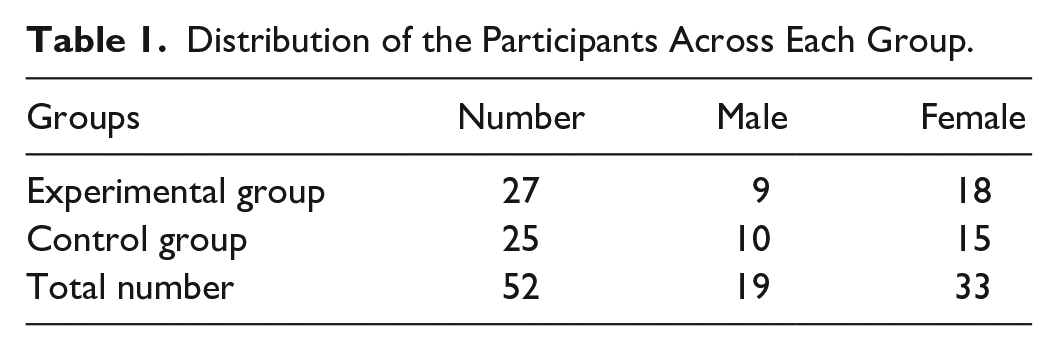
To achieve the aims of this research, a sample of 52 English major learners from two intact classes at one of the branches of Islamic Azad University in Iran were recruited as the participants of this research (see Table 1). They were both male (N = 19) and female (N = 33) learners whose age ranged from 19 to 24 years. The two intact groups were randomly assigned to an experimental group (N = 27) and a control group (N = 25). To make sure about the homogeneity of the participants with regard to their English proficiency, Oxford Placement Test (OPT; Allan, 2004) was given to the students of both groups. The scores of students on OPT revealed that the participants can be categorized as upper intermediate in general English proficiency. All the participants had at least a 5-year experience of learning English in language learning institutes. Both groups were instructed by the same instructor, and an identical textbook and the same learning materials were used for both classes. The strategy instruction intervention lasted for about 16 weeks.
Distribution of the Participants Across Each Group.
Instruments
English proficiency test
OPT (Allan, 2004) was used to investigate the homogeneity of the students of both groups in terms of their general English proficiency. OPT can be given to various learners of different abilities to identify their levels. OPT consists of a six-rating scale; students whose scores lie between 0 and 17 are categorized as basic (A1), and students whose scores fall between 18 and 29 are considered as elementary students (A2). Students whose scores are between 30 and 39 are in the lower intermediate group (B1). Those students with scores of 40 to 47 are labeled as upper intermediate (B2) and the students with scores 48 to 54 and 54 to 60 are categorized as advanced (C1) and very sophisticated (C2) levels, respectively. The internal consistency of OPT as estimated by Cronbach’s alpha was reported to be .86 in this study. OPT is a time-saving and reliable English language proficiency test, which was developed by Cambridge English for Speakers of Other Languages (ESOL) and Oxford University Press and was validated in 20 countries by more than 6,000 students.
To compare the OPT mean scores of the two groups, an independent-samples t test was carried out. The results presented in Table 2 demonstrated that there was no statistically significant difference in between the mean scores of the experimental group (M = 42.66, SD = 11.35) and the control group (M = 44.50, SD = 11.14), t(50) = −0.58, p > .05, revealing that both groups were homogeneous in terms of their general English ability before initiating the intervention.
Results of the OPT for Each Group.
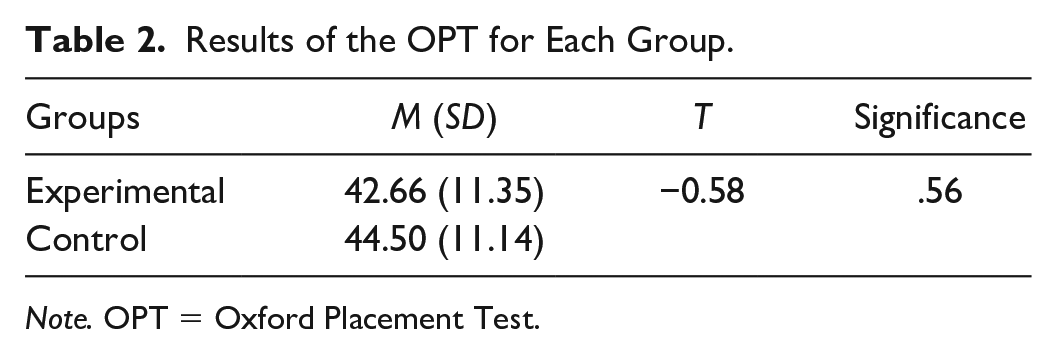
Note. OPT = Oxford Placement Test.
International English Language Testing System (IELTS) listening section
To measure the listening comprehension ability of the participants prior to the intervention and after the intervention, the IELTS listening practice tests (Scovell et al., 2004) were administered. There are four parts in the IELTS listening module. The first two parts are concerned with topics of general interest. The Cronbach’s alpha reliability coefficient indices for the pre- and posttests were .79 and .82, respectively.
FLLAS
To measure listening anxiety of the participants before and after the intervention, FLLAS that was developed by Kim (2000) was administered to the participants. FLLAS is a self-report scale in the form of a 5-point Likert-type questionnaire designed mainly according to Horwitz et al.’s (1986) scale, which was developed and validated to measure general FLA. FLLAS includes 33 items measuring three dimensions of L2 listening anxiety: tension and worry (10 items), lack of confidence (seven items), and problems encountered (16 items). Kim (2000) reported the internal consistency of the scale to be .93. The reliability coefficient of the scale, as measured by Cronbach’s alpha formula, was .81 in the present study. With respect to its validity, it has been administered in the Iranian context by other researchers.
Second Language Listening Self-Efficacy Questionnaire (SLLSQ)
To assess L2 listening self-efficacy of the participants, SLLSQ that was developed and designed by Kassem (2015) was employed in the present study. This scale includes 40 items in the form of a 5-point Likert-type scale measuring five underlying subscales: progress (one’s perception of present performance in comparison with past performance), observational comparison (one’s perception of his or her performance in comparison with that of peers), physiological states (the learner’s feelings while doing listening tasks), strategic awareness (learner’s ability in dealing with listening task and overcoming difficulties), and challenge (the learner’s willingness to do such a task). The internal consistency of the questionnaire, as estimated by Cronbach’s alpha formula, was reported to be .79 in this study.
Procedure
The present research was a part of a bigger project wherein the effects of a listening strategy instruction program on several L2 listening cognitive and affective variables were investigated. Nevertheless, this article reports the details of a section of the procedure in which the effect of strategy instruction on listening anxiety and self-efficacy was under investigation.
One session prior to initiating the intervention of the study, the English proficiency test (OPT) was given to the learners of both groups. The purpose was to make sure that the intact groups are not of different level of language proficiency. Besides, the listening section of the IELTS was administered to measure the listening comprehension ability of the students before (i.e., as pretest) and after (i.e., as posttest) the strategy instruction. Then, the two scales of listening anxiety and listening self-efficacy were administered to the students as the pretests of the study.
During the first week of the intervention for the experimental group, the teacher discussed the significance of teaching listening strategies very briefly and provided the learners with a general description of the instructional program for the whole strategy instruction period. He also briefly explained the strategy instruction framework utilized in the program. Yeldham and Gruba’s (2014) model was adopted as the framework for strategy instruction in the current research. Yeldham and Gruba believed that such a mixture could be more productive and could solve the likely shortcomings in either approaches. They maintained that a totally embedded approach can be tedious for learners (Vandergrift & Tafaghodtari, 2010), whereas very explicit procedures might be too prescriptive too be interesting to learners.
The strategy teaching framework employed for the present study was cognitive academic language learning approach (CALLA; Chamot & O’malley, 1994) developed by Chamot et al. (1999), constituting five key phases of preparation, presentation, practice, evaluation, and expansion (see Table 3). Moreover, the strategy instruction model used for this study consists of three categories of top-down, bottom-up, and metacognitive set of strategies. Concerning the top-down strategies, the learners of the experimental group were taught on how to make predictions about aural content and lexical items, infer and deduce the meaning of unknown vocabularies in texts, guess the new aspects of text, make use of contextual clues to understand the aural text, and utilize textual markers to predict complicated content and the succeeding content. As for the bottom-up strategies, the learners were instructed on how to make use of cues and jot down keywords during listening activities to improve their own comprehension, use discourse and text markers to enhance their understanding, and recognize stressed content words in spoken language. Regarding the metacognitive strategies, the students were taught on how to grasp an overview of various listening strategies, concentrate on metacognitive orchestration of different strategies, and monitor more successfully and productively, for example, how to monitor text for malformed utterances and to monitor utterances including confusing schema (Yeldham & Gruba, 2014). Following what Vandergrift et al. (2006) identify, metacognitive listening strategies are categorized into five types of strategies, encompassing problem solving, planning and evaluation, mental translation, person knowledge, and directed attention. Vandergrift et al. mention that problem solving manifests a group of strategies that listeners need to draw on to predict what they do not infer in the process of listening and to monitor these inferences. Planning and evaluation strategies pertain to those strategies that listeners utilize to prepare themselves for listening tasks and to evaluate the results of their listening efforts. They further argue that mental translations are those strategies that listeners need to avoid if they want to become tactful listeners (Vandergrift, 2003). Person knowledge strategies encompass listeners’ perceptions and attitudes with respect to the difficulty of the listening task and their self-efficacy about second language (L2) listening. Directed attention entails strategies that listeners embark on to concentrate and stay on listening task. Vandergrift et al. postulate that the listeners’ awareness of these five types of strategies that can help them regulate the process of L2 listening comprehension.
Description of Listening Strategy–Based Instruction.

During the sessions of strategy instruction intervention, listening strategic instruction was incorporated into the regular instruction. This was carried out using the instructional cycle proposed by Vandergrift (2007) to assist learners in coordinating their used strategies. In these sessions, the students were also taught on how to make predictions about the content of the aural texts after having listened to its initial utterances or to identify its topic. In addition, upon being exposed to the text for the first time, the learners checked their predictions as well as their guesses and compared their understanding of the text with that of their peers. When they listened for the second time, they reexamined their own understanding, and talked about their comprehension and interpretations of the aural text with their classmates. While listening for the third time, the learners reflected on their comprehension and made planning for similar subsequent listening activities. In the meantime, the learners in the control group were taught traditionally without receiving any strategy instruction. By traditional, we mean that they did not work on different types of three categories of top-down, bottom-up, and metacognitive set of strategies. Moreover, the teacher did not have any discussion on strategy use, neither did he engage the participants in any systematic attempt to reflect on their employed approach to listening. More particularly, the traditional listening instruction was based on the listen–answer–check (Vandergrift, 2004) approach, in which the participants were required to listen to numerous aural texts and then answer the following listening comprehension questions. The aural texts were either dialogues or monologues with various task demands including multiple-choice items, fill-in-the-blank questions, and open-ended items (i.e., responding to Wh-questions). The control group received the same listening activities and tasks from the identical course book.
Finally, at the end of the completion of the strategy instruction intervention, the learners of both groups were invited to answer FLLAS and L2 Listening Self-Efficacy Questionnaire as the posttests of the study. It is noteworthy that during both pretest and posttest, the teacher was present to clarify any sort of misunderstanding while completing the questionnaires.
Data Analysis
To answer the research questions, three one-way between-groups analysis of covariance (ANCOVA) were performed. According to Pallant (2013), ANCOVA can be used when there is a pretest/posttest design (e.g., comparing the effects of two different interventions, taking before and after measures for each group). The scores on the pretest are considered as a covariate to “control” for preexisting differences between the groups. Moreover, to demonstrate the within-group change from pretest to posttest for each variable, paired-samples t tests were also carried out.
Results
Research Question 1: Does Listening Strategy Instruction Significantly Enhance Iranian EFL Learners’ L2 Listening Comprehension Ability?
Because participants’ listening comprehension ability plays an indispensable role before and after the intervention as one of the variables of the study, paired-samples t tests were carried out to compare the listening scores in the pretest and posttest. The results demonstrated that there was a significant increase of the mean scores for both experimental and control groups. Table 4 reveals that the listening mean scores of the experimental group significantly improved (t = −5.84, p < .05); moreover, the performance of the control group statistically improved (t = −2.36, p < .05). The results indicated that the mean score of the experimental group was 17.77 on the pretest and it increased to 22.93 on the posttest, which was statistically significant. Likewise, the listening pretest mean score for the control group rose from 18.43 to 20.23 on the posttest, which led to the significant difference.
Paired-Samples t Test for Listening Scores in Each Group.

In addition, a one-way between-groups ANCOVA was run to find out the effects of the two types of listening instructions utilized in the control group and the experimental group. The strategy instruction was the independent variable and the dependent variable was the scores on the listening test; students’ scores on the pretest of the listening test served as the covariate in this analysis. The researchers were ascertained that there was no violation of normality, linearity, homogeneity of variances, homogeneity of regression slopes, and reliable measurement of the covariate. As Table 5 illustrates, there was a significant difference between the two groups on posttest scores of listening comprehension ability, F(1, 49) = 7.57, p = .008, partial η2 = .13.
ANCOVA Results for Listening Comprehension Scores.

Note. ANCOVA = analysis of covariance.
Research Question 2: Does Listening Strategy Instruction Significantly Reduce Iranian EFL Learners’ L2 Listening Anxiety?
To investigate the effect of listening strategy instruction on listening anxiety of the participants, a paired-samples t test was carried out to compare the mean scores of both groups from the pretest to posttest. As presented in Table 6, the results show that there was a statistically significant change from the pretest to posttest of L2 listening anxiety for both the experimental group, t(26) = 37.03, p < .00, and the control group, t(24) = 9.17, p < .00. As seen in Table 6, the listening anxiety mean score for the experimental group decreased from 44.37 on the pretest to 37.00 on the posttest. Similarly, the listening anxiety mean score of the control group decreased from 45.62 on the pretest to 43.08 on the posttest. These results indicated that listening anxiety of both groups was significantly reduced.
Paired-Samples t Test for L2 Listening Anxiety Scores.

In addition, a one-way between-groups ANCOVA was carried out to compare the effects of the two types of L2 listening instructions employed in the present study on the L2 listening anxiety. The independent variable was the type of instruction (i.e., strategy-based instruction or traditional), and the dependent variable was the scores of the participants on the posttest of listening anxiety. The pretest scores of listening anxiety were considered as the covariate in the ANCOVA. Preliminary analyses were conducted to make sure that the assumptions of normality, linearity, homogeneity of variances, homogeneity of regression slopes, and the reliable measurement of the covariate were not violated. The results of the ANCOVA (see Table 7) show that a statistically significant difference existed between the two groups in the mean scores on the posttest of L2 listening anxiety, F(1, 49) = 225.10, p = .000, partial η2 = .82. These results reveal that teaching L2 listening strategies contributed to reducing listening anxiety of the experimental group more than the traditional L2 listening instruction.
ANCOVA Results for L2 Listening Anxiety Scores.

Note. ANCOVA = analysis of covariance.
Research Question 3: Does Listening Strategy Instruction Significantly Improve Iranian EFL Learners’ L2 Listening Self-Efficacy?
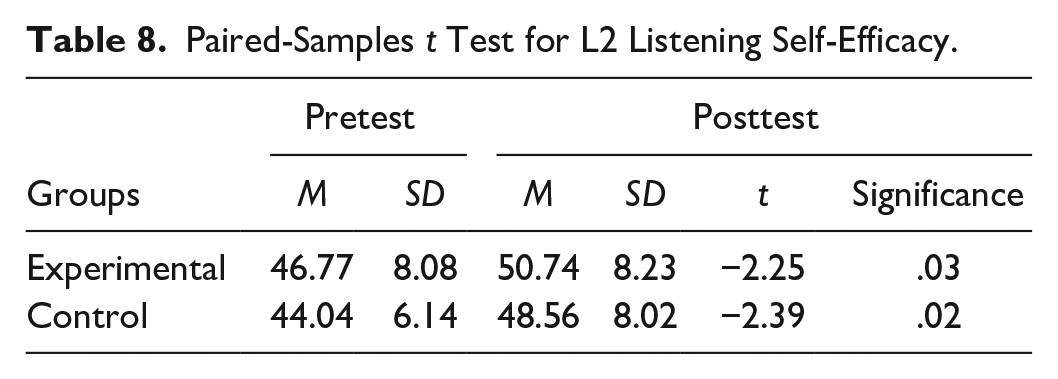
The third research question aimed to examine the effect of listening strategy instruction on EFL learners’ L2 listening self-efficacy. To answer this question, a paired-samples t test was conducted to investigate the mean scores of L2 listening self-efficacy for both the experimental and control groups from the pretest to posttest. In fact, the purpose of this analysis was to investigate the effects of the strategy-based instruction and traditional listening instruction on the listening self-efficacy of the participants. As Table 8 indicates, there was a statistically significant increase in the mean scores of L2 listening self-efficacy from the pretest to posttest for both the experimental group, t(26) = −2.25, p < .05, and the control group, t(24) = −2.39, p < .05. As presented in Table 6, the mean score of L2 listening self-efficacy for the experimental group increased from 46.77 on the pretest to 50.74 on the posttest. Likewise, the listening self-efficacy mean scores of the control group was raised from 44.04 on the pretest to 48.56 on the posttest.
Paired-Samples t Test for L2 Listening Self-Efficacy.
Furthermore, a one-way between-groups ANCOVA was also run to compare the effectiveness of the two types of L2 listening instruction. The type of intervention (i.e., strategy-based instruction or traditional) was the independent variable, and the learners’ scores on the posttest of L2 listening self-efficacy served as the dependent variable. Also, the learners’ scores on the pretest of L2 listening self-efficacy were considered as the covariate in the ANCOVA. Preliminary analyses revealed that there was no violation of normality, linearity, homogeneity of variances, homogeneity of regression slopes, and reliable measurement of the covariate. The results of the ANCOVA (see Table 9) indicated that there was no statistically significant difference between the two groups in the mean scores on the posttest of L2 listening self-efficacy; F(1, 49) = 0.358, p = .552, partial η2 = .00. These results show that listening strategy instruction failed to improve Iranian EFL learners’ L2 listening self-efficacy.
ANCOVA Results for L2 Listening Self-Efficacy.
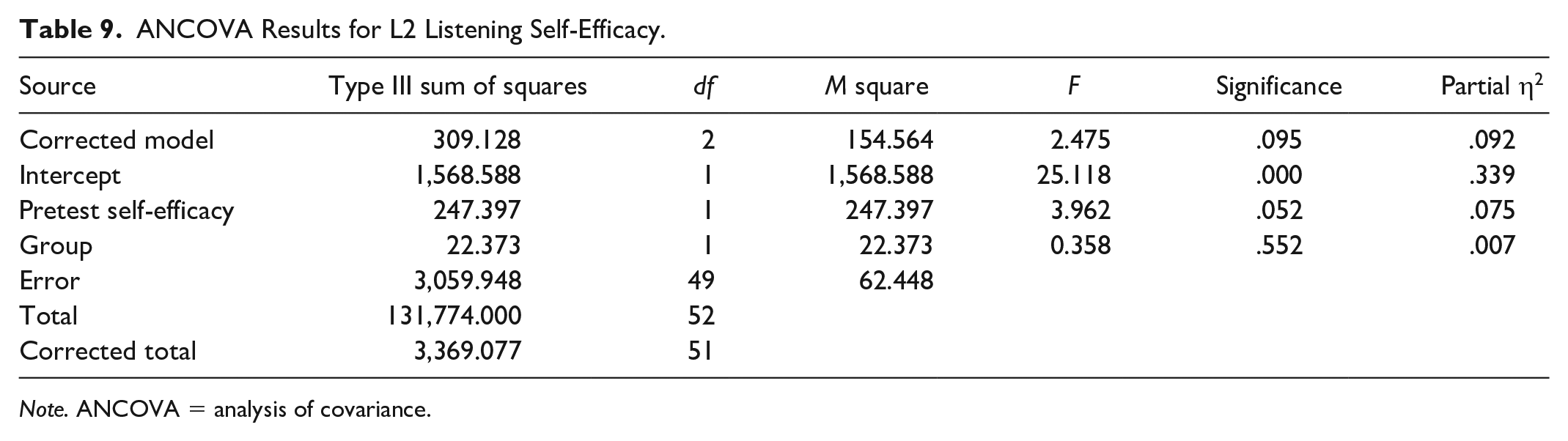
Note. ANCOVA = analysis of covariance.
Discussion and Conclusion
This research sought to examine the effects of teaching listening strategies on the listening comprehension, listening anxiety, and listening self-efficacy of Iranian EFL learners. To accomplish the objectives of this study, Yeldham and Gruba’s (2014) model of strategy instruction was incorporated into a 16-week treatment period. Results of the first research question indicated that the experimental group significantly outperformed the control group on the listening performance test, corroborating that the listening strategy instruction may be effective in boosting participants’ listening comprehension. The findings of this study resonate with those of previous studies (Graham & Macaro, 2008; Vandergrift & Tafaghodtari, 2010; Yeldham & Gruba, 2014) and are not in alignment with those of Rees-Miller’s (1993) and Rossiter’s (2003). Furthermore, the findings of this study are suggestive of the fact that Yeldham and Gruba’s model proved to be effective in developing learners’ comprehension ability. Because this model is a combination of the explicit and embedded approaches, it yields the most successful results, which have been substantiated by other studies (Oxford, 2011; O’Malley & Chamot, 1990). Unlike most previous studies that focused on few participants and have focused on the explicit teaching of strategies (Yeldham & Gruba’s, 2014), the present study was conducted with a bigger sample of Iranian EFL students of upper intermediate proficiency level and employed a quasi-experimental design. Furthermore, the previously conducted bodies of research focused on the metacognitive strategies and top-down processing (e.g., Goh, 1998; Vandergrift, 1997), but this study employed bottom-up skills and strategies to teach listening as well. This finding is consistent with that of Yeldham and Gruba, concluding that drawing on just bottom-up strategy instruction, without the integration of top-down skills and strategies, is less likely to boost the learners’ listening comprehension. This study embarked upon presenting and modeling strategies, and students were given enough practice, which ultimately resulted in the better listening performance of the participants.
The improved listening comprehension of the participants in the experimental group may be justified in light of sociocultural theory (Vygotsky, 1978), in a sense that, listening strategy use was mediated by the scaffolding of the teacher as a more capable person in the learning process of the students (Gardner, 2010). Explaining and modeling the strategy use, the teacher helped the EFL learners to use listening strategies more effectively. As such, the learners might have been empowered to fill the gap between the strategies they knew and their actual competence for using them, an effective situation that helped the learner to improve their listening comprehension.
The results of the second research question demonstrated that listening strategy instruction significantly reduced Iranian EFL learners’ listening anxiety. This finding concurs with a significant body of L2 listening research in emphasizing the role of strategy instruction in decreasing listening anxiety (Goh & Taib, 2006; Mohamadpour et al., 2019; Movahed, 2014; Vandergrift, 2007). Such a finding also verifies the findings of correlational studies (e.g., Golzadeh & Moiinvaziri, 2017; Xu & Huang, 2018), which indicated that a negative correlation exists between strategy use and listening anxiety. This finding is attributed to some reasons. First and foremost, one key cause of listening anxiety in L2 is exposure to new vocabularies (Vogely, 1998; X. Zhang, 2013). As the strategy instruction program helped the listeners to make informed guesses about the meaning of unfamiliar words and have less difficulty processing new vocabularies, the participants of the experimental group felt less listening anxiety after receiving strategy instruction. Guessing the meanings from the text that has been frequently employed by the communicative L2 teaching approaches is reported to be conducive in reducing listening anxiety (X. Zhang, 2013). In addition, strategy instruction might have increased the participants’ risk-taking level, which encouraged the learners not to be resistant in guessing incorrectly or making mistakes in L2 classrooms (Yan & Horwitz, 2008). This increased risk taking of the participants could have reduced listening anxiety of the learners.
Moreover, as the listening strategy instruction involved further interaction among students and the teacher through teacher’s regular feedback, the participants perceived less distance between themselves and the teacher. Therefore, a more comfortable and nonthreatening learning environment was created for the learners who enjoyed doing listening tasks and might have reduced their listening anxiety. This stress-free learning environment is likely to have changed the perceptions of participants on listening and to have created positive attitudes among them. It is also likely that participants of the experimental group, perceiving the less distance with the teacher, might have verbalized their feelings and shared their listening difficulties with the teacher who could have provided them with solutions or workable strategies, which contributed to reducing their listening anxiety.
Furthermore, it can be argued that strategy instruction might have encouraged the participants to manage and monitor their learning, take responsibility of their learning, and gain more self-confidence in doing learning tasks, thereby reducing their anxiety. Appropriate strategy use may assign the learners the competence and confidence to take control of their own learning process and feel more autonomy (Siegel, 2015), all of which might have contributed to reducing listening anxiety. The effect of strategy use in reducing L2 anxiety has been acknowledged in L2 literature (Lu & Liu, 2011). The findings of the present study are also partially consistent with those of Sioson (2011), who found that the use of metacognitive language strategies could reduce L2 anxiety by enabling the learners to become more competent in setting goals, planning, and self-monitoring their learning process. This also verifies the claim made by Vandergrift (2002), who stated that metacognitive instruction or raising learners’ metacognitive awareness can equip the L2 learners with listening competencies to be able to successfully transfer what they have learned in listening tasks to authentic target language situations outside the class.
More particularly, the findings of the present study confirmed the effectiveness of the adopted strategy instruction framework (Yeldham & Gruba, 2014) in lowering listening anxiety. One likely reason might be the fact that this framework was a composite of the three sets of top-down, bottom-up, and metacognitive strategies. It is argued that overreliance on limited bottom-up strategies makes the learners become too preoccupied with word-level processing and consume much attentional processing at the expense of ignoring higher order semantic processing of the text (Field, 2003). However, Yeldham and Gruba’s (2014) model helped EFL learners to use their top-down strategies and schematic knowledge to process the aural texts more effectively. In the meantime, metacognitive strategies of the model encouraged the learners to plan, monitor, and orchestrate their employed strategies more effectively. Therefore, the perceived success in comprehending texts, accompanied by less cognitive load due to receiving strategic instruction, is likely to have reduced the anxiety of the participants. This is consistent with the findings of I. Chen and Chang (2009) who found that further cognitive load and less working memory processing could increase L2 listening anxiety.
Moreover, concerning the third research question, it was revealed that teaching L2 listening strategies failed to improve listening self-efficacy of the students more than the traditional listening instruction. This finding is at variance with numerous previous studies (e.g., Graham & Macaro, 2008; Rahimirad & Zare-ee, 2015; Wong, 2005) revealing that strategic instruction can affect self-efficacy of the participants. The listening self-efficacy of the two groups in the present study increased in the posttest, and there was no significant difference between the two groups. This finding might be accounted for by the fact that both groups were engaged in experiencing listening activities by which they have gained a sense of mastery that contributed to increasing listening self-efficacy of both groups. Although the control group did not get exposed to any strategy instruction, they had adequate exposure to various listening tasks and activities during their instruction. Successful experience of the control group students in doing listening activities has served as a key source of listening self-efficacy for the experimental and control groups. According to Bandura’s (1997) notion of self-efficacy grounded in sociocognitive theory, mastery experience or successful doing of something acts as the most significant source of self-efficacy beliefs. Moreover, the two groups were taught by the same teacher who tried to encourage the students of both groups by providing them with relatively identical verbal persuasion as the other source of self-efficacy. Another plausible reason for the insignificant difference between the experimental and control groups’ level of listening self-efficacy might be due to the relatively short period of the instruction. However, the treatment conducted by Graham and Macaro (2008), which confirmed the effectiveness of strategy instruction in enhancing listening self-efficacy, lasted for a period of 6 months.
Moreover, it is argued that students’ verbalization of listening strategies after being modeled by a teacher could improve listeners’ self-efficacy because verbalization encouraged learners to pay more attention to the taught strategies and foster their encoding (Graham, 2011; Schunk & Rice, 1984). The participants of the experimental group did not practice to repeat the used strategies verbally. In fact, the teacher modeled the use of listening strategies and explained them out loud, but the participants did not repeat them verbally prior to implementing them to listening activities. This may be considered as another possible justification for the fact that listening strategy instruction did not significantly enhance L2 listening self-efficacy of the learners.
As far as the Iranian EFL context is concerned, L2 practitioners seem to be neither competent nor willing to teach listening strategies in their own classrooms (Eslami & Ranjbary, 2003). Nor do EFL curriculum developers and syllabus designers pay adequate attention to teaching listening strategies explicitly. Most of the listening class hours are devoted to completing tasks and doing activities by the students. As a result, focusing on just the end points and products in the form of carried-out listening exercises, activities, and tasks is likely to increase listening anxiety of the EFL learners. Therefore, integration of listening strategic instruction into regular classrooms might be a promising venue for EFL teachers not only to improve the listening proficiency of their students but also to reduce their anxiety as well as enhance their motivation and self-efficacy in doing listening tasks.
By the same token, EFL teachers should inculcate in their pupils a positive attitude toward using strategies to increase the effectiveness of strategic instruction in culminating in the most favorable outcomes in both cognitive and affective variables related to the particular L2-related tasks or skills (Oxford, 1990). Furthermore, L2 teacher education programs should equip the practitioners with necessary theoretical and practical competencies to be able to effectively implement strategic instructions in their classrooms. This issue becomes more crucial as far as listening instruction is concerned because it is argued that teachers play an influential role in teaching listening effectively (Graham & Santos, 2015).
Limitations and Directions for Further Research
Given the fact that L2 listening has been more underresearched than other skills (Vandergrift & Goh, 2012) as well as given the invisible and intricate nature of listening process (Vandergrift & Cross, 2017), doing further empirical research on L2 listening and its related psychological factors (i.e., anxiety, self-efficacy, and motivation) across different contexts using various interventions seems to be very warranted. In addition, because strategy use is a covert process, some researchers have recommended using qualitative research procedures to gain a more comprehensive and in-depth insight into learners’ use of listening strategies (Y. Chen, 2005; Ngo, 2019). More specifically, the use of quantitative self-report scales for measuring affective variables may not provide a deep insight into the effects of strategy instruction on such affective variables as anxiety and self-efficacy. Also, participants’ general sense of efficacy and academic self-efficacy might have affected the results of this study with regard to the effectiveness of strategy instruction on listening self-efficacy. As a result, future researchers may investigate the moderating effects of general and academic self-efficacy on L2 listening self-efficacy.
Future researchers are recommended to replicate similar studies using qualitative or mixed-methods research designs. The use of stimulated recalls and think-aloud protocols can help future researchers to cast a better picture of the effect of listening strategy instruction programs on listening affective variables such as anxiety and self-efficacy. Also, future researchers may employ delayed posttests to investigate whether the impacts of listening strategy instruction could be maintained over time. Finally, future researchers can examine the effect of other models of listening strategy instruction on listening ability, anxiety, and self-efficacy of bigger samples of learners at different levels of language proficiency using different listening tasks with various genres.
Footnotes
Declaration of Conflicting Interests
The author(s) declared no potential conflicts of interest with respect to the research, authorship, and/or publication of this article.
Funding
The author(s) received no financial support for the research, authorship, and/or publication of this article.
