




Abstract
This article investigated the English research article (RA) titles across different disciplines and cultures. To this end, 600 RA titles in the Chinese context and 600 RA titles in the international context were collected from six disciplines, which are grouped as social and natural sciences. The frequency of title types, their subtypes, and title length are calculated in terms of cultural and disciplinary factors. The result showed a significant difference in title types and subtypes along two dimensions. It suggested that Chinese culture and language and the discourse practice of academic publication are responsible for the salient features of English titles by Chinese scholars. The suggestion for further study is to collect more titles from other disciplines and cultural contexts to verify the results.
Introduction
In recent decades, there has been an increasing interest in the importance of scientific research article (RA) titles to determine whether it is effective or not (Anthony, 2001; Bird & Knight, 1975; Buxton & Meadows, 1977; Byrne, 1975; Day, 1995; Diodato, 1982; Haggan, 2004; Harmon & Gross, 2009; Hartley, 2005, 2007a, 2008; Nahl-Jakobovits & Jakobovits, 1987; Peritz, 1984; Soler, 2007, 2011; Swales, 1990; Whissell, 1999; White & Hernandez, 1991; Yitzhaki, 1994, 2002). The previous studies have been mainly examined from four aspects of RA titles: the function of titles (Harmon & Gross, 2009; Hartley, 2005, 2007a), the structure of titles (Haggan, 2004; Soler, 2007), the informativity of titles (Balog, 1981; Eyrolle et al., 2008; Feinberg, 1973; Tocatlian, 1970; Yitzhaki, 1997), and the nonlinguistic features of titles such as the preference of colon in titles or the title length (Dillon, 1981, 1982; Hartley, 2007b, 2007c; Lewison & Hartley, 2005; White, 1991; Yitzhaki, 1994, 2002). In particular, there has also been research on characteristics of RA titles in a special discipline in an attempt to benefit corresponding researchers publishing in that field (Anthony, 2001; Goodman et al., 2001; Wang & Bai, 2007). The recent research on RA titles has reached a general agreement on the role of the titles. According to Hartley (2008), a title “should attract and inform the readers and be accurate” (p. 23). This idea has been reinforced by previous studies in one way or another. For example, Yitzhaki (1997) states that the RA titles should “draw a reader’s attention to a paper and to indicate its content from a short glimpse, thus contributing to its initial selection or rejection” (p. 219). The miscellaneous studies on RA titles imply that it still needs further research on the features of RA titles across disciplines, genre, or even cultures using empirical methods.
Therefore, Haggan (2004) and Soler (2007) focus on the most recurrent structures of RA titles based on the empirical data, by classifying titles into three or four subcategories with slightly different terminology: nominal group titles, full-sentence (FS) titles, compound (CP) titles, and question titles. Both of the studies cover different disciplines/genres: literature, linguistics, and science (Haggan), and biological sciences and social sciences (SS)/review papers and research papers (Soler). The results show heterogeneity in the constructions of RA titles. First, the nominal group construction is the most frequently adopted construction in all the disciplines and genres they selected. Second, the CP title is most preferred in literature (Haggan) and SS, secondary to the nominal group title in Soler’s observation. Third, both of these observations indicate that the full sentence title is of the least occurrence in all the data observed although this group occurs more frequently in biological sciences, with the highest percentage (51%) of this group in biology discipline and with no occurrence of CP titles in review papers (Soler).
The above survey has indicated that a number of studies of RA titles, whether empirical or not, have been carried out within a discipline or across disciplines. One notable gap of study to date is a lack of attention to RA titles composed in intercultural contexts, comparing with other subgenres such as RA abstracts (Martı́n, 2003; Van Bonn & Swales, 2007). There do exist two noteworthy intercultural studies of titles. Busch-Lauer (2000) investigates 150 German and English titles in linguistics and medicine in terms of the length, structure, and communicative effectiveness. To examine first language (L1)/second language (L2) differences, a third sub-corpus comprising 50 English titles written by German researchers was set up. The conclusion summarizes that “German researchers (and perhaps other non-native speakers of English) use conventions of L1 to formulate titles in English, which are often inappropriate in terms of language and style” (Busch-Lauer, 2000, p. 93). However, it is obvious that this generalization needs further examination. Similarly, Soler (2011) continues her previous two studies on RA titles (Soler, 2007, 2009) by constructing a corpus of 1,140 RA titles with an attempt to find out the interlingual and interdisciplinary differences of title constructions between Spanish and English. The results indicate that nominal group titles are preferred as a linguistic strategy of scientific discourse, that FS construction of research paper titles are frequent in biological sciences, CP titles in SS, and that there exist differences in title length across languages and disciplines.
In addition, title characteristics could impact the citation rates of articles. An article with a longer title and the presence of colon and acronym received high citation rates (Jacques & Sebire, 2010). Habibzadeh and Yadollahie (2010) also suggested that longer titles were positively associated with higher citations rates, but titles from journals with higher impact factors were significantly shorter than those from journals with low impact factors. Buter and Van Raan (2011) found a positive correlation between the presence of non-alphanumeric characters in titles such as hyphen and colon and the citation rates. Although there were positive findings concerning the title characteristics and article citation rates, Buter and Van Raan (2011) pointed out that many additional factors, such as author eminence, journal prestige, and the length of a publication could positively promote the number of citations and these factors should be considered holistically. Contrary to the previous studies, Gnewuch and Wohlrabe (2017) found that articles with a short title containing a non-alphanumeric character tended to be cited more in economics.
Furthermore, some studies listed the main characteristics of good titles. Dewan and Gupta (2016) stated that a good title should be concise, specific, and descriptive, whereas it should avoid interrogative and declarative titles, acronyms/abbreviations in the title, and so on. Bavdekar (2016) proposed that a good title should be informative, simple, direct, clear, brief, and attractive, and not contain abbreviations or jargon and numerical values of the parameters. A good title should include keywords used for indexing. Grant (2013) also suggested that a good title should be informative, concise, and appropriate. Kumar (2013) commented that among the three typical types of titles, nominal titles were the most, FS titles were the least, and CP titles were located in between. Nair and Gibbert (2016) found that most titles contained non-alphanumeric characters (88.1%), CP titles accounted for 69.3% in their data, and, in terms of title format, 92.9% titles were descriptive titles and 83.5% titles specified method or design in terms of title classification.
Despite a wealth of previous studies contributing a lot to the knowledge of title characteristics, there still is a need for further investigation about disciplinary variation and cultural impact in title features to test and confirm previous research. This is because particular academic communities have their own ways to communicate with readers and culture factors also play an important role in the academic writing (Golebiowski & Liddicoat, 2002; Lorés-Sanz, 2011; Taylor & Chen, 1991). Moreover, there exists the inconsistency of results on good titles. This article attempts to conduct an exploratory comparison between English RA titles in the Chinese context (CC) and that in the international context (IC) across the field of natural sciences (NS) and SS. The aims of the present article focus on two features of RA titles: title length and title constructions, and answer the following research questions: (a) whether the English RA titles written in CC are significantly different across disciplines, (b) whether the English RA titles written in IC are significantly different across disciplines in the present study, and (c) whether the English RA titles written in both CC and IC are significantly different across corresponding disciplines. The study would provide further insights into the title characteristics in terms of discipline and culture, benefiting the academic communities on the aspects of academic writing, information retrieval, academic evaluation, intercultural rhetoric, and so on.
Data Information
Data Collection
To answer the above questions, first, a corpus consisting of 1,200 English RA titles was constructed, containing two sub-corpora: 600 RA titles in CC and 600 RA titles in the IC. In China, most academic journals require the contributors to present an English version of title and abstract to the article, whether translated or composed. In the present study, the hypothesis is that the production process of titles is ruled out and texts collected are already products (Connor & Moreno, 2005). Second, the sub-corpora were further classified as NS and SS within each context, as suggested by Soler (2007) and Cao and Xiao (2013), who provided a standard to classify the journals: chemistry, physics, and biology (NS) and history, linguistics, and psychology (SS). The journals labeled as social science in the present study were indexed by Arts and Humanities Citation Index/Social Science Citation Index (A&HCI/SSCI), while those labeled as NS were indexed by Science Citation Index–Expanded (SCI-E). Therefore, history was considered as a social science in the present study, to be included as a less studied discipline in the previous research. Each of the six disciplines included 100 titles from five journals (Table 1). The journals in the CC were selected as the key journals from the China National Knowledge Infrastructure (CNKI) database, with higher impact factors in the disciplines. Similarly, the journals in the IC were collected as the leading journals in that discipline, based on the impact factors, from clarivate.com and Web of Science. All the journals were indexed by SCI-E, SSCI, or A&HCI, with one exception that Journal of Physical Studies was indexed by Emerging Sources Citation Index (ESCI). Another classification of journals considered came from the official webpages of the journals, reference books and sources, and colleagues’ opinions in the specific disciplines. The journal information was evaluated and compared in terms of topics, aims, scopes, and coverage to guarantee the cross-cultural comparability of disciplines (Cao & Xiao, 2013; Soler, 2007). Based on the abovementioned frame, titles, as well as journals, were sorted out randomly.
Selected Journals (2009) of RA Title Corpus.

Therefore, to secure the comparability of the corpora, especially the cross-cultural corpora, this article followed the method, tertia comparationis, proposed by Connor and Moreno (2005) in contrastive rhetoric research. This method was adopted by Soler (2011) to prevent the limitations of imbalance of corpora in her comparative/contrast analysis of scientific paper titles in English and Spanish. In the present contrastive rhetoric study, similarly, the comparability was also secured based on the following similarity constraints:
Communicative purpose (tertium comparationis) 1: All journals selected aim at publishing articles that make a clear contribution to the debate in specific fields of research (Soler, 2011). Noticeably, the Chinese writers attempt to attract international attention and communicate their research with their international counterparts by attaching an English version of titles or abstracts.
Representativity (tertium comparationis) 2: All journals selected are representative samples of discourse-community populations in the two writing cultures analyzed (Soler, 2011).
Audience (tertium comparationis) 3: All journals selected address a peer reader with expertise in specific fields of study related to the disciplines selected for the present research (Soler, 2011).
Editorial policy followed (tertium comparationis) 4: When submitting a manuscript, authors must affirm that the material has neither been published nor submitted for publication elsewhere (Soler, 2011).
Chronological coverage (tertium comparationis) 5: All journals selected were published in the same year, that is, 2009.
Genre (tertium comparationis) 6: All titles selected belong to the same genre, RA titles.
Language (tertium comparationis) 7: All titles selected are written in English.
Title Classification
Based on previous studies (e.g., Haggan, 2004; Soler, 2007) and my pilot study, RA titles are classified here into five categories: nominal phrase (NP) titles, CP titles, verbal phrase (VP) titles, prepositional phrase (PP) titles, and FS titles. As for VP titles, this type of titles is initiated by a verb, whether in to-infinite form or in present participle form, such as “Constructing female identities through feminine hygiene TV commercials,” J. of Pragmatics 41(12): 2535–2556, 2009 (IC SS title). By PP title, it means that the title begins with a preposition, such as “On the history of definiteness marking in Scandinavian,” J. of Linguistics 45(3): 617–639, 2009 (IC SS title). The other types of titles, NP, CP, and FS, are identical to previous classifications (Haggan, 2004; Soler, 2007) by using different terminologies. The present taxonomy has its own advantage by considering the contextual differences, problems of overlapping of titles being solved. In addition to the above classification, the present study further analyzes the structure of two major types of titles: NP titles and CP titles. According to Wang and Bai (2007), the nominal group titles of medical RAs can be analyzed as uni-head, bi-head, and multi-head nominal group. Thus, the present study classified the NP titles in a similar way into seven subtypes: NP, NP + NP, NPs, NPs + PPs, NP + PP, NP + PP + PP, and NP + PPs. Accordingly, the in-depth analysis of the CP titles in the present study was inspired by Anthony (2001) and Swales and Feak (1994). Due to the fact that the CP title is a two-part title, separated by a colon or other punctuation mark, the present further division of this type of titles is based on the structures of the two parts, of which each part is labeled as FS (clause or full sentence), NP, VP, and PP. Thus, the possible subtypes of CP titles are the combination of these labeled parts, for example, “What you see may not be what you get: Relationships among self-presentation tactics and ratings of interview and job performance” (J. Appl. Psychol 2009, 94[6]: 1394–1411), is FS: NP, a subtype of CP titles.
Data Analysis
All the data were stored in the spreadsheet first and kept ready for further analysis by using SPSS 20.0 to testify the significance of the results. The significance test for title length was performed by independent-samples t tests; the difference for the frequency of title structures was tested by using chi-square tests. Based on the quantitative results, the reasons that would cause the differences between titles were discussed.
Results
Title Length
The quantitative data indicate that the average length of titles in SS is shorter than those in the NS within respective contexts (Table 2). Cross-culturally, the average title length in the CC is shorter than those in the IC within corresponding disciplines. Interestingly, the shortest title in both contexts is the linguistics titles although the average length of linguistics title in the CC (9.87) is far shorter than that in the IC (11.23). As to the title length across the five subtypes, namely, NP, CP, VP, PP, and FS title, the results show the heterogeneity. The most striking difference is that between the shortest average length of FS title (6.5) in SS and the longest average length of FS title (13.73) in NS within the CC. Furthermore, there is also a difference between the average FS title length cross-culturally within the same discipline (SS) and within international SS characterized by the longer FS title (11.22). Moreover, the average length of VP title in both contexts is the longest with an average of 18 words per title in Chinese SS and 15.63 words per title in international NS. The shortest average title length in IC is PP titles (8.33) of SS. However, the average length of PP titles is the shortest within international NS (10). To investigate further, the independent-samples t tests of title length between cultures and disciplines were conducted to determine the significance of the results. The results showed that there was a significant difference between titles in terms of cultural factor (t = 4.782, df = 1198, p < .000). Moreover, the significant differences were also found between the international NS and SS (t = 2.101, df = 598, p < .05), international NS and Chinese NS (t = 4.276, df = 563.008, p < .000), and international SS and Chinese SS (t = 2.498, df = 598, p < .05). However, no significant difference of title length was found between Chinese NS and SS (t = 0.474, df = 583.338, p > .05).
Length of RA Titles Across Disciplines and Cultural Contexts.

Note. RA = research article.
Title Structures Across Disciplines and Cultures
After the frequencies of each subtype of titles are put out in Table 3, the average title length and frequencies of the subtypes of the titles across both disciplines and cultures were investigated (Table 4). Based on this table, the percentage of distribution of each subtype title is presented in Figure 1, and then, a statistic test of difference is carried out by means of the chi-square test. RA titles demonstrated significant differences (p < .05) in terms of four aspects: differences of title distribution between SS and NS within CC (Pearson chi-square = 82.506, p < .000), differences of title distribution between SS and NS within IC (Pearson chi-square = 88.981, p < .000), differences of title distribution between CC and IC within SS (Pearson chi-square = 105.215, p < .000), and differences of title distribution between CC and IC within NS (Pearson chi-square = 87.479, p < .000). The results show that the NP titles are the most preferred subtype across the two cultures (69.67% in Chinese SS, 92% in Chinese NS, and 60.67% in international NS), except for the SS in IC (38%), which is the second largest group in this domain. In particular, the most favorable subtype of titles in international SS is CP titles (54.67%). Interestingly, nearly all the titles in Chinese NS are the NP titles (92%). The two dominant contrasts concern CP titles between two cultural contexts in terms of two broad disciplines (20% in Chinese SS vs. 54.67% in international SS and 2% in Chinese NS vs. 20% in international NS) and FS titles between Chinese NS (3.66%) and international NS (15.67%). Figure 1 also indicates that VP, PP, and FS titles are far fewer across the two cultural contexts and two disciplines. Examples are presented in Table 5.
Length of RA Titles by Title Types.
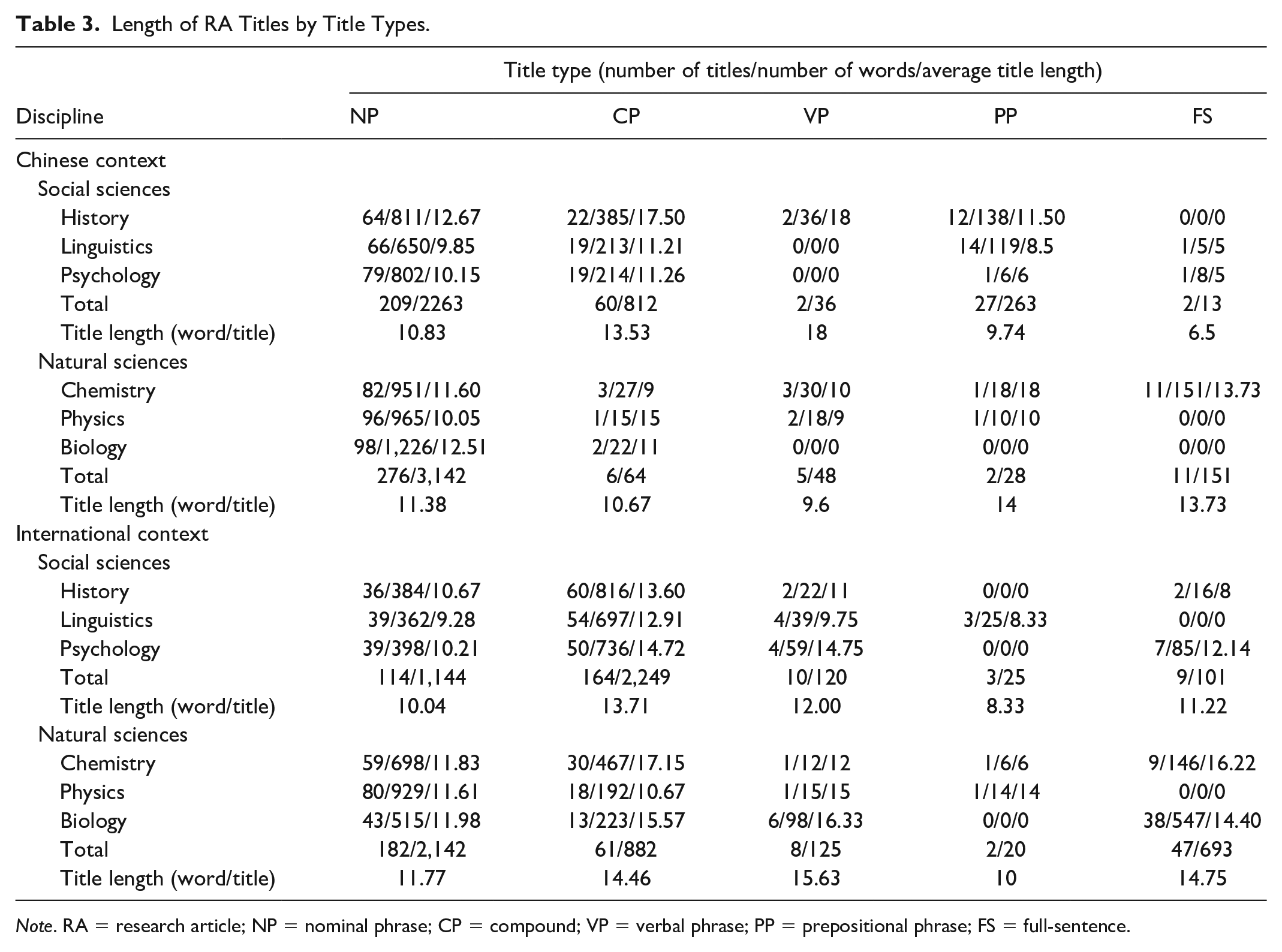
Note. RA = research article; NP = nominal phrase; CP = compound; VP = verbal phrase; PP = prepositional phrase; FS = full-sentence.
Frequencies of Subtypes of Titles.

Note. NP = nominal phrase; CP = compound; VP = verbal phrase; PP = prepositional phrase; FS = full-sentence; CC = Chinese context; IC = international context; NS = natural sciences; SS = social sciences.

Title structures across disciplines and cultures.
Examples of Subtype Titles.

Note. NP = nominal phrase; NS = natural sciences; SS = social sciences; CP = compound; VP = verbal phrase; PP = prepositional phrase; FS = full-sentence.
NP and CP Titles Across Disciplines and Cultures
Due to the larger proportion of NP and CP titles in the present observation, further analysis indicates heterogeneity of the internal structures of NP and CP titles. The internal construction of NP titles varies from “extremely brief units to exceedingly long word strings with intricate interconnections and the capacity to express complex ideas” (León & Divasson, 2006, p. 290). In other words, the complex NP titles are made up of one or more heads with or without premodifiers and with or without postmodifiers. Although more complex NP titles, such as verbal construction in “-ing” or “-ed” form used as postmodifiers, were found, the occurrence is rare. Examples of NP titles are as follows:
An experimental study on enhancing the academic emotions of 2nd graders of junior high school by systematic intervention. Ma Huixia, Guo Hongyan, Shen Deli. Psychological Science 2009, 32(4): 778–782 (Psychology CC SS title).
Determination of the Free Energy Landscape of α-Synuclein Using Spin Label Nuclear Magnetic Resonance Measurements. Allison J. R., Varnai P., Dobson C. M., Vendruscolo M. Journal of the American Chemical Society 2009, 131(51): 18314–18326 (Chemistry IC NS title).
Iconicity in Idioms. Jiang Chengsheng, Liao Dingzhong. Foreign Language Education 2009, 30(6): 14–16, 23 (Linguistics CC SS title).
Gladstone and slavery. Quinault R. The Historical Journal 2009, 52(2): 363–383 (History IC SS title).
The internal structure of NP titles, characterized by NP + PP and NP + PP + PP structures, has a slight difference in the distribution in terms of cultural context and discipline (Figure 2). The former subtype has a structure in which a noun serves as the head postmodified by a preposition phrase, and the latter is realized by the structure in which a noun serves as the head postmodified by two PPs. Such construction is neither too complex to be a nontitle or headline nor too simple to fully summarize the main idea of an RA paper.

NP title structures in detail.
On the contrary, the distribution of internal constructions of CP titles reveals stark differences between the two cultural contexts (Table 6). Whereas a diversity of CP internal structures was found in the international SS as well as in NS, such internal structures tend to be homogeneous in Chinese SS, especially in Chinese NS. Although further analysis is constrained by, relatively, a few subtypes of CP titles, one striking characteristic revealed in the study is the preference of NP: NP construction in terms of both cultural contexts and disciplines. Such construction of CP titles is the combination of two NPs separated by a punctuation mark, usually the colon. For example,
Answers without questions: The emergence of fragments in child language. Ginzburg J., Kolliakou D. Journal of Linguistics 2009, 45: 641–673 (Linguistics IC SS title).
Longitudinal perspectives: The sequences of theory-of-mind development in Chinese preschoolers. Fang Fuxi, Wellman H. M., Liu Yujuan, Liu Guoxiong, Kang Rong. Acta Psychologica Sinica 2009, 41(8): 706–714 (Psychology CC SS title).
CP Title Structures in Detail.
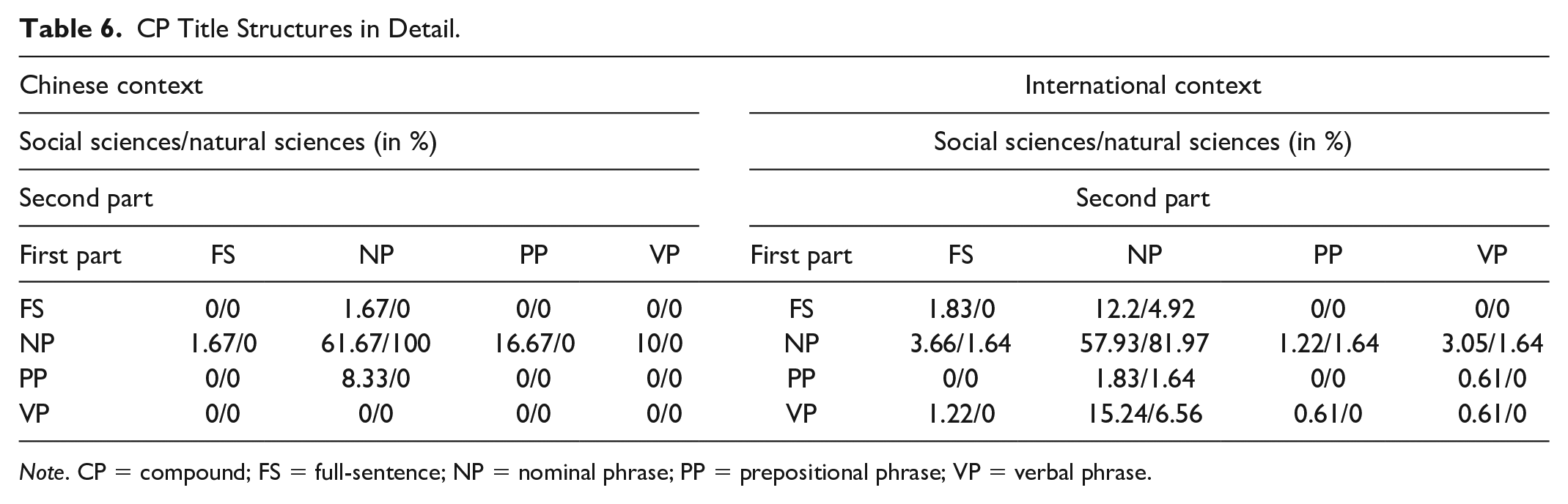
Note. CP = compound; FS = full-sentence; NP = nominal phrase; PP = prepositional phrase; VP = verbal phrase.
Examples of some other constructions of CP titles:
Is loss aversion a robust effect? An uneven route of seeing that losses loom larger than the same amount of gains. Liu Huan, Liang Zhuyuan, Li Shu Acta Psychologica Sinica 2009, 41(12): 1123–1132 (Psychology CC NS CP FS: NP title)
Examining the core: Relations among reading curricula, poverty, and first through third grade reading achievement. Crowe E. C., Connor C. M., Petscher Y. Journal of School Psychology 2009, 47(3): 187–214 (Psychology IC SS CP VP: NP title)
Toward the total synthesis of vinigrol: Synthesis of epi-C-8-dihydrovinigrol. Gentric L., Le Goff X., Ricard L., Hanna I. Journal of Organic Chemistry 2009, 74(24): 9337–9344 (Chemistry IC NS CP PP: NP title).
A world of love: Exploring emotional dimensions of pre-imperial Chinese debates on human nature. Chi Zhen Journal of Historical Science 2009, 11: 31–44 (History CC SS CP NP: VP title).
Discussion
According to Swales and Feak (1994), a good RA title “should indicate the topic of study, should indicate the scope of the study, and should be self-explanatory to readers in the chosen area” (p. 205). Soler (2007, 2011) further corroborates that the two features of titles in science are informativity and economy. The present study also corroborates these features in agreement with the previous research on the titles. However, there is revealed a striking difference between the titles across cultural contexts and disciplines, which is reflected by the distribution of title type in terms of two factors: discipline and culture. In terms of cross-cultural contexts, there are two different metaphors: “TITLE IS A NAME” (in CC) vs. “TITLE IS A HEADLINE” (in IC). In the CC, the title is more like a signifier, a symbol that represents the rest of the RA or the main content of RA by using more NP titles, which means giving texts names. In the IC, titles of RA fulfill different functions more than the basic informational function, such as “to attract the readers” by using more CP and FS titles. In terms of disciplines, the main difference is “to inform” vs. “to attract.” In SS, the variation of title types tends to fill a whole gamut of five title types occurred in our corpora, in contrast with the relatively stiff and limited title types in NS.
On the contrary, according to Shichao Yin (2001), the Chinese titles fulfill the functions as “summarization, attraction, and indication,” and they can be classified into “marked” and “unmarked” titles and into “reporting title” and “referring title” as well. Moreover, Bailin Hua (2007) investigated the Chinese titles in the discipline of library and information science and found that the non-keyword title structures are mostly those with marked words of synonyms such as “lun” (to discuss/argue), “tan” (to talk about), and “guan yu” (about), and so on, and those with pre-modifier attributive adjective marker in Chinese “de” (of, the adjective marker in Chinese) at the same time. Just as Connor (1996) proposed that writing is an activity embedded in a culture, English titles translated by Chinese scholars are strongly influenced by their culture. Kachru and Smith (2008) stated that “grammatical differences are aspects of acculturation and nativization of the language to express the meanings the users intend to convey” (p. 101). Our present findings corroborate these observations in the academic settings and further suggest that the cultural factors not only mirror and influence but also constrain, filter, or boost certain linguistic, formal, or structural features of RA titles at the textual level while Chinese scientists are using English.
As to the title length, our count shows that, generally speaking, average words per title are shorter in terms of cultural contexts and disciplines compared with the previous studies. Such a result suggests that titles might change across time, for our corpora are more recent than previous studies, and that there is a dynamic interplay between economy and informativity of titles within different cultures and disciplines. According to Harmon and Gross (2009), the goal of titles is “the maximization of information content within a short compass” (p. 455). In terms of cultural contexts, intercultural practices or discourse communities (Connor, 1996, 2008) also engender the differences in title length and structure. The fact is that in China the importance of English titles is at the secondary place, for journals are not providing detailed requirements and standard of English titles on their website. Even worse, due to English being a foreign language to Chinese scholars, they sometimes lack the skill to write an effective title. This leads to a too “faithful” translation of the Chinese title into an English version. Obviously, Chinese title grammar finds a way in English codes.
In agreement with previous studies on RA titles (Haggan, 2004; Soler, 2007; Wang & Bai, 2007), our count shows that the NP titles are the most recurrent title types in the two cultural contexts and disciplines (Table 4 and Figure 1). This type of English RA titles, defined as “prototypical discourse patterns for experimental science” by Halliday and Martin (1993, p. 7), operates “as a means to imprint the nominal, lexical dense and impersonal style that typifies scientific discourse” (Soler, 2011, p. 13), which is indicative of less impact from disciplinary and cultural factors.
In both cultural contexts, the preference of NP titles indicates that this type of titles “permits the straightforward materialization of informativity through the piling up of pre- and post-modifiers or through lexical density” (Soler, 2011, p. 10). According to Soler (2011), the nominal group’s analyzed lexical density (i) enables scientists to account for their studies and findings synoptically, (ii) contributes to demonstrating the specification of either the object of study or the results collected, (iii) imprints impersonality, thus placing emphasis on the object of the study rather than on the author of the study, and (iv) caters to the readers’ particular needs as these titles map the main subject matter of the papers within the corresponding scientific field. (p. 10)
However, cross-culturally, the NP titles in English by Chinese writers are restricted to a fixed and stiff pattern, especially with the marked words such as “study” and PPs as postmodifiers. This corroborates Haggan’s observation (2004) that “titles are texts in miniature,” but in this study, such texts, influenced by cultural factors, are materialized by magnifying certain aspects of title functions or structures (p. 312). Just as we mentioned above, the title, for Chinese writers, is a NAME, which is naturally formed in nominalization or nominal structures.
The present study has the following implications. First, the average length and recurrent title structure in the discipline and culture would guide the article writers to compose an effective RA title. Second, the writers could choose between the length and structures of title to achieve particular goals, such as to attract the readers, enhance article visibility and citation rate, and facilitate information retrieval. In addition, the study would voice a suggestion on the research evaluation. If the disciplinary and cultural factors inevitably impact the academic writing as Connor (1996) stated, the journal editors, article reviewers, and publishers should tolerate and accept some peculiar linguistic features of English in the academic writings (Flowerdew, 2001, 2008; Hyland, 2016), in this case, the RA titles.
Conclusion
This article compared English titles by Chinese scholars and their international counterparts in terms of cultural and disciplinary factors. Although some common tendencies are found in the present study along the two dimensions, compared with the previous studies, the current study revealed the difference in title length, the distribution of title types, and the distribution of subtype title structure between different cultures and disciplines. It suggests that the difference concerning culture factors is the influence of Chinese way of thinking and Chinese language; the difference concerning discipline factors is caused by particular academic communities. One limitation of the present study was that only titles in the CC were compared with the international journals and the number of journals and disciplines was still small. Further study could incorporate more disciplines, cultural contexts, and titles. By considering the two factors, culture and discipline, this study has an implication to benefit the editors and writers in the global contexts, which will promote intercultural communication, at least in the academic setting.
Footnotes
Acknowledgements
I would like to thank all the anonymous reviewers for their valuable comments that helped me to improve my article a lot.
Declaration of Conflicting Interests
The author(s) declared no potential conflicts of interest with respect to the research, authorship, and/or publication of this article.
Funding
The author(s) received no financial support for the research, authorship, and/or publication of this article.
