




Abstract
Psychological intervention has a positive impact on the competitive psychological ability and performance of athletes, while there are few studies on this subject. To improve the psychological ability of athletes’ mood and coping styles and promote the smooth progress of the competition, a single-subject experimental design model is used carry out psychological intervention on four high-level athletes for 8 months. According to the characteristics of Wushu routines, the psychological measurement and social validity evaluation are combined to explore the effect of psychological intervention. The results show that the mood state of four athletes improved obviously with the same trend. The coping styles showed a positive upward trend after psychological intervention. The results of three athletes also improved in the City Games. In addition, the results of “social validation” obtained from the coaches and athletes support the effectiveness of the intervention. Psychological intervention can effectively improve the bad mood and negative coping style of Wushu routine athletes so as to improve the competition of athletes.
Introduction
Mood is a kind of lasting and weak state that can widely affect people’s psychology and behavior, generally including more than one emotion (Lane & Terry, 2000). There are five kinds of negative emotions: anger, depression, tension, fatigue, and panic and two kinds of positive emotions: energy and self-esteem (Mcnair et al., 1971). Positive mood before competition is the psychological basis for athletes to achieve the best results in competition. However, it is the coping on stress that really affects the performance of athletes’ skills and tactics. Coping styles have been defined as “the methods of coping that characterize individuals’ reactions to stress either across different situations or over time within a given situation” (M. Wu & Wang, 2016). The coping styles includes many factors (H. B. Wang, 2014), which can be divided into positive coping, negative coping, and emotional response. Positive coping is characterized by aggressiveness, initiative, activeness, and outward. Negative coping is characterized by avoidance, passivity, inhibition, and inward. Emotional response is mainly characterized by emotional catharsis (Tan & Fan, 2001).
Athletes’ adaptation to fierce competition and coping styles with emergencies in competition have become the key factors to win. Therefore, it is necessary to evaluate the influence of psychological intervention on mood state and coping styles of athletes. There is a certain relationship between athlete’s mood and their performance level. Athletes are more likely to show their best ability in the most “ideal” mood than in other moods. For the relationship between mood state and sport records, the research can be inspired by Morgan, who put forward the famous iceberg profile (Mcnair et al., 1971). Many experts believe that sports achievement can be predicted by monitoring the mood state and coping styles of athletes (Si et al., 2016; Zhuang & Zheng, 2016), and the high-level athletes are more positive than ordinary athletes according to the total evaluation of mood state and coping styles (He et al., 2014; Song & Zhou, 2015). Beedie et al. have conducted two meta-analyses of 29 published studies on mood (13 of which were the relationship between mood and performance of athletes at different levels, 16 of which were the relationship between mood and performance of athletes with the same level) and concluded that mood had a significant effect on performance results prediction (Beedie et al., 2000). The optimism and positive mood of athlete are related to the effect of coping styles, which are the positive prediction factors of competition results (Qu et al., 2009; H. Y. Wu & Dou, 2001). At present, cognitive-emotional regulation training method, simulated stress training method, relaxation training method, and control point training method are effective methods and means to improve pre-competition emotional state and on-the-spot stress coping styles (H. Y. Wu & Dou, 2001). Many case study data show that psychological skill training can improve the positive emotional state (mood state and training satisfaction) and reduce the negative emotional state (mental fatigue and competition anxiety) (Fang & Zhang, 2010; Q. Zhang, 2015; Zhao & Zhang, 2012). Coping style is also positively correlated with athlete’s performance (Qu et al., 2009), that is, the better the performance of athletes, the more positive the coping style.
Competitive Wushu is a traditional sport characterized by height, difficulty and beauty, with subjective score as the result. Combining with the Olympic tenet of “higher, faster and stronger,” Wushu routine competition is becoming more and more intense, and the relationship between the psychological state of athlete and sport performance is close. According to the questionnaire test of “Chinese athlete coping scale” (Chung & Si, 2004), Zhao and Zhang (2012) concludes that the adolescent Wushu Athletes’ stress coping, emotional coping, avoidance coping, and transcendence coping are at the middle and low levels respectively. Thus, it is one of the difficult problems for coaches to effectively intervene the athletes’ psychology before the competition and make them play the best in the competition.
As discussed above, it is of great significance to carry out psychological intervention on mood state and coping styles for high-level athletes before competition, which can guarantee the training quality and athletes show best ability in the competition. In this study, the single-subject design is applied to monitor the psychological state of athletes in the training and obtain the changes of athletes in their mood state and coping styles for different times. Based on the special characteristics of Wushu routine, this article puts forward the method of psychological intervention for four high-level Wushu routine athletes so as to improve the emotional state and training quality of athletes.
Experimental Design
Characteristics and Psychological Challenges of Wushu Competition
Wushu originated from China. It is a technical system of unarmed and armed sports with Sanda and routine as the main content and around fighting (Yang, 2008; Yang & Cheng, 2013). Wushu routine is a series of action combinations with attack and defense. At present, World Wushu routine competition mainly includes three categories: Changquan, Taijiquan, and Nanquan, and some traditional boxing and pair exercise items. Through long-term communication with coaches and athletes and observation of competition training, the characteristics of Wushu and the psychological challenges faced by Wushu athletes are shown as follows:
First, the Wushu routine is mainly a closed-type sports skill. It is necessary for athletes to maintain a high level of internal attention in the long completion of technical movements.
Second, as a scoring event, Wushu routine competition, needs to be judged by the subjective scores of referees. It is influenced by many factors, such as the recognition degree and playing order of athletes (Tenenbaum & Eklund, 2007). Wushu athletes are more dependent on the uncontrollable psychological pressure of external factors (J. J. Li et al., 2010).
Third, modern Wushu routine has very strict requirements on movement stability, and its difficulty coefficient is increasing (C. L. Li, 2016). As Wushu routine movements are mainly based on jumping, turning, and single-leg stance, the pursuit of stable psychology has become the main content of competitive Wushu.
Fourth, to find improvement space for this difficult performance competition, coaches evaluate the quality of movements with a critical attitude so that athletes can form a negative habit of thinking in training, which is prone to have burnout psychology in training.
According to the above psychological characteristics of Wushu routine, psychological intervention is carried out for athletes, and the effect of psychological intervention is tested by checking the changes of athletes’ mood and coping styles (Liu et al., 2016).
Experimental Method
Based on the small sample model of psychological research, a nonparallel and multiple baseline method designed by a single-subject design was adopted at different times to evaluate the influence of mood state through psychological intervention (Yan et al., 2013). The design of single-subject experiment is characterized to emphasize a single subject or a few subjects. A typical single-subject design usually consists of three to five subjects, and each of them takes himself as a reference and receives psychological intervention at different times. This design method needs a stable baseline level of dependent variables before psychological intervention. Single-subject design usually includes the evaluation of social effectiveness, which mainly refers to the feelings of subjects on the methods used and the results obtained (Boyle, 1983; Hrycaiko & Martin, 1996; L. C. Zhang, 2016). In addition, this method can test the degree of consistency between different individuals, and allow multiple baseline designs, which indicates that the baseline level of dependent variables may be different between different individuals. The internal and external validity of single-subject design method is higher than that of case study. To make psychological intervention have better dynamic validity and adapt to the special training of Wushu routine athletes, it is appropriate to apply this nonparallel and multiple baseline design method. Four Wushu routine athletes are tested for psychological intervention for 8 months after getting the baselines.
Research Subjects
Four high-level Wushu athletes, who have participated in the City Games in China are selected as the research subjects. To improve their competition performance, psychological intervention needs to be involved. The selected high-level athletes who qualified to participate in the national championship have reached the national level in China. The situations of the subjects are shown in Table 1.
The Situation of Subjects.

Dependent Variable: Mood State and Coping Styles
For the relationship between mood and sport performance, four types of variables have been explicitly pointed out by researchers as follows (Yan et al., 2013): (a) sports duration, (b) required capacity of sports and the degree of homogeneity, (c) evaluation criteria of sports performance, and (d) the number of athletes in joint training or competition. Short duration sports such as Wushu are more susceptible to mood than long duration sports (such as basketball). Sports with high homogeneity (e.g., sprinting mainly requires speed) are more susceptible to mood than sports (e.g., decathlon) with low homogeneity. Self-expression-oriented sports (figure skating) are more susceptible to mood than winning- or losing-oriented sports (tennis). Sports with fewer people (e.g., Wushu) are more susceptible to mood than sports with more people (e.g., football). When athletes are in a good mood, their training quality or performance will be much better than the bad mood. Especially in the intensive training before competition, because of the pressure caused by various factors, the mood fluctuation of athletes will affect the coping styles. As discussed above, Wushu routine athletes are more susceptible to the influence of mood state (Y. Wang & Zhang, 2012).
Pre-competition mood is an important factor affecting the competition performance. To improve the training quality of athletes and overcome the psychological obstacles in the training process, the method of psychological intervention is carried out in the study. This study assumes that psychological intervention can improve the emotional state of individuals. According to Lazarus’s main argument (Tenenbaum & Eklund, 2007), the way people assess and cope with personal events is affected by mood state. The psychological intervention can improve the ability of athletes to cope with training and competition pressure. Therefore, the ability of athletes to cope with competition is the focus of this study.
Measurement Tools
To truly reflect the psychological state of Wushu routine athletes, this study uses Profile of Mood States (POMS) and Coping Orientation to Problems Experienced (COPE) Scale to measure.
POMS scale
POMS is a self-evaluation scale of mood state, which is revised by Professor Zhu as a norm, with a reliability of .62 to .82 and an average of .71 (Zhu, 1995). The revised POMS scale has 40 questions, which included seven different mood state dimensions (stress, anger, fatigue, depression, energy, fluster, and self-esteem.). Subjects were asked to respond to each item based on “how you feel right now” using a 5-level Likert-type scale from 1 (not at all) to 5 (extremely). The sum of Likert-type scores was used as a result variable in the statistical analysis; the higher the scores, the better the mood. In this study, the mood states of athletes are tested 6 times before preliminaries and finals, prepared to explain the mood state problems. The tests are carried out under special supervision and guidance, and each test is conducted immediately after the end of sports training.
COPE scale
In this study, the player COPE scale revised by Tan and Fan (2001) is used to evaluate the psychological intervention of athletes. There were 45 questions, which were divided into nine factors. These factors can be classified into positive coping, negative coping, and emotional coping. Emotional coping is the only middle way besides positive and negative responses. Examples of different copings list on the COPE Scale are as follows: I use direct action to deal with problems (positive coping), I pretend that this is really happening (negative coping), and I often talk about my feelings (emotional coping) with others. The revised COPE scale has good reliability and validity, and can be used as an evaluation tool for the coping activities of athletes.
Social Validity Questionnaire
After 8 months of psychological intervention, four athletes and four coaches need to complete a 6-item questionnaire. Each question was rated from 1 (very bad) to 5 (very good) for the effect evaluation of psychological intervention.
Psychological Intervention
Executor
Psychological intervention refers to the process of exerting a planned and step-by-step influence on the psychological activities, personality characteristics, or psychological problems of certain subjects under the guidance of psychological theories so as to make them change toward the expected aim (L. Li & Shi, 2010). In this study, psychological interventions for Wushu athletes are mainly carried out in the following aspects: attention training, cognitive training, imagery training, positive suggestion training, and relaxation training. According to mass communication between coach, athletes, and teammates, the content of psychological intervention is formulated by the tracking observation and measure after a long dynamic process. To ensure psychological intervention is effective in the whole process, the contents of psychological intervention should be adjusted through the feedback of athletes or coaches. On the basis of the psychological intervention model proposed by J. Z. Wang et al. (2008), the author carried out psychological intervention.
Types of psychological intervention
Base on the characteristics of Wushu and the psychological challenges of wushu competitions, two types of psychological intervention are used in the study: (a) the collective teaching on the comprehensive psychological skills training, including attention training, cognitive training, imagery training, positive suggestion training, and relaxation training. The collective teaching is carried out in the conference room of Wushu Management Center for 1.5 hr once every 2 weeks. (b) the individual psychological consultation, which mainly guides athletes to carry out coping training for bad emotions and stress, 2 hr once a week in the athlete dormitories. Different training methods are applied for different mood states, such as relaxation training is for fatigue and tension state, cognitive training for anger and depression, positive suggestion training for fluster, and attention training for energy and other emotional states, which are measured by POMS. The psychological intervention is arranged in the rest time and approved by the sports coach. After each class, the athletes will complete the practice of psychological skills in teaching.
Monitoring of psychological intervention
Psychological intervention is approved by Hubei wushu sports management center and implemented with the consent of coaches and athletes, which is conducted in accordance with the principles of psychological ethics. To strictly control the irrelevant technical variables, the subjects received psychological intervention in closed training. The pretest and posttest were conducted after the normal training in the week before the preliminary and final competition so as to make the test situation as highly consistent as possible.
Monitoring of psychological intervention is carried out by the training team director and coach. The implementation of psychological intervention includes three parts: (a) quality assessment by the author, (b) the monitoring of sports coach, and (c) self-feedback of athletes. The reliability of psychological intervention results can be guaranteed through the tripartite feedback of author, coaches, and athletes. To further make the effect of psychological intervention, sports coaches and athletes need to complete the questionnaire of the social effectiveness evaluation. The total process of psychological intervention is shown in Figure 1.

Psychological intervention process of Wushu routine athletes.
Analysis
Mood State
The mood state measure before psychological intervention is used as the pretest and after psychological intervention is used as the posttest. To reduce the test error, the pretest is arranged once every other day for 6 times. The posttest is finished in half a month before the finals of the City Games with testing once every other day.
Figure 2 shows the comparison of mood state between pretest and posttest of Athlete C. Negative emotions such as stress, anger, and fatigue are significantly greater than positive emotions before psychological intervention. To guide Athlete C to self-psychological control, psychological intervention is carried out from the aspects of language suggestion training, emotional catharsis, and relaxation training. After psychological intervention, the emotional state of Athlete C is close to that of excellent athletes with high positive emotion, strong vitality, and good self-esteem. The average value of mood state decreases 30% from 136 to 95, and the span value of mood state decreases obviously from 90 to 99 after psychological intervention. Therefore, the Athlete C has a great fluctuation of 125 to 146 before the test, and the mood state tended to be stable, which indicates that psychological intervention had a good effect on the mood state of Athlete C.
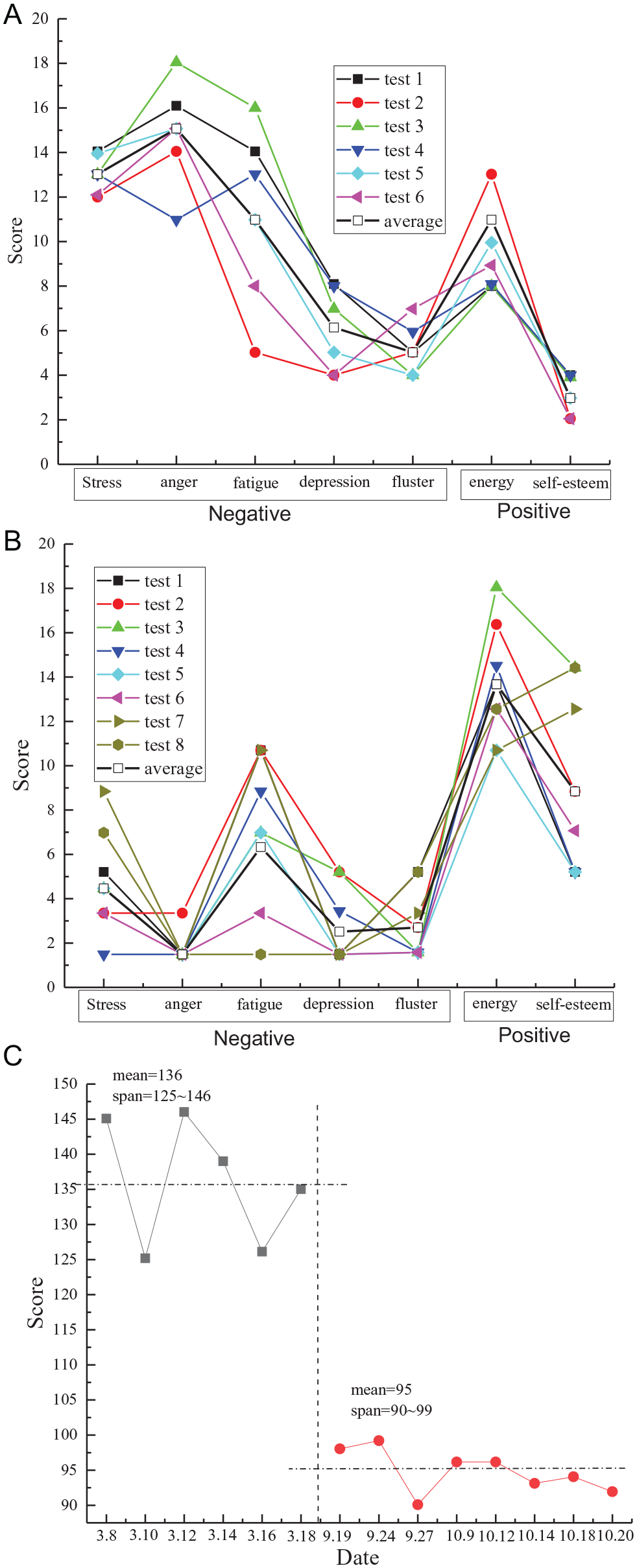
The comparison of mood state between pretest and posttest of Athlete C: (A) pretest, (B) posttest, and (C) comparison of POMS.
Figure 3 shows the comparison of mood state between pretest and posttest of Athlete W. Before psychological intervention, the negative emotions such as anger and fluster are very obvious and the mood state is in disorder; while the condition of mood state is very good and regular after psychological intervention. The mood state of Athlete W is close to that of the excellent athletes who are energetic, have good self-esteem, less anger and confusion. After psychological intervention, the breadth of emotional state decreases from 84 to 96. The average value of mood state decreases 20% from 115 to 91. The Athlete W has a great fluctuation of 90 to 131 before the test and the mood state tends to be stable. Therefore, psychological intervention has a good effect on the improvement of mood state of Athlete W.

The comparison of mood state between pretest and posttest of Athlete W: (A) pretest, (B) posttest, and (C) comparison of POMS.
Figure 4 shows the comparison of mood state between pretest and posttest of Athlete G. Before psychological intervention, the negative emotions such as anger, fatigue, and depression are significantly greater than the positive emotions, but the tension is very low and fluctuates greatly. Anger and depression decrease significantly after psychological intervention, and fatigue still exists. The mood state characteristics of Athlete G are gradually approaching the excellent athletes with higher positive emotions, more vigorous energy, and good self-esteem. The average value of mood state decreases 30% from 131 to 91, and the span value of mood state decreases from 90 to 106 obviously after psychological intervention. Athlete G fluctuated greatly from 96 to 143 before the testing, and the mood state tended to be stable, indicating that psychological intervention has a good effect on the mood state of Athlete G.

The comparison of mood state between pretest and posttest of Athlete G: (A) pretest, (B) posttest, and (C) comparison of POMS.
Figure 5 shows the comparison of mood state between pretest and posttest of Athlete X. The negative emotion especially for fatigue is relatively weak and the positive emotion also is very low before psychological intervention. The profile of mood states of Athlete X is approaching that of the excellent athletes. The law of mood state is in disorder before psychological intervention, while the condition of mood state is very good and regular after psychological intervention. The average value of mood state decreases 20% from 115 to 92, and the fall value is less than other three athletes. The span value of mood state decreases obviously from 84 to 100 after psychological intervention. Meanwhile, psychological intervention has a good effect on the mood state of Athlete X.

The comparison of mood state between pretest and posttest of Athlete X: (A) pretest, (B) posttest, and (C) comparison of POMS.
Coping Styles
Figure 6 shows the tested scores of Athlete C by the COPE scale. It can be found that the scores of positive and negative coping are basically equal in the pretest, while the posttest results show that the positive coping is the main way. According to Athlete C, although he has learned the correct and positive coping style, there are also some negative behaviors when the game comes, such as relying on luck which leads to the increase in the score of religious belief score before the game.

Score of Athlete C by COPE scale.
The tested scores of Athlete W by the COPE scale is shown in Figure 7. The scores of positive response and negative response are almost the same, while the posttest results show that the score of positive response is very high and the score of negative response is very low. According to Athlete W, the introverted and conservative factors still make him conservative in response to coping style. Although Athlete W has a good understanding of the correct positive coping, the restraint factor score is higher than that of pretest.

Score of Athlete W by COPE scale.
Figure 8 shows the tested scores of Athlete G by the COPE scale. The score of negative coping is higher than that of the positive response, while the posttest results show that the positive response is high and the negative coping score is very low, indicating that the coping styles changes obviously.

Score of Athlete G by COPE scale.
It can be found from Figure 9 that the nine coping factors of Athlete X have obvious progresses after psychological intervention. The progress of positive response is very regular and continuous, which is the goal of psychological intervention, and also what athletes and coaches expect.

Score of Athlete X by COPE scale.
Social Evaluation
To further evaluate the effect of psychological intervention, each athlete and his coach completed a practice assessment questionnaire, that is, Social Validity Evaluation (Ye et al., 2016). The questionnaire is finished by coaches and athletes after the game, as shown in Table 2. For Question 1, athletes and their coaches think that the training level of athletes has been greatly improved in the process of psychological intervention, with an average score of 4 points. The average score of Questions 2 and 3 is 4.1 points, which shows that athletes have great changes in training quality and mood. Through psychological intervention, the coping styles of athletes have changed a lot with an average score of 4.8 points (Question 4). For Question 5, athletes are able to accept the content and way of psychological intervention, with an average score of 4.5 points. Because Athlete G made a big mistake in the game, he and his two coaches gave a low evaluation of Question 6, with an average score of 2.9 points. The total average score of the social validity evaluation is 4.07, which indicates that the effect of psychological intervention is highly evaluated by athletes and coaches.
Social Validity Evaluation.

Competition Performance
For the competition performance in City Games, Athlete X entered the first place in the final from the fourth place in the preliminary. Athlete W kept the first place in the final with wonderful technical actions. Athlete G dropped from the fourth place in the preliminary to the eighth place, and Athlete C still kept the tenth place.
Athlete G is the first player on the field. The deafening shouting of the audience on the final day caused a big interference, which made him make mistakes unprepared. Then, Athletes C, X, and W responded positively to the interference and realized normal or super performance. Among the four athletes, G performed poorly in the competition.
Conclusion
The mood states of the above athletes have been improved by psychological intervention. In general, the improved effect of Athletes C and W is better than that of Athletes G and X. According to four standards of visual inspection suggested by Hrycaiko and Martin (1996), we have the enough confidence to improve the mood state in psychological intervention. Through psychological intervention, the coping styles of the four athletes are improved. The improvement of Athletes W and X has significant changes in coping styles and the scores of coping factors are all positive. Psychological intervention has changed the coping styles of Wushu routine athletes in training and competition, and the hypothesis of this study has been confirmed. The effect of psychological intervention has been accepted from the social validity evaluation. For the training input and mood state improvement, the evaluation of athletes is higher than that of coaches. In this study, psychological intervention has played a positive role in the preparation of Hubei Wushu team for the City Game and achieved good results, which has been accepted and affirmed by coaches and athletes.
However, the sampling of dependent variable has a certain influence on the psychological intervention. In the future, psychological intervention work will be further carried out in the Wushu team by the combination of the sports psychology theory and the characteristics of Wushu competition (Pensgaard & Abrahamsen, 2012). To improve the stability of Wushu Athletes’ competition performance, it is necessary to develop a more systematic psychological intervention program and increase the sample size of psychological intervention.
Footnotes
Declaration of Conflicting Interests
The author(s) declared no potential conflicts of interest with respect to the research, authorship, and/or publication of this article.
Funding
The author(s) disclosed receipt of the following financial support for the research, authorship, and/or publication of this article: The work is supported by the Teaching Research Foundation of Hubei Province, China (Grant No. 2018285) and Basic scientific research business expenses of provincial undergraduate universities in Heilongjiang Province (Grant No. 2020YTW-T-03).
