




Abstract
The present study aimed to investigate factors predicting inquiry-based teaching in science across One Belt One Road countries and regions (OBOR economies). Teacher-level (N = 8,603) and school-level (N = 1,385) data were drawn from the Program for International Student Assessment (PISA) 2015. Hierarchical linear modeling was adopted for data analysis. The results showed at the teacher level that teacher collaboration was positively correlated with inquiry-based teaching in OBOR economies, and that teacher beliefs were positively associated with inquiry-based teaching in each sample. At the school level, no consistent result was found among OBOR economies. School location was positively related to inquiry-based teaching in the Dominican Republic, Macao, and the United Arab Emirates. By contrast, science-specific resources showed a negative association with inquiry-based teaching in Taiwan, the Czech Republic, and Macao. Other specific findings were presented and the implications of all findings were discussed.
Keywords
At the beginning of the 21st century, inquiry-based teaching became a well-known pedagogy in science education (Anderson, 2002; Cairns, 2019; Furtak et al., 2012; National Research Council, 1996). Although there is no consensus on the definition of inquiry-based teaching, a common perception of this concept is that it involves hands-on activities, higher order skills, and creative thinking but is not aimed at developing students’ basic skills. Therefore, it has been highly recommended as a form of advanced pedagogy in the teaching of science and mathematics (e.g., Sandoval & Reiser, 2004). Program for International Student Assessment (PISA) 2015 not only identified inquiry-based teaching as one of four teaching approaches but also surveyed both 15-year-old students and their teachers on how this approach was demonstrated in their science class. The present study draws from PISA 2015 data on One Belt One Road countries and regions (OBOR economies) to compare inquiry-based teaching at teacher level with school level. To date, PISA 2015 data represent the most recent investigation into science teaching among OBOR economies.
OBOR is an ongoing economic project initiated by the Chinese government in 2015. It was inspired by the historic Silk Road, an extensive network of land trade, communication, and cultural exchange between China and countries in Asia, the Middle East, Africa, and Europe in ancient times. Nowadays, OBOR countries and regions comprise a strong strategic framework for the Chinese government whereby they improve regional interconnection, enhance China’s political influence, and also promote closer economic integration with other countries across Asia, Africa, Europe, the Middle East, and America (Yu, 2017). The OBOR countries expect to have their biggest economic and political gains through their interactions with China (Sevilla, 2017). By 2015, the OBOR project encompassed 65 countries (Chin & He, 2016). Certain OBOR countries selected in the present study (e.g., Chile, Czech Republic, and the United Arab Emirates) have established a very close partnership with China (Ministry of Foreign Affairs of the People’s Republic of China, 2019). According to 2019 series reports from the official website of the Ministry of Foreign Affairs of China, China is Chile’s largest trading partner in the world for both exports and imports, whereas Chile is China’s third largest trading partner in Latin America and the largest supplier of copper. In 2018, bilateral trade between China and Chile was worth US$42.75 billion, an increase of 20.1% over the previous year. The Czech Republic was China’s second largest trading partner in Central and Eastern Europe. From January to October 2018, bilateral trade between China and the Czech Republic was up to US$13.03 billion, an increase of 31% compared with 2017. The United Arab Emirates was China’s largest export market and second largest trading partner in the Arab world. In 2018, the bilateral trade volume between China and Arab countries reached US$45.918 billion, up 12.06% year-on-year. Whereas China’s exports reached US$29.66 billion, 3.2% higher than the previous year, China’s imports increased by 32.8% over the previous year, totaling up to US$16.258 billion.
Although OBOR countries take economic exchanges and cooperation as the basis, economic development and cooperation inevitably involve cultural and people exchanges. There is to date an urgent call for promotion of these exchanges and for further progress on collaboration between China and other OBOR economies regarding education, tourism, academics, art, and other fields. The present study makes efforts to further educational understanding among the eight OBOR economies that were shown to be the typical high and low performers in the PISA 2015 science tests. Some of the eight economies (e.g., Mainland China, Taiwan, and Korea) have kept good documentation of their educational reforms and educational policies, and also have demonstrated the effectiveness of their teaching and learning practices in their English-written literature. However, other countries/regions, such as Chile, the Czech Republic, the Dominican Republic, Macao, and the United Arab Emirates failed to do so. Among all these economies, Mainland China, Taiwan, Korea, and Macao were the top performers in the PISA 2015 science test, with scores in the range of 516 to 532, as compared with the average PISA score of 493 obtained by the Organisation for Economic Co-operation and Development (OECD, 2016). The Czech Republic’s score was 493, just on the OECD average; Chile’s and the United Arab Emirates’ scores were 447 and 437, respectively; and the Dominican Republic fell in last place, with a score of 332.
In the present study, we put these OBOR economies, both PISA top performers and low performers, together for educational comparison to arrive at a comprehensive understanding. We do not intend to compare the former with the latter, with respect to the quality or implementation of inquiry-based teaching: Our aim is to identify general and specific problems. When a given country finds a weakness in its economy, other OBOR members may provide help to resolve the problem. Such actions exemplify one of the missions of the OBOR project, which is to help OBOR members enhance the quality of their education practices. To date, inquiry-based teaching in science teachers’ classes has been well-studied in Mainland China, Taiwan, and Korea but not adequately investigated in Chile, the Czech Republic, the Dominican Republic, Macao, and the United Arab Emirates. Thus, the aim of the present study was to provide additional knowledge on comparative education. Three research questions guided the present study:
We are interested in determining what factors predict inquiry-based teaching where the results contribute to the improvement of inquiry-based teaching among OBOR economies.
Literature Review
The Conceptions of Inquiry-Based Teaching
Inquiry-based teaching has been defined in a multitude of ways in the literature (Anderson, 2002; Areepattamannil, 2012; Dobber et al., 2017; National Research Council [NRC], 1996). The definition of inquiry-based teaching proposed by National Science Education Standards (NRC, 1996) has been broadly accepted for some years: According to NRC (1996), inquiry-based teaching refers to teaching that facilitates student learning in a variety of ways, such as questioning skills, conducting investigations, using appropriate techniques to gather data, thinking critically about relationships between evidence and their explanations, and communicating scientific arguments. Anderson (2002) suggested that inquiry is a learning activity that develops students’ knowledge and understanding of scientific concepts as well as comprehension of the natural world through a scientific lens. As the literature accumulated, clearer classifications were developed and an inquiry can now be classified as either student-directed or teacher-directed. An example of student-directed inquiry is found in Areepattamannil’s (2012) study that was based on PISA 2006 data and that investigated 5,120 adolescents from 85 schools in Qatar: The study featured inquiry as student-centered interactions, student investigations, hands-on activities, and a focus on models or applications in science. By contrast, Dobber et al. (2017) reviewed relevant qualitative and quantitative studies of inquiry-based education, finding that teacher-directed inquiry focused on the questions investigated and the method of investigation decided by teachers. According to a meta-analysis of experimental and quasi-experimental studies from 1996 to 2006, the effect of teacher-led inquiry was greater than student-led inquiry during that period (Furtak et al., 2012).
Research on inquiry-based teaching identified it as a comprehensive concept, consisting of three categories: conceptual, epistemic, and social (Duschl, 2008). The conceptual domain focuses on scientific facts, theories, and principles. The epistemic domain refers to the students’ own efforts to collect, evaluate, and interpret evidence, and acquire knowledge. The social domain refers to how students interact through communicating, arguing, debating, presenting, and reasoning. Furtak et al. (2012) added a procedural domain, which was extracted from Duschl’s (2008) epistemic domain to form a new cognitive construct of inquiry-based teaching. The procedural domain focuses on asking questions, designing experiments, and executing procedures in science.
Factors Predicting Inquiry-Based Teaching
Inquiry-based teaching as an instructional strategy has been shown to be central to many classes with regard to establishing, strengthening, exploring, and investigating the procedures involved (Leikin & Rota, 2006). Researchers have identified the different factors that influence teachers’ implementation of inquiry-based teaching in different teaching contexts (Alhendal et al., 2016; Correia & Harrison, 2019; Haney & McArthur, 2002; Nam et al., 2013; Ramnarain, 2016; Roehrig, 2004). For instance, Correia and Harrison (2019) observed four lessons run by two secondary science teachers who had 13 and 34 years of teaching experience, respectively, finding that the teachers’ beliefs about inquiry shaped their guidance of students in the class. Haney and McArthur (2002) investigated four preservice teachers regarding their science teaching experience. The results showed that teacher belief was an important factor affecting the teachers’ use of inquiry-based teaching. Cronin-Jones, (1991) claimed that teacher beliefs have a positive and significant association with inquiry-based teaching in middle school science classrooms: Attitudes toward the delivery of inquiry-based teaching was also a good predictor. Alhendal et al. (2016) investigated 496 primary school science teachers through questionnaires and found that teachers’ attitudes toward adopting inquiry-based teaching significantly predicted their capacity to create and deliver inquiry-based lessons.
Collaboration among teachers has been found to be associated with inquiry-based teaching (Lebak, 2015; Nam et al., 2013; Svendsen, 2016). Nam et al. (2013) investigated three beginner science teachers and three mentors at a middle school in an urban area of South Korea: The findings indicated that the preservice teachers reflected their own perceptions of teaching, in turn leading to an improvement in inquiry-based teaching in their classroom practice. Svendsen (2016) investigated three secondary schools, noting that collaboration and reflection among the science teachers there had a positive effect on their understanding of inquiry-based teaching. Clearly, these results point to the importance of a positive learning community in enhancing collaborative teacher learning and allowing for the nurturing of teachers even further in a positive feedback loop. Lebak (2015) argued that collaborative professional development provides opportunities for science teachers to reflect on their practice in the science classroom.
Teaching experience has been shown to be a good predictor of inquiry-based teaching (Calderhead, 1988; Crawford, 1999; Furman et al., 2019; Roehrig, 2004; Volkmann & Anderson, 1998). Beginner teachers tend to have difficulty adopting inquiry-based teaching in class due to a lack of teaching experience although they first acquired pedagogical knowledge about inquiry-based science teaching (Calderhead, 1988; Crawford, 1999; Volkmann & Anderson, 1998). When they studied the challenges that teachers faced in the process of implementing an early years’ inquiry-based science unit, Furman et al. (2019) found that the teachers without inquiry-based teaching experience struggled to use activities for the training of scientific skills. Roehrig (2004) investigated 14 teachers who had different amounts of experience in teaching secondary science, finding that lack of classroom teaching experience was one of the common barriers to inquiry-based teaching.
A number of research studies (e.g., Capps et al., 2012; Loucks-Horsley et al., 2003; Ramnarain, 2016; Rushton et al., 2011) have indicated that teacher professional development is associated with inquiry-based teaching. For example, in an investigation of 186 science teachers in South Africa, Ramnarain (2016) identified the contribution to inquiry-based teaching of professional scientific knowledge as an intrinsic factor and professional support as an extrinsic factor. Loucks-Horsley et al. (2003) showed that it was essential to design professional development activities to facilitate science teachers’ implementation of inquiry-based science instruction. Capps et al. (2012) pointed out that teachers should be provided opportunities to examine their beliefs and reflect upon their teaching in meaningful contexts to support inquiry-based instruction. Rushton et al. (2011) investigated the beliefs and practices of seven high school chemistry teachers who participated in a yearlong inquiry project, finding that professional development helped the teachers understand inquiry-based practices much better and also produced a conceptual change in the participating teachers.
Other variables, such as gender, teacher qualification, class size, and school resources have also been shown to predict inquiry-based teaching (Alhendal et al., 2016; Johnson, 2007; Lumpe et al., 1998; Ramnarain, 2016). Alhendal et al. (2016) showed that gender significantly predicted science teachers’ behavioral intentions toward the use of inquiry-based instruction in science classrooms. Availability of resources and class size were shown by Johnson (2007) and Lumpe et al. (1998) to influence teachers’ use of an inquiry approach. Ramnarain (2016) argued that resource adequacy had a significant effect on implementing inquiry-based education at schools in South Africa.
In summary, the extant literature shows that teacher belief, collaboration, teaching experience, teacher professional development, and other variables such as gender, teacher qualification, class size, and school resources may predict inquiry-based teaching in different teaching contexts. In the present study, most of these variables, at both school level and student level, were selected for investigation (see the “Method” section for details).
Inquiry-Based Teaching in OBOR Economies
During recent decades, inquiry-based teaching has commonly featured as a teaching method in worldwide educational reform (Anderson, 2002; Dobber et al., 2017; Furtak et al., 2012). The OBOR economies selected in our study carried out their educational reform in different ways. As aforementioned, some of them (e.g., Mainland China, Taiwan, and Korea) presented inquiry-based teaching in both their reform policies and teaching initiatives, whereas others (e.g., Chile, the Czech Republic, the Dominican Republic, Macao, and the United Arab Emirates) to some extent started new reform agendas but encountered some hurdles in doing so.
Although Mainland China, Taiwan, and Korea started their reform with an emphasis on inquiry-based teaching in science education, these OBOR economies face problems regarding class length and also have been influenced by the level of students’ test scores. For instance, in 1999, Taiwan’s educational authority initiated new curriculum standards that advocated inquiry-based teaching (Abd-El-Khalick et al., 2004); Fang et al. (2016) pointed out that Taiwan’s educational reform set the goal of “activating” teaching in secondary schools, emphasizing the need for students to participate in scientific inquiry activities, and the Korean Ministry of Education and Human Resources (2007) emphasized the need for the inquiry process in science learning. However, all these reform strategies were not implemented to any great extent at the practice level. Science teachers in Taiwan preferred to adopt both traditional (teacher-directed) and inquiry-based teaching in their classes due to the constraints of instructional time, content-based tests, and Confucian teaching beliefs (Abd-El-Khalick et al., 2004; Huang & Asghar, 2018). Similarly, inquiry-based teaching was advocated by China’s Ministry of Education and highly recommended by the first- to ninth-grade curriculum standards in 2001 and 2011 (Xie, 2014). Although teachers were capable of using this teaching model in their class, they were not enthusiastic about it as they felt it was time-consuming (Jiang & Sun, 2015).
By contrast, other OBOR economies such as Chile, the Czech Republic, and the Dominican Republic had not deeply considered inquiry-based teaching for their science teaching due to a variety of reasons, despite already having conducted educational reform. In Chile, the two education reforms in 1990 and 2006 changed the national curriculum, aligning it more with the mainstream curriculum of other developed countries (Salinas, 2017). For instance, the Chilean national science curriculum for elementary schools formulated three objectives of science: These were content, skills, and attitudes, where science inquiry was considered as one of the skills of practicing science. However, the science teachers involved conducted lessons mostly by using a teacher-directed method (Lederman et al., 2017). Such practices may be contingent on a lack of qualified science teachers. According to Chilean government reports, Chilean science teachers have been found not to have enough practicum or enough training on science method and the nature of science (Cofre’ et al., 2010, cited in Lederman et al., 2017).
Svec (2007) reported how the Czech science education system reformed their curriculum and instructional practices to be more consistent with U.S. science education. Moreover, Cincera (2014) claimed that universities and environmental education centers in the Czech Republic were conducive to the development of inquiry-based science education. However, Spritzer (2004) reported that the largest problem noted in the 2003 Czech School Inspection Office Report was that teachers conducted lessons with factual knowledge rather than facilitating students’ creativity. This was further confirmed by other researchers: For instance, after analyzing class videos, Roth and Garnier (2006) reported that the Czech students involved had little time for independent work and that there was little evidence to suggest the implementation of inquiry-based science teaching.
In the Dominican Republic, elementary and secondary education was developed poorly and has not been studied well in the literature although a few studies have shown that the teaching is outdated. Näslundhadley et al. (2014) conducted a qualitative study on three Latin American countries, including the Dominican Republic, to review their science and mathematics teaching. The video analysis demonstrated that the majority of teachers used drill and practice in their classes: Students were asked to memorize fact and formulas, and very few concerted efforts were made to engage students in hands-on activities. It is therefore not surprising that these students performed poorly on science and mathematics. Furthermore, Bartlett (2012) demonstrated that some migrant children were deprived of access to basic education in the Dominican Republic, thereby revealing the weakness of the existing educational system. In the Second Regional Comparative and Explanatory Study (SERCE), 77.11% of Dominican students performed at an unsatisfactory level in science and 47.48% in mathematics (Näslundhadley et al., 2014).
Method
Data and Sample
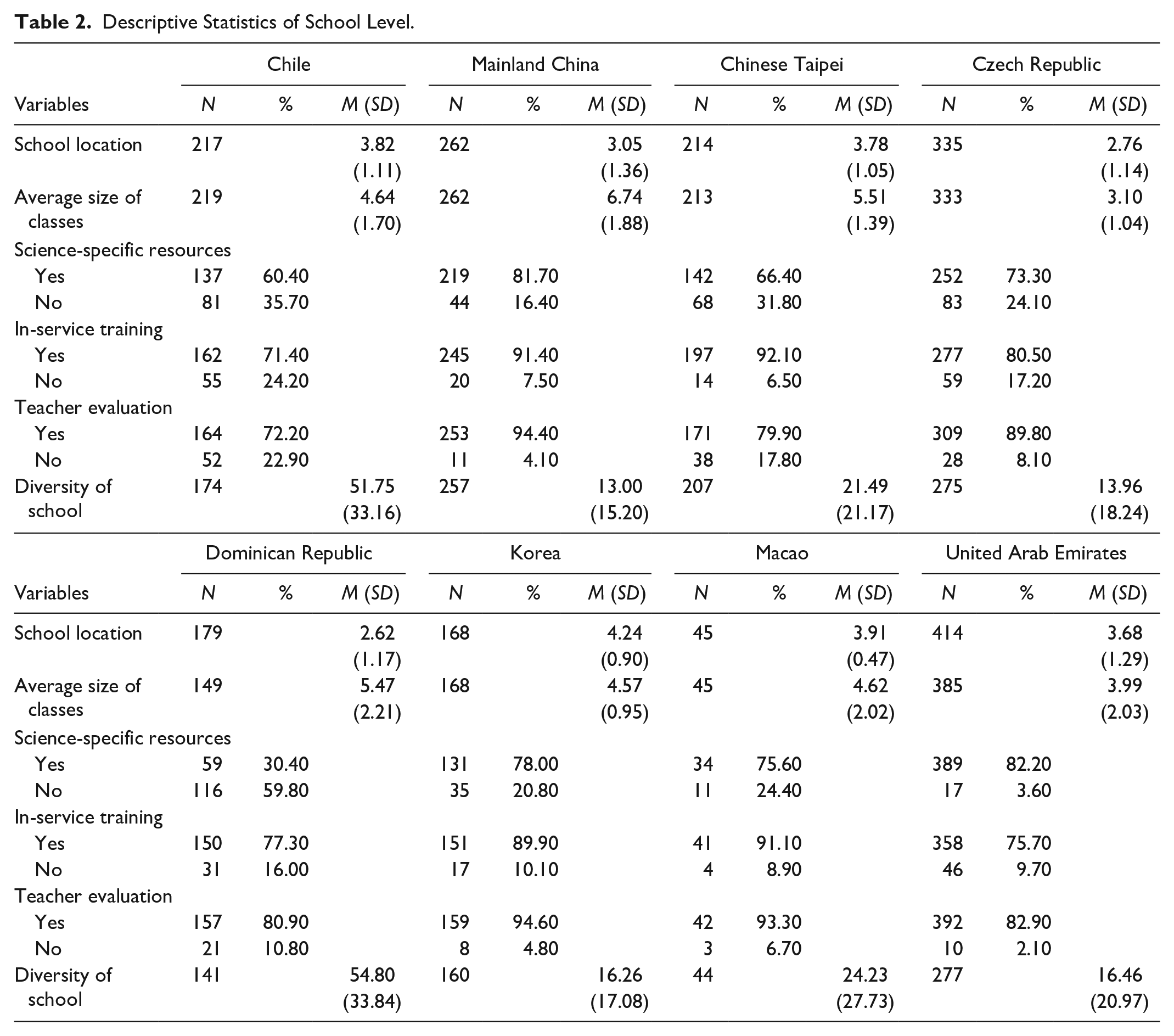
Data for this study were drawn from the PISA 2015 database. Although PISA released its 2018 data in December, 2019, its 2018 data focused mainly on students’ reading literacy. Thus, PISA 2015 data are the most recent for science teaching and learning. According to the PISA 2015 official description, 10,829 teachers from 18 economies participated in the survey. They were asked to complete teacher questionnaires. In addition, some school principals were invited to finish a school survey. Among the 18 economies participating in PISA 2015, 11 joined in the OBOR project: Chile, Mainland China, Chinese Taipei, the Czech Republic, the Dominican Republic, Hong Kong, Italy, Korea, Macao, Portugal, and the United Arab Emirates. The data from these 11 economies underwent an initial hierarchical linear modeling (HLM) check. As a result, three economies, that is, Italy, Hong Kong, and Portugal, were deleted from the sample. The Italy data did not contain the variables (e.g., teacher belief) necessary for data analysis. The Hong Kong and Portugal data proved to be inappropriate for an HLM analysis. As a result, the data used in the present study comprised 34,336 teachers in 1,836 schools from eight OBOR economies. The sample size of each economy is reported in Tables 1 and 2.
Descriptive Statistics of Teacher Level.

Descriptive Statistics of School Level.
Variables
The dependent variable in the present study was inquiry-based teaching. The OECD PISA report of 2016c describes how, in inquiry-based science education, students are engaged in experimentation and hands-on activities, challenged, and encouraged to develop a conceptual understanding of scientific ideas. Furtak et al. (2012) divided inquiry-based teaching into four domains: procedural, conceptual, epistemic, and social. Based on the conceptualization of inquiry-based teaching in the OECD PISA report of 2016c and the Furtak et al. study, the inquiry-based teaching scale used in the PISA 2015 questionnaire, consisting of five items (TC037Q01, Q02, Q04, Q07, and Q09), was selected for use in the present study. A 4-point Likert-type scale was used for each of the items, ranging from 1 (never or almost never) to 4 (every lesson or almost every lesson). Some sample statements are “Students are asked to draw conclusions from an experiment they have conducted,” “Students are given opportunities to explain their ideas,” and “A small group discussion between students takes place.” Cronbach’s alpha showing internal consistency was higher than .70 for the questionnaire for all eight OBOR economies.
In line with extant literature, certain independent variables at the teacher and school level were selected for use in our study. At the teacher level, gender, teaching experience, level of education, professional development activities, science-specific teacher collaboration, and teacher belief were included. At the school level, school location, average size of classes, science-specific resources, in-service training, teacher education, and diversity of school acted as indicators. Considering the many predictors involved in this study, multicollinearity was essential to examine through correlation: Correlation coefficients obtained thus should not exceed .80 (Field, 2009). We found that none of our correlation coefficients exceeded this criterion. Predictors at teacher level and school level are listed in Table 3.
A Summary of Teacher- and School-level Variables.

Note. ISCED = International Standard Classification of Education.
HLM
The associations between each of teacher factors and school factors with inquiry-based teaching were examined through HLM (Bryk & Raudenbush, 1992). The analysis was divided into three parts: (a) the variance in teachers’ inquiry-based teaching among schools; (b) the effect on inquiry-based teaching of gender, teaching experience, level of education, professional development activities, science-specific teacher collaboration, and teacher belief; and (c) the effect on inquiry-based teaching of school location, average size of classes, science-specific resources, in-service training, teacher education, and diversity of school.
The null model was represented by


Where the dependent variable was Inquiry-based teaching ij , which represented teacher i in school j. β0j was the intercept representing the average score of inquiry-based teaching in school j. γ00 was the intercept representing the grand mean of inquiry-based teaching. rij meant the within-school variance of inquiry-based teaching, and µ0j stood for the between school variance.
The equations of the final full model in this study were displayed.
Level-1 model
Inquiry-based teaching ij = β0j + β1j (gender) + β2j (teaching experience) + β3j (level of education) + β4j (professional development activities) + β5j (science-specific teacher collaboration) + β6j (teacher belief) + rij.
Level-2 model
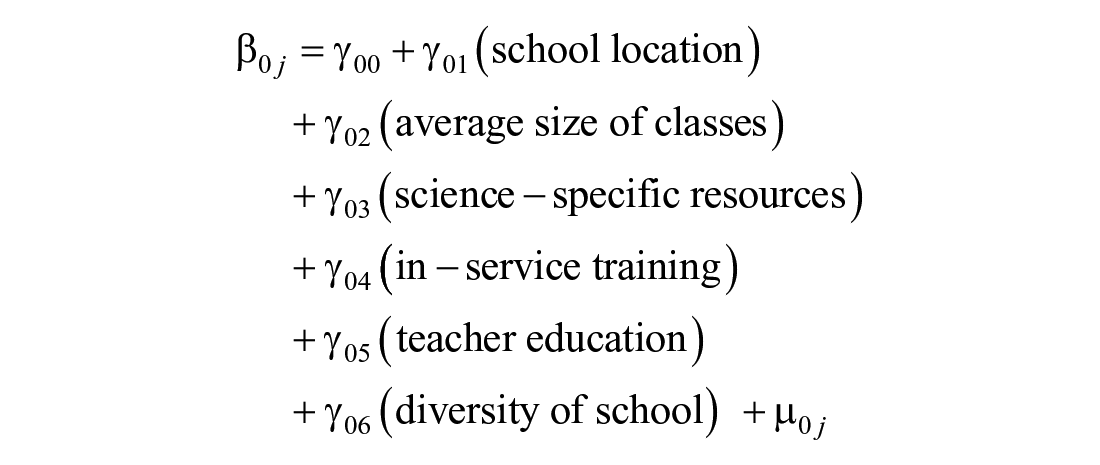
Where β1j is the coefficient of gender, exploring the relationship between gender and inquiry-based teaching in school j in the Level-1 model. γ01 is the coefficient of school location, exploring the relationship between school location and inquiry-based teaching in the Level-2 model. These statistical models were handled by HLM 6 (Raudenbush et al., 2004).
Results
Descriptive Statistics
Descriptive statistics for the independent variables and the dependent variable for each of the eight economies are shown in Tables 1 and 2, respectively. The results showed that teachers from the Dominican Republic were the most likely to support inquiry-based teaching in classes. By contrast, Korean teachers exhibited the lowest frequency of inquiry-based teaching. The means for inquiry-based teaching ranged between 2.44 and 2.56 in Chile, Macao, and Chinese Taipei, indicating that the teachers from these economies exhibited similar frequencies of adopting inquiry-based teaching.
HLM Analysis of Inquiry-Based Teaching
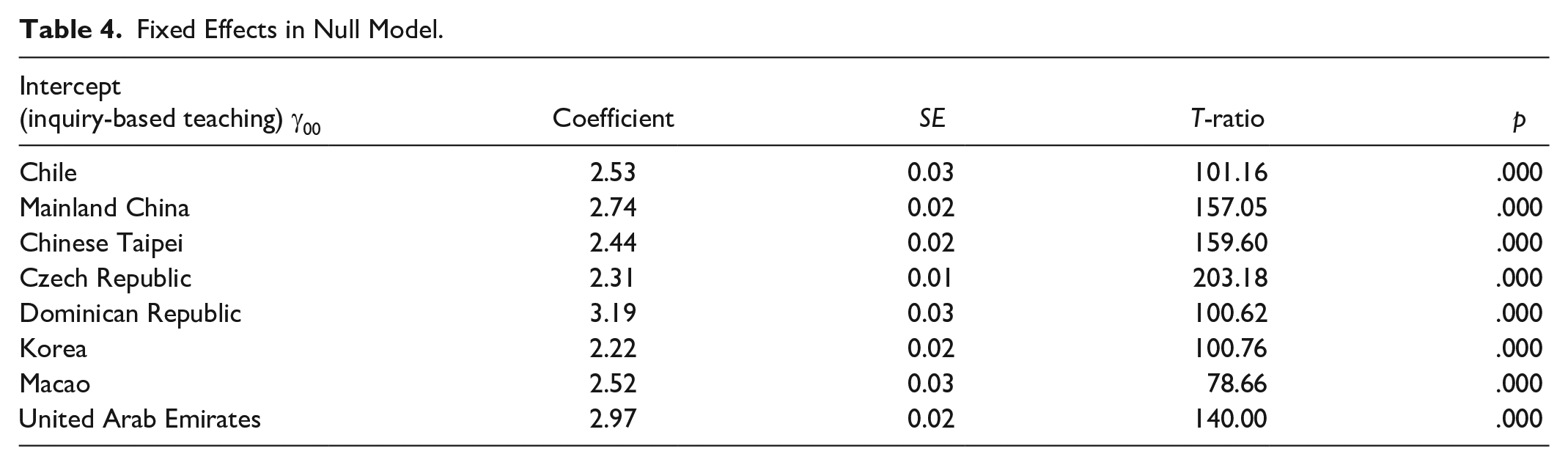
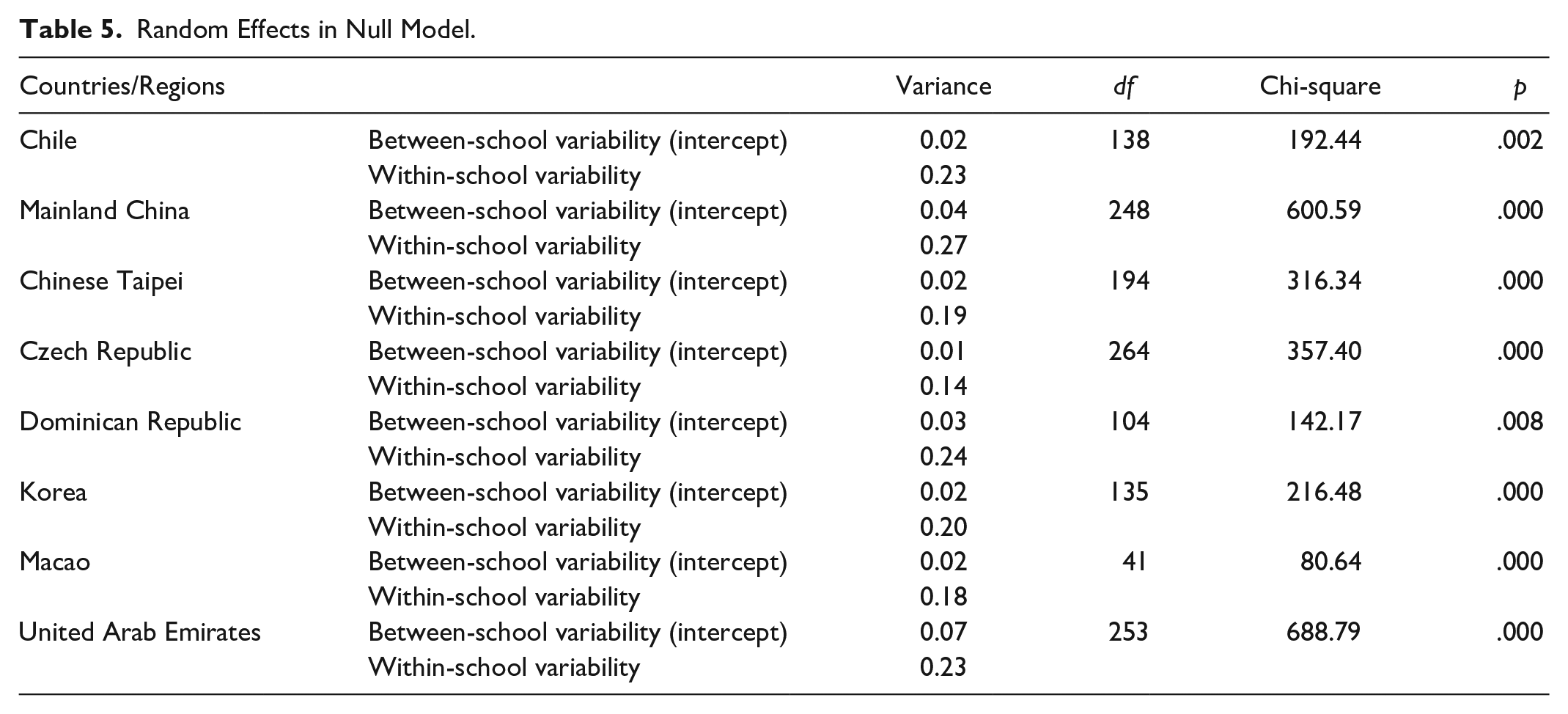
The results for the null models for each region were estimated (see Tables 4 and 5). The grand means of inquiry-based teaching (γ00) ranging from 2.22 to 3.19, and the random effect estimates provided inquiry-based teaching variance between teachers (σ2 = 0.14~0.27), and across schools (τ00 = 0.01~0.07). The school-level variances for inquiry-based teaching in Chile, Mainland China, Chinese Taipei, the Czech Republic, the Dominican Republic, Korea, Macao, and the United Arab Emirates were, respectively, 8%, 12.9%, 9.5%, 6.7%, 11.1%, 9.1%, 10%, and 23.3%. Further analysis using HLM was needed to examine the predictors’ effects according to different levels of variance due to the fact that a considerable proportion of the total variance found in inquiry-based teaching was attributable to school effects.
Fixed Effects in Null Model.
Random Effects in Null Model.
The results of the full model are displayed in Table 6. Teacher collaboration was positively correlated with inquiry-based teaching in all eight economies (β = 0.14–0.23), that is, inquiry-based teaching scores increased from 0.14 to 0.23 points, on average, for every unit increase in teacher collaboration: These collaborations included teachers’ discussing teaching and learning strategies and techniques with fellow teachers and also their learning specific skills from one another. Similarly, teacher beliefs toward inquiry approaches or use of a variety of teaching methods was positively associated with inquiry-based teaching in each sample (β = 0.16–0.54). Excluding the sample of Chile, the strongest variable to significantly predict inquiry-based teaching was teacher belief. Moreover, professional development activities had a negative association with inquiry-based teaching (β = −0.25 to −0.08) in China and the Dominican Republic, indicating that the teachers who performed professional development activities were more likely to conduct inquiry-based teaching than those who did not. In the Dominican Republic data, teaching experience (β = 0.01) and level of education (β = 0.13) showed a positive association with inquiry-based teaching. By contrast, teaching experience was negatively correlated with inquiry-based teaching in Chile (β = −0.01).
Fixed Effects in Full Model.

p < .05. **p < .01. ***p <.001.
At the school level, school location was positively related to inquiry-based teaching (β = 0.03–0.09) in the Dominican Republic, Macao, and the United Arab Emirates, showing that the more developed the region in which a school was located, the more frequent was the use by teachers of inquiry-based teaching. By contrast, science-specific resources showed a negative association with inquiry-based teaching (β = −0.20 to −0.06) in Chinese Taipei, the Czech Republic, and Macao, showing that teachers who had science-specific resources at their school were more likely to adopt inquiry-based teaching frequently than those who did not. Only in the United Arab Emirates was average size of class negatively associated with inquiry-based teaching (β = −0.02), indicating that in larger classes, teachers tended to adopt less inquiry-based teaching methods. Furthermore, only in the Czech Republic did diversity of school show a negative relationship with inquiry-based teaching (β = −0.01). The full models accounted for 15.5% to 36.2% of the variance in inquiry-based teaching at the teacher level, and 7% to 30% of the variance at the school level.
Discussion
The analysis revealed that teacher collaboration and teacher beliefs were significantly associated with inquiry-based teaching in the eight OBOR economies examined. These two variables are usually perceived as important factors in their association with teaching behaviors: First, teaching beliefs are central to teachers’ pedagogy selection and their understanding of classroom practice (Clark & Peterson, 1986; Pajares, 1992; Pintrich, 2002). The finding that teacher beliefs positively predicted inquiry-based teaching in our study is consistent with a number of studies (e.g., Cronin-Jones, 1991; Haney & McArthur, 2002) where teachers’ espoused beliefs were shown to accord with their classroom practices. Second, the finding that teacher collaboration positively predicted inquiry-based teaching in our study is also consistent with extant literature. Svendsen (2016) investigated three secondary schools and found that through teachers’ collaboration and reflection, they gained more knowledge about adopting inquiry-based teaching in class. Lebak (2015) found an indirect association between teacher collaboration and inquiry-based teaching: Teachers’ collaboration resulted in teachers’ reflection; teachers’ reflection then caused a change in their teaching beliefs and the changed teaching beliefs in turn affected teachers’ enacted practice in the science classroom. The two findings in the present study suggest, for the purposes of fostering inquiry-based teaching, that the teacher professional development program may take priority over changing teacher beliefs and helping teachers gain skills in collaboration.
The results of the present study suggest further that economic and educational development do not prevent science teachers from adopting inquiry-based teaching. According to The World Bank (2019) report, among the eight OBOR economies we focus on, the Dominican Republic had the lowest per capita GDP in 2018 (US$7,650.073). However, among the eight economies, Dominican science teachers reported the highest frequencies of conducting inquiry-based teaching (M = 3.19). Similarly, China had the second lowest per capita GDP in 2018 (US$9,770.847), whereas the mean of inquiry-based teaching frequency ranked in the top three for the economies. The Korean per capita GDP in 2018 was in the top three (US$31,362.751) among OBOR economies studied, whereas Korean science teachers had the lowest frequencies (M = 2.22) in terms of the use of inquiry-based teaching in their classes. The highest GDP per capita in 2018 among OBOR economies studied was Macao (US$86,355.408), whereas Macao’s science teachers’ inquiry-based teaching practice performed just on average (M = 2.52). However, these findings do not imply that economic and educational development is irrelevant to the adoption of a new pedagogy: Decidedly, a well-developed economy is fundamental to the initiation of good educational practice. Furthermore, there are many factors that may influence the adoption of a new pedagogy: educational policy, teaching beliefs, teacher training, teacher qualities, student performance, curriculum, and national culture. Our results indicated an imbalanced development of education only in some regions, for example, Macao and Korea.
Our findings that gender, class size, teaching experience, and resource adequacy did not statistically predict inquiry-based teaching are not consistent with the extant literature. A number of authors have claimed that inquiry-based teaching is predicted by gender (Alhendal et al., 2016; Haney et al., 1996; Hargreaves, 2005), class size (Johnson, 2007; Lumpe et al., 1998), and teaching experience (Crawford, 1999; Roehrig, 2004). These inconsistencies may be caused by factors relating to different educational contexts. For instance, in Roehrig’s (2004) study, the sample size of interviewees was 14, in contrast to the 33,724 OBOR participants in our study. In Johnson’s (2007) study, only six teachers were interviewed, which is also a very small sample size compared with the PISA 2015 data. The PISA 2015 findings appear to allow for a better understanding due to the large number of participants used but further study is needed to explore the inconsistencies in depth.
The present study has several limitations. First, for some OBOR economies, due to the paucity of educational information in English-written text, it is difficult to make strong conclusions. For instance, PISA 2015 data showed that the Dominican Republic had the highest frequency (M = 3.19) of adopting inquiry-based teaching in science class. However, Näslundhadley et al. (2014) argued that Dominican teachers implement an outdated pedagogy by featuring drill and practice in science class, with over 77% students performing at an unsatisfactory level. Are these conflicting findings due to biased samples or other factors? Has teacher quality improved in the Dominican Republic? To date, researchers have not been able to obtain evidence from educational literature to answer these questions due to the paucity of investigations. The present study calls for international collaboration among scholars from the Dominican Republic and other countries so that new research projects can be undertaken. OBOR economies in particular should undertake this kind of collaboration. The Ministry of Education in each of these countries/regions could create specific plans to fulfill their OBOR duties. Second, the PISA 2015 school questionnaire does not provide appropriate categorization of several independent variables, such as school location (which we used in the present study). In PISA’s specification, location relies on the number of people living in a community. This strategy makes for inappropriate comparisons among cities (e.g., Macao), provincial areas (e.g., Taiwan), and countries. PISA officials could usefully address this issue in their future rounds of investigation.
Conclusion
The present study aimed to investigate factors predicting inquiry-based teaching across OBOR countries and regions. Teacher-level and school-level data were drawn from PISA 2015 and analyzed by using the hierarchical linear model. The results showed that, at the teacher level, both teacher collaboration and teacher beliefs were positively correlated with inquiry-based teaching in all OBOR economies studied. At the school level, no consistent result was found among the OBOR economies. School location was positively related to inquiry-based teaching in the Dominican Republic, Macao, and the United Arab Emirates. Science-specific resources showed a negative association with inquiry-based teaching in Taiwan, the Czech Republic, and Macao. Teaching experience was positively associated with inquiry-based teaching in the Dominican Republic, in contrast to showing a negative association with inquiry-based teaching in Chile. The level of education positively predicted only inquiry-based teaching in the Dominican Republic. These findings call for further comprehensive studies so that any shortcomings in education for OBOR economies can be addressed.
Footnotes
Declaration of Conflicting Interests
The author(s) declared no potential conflicts of interest with respect to the research, authorship, and/or publication of this article.
Funding
The author(s) disclosed receipt of the following financial support for the research, authorship, and/or publication of this article: This work was supported by the National Social Science Fund for Educational Research of China (grant number BEA170108).
