




Abstract
Looking at the course of educational development in developing countries, nongovernmental organizations (NGOs), nonprofit organizations (NPOs), and volunteers have played a significant role in increasing educational resources in underdeveloped areas and moving educational resources to a balanced state. This study used a mixed-methods approach to investigate the underlying factors affecting volunteer teaching activities of Chinese college students. Data were collected from multiple resources using a self-developed questionnaire and semi-structured interviews. It was found that volunteer teaching activities of college students in China were affected by five key factors including motivation ambiguity, confused identity, unspecialized service, weak incentive mechanism, and a lack of supervision mechanism. In addition, exploratory factor analysis revealed that skills, activity experience, and volunteer performance were significantly correlated with the college students’ willingness to participate in volunteer teaching. Informed by the data, we proposed some tentative solutions to solve the challenges and dilemmas from the perspective of consciousness training, systematism cultivation, concept guidance, and the establishment of incentive and supervision mechanism.
Keywords
Introduction
Around the world, the unbalanced allocation of educational resources is a common problem faced by many developing and underdeveloping countries (Richter & McPherson, 2012). Nongovernmental organizations (NGOs), nonprofit organizations (NPOs), and volunteers from various countries have played an important role in the efforts to increase educational resources and make them flow toward a balanced state. Volunteers provide important manpower, good ideas, and financial resources (Prouteau & Wolff, 2008). Meanwhile, volunteer activities have also become one of the important elements of citizenship and liberalism (Kelemen et al., 2017). Take China for example, by the end of 2018, the number of Chinese registered volunteers exceeded 100 million, half of whom served in education-related fields, more than 270,000 college students voluntarily served in northwest and southwest of China and made important contributions to local education, health, agricultural technology, and poverty alleviation (China Youth, 2018). Although a substantial body of scholarship conducted research on volunteer activities in western countries (Shantz et al., 2014; Thoits & Hewitt, 2001; Wilson & Musick, 1997), little attention has been paid to Asian countries, particularly China, which is confronting the worsening education inequality.
Taking all these into consideration, this study used a mixed-methods approach to investigate the factors affecting Chinese college students’ participation of volunteer teaching activities. The volunteer teaching activities in this study means all kinds of nonprofit volunteer teaching activities actively participated by college students themselves. Then, the study will conduct a comprehensive analysis on the dilemmas and challenges from psychological and social economic aspects including intrinsic motivation, systematism degree, incentive mechanism, and supervision mechanism. We believe that findings collected from this study can not only improve the participation of Chinese college students in volunteer teaching activities but also have important reference value for other developing countries.
Volunteering in Developing Countries
Since the late 1970s, when the developing countries began their strategic transformation and their economic development entered the fast lane, social problems have also emerged (Houlihan & Green, 2006). Education, as one of the social problems widely concerned by the people, has been paid more and more attention by the government and the public (Wan, 2014). The allocation, acquisition, and fairness of educational resources need to be solved urgently. In India, NGOs play an extremely important role in educational poverty alleviation process, with 20.4% of NGOs active in education and most concentrated in remote rural areas (PRIA, 2002). In Brazil, the number of education-related NGOs only accounts for 6.3%, while these organizations play an essential role in alleviating educational poverty and inequality. They are not only partners of the government but also play a role in restricting and supervising the implementation of government policies (Instituto Brasileiro de Geografia e Estatística, 2004). In 2004, Mexico implemented “Federal Civil Society Organization Activity Promotion Law,” which symbolized that the federal government officially recognized NGOs’ right to participate in making national policy and to engage them to deal with their internal affairs (Grindle, 2011). As a developing country with such a large population for education, China is being challenged by meeting the ever-growing educational demand of the society (Tan, 2001). Many volunteer organizations came into being, committed to improving the unbalanced allocation of educational resources. By the end of 2018, China had 10,102 educational social organizations, 1,511 educational foundations, and 240,012 educational public welfare organizations. In the past 5 years, the growth rate has remained above 13% (Ministry of Civil Affairs of the People’s Republic of China, 2018). It is enough to prove that NGOs and NPOs play an important role in promoting education equity.
Literature Review
In recent years, how to keep volunteers in the organization and how to manage volunteers has become a research hotspot (Studer & von Schnurbein, 2013; Wilson, 2012). However, before that, it is necessary to find out why volunteers are reluctant to stay in the organization. What difficulties did they encounter? This study focuses on the dilemmas and challenges faced by volunteer teaching activities of college students. Therefore, literature review focuses on motivation, identity, incentive, and supervision, which are easy to lead to the loss of volunteers.
Motivation
Most of the researches on volunteer activities focus on the motivation and resources of volunteers. Besides, more and more studies have shown that the motivation is in a dynamic process (Haski-Leventhal & Bargal, 2008; O’Toole & Grey, 2015; Willems et al., 2012). Volunteers devote passion and effort into volunteer activities to improve and express themselves (Kahn, 1990; Schaufeli & Bakker, 2004; Shantz et al., 2014). Happiness and social value means a lot to volunteers, which is a new perspective for the research of volunteer incentive mechanism (Meyer & Simsa, 2018). In terms of the Chinese contexts, Wu (2007) divides the volunteer motivation into three categories, which are traditional motivation with “the sense of responsibility” as the axis, modern motivation with “development” as the axis, and post-modern motivation with “happiness” as the axis. Luo and Wang (2012) observed that volunteering is “altruistic and self-interest” not only in result but also in motivation.
Identity
Some previous studies have proved that the recognition of volunteers’ identity and specific volunteer organizations would affect volunteers’ continuous participation in volunteer activities or in the same volunteer organizations (Oesterle et al., 2004; Thoits & Hewitt, 2001). A higher degree of recognition means a greater possibility of continuous participation in such activities (Grube & Piliavin, 2000). Volunteering is somehow stable, so participants’ past experience can decide whether they will continue engaging in volunteer activities (Butrica et al., 2009; Lancee & Radl, 2014; Wilson & Musick, 1997). Their identity of volunteer gradually forms by dynamic reaction with organization and environment (Kewes & Munsch, 2019). The probability of participating in the volunteer activities once more may increase from 12.61% to 60.05% because of the past volunteering experience, and about 36% persistent volunteering resulted from the past volunteering experience (Dawson et al., 2019). In the process of continuous participation in volunteer activities, volunteers gradually establish a dual identity of volunteer identity and professional identity (Zheng, 2012).
Incentives mechanism
From the perspective of social system composition, volunteering became a specific aspect of third sector organizations with the assistance from altruistic motivation, diversity of tasks, and complex relationships with professionals (Cnaan & Amrofell, 1994). The effective system can better motivate volunteers and keep them for the organization (Tang et al., 2009, 2010). At the same time, O’Toole and Gray (2015) have suggested that various aspects of volunteering, in particular emotions, social relationships, and physical challenges, must all be considered. Previous research has revealed that organizations can foster volunteering by offering employees the opportunity to participate in volunteering activities (Booth et al., 2009; Jones, 2010; Rodell, 2013). This is usually done as part of corporate volunteerism programs where employers sponsor release time and regular compensation to enable interested employees to donate their time to a specific cause. As Wei (2013) explained, spiritual motivation is more than material motivation, which is not conducive to the in-depth development of volunteer activities.
As reviewed earlier, there are also some limitations in the previous studies. First of all, research on volunteering motivation mainly focuses on the results and ignores the formation of motivation from scratch. Second, most of studies on participants’ identity focus on the role of organization but seldom on the individual efforts of volunteers. Third, research on incentive mechanism mostly focuses on the incentive of policy, organization, and public opinion from a macro perspective, and fails to pay enough attention to the incentive role of interaction between volunteers and recipients in volunteer activities. Fourth, as for the supervision mechanism, most of the previous research results are discussing principles, directions, and suggestions, while the operational strategies are barely mentioned.
Method
This study conducted an in-depth investigation of Chinese college student volunteer activities to answer two research questions:
A mixed-methods approach was used including a self-developed questionnaire and semi-structured interviews.
Participants
According to the International Labor Organization (2011) Manual on the Measurement of Volunteer Work, the volunteer activities contain three main elements: volunteering mainly contains physical activities, on which participants need to physically work by themselves rather than purely donate money or other goods; it is not for profit, one’s labor cannot be paid; participants must be willing to do volunteering. Based on the third point, the manual stipulates the age of participants and believes that people aged more than 15 years can be responsible for their decision and behavior. The object of the survey is college student volunteers in teaching activities, so the object has met the requirement of “over 15 years old,” according to China’s educational system.
The proportion of sampling survey in this study is 5% to 30%, and the survey time is from January 2019 to April 2019. The survey bases on six provincial administrative regions, including Heilongjiang province, Shanxi province, Guizhou province, Yunnan province, Sichuan province, and Xinjiang Uygur Autonomous region. Those regions are evenly distributed and distinctive in population density and economic development. All of those reflect the uneven development of China. The recruitment criteria of the respondents are divided into two categories: quantitative analysis sample and qualitative analysis sample.
Basic information of participants in survey study
This study invited junior students to participate in the questionnaire, due to the characteristics of Chinese college training programs, in which the third-year undergraduates possess more free time and are more likely to become volunteers compared with other year levels. Altogether a total of 10 universities were voluntarily recruited, covering such six majors as technology, science, culture, agriculture, forestry, and commerce. In terms of geographical distribution, most of these universities are located in central China and a few in south and north China, which accords with the regional distribution characteristics of Chinese universities. From the perspective of types and levels, there were three comprehensive research universities, three featured research universities, and four application-oriented universities. In total, 435 questionnaires were distributed and 400 were recovered as valid ones, representing a recovery rate of 91.9%. Among them, 203 are males, accounting for 51%, and 197 are females, accounting for 49%.
Basic information of participants in interview study
The participants for interview study included four categories: college students of volunteer teaching, personnel of colleges, recipient schools, and recipient students (Table 1). The interviewees of the first category were members of postgraduate volunteer teaching corps, leaders of college students recruited by NPO, on-post interns organized by normal colleges, members of young volunteer associations of colleges and universities, and individual volunteers, totaling 104 volunteers. Samples of the second and the third categories were from the 10 universities of the survey study, and the primary and secondary schools supported by these universities. A total of 95 samples were selected. Samples of the fourth category were selected from students of the primary and secondary schools supported by these universities. A total of 202 samples were selected.
Basic Information of Participants.

Out of the consideration of privacy protection, the real name of each sample was omitted and was replaced by code. There were 60 volunteers from postgraduate volunteer teaching corps, who were coded from Y1 to Y60; 16 volunteers representing Willoong, who were coded from W1 to W16; 12 on-post intern volunteers, who were coded from S1 to S12; 11 volunteers representing university young volunteer associations, who were coded from G1 to G11; and 5 individual volunteers, who were coded from Z1 to Z5. Samples of university working staff included 30 teachers, who were coded from J1 to J30, and 24 management personnel, who were coded from DG1 to DG24. Samples of assistance receiving parties included 15 principals, who were coded from X1 to X15; and 26 teachers, who were coded from XJ1 to XJ26. Samples of recipients included 202 students, who were coded from XS1 to XS202.
Measurements
This study used a mixed-methods approach to investigate the dilemmas and challenges faced by college student volunteers in teaching activities. Data were collected from multiple resources using a self-developed questionnaire and semi-structured interviews.
A large scale survey
This study developed a large-scale survey to investigate the current situation of college student volunteers in teaching activities and also the challenges faced by the students. The questionnaire is for college students’ participation in volunteer teaching activities by research group, which was divided into two parts. The first part focused on the basic information of participants. The second part was a survey of the participation of college students through non-scale and scale questions. The non-scale questions mainly focused on the motivation, level of expertise, and type of activities in volunteer teaching activities. The scale questions focused on the self-assessment. The questionnaire contained 29 scale questions, which were classified into a 4-level scale: 1 = “totally disagree,” 2 = “disagree,” 3 = “basically agree,” and 4 = “totally agree.” SPSS22.0 was applied as the questionnaire analysis tool.
Semi-structured interviews
To elicit in-depth information, this study conducted semi-structured interviews to a group of participants including college students who had participated in volunteer teaching activities, college teachers, principals and teachers of recipient schools, and recipient students. The specific interview forms include face-to-face interview, telephone interview, online interview, participating in observations and writing. Each interview for each one lasts about 40 to 50 min. To avoid the differences caused by the interview types, the researcher strictly followed the interview protocol and tried to start with some ice-breaking questions to relieve the anxiety caused by the unfamiliarity. The first part of the interview outline was basic information about the interviewees. The second part was centered on the interviewees’ attitude toward, assessment of, and suggestions on volunteer teaching activities (see the appendix). For recipient students, the writing method was adopted because most of them are pupils and middle school students. During the interviews, it was found that they did not understand the questions or were unwilling to say about others, so it would be better to anonymously write those down. The title of composition was “Volunteer Teacher in My Eyes” for students above Grade 4 and “Whispers to the Teacher” for students below Grade 4. There was neither requirement for writing the name nor limit to the number of words in a composition.
Findings
Among the 400 samples, 339 used to participate in volunteer teaching activities, representing 85% of the total. This result is consistent with the survey of Global Service Institute targeting 210 civic service programs in 57 countries, that is, among the civic service programs surveyed, 92% belonged to volunteer projects, 77% were provided by young people, and 80% were associated with education (Jiang, 2005). It can be seen that educational support is the area in which young volunteers are more interested and willing to participate. Yet, the high participation rate couldn’t cover up the problems that exist.
Dilemmas and Challenges of Volunteer Teaching Faced by Chinese College Students
The data collected from the questionnaire and interviews together revealed the following problems and challenges.
Ambiguous participation motivation
According to the theory of motivation, different volunteers have different motives and goals, and their motives are multiple but have priorities (Studer & von Schnurbein, 2013). This theory proposed the matching hypothesis, that is, in the continuous volunteering stage, volunteers have greater intentions of volunteering again in the future when their primary motivations were satisfied (Clary et al., 1996). However, this survey discovered that “motivation ambiguity” that is not classified as any of above categories is quite prevalent among college student volunteers in teaching.
The statistical results of the questionnaire survey showed that, among all motives, 51.9% were “volunteering participation,” 39.5% were “completing tasks organized by the university,” 11.5% were “being influenced by parents,” and 6.2% were “paying a debt of gratitude” and “for other motivations.” While a survey of China Youth & Children Research Center (2013) showed that only 11.62% of young volunteers spontaneously participated in volunteer activities, which is inconsistent with the findings of our study. One of the possible reasons may be that college student volunteers have insufficient awareness, understanding, and thinking of the motivation for participating in volunteer activities, thus their participation being rather arbitrary.
As discovered in interviews, 30% volunteers in short-term projects took the volunteer activities organized by their universities, Chinese Communist Youth League Committee or classes as “volunteering” participation and didn’t distinguish individual self-conscious and self-awakening volunteering and “called volunteering.” The risk of losing volunteers with ambiguous motivations was higher than that with clear motivations.
Confused identity in performing volunteer teaching activities
This survey discovered that almost all college student volunteers experienced a long period of confusion in terms of role identity. The episodes from the interviews further corroborated the findings while unveiling the underlying reasons. For example, volunteer G4 of a university youth volunteer association said as follows: We wish to help local children build confidence and have the belief of diligence and persistence through organizing various activities. Yet, local principals and teachers take this disapprovingly and argued that helping the children with their homework and watching them playing outdoors would be enough for them.
Volunteers Y4, Y5, and Y6 of a postgraduate volunteer teaching corps serving a nine-year school in Shaanxi Province expressed the same confusion. Volunteer Y4 reflected as follows: I’ve been serving here for almost half a year, but we are still called “the three college students” by school leaders at meetings. Students’ parents also directly call us “volunteer teachers.” As time goes by, we are confused, “who are we? What should we do?”
The party receiving assistance and students’ parents lack trusts in the volunteers. In turn, volunteers lack psychological expectations for the volunteer teaching life. These reasons would prevent the volunteers from getting into the role smoothly. It’s difficult for them to build a role identity in teaching activities, thus leading to the loss of volunteers in short-term projects and the loss of motivation for long-term volunteer teaching.
Low level of specialization in teaching and social services
Modern volunteering was born out of religious charity. After being separated from charity and becoming an independent social activity, volunteering has no longer been limited to vulnerable groups (Payton & Moody, 2008). The objects of volunteer teaching activities have been expanded to all people with further educational needs. That said, the low level of specialization has limited the further development of volunteer teaching activities. According to statistics of this questionnaire survey, the proportion of volunteers who received training was 48.4%. Among them, 29.5% were trained by their own universities whereas only 4.7% were trained by the assistance receiving parties. These figures demonstrate that college student volunteers are less specialized. Volunteer W3 noted as follows: During the organization of a summer camp, we found that children in cities, towns and villages have their respective characteristics, which has a lot to do with local environment. 3 days of intensive training before the start of a camp is far from enough.
In the interviews with principals of schools supported, all of them suggested that college student volunteers should receive systematic professional training. Principal X1 of a nine-year school in Chenggu County of Shaanxi Province also expressed the wish: The school in Qinling Mountain is struggled with poor conditions, large staff mobility and difficulty in retaining excellent teachers. We are willing to train the volunteer teachers, but we are less capable of doing so.”
All the 10 universities surveyed organized certain training for members of postgraduate volunteer teaching corps before sending them to the serving destinations, but most of these trainings were centered on sharing experience, visits, and lectures. One university in Shanghai did a good job in this regard. The university sent some volunteers to a target school for a 1-week training, during which the volunteers lunched, studied, and played with the pupils. The volunteers who received this training said that they benefited a lot from this training, but they wished for a longer time of such training so that they could have a clearer picture of the school’s running mode and children’s behavioral characteristics.
Weak incentive mechanism
Organizers of volunteer teaching activities in China are basically governments, communities, colleges, and universities, and public good organizations. Governments and universities mainly focus on policy incentives, spiritual incentives, and material incentives. Taking the postgraduate volunteer teaching corps organized by the Chinese Communist Youth League Committee as an example, its members are respectively provided with a living allowance of 2,500 yuan per month by the state during their volunteering as teachers. At the same time, they are also given a certain amount of living allowance by local education bureaus according to the financial status. Besides, after 1-year volunteer teaching, they could be exempted from the entrance examination to obtain a graduate qualification of their own schools and the scholarship for the first year of graduate study (He & Song, 2017). Public good organizations provide the required venues, props, and funds to volunteers. After the completion of a volunteer teaching activity, a reporting evaluation will be organized and the winning team would receive bonuses and honors (Zhang, 2017). Communities typically motivate college volunteers through establishing a volunteer time bank and rewarding star volunteers (Ding & Jiang, 2007). These measures have strongly stimulated the enthusiasm of college students to participate in volunteer teaching activities, but these are far from enough. On-post intern volunteer S7 said they didn’t feel any incentive: Assisted schools and guardians believe that we are here to practice our skills and so work hard even if we are not inspired. During half a year’s internship, we didn’t enjoy the welfare of the assisted school. Nor did my university give us material rewards, except for sending cars to pick us up.
Individual volunteer Z2 argued that the efficiency of volunteer organization was not high, and they are not willing to participate in organized volunteer teaching activities, which also led to their loss of access to incentives. As Z2 posited, I don’t belong to any organization, which makes it more difficult to gain trust and incentive. But I’m impatient with the cumbersome procedures of organization.
It can be seen that the volunteer teaching activities organized by the government is easier to get incentives as compared with other types of volunteers. This shows that there is not a perfect incentive mechanism in the field of volunteer teaching activities.
Lack of supervision mechanism
Supervisions over volunteer activities in China mainly rest with the government, media, and volunteers themselves. Some scholars had realized the shortcoming of such supervision mechanism long ago, but the force to call for and study the establishment of a supervision mechanism remains weak compared with the force to study the mechanism for motivating volunteer activities. In this case, it’s urgent to develop industry supervision and introduce professional institutions for supervision (Liu, 2010). This study discovered that the Chinese Communist Youth League Committee issued special documents for ensuring the smooth implementation of the “Go West Program” and has provided guiding opinions in volunteer recruitment, selection and training, policy support, financial guarantee, assessment, incentive, and so on (China Youth, 2019). However, there is still a lack of execution when it comes to the organizers, volunteers, and assistance receiving parties due to the shortage of an effective supervision mechanism. For instance, a large number of places receiving supports have not yet started to provide social security for volunteers, and local financial subsidies are lower than the minimum standard set by the state. In terms of volunteers, some volunteers lack a sense of responsibility and vary in working skills. Volunteer Y19 expressed disappointment with the service place.
The government requires providing reasonable medical, accident, and other insurances to volunteers, but we are still not covered by the social security. We dare not get sick as seeking medical treatment would cost half a month’s allowances.
Principal X2 of a nine-year school in Yunnan Province noted as follows in the interview: Most volunteers have a strong sense of self-discipline and responsibility, but there are some exceptions. For example, one of the volunteers last year took time off frequently, and the entire working time at the school was less than 3 months throughout the year.
At a rural primary school being supported, among the 17 compositions of Grade 3, 15 mentioned one same case about a volunteer. One student wrote in the composition as follows: On May 20, our teacher wrote down “520, I love you” on the backboard and told us, “It is Valentine’s Day today, and I’m going to see my girlfriend.” After saying that, our teacher left. We were reluctant to let the teacher go, and we all cried.
This volunteer’s behavior made a group of 8-year-old children firmly remember the Valentine’s Day. The influence of this case cannot be underestimated as it may mislead the children’s view of right and wrong. On the next Valentine’s Day, these kids would be the one skipping class. The lack of a supervision mechanism for volunteering would cause volunteers to feel emotionally listless, thus slack working behaviors. In turn, the places receiving supports would have a psychological resistance to the assistance, which would affect follow-up volunteer services, and children would be hurt the most. Children’s growth is irreversible, and being adversely affected in the golden age of habit and character formation would cause immeasurable damages to their physical and psychological health. Therefore, the failed supervision mechanism is the most pressing challenge faced by college students’ volunteer teaching activities.
Factors Contributing to Chinese College Students’ Participation of Volunteer Teaching
To examine the factors contributing to college students’ participation of volunteer teaching activities statistically, the questionnaire analyzed the relationship between self-assessment and college students’ willingness to participate in volunteer teaching activities continuously through scale analysis. An exploratory factor analysis (EFA) was used to statistically extract factors contributing to college students’ participation in volunteer teaching. After several rounds of factor analysis and deleting the questions inconsistent with professional expectations, four factors were extracted. The Kaiser-Meyer-Olkin (KMO) value was 0.914, higher than 0.7 with significant p value, satisfying Bartlett’s Test of Sphericity, so the factors extracted were appropriate for analysis. The cumulative percentage of variance explained was 59.08%, higher than 50%, demonstrating good results of factor analysis. The four factors were named as skills, activity experience, volunteer performance, and objective environment. Table 2 shows the internal reliability of all factors, which are all higher than 0.7, demonstrating that the survey is rather reliable.
Factor Reliability Analysis.
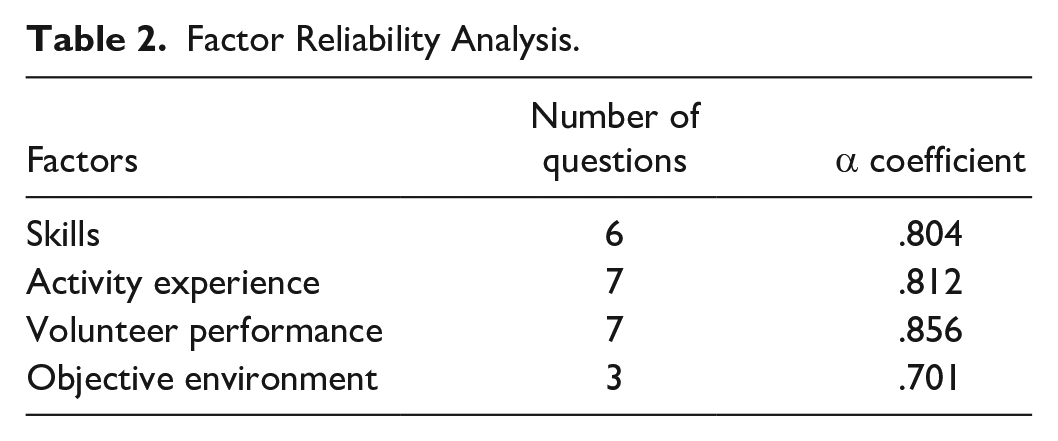
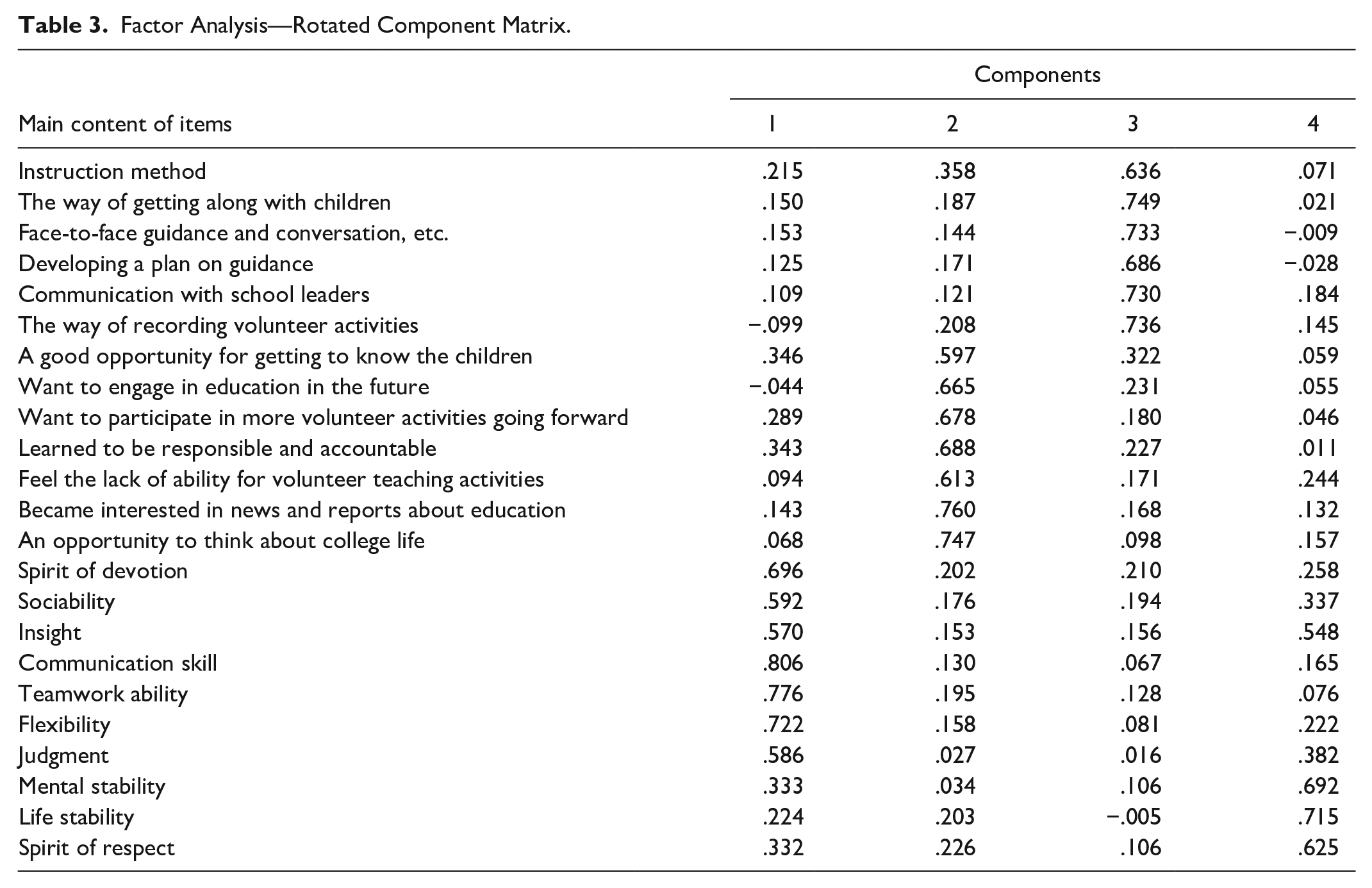
Table 3 shows the construct validity of factors. The questions correspond well to the factors. The loading coefficients of all items are higher than .4, and the highest and lowest coefficient values are, respectively, .570 and .806. The questions can effectively express the factor information, indicating a good overall validity.
Factor Analysis—Rotated Component Matrix.
There was also a further analysis of the influence of the four factors on college students’ willingness to participate in volunteer teaching activities. According to the results of relevant analysis, skills, activity experience, and volunteer performance are significantly correlated with the willingness. The Bivariate Logistic Regression Analysis showed the influence of these three factors on the willingness. As shown in Table 4, the p value of activity experience is less than .05, indicating that activity experience has the greatest influence.
Correlation Analysis—Variables in Equation.

The factor of activity experience includes seven questions, covering the feelings in four aspects, namely, children, education, self-growth, and occupational planning. The survey results proved that volunteers would be more willing to take part in volunteer teaching if they could have more profound and richer activity experience. The interviews also concluded the same result. When being asked about “the most unforgettable experience,” the volunteers interviewed all mentioned children’s growth, harmonious interpersonal relationship, and thinking of life and future and unexpectedly gave cold shoulder to work skills and material rewards. In this connection, apart from providing basic material guarantee, the organizers need to attach more importance to strengthening the communication with the parties supported to reach a consensus on enhancing the volunteers’ activity experience, and trying the best to enable volunteers to gain richer and more profound experience from their interactions with the assistance receiving parties.
Discussion
The mixed-methods study revealed that volunteer teaching activities of college students are facing a range of challenges: motivation ambiguity, confused identity, unspecialized service, weak incentive mechanism, and a lack of supervision mechanism. In addition, college students’ willingness to participate was under the influence of their skills, activity experience, and volunteer performance. Informed by the findings, this study puts forward some tentative strategies, including consciousness training, systematism cultivation, concept guidance and incentive and supervision mechanism, to help more developing countries formulate a good policy for promoting the development of youth volunteer teaching activities on the basis of local reality.
Cultivating Volunteering Awareness of the Young Groups
The results show that there is motivation ambiguity among college student volunteers, and the previous studies have also paid attention to the problem of the ambiguous motivation of college student volunteers and the nonrecognition of volunteer activities, and then put forward a series of strategies to foster college students’ volunteering awareness (Zhang & Su, 2017). However, from the perspective of psychology and physiology, college students have entered the adult stage, their world view and value have been formed, which means it may be not effective to implement ideological education during the tertiary education. Therefore, the cultivation of youth volunteering awareness should seize the golden period of ideological education. The Chinese government has realized the importance of fostering youth volunteering awareness, and continuously introduced the regulations on youth volunteer activities, which are “Interim measures for the administration of student volunteer service” and “On strengthening the implementation of secondary school volunteer service.” However, those regulations are based on their own management scope and need, while lacking integration and coordination across regions and nations (Xia, 2018). In terms of national plans on encouraging volunteer activities, programs for college students are more substantial, while programs for adolescents are insufficient. With the limitation of “regulations” and without the incentive of “programs,” this implicit suppression management strategy has led Chinese youth volunteer activities to a tepid state. School education is the main way to foster youth volunteering awareness. In the volunteer culture transmission, it is necessary to avoid heavy flag set of volunteer activities, to encourage every teenager spontaneously to participate in volunteer activities. Salvaging a stray dog is more powerful than many litter picking up activities. The behavior only from one’s bottom of heart can foster teenagers to identify volunteering activities. On the other hand, parents’ roles in family education are also very important because a benevolent family can raise a warm-hearted child.
Vigorously Establishing a Range of Organizations for College Student Volunteers
It can be seen from this survey that the modes of participating in volunteer teaching activities have become increasingly diversified. The societies initiated by college students are a new important force, but they cannot be compared with official organizations in both number and size. In addition, the lack of public recognition has made it more difficult for the organizations of college student volunteers to obtain social funds and public supports. The general public takes college students as immature and believes that their volunteer activities are aimed at self-training and social experience and doesn’t look at college student volunteer activities at the height of serving the community. In this connection, organizations of college student volunteers are confined to the lack of funds and are unable to exist for long (Wei, 2013). However from the interviews with the faculty and management of universities, we learned that most college students are extremely enthusiastic about volunteer activities and many college volunteer associations have 300 to 400 members in total. Colleges and universities can actively create a relaxing growth environment for organizations of college student volunteers, encourage them to organize and explore challenging, meaningful and innovative volunteer service projects, and provide a broad platform for aspiring young people to engage in this endeavor through establishing foundations, association incubation bases, and the introduction of mature NPO or NGO resources.
Building a Cultural Atmosphere Full of Care for Volunteers
Culture is a strong power that can change human social behaviors. In a society where volunteer culture has become a universal value and everyone is a volunteer and a recipient, there will be no confusion of role identity (Rehberg, 2005). For a long time, volunteering in China has long been guided by the “Lei Feng Spirit,” which prompts selfless dedication to others (Mu et al., 2012). Although many role models have emerged, a lot of ordinary people with fraternity and compassion have become to feel unreachable. The purely altruistic “Lei Feng Spirit” is the highest direction of volunteerism, but volunteerism rejects neither acting altruistically for self-interest nor benefiting from acting for others’ interest. The stage from acting altruistically for self-interest to benefiting from acting for others’ interest and to the highest level of being purely altruistic is essential in fostering the spirit of individual volunteerism. Modern volunteerism advocates spontaneous participation, free choice, and independent decision-making in volunteer activities. So, while promoting volunteerism, introspective enlightenment, experience and edification could lead college students to truly participate in volunteer activities and gradually have a clear-cut participation motivation compared with exogenous calling and even the inclusion of volunteer activities into the assessment system. As thus, college students need to be encouraged to start from trivial matters around them, from their own characteristics, and from practical projects and social problems to gradually build a cultural atmosphere full of universal care for volunteers.
Constructing Diversified Incentive and Supervision Mechanism
The premise of motivation is to understand the motives. Motives may vary due to different natural conditions and behavioral stages of different performers (Omoto & Snyder, 1995). College students are a large population and the modes of their participation in volunteer activities are diversified. Volunteers taking part in government programs can easily get motivated whereas those in nongovernment programs are always marginalized. Therefore, the motivation methods need to be diversified, multilevel, and targeted. Also, the motivation subjects need to be diversified. For example, the government may provide policy, material, and spiritual incentives, the general public and the media may give incentives through public opinions, and assistance receiving parties may actively assist volunteers in their works, which is an indirect motivation. These motivations could enable the volunteers to give full play to their abilities, thus gaining an activity experience fruitfully and participating in volunteer activities continuously. Edward E. Lawler in his seminal work titled Motivation in Work Organization argued that no method is perfect, there are something wrong in some parts, and all methods only pay attention to motivating workers with one strategy but neglect the fact that there is no “one-size-fits-all” method (Lawler, 2011, p. 235). Therefore, research on motivation needs to not only consider universality but also create the particularity suitable for each volunteer. The key of supervision is fairness and justice. The right of supervision should not be controlled by any party involved in the activity. Therefore, the introduction of a third-party industry supervision mechanism is a path that can be tried. Supervision and motivation are two rounding curves with the same purpose, so effective supervision is an effective way of increasing motivation.
Conclusion
This empirical study focused on Chinese college students and used a mixed-methods approach to investigate the situation of volunteer teaching. It was found that motivation ambiguity, confused identity, unspecialized service, weak incentive mechanism, and a lack of supervision mechanism were the barriers to the development of the volunteer teaching activities. The development of a good behavior is inseparable from the intervention of his early life (Vargas, 2000). Therefore, it is of great importance to pay attention to the cultivation of voluntary consciousness in adolescence. Volunteer activity is somehow embedded in collective action (McAdam, 1989) and is a kind of productive activity (Herzog et al., 1989). Thus, the long-term volunteer activity has to rely on organizational activity, and to increase the level of specialization mostly relies on the development of college volunteer organizations. From the perspective of cultural capital theory, cultural atmosphere will affect the spread of voluntary spirit, and thus affect people’s attitude toward volunteer activities (Wilson & Janoski, 1995). Therefore, building a cultural atmosphere full of universal care for volunteers can reduce the psychological burden of participants, and encourage more and more young people to participate in volunteer activities. During the process, both appropriate incentives and supervision are essential. Also, sufficient guarantee for volunteers and considerate concern for recipients is important (Reijnders et al., 2018). Thus, constructing a diversified and multilayered incentive mechanism and introducing a third-party supervision mechanism are worthy of being tried to solve the problems of weak incentive and supervision mechanisms.
The data for other developing countries would be expected in future studies in this lens, which is not an easy task depending on international cooperation. Due to the different national conditions, varying results may be expected. However, one thing is for sure, in any country, college students are the elite of the youth. If the college students are passionate about educational public-service activities, it will lead all the other teenagers to participate in those activities, so as to effectively improve the allocation of educational resources. However, college students have encountered many difficulties in the process of participating in volunteer teaching activities. To solve these problems requires governmental support on policy as well as more trust and encouragement from the public. Besides, it is essential to improve professional skills of college students to carry out volunteer teaching activities more effectively and sustainably.
Footnotes
Appendix
Author Contributions
Liu Lili prepared the original draft while Cui Yingjin did the final review and editing.
Declaration of Conflicting Interests
The author(s) declared no potential conflicts of interest with respect to the research, authorship, and/or publication of this article.
Funding
The author(s) disclosed receipt of the following financial support for the research, authorship, and/or publication of this article: This research was supported by Philosophy and Social Science Program of Heilongjiang Province (Grant No. 17EDE314) and Teaching Reform in Higher Education Program of Heilongjiang Province (Grant No. SJGY20180225).
