




Abstract
Historically, the influx of people with different cultural and linguistic backgrounds (e.g., Onitsha, Hausa, Yoruba, and Idoma) in Nigeria to Obollo from 1970s onward led to language contact and its consequences on an unprecedented scale. The influx of people needs sociolinguistic awareness as they develop a complex mosaic of multiple communicative competences. In addition, the mass movement of people associated with globalization, business transactions, high rate of mobility of people, and their linguistic repertoire entails new sociolinguistic configuration of a type not previously experienced. This study therefore explores linguistic borrowing and translanguaging in the superdiverse Obollo region using translanguaging and linguistic borrowing theory. Data from Obollo through semi-unstructured oral interview and participial observation were analyzed descriptively. The article identifies core and cultural borrowing, code-meshing, and translanguaging. The study contributes to translanguaging and linguistic borrowing literature and provides relevant information for education and research into contemporary language use in multilingual contexts.
Keywords
Introduction
The increase of peoples’ mobility informed largely by globalization, migrations, and language contact, currently indicate social, linguistic diversity, and flexible use of linguistic resources by emergent bilinguals of a sort that needs special attention in Obollo Southeastern region of Nigeria. Beyond that, the language interactions associated with such contact situation, and the fact that sociolinguists have always been leaders in advocating for the legitimacy of all language practices, new theoretical approach needs to be deployed. Translanguaging (TL), an emerging theory that captures the linguistic practices of bilingual speakers in contact and urban regions, has hardly been investigated in many African countries, especially Nigeria. Although the historical trajectory of TL goes back to 2009, its study in linguistic diverse Obollo region remains a marginalized view. Beyond that, studying TL alongside linguistic borrowing which are natural and complimentary phenomena that occur in multilingual and contact regions has eluded earlier researchers especially in this part of the globe—Obollo speech community (SC).
Among the three major languages in Nigeria, Igbo spoken in southeastern part of the country is one of them. In Nigeria, about 140 million people speak an estimate of about 527 languages in 2009 (cf. ethnologue 16th edition). English is the official while Hausa, Igbo, and Yoruba are the major national languages plus over 390 other state and minor languages (Agbedo, 2011). Blench (1998) observes that Nigerian languages belong to African language families (Afro-asiatic, Nilo-Saharan, and Niger-Congo). Niger-Congo continues Blench includes Igbo language, Yoruba, Igala, Edo, Idoma, and Nupe. He observes that Hausa language, a (group of West Chadic) subgroup of Afro-asiatic, is spoken by 18.5 million people in Nigeria. He further contends that Hausa is the most widely spoken language in West Africa as well as Nigeria. For him, the language seems to be the most common language in Nigeria and is also used as a trade language. The assertion above probably account for the reason why Hausa people and their language are being spread in Obollo SC as we shall show in this current study.
Obollo forms the meeting point of people from different cultures and linguistic backgrounds in Nigeria (Hausa, Igbo, and Yoruba) before and after the Nigerian Biafra war in 1967. Beyond that, Idoma and people from other subcultures in Igboland such as Onitsha, and Owerri are also in contact with the indigenous community in the study area. Obollo, Onitsha, and Owerri are all varieties/dialects of the Igbo language but some of their linguistic items are not mutually intelligible (Ugwuona, 2018). Onitsha and Owerri are often believed to have more affiliation to the standard Igbo due to their earliest contact with the Europeans (historical antecedents), education, economic, and sociopolitical power than other dialect (about 40) groups of the Igbo language, hence perceived to be the prestigious varieties of the Igbo language (Ugwuona, 2007). It is a common assumption that one of the basic features of a standard variety is mutual intelligibility which transcends all regional, social, and generational boundaries of the given SC. In contrast, Agbedo (2011) observes, This is hardly the case with the so-called standard Igbo as other Igbo dialects which were not part of the Union Igbo contraption are hardly mutually intelligible. Speakers of these other non-standard varieties of Igbo learn to speak the standard variety only in formal settings as students of educational institutions where Igbo is taught as a subject. It could equally be acquired through interactions during language contact institutions in urban areas of Igboland by those whose economic activities take them outside their immediate speech community. For the illiterate and those whose daily routine revolves around their local milieu, the standard Igbo equated to an entirely different oyibo (English) Igbo. (p. 148)
In line with the above assertion, Obollo, Onitsha, and Owerri are all dialects/varieties of Igbo language but there are some Obollo Igbo linguistic terms that are not mutually intelligible with Onitsha and Owerri Igbo even as they are in contact in Obollo. Consequently, borrowings and TL are prevalent in the SC, and this type of language use in a multicultural and linguistic diverse situation has eluded earlier researchers (e.g., Emenanjo, 2010; Illoene, 2010; Mbah & Mbah, 2014; Nwadike, 2009; Nwaozuzu, 2008; Ugwuona, 2017, 2018) in many instances of Igbo language studies. Beyond that, to the best of our knowledge, many lexical items within this SC are controversial with respect to whether they are indigenous or not, and no evidence and elaborate data are given for this prejudiced assumptions. Beyond that, although many fascinating research about TL in and outside African countries (e.g., Velasco & García, 2014), such studies have hardly been developed in Nigerian society, hence, another important need for this study. In that regard, we are to investigate the cultural versus core borrowings alongside TL of bilingual speakers in Obollo SC using linguistic borrowing and TL theories and the effects it has created on the linguistic repertoire of bilinguals. The study contributes to the emerging literature on sociolinguistics, facilitates teaching and learning, and serves as a guide to language planning and policies both in Nigeria and beyond.
Literature Review
In this section, we review some of the related and relevant literatures to this study. The section is divided into three such as theoretical studies, empirical studies, and theoretical framework.
Theoretical Studies
Linguistic borrowing involves speakers importing features from other languages into their native languages (Appel & Muysken, 1987; Holmes, 2008; Labov, 1994, 2001; Thomason & Kaufman, 1988; Ugwuona, 2013, 2017, 2018; Wardhaugh, 2006). For them, there is no language that has not borrowed words from some other languages, just as there is no culture that has developed entirely from scratch. In other words, linguistic borrowing refers to taking some features from another language into one’s inherent language. Hoffer (2005) observes that the most obvious and noticeable consequences of cultural exchange and interaction are the arrays of loanwords introduced into the lexis of both languages. In consequence, in a multicultural or multilingual SC, linguistic borrowing occurs, and bilinguals copy linguistic other linguistic elements or variety to their indigenous language. Terms or lexis that goes into a language as a consequence of borrowing is referred to as loanword or lexical borrowing (Haspelmath, 2003). In this, loanword and lexical borrowing are synonymous. Myers-cotton (2002) asserts that “cultural borrowing and core borrowings have different origins” (p. 239). She observes further that when influential groups use words for new objects such as espresso or words for new concepts such as zeitgeist, cultural borrowings occur. Alternatively, core borrowing takes place if words borrowed from other languages duplicate the already existing ones. OK in German borrowed due to cultural pressure, and which duplicates gut or einverstanden that German already has is a good example of core borrowing. In consequence, loanwords can be in form of cultural or core borrowing, and such can take place through code-switching by bilinguals. In other words, code-switching is a viable ground for cultural or core borrowing. Beyond that, another day-to-day language practices of bilinguals in multilingual speech community (MSC), and their malleable use of their linguistic features to make meaning of their lives is referred to TL (García, 2009). In this, TL transcends the usual ideas of bilingualism. At this juncture, it seems pertinent to examine TL as a new concept in the study of bilinguals in multilingual situations. The charting of TL and its various expressions are relatively recent in the history of linguistics. TL as a concept does not have a particular and generally accepted definition. For instance, these scholars—García (2009), Creese and Blackledge (2010), Baker (2011), Jørgensen (2010), Otsuji and Pennycook (2010), and Velasco and García (2014)—have defined TL rather differently. The assertion that TL is the flexible and meaningful actions through which speakers select features in their linguistic repertoire in a bilingual setting to communicate properly is currently associated largely with the linguist García (2009). García and Wei (2014) assert that the term translanguaging comes from the Welsh trawsieithu and was invented by Cen Williams in 1994. Before TL, another term has been used. It is important to note that TL in its original form is referred to as pedagogical practice by García and Wei (2014) where students are asked to alternate languages for the purposes of receptive or productive use. Translingual practice, as noted by prominent scholars (such as Canagarajah, 2013a; García, 2009; García & Wei, 2014), conceives of language resources as always mobile and in contact, generating new grammars and meanings. Baker (2011) gives example of such pedagogical practice as when students are asked to read in English and write in Welsh and vice versa (see García & Wei, 2014). Heller (1999) and Cummins (2006) reserve the term multilingual to an orientation to labeled languages as separate, and maintaining their autonomy, even in situations of contact. However, TL does not view the languages of bilinguals as separate linguistic systems; rather, it stresses the flexible and significant activities through which individuals choose features in their linguistic repertoire to enable him or her to communicate suitably in a multilingual situation, rather than viewing the languages of bilinguals as a separate linguistics systems. TL (Velasco & García, 2014) is an important day-to-day language behavior of bilinguals in multilingual and contact situations, and it seems to be one of the most significant consequences of language contact in the contemporary urban areas. Significantly, Obollo SC, a multilingual urban area in Nigeria, is not an exception. In consequence, TL has emerged as a term that relates to the interrelationship between language practices of bilinguals. Simpson (2016) refers to TL as superdiverse practice paradigm for describing much contemporary multilingual interaction. For García and Wei (2014), TL goes beyond the concept of the two languages of additive bilingualism or interdependence. The forgoing align to García (2011) that TL is performed by bilinguals accessing different linguistic features or various modes of what are described as independent languages to maximize communicative potentials.
At this juncture, it seems pertinent to distinguish between TL and code-switching. Yip and García (2016) advise that it is important not to confuse TL with the simple shifting of named languages, what linguists call code-switching. García (2009) and García and Wei (2014) as cited by Yip and García (2016) define TL as the internal viewpoint that sees the language performances of bilingual children not simply as being in named languages such as English, Spanish, Chinese, and others, but as leveraging their full language repertoire. In this, TL refers to the internal viewpoint of what speakers do with language that is simply their own. Code-switching, on the contrary, can well be referred to code alternation (e.g., Migge & Léglise, 2013). When bilinguals use two or more languages in the same exchange, code-switching occurs (Appel & Muysken, 1987). In code alternation and/or code-switching, speakers make use of elements from more than one variety or language in the same interaction, during the same turn at talk and/or across different turns (Migge & Léglise, 2013). Code-switching or code-mixing as in the words of Milroy and Muysken (1995) refers to the alternative use of two or more languages or varieties in the same discussion. On the contrary, TL can well be referred to poly-languaging as in the words of Canagarajah (2011). Canagarajah explains that the use of structures from many languages in the same construction denotes TL. In this, the practice may be frequent or normal particularly in group communication even if the speakers have little knowledge about the numerous languages involved. Today’s population increasingly needs TL consciousness as they compound many multilingual and multicultural communicative competences and repertoire. Verschueren et al (2001) also draw attention to the fact that TL is the complex forms of spoken and written code-mixing, and which emphasizes mobility, flexibility, and instability in most of its outcomes.
Empirical Studies
Simpson (2016) observes that the study of TL and superdiversity is important as, in some regions, the multilingualism associated with globalization is often seen as a problem. The situation mentioned above is prevalent in Nigeria hence, another important need for this study. Because a working knowledge of English is required in United States, United Kingdom, and many other developed countries of the world, many fields, professionals, education departments throughout the globe mandate the teaching of English to at least a basic level in the attempt to increase the competitiveness of their economy. Contrastively, it is held here that the various grammar and linguistic competence at an intralinguistic level which are held to be the prime concern of speakers communicative competence cannot be accounted for properly without reference to extralinguistic contexts (social, regional, contact, multicultural, multilingual) in which these phenomena are situated. Similarly, Choudhary (2019) observes that language is plainly a social phenomenon; if society does not exist, there would be no language and it follows from this that an asocial approach to its study has a comparatively limited interest. Earlier researchers (Creese & Blackledge, 2010) relate TL as activities that take place mainly in classrooms, where children read a text in one language and discuss it in another. I agree with Canagarajah (2013) that today’s population increasingly needs translingual awareness not only in classrooms but also in communication competence (outside classrooms) in other social contexts. These insights provide more justification for the exploration of TL and linguistic borrowing in the Contact region of Obollo Southeastern Nigeria. In their example of practical TL, Yip and García (2016) use García’s speech at home to illustrate how it works. For instance, they reveal that Ofelia speaks Spanish to her grandchildren at home: la comida, the son-in-law, la hija, dormirse, have breakfast, and so on. Yip and García clarify that those words are not just words from Spanish and English, rather they are her words as well as her repertoire to make sense. In consequence, Ofelia is aware of when to use each term to speak to various people. They note also that she speaks to her son-in-law in words that some would call Spanish but uses her full repertoire when talking to her mother-in-law as no one is checking or ranking her language performs. Cummins (2006) expresses that developing bilinguals often produce better written texts if they are allowed to share their past and present challenges, encounters, experiences, and linguistic choices. He demonstrates that if children are permitted to apply all multimodalities such as spoken, written, musical, visual and dramatic activities, they will be better equipped in written texts.
Velasco and García (2014) find that a kindergartener, who was asked to produce some drawing written text in Korean with some English words such as start, bonus, hit here, and finish, went ahead extending and producing them using the full semiotic repertoire he has at his disposal in the drawing, as well as his English words. They observe that the writing sample illustrates that this bilingual child understands the purpose of planning.
In his study of speech Patterns of Obollo-Orie Lect of Igbo, Ndiribe (2014) identifies three variation patterns among the indigenous speakers of Obollo such as phonological variation seen in replacement of the voiceless fricative /h/ in aho market day to voiceless labiodental fricative /f/ in àfò; lexica variation seen in ụgọdụ to nkita dog; and syntactic variation as can be observed in: Bia mbe to Bia ebe a come here. He observes that the contact among the indigenous speakers and others from different linguistic groups in the area informs the variations. Ndiribe’s study is very peripheral in terms of borrowing and TL as it did not consider borrowing items from others culture such as Hausa, Yoruba, and Idoma in the area.
Theoretical Framework
As mentioned earlier, the theoretical framework for this study is linguistic borrowing and TL framework. Canagarajah (2011) perceives TL as the overall communicative competence of multilinguals especially in informal contexts, and code-meshing for TL in texts. Canagarajah believes that code-meshing differs from code-switching, as it goes beyond mixing language and varieties of languages. Continuing, he notes that in code-meshing, all speeches are actively integrated into coherent sociolinguistic contexts. In other words, TL should be regarded as a naturally occurring phenomenon among multilingual, particularly in contact and multicultural contexts. TL theory will also expose and help in understanding of divergent practices in the use of language. It assists also in understanding the need for multiple language use and the realities of multicultural and MSC. The choice of TL alongside linguistic borrowing theory in this study is germane as the theories to a large extent will explain the day-to-day language behavior of multilingual speakers in the contemporary Obollo multicultural SC. The theories are highly effective, explorative, and inferential in intent. They can handle the communicative events prevalent in the area under study.
Research Methodology
This section discusses the method applied in this research work as follows:
The Area of Study
The area of study is linguistic borrowing and TL. Specifically, the study focuses on the cultural and core borrowing in Obollo multicultural SC of Igboland using the cultural and core borrowing theory as enunciated by Appel and Muysken (1987) and Myers-Scotton (1992), and García’s TL, respectively.
Research Design
In this study, we employed unstructured oral interview, elicitation of information through interactive techniques, and analysis of the observed ways speakers borrow and use language in its social context, and in their day-to-day interaction.
The Study Population
The study population comprises the six linguistic groups (Awka, Hausa, Idoma, Obollo, Onitsha, and Yoruba) that are in contact in Obollo multicultural SC. The subjects for the study comprise people between the ages of 18 and 65 years. Ten persons were purposively picked from each of the six linguistic groups in the area making a total of sixty respondents, male and female on equal numbers. They largely comprised business and civil servants.
Sampling Techniques
We employed simple random technique as it enables one to draw a genuine sample population, which must be thoroughly representative of all parts of the population and completely unbiased. Wardhaugh (2006) also believes that “all parts of the population of a research population must be adequately represented, and no part or cluster should be overrepresented or underrepresented to avoid creating bias of some kind” (p. 155).
Method of Data Collection
The data for this study are collected through the use of unstructured oral interviews (on the consent of the respondents), participial observations, surreptitious recordings, and library work. For a more stringent data and authentic result, we collected our data mainly from the urban area of the SC: New-Road, Main market, and the church. These are the major context/area populated with people from different language (Hausa, Igbo, Idoma, and Yoruba) background, and linguistic borrowing and TL largely take place in the area. Data collected were analyzed using linguistic borrowing and TL model of analysis. We employed three research assistants, each being very conversant with each of the languages of the three different cultural groups (Hausa, Yoruba, and Idoma) in the area. We interviewed and recorded them at different intervals of 1 month for the period of 1 year in their various business centers in New-Road and main market areas where business people can easily be found in large numbers. In all the interviews and recordings, we tried as much as possible to avoid noisy environment for clear and accurate recordings. As indigenous speaker residing close to the SC, we observed business transactions of multilingual speakers at regular interval in the urban area, and we participated also in several occasions such as marriages, church services, weddings, naming, and funeral ceremonies that involve people from the different linguistic group under study. At such gatherings, we gathered handful of data from their speech patterns (male and female on equal basis). Some complex data were transcribed using IPA (SIL IPA93Manuscript Font) convention for easy understanding.
Linguistic Borrowing and TL in Multicultural Obollo SC
This section investigates cultural and core borrowing, and TL in the urban area of the SC.
Cultural Borrowing in the Urban Area: Religion Terminologies
As said earlier, the indigenous community is in contact with people from other linguistic and cultural backgrounds, and as expected, words for new concepts usually appear sharply especially when prominent groups use them. Different religious terms have entered the SC through the contacts. For instance, the following religious terms have been borrowed by the indigenous speakers of Obollo from Onitsha linguistic group: Jeso Kristi (Jesus Christ), Odozi-Obodo (a type of religious sect), Mụọma (good spirit), alleluia, church, Olumba Olumba, chosen (Christian denomination), akanchawa (progressiveness), Fada (catholic Priest), Pope, Bishop, Angel, monk, mass, Saint, Savior, and so on.
The following cultural borrowings (religious terms) have entered the SC from Hausa linguistic group: Allah (God), Mohamed (founder of Islam), Edelfitri, saraka (thanksgiving), Alakwuba, Ajiia, Mecca, Koran (Quran), budah and Salla (Islam feasts), Boko haram, and so on. In the examples above, the terms in italics are the borrowed/loanwords, while the ones in bracket are the gloss. The linguistic items are prevalent in the area and have formed the speech pattern of the indigenous SC.
TL in the Cultural Religious Borrowed Terms in the Urban Area
As mentioned earlier, TL relates to self-regulation of bilingual speakers linguistic repertoire; how speakers manage their language in relation to their cultural background, situations (people involved in the interaction), and goals of interaction in a multilingual situations. In that regard, we observed that the indigenous speakers of Obollo variety of the Igbo language use those terms in their inherent variety while interacting with their co-indigenous Obollo speakers in the Urban area such as Jeso (Jesus Christ), ọganifu (progressiveness), atama ma (Fada), ụka (mass), onye nzọfụta (Savior), ɛʹmma ma (good spirit), Ezechitokeabiama (God).
Code-Meshing/TL in the Church
In another instance, we observed an Obollo indigenous Catholic Priest employing different linguistics repertoire/language resources (from Onitsha, Obollo, English, Hausa, and Yoruba languages) while celebrating a mass in the urban church comprising people from Obollo, Onitsha, Owerri, and some travelers from various parts of the country in the study area. In the beginning of service, the Priest employed Onitsha variety thus: N’afa Nna, na Nwa, na Mụọ nsọ (In the name of the Father, and of the Son and of the Holy spirit). He follows it up by introducing the day’s celebration in Obollo variety thus: ụka nke nta bụ nke ɛtọ n’ime afa nkịtị nke ụka (Today’s Sunday is the third one in ordinary time of the church). During preaching, the priest severally uses English language: Praise be to Jesus, Praise the Lord, Our God is good . . ., and all the time . . . and so on. He also translanguages/code-meshes to Onitsha and Obollo Igbo, Hausa, and English language thus:
Kedu ndə na- asə na Buhari amagə achị? (Who is saying that Buhari is a bad leader?) In the sentence (i) above, Kedu is Onitsha variety, while ndə na- asə nɛ Buhari amagə achị? Is in Obollo varity.
But let me ask you again, Abi ki naji Hausa kedenkede? (But let me ask you. Well do you hear a little bit of Hausa?) In the construction (ii) above, But let me ask you again, is English language; Abi ki naji Hausa kedenkede? is Hausa language;
Ọ bụ Bụhari onye Mualim sərə unu asụchalɛ ɛshụshụa dəcha n’egbere ulọ ụka? (Is it Buhari, a Muslim that told you not to clear the grasses around this church?).
The priest received answers that reflected understanding by the congregation, for example, mba, Buhari did not tell us so. In the sentence (iii) above, Buhari and Muslin are Hausa terms while the rest are Obollo Igbo terms.
Our people are lavishing their resources unnecessarily during burial ceremonies; ebe a na-akwa akwa ashebi, agbada, na- ego nama maka suya. (Our people are lavishing their resources unnecessarily during burial ceremonies making ashebi and agbada clothes and buying cows for suya.) In the sentence (v) above, the first part is in English language, ebe a na-akwa akwa, na-ego, maka are in Onitsha Igbo, ashebi, agbada are Yoruba terms, while nama, suya are Hausa terms.
The priest also code-meshes in Latin language during the consecration and blessing of the Holy Communion. The TL contributes in making people from different linguistic and cultural backgrounds in the church put on joyful and smiling faces. The priest actually engages in his bilingual repertoire at his disposal and the bilingual congregations appreciate his speeches. These points to the fact that the priest understands his purpose of preaching and so on.
Cultural Borrowing: Culinary and Technological Terms
Obollo, the indigenous community seems to lack some expressions for new objects not only for food but also in the area of modern scientific, technological, and innovative terms or concepts that are not indigenous to the SC. Onitsha, Owerri, Hausa, and Yoruba linguistic groups provided several food terms as we can observe from the following structures of the indigenous speakers:
(1) i. Nkechi sərə ohoyi ọkazị
ii. /Nkeʧi sərə oɦojɪ ɔkαzɪ/
iii. Nkechi siri ofe ọkazị
iv. /Nkeʧi sɪrɪ ofe ɔkαzɪ/
vii (Nkechi cooked ọkazi soup)
In sentence i. above, Nkechi sərə ohoyi is Obollo
(2) i. Anyi tàrə àbacha
ii. /α’ɲɪ́ tα’rə’ α’bα’ʧα’/
iii. Anyi tàra àbacha.
iv. /α’ɲɪ́ tα’rá α’bα’ʧα’/
v. (We ate tapioca.)
(3) i. Íjè gòtèrə̀ yàbas
ii. /ɪʤe gòtèrə̀ jα’bάsɪ’/
iii. Ije zụtara yabasị
iv. /ɪʤe zʊtɑrɑ jàbásɪ’/
v. (Ije bought onions)
(4) i. Ọ’ ṅə’rə’ bùrùkù
ii. /ɔ ŋərə bùrùkùtù/
iii. Ọ ṅụrụ bùrùkùtù
iv. /ɔ ŋʊrʊ bùrùkùtù/
v. (He or she drank burukutu)
(5) i. Ọ tàrə’ gworò.
/ii. ɔ tarə gworo/
iii. Ọ tàrà gworò
/iv. ɔ tara gworo/
v. (He or she ate gworò)
(6) i. Adə m n’àshèbi ye.
ii. /ɔ də m n’àʃèbi je/
iii. E so m n’àshèbi ya
/iv. E so m n’àʃèbi ja/
v. (I am among her committee of friends).
(7) i. Eberè sərə mọị mọị nẹ ẹba.
iiii. /eberè sərə mɔɪ mɔɪ/ nɛ ɛba.
iii. Ebere siri mọị mọị na ẹba.
iv. Ebere siri mɔɪ mɔɪ/ nɛ ɛba.
v. (Ebere cooked moi moi and ɛba).
(8) i. O jèrə n’itaneet
ii. /O ʤèrə nɪtanet/
ii. O jèrè n’itaneet
iv. /O ʤère nɪtanet/
v. (He or she went to the internet).
(9) i. Moto ye mébìrì.
ii. /Moto je mebìrì/
iii. Moto ya mebiri.
iv. /Moto jα mebìrì/
v. (His car spoilt)
In the examples above, the lexical items in italics are not Obollo Igbo indigenous expressions but they are expressions loaned through contact due to lexical gaps. For instance, ọkazị and abacha are borrowed from Owerri and Onitsha dialect speakers. Yabasi, gworo, and burukutu are loaned from Hausa, mọị mọị, ɛba, and ashebi are from Yoruba. Intaneet and moto are adopted through direct or indirect contact with the English language by the mobile youth, and spread to other parts of the SC. Other lexical items borrowed by Obollo indigenous speakers from English due largely to lexical gap and modernization are indomie, superghati, peper soup, and apple.
TL in the Cultural Borrowed Culinary and Technological Terms
In the urban area, speakers know how and when to use words or sentences to speak to people from different linguistic backgrounds. For instance, in the examples above, the indigenous Obollo speakers largely use the constructions under i. of each of the groups under nos. 1 to 9 (e.g., i. Nkechi sərə ohoyi ọkazị; i. Anyi tàrə àbacha etc) to speak to co-indigenous Obollo speakers, while they use that of no. iii of each of the groups under nos. 1 to 9, to speak to other linguistic groups, especially Owerri and Onitsha (e.g., iii. Nkechi siri ofe ọkazị; iii. Anyi tàra àbacha etc). Similarly, speakers of Owerri and Onitsha linguistic groups, especially, use the constructions under no. i of each of the group constructions from 1 to 9, to communicate with Obollo indigenous and that of nos. iii, to communicate with their co-indigenous Onitsha and Owerri speakers. They often use their full bilingual repertoire at their disposal because no one is monitoring their language practices. Furthermore, cases of TL or code-meshing between Obollo Igbo and Onitsha, among Owerri, Hausa, Yoruba, and English languages can be observed in the nine sentences.
Core Borrowing (Loanwords) in Urban Area
Speakers especially the youth we interviewed, respond largely to the wider society’s speech norms by using fewer vernacular norms and more of the perceived prestige forms. Examples of loanwords by Obollo indigenous youth from other linguistic group such as Yoruba include kpẹlẹ (darə) “well done,” agbada (àyàlà) “men’s occasion wear,” abi (that is it), o΄dō (ikwe) “morter.” ’Ọgọ’dọ’ (ẹ΄kwà) “type of cloth,” ákpụ (ókpòlógō) “casava,” ọ’pàpá (ọ΄kpámpā) “groundnut,” ị΄gbánkwụ΄ (ívūmányā) “traditional marriage ceremony,” fiọ’ fiọ’ (ẹ’gẹ’dẹ΄mgbə΄) “brand of beans,” nnu (íkérjíké) “salt,” iko΄ (ọba) “cup,” and m’pànáká (ọ’pànẹ΄ká) “local lamp” are taken from indigenous speakers of Onitsha linguistic group. Kanda (akpụkpọanə) “meat from skin of animal,” kwudi (égō) “money,” kwunu (ụmụmụ) “drink from cereal,” tuur (ọdọyị) “okey” are from Hausa. Inyàngá (àchị ’-′) “proud” is taken from Idoma. In the representative examples above, it can be observed that Obollo loaned four terms from Yoruba, seven terms from Onitsha, four from Hausa, and one from Idoma in that domain. Hence, the highest loanwords came from Onitsha, followed by Hausa, then Yoruba, and finally Idoma. The borrowings confirm with Myers-Scotton’s (2006) asserts that core borrowing is a loanword that has been adopted regardless of the fact that the term for the concept already exists in the recipient language or variety.
TL in Core Borrowed (Loanwords) Terms in the Urban Area
The bilingual indigenous Obollo youth we interviewed during marriage ceremonies use more of the indigenous Obollo terms in the bracket (darə, àyàlà, ikwe, ẹ΄kwà, ókpòlógō ọ́kpámpā, etc) largely to talk to their co-speakers from the indigenous SC as well as to other speakers who show interest in the language. They also use the perceived prestige forms such as the terms in bracket (kpẹlẹ, agbada, abi, ódo’, Ọgọ’dọ’, ákpụ, ọ’pàpá, etc) to communicate with speakers from other linguistic groups. People from other linguistic group often do similar things to their co-speakers of the same linguistic group and vice versa.
Core Borrowing (Structural Borrowing) in the Urban Area
The indigenous community, especially the upwardly mobile youth, in their bid to associate with the perceived prestige form and to adapt to the speech pattern of the different linguistic groups in the SC, borrow words that duplicate words in their inherent and indigenous language from these linguistic groups in the area. This is conspicuously demonstrated by their attitude toward the use of the speech pattern of the Onitsha, Owerri, Awka, Hausa, Idoma, and Yoruba groups. Instances of the Onitsha variety are nnọ (àla) “welcome,” ebe a (mbenà) “here/this place,” ihe a (ihe na) “this thing,” ihe ahụ (ihe nufu) “that thing,” kedu ya? (gede ye?), “Where is it?” nye m (nə m) “give me,” nọ’rọ àlà (tukwuru àlə) “sit down,” mgbèdè (ùru ὲnyàsə) “evening.” Chukwu (Ezechitokeabiama) “God,” Ajọ mụọ (έjọ mä) “evil spirit,” mmeme (ὲgbà) “festivity,” Ngọzi (ngọzə) “blessing,” àjà (ὲja) “sacrifice,” àbụmọnụ (ǹtọ́nọ́nụ̀) “curse,” n’aha nna (nέhà nna) “in the name of the father” and so on are adopted through cultural contact with Onitsha and Imo. Instances of Owerri variety include echi (echilë) “tomorrow,” ọkazị “type of vegetable.” Orikàịjkọ, “a type of soup,” ètu ole? (agaa) “how?” Examples from Hausa include: kànda (ákpə́kpọ́ ánə́) “skin of animal,” yaro ( έgaal) “young man,” yàyà (I də agaa?) how are you? Mallam (ọga) “master” ameria “young married woman.” These lexical terms in italics above are indigenous to Obollo while those not in italics were borrowed into the SC by the indigenous speakers especially the youth.
TL in the Core Borrowed Structures in the Urban Area
We observe that TL is common in the core borrowed terms in the urban area as bilinguals use their full linguistic repertoire (Onitsha, Owerri, Hausa, Yoruba, English, or Idoma language) at their disposal in their daily interaction in the area. In other words, bilinguals’ self-regulatory actions take them to TL. For instance, a young man bargaining with an Hausa man says: Mallam, nno, bia gote this goat maka na I ga-eji ya nweta ezigb kanda maka mmemme unu echi. Master welcome; come and buy this goat because it will give you good skin meat for your festival tomorrow. In the above repertoire by an indigenous Obollo Igbo speaker, Mallam is Hausa term, nno is Onitsha Igbo term; bia gote is Obollo Igbo term; this goat is English term; maka na I ga -eji ya nweta ezigbo . . . maka mmeme unu echi is Owerri term.
In the New-Road area of the study area, a number of hawkers, passengers, shopkeepers, hoteliers, and eateries from different linguistic background populate this area. Here, we observed how the use of TL strategies allows a bilingual hawker to sell her good to people from different linguistic background of Nigeria that populate a luxurious bus that had a stopover in the area. She code-meshes/translanguages in Onitsha Igbo, Obollo Igbo, Hausa, Yoruba, Idoma, and English language according to the buyer’s language of bargain.
Wanini me oroma wana? (Who is the owner of this orange?)
Nini me shi oroma. (Am the owner of the orange)
Nwanyị, nawa nawa? (Woman, how much?)
Deri biu ka a na-ere ya. (It is sold for two hundred naira)
Gashi kwudi, thank you (take money, thank you)
In the example above, the structures in italics are Hausa terms, whereas the rest are in Onitsha Igbo language. The buyer also code-meshes to English language and Hausa language in the last line thus: Buyer: Gashi kwudi, thank you (take money, thank you). She also uses Obollo variety, Idoma, Yoruba and English to narrate to an indigenous lady what has transpired in that business transaction thus: Janyi, onye Hausa a gorə m orome yi agbada yiri nke Ayagbo Idoko onye Idoma a ne-ere ọchanja n’ifə shed m. In the above construction, Janyi onye . . . a gorə m orome yi . . . yiri . . . onye . . . a ne-ere . . . n’ifu are Obollo Igbo terms; Hausa is Hausa term; agbada is a Yoruba term, Ayagbo Idoko . . . Idoma. . . ọchanja are Idoma terms, and shed is English term.
From the table, it can be observed that Obollo indigenous speakers borrowed the Linguistic Items 1 to 4 from Onitsha; 5 to 12 from Hausa; 13 to 17 from Yoruba; and 18 from Owerri linguistic groups. Hence, the borrowing is more from Hausa, followed by Yoruba, then Onitsha, and finally Owerri. We observed that both the youth and the old people borrowed the terms and use them as well.
In the table (1–3), the representative example shows the core borrowings (loanwords) that Obollo borrowed from Hausa, whereas the others (4–7) are from Onitsha linguistic group. The borrowed terms/new forms are not restricted to those in the urban area of the SC rather they have spread to the rural areas mainly by the youth.
Cultural Borrowing/Loanwords.

Source. Borrowed terms by Obollo indigenous speakers in different domains in the speech community.
Note. The representative items in the table are loanwords adopted by the Obollo indigenous speakers from Hausa, Onitsha, Yoruba, and Owerri cultural groups in the study area.
Core Borrowing (Loanword) in the Urban Area.
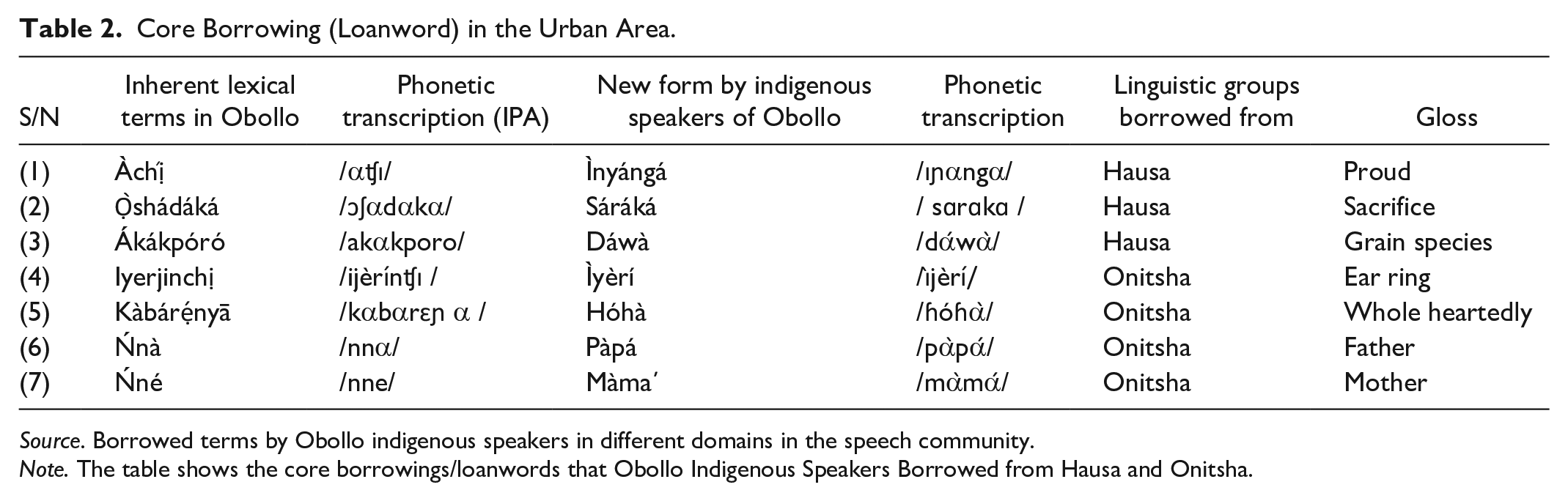
Source. Borrowed terms by Obollo indigenous speakers in different domains in the speech community.
Note. The table shows the core borrowings/loanwords that Obollo Indigenous Speakers Borrowed from Hausa and Onitsha.
Lexical Terms (Core Borrowing) That Yoruba Indigenous Speakers Have Borrowed From Obollo Indigenous Speakers in the Urban Area.

Source. Borrowed terms by Yoruba indigenous speakers in different domains in Obollo speech community.
In the table above, indigenous speakers of Yoruba have borrowed the items to duplicate the already existing ones from Obollo due largely to their long-term contact with the indigenous speakers of Obollo in the study area. Hence, the dense multiplex networks during business transactions mainly have created a number of linguistic influences.
Summary of Findings and Conclusion
This study has investigated the linguistic borrowing and TL phenomena in the multicultural Obollo SC in Southeastern Nigeria through data collected from speakers in the area. From the study, we observed that four cultures (Hausa, Igbo, Yoruba, and Idoma) and their different languages are in contact in the SC; hence, linguistic borrowing and TL become inevitable. We identified two major types of borrowing such as cultural borrowing and core borrowing. The items often borrowed include religious, food/culinary, and technological terms. Obollo indigenous speakers in the urban area borrow more from Hausa, Onitsha, than from Idoma. In the urban area, the indigenous speakers of Obollo borrow more from Hausa and Onitsha linguistic group than from the other linguistic groups, suggesting that Hausa is the perceived prestige language, whereas Onitsha is the perceived prestige variety of the Igbo language in the study area. The findings conform to Myers-Scotton (1992) and Appel and Muysken (1987) that cultural borrowings are concepts for new objects and they usually appear suddenly when prominent groups use them. Contrastively, core borrowings are words or concepts that more or less duplicate or replace the already existing words or concepts. The study also portrays the flexibility of bilinguals in the multilingual urban area in TL in different languages and varieties, a flexibility that has enabled them to engage in leveraging their full language repertoire. We discovered that TL often takes place in the Catholic Church by the catholic priests during ceremonies, and business transactions. The study conforms also to García’s (2009) assertion that TL is the utilization of speakers’ full linguistic varieties without regard for watchful adherence to the socially and politically defined boundaries of named languages. Linguistic borrowing and TL have been identified as the major consequences of the cultural contact in Obollo SC, and are fundamental to their identity. They serve also as the key element of socioeconomic and linguistic vibrant in the SC. Consequently, linguistic borrowing and TL should be regarded as normal and rewarding, especially when the borrowing is not abusive in multicultural and/or bilingual speech communities. We hope that this study will stimulate and motivate further studies on different dimensions of TL and linguistic borrowing in multicultural and urban areas of Nigeria, Africa, and beyond.
Footnotes
Declaration of Conflicting Interests
The author(s) declared no potential conflicts of interest with respect to the research, authorship, and/or publication of this article.
Funding
The author(s) received no financial support for the research, authorship, and/or publication of this article.
