



Abstract
The study aims to develop and validate an affordable and generalizable survey design tool to measure pre-service EFL teachers’ self-efficacy beliefs about cultural and linguistic diversity. It is significant as there are relatively low number of studies aiming to measure such beliefs in today’s changing demographic conditions which are beyond its limits especially in some countries due to the massive flow of migrants. Most of these studies are qualitative which are not cost-effective and flexible. In this study, exploratory sequential mixed method was conducted. Initially, qualitative research design was employed. Findings were used to develop a valid and reliable survey design tool in a second quantitative phase in which data was gathered quantitatively to reduce the number of the variables to a few values representing self-efficacy beliefs and determine the latent components in the scale. Final version of the scale included 20 items across five factors after Exploratory Factor Analysis through principal axis factoring and Confirmatory Factor Analysis through maximum likelihood analysis. Findings supported that a set of 20 items in the final scale form was statistically valid and reliable in measuring pre-service EFL teachers’ self-efficacy beliefs about teaching in culturally and linguistically diverse student groups.
Introduction
According to Andrews (1989), Turkiye is a home to at least 51 different ethnic groups. The country has also been experiencing an unprecedented flow of migrants from Syria, Afghanistan, and Iraq in recent years (İçduygu & Şimşek, 2016). Turkiye has always been a very popular destination for the immigrants throughout the history and again has been exposed to a massive flow of Syrian and Afghan refugees among many others from different countries nowadays due to several reasons in their own countries such as wars, civil wars, terrorism, poverty, safety issues and religious connections (Neccar, 2016). All these massive numbers of refugees represent the very new ingredients of the society in Turkiye with their own unique cultural and linguistic characteristics. Piller (2016) asserts that most of such people who speak different languages and have to learn the language of the mainstream community may experience oppression concerning their learning or not learning the new language which might completely be different from their own mother tongues. They may lose the opportunity of continuing to a higher education or finding a better job. Therefore, the price migrants and linguistically diverse people have to pay may also be the linguistic penalty on such occasions which may further result in conflicts inside the society and also the marginalization of such groups of people due to the daily compounded discrimination among the members of the mainstream community (Piller, 2016).
In Turkiye, several issues about the integration of internal or external migrant students into formal education system have been reported through various studies in recent years. Aydin and Kaya (2017) identified some serious problems which Syrian students experience in Turkish education system. The non-existence of a specific program to overcome the language barrier, low academic success, Syrian students’ state of depression and deficiencies in the curriculum were reported as the main difficulties. Baltaci (2017) compared the views of external migrant students from Turkiye and Germany on their career expectations and reported that the students in Turkiye do not intend to learn the language of the mainstream culture as they do not desire to stay in Turkiye permanently. According to similar studies, language issues, adaptation problems, intercultural issues related to diversity, and discrimination can be stated among the main problems migrant students encounter with in Turkiye (Çelik & İçduygu, 2018; Toker & Acar, 2018). All these results suggest that linguistic and cultural limitations foreign students encounter with during their journeys in Turkish education system require intense care. Obviously, the most urgent need of culturally and linguistically diverse students in Turkiye is creating a safe and caring school environment and a society in which they do not have to cope with language barriers, prejudice and oppression.
Developing appropriate attitudes and adopting a multicultural understanding in their classrooms can help teachers to become more effective facilitators of instruction (Banks, 2010; Deardorff, 2016), and achieve the integration of those students with diverse cultural and linguistic backgrounds into a more tolerant and fair society (Banks, 2010). Ethnic minority students may sometimes be negatively evaluated by their teachers due to their differences, as well (Glock, 2016). Such students from minority groups whose academic success rates are lower (Borgna & Contini, 2014; Haycock, 2001; Lee, 2002) may experience more disadvantages due to such biased teacher judgments, and low levels of self-efficacy beliefs for teaching culturally and linguistically diverse students (Bakari, 2003; Baldwin et al., 2007; Cabello & Burstein, 1995; Parks & Kennedy, 2007). On the other hand, the research results of Ponterotito et al. (1998) demonstrate that sensitiveness to the issues related to cultural diversity is linked to possessing positive perceptions and attitudes toward the differences students hold. Nonetheless, according to the research findings of Bandura (1997), people may be uneager to turn their knowledge and awareness into practice when they perceive that the results of their practices might end up with failures. In other words, teachers who self-report culturally responsive awareness and sensitivity may still resist to perform culturally responsive classroom practice. Teachers’ self-efficacy beliefs appear to have a direct impact on culturally diverse students’ performance and success rates according to several research findings (Ferguson, 2003; Gutentag et al., 2018; Jussim et al., 1996; Muller et al., 1999). Self-efficacy is regarded as one of the strongest incentives of behavior, because it is directly and robustly connected with the intention to carry out a duty, the extent to which efforts to perform that duty are going to be increased and the duration of perseverance in that duty (Gardner & Pierce, 1998). All these perspectives and evidence demonstrate that it is critical to adopt positive attitudes toward such differences, be knowledgeable about how to show care for them, and possess significantly higher levels of self-efficacy beliefs toward teaching students with culturally and linguistically diverse backgrounds to create an appropriate classroom atmosphere and society in which any difference is regarded as an inseparable element of the mainstream culture and the society. Because such beliefs are formed at the initial stages of a profession and it is hard to modify these beliefs when they are formed, it is suggested to realize the components which support and weaken them at the early stages of a service (Hoy & Spero, 2005).
Consequently, it is vital to explore whether pre-service EFL teachers feel adequate enough to teach culturally and linguistically diverse students. Some relatively limited number of studies on the self-efficacy beliefs of teachers and pre-service teachers toward cultural and linguistic diversity (CLD hereafter) exists; however, most of them are qualitative studies which were conducted with limited number of participants in limited contexts. Therefore, a cost-effective, flexible, valid and reliable scale tool to measure large number of EFL teachers’ self-efficacy beliefs about CLD which mainly refers to linguistic and cultural deviations from the mainstream language and culture (Chamberlain, 2005) and to support the studies in the field is required so that the responsibilities and chores teachers and pre-service teachers feel the least and the most efficacious can be identified. Accordingly, the main aim of this research is to develop a valid and reliable measurement tool to assess pre-service EFL teachers’ self-efficacy beliefs about teaching in culturally and linguistically diverse student groups. Cultural and Linguistic Diversity Self Efficacy Beliefs Scale (CLDSEBS) can provide practitioners with an encouraging, cost-effective and flexible tool, with implications for measuring EFL teachers’ self-efficacy beliefs for responsiveness to cultural and linguistic differences while creating opportunities to raise awareness toward promoting cultural and linguistic diversity at schools and universities. In order to create a comprehensive item pool several methods dealing with teaching culturally and linguistically diverse student groups were studied. Multicultural education, culturally responsive and relevant education, social justice education and opposingly colorblind approach are among the most frequently uttered approaches to successfully offer equal educational opportunities to culturally and linguistically diverse students.
Multicultural Education
Banks (2010) defines multicultural education as an idea which claims that all students should get involved in the equal educational experience at school, an educational reform movement which aims to change the school with all its fundamentals into an inclusive one by supporting educational impartiality and process which may never be entirely accomplished. It endeavors to serve inclusively by acknowledging and appreciating cultural differences and the contributions of these differences to the shared community (Verkuyten, 2006). Equal opportunity and equality for all students to learn and academically achieve is the central tenet in some other definitions too (Gay, 2005; Gollnick & Chinn, 1990).
Multicultural education is a very broad term. Banks (2010) has provided five dimensions of multicultural education as a guide for the educators to be used while trying to carry out multicultural education. These dimensions include content integration, the knowledge construction process, prejudice reduction, equity pedagogy, and an empowering school culture and social structure. By embracing these five dimensions as a school culture, perceptions and attitudes of teachers toward diverse cultural backgrounds, teaching strategies, procedures and materials in the classroom and school organization, and eventually the whole society are hoped to be re-organized and changed.
Culturally Relevant and Responsive Education
Other approaches which are generally linked to multicultural education are culturally responsive teaching (CRT) and culturally relevant pedagogy (CRP). When the literature is reviewed extensively, it is seen that both CRT and CRP are used interchangeably by many scholars (e.g., Bassey, 2016; M. R. Brown, 2007; Brown-Jeffy & Cooper, 2011; Y. Choi, 2013; Esposito & Swain, 2009; Morrison et al., 2008; Siwatu, 2007; Sleeter, 2012; Vavrus, 2008; Zeichner, 2003) to refer to multiculturally appropriate interventions designed as an equity strategy to empower students with diverse backgrounds through building multicultural bridges between their diverse background knowledge and their academic and social integration.
Gay (2002) defines CRT as “using the cultural characteristics, experiences, and perspectives of ethnically diverse students as conduits for teaching them more effectively” (p. 106). As a guidance on the road to be prepared for it, she has introduced five key factors which are “developing a knowledge base about cultural diversity, including ethnic and cultural diversity content in the curriculum, demonstrating caring and building learning communities, communicating with ethnically diverse students, and responding to ethnic diversity in the delivery of instruction” (p. 106). Ladson-Billings (1995) defines CRP as an education of empowerment which is different from Critical Pedagogy in that it is particularly engaged to collectively empowering. While situating CRP critically, Ladson-Billings (1995) proposes three outputs CRP should generate. These are creating academically successful learners, culturally competent learners and producing learners who are capable of understanding and critiquing the existent society.
If the educators are of the opinion that all the students should be taught properly and fairly, it is essential to perform culturally relevant and responsive education (Morrison et al., 2008). In order to completely operate the various factors of it explained here, Morrison et al. (2008) suggest that teachers should be allotted with more time with their partners to design the course content, to build up communication with the families of their learners and to take part in these learners’ own social groups. To enhance institutions for linguistically diverse students, such social groups are required to be comprised of families, community shareholders and teachers because the institutions are required to completely and equally involve any member in the transformation movement to develop the relations which backs up the learners’ success (Heineke et al., 2012).
Colorblind Approach
In some teacher education courses, it is reported that some student teachers from the mainstream culture may adopt an approach of not recognizing the differences intentionally as they frankly believe that seeing differences may mean stereotyping them and they may even criticize adopting different approaches with regards to different racial characteristics students may possess (J. Choi, 2008). Such an approach which is generally expressed by liberal discourse and called as colorblind approach may seem truly innocent since colorblind teachers seem to support the success of all the students who are accepted as equal members of the society (J. Choi, 2008). According to this approach, trivially emphasizing differences among groups of people may create prejudice and it can be reduced by placing less emphasis on differences (Rosenthal & Levy, 2010). Proposing an easy scheme to cope with racial issues among today’s people makes colorblind approach attractive, in that, when racial differences are not recognized, such differences are not important (Apfelbaum et al., 2012).
On the other hand, teachers who have a tendency to hold colorblind approach through refusing to bring learners’ cultural heritage into classroom (Ladson-Billings, 1995) may have difficulty in adapting their instructional techniques and practices so as to meet with the needs of culturally diverse students favorably (Hachfeld et al., 2015). Hachfeld et al. (2015) conclude and remark that “the more strongly participants endorsed colorblind beliefs the less they reported being willing to adapt their teaching to the specific needs of immigrant students and culturally diverse classes” (p. 51). Irvine (2003) criticizes colorblindness approach to teaching as she emphasizes that it may restrict the opportunities education can provide. An unfavorable effect of adopting this unfortunate approach is developing a tendency to neglect the possibility of cultural dissimilarities between minorities and the majority which may affect the way they perform in learning environments (Schofield, 2010). Research findings also suggest that people who endorse colorblind approach rather than multicultural approach tend to develop more stronger stereotypes and people who endorse multiculturalism tend to have a higher motivation to deal with their biased opinions (Richeson & Nussbaum, 2004; Ryan et al., 2007).
As can be drawn from the suggestions and perspectives, as an opposition to colorblindness, a more reasonable and productive attitude reflects a holistic approach which comprises inclusive attempt to develop culturally responsive skills in and attitudes toward every component of education ranging from the curriculum design to recruiting the employees, build up congruence among group members including people from the mainstream culture and minorities along with developing a shared identity (Schofield, 2010) and develop and appreciate an awareness toward different cultural perspectives through discussing any racist thought and colorblind discourse critically and explicitly (Bell, 2002).
Self-Efficacy Beliefs and Assessing Pre-service EFL Teachers’ Self Efficacy Beliefs Towards CLD
Self-efficacy beliefs reflect a person’s perception of his own capacity to carry out a particular assignment (Schunk, 1991). Tschannen-Moran et al. (1998) define self-efficacy beliefs as the teachers’ beliefs in their own capabilities to construct and carry out teaching practices which are required to complete a particular teaching task in a specific situation. Moreover, “self-efficacy is a context-specific assessment of competence to perform a specific task” (Pajares, 1996, p. 561). Similarly, Siwatu (2007) summarizes that the potential of self-efficacy beliefs to foresee prospective behaviors and classroom practices depends on whether the instrument developed for measuring such beliefs reflects the specific CRT skills and competencies. Therefore, the items on the scale being developed in this study are required to be context-specific structures which specifically reflect the self-efficacy beliefs regarding culturally and linguistically responsive teaching. In this case, the key skills and competencies which are specific to the context can be summarized as being knowledgeable about its impact on students’ motivation, academic success, and integration into the education system, integrating ethnic and cultural diversity into the course content and assessment procedures, promoting CLD in the education system, demonstrating cultural caring, developing multicultural communication competency, developing critical cultural awareness in the classroom, implementing effective socially just teaching, being knowledgeable about cultural and linguistic differences, changing deficiency expectations of any cultural identity, having constructive beliefs about the potential of culturally and linguistically diverse students, and adopting negative attitudes toward the colorblind approach. An in-depth literature review has been conducted to detect these key competencies.
Bandura (1997), who is the developer of social cognitive theory, considers self-efficacy beliefs to be the strong indicators of behavior as such beliefs are the definite reflections of one’s own character. He describes self-efficacy beliefs as individuals’ perceptions of their own competence in forming and carrying out a set of intended actions necessary for achieving classified forms of behaviors (Bandura, 1986). Self-efficacy beliefs can be accepted as the basis for inspiration and achievement (Bandura, 1997; Chester & Beaudin, 1996). The self-confidence with which individuals tackle and perform complicated tasks controls how their capabilities are used; for instance, deceptively having doubts about one’s own capabilities can repeal the best skills of him without difficulty (Bandura, 1997). Self-efficacy beliefs affect the number of efforts devoted by the individuals, the limits of their endurance when encountered obstacles, the strength levels when encountered failures, and the amount of stress they experience while dealing with challenging conditions (Bandura, 1997).
Having stronger self-efficacy beliefs makes teachers less critical of learners as they make mistakes (Ashton & Webb, 1986). Gibson and Dembo (1984) have also found that teachers with high self-efficacy beliefs support less successful learners more than the ones with low self-efficacy beliefs. Similarly, research studies regarding the role of possessing high self-efficacy beliefs concerning teaching in multicultural classrooms demonstrate that teachers with high self-efficacy beliefs can arrange appropriate learning environments for learners with diverse cultural and linguistic backgrounds through conducting various teaching methods (Berry & Kalin, 1995; Taylor & Sobel, 2001).
Siwatu (2007) considers that the potential of self-efficacy beliefs to foresee prospective behaviors and classroom practices depends on whether the instrument developed for measuring such beliefs reflect the specific CRT skills and competencies. Therefore, the items on the scale being developed in this study are required to be context specific structures which specifically reflect the self-efficacy beliefs regarding culturally and linguistically responsive teaching practices.
According to Fathi et al. (2021), teacher self-efficacy beliefs are positively related to emotion regulation which is a type of self-regulation strategy. Emotion regulation is crucial for conforming to different circumstances to correspond with the needs of a new cultural or social situation (Eisenberg & Spinrad, 2004). Moreover, emotion regulation strategies such as cognitive reappraisal and expressive suppression are reported to be reducing the experience of emotional exhaustion and the feeling of burnout which can also result in maintaining higher self-efficacy beliefs (Tsouloupas et al., 2014). Due to its direct relation to self-efficacy beliefs, items measuring beliefs about emotion regulation strategies with respect to the context of CLD self-efficacy beliefs can also be added to assess self-efficacy beliefs of teachers and pre-service teachers.
As social cognitive theory recommends, the items to measure self-efficacy beliefs include efficacy expectations which reflect individuals’ confidence about organizing the required practices to perform a specific task and outcome expectancies which reflect their evaluation of the possible results of carrying out that specific task with an anticipated degree of performance (Bandura, 1986). Bandura (1997) indicates that teachers’ self-efficacy beliefs should not produce a one-factor solution as the tasks they are required to carry out may differ across different contents and focus of attention. For example, Siwatu (2007) who developed the Culturally Responsive Teaching Self-Efficacy Scale (CRTSE) found that the initial item pool of CRTSE consisting of 40 items yielded seven factors although it was also found that the multiple factor solutions were not interpretable. In our case there are various tasks to be assigned to the practitioners of culturally responsive and relevant teaching. Culturally relevant and responsive teaching literature can help to produce various distinctive themes and codes such as culturally responsive content integration, culturally responsive communication and attitudes toward colorblind approach. Thus, it was also assumed that a multifaceted factor solution may be produced in the validation of CLDSEBS. The set of the items in the initial item pool can also seek to explore whether pre-service EFL teachers feel lower self-efficacy beliefs due to possessing a colorblind approach which may represent their erroneous beliefs about CLD.
Methodology
Research Design
In line with the main purpose of the study, an exploratory sequential mixed methods design was implemented to develop a valid and reliable instrument to research pre-service EFL teachers’ self-efficacy beliefs about teaching culturally and linguistically diverse student population. Qualitative data is explored first, and then the findings were used to develop a valid and reliable survey design tool in a second quantitative phase (Cresswell, 2014). According to Cresswell (2014), the purpose of this strategy is to decide whether the themes drawn from the qualitative study can be generalized to a greater sample. Beginning the research design qualitatively makes it best suited for exploring the phenomenon of the study. Such an exploration can be appropriate when the researcher wants to assess the generalizability of qualitative results to different groups, or measures, instruments, or experimental activities which are specific to a target culture are not available (Creswell & Plano Clark, 2011).
Cresswell (2014) expresses that the researchers who utilize exploratory sequential mixed method apply a three-phase study. Accordingly, in the first phase, some qualitative data was generated through literature review to create codes and themes. A thorough review of the related literature provided the researchers with clearer concepts and better understanding of the phenomenon. Then, the set of themes and codes with related references were organized and classified by using an Excel form and an item pool which was expected to reflect the main purpose of the study thoroughly as DeVellis (2016) recommends was generated. While wording the items, the recommendations of DeVellis (2016) to write unambiguous, relatively short, and easy statements which can be understood clearly was taken into consideration. Creating items which convey more than one idea and generating abnormally long statements were avoided at the same time (DeVellis, 2016; Rea & Parker, 2014). According to DeVellis (2016), selected items should completely reflect the purpose of the study. With respect to the research recommendations and with regard to the major themes drawn from an extensive research review, 54 items were created for the initial item pool both in English and Turkish languages.
Sampling
According to Creswell and Plano Clark (2011), “in this three-phase design—qualitative-quantitative-quantitative—the initial qualitative phase calls for purposeful sampling and the final quantitative phase ideally calls for random sampling” (p. 306). Accordingly, the researchers of this study initially employed a group of experts who possess certain qualifications related to the context of this study. This group included three Turkish Language and Literature teachers working at Turkish high schools and five instructors working at Turkish universities who were chosen purposively.
According to Fabrigar and Wegener (2012), for the adequate sample size for conducting factor analysis, there are several guidelines which are intuitively created, and they do not have strong empirical and theoretical foundations. They indicate that when the factor loadings of measured variables are of an average of 0.70 or higher, and each component comprises at least three to five measured variables with considerable factor loadings, desirable estimates can be achieved with relatively small sizes of samples. They have concluded that a sample of at least 200 participants can be adequate when the communalities range between 0.40 and 0.70 and at least three measured variables are loaded in each factor. To conduct the quantitative part of this study, the participants were chosen from the population of pre-service EFL teachers studying at a state university in Turkiye in November and December 2021. Permission was received from a state university Ethics Board to conduct the study. The preliminary version of the scale was administered to 243 participants to conduct Exploratory Factor Analysis EFA (hereafter). The developed version of the scale was administered to 395 participants to conduct Confirmatory Factor Analysis (CFA hereafter).
Expert Review Phase
To ensure the content and face validity of the set of the item pool, it was decided to design an expert review phase for the study. Utilizing an expert review phase has been the most extensively used method for content validity analysis (Morgado et al., 2017). An expert review is required to ensure content validity (Taherdoost, 2016) and through an expert review the items can also be evaluated for accuracy, grammar, brevity, face validity, redundancy and comprehensibility (Latif & Sajjad, 2018). The feedback from experts is regarded as being crucial for generating an item pool and distinguishing process of dimensions (DeVellis, 2016; Worthington & Whittaker, 2006).
To achieve trustworthiness, the expert review phase involved three stages. Initially, a panel of experts was gathered by contacting experts who have already conducted studies on CLD in teaching or scale development. This panel included two experts who had studied CLD and three experts who developed scales related to the role of cultural diversity in education. In the second phase, a form was created for helping the experts to review the items, provide suggestions in an organized way, and to quantitatively assess the content validity of the scale. Each assessment was compared and discussed to reach intercoder agreement. While creating the form, the method of Lynn (1986) was taken into account. A minimum number of five experts and establishing a four-level, Likert-type rating scheme can achieve decreasing the likelihood for chance agreement (Lynn, 1986). Some of the participants in the expert review process were called to get detailed feedback on their explication and commentary for the forms as Carpenter (2018) suggests. In the last phase the item content validity index was computed by dividing the number of experts who rated the item as acceptable by the total number of experts to determine the proportion of disagreement about the relevance of each item with the context (Lynn, 1986). For a minimum group of five experts Lynn (1986) considers that the item content validity index must be 1.00. While determining the number of the items to be retained, this value was accepted as the threshold because the expert panel of this study was composed of five experts. In the end of this phase three Turkish Language and Literature experts helped to overcome any possible ambiguous form in the Turkish meaning and checked the sentence order of the items.
Conducting the Preliminary Version of the Instrument for EFA
The preliminary version of the scale included 37 items that were scored on a 5-point Likert Scale and was organized as: strongly agree (5), agree (4), neutral (3), disagree (2), and strongly disagree (1). It was handed out to the participants as written forms before class hours and conducted through the convenience sampling method because it is “affordable, easy and the subjects are readily available” (Etikan et al., 2016, p. 2). On the written form a specific part was prepared to assure that all the participants had consent to voluntarily participate in the study. The participants were also informed that their answers were going to be kept confidential and they could withdraw from the study whenever they want without being questioned. The study was conducted with 76 males, 163 females, and 4 participants who do not want to give information on their genders. Their ages range from 17 to 35 years (M = 21.41, SD = 1.84). The data gathered at this stage was analyzed through SPSS (Version 22.0) for the EFA and some descriptive statistics regarding item total correlations and the reliability of the item list were calculated using Cronbach’s alpha.
Conducting the Final Version of the Instrument for CFA
After the final version of the instrument obtained through EFA was conducted and the data was obtained, correlation matrix was inspected by conducting Bartlett’s sphericity test, and KMO sampling adequacy test was implemented to explore whether CFA can be applied to our research data. Univariate and multivariate normality of the data was also checked. The CFA was conducted using SPSS AMOS (Version 22.0) structural equation modeling program (Version 22.0) with the dataset obtained from the confirmatory sample of 395 participants studying EFL teaching at a state university. Their ages range from 18 to 35 years (M = 21.55, SD = 2.42) and in this phase the study was conducted with 137 males, 245 females, and 13 participants who do not want to give information on their genders.
Findings and Discussion
The Qualitative Phase
In this phase it was evaluated that there are some available approaches and methods which are very broadly accepted and evaluated by many important researchers and methodologists (e.g., Bennett, 2001; Ginsberg & Wlodkowski, 2009; Nieto, 2009) to define appropriate teaching practices that can be performed while teaching in culturally and linguistically diverse classrooms. In order to gather the required data to explore the main themes and sub-themes which can help to develop a valid instrument, 19 books and 37 articles related to CLD, multicultural education, and culturally relevant and responsive education were studied. In this initial stage of the study Creswell and Plano Clark (2011) recommend researchers to employ a typical qualitative data analysis, which includes defining beneficial quotes or sentences, coded fragments of some specific knowledge, and classifying the codes through broad themes. The researchers used an Excel form to analyze all the specific information, codes, themes, and quotes which were labeled with their references. This phase helped them to decide on which key themes can help to suggest a new variable that can measure pre-service EFL teachers’ self-efficacy beliefs about teaching culturally and linguistically diverse student groups. In the initial part of creating the Excel form, it was discovered that the most widely uttered approaches to teach in culturally and linguistically diverse classrooms are the concepts of multicultural education by Banks (2010), CRT by Gay (2000) and CRP by Ladson-Billings (1995). Therefore, the principles of these approaches were set as the specific contexts that should be researched to develop context-specific self-efficacy belief items as Pajares (1996) recommends. The main themes which were explored through in-depth analysis on these main contexts include CRT, linguistically responsive teaching, cultural awareness, developing cultural knowledge, linguistic awareness, cross-cultural communication, culturally and linguistically responsive content integration, colorblind approach, and culturally responsive caring.
When some of the self-efficacy belief scales developed in the fields of CRT and multicultural education (e.g., Guyton & Wesche, 2005; Siwatu, 2007; Yildirim & Tezci, 2016) were analyzed, it was seen that many of these themes were represented with related variables in such scales. For example, Yildirim and Tezci (2016) who developed a scale for detecting teachers’ self-efficacy perceptions, attitudes, and beliefs concerning necessity of multicultural education produced a self-efficacy scale which consists of 13 items and 3 factors. The factors were named as designing activity about cultural diversity, managing diversity, and understanding diversity. When the scale items were analyzed, it was seen that each factor includes similar items to measure the self-efficacy beliefs of teachers about designing a culturally responsive course and integrating the culturally responsive content into this course design. There are also some items which aim to evaluate the beliefs of teachers about the sensitivity to cultural differences, and culturally responsive communication. Differently, in the qualitative phase of this study it was projected that items evaluating the pre-service EFL teachers’ culturally responsive caring in and outside the classroom should be created and added in the initial item pool because it is considered that caring for cultural and linguistic differences is linked to the motivation that can help to meet the culturally and linguistically diverse students’ needs, establish good relationships and take appropriate actions while instructing in a culturally and linguistically diverse school.
The Multicultural Efficacy Scale of Guyton and Wesche (2005) was initially theorized to include five subscales: general knowledge, efficacy, experience, instructional knowledge, and attitude. When the scale was validated, three subscales including multicultural efficacy, cross-cultural experiences, and attitudes were achieved. In this study, assessing experiences was mainly disregarded as the scale was developed to measure the self-efficacy beliefs of pre-service EFL teachers who do not have any or only a few months of teaching experience in general.
The basic components (Siwatu, 2007) utilized involve CRT competencies. According to the researcher, the key competencies include cultural enrichment, curriculum and instruction, student assessment and classroom management. At a later study, Siwatu et al. (2017) developed the Culturally Responsive Classroom Management Self-Efficacy Scale which is a one-factor structure consisting of 35 items. In the development of this scale the criterial task reflecting the specific domain self-efficacy beliefs are related to is defined to be comprised of the essential knowledge and skills which are identifiable among teachers who engage in CRT. Specifying the competencies required for CRT helped the researcher team to begin writing the self-efficacy belief items. Similarly, in the development of CLDSEBS, the researchers of this study identified CRT and multicultural education competencies through gathering and analyzing themes to write the items for the initial item pool. The main themes gathered in the qualitative part of this study are mainly in line with these competencies.
After creating the initial item pool consisting of 54 items, an expert review phase was processed to explore the content validity of the items and the content validity index was computed for each item to determine the number of the items which should be retained. Accordingly, 17 items which do not comply with the relevant criterion (Lynn, 1986) were deleted from the item list. The set of the items was revised with regard to the experts’ reviews and ordered to form an instrument consisting of 37 items. The Turkish versions of the items were also revised and improved by the Turkish Language and Literature expert panel.
The Quantitative Phase
The Convenience of the Data to be Analyzed and the Reliability Analysis
According to Carpenter (2018), inspecting the correlation matrix by conducting Bartlett’s sphericity test, and Kaiser-Meyer-Olkin (KMO) sampling adequacy test can be used to explore whether factor analysis (FA) ought to be applied to our research data. As a significance test of correlations in the correlation matrix, the KMO measure can support the researcher to assess the reliability of the correlation between variable pairs (Tabachnick & Fidell, 2013). The KMO value index higher than 0.50 is considered to be suitable to continue with the factor analysis (J. E. Hair et al., 1995). Tabachnick and Fidell (2013) recommend KMO values which are higher than 0.60 for proper FA. According to the data collected through the preliminary scale to conduct EFA, the KMO measure of sampling adequacy demonstrated that the relationships among variables was strong (KMO = 0.86) and Bartlett’s test of sphericity was significant (χ2 (666) = 3687.993, p < .001); therefore, it proved to be acceptable to continue with the EFA. To measure whether the data were appropriate for CFA the KMO test and Barlett’s test of sphericity tests were implemented again with the data collected through the last version of the scale. The KMO measure of sampling adequacy demonstrated that the relationships among variables was strong (KMO = 0.88) and Bartlett’s test of sphericity was significant (χ2 (231) = 4070.451, p < .001); therefore, it proved to be acceptable to continue with the factor analysis.
In the preliminary phase of this study Cronbach’s alpha was calculated as .88 which demonstrated that the 37 draft items had high internal consistency and all item-total correlation coefficients were between .17 and .63 (Pallant, 2007). The Cronbach’s coefficient of the 22-item version of the scale was also calculated and found as 0.86. All item-total correlation coefficients were calculated between .17 and .61 which demonstrated similar results of internal consistency. The Cronbach’s coefficients of factors 1, 2, 3, 4, and 5 were calculated as 0.91, 0.76, 0.90, 0.77, and 0.74 respectively.
The EFA Results
The EFA was carried out to explain and outline the research data through organizing the correlated variables in order to explore whether the variables have the potential to fit into the components whose development has been decided in mind (Tabachnick & Fidell, 2013). Principal axis factoring (PAF) was used because the assumption of multivariate normality of the data set is generally violated (Fabrigar et al., 1999). In this study, while determining the number of factors to retain, two methods were used. Kaiser-Guttman criterion which is generally referred to as Eigenvalue >1 rule was used together with the scree test as Kaiser-Guttman criterion is among the least accurate methods for choosing the number of factors to retain (Costello & Osborne, 2005). The authors explain that the scree test calls for analyzing the graph of the eigenvalues obtained through the software package (in this case SPSS version 22.0) and seek the natural break point on which the curve flattens out. Costello and Osborne (2005) also suggested running multiple factor analyses again while defining certain numbers of factors to be retained manually on the program. These certain numbers of factors are the ones suggested by the curved point on the scree test. According to the authors, one or two numbers above or below the curved point can be tested manually to decide on the clean factor structure which include item loadings above 0.30, without or fewer crossloadings and factors with at least three items. It is also suggested to drop problematic items which are low-loading, crossloading or freestanding and run the analysis again by the authors.
Oblique rotation (Direct quartimin oblique rotation) was carried out in the EFA of this study because “when the common factors underlying the data are correlated, oblique rotations will usually produce better simple structure than orthogonal rotations” (Fabrigar & Wegener, 2012, p. 75). Direct quartimin oblique rotation which is recognized to mainly operate well and suggested to be used is specified as direct oblimin rotation in SPSS (Fabrigar & Wegener, 2012). Direct oblimin is also considered to operate well when conducted with small samples (Field, 2009). While conducting the EFA, several suggestions helped the researchers to study the results and analyze the data. If an item in a scale has communality magnitude of less than 0.40, it can be deduced that it does not have any relation with the other items, or an additional factor can be explored. (Costello & Osborne, 2005). According to the authors, more common magnitudes in the social sciences include low to moderate communalities of 0.40 to 0.70. The authors also suggest that a factor composed of less than three items is mostly weak and unstable; furthermore, a factor composed of five and even more than five items which are strongly loaded demonstrate a good and solid factor. Dropping a crossloading is suggested too if it has a factor loading at 0.32 or higher on two or more factors. The required minimum factor loading for each item was cited as 0.32 by Tabachnick and Fidell (2013).
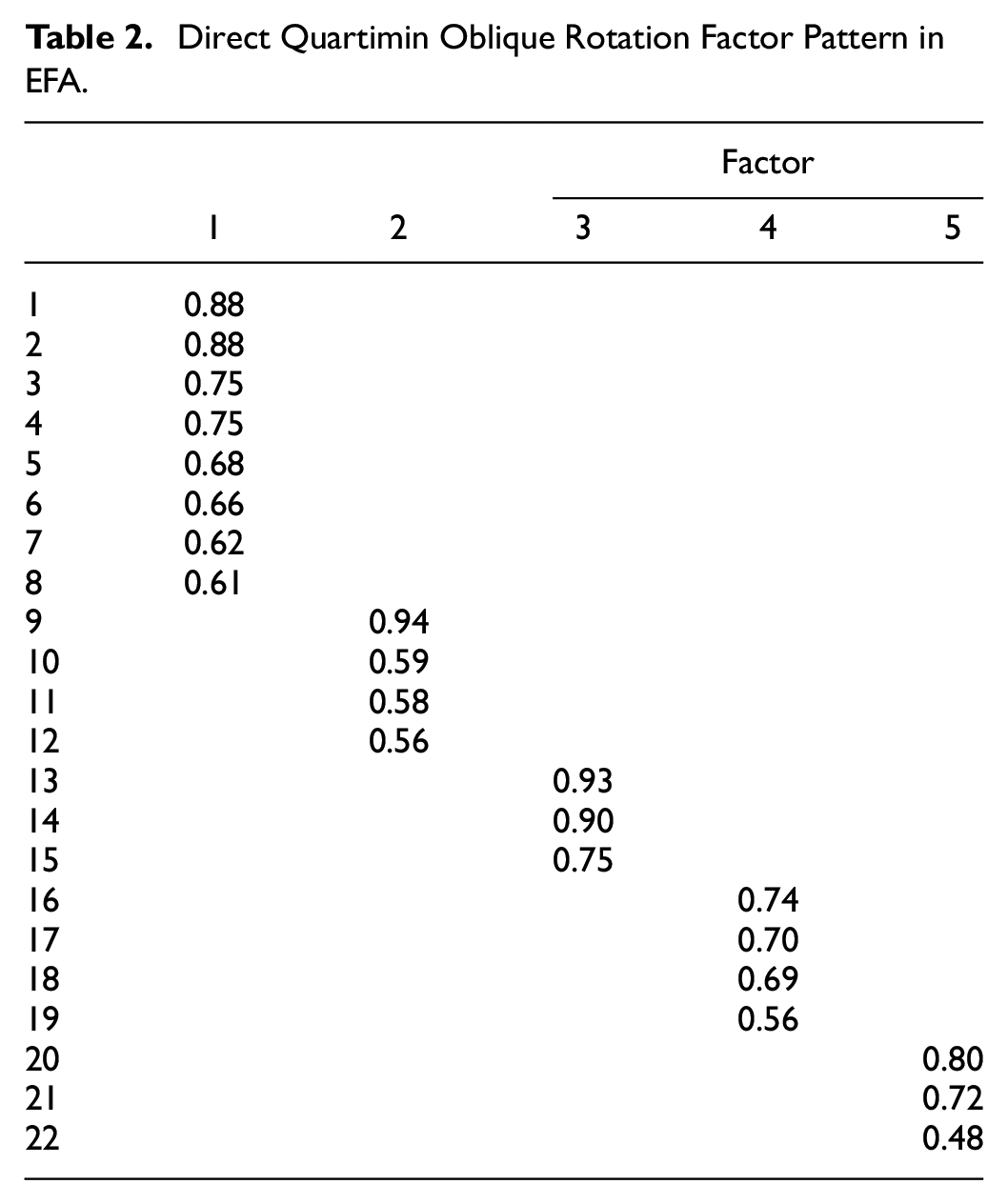
Initially, 10 factors with eigenvalues greater than one were extruded. Factor analysis was rerun after the elimination of each item that did not meet the criteria summarized above. About 11 items were eliminated from the initial form due to low factor loadings which were less than 0.32 and four factors were eliminated as they produced one-item factor solutions. All in all, the most reasonable and interpretable 22 items in the form of a five-factor solution explaining altogether 65.89% of the total variance were achieved. The first factor comprised of eight items was strong, with an eigenvalue of 7.03, and it accounted for 31.98% of the variance. Factor two had an eigenvalue of 2.43 and accounted for a further 11.06% of the variance. The eigenvalue for factor three was 1.99 representing the 9.05% of the variance. The eigenvalues for factors four and five were 1.76 and 1.27 respectively, accounting for 13.81% of the total variance together (See Table 1). The total variance explained by five factors is demonstrated in Table 2.
Factors Extracted by EFA.

Direct Quartimin Oblique Rotation Factor Pattern in EFA.
The scree plot in Figure 1 also suggested that five factors could be extracted as the natural break point on which the curve flattens out was detected after factor 5 (Costello & Osborne, 2005).
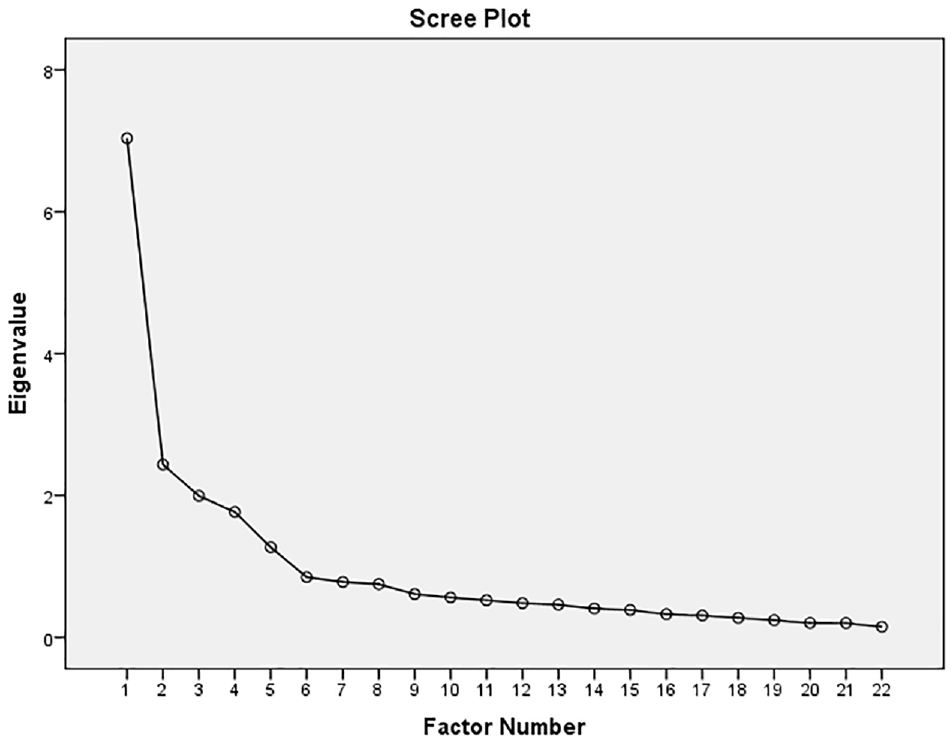
Screen plot.
The first factor accounting for large amounts of the variance was labeled as developing culturally responsive knowledge as it includes items which try to determine whether the participants feel knowledgeable to teach culturally and linguistically diverse student groups. According to Gay (2002), developing a cultural diversity knowledge base is among the key competencies of CRT. The items in this factor are created to determine whether the participants feel adequate enough to avoid uttering expressions that can cause misunderstanding by culturally and linguistically diverse students, and distinguish the cultural and linguistic differences. Moreover, the items also aim to explore whether the participants believe in the potential of education to change students’ negative attitudes toward cultural diversity and the potential of themselves to care for the different needs of each student so as to guarantee equity in the classroom. Whether the participants feel adequate enough to get information about students’ cultural backgrounds through contacting their family members is also aimed to be explored with one item in factor 1. Facilitating collaboration between school and family members is among the best practices of culturally relevant teaching (Araujo, 2009).
Factor 2 was labeled as demonstrating colorblind attitudes because the items mainly assess pre-service EFL teachers’ beliefs about color blind perspective. By taking on an entirely colorblind approach instructors can disregard culturally responsive awareness and using the information related to this awareness which can be supportive in determining what kind of materials should be used and what kind of communication styles can work out well for all the students in their classrooms (Schofield, 2010). There is also evidence demonstrating an inverse correlation between adopting colorblindness approach and novice teachers’ willingness to adapt teaching procedures to satisfy the diverse students’ needs (Hachfeld et al., 2015). There are four items in factor 2 related to expecting potential difficulties while teaching in culturally and linguistically diverse classrooms and favoring dominant cultural norms in the classroom which are the characteristics of color-blind approach (Ryan et al., 2007; Schofield, 2010).
Factor 3 was labeled as culturally responsive content integration as the items it includes aim to measure self-efficacy beliefs about integrating the cultural and linguistic differences of the students into course design. This factor comprises three items concerning about the self-efficacy beliefs toward encouraging students to make use of their cultural and linguistic differences in the studies they carry out, adapting CRT materials and arranging the English language course content with regard to cultural and linguistic differences. Designing a course with cultural concepts and information which are similar to students’ cultural background may help the culturally and linguistically diverse student groups to construct better understanding of the content and language (Rupley et al., 2008).
Factor 4 was labeled as developing cross cultural communication as the items it includes try to measure self-efficacy beliefs about developing skills for achieving successful styles of communication with culturally and linguistically diverse student groups. Gay (2002) defines effective cross-cultural communication as one of the five key factors of getting prepared for CRT. Successful cross-cultural communication with the native speakers of a language which can be facilitated through cultivating the ability of cultural empathy is also suggested to be the final aim of second language teaching (Jiang & Wang, 2018).
Factor 5 was labeled as demonstrating culturally and linguistically responsive caring because the items it includes are related with culturally responsive caring which requires ethically, emotionally, and academically valuing the partnership with culturally and linguistically diverse student and teacher groups based on respect, honesty, cohesion, and honor (Gay, 2000). Culturally responsive caring also requires demonstrating high expectations of academic success and believing in the intellectual potential of students with diverse backgrounds (Gay, 2002). In factor 5, Item 22 “I believe that I can turn the cultural and linguistic differences of my students into an advantage with regard to my professional development” was one of the items created to determine whether the participants demonstrate such high expectations.
The CFA Results
In this study, the CFA was used to validate CLDSEBS in terms of convergent and discriminant validity (Worthington & Whittaker, 2006). The output created through the AMOS analysis supported the researchers to evaluate the convergent and discriminant validity of the model and the goodness of fit statistics which can demonstrate the degrees of how well the dataset fits the model.
Maximum Likelihood analysis which is the most commonly used estimation method in CFA (Bandalos, 2018) was conducted to estimate the common factor model and evaluate the scale’s goodness of fit. There are various requirements for conducting Maximum Likelihood analysis in CFA. It is recommended that any missing data should be handled as it may lead to non-significant findings (Fan et al., 2016; Harrington, 2009). In this study, SPSS Missing Values Analysis (MVA) was used, and no missing data was detected in the data view. Seeking for the normality of the data is also required (Harrington, 2009) because most of the fit indices such as CFI, RMSEA and SRMR are greatly affected by multivariate normality (Fan et al., 2016). The data set was checked against both conditions of univariate and multivariate normality. Outliers in the data may affect the analysis results negatively (Çokluk et al., 2012). In this study, in order to detect the outliers in the data set Mahalanobis distance test was conducted and 59 scale forms out of 395 which have values of p1 < .05 were eliminated from the data in order to guarantee the normality of the data as recommended by Hahs-Vaughn (2017). After the outliers were eliminated, tests for normality and outliers were conducted again. It was found that the skewness values of items range between −0.850 and −0.102 and the kurtosis values range between −1,141 and −082. Tabachnick and Fidell (2013) recommend an acceptable range of below +1.5 and above −1.5 for skewness or kurtosis values, so it was assured that the distribution of the data produced acceptable ranges of skewness and kurtosis values for each item. Multivariate kurtosis and its critical ratio was also checked to ensure the multivariate normality of the data. In AMOS SPSS, multivariate normality is measured by using Mardia’s multivariate kurtosis (Mardia, 1970). As a result, the present study’s findings demonstrate that the values of most of the critical ratios measuring skewness and kurtosis were also assessed around the values of 3 or less; moreover, the multivariate critical ratio value is 3.271. In practice Bentler (1995) recommends that multivariate critical ratio values >5.00 indicates the nonnormal distribution of the data. Therefore, it can be concluded that the condition for a sample to be multivariate normal for conducting Maximum Likelihood Analysis for CFA was moderately fulfilled.
Gathering a powerful sample size is the other requirement suggested by Harrington (2009). Even though there are some rule of thumb recommendations which were also discussed in this study to determine the sample size, it should not be the major concern as long as the communalities are not low, and the factors are highly overdetermined (Harrington, 2009). No violation was detected concerning this situation in AMOS analysis. Fulfilling all these requirements, the data set gathered with the new version of the scale for CFA was tested through Maximum Likelihood Analysis.
In order to identify a correct model, it is essential to take multiple criteria into consideration and evaluate a model fit with various types of measures at the same time and for structural equation models huge variety of fit indices which can help to determine an acceptable fit of the structural model has been developed (Schermelleh-Engel et al., 2003). There is a high range of different recommendations of fit indices to evaluate the adequacy of a given structural equation model. In this study, the recommendations of Schermelleh-Engel et al. (2003) were taken into consideration and the values of Chi-Square (χ2), χ2/df, Non-normed Fit Index (NNFI), Comparative fit index (CFI), Standardized Root Mean Square residual (SRMR) and Root Mean Square Error of Approximation (RMSEA) were evaluated to assess the model fit. SRMR, RMSEA, CFI, and Tucker-Lewis index (TLI) were particularly chosen because they can provide a general satisfactory performance as they did in the simulations of L. T. Hu and Bentler (1998) and L. Hu and Bentler (1999). More specifically, Kline (2016) recommends reporting a minimum set of fit statistics which include a model test statistic and three approximate fit indices when it is possible. These fit indices consist of Model χ2 with its degrees of freedom and p-value, and also RMSEA, CFI, SRMR test results. T. A. Brown (2006) labels three categories of fit indices to be reported due to their performance and popularity. These indices include parsimony correction indices, absolute fit indices, and comparative fit indices. In this study, as absolute fit indices SRMR and χ2, as a parsimony correction indice RMSEA, and as comparative fit indices CFI and TLI were tested and reported. Several cutoff values for these fit indices to evaluate CFA results supported the researchers to determine the best model fit of the scale.
χ 2 tests the theory according to which there is an inconsistency between the original covariance matrix and model-implied covariance matrix (Fan et al., 2016). For an optimal level of model fit of a scale, the χ2 can be perfect with a value of p > .05 (L. Hu & Bentler, 1999; Kline, 2016) which represents a non-significant inconsistence (Fan et al., 2016). However, it is also important to note that the results regarding a p-value lower than the acceptable threshold should not worry the researcher excessively because the χ2 test is very susceptible to the size of the sample and it is not comparable among different structural equation models (L. Hu & Bentler, 1999); therefore, conducting more detailed evaluation of fit with other fit indices are recommended (Kline, 2016). In fact, for a good model fit, the ratio χ2/df is required to be as small as possible (Schermelleh-Engel et al., 2003). Although there are not any exact values of standards for the ratio χ2/df, a ratio close to 2 indicates a good data-model fit, and a ratio close to 3 indicates an acceptable one (Schermelleh-Engel et al., 2003).
The initial results have demonstrated that the values of fit indices provided support for the acceptability for the factors extracted through CFA according to the criteria of Schermelleh-Engel et al. (2003) according to whom TLI values higher than 0.95 can be viewed as an acceptable fit, a ratio χ2/df close to 2 indicates a good data-model fit, and a ratio close to 3 indicates an acceptable one. Additionally, suggestions of different researcchers (L. T. Hu & Bentler, 1995; L. Hu & Bentler, 1999; Kline, 2016; Tabachnick & Fidell, 2013) were also taken into consideration and a CFI value higher than 0.95, a RMSEA value ≤0.05, a SRMR value ≤0.05 were accepted as threshold levels for a good model fit. The chi-square test results revealed a moderate goodness of fit: χ2 = (179, N = 336) = 320.599, p < .01; χ2/df was 1.79. The TLI, CFI, RMSEA, and SRMR values were 0.95, 0.96, 0.049, and 0.057 respectively. Despite this initial support for the acceptability of a five-factor model, the judgment is required to be verified by taking the other two aspects of fit evaluation which are localized areas of strain and parameter estimates (e.g., the size and significance of standard factor loadings and correlations between factors) into consideration in order to provide more specific information about the acceptability and adequacy of the solution (T. A. Brown, 2006). Convergent validity which assesses the extent to which a specific constructs’ indicators demonstrate a high proportion of variance shared is a method to test construct validity (J. E. Hair et al., 1995; J. F. Hair et al., 2019). In this study, three types of statistical measures which are standardized factor loadings, average variance extracted (AVE), and construct reliability (CR) helped the researcher to determine the convergent validity (J. E. Hair et al., 1995; J. F. Hair et al., 2019). Standardized factor loading signifies the correlation between the factors and the variables, and the adopted cutoff value for an acceptable cutoff value is .50 and higher in this study (J. E. Hair et al., 1995; J. F. Hair et al., 2019). At the same time, AVE assesses the convergence among the items which represent a latent construct and the recommended cutoff value for an acceptable AVE is 0.50 and above (J. E. Hair et al., 1995; J. F. Hair et al., 2019). In this study AVE was calculated on a Microsoft Excel form according to the formula of Fornell and Larcker (1981). AVE values above 0.4. still can be accepted as far as CR value of the factor is higher than 0.6 (Fornell & Larcker, 1981). CR is the assessment of the internal consistency and the reliability of a set of items representing a latent construct, and the adopted cutoff value for CR is 0.60 and above (J. E. Hair et al., 1995). CR was calculated on a Microsoft Excel form according to the formula of Fornell and Larcker (1981) and Kline (2016).
In this study, item 7 was removed due to low factor loading (<0.50). Table 3 demonstrates the factor loadings, AVE, and CR values for each factor.
Parameter Estimates without item 7.

One alternative to guarantee discriminant validity is based on the criterion of Fornell and Larcker (1981) according to which the discriminant validity can be guaranteed as long as the square root of AVE of a specific factor is greater than the correlation between this factor with other factors (Zait & Bertea, 2011). Table 4 demonstrates the discriminant validity scores calculated by using this formula. Each score indicates that the discriminant validity of the scale is justified (J. E. Hair et al., 1995; J. F. Hair et al., 2019).
Discriminant Validity Scores.

Note. Square value of AVE is represented with bold character. Off diagonal represents the correlation between dimensions. AVE = average variance extracted.
The modification indices and the matrix of standardized residuals were also analyzed to identify focal areas of misfit in the initial CFA solution of this study as suggested by T. A. Brown (2006). Whereas SRMR provide a global summary of the variance between model-implied matrices and the sample, the standard residual matrix demonstrates some specific information on how fit each covariance and each variance are duplicated by the parameter estimates of the model (T. A. Brown, 2006). The analysis of the standard residual matrix have shown that standard residual covariance values between I9 and I22, I9 and I21, and I9 and I20 are greater than 2.58 (p < .01), with absolute values of −3.24, −2.93, and −2.72 respectively, indicating that there are statistically significant discrepancies which are worth paying attention to between the variables noted (Byrne, 2013). As the theory according to the model depicted in Figure 2 does not allow any modifications between I9 and these items, and there are at least three more variables functioning well to measure the same factor, I9 was eliminated from the initial structure and the analysis were rerun.

Structural model for 21-item scale.
Table 5 demonstrates the factor loadings, AVE and CR values for each factor after the elimination of Items 7 and 9 which did not meet the relevant criterion.
Parameter Estimates without items 7 and 9.

Modification indices were also examined as it was considered that freeing some correlated errors in a solution can enhance the borderline value of provided fit indices. However, it is also argued that such applications can result in different problems (T. A. Brown, 2006). As there is not any theoretical basis provided for model modifications, the researchers did not relax any model restriction after inspecting the modification indices.
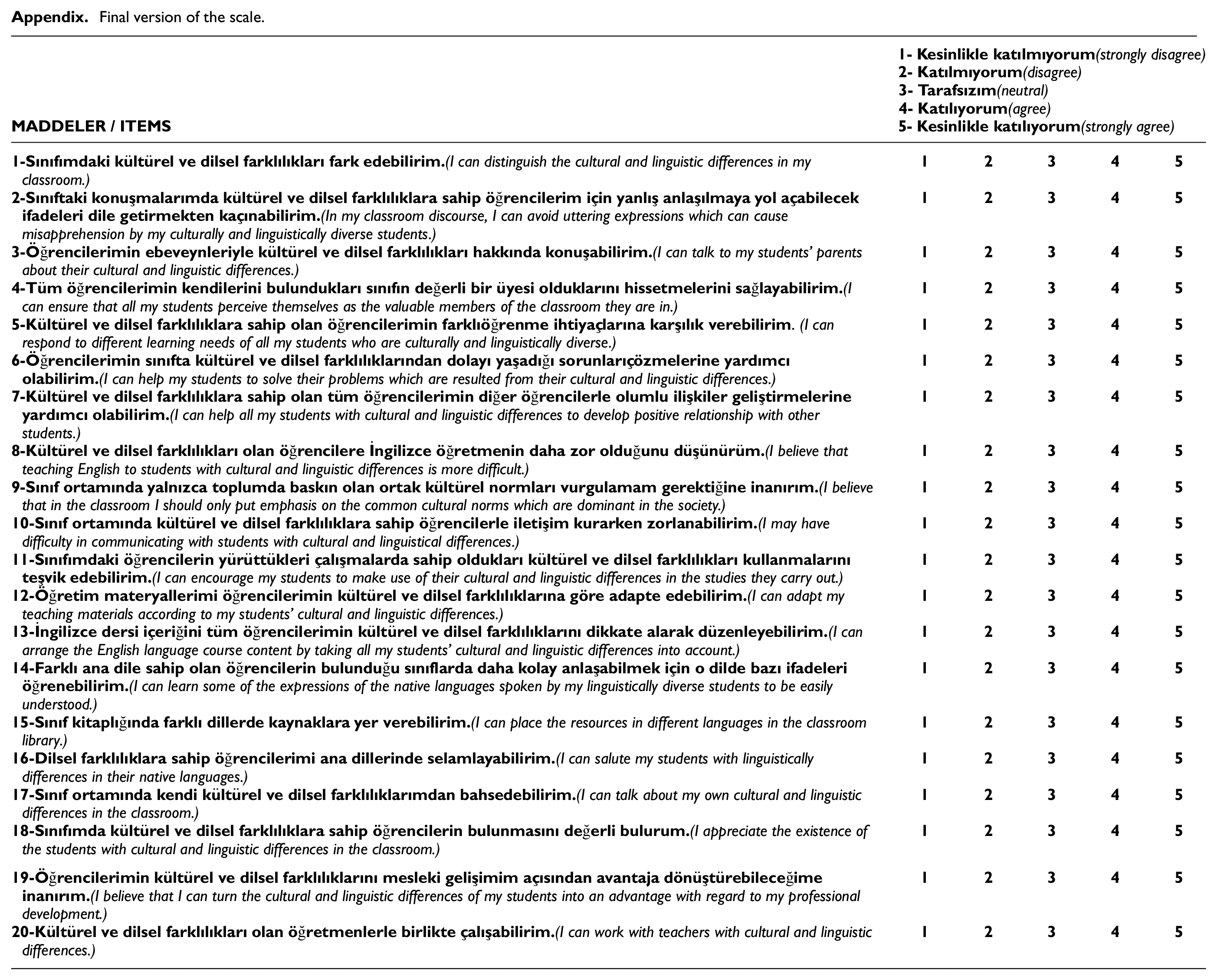
After the modifications, the results have demonstrated that the values of fit indices provided sound support for the acceptability of the factors extracted through CFA. The chi-square test results revealed a moderate goodness of fit: χ2 = (160, N = 336) = 242.329, p < .01; χ2/df was 1.51. The TLI, CFI, RMSEA, and SRMR values were 0.97, 0.98, 0.039, and 0.043 respectively. Subsequent to the elimination of Item 7 and 9, fit indices of the scale were enhanced, and based on these findings, it can be concluded that a set of 20 items were statistically valid and reliable in measuring pre-service EFL teachers’ self-efficacy beliefs about teaching in culturally and linguistically diverse student groups (See Appendix). Significant coefficients in the standardized form are illustrated in Figure 3.

Structural model for 20-item scale.
Conclusion and Implications
Cultural and linguistic diversity is undoubtedly an under-researched area in Turkiye and it needs further attention around the world where EFL teachers have to serve an increasing number of students with different cultural and linguistic characteristics nowadays due to a massive flow of migrants. To achieve the integration of the learners with diverse linguistic and cultural backgrounds into a more tolerant and fair society, several approaches such as multicultural education, culturally responsive education, and culturally relevant education which suggest plenty of strategies to teach culturally diverse student population appropriately and successfully have been introduced so far. Teachers’ self-efficacy beliefs about implementing such teaching strategies appear to have a direct impact on culturally diverse students’ performance and success rates (Gutentag et al., 2018) and some study results have demonstrated that possessing lower self-efficacy beliefs may result in failures to implement appropriate strategies in the classroom (Gordon, 2001; Schwarzer & Hallum, 2008). On the other hand, teachers having strong self-efficacy beliefs can arrange appropriate learning settings for their linguistically and culturally diverse students by conducting different teaching and assessment methods and strategies (Berry & Kalin, 1995). Self-efficacy beliefs are viewed as one of the strongest motives for appropriate behavior as they are directly connected with the intention to carry out a duty, the extent to which efforts to perform that duty are going to be increased and the duration of perseverance in that duty (Gardner & Pierce, 1998). In today’s Turkish classrooms with more students with linguistically and culturally diverse backgrounds than ever, it is critical to adopt positive attitudes toward their differences, be knowledgeable about how to show care for them, and possess higher levels of self-efficacy beliefs toward teaching them to create an appropriate classroom atmosphere and society in which any difference is regarded as an inseparable element of the mainstream culture and the society. Because such beliefs are formed at the initial stages of a profession and it is hard to modify these beliefs when they are formed, it is suggested to realize the components which support and weaken them at the early stages of a service (Hoy & Spero, 2005). It is also important to determine the elements which have the potential to support the exploration of self-efficacy beliefs of pre-service teachers concerning teaching in a culturally and linguistically diverse classroom in order to explore whether pre-service EFL teachers in Turkiye feel adequate enough to teach in such classroom.
The study attempted to develop and validate an affordable and generalizable instrument to measure pre-service EFL teachers’ self-efficacy beliefs concerning their skills and ability to instruct students with linguistically and culturally diverse backgrounds. The findings have suggested that a five-factor solution with 20 items can help to explain pre-service EFL teachers’ self-efficacy beliefs concerning linguistically and culturally responsive education in a linguistically and culturally diverse environment. The values underlying the five factor solution were found to be representative of pre-service EFL teachers’ tendency to adopt a colorblind perspective and efficacy beliefs about their ability to develop culturally responsive knowledge, integrate culturally responsive content into the course design, develop cross cultural communication and demonstrate culturally and linguistically responsive caring. The analysis to explore the validity and reliability of the scale revealed that the items across five factors can provide adequate measurements in terms of validity and reliability. This study can also narrow the gap in the literature by addressing the relative lack of research focused on teaching to culturally and linguistically diverse students’ population in Turkiye. Through conducting further research studies, the scale developed in this study can help to explore whether pre-service EFL teachers in Turkiye believe they feel adequate to teach in linguistically and culturally diverse classrooms, schools, and a society.
The main limitation of this study is that the sample group gathered for EFA and CFA analysis includes a limited number of pre-service EFL teachers almost all of whose native language is Turkish. Therefore, more studies conducted with different sample groups with different native languages to test the English versions of the items can enhance and develop the study results.
Footnotes
Appendix
Final version of the scale.
|
|
|
||||
|---|---|---|---|---|---|
|
|
|
|
|
|
|
|
|
|
|
|
|
|
|
|
|
|
|
|
|
|
|
|
|
|
|
|
|
|
|
|
|
|
|
|
|
|
|
|
|
|
|
|
|
|
|
|
|
|
|
|
|
|
|
|
|
|
|
|
|
|
|
|
|
|
|
|
|
|
|
|
|
|
|
|
|
|
|
|
|
|
|
|
|
|
|
|
|
|
|
|
|
|
|
|
|
|
|
|
|
|
|
|
|
|
|
|
|
|
|
|
|
|
|
|
|
|
|
|
|
|
|
|
|
|
|
|
|
|
|
|
|
|
|
|
|
|
|
|
Author’s Note
This paper was produced from the master’s thesis written by the first author under the supervision of the second author.
Declaration of Conflicting Interests
The author(s) declared no potential conflicts of interest with respect to the research, authorship, and/or publication of this article.
Funding
The author(s) received no financial support for the research, authorship, and/or publication of this article.

Data Availability Statement
The dataset supporting the conclusions of this article is included within the article and for more details can also be kindly requested from the corresponding author whenever necessary.