




Abstract
Religiosity covers all aspects of human life values. Consumer decision-making in Muslim product purchase needs to involve religiosity. Muslim fashion is increasingly popular and becomes a potential business for fashion entrepreneurs in Indonesia. This condition evokes a dilemma for the consumers as Muslim fashion users on whether they have to conform to the religious sharia or follow the trend. The purpose of this article is to identify the role of religiosity as a factor affecting Muslim consumers to revisit Muslim fashion stores. This research involved 243 Muslim consumers of several Muslim fashion stores. The results showed that religiosity of Muslim consumers had a direct effect on patronage intention and indirect effect on patronage intention of Muslim fashion stores through Customer Satisfaction. The research findings are directed to managerial implications for Muslim fashion entrepreneurs in relation to consumer religiosity and marketing of Indonesian Muslim fashion products.
Introduction
The Muslim fashion industry is important to discuss considering the growing phenomenon in the world, especially in Indonesia. The Muslim population in Indonesia is among the largest in the world (about 85% of the population is Muslim), so it needs clothes that will suit their religion. In 1970 and 1980s, Indonesia banned the use of headscarves because it is considered illicit, especially at schools. Headscarves are still limited to Muslims who have high religiosity such as in Islamic boarding schools. Over time, the awareness of wearing headscarves is not only limited to older women or those living in Islamic boarding schools but also for young women (Arifah et al., 2018). Hence, there is an increase in wearing headscarf among artists, presenters, and even public officials. This phenomenon is then increasingly developed and follows fashion trends. Some Muslim women think that this style is way better than wearing no headscarf at all (Agustina, 2015).
The fashion market is one of the important markets for global Muslim consumers. The Muslim population is a fast-growing market that potentially grows businesses around the world, including fashion. Hijab fashion is a symbol of Muslims. According to Blommaert and Varis (2015), religion-oriented Muslim women can dress stylishly. Muslim fashion in Indonesia increasingly develops, given that the Indonesian Muslim population belongs to the largest one in the world (around 85% of the population are Muslim). Therefore, the need for clothing that is in accordance with Islamic rules is also high. Such a condition encourages Indonesian Muslim fashion to grow along with the arising phenomenon that many Indonesian women wear hijab. Indonesia is third ranked in terms of Muslim fashion shopping in the global market (Global Islamic Economic Report, 2014–2015), meaning that Indonesia has market potential at the global Muslim fashion level. Fashion producers or designers will be motivated to always work in creating new designs for Muslim fashion in Indonesia particularly and in the world generally. Considering the global Muslim market potential, Indonesia is increasingly active in improving the Muslim fashion industry.
This promising business trend attracts many parties to create products that have a great vogue among Muslim fashion users, which is increasingly shifting from the simple to stylish and fashionable concepts. This transformation becomes very important to be studied, given that Muslim fashion currently has increasingly neglected Islamic rules. The consumer behavior theory suggests that marketers need to accommodate consumer needs, but on another side, should also pay attention to the applicable Islamic rules. Marketers often follow fashion development just in pursuit of profits while consumers often follow fashion trend just to look more modern and stylish. Religion plays an important role in Muslim fashion, meaning that dressing must suit religious rule. It requires someone’s religiosity to Muslim fashion.
Religiosity develops into a major topic of personality and social psychology studies (Saroglou, 2014; Sedikides, 2010). Based on the data, 65% of people in the world consider religion to be an important part of daily life (Diener et al., 2011). This shows that religiosity plays an important role in the way a person brings him/herself to the social environment (Baumeister, 2002).
Religiosity is associated with consumer shopping behavior. Researchers have argued that the effect of religion on consumer behavior depends on the level of individual religious commitment in his personal life because religion is basically very personal (Mokhlis, 2009). Houck et al. (2018) wrote that religion tends to cause complexity because the nature of a religious system (the questions they face) is often complex, whereas, on the other hand, religion also able to create an easy way of thinking. Consumer behavior is an important part of marketing as it describes individual behavior in meeting his life needs by buying products. Marketing in Islam emphasizes the fulfillment of several parameters of the Qur’an, Sunnah, and the principle of Islamic religion (Al-Azmeh, 2009). Islamic marketing serves as a strategy to improve the welfare of stakeholders and communities based on the Qur’an and Sunnah (Fischer, 2011). According to Sandıkcı and Jafari (2013), the Muslim market segment potentially attracts marketers’ interest in the concept of Islamic marketing. The purpose of the Islamic market is in line with the purpose of Islamic sharia that humans are messengers of God, thus all human behaviors are controlled and managed according to the will of God (Haneef, 1997; Hassan & Lewis, 2007; Khan, 1991).
Gökarıksel and Secor (2009) said that there is a combination of Islamic fashion, moral, and capitalistic philosophy. Islam demands fashion companies to represent the Islamic rules on their products and, at the same time, the companies want to increase profits for their business continuity. That is, Muslim fashion stores as Muslim product sellers are allowed to offer and sell the latest fashion products but still required to remain wise and obedient to the Islamic sharia. Muslim fashion consumers will revisit certain Muslim fashion stores that provide products according to their needs, values, and expectations. Religiosity determines a person’s intention to revisit a Muslim fashion store as the products are in accordance with his expectation. If a Muslim fashion store is perceived to match one’s religiosity, the store will likely to be revisited by the person. Sandıkcı and Ger (2010) carried out a study of Muslim fashion and revealed that Muslim consumers would take a long time to just harmonize their clothes with their veils. Fashion products provided at the store can affect the desires of Muslim consumers so that when the store has provided products as expected, buyers can visit them. Religiosity influences retail patronage activities (Mokhlis, 2006).
Thus, this research aimed to determine the role of religiosity in influencing Muslim customers’ patronage intention associated with Customer Perceived Value (CPV) and Customer Satisfaction. To achieve the research objective, we conducted these following steps: first, examining the relationship between religiosity and CPV; second, examining the relationship between religiosity and customer satisfaction; and third, examining the relationship between religiosity and patronage intention through CPV and Customer Satisfaction. This research focuses on fashion products for Muslim consumers provided by Muslim fashion stores. This research selected Muslim fashion stores due to its significant trend toward Muslim fashion products and ease to recruit Muslim fashion consumers for this study.
Literature Review
Theory of Reasoned Action was designed to take account of people’s decision-making (Ajzen & Fishbein, 1980). This theory involves normative beliefs and behaviors, attitudes, and subjective norms as antecedents of intentions on individual efforts to specific behaviors (Ajzen, 1991, 2011; Ajzen & Fishbein, 1988). Subjective norms are individual beliefs about what other people think she or her should do in a certain context but give less attention to the concept of personal norms (i.e., individual beliefs or perceptions of right or wrong). Attitude is an individual feeling to perform certain behaviors that are beneficial and unfavorable (Fishbein, 2008). An individual behavioral intention is a combination of attitudes toward behavior and subjective norms.
If consumers feel the positive result of doing a behavior, they will have a positive attitude to conduct the behavior in the future. And vice versa, if a behavior is felt to be negative, consumers will have a negative attitude to conduct the behavior in the future. This study does not require subjective attitudes and subjective norms as variables because the one categorized attitude is CPV and Customer Satisfaction while the subjective norm is religiosity. Attitudes toward behavior and subjective norms create intentions to behave in certain ways. Fishbein and Ajzen (1975) proposed that the intention to behave refers to future behavior. The intention to behave meant is patronage intention. Patronage intention is the closest antecedent of patronage and an indicator whether customers will continue to visit or switch from stores (Zeithaml et al., 1996).
Religiosity and Fashion Muslim
Religiosity is highly important to be discussed because it plays a big role in transmitting religious values and forming a part of individual self-identity (Maclean et al., 2004). The assumption is that if an individual involves religion as his identity, it will greatlyaffect his behavior. One of the highlighted behavior is product-purchasing behavior. Musgrave and McFarlane (2004) defined religiosity as the way people express their beliefs and practice their religions. According to Johnson et al. (2001), religiosity is to what extent an individual is committed to his religion and its teachings such as attitudes and behaviors that reflect the commitment. Delener (1994) stated that religiosity as ahighly important construction affecting consumer decision-making through individual cognitive and behavioral influences over time. Religion can also influence the aspects of consumer behavior (Burroughs & Rindfleisch, 2002; Delener, 1990, 1994; Hirschman, 1981; McDaniel & Burnett, 1990; Mokhlis, 2006; Rindflisch et al., 2004; Wilkes et al., 1986). Idris et al. (2011) agreed that religiosity was a significant factor to choose Islamic products.
Islamic people demand Islamic products and services which constitute the latest prospect from markets around the world. The relationship is that if the products do not penetrate into the Islamic market, the coIDRorate sustainability will be threatened (Morphitou & Gibbs, 2008), one of which is implemented in fashion products. As argued by Gooch (2011), Islamic fashion for women is generally costumes that cover from the head to ankle. Therefore, fashion products for Muslimah should at least be adjusted to this rule. On the other side, according to Bilefsky (2012), Muslims are required to save money while Islamic fashion leads them to consumerism. As explained by Razzaq et al. (2018), religiosity moderates the effect of sustainable fashion consumption and pro-environmental attitudes toward sustainable clothing consumption. This means that Islam still prioritizes religious values in products consumption.
According to Lewis (2015), wearing headscarf is a phenomenon that applies to contemporary consumer global culture. In Western countries, the communities and academics prohibit headscarf as fashion because they assume that it is limited to ethnicity and religion. Headscarves are not a definite entity but a phenomenon bound by space and time related to the aspects of individual personal and social life. Muslim communities in Britain and cosmopolitan cities throughout the West wear Muslim fashion as an expression of their identity and faith. Meanwhile, individuals tend to change their fashion style outside the framework of Muslim fashion. A Muslim woman may who looks not attract attention in one place but is very attractive in another (Tarlo, 2010).
There are differences between Indonesia and the Middle East term regarding headscarves and veils as a women’s headdress. Headscarves are a piece of cloth that almost completely covers a woman’s body except for the face and hands while veils usually refer to a long transparent shawl that covers a woman’s hair. Islamic clothes are not only a symbol of godliness but also reflect individual and communal identity. For some people, fashion is a part of a lifestyle, but for those living in an Islamic boarding house, it will be different because there is a special rule in dressing (Amrullah, 2008).
CPV
Perceived Value is a comparison between what customers get (i.e., benefits, quality) and what they give (i.e., cost or sacrifice) (Zaithaml, 1988). CPV is consumers’ whole assessment about the usefulness of products or services based on their perceptions of the product benefits they will receive (Zeithaml, 1988). Previous research showed that individual values influenced the decision to opt for certain clothing styles (Solomon & Rabolt, 2009). Value is defined as an interactive experience and distinguishes a person’s experience in interacting with objects or events. Value is defined as consumer behavior from the emotional aspect and consumer interaction with the product. Solomon (2008) compared utilitarian, hedonic shopping value, and pleasure. Value occurs when consumers shop because of the possibility to socialize with their friends (Bäckström & Johansson, 2006). A collection of individual values is very important for consumption activities. Many purchases are made because consumers think the product of purchase will result in the achievement of goals related to the value (Solomon, 2008). Value is very influential in fashion shopping decisions.
Muslim women in Kuwait are attracted to Western luxury fashion brands as a symbol that expresses a woman’s sexual freedom. Consumers neutralize the consumption of luxury fashion brands by presenting “modestly sexy” in recreating the meaning for western luxury fashion brands in Kuwait leading to positive brand perceptions (Al-Mutawa, 2013).
Customer Satisfaction
Kotler (2000) argued that Customer Satisfaction refers to a person’s feeling of pleasure or disappointment related to the conformity between product performance and his expectation. During sales, customers are encouraged to repurchase and become loyal customers (Kocoglu & Kirmaci, 2012). Customer Satisfaction is an assessment of the conformity between pre-product purchase expectations and the results achieved after purchase. Customer satisfaction is a concept to determine how the product or service delivered meets or exceeds customer expectations (Christopher et al., 1991). Kotler (2003) said that the concept of customer satisfaction is abstract and the real satisfaction expression. The level of satisfaction differs depending on how the customer compares the company’s product or service.
Satisfied customers tend to shop at retail and come back for future purchases. (Ranaweera & Prabhu, 2003; Vesel & Zabkar, 2010; Williams & Naumann, 2011). Customers often rely on satisfaction to decide which retailers are worth keeping (Raciti et al., 2013).
Patronage Intention
Patronage intention is the closest antecedent of patronage and an indicator determining whether a customer will continue to visit or move from a store (Zeithaml et al., 1996). Mathwick et al. (2001) said that patronage intention is the willingness of customers to consider, recommend, or buy from the same retailer in the future. The initial concept of behavioral intention toward the store/brand is mainly focused on the willingness to buy (Dodds, Monroe, & Grewal, 1991). A study of the concept of behavior toward stores sees patronage intention as a multidimensional construction including the willingness to recommend and buy, and the possibility of shopping as the patronage dimension of store intention (Baker et al., 2002).
Previous studies of consumer behavior defined patronage intention as consumers’ desire to behave in a certain way regarding spend time in a shopping facility, interact with sales partners and products, and the possibility to buy products and services (Donovan & Rossiter, 1982).
Hypothesis Development
Religiosity and CPV
Religiosity reflects what extent beliefs in religious values and ideals are held and practiced by an individual (Delener, 1990). Religion has a role in shaping the need for consumption in Muslim countries (Rehman & Shabbir, 2010). The characteristics of Muslim consumers depend on religious values while the characteristics of purchases depend on their religious beliefs (Alserhan, 2010).
A study conducted by Shah Alam et al. (2011) revealed that religiosity affects Muslim consumers to shop. Wilson and Liu (2011) stated that Muslim consumers categorize products as high involvement because they are tied to their religion so they must be careful in purchasing products. If the product has provided religious benefits to Muslim consumers, it will affect the shopping behavior of Muslim consumers. Muslim consumers will develop better attitudes and motivations to visit stores with products that are similar to the value they hold. The more religious Muslim consumers, the more they become obedient to religion and look at the store not only to meet certain consumption needs but also religious motives (Fauzi et al., 2016).
Some opinions state that religious people do not really like fashion or otherwise people who like fashion are not religious. Simplicity in dress is very important for Islam (Badr, 2004; Boulanouar, 2006). Following Muslims principles of fashion, the product they want is simple and far from being flamboyant and emphasizes status and prestige (Farrag & Hassan, 2015). Thus, Muslims with a high level of religiosity must be more inclined to adjust to Islamic clothes by fulfilling modesty requirements than that of individuals with low levels of religiosity (Bachelda et al., 2013).
Thus, the relationship between Religiosity and CPV can be explained as follows: if a fashion product does not meet the benefits as consumers expect, the CPV will be low. The benefits referred to here are fashion products that correspond to the level of one’s religiosity. Thus, there is an effect of religiosity on CPV. The following hypothesis is posited:
Religiosity and Customer Satisfaction
Religiosity considers the quality or the extent to which a person is religious (Eid & El-Gohary, 2015). Islam obliges to dress in a certain way, and according to the Sunnah of the Prophet (Haneef, 1996). Nowadays, Muslim women are more aware of the meaning of fashion that reflects self-image and social identity which affects their consumption of fashion (Hassan & Harun, 2016). Shukor’s (2012) study showed that there are six benefit factors of clothing on Muslim British: conformity, social status, simplicity, uniqueness, and personal identity. It indicates that Muslim consumers will be satisfied if there are elements of several benefits provided by Muslim fashion products in the related store.
This research intended to examine whether someone with high religiosity would have high satisfaction with a product as it had met his expectations. If a product quality is considered to match one’s religiosity, it will create satisfaction. Thus, there is an effect of religiosity on Customer Satisfaction. The following hypothesis is posited:
Religiosity and Patronage Intention
Religion has the greatest potential to influence an individual spend on fashion. Religiosity can directly affect the choices or alternatives of consumer spend on fashion (Siguaw & Simpson, 1997). Sheth (1983) provided two alternatives of how religion can impact shopping behavior: an indirect way that originates from the impact of religion on personal values and the direct way through which religion influences alternative retail outlets (Siguaw & Simpson, 1997).
Patronage intention is a customer behavior to revisit or move from a store (Zeithaml et al., 1996). Religious consumers will consider their purchasing decisions because they truly act on their religions. Thus, whether consumers will come back to the store selling products that match their religiosity is an important thing to be considered. The following hypothesis is posited:
CPV and Customer Satisfaction
Zeithaml (1988) stated that CPV is the overall assessment of consumers about the usefulness of a product or service based on their perceptions of what is received and given. Moreover, Woodruff (1997) stated that CPV is a perception of what customers feel, and the evaluation of product attributes, performance, and consequences after the product consumption will make the customers achieve their goals in various usage situations. Customer satisfaction is an antecedent and also a consequence of value perceptions. Several researchers support for the values that are positively perceived and directly influence customer satisfaction (Cronin et al., 2000). Customer values will be obtained if consumers have been through various situations such as experience, knowledge, and even the use of products. That is, customer satisfaction with a product will emerge due to various situations they have experienced. The following hypothesis is posited:
CPV and Patronage Intention
According to Sanchez-Fernandez et al. (2007), consumer values are values perceived to be visible from two perspectives, namely economic and psychological perspectives. From the economic perspective, the value refers to the price that consumers are willing to pay for a product and the product usefulness for the consumers. Meanwhile, the psychological perspective associates the value with cognitive and affective aspects that affect consumer purchasing decisions (Gallarza et al., 2011). Consumers can provide an assessment of fashion products not only limited to these two perspectives but can be based on several aspects: functional, physical, social, cultural, and spiritual when evaluating products. According to Shim and Bickle (1994), the are several benefits of clothes: self-improvement, social status/prestige, sex appeal/femininity, fashion image, functional/comfort, role identification, compensation for lack of images, individuality, and mature/sophisticated appearance. Those benefits can be used to evaluate fashion products, especially Muslim fashion.
According to Ajzen and Fishbein (1980), an intention is determined by two basic factors, namely personal and social factors. Personal factors include individual evaluation of something reflected in attitudes and behavior (Ajzen & Fishbein, 1980) while social factors refer to individual perceptions of something based on individual pressure to behave or not behave (Ajzen & Fishbein, 1980). Consumers feel and assess products based on their experience with the products. Therefore, consumers will repurchase or use a product if the product is assessed to be good by consumers. The following hypothesis is posited:
Customer Satisfaction and Patronage Intention
The previous theories indicate that Customer Satisfaction is the main key to patronage intention (Hutcheson & Montinho, 1998; Stank et al., 1999; Taylor & Baker, 1994). In the end, customer satisfaction is indicated to directly affect patronage intention. Consumers who are satisfied with a product will do positive behaviors such as repeatedly buying the same product or different products in the same store. Customer satisfaction generates the possibility of higher repeat purchase in time (Zeithaml et al., 1996). Patronage intention is a repeat purchase behavior in a particular store for the same product or different products (Osman, 1993). Thus, the higher a person’s Customer Satisfaction is, the higher his patronage intention will be. The following hypothesis is posited:
Based on the TRA and literature review, we formulated a conceptual model of this research to answer the proposed hypotheses (presented in Figure 1). The model was built on the concepts of Religiosity, CPV, Customer Satisfaction, and Patronage Intention. The assumption underlying this model was that religiosity affected CPV and Customer Satisfaction which subsequently influenced consumers’ desire to revisit the store.
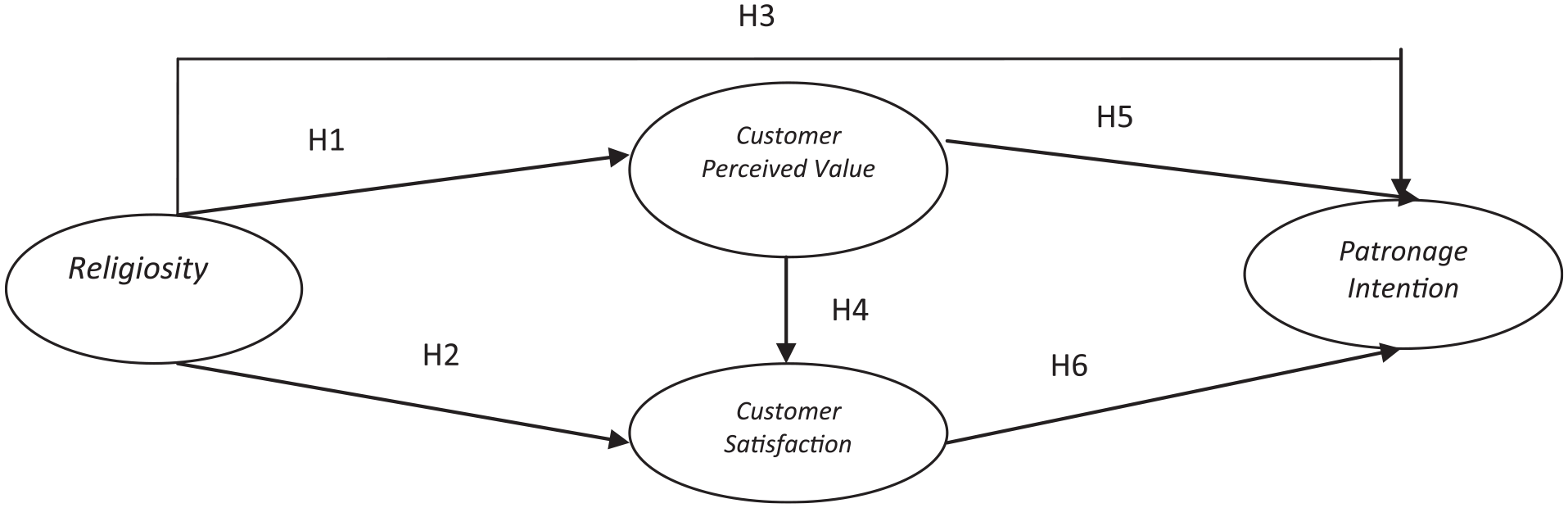
Research framework.
This research examined the relationship between religiosity, CPV, customer satisfaction, and patronage intention. Each variable was chosen based on the previous theories and studies. Based on the theory of Foxall and Goldsmith (1994), only a few opinions state that religion related to cognitive elements can provide basic knowledge to control human attitudes and behaviors. However, according to Fam et al. (2004), religion plays a dominant role in shaping individual attitudes and behaviors toward goods and services, indicating that one’s religiosity can affect CPV. On the other side, Eid and El-Gohary (2015) found the relationships between religiosity and customer satisfaction. Meanwhile, Gallarza et al. (2016) studying consumers of chain stores in Spain found the relationship between CPV and customer satisfaction. Differently, Blasco et al. (2017) examined the effect of different value dimensions (functional, emotional, social) on two types of customer satisfaction (cognitive and affective) and loyalty as the behavior results of retailers in Spain. Moreover, Jamal and Sharifuddin (2014) found the relationship between religiosity and patronage intention on halal-labeled products consumed by Muslims in the United Kingdom. The relationship between CPV and patronage intention was also discovered by Rahman et al. (2016) in malls in Wuhan China, in which the correlation between mall personality, fashion orientation, shopping value, and patronage intention was examined. Jamal and Sharifuddin (2014) also tested such a relationship on halal-labeled products consumed by Muslims in the United Kingdom to identify the impact of perceived value and perceived usefulness of halal-labeled products, culture, and religion on purchasing intention and patronage intention. Furthermore, Sadachar and Fiore (2016) examined the effect of customer satisfaction on patronage intention in Indian retailers while Sharma (2015) discussed on the perception of service quality in the context of small retail businesses or chain stores in Lousiana.
Method
The sampling technique of this study was purposive. In this research, a survey was conducted on consumers who had bought Muslim fashion products in Muslim fashion stores in Yogyakarta and Semarang cities, Indonesia. The samples were consumers who had twice bought Muslim fashion products in the last 6 months. Before the research was carried out, the researchers asked for permission to collect data from the store management. Data were collected for 2 months from June 2018 to August 2018. Samples obtained were 243 respondents consisting of 129 and 114 respondents in Yogyakarta and Semarang. The different sample in each city depended on the response rate. This research was conducted in 17 outlets under 4 Top Brand Muslim Fashion namely Zoya, Rabbani, Elzatta, and Dannis. The procedure undertaken by the researchers was approaching consumers in the stores right after they made a purchase and asking for their participation in the research survey. To avoid rejection, the researchers first explained the purpose of the survey and then distributed questionnaires to them.
Scale of Measurements
Measurement items were adopted from the previous studies associated with the research variables. Religiosity was measured using eight items adapted from Rahman et al. (2016) and three items adapted from Farrag and Hassan (2015). The CPV variable was measured using four items taken from Chi and Kilduff (2011) and Bhaduri and Stanforth (2017) and three items adapted from Albrecht et al. (2015). As for the Customer Satisfaction variable, it was measured using four items adopted from Blasco et al. (2017) and Kuhn et al. (2016). Moreover, the Patronage Intention variable was measured using two items adapted from Mehta et al. (2013) and four items adapted from Kaul et al. (2010). All the items were measured on a 5-point Likert-type scale ranging from 1 (strongly disagree) to 5 (strongly agree). The demographic description in this research includes age, status, occupation, income, and fashion shopping.
Results
Respondent Profiles
Respondents in this research amounted to 243 female Muslim (Muslimah) consumers of Muslim fashion stores who were at least 18 years old. The majority of respondents were 18 to 26 years old (51.85%) and the status of the majority of respondents was single or unmarried (49.79%). In terms of occupation, the majority of respondents were university students (27.6%). Regarding the last education, the majority of respondents were high school graduates (almost reaching 56.8%). And, the pocket money of most of the unmarried respondents amounted to IDR 150,000 to IDR 1,120,000 (53.72%). Meanwhile, in terms of fashion shopping in 1 month, 58.44% of the respondents spent IDR 50,000 to IDR 440,000. Most respondents preferred to go shopping in outlets rather than shopping in malls and online stores (63.4%).
Measurement Model
To verify the hypotheses, we conducted a component-based structural equation analysis with WarpPLS 5.0 (Kock, 2013) to detect how Religiosity affected Patronage Intention through CPV and Customer Satisfaction. The data were analyzed using WarpPLS 5.0 (Kock, 2013). The steps carried out in this research were examining the relationship between variables and then testing the effect of CPV on Customer Satisfaction. The Cronbach alpha values obtained in this research ranged from .782 to .911. The standard Cronbach alpha value used in this research was .6 with the assumption that the list of questions tested would be said reliable if the Cronbach alpha value reached ≥ .6 (Nunally, 1996 in Imam Ghozali, 2005). In addition, the average variance extracted (AVE) from the four constructs ranging from 0.509 to 0.607, which significantly exceeded the minimum acceptable value of 0.5 (Fornell & Larcker, 1981). According to Fornell and Larcker (1981), if AVE is less than 0.5 but has a reliability composite of more than 0.6, it can still be considered to meet the validity requirements.
This convergent validity of this analysis was confirmed. It was shown that each construct was unidimensional. As seen in Table 3, the correlation matrix has met the provision limits according to Fornell and Larcker (1981) and the coefficient was greater than the correlation coefficient between constructs so as to achieve discriminant validity. In conclusion, the research instruments were valid and reliable.
Sociodemographic Characteristics (n = 243).

Instruments and Sources Validity.
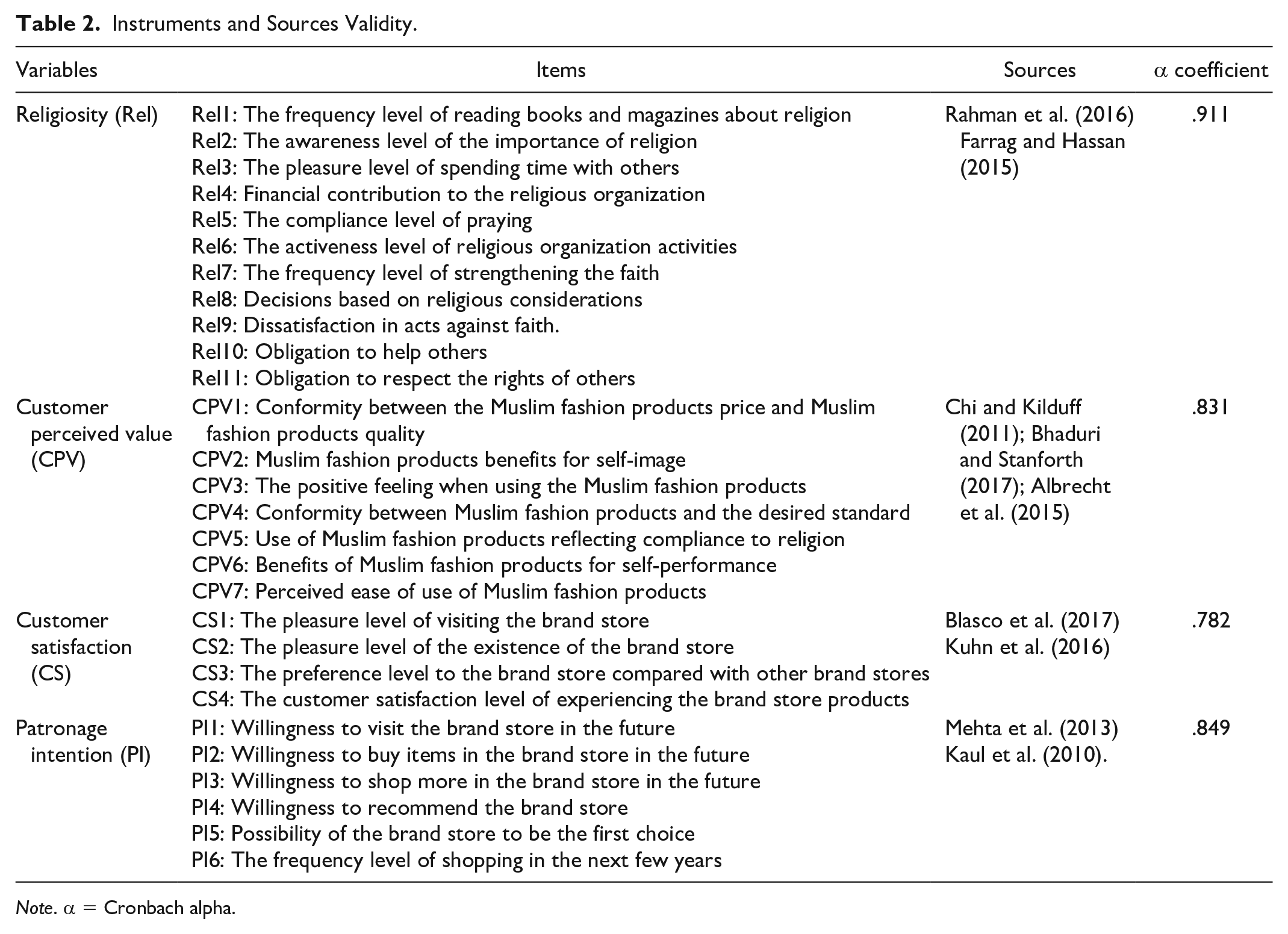
Note. α = Cronbach alpha.
Measurement Model.

CR = composite reliability; AVE = average variance extracted.
Hypothesis Testing
The validity of both the research model and hypotheses was tested using PLS. Measurement of model fit and quality indices refers to the data analysis using WarpPLS (Kock, 2013). The measurement results showed: Average Path Coefficient (APC) = .275, p < .001; Average R-Squared (ARS) = .254, p < .001; Average Adjusted R-Squared (AARS) = .249, p < .001; Average Block VIF (AVIF) = 1.180, acceptable if ≤ 5; Average Full Collinearity VIF (AFVIF) = 1.535, acceptable if ≤ 5; Tenenhaus Goodness of Fit (GoF) = 0.376, acceptable if ≤ 0.36; Sympson’s Paradox Ratio (SPR) = 1.000, acceptable if ≥ 0.7; Statistical Suppression Ratio (SSR) = 1.000, acceptable if ≥ 0.7; Nonlinear Bivariate Causality Direction Ratio (NLBCDR) = 1.000, acceptable if ≥ 0.7. The results indicate that the model was appropriate and supported by good data.
Table 4 shows the coefficient of each path (path coefficient). After the data were analyzed, the results would determine whether the hypotheses proposed were accepted or rejected. Based on the results, H1 stating that Religiosity has a positive effect on CPV was accepted (α = .270; p < .001), H2 stating that Religiosity has a positive effect on Consumer Satisfaction was accepted (α = .202; p < .001), H3 stating that Religiosity has a positive effect on Patronage Intention was accepted (α = .129; p < .001), H4 stating that CPV has a positive effect on Customer Satisfaction CPV (α = .377; p < .001); H5 stating that CPV has a positive effect on Patronage Intention was rejected (α = .086; p < .001), and H6 stating that Customer Satisfaction has a positive effect on Patronage Intention was accepted (α = .586; p < .001).
The Matrix of Correlations Between the Variables That Make Up the Model.
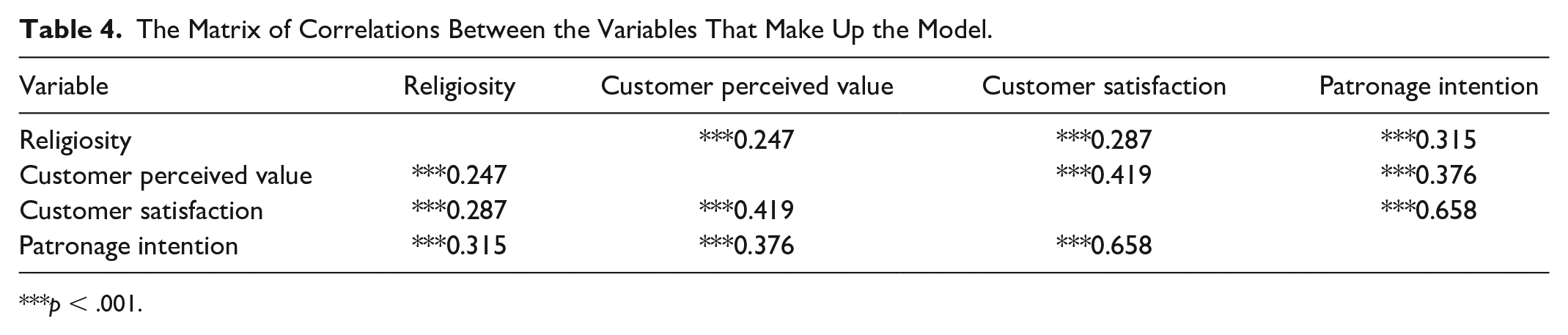
p < .001.
To examine the further mediating effects of CPV and Customer Satisfaction in Table 5, an analysis was done using the method adopted from Brown (1997) to determine the direct, indirect and total effects. This research examined the effect of Religiosity as the independent variable on Patronage Intention as the dependent variable as well as the mediating effects of CPV and Customer Satisfaction. The results showed that the Customer Religiosity toward Muslim fashion products had a significant indirect effect on Customer Satisfaction (α = .201, p < .001).Thus, Religiosity had direct and indirect effects on Patronage Intention, in which the indirect effect was through Customer Satisfaction.
Significance Testing Results of the Structural Model Path Coefficient.

Note. NS = not significant.
p < .10. **p < .05. ***p < .01.
Direct, Indirect, and Total Effects.

Figure 2 presents the final results of the structural model regarding the relationship between Religiosity and Patronage Intention through CPV and Customer Satisfaction. All the relationships between the variables (Religiosity and CPV; Religiosity and Customer Satisfaction; CPV and Customer Satisfaction; Customer Satisfaction and Patronage Intention) were significant at p < .01, excluding the direct relationship between Religiosity and Patronage Intention which was significant at p < .05. There was only one relationship with no effect, that was between CPV and Patronage Intention.

Measurement model.
Discussion
This research aimed to find out the relationship between religiosity and patronage intention in the context of Muslim fashion products. Based on the literature review, the researchers proposed and tested the research model examining the mediating effects of CPV and Customer Satisfaction. The results are consistent with the study conducted by Jamal and Sharifuddin (2014). According to Maclean et al. (2004), religiosity has an important role in transmitting religious values and forming part of individual self-identity. The assumption is that if an individual includes religion as his identity, it will greatly influence his values and behavior. One behavior highlighted in religion is the behavior toward products according to religious teachings, one of which is Muslim fashion products. Fashion is a driving force that shapes the way people live, affecting clothing, hairstyles, art, food, cosmetics, vehicle, music, and others of daily life (Solomon & Rabolt, 2009). Fashion functions to help a person create a good impression on others (Auty & Elliott, 1998) and communicate his position in society. Therefore, fashion representing the identity of Muslims should be in accordance with Islamic clothing rules. In linear, Muslim fashion businesses are increasingly following the Muslim clothing style trend, so are the stores selling Muslim fashion products. The adjustments made by Muslim fashion stores on the products are considered according to Islamic rules so as to attract Muslim consumers with high religiosity.
The research results prove that the effect of religiosity on CPV was significant, confirming the previous theories (Zeithaml, 1988). There had long been no studies examining the effect of religiosity on CPV. Religiosity determines life ideas reflected in individual and social values and attitudes (Fam et al., 2004). The attitudes and values shape the behaviors and practices of people and groups. One’s religiosity can reflect his or her value in choosing Muslim fashion products. The higher a person’s religiosity is, the higher the person’s value in choosing Muslim fashion products will be.
The previous studies have suggested the positive relationship between Religiosity and Customer Satisfaction. This research strengthens the previous study of Eid and El-Gohary (2015). Moreover, Delener (1994) defined religiosity as a highly important construction affecting consumer decision-making through individual cognitive and behavioral influences over time. If a consumer makes an appropriate purchasing decision, he will be satisfied. Customer Satisfaction generates the possibility of higher repeat purchase in time (Zeithaml et al., 1999) and makes the satisfied customers kindly recommend the product to others (Reynolds & Beatty, 1999). A good product-purchasing decision made by Muslim fashion product buyers who have high religiosity can lead them to satisfaction with the Muslim fashion products offered in the store.
This research also supports the study of Jamal and Sharifuddin (2014) examining the relationship between religiosity and patronage intention. Consumers buying Muslim fashion products consciously understand that they as Muslim must wear clothing according to Islamic sharia. In other words, the religiosity level of the respondents in this research is quite high, directly and indirectly encouraging them to revisit the Muslim fashion stores. According to Shim and Kotsiopulos (1992), patronage intention is consumer behavior in choosing a store that represents their purchasing activity preferences in a particular store. In this case, the Muslim fashion stores involved in this research have represented the consumer preferences in choosing and buying products that match their religiosity. The Muslim fashion stores have also met the terms and conditions of Islamic teachings in producing and selling Muslim fashion products.
Furthermore, the results of this research are in line with studies conducted by Blasco et al. (2017); Gallarza (2016); and Eid and El-Gohary (2015) examining the relationship between CPV and Customer Satisfaction. CPV is a perception of what customers feel, and the evaluation of product attributes, performance, and consequences after the product consumption will make the customers achieve their goals in various usage situations (Woodruff, 1997). Customer satisfaction is an antecedent and also a consequence of value perceptions. Several researchers more support for the values that are positively perceived and directly influence customer satisfaction (Cronin et al., 2000). Customer values will be obtained if consumers have been through various situations such as experience, knowledge, and even the use of products. That is, customer satisfaction with a product will emerge due to various situations they have experienced.
This research found that CPV had no effect on Patronage Intention, not supporting the previous studies of Rahman et al. (2016); Michon et al. (2015); Jamal and Sharifuddin (2014). CPV is consumers’ whole assessment about the usefulness of products or services based on their perceptions of the product benefits they will receive (Zeithaml, 1988). Therefore, perceived values are subjective. That is, if the value of a Muslim fashion product is perceived to be positive, the buyer will intend to revisit the same store as the product matches his expectation. In this research, the relationship between CPV and Patronage Intention was not significant because limited to the selection of shop and area criteria so that Muslim fashion products are considered less varied and limited. This is also triggered by consumer perceptions of fashion that are not always positive. This can be caused by several factors such as the level of individual religious commitment, fashion sensitivity, financial situation, and the clothing style/design.
Although the store characteristics were the same, the Muslim fashion products offered were limited, so the products did not widely vary. If product variation is limited while the customer value is high, consumers will not be interested in visiting the same store. This research found that the majority of the respondents were young aged, so it can be concluded that the young Muslim women have a tendency not to revisit to the same store due to their changeable tastes. Thus, the products sold should follow the trend. Wai Yee et al. (2016) said that young consumers are stylish buyers who have a strong tendency to follow the latest fashion trend. Customer satisfaction acts as a variable that mediates CPV with Patronage Intention. Muslim consumers having a good CPV on the product will not visit the same store if they are not satisfied at first. Bolton and Drew (1991) found that behavioral intention is the key to patronage and can be developed by increasing more satisfied customers by adding value to the services provided.
In this research, the relationship between Customer Satisfaction and Patronage Intention was significant, reinforcing the previous studies of Sadachar and Fiore (2016) and Sharma (2015). According to the previous studies, customer satisfaction is the main key to patronage intention (Hutcheson & Moutinho, 1998; Stank et al., 1999; Taylor & Baker, 1994). In the end, customer satisfaction directly affects patronage intention. Consumers who are satisfied with a product will revisit the same store or recommend the products to others.
Implication
The results of this research provide several managerial implications. First, Muslim fashion store entrepreneurs must ensure that the products sold have a high value of religiosity and maintain the product quality according to Islamic sharia so as to generate high consumer perceived values. If the consumer perceived values of the products offered are high, they will tend to revisit the store. According to Kahle et al. (2005), religiosity is not widely studied in research on consumers. This is due to the assumption that religion and religiosity are the basis of social values in society. Religiosity can be measured as a person’s cognitive attitude in which individual religiosity can vary according to their interests. Therefore, if a fashion product is perceived to be not in accordance with the religiosity benefits as consumers want, the CPV will be low. Moreover, the results of this research indicate that higher religiosity will increase CPV.
Second, Muslim fashion designers or entrepreneurs who produce and sell Muslim clothing should know the dress code for Muslim women so that the products sold follow the Islamic rules. Religiosity considers the quality or the extent to which a person is religious (Eid & El-Gohary, 2015). This research intended to examine whether someone with high religiosity would have high satisfaction with Muslim fashion product as expected. If a product quality is considered to be in accordance with one’s religiosity, it will create high satisfaction.
Third, positive perceptions of Muslim fashion products need to be embedded in Muslim fashion store visitors so as to generate consumer satisfaction. The effective way is to follow fashion trends and develop products according to the expectations of consumers who have high religiosity. CPV is a perception of what customers feel, and the evaluation of product attributes, performance, and consequences after the product consumption will make the customers achieve their goals in various usage situations (Woodruff, 1997). The research results indicate that the higher the CPV is, the higher the consumer satisfaction will be.
Fourth, high customer satisfaction will increase the desire to revisit the same store. The previous theories defined Customer Satisfaction as the main key for Patronage Intention (Hutcheson & Moutinho, 1998; Stank et al., 1999; Taylor & Baker, 1994). Sadachar and Fiore (2016) studying Indian retailers showed that Customer Satisfaction has an effect on Patronage Intention.
Furthermore, the researchers found a significant relationship between religiosity and patronage intention. This finding is in contrast with Jamal and Sharifuddin’s (2014) study but supports Fara et al.’s (2016) study. Religiosity can, directly and indirectly, affect customer intention to revisit the Muslim fashion store. The indirect effect is obtained through other factors, namely CPV and Customer Satisfaction. A religious consumer can directly intend to revisit a store if the store provides products as he expects. Meanwhile, through Customer Satisfaction, a consumer needs to consider first the fashion store on whether the products sold match his level of religiosity. Therefore, Muslim fashion stores need to maintain and improve products that reflect the high level of one’s religiosity.
As for the relationship between CPV and Patronage Intention, no significant effect was found, not supporting the study of Rahman et al. (2016) but concurs well with the study of Jamal and Sharifuddin (2014). This is because the products studied are categorized into Muslim fashion so that consumers really consider the value of religiosity inherent in Muslim fashion products sold in the stores. That is, when the stores do not provide the value of religiosity, consumers do not intend to revisit the same store. The intention to revisit Muslim fashion stores can also be due to factors other than CPV.
Conclusion
Religiosity has both direct and indirect effects on patronage intention, in which the indirect effect is mediated through customer satisfaction. CPV has no effect on patronage intention. Muslim consumers with high religiosity will show their interest to make a repeat purchase of Muslim fashion products in the same store both directly and indirectly (through CPV and customer satisfaction first). Consumers who intend to visit a Muslim fashion still need to consider the conformity between their religiosity and the products offered in the store as the research results indicate that CPV has no effect on patronage intention. In line with this, Muslim fashion stores should increase the important attributes of their products so as to generate the consumer intention to revisit the store directly (without through other variables).
Limitation and Future Studies
This research has several limitations. First, the data were collected from Muslim fashion stores with limited areas. Therefore, future studies are suggested to expand the scope, not only involving Muslim fashion stores or outlets but also malls, department stores, hypermarkets which tend to sell various products (not only Muslim fashion). Second, this research only used a limited number of samples. Therefore, future studies should enlarge the sample size. Third, this research was limited to female (Muslim women) consumers. Hence, further studies are expected to involve male (Muslim men) consumers.
Furthermore, the researchers recommend further studies to add other variables, such as store atmosphere, storekeeper service quality, and consumer experience, that can mediate the relationship between religiosity and patronage intention. In addition, further works are hoped to add the variables of loyalty and customer engagement as the next patronage intention behaviors.
Footnotes
Declaration of Conflicting Interests
The author(s) declared no potential conflicts of interest with respect to the research, authorship, and/or publication of this article.
Funding
The author(s) received no financial support for the research, authorship, and/or publication of this article.
