




Abstract
This research is quantitative research with a survey method that aims to obtain and determine the level of perception, namely on situational factors, perception factors, and object factors with research subjects namely women in 34 provinces in Indonesia. The sample in this study was women with an age range of 16 to 45 years with a total sample of 1,171 respondents and the distribution of research questionnaires was carried out online. The research finds that the situation factor which became the first indicator in this study, there were six questions given with an average of 78.62 or in the very good category range. The second indicator is the perception factor with eight questions that get an average of 60.34 so that it is included in the good category. The third indicator is the object factor with six questions that have a higher average value of 88.82 with an excellent category. This shows that the index of women’s perceptions of corruption cases in Indonesia has a very good index on the object factor, a good index on the situation factor, and a good index on the perception factor. However, women in Indonesia also perceive corruption as a normal thing and it has even become a culture in people’s lives. Therefore, it can be interpreted that corruption cases become objects or targets of events that are very influential in the minds or perceptions of women in Indonesia.
Plain language summary
Corruption cases in Indonesia have long been a concern of the people. This research aims to gain a deeper understanding of how women in Indonesia view and engage with corruption cases in the country. This study explores the level of concern, concern, and interest shown by women toward corruption, taking into account various situational, perceptual, and objective factors. By investigating these aspects, this study aims to provide a comprehensive understanding of women’s perceptions of corruption and their role in overcoming this problem in Indonesia. The research results show that the index of women’s perceptions of corruption cases in Indonesia has a very good index on the object factor, a good index on the situation factor, and a good index on the perception factor. Regarding the survey, can be concluded that there are quite many women who think that the problem of corruption in Indonesia has become entrenched. This research results illustrate that for women, corruption is considered a common thing that occurs in people’s lives and has even become entrenched in everyday life. Corruption is a common thing in social life in Indonesia. Corruption cases become objects or targets of events that are very influential in the minds or perceptions of women in Indonesia. Indonesia’s government and KPK should be able to carry out a massive anti-corruption education from an early age to the next generation so that honest attitudes and behavior can be well inculcated. Women who have a big role in education in the family should be more involved in anti-corruption education so that corrupt acts can be eliminated from the lives of Indonesian people.
Introduction
The case of corruption in Indonesia is an old issue that has caught the attention of the Indonesian people until now. In the 2020 Corruption Perception Index report, for example, Indonesia was ranked 102 in the world with 37 index number (Transparency, 2021). Corruption in this research defined in accordance with Indonesia’s Law No. 31 Year 1999 as amended by the Law No 20 Year 2001 on the Eradication of Corruption. Under Law No. 31 Year 1999 as amended by the Indonesia Law No 20 Year 2001 on the Eradication of Corruption, there are seven categories of offences that constitute corruption; acts that cause losses to the nation, bribery, occupational embezzlement, extortion, deception, conflict of interests in procurement of goods and services, and gratification (Republic of Indonesia Government, 2001).
Corruption, being a disease to society, encompasses individuals who are meant to serve as societal role models. These individuals are elected based on their pledges to the public, possess education and extensive knowledge, and assume their responsibilities (Prabowo et al., 2017; Znoj, 2008). Despite having taken oaths in accordance with their religious and personal beliefs, corruption remains prevalent in Indonesia (Yogi Prabowo, 2014). The Anti-Corruption Education Centre emphasized that effectively eliminating corruption necessitates a collective comprehension and shared perception of corrupt practices. This shared understanding enables prompt and targeted actions in combating corruption. There are three strategies that can be carried out simultaneously so that the eradication of corruption runs more effectively. The first is repressive, namely legal action to bring corruptors to court. Public complaints are one of the most important sources of information to be forwarded by the Corruption Eradication Commission (KPK) (Nugraha & Nuraini, 2017). Improvements to the system must be carried out and even tightened so that there is no longer a gap for people who like diseases such as corruption. The third strategy is to conduct education and campaigns. Education and campaigns are anti-corruption education learning strategies with the aim of raising public awareness about the impact of corruption, inviting the public to be involved in the anti-corruption movement, and building anti-corruption cultural behavior (Abraham & Sharron, 2015; Wiyono et al., 2020). With anti-corruption education, it is hoped that the same perception will grow on preventing corruption in Indonesia.
Corruption is a pervasive phenomenon, particularly in less developed nations. Based on data from Transparency International, as a developing country, Indonesia gets score of 38/100 in the Corruption Perception Index (CPI) 2021, and is ranked 96th out of 180 countries. The 2022 Corruption Perceptions Index (CPI) Indonesia in 2022 is at a score of 34/100 and is ranked 110 out of 180 countries surveyed. This score is down four points from last 2021, which was at a score of 38/100. This needs to be a serious discussion in seeing how the public responds to the issue of corruption, especially in Indonesia, as one of the countries with the largest economy in Southeast Asia. The urgency that needs to be discussed in the perception of corruption is basically also related to cultural aspects, including the aim in this study to look at women’s perceptions of the issue of corruption in Indonesia.
The discourse on women’s participation in society is also associated with the issue of preventing corruption (Debski et al., 2018). Multiple significant researches have affirmed that the involvement of women in politics and as bureaucrats does not lead to a decrease in petty corruption in countries where corruption is widespread (Brierley & Pereira, 2023). Furthermore, there is an observed adverse correlation between the presence of women in public agencies and the prevalence of corruption. Women’s perceptions related to corruption are important to be seen as another point of view in interpreting how corruption is interpreted by society. Corruption and the perception of corruption can be seen as cultural phenomena as they are influenced by a society’s understanding of rules and what is considered a deviation from those rules (de Oliveira Leite et al., 2020; Melgar et al., 2010). Furthermore, these phenomena are not solely determined by societal norms but also by an individual’s personal values and moral perspectives. For instance, while one person may never consider paying a bribe acceptable, another individual may justify such an action. This willingness to engage in corrupt practices is likely to be positively associated with one’s perception of corruption. Recognizing the factors influencing individuals’ perception of corruption holds significant importance, as perceiving high levels of corruption can lead to a culture of distrust, which may prove more harmful than the corruption itself. In fact, the perception of corruption can have a tangible impact on the actual occurrence of corruption (de Oliveira Leite et al., 2020).
In Indonesia, women play an important role in the process of family education of ideology, ethics, and norms, where the position of women is very central in shaping family culture (Mahsun et al., 2021). Thus, the perception of Indonesian women about corruption, can be describe with wider perspective on corruption issues. In 1974, the Indonesia government officially recognized women as an important force in their participation in national development. The year before an Indonesian had been initiated, which had classified women as a vital group in society with a special role and responsibility in the development process (Evers & Gerke, 2007). Based on those arguments, the significant role of women in the discourse of social development can be stated to be important issue, so that the perception of Indonesian women toward corruption may offer a new perspective in viewing social development in Indonesia.
Of the many literatures, one of the interesting is the influence of women’s representation on perception of corruption in government. Using time series analysis from 140 countries around the world from 1998 to 2011, it was found that women’s representation correlated with lowers corruption, while gender perceptions of corruption among political elites (Watson & Moreland, 2014). The results of research related to mayoral elections in France show that female mayors reduce the risk of corruption, it’s just that gender differences are not clearly observed (Bauhr & Charron, 2020). So that the author’s approach in offering another perspective in looking at the perception of corruption in Indonesia, is expected to provide another perspective in linking the course of women’s perceptions of corruption in the culture of Indonesian society which has its own cultural characteristics and uniqueness.
Perception is conditioned by individual opportunities and constraints. Political and economic developments also contribute to individual perceptions. There is also a gender gap in perceptions of corruption. In the Korean context, Women are more tolerant of inappropriate claims of state benefits (Lee & Chavez, 2020). Culture can also influence an individual’s perception of ethical behavior. Getz and Volkema describe culture as the antecedent of corruption and note that cultural values drive social norms that guide decisions about whether to engage in corruption (DiRienzo, 2019). Based on a survey of civil servants in China, clientelism is revealed as an important clear variable in the relationship between gender and tolerance to corruption (Tu & Guo, 2021).
How people respond to the problem of corruption in Indonesia is an important thing to know. This is related to the anti-corruption education strategy that seeks to instill the values of honesty, truth, and justice in everyday life. When most people have the same perception about corruption as a heinous act that not only violates laws and regulations, but also violates human rights, it is certain that people will avoid acts of corruption. According to the UN, an estimated 70% of the world’s poor are women. Corruption, according to Transparency International hits the poor and vulnerable groups the hardest, especially women, who represent a higher share of the world’s poor (Chêne & Rheinbay, 2016).
The inculcation of the values of honesty, truth, and justice as the foundation against corruption in Indonesia cannot be separated from the role of women. As a mother who has an important role in the education of children from within the family, she is one of the key factors in anti-corruption education. When children have been instilled the values that form the basis of an anti-corruption attitude, usually children will always hold fast to these principles until adulthood. In addition, in today’s fast-paced era, women also have an important role in decision-making in the legislative, judicial, and executive levels. Women in Indonesia have been able to actively participate in political and policy processes that concern the lives of the Indonesian people.
Research from Sundstrom and Stockemer (2019) using new indicators that measure corruption in the executive branch, shows that corruption tends to hinder the presence of women in the cabinet, although only in democracies and not autocracy. They found that corruption was not gender neutral. Democracies are highly corrupt, lagging in terms of quotas of women from cabinet positions (Sundstrom & Stockemer, 2019). Gender relations may limit women’s opportunities to engage in corruption and there is little evidence that women would act in a less corrupt manner if they could access high-level decision-making or management positions in the public and the private sectors (Chêne & Rheinbay, 2016). Women’s Women empowerment is a powerful tool to mitigate corruption as it complicates the social networks and mechanisms that allow corruption to proliferate (Carranceja, 2021).
This study aims to delve deeper and provide greater specificity regarding the perspectives of women on corruption cases in Indonesia. The researchers seek to investigate how women in Indonesia perceive, acknowledge, and engage in discussions concerning the pervasive issue of corruption in the country. The research also intends to examine how the interest, concern, and attention that women have toward the ongoing prevalence of corruption cases in Indonesia. This study proposes three main hypotheses.
H1: The level of attention and concern displayed by women in Indonesia toward corruption cases is insufficient, considering various situational, perceptual, and objective factors.
H2: Women in Indonesia exhibit diverse attitudes toward corruption cases and corrupt behavior within society, which can be observed through situational factors, perceptions, and objectives.
H3: Indonesia’s women have the potential to play a pioneering role in the anti-corruption movement, starting from grassroots initiatives to broader societal contexts.
Literature Review
Gender and Women’s Corruption Perceptions
Perception is a process to understand the environment, which includes objects, people, and symbols or signs that involve cognitive processes (recognition). Cognitive process is a process in which individuals give meaning through interpretation of stimuli (stimulus) that appear through certain objects, people, and symbols. In dealing with a condition and also a problem, we often have different perceptions even though the object of the problem may be the same. This happens due to differences in the value system and personality traits of the individual concerned (Abraham & Sharron, 2015). Perception is defined as seeing or how people see things. In a broader sense, Leavitt in Sobur defines perception as how someone perceives or interprets something (Sobur, 2009). Perceptions that are owned can influence a person’s actions, so if it is associated with risk, the perception of risk is a process where individuals interpret information about the risks they get (Notoatmodjo, 2005).
There are three factors that influence a person’s perception according to Robbins and Judge (2014), namely; (a) Situation Factor. Perception must be viewed contextually, which means the situation in which the perception arises and must also get attention. The situation is a factor that plays a role in the process of forming one’s perception. (b) Perceiving Factor. This factor exists when someone who sees something and tries to give an interpretation of what he sees will be influenced by individual characteristics such as attitudes, motives, interests, interests, experiences, knowledge, and expectations. (c) Object/Target Factor. The object or target of perception can be a person, object, or event. These characteristics usually affect the perception of people who see it. The perception of the target is not something seen in theory, but in relation to the other people involved. This will cause a person to tend to group people, objects, or similar events and separate them from other dissimilar groups.
The discussion surrounding perceptions of corruption revolves around the understanding and definition of corruption itself, as well as the factors that contribute to the formation of these perceptions. According to Blackburn et al. (2004, p. 5), public sector corruption involves the illicit or unauthorized profiting by officials who exploit their positions for personal benefit (Rustiarini et al., 2019). The concept of corruption is applied in various contexts, and its interpretations differ significantly not only between societies but also among individuals. Corruption is seen as a cultural phenomenon by Melgar et al. (2010). The argument that places corruption as a cultural phenomenon then opens a wider discussion space in examining the issue of corruption in a more specific approach. Including discussions related to perceptions of corruption in diverse cultural conditions in various countries in the world.
Regarding the perception of corruption, we compiled a literature that builds a conceptual framework that can explain the perception of corruption as a phenomenon that also explains the condition of corruption itself in government or state institutions with various cultures. Consequently, when there is no universally agreed-upon definition of corruption, it becomes challenging for researchers to determine which factors contribute to the perception of corruption. In simpler terms, how individuals perceive the extent of corruption may rely on their own interpretation of corrupt behavior and their individual traits or qualities (Rachmat, 2016). Personal character is one of the variables that becomes a specific aspect in explaining the perception of corruption in general, so efforts to explain the perception of corruption need to capture aspects of individual characteristics including socio-demographic. Bauhr and Charron (2020) concluded that factors such as role socialization, social status and life experience can make women and men feel various types of corruption. Corruption is sometimes driven by “necessity” rather than “greed.” Women may be more exposed to corruption needs because they take greater responsibility in both professional and personal areas.
The findings of previous researchers, Guerra and Zhuravleva (2022), Brierley and Pereira (2023) stated that societies in Latin America view the position of men and women can be equally corrupt. Citizens expect bureaucratic men and women to distribute an equal share of their salaries with their extended families. Equality in financial stress explains why bribe acceptance rates may be similar between the sexes. The difference lies in the aspect of tolerance, when not directly involved in bribery, men punish less than women. This contrasts with what is said (Barnes & Beaulieu, 2019), that voters may perceive women as marginalized in political institutions or more risk averse. Using survey experiments, male respondents perceive that women are more honest and thus less likely to be involved in corruption. These findings have implications for how women can create an effective political image.
In a regional analysis of 17 European countries (Jha & Sarangi, 2018), it was found that corruption was lower if women enjoyed greater status equality with men, perhaps because they were better able to influence policymaking. The interpretation of the results of this research is that a greater presence of women in parliament will reduce perceptions of corruption. This is in line with research using the Environmental Performance Index to measure the overall success of environmental policies at the country level, (DiRienzo & Das, 2019), showing a greater percentage of women’s power in political power correlates with reduced levels of corruption.
Women’s Participation and Role
Women, as stated by Plato, in terms of physical and spiritual strength and mentally are weaker than men, but these differences do not cause any differences in their talents. Meanwhile, Mansour Faqih conveyed that gender is something that is inherent in men and women which is constructed socially and culturally. Women are identified with gentle, beautiful, emotional, and motherly traits. While men are identical with strong, manly, mighty, and rational traits (Fakih, 2007). From social and cultural differences that have been passed down from generation to generation and last for a long time, in the end the construction of gender becomes something that is considered “reasonable” and even considered as “nature” for some people.
Gender is a concept used to distinguish the differences between women and men from a non-biological point of view. Gender emphasizes more concentration on social, cultural, psychological, and other non-biological aspects. The word gender can be interpreted as a visible difference between men and women in terms of values and behavior (Neufeldt, 1984). Gender is the role of men and women, which is the result of the process of social and cultural construction in society. An identification of the characteristics and roles given to men and women because they are based on habits or culture which ultimately forms a conclusion that these traits or roles are only carried out by men and women according to their respective roles.
According to the United Nations Development Program (UNDP) Indonesia, the underrepresentation of women in decision-making roles within the public sector has resulted in the formulation of economic and social policies that prioritize the viewpoints and interests of men (Bari, 2010). Furthermore, national resources have been allocated in a manner that predominantly benefits men. In fact, sometimes women have a dual role in a family, when they must carry out the role as a mother and on the one hand also as working women who earn a living for the family. Although women in Indonesia actively contribute to the national and the household economy through their productive and reproductive work, they are still excluded from various structures and decision-making processes at the family, community, and country levels.
The important roles of women is the first educator in the family. The first-time children get an education about physical activities, talking, knowing something, imitating, and other activities, is through family education. Through family education, children begin to recognize various symptoms, they learn to hear, see, and feel things around them. Likewise, character in family education, morals, behavior, cognitive abilities, attitudes, and various other aspects began to form (Rahman, 2015). Therefore, family education, which is mostly done by women (mothers) is the basis for further children’s education, both formal and non-formal education and more importantly in the context of the problem of corruption in Indonesia is how family education has contributed to the formation of character and characteristics of children related to anti-corruption traits and attitudes. With women’s perceptions and understanding of corruption issues, it is hoped that they can increase their understanding and application of insight into corruption issues in the family and community. In addition, the increasing number of women involved in the public sector, especially in the economic and political fields, is expected to bring progress to the participation and role of women themselves. With this progress, women can bring about change in the prevention and eradication of corruption in Indonesia.
Research Method
The method approach used in this research is a quantitative method. So that the empirical data obtained from quantitative data (questionnaires) can be well elaborated. In the context of this study, measurements were made on women’s perceptions of corruption cases in Indonesia, which is technically methodical. Measuring women’s perceptions of corruption cases in Indonesia using a public opinion survey with the quantitative method will apply the principle of probability in sampling. Probability is an empirical way to show the number representation in mapping data sources (the respondents; Creswell, 2016). The survey was conducted on women in 34 provinces throughout Indonesia by distributing online questionnaires. Furthermore, the survey data are presented in the quantitative descriptive form to get a picture or description of the variables of women’s perceptions of corruption cases in Indonesia. The data collected in this study was carried out using an online questionnaire that was submitted using Google Form.
With the method of determining probability, research only needs to be carried out on a few groups from most of the population. However, this method has a method test rule so that it has a high data accuracy with a truth range of 92% to 97%. In the implementation of sampling, the research team used a cluster random sampling technique, or random sampling based on area. With this technique, respondents are determined from the beginning, according to the percentage of the population in each province. The target population in this study was women aged 16 years and over. The sampling in this study used a purposive sampling technique which took samples according to the number of female residents in 34 provinces in Indonesia. So the research sample is 1,171 women aged at least 16 years.
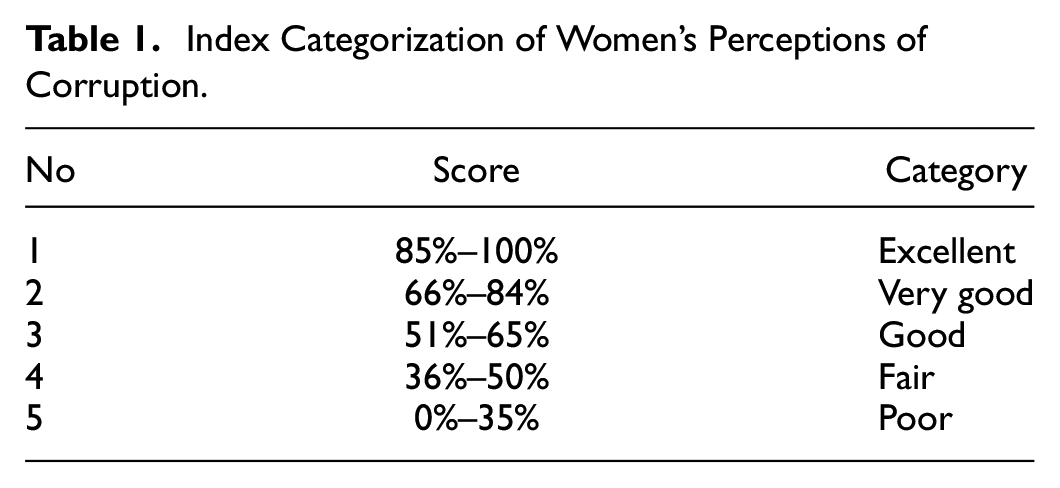
Data analysis for the measurement of the Women’s Corruption Perception Index in Indonesia uses descriptive statistical analysis. The three perception factors were then compiled into a questionnaire with 20 question items and four answer choices. The scoring uses a Likert scale, with a score of 1 to 4. The next analysis converts to a scale of 100, and the categorization of the index of women’s perceptions of corruption in Indonesia is determined as described in Table 1.
Index Categorization of Women’s Perceptions of Corruption.
The sampling technique used in this study is a cluster random sampling, or random sampling based on area. With this technique, respondents were pre-determined according to the percentage of the female population in each province and then compared to the female population in Indonesia, as listed in Table 2. From this percentage, the number of respondents by province described in Table 3.
Number of Respondents in Each Province.

Characteristics of Respondents by Age Range.

Results and Discussion
The respondents of this study were women aged 16 years and over. From the data obtained, it is known that the age of the respondents who participated in this study were respondents with an age range of 16 to 25 years or 57%, followed by respondents aged 26 to 35 years, with a percentage of 20%. In this case, the researcher sees that adolescent girls from the age of 16 years to women aged 35 years have great enthusiasm or desire to participate, especially with the topic of corruption cases in Indonesia.
The researcher also clustered the respondents' occupations, which were divided into students, self-employed, private employees, State Civil Apparatus, and others, as shown in Figure 1.
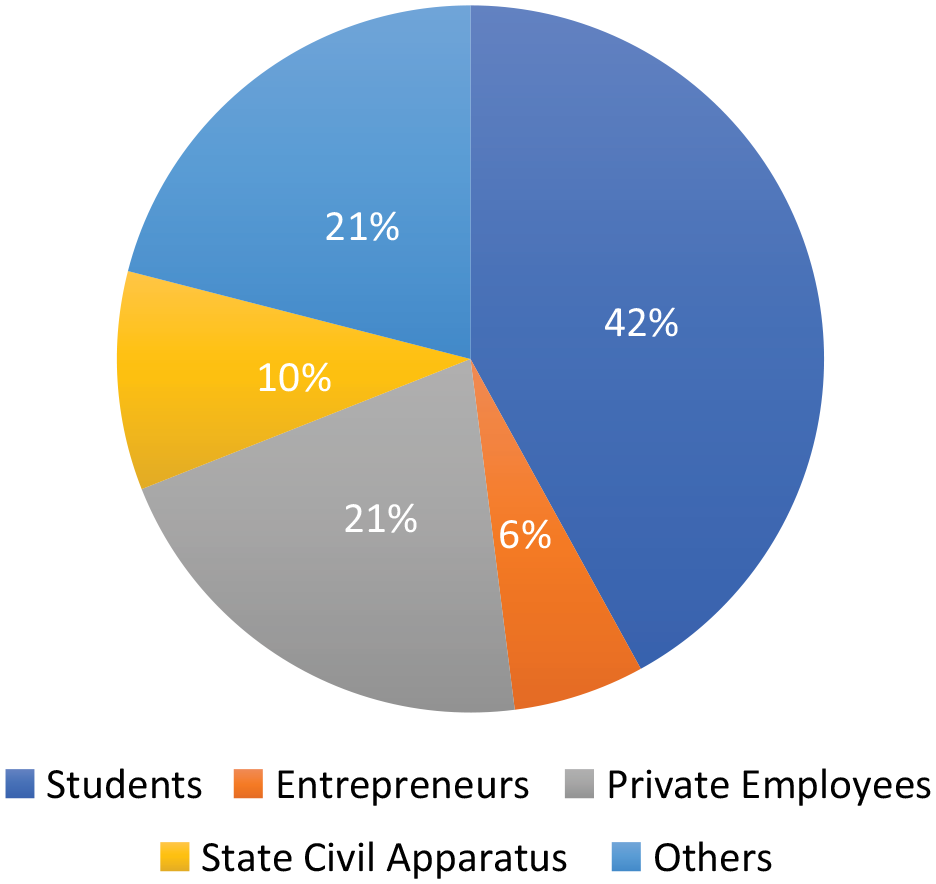
Characteristics of respondents by occupation.
Based on the pie chart above, it can be seen that the characteristics of the most respondents in this study are students with a score of 42%, followed by respondents with private employees and others, which are 21%. Respondents with the profession of State Civil Apparatus ranked third at 10% and the last one was respondents who worked as entrepreneurs, which was only 6%.
Before entering the index data, based on the results of the study, the researcher will describe in detail the mean value and category range of 1,171 respondents on each question item for each indicator, namely the perception factor.
Index of Women’s Perceptions of Corruption in Indonesia
Based on existing data, 1,171 women in 34 provinces in Indonesia have a tendency to respond differently to each indicator on the perception factor. This data can be the first step in mapping how women perceive in Indonesia regarding corruption cases that continue to be present and endemic in Indonesia. Or is it true that corruption has become a national culture?
This index illustrates that the level of women’s concern for corruption cases that are rampant to this day can still be increased. Although women in Indonesia have sufficient attention to education efforts and the anti-corruption movement, the efforts made by the government and the Corruption Eradication Commission (KPK) still has not built women’s awareness of the dangers of corrupt actions and behavior in social life.
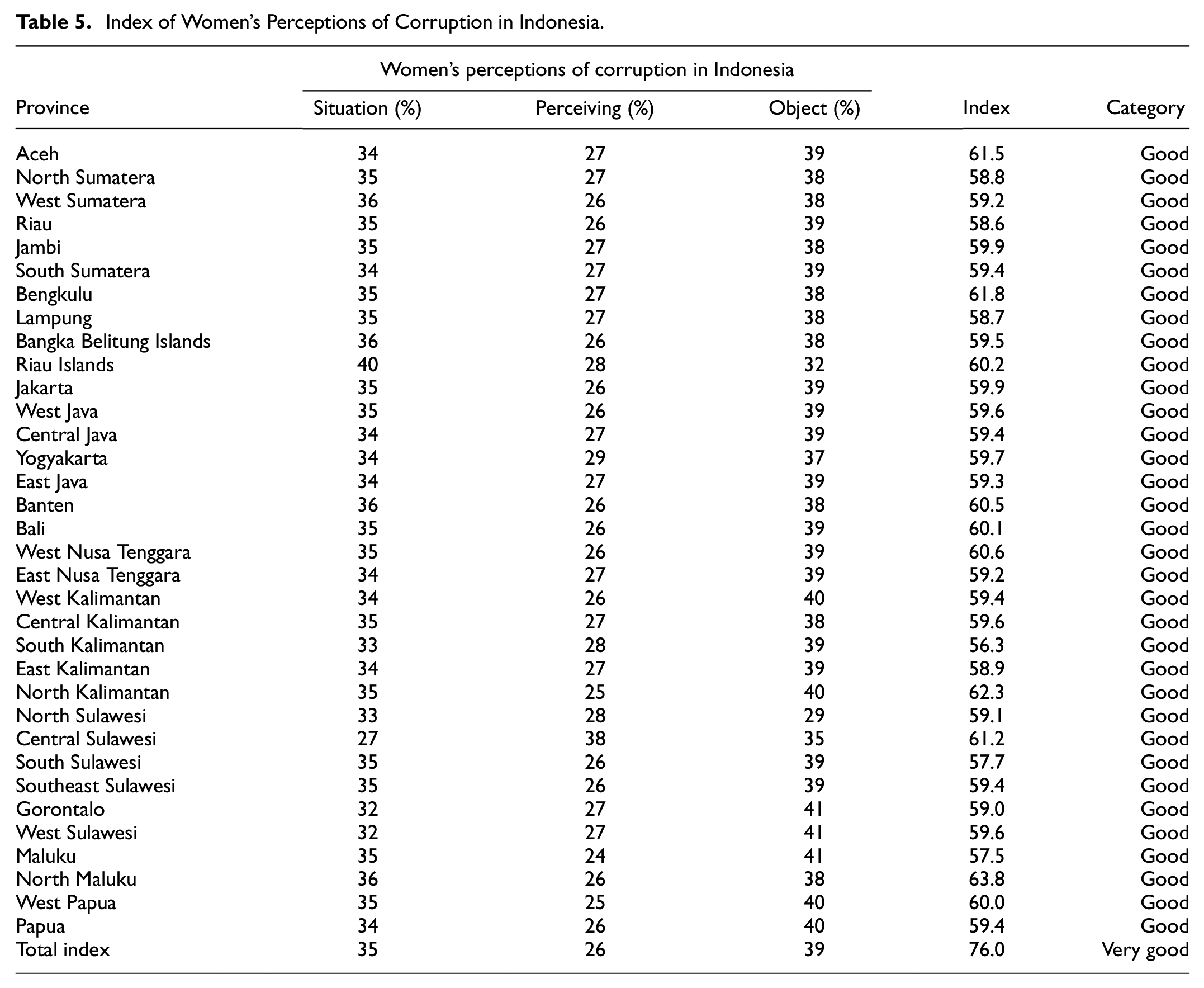
The interesting thing about the acquisition of the index data above, if we look closely, the percentage gain on the object factor indicator tends to be more dominant in almost every province, studied except for the Riau Islands and North Sulawesi, which are observed to have a higher percentage of the situation factor, which is 40% and 33%. Nevertheless, this figure still brings the two provinces in the good category range. Situational, perceiver and object factors are perception-forming factors capable of measuring and mapping which part of the factor is the most dominant in shaping one’s perception. Overall, the object factor is the factor that has the largest percentage, namely 39%, followed by the situation factor at 35% and the last is the perception factor, which is 26% to an index of 76.0 or falls in the very good category.
From Figure 2 it can be conveyed that the results of the research on the Women’s Perception Index of Corruption in Indonesia are in a good category with an average score of 76. With these results, it can be said that women in Indonesia have a fairly good concern for corruption cases in Indonesia. This index illustrates that women are still not sufficiently concerned about corruption cases that are rife today. From Figure 2 it can be seen that the situation factor is at 78.62 or in the good category. Regarding the situational factors in this survey, when asked whether corruption is part of the culture of the Indonesian nation, our findings show that 31%of respondents answered yes. So it can be concluded that there are quite many women who think that the problem of corruption in Indonesia has become entrenched. Likewise, when asked whether corruption is a common thing in social life in Indonesia, 46% of respondents, or a total of 540 people answered that they agreed. This illustrates that for women, corruption is considered a common thing that occurs in people’s lives and has even become entrenched in everyday life. Corruption is a common thing in social life in Indonesia.
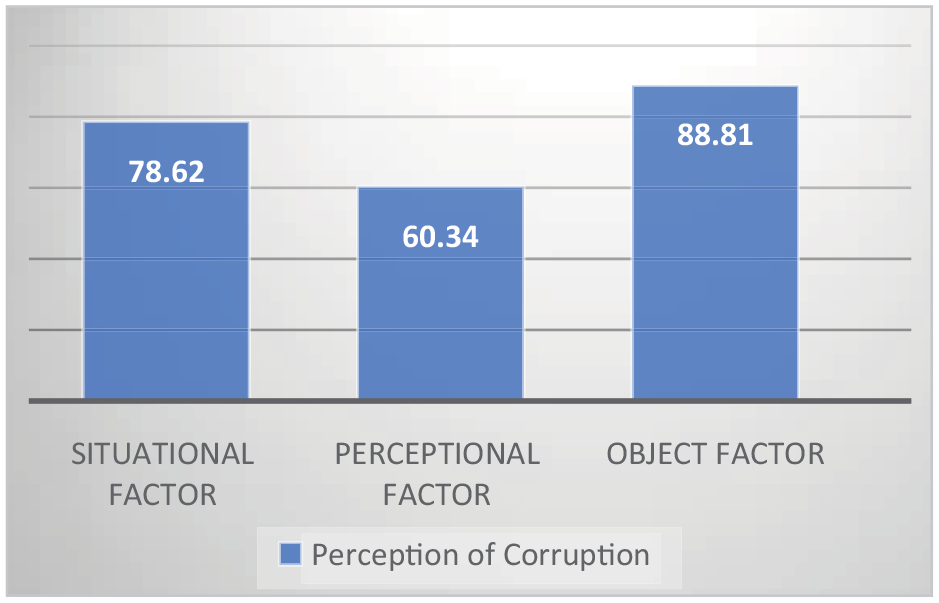
Index of women’s perceptions of corruption in Indonesia.
As we know, the object or target factor in perception is a person, object, or an event that will cause a person to tend to group the three things that are similar and then separate them from other groups that are not similar. This can mean that women in Indonesia are more inclined to understand, be aware of and know the weaknesses, shortcomings and what things can be improved, for example the Movement to fight corruption in Indonesia According to the data in Table 4, we can see that most respondents, 83.9%. agreed that the 2019 Amendment to the Corruption Eradication Comission (KPK) Law had weakened the power of the Corruption Eradication Comission (KPK) in eradicating corruption in Indonesia. Regarding the Anti-Corruption Movement, 99% of respondents agree that the anti-corruption movement must be deeply rooted in all levels of society. This of course needs to get the attention of all stakeholders in efforts to prevent and eradicate corruption in Indonesia. Likewise with regard to Education or the Anti-Corruption campaign, 98% of respondents think it should reach all levels of Indonesian society in an effort to prevent corruption.
Mean Value of Research Results.

According to the Table 5, we can see that situational factors are factored indicators that have the second largest percentage of 35% in 34 provinces in Indonesia. In this factor, perceptions are viewed contextually, which means that Indonesian women pay attention and participate in observing corruption cases that always appear, especially in Indonesia. Regarding the situational factors in this survey, when asked whether corruption is part of the culture of the Indonesian people, our findings are that 31% of respondents answered agree. So, it can be concluded that quite a lot of women think that the problem of corruption in Indonesia has become an entrenched thing. Likewise, when asked whether corruption is common in social life in Indonesia, 46% of respondents answered agree. This illustrates that for women, corruption is considered a common thing in people’s lives, and has even become entrenched in everyday life.
Index of Women’s Perceptions of Corruption in Indonesia.
The last factor that has the lowest percentage is the perceiving factor, which is 26%. Basically, the perceiving factor exists when someone sees something, at that time that person will give an interpretation of what he sees and will be directly influenced by his individual characteristics such as attitudes, motives, interests, interests, experiences, knowledge, and hopes. The interesting thing is that in women’s understanding of corruption cases in Indonesia, the experiences, attitudes, and motives related to corruption, Indonesian women still have very little awareness. The research team found interesting things where there was still 5.6% of respondents who received gratuities or 66 respondents, 2.7% or as many as 32 respondents had received bribes, and 4.9%, namely 58 respondents had made illegal levies. Likewise, when asked whether the respondent’s family had ever committed corruption, it turned out that 4% or 47 respondents answered that their family had committed corruption. This finding illustrates that there are still quite a lot of women in Indonesia who commit corrupt actions and behavior in the work environment and society.
The results of this research need to get the attention of all stakeholders related to corruption eradication, especially the government and the Corruption Eradication Commission (KPK) in order to strengthen the prevention and eradication of corruption (Husin & Tegnan, 2017; Suwana, 2020). The role of the President is very important in providing support and strengthening the Corruption Eradication Commission (KPK) as an anti-corruption institution that is the hope of the community. The government and the Corruption Eradication Commission (KPK) should be able to make a massive anti-corruption campaign to all levels of society, and not only through certain communities. Anti-corruption education must be given from an early age to the next generation so that honest attitudes and behavior can be embedded properly. Women who have a big role in education in the family should be more involved in anti-corruption education, so that corrupt actions can be eliminated from the lives of Indonesian people (Sukmareni et al., 2018; Syahuri et al., 2022).
Conclusion
From the results of the research the Women’s Perception Index of Corruption in Indonesia is in the good category with an average value of 76. With this result, it can be said that women in Indonesia have a fairly good concern for corruption cases in Indonesia. The situation factor is at 78.62 or in the good category. Meanwhile, the perception factor is at 60.34 or sufficient, meaning that on the perception factor related to experiences, attitudes, and motives related to acts of corruption, Indonesian women have less awareness. In terms of object factors related to figures, institutions, and movements in society, the research results are at 88.81 or very good. However, women in Indonesia also perceive corruption as a normal thing and it has even become a culture in people’s lives. The role of women is very important in the anti-corruption movement so that anti-corruption attitudes and actions are rooted in all levels of society. The position of women as subjects is very important in anti-corruption education as an effort to prevent acts of corruption. Early anti-corruption education for children by women (mothers) is expected to be an effective preventive effort against corruption eradication.
The results of this research need to get the attention of all stakeholders related to eradicating corruption, especially the government and the Corruption Eradication Commission (KPK) to be able to strengthen the prevention and eradication of corruption. The Indonesia’s government and KPK should be able to carry out a massive anti-corruption education to all levels of society, and not only through certain communities. Anti-corruption education must be given from an early age to the next generation so that honest attitudes and behavior can be well inculcated. Women who have a big role in education in the family should be more involved in anti-corruption education, so that corrupt acts can be eliminated from the lives of Indonesian people.
Footnotes
Acknowledgements
Thanks to Telkom University Bandung, Indonesia, and Mercubuana Yogyakarta University for the funding of this article.
Declaration of Conflicting Interests
The author(s) declared no potential conflicts of interest with respect to the research, authorship, and/or publication of this article.
Funding
The author(s) disclosed receipt of the following financial support for the research, authorship, and/or publication of this article: This article get financing from Telkom University Bandung and Mercubuana Yogyakarta University

Data Availability Statement
Data sharing not applicable to this article as no datasets were generated or analyzed during the current study.