




Abstract
Foreign aid is an important opportunity for developing countries to financing for development. As a result of this theory-based acceptance, foreign aid has long been granted to the Turkish Republic of Northern Cyprus (TRNC). However, the country’s level of development shows that the expected output from foreign aid has not been achieved. Yet, the continuation of foreign aid is only possible if it works. Identifying the barriers to the effective use of foreign aid will provide both the expected benefit and continuity of foreign aid for the TRNC. When we investigate the factors that cause this situation, we find that the literature does not provide a scattered, contradictory, and concise description of the causes. After an intensive literature review, we identify the factors that affect foreign aid. Through field surveys and other surveys, we confirm that these factors also apply to the impact of foreign aid to the TRNC. To quantify these factors, we have scored them for TRNC using different approaches. After this scoring, we reveal the factors that are open to improvement in TRNC. In other words, by applying this model to foreign aid to TRNC, we uncover the efficiency climate of foreign aid. As a result, for foreign aid to be effective, we conclude that it may be important to look at whether the conditions of the country are appropriate and to improve the noneligible ones to be more effective.
Introduction
Foreign aid refers to an ambiguous concept that does not have a general consensus about its meaning and limits and can be defined in different ways by different organizations and different states (Healey, 1971). To reach a conclusion by making use of the common points of these definitions, foreign aid can be defined as all of the donations, loans, and debts given by a state or an international organization to another state or international organization for the purpose of promoting economic and social development, improving democracy and human rights, social equality, meeting basic needs in emergencies, and so on (Keklik, 2011). In addition to this approach in the literature, the Organisation for Economic Co-operation and Development (OECD), which shapes a significant size of international aid organizations, has been carrying out important activities in this field and has an influence on the establishment of concepts. OECD Aid Committee (DAC) external aid and financial flows in the form of grants and subsidized loans, aimed at increasing the economic development and prosperity of that country from one country to another, are defined as transfers of resources such as technical support and goods that will contribute to the economic development and prosperity of the recipient countries (Görgülü, 2016).
For more than 40 years, TRNC has been receiving foreign aid to ensure economic development. At this point, it is often interpreted that these aids do not meet expectations and that the TRNC does not develop to the expected extent (TR-TRNC 2016-28 Program: 4). We accept this determination in official reports as data in our study. Our aim here is to determine the impact of foreign aid on the development of countries through literature review and to determine the determinants of this effect. In this way, we will investigate the factors that we need to pay attention to to increase the effect of the aid to TRNC. By analyzing the situation of these factors in the TRNC, we will contribute to the creation of the necessary climate for the effective use of foreign aid.
The research data will be analyzed in two cycles. In the first cycle analysis, the theoretical studies related to foreign aid will be examined and classified. In this cycle, empirical studies on the subject will be examined and the data on the effectiveness of foreign aid will be categorized. In the second cycle analysis, the data obtained from qualitative interview data will be coded and analyzed, and interpreted for the purpose of the research together with the data obtained from written sources. In the light of these explanations, Figure 1 shows the steps of the research.
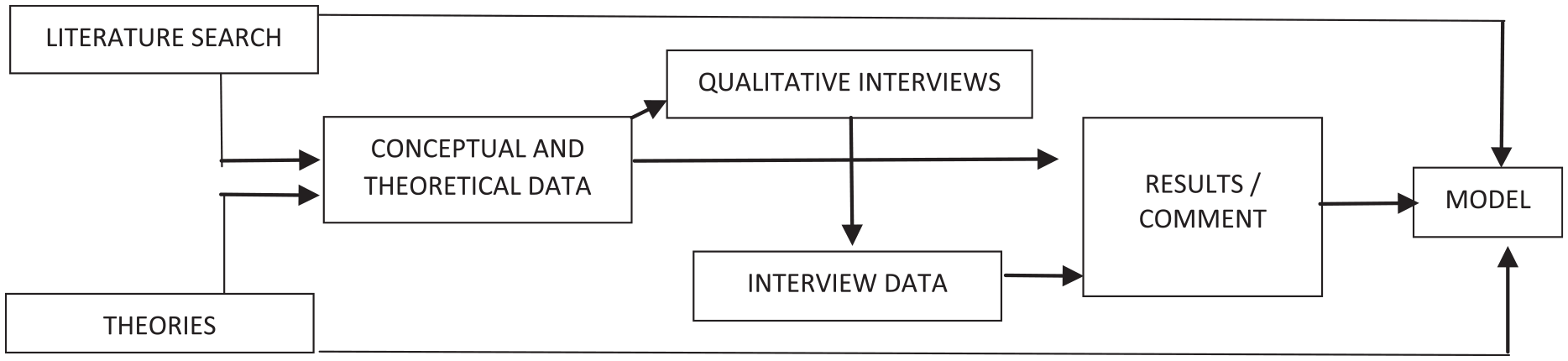
Research methodology.
In the first stage (Literature review), the current situation of the studies in the literature on foreign aid will be determined. In this context, the role of foreign aid in development economics will be examined and the empirical researches on foreign aid will be examined. What aspects of the effectiveness of the aids have been studied in the literature, what are the findings, and the consistency and the evaluation of the determinations will be carried out in this section.
As indicated in Figure 1, survey research of the study consisted of qualitative interviews. As a result of existing theory and literature, theoretical validity is achieved and structured interviews were used. Because of the nature of the research, judgment sampling was applied as detailed in the “Identification of Factors and the Survey” section.
In the second stage (Field research) of the research, whether the factors that are determined in the first stage are valid for TRNC will be tested in the field. The questions that have an impact on the effectiveness of the foreign aid will be determined through the questionnaires created by using the findings determined in the first stage. The data obtained will be analyzed.
In the third stage (Comparison of analysis results), the data obtained as a result of theoretical analysis and field research will be compared.
In the fourth stage (Model building), a separate literature review will be conducted on the item headings identified in the third stage, and how these headings are related to the aid, which direction of the relationship and how much affect the result will be revealed. Therefore, at this stage, there are questions to answer concerning the model’s functionality about that each item will be divided into pieces and analyzed and it will be revealed how these parts can be obtained in country examinations, and the literature review, the creation of new questionnaire, and the demonstration of how statistical data can be obtained.
In the fifth stage (Application of the model to the aid provided to the TRNC), it will be examined by running the model whether the aid provided to the TRNC is effective or not. Each item affecting the effectiveness of external aid will be examined and scored using the analysis methods described in the previous stages. As a result of this scoring, spider web analysis will be conducted and the recommendations will be made to the related parties on which items should be improved to provide more effective aid in the next period.
The article will begin with a literature review. For this purpose, “Foreign Aid and Researches on the Effectiveness of Foreign Aid” section was created. The section “Identification of Factors and the Survey” is then followed by field testing of the findings obtained in the first section. The section “The Efficiency Climate Analysis of the Aid Provided to TRNC” includes the examination of the findings in its 21 subsections. The article is completed with conclusions.
As a result, according to OECD data, all factors that hinder or support the success of foreign aid which reaches US$415 billion per year (OECD-DAC Total formal and private aid) can be addressed in a holistic approach using this model. In this way, donor countries will be able to analyze the existence of an adequate climate in that country for effective assistance before providing assistance. This amount shows that foreign aid is still important. This research will not only make efficient use of these amounts, but will also shed light for people with very low welfare levels to reach a higher welfare level.
Foreign Aid and Researches on the Effectiveness of Foreign Aid
One of the most important reasons for the underdevelopment of countries is the lack of capital. In economically underdeveloped and underdeveloped countries, capital is a scarce production factor, and in these countries, there are generally shallower capital markets. One of the theoretical solutions to these countries’ lack of capital is external financing. Two Open Theory (Karluk, 1980), Harrod–Domar Growth Model (Akdağ, 2007), Paul Rosenstein-Rodan Big Push Theory (Bakırtaş, 2014), Leibenstein Growth Model (Akdağ, 2007), Rostow Growth Model (Henrietta, 2006), Prebisch–Myrdal–Singer Growth Model (Akdağ, 2007), Ragnar Nurkse’s Growth Model (Arslan & Kiper, 2015; Bakırtaş, 2014) agreed on the positive impact of external financing. There are many types of external financing. Foreign aid, which is one of the types of external financing, is the most advantageous external finance used for development purposes because it has no repayment and/or good repayment conditions.
Although foreign aid was available in previous years, foreign aid in the modern sense began in the 1950s. Immediately afterward, researches began on the effectiveness of foreign aid. In general, according to the literature, the contribution of foreign aid to the development of countries is uncertain. Tüzemen and Tüzemen (2015, p. 61) and Görgülü (2016, p. 1314) state that “the expected effect of foreign aid was not seen in the past.” Since the 1950s, in the early years, as the theoretical results expected from foreign aid could not be seen in practice, researchers were called to study the effectiveness of foreign aid.
In the empirical research initiated after the 1960s, the link between aid and saving was not as clear as it was assumed. In this framework, studies of Doucouliagos and Paldam (1970), Weisskopf (1972), Bauer (1972), and Mosley et al. (1987) are the leading ones. In these studies, following outcomes was identified: foreign aid did not have a total effect on economic growth; there is little or no relation between foreign aid and growth rates in developing countries; increasing foreign aid had a negative impact on domestic savings; as the amount of foreign aid increases, the yield of the receiving country decreases (Görgülü, 2016; Tüzemen &Tüzemen, 2015).
The studies conducted after the 1980s are those that focus on root causes compared with the previous ones. After this period, the effect of external aids on growth was tried to be determined by correlating with some specific factors. The same factor has been examined for many countries by considering many time periods.
Of these, Mosley (1987), Rattso (1992), Morrissey (1993), and Boone (1996) conducted important researchers in years between 1980s and 1990s. In their studies, the term macro–micro paradox of aid was developed. It was ascertained that foreign aid causes an increase in state consumption and may enable an environment for corruption, and the conditional aid could adversely affect growth rates (Görgülü, 2016; Mercieca, 2010; Morrissey, 1993).
In the second half of the 1990s, studies of Hadjimichael et al. (1995), 1 Durbarry et al. (1998), Isham et al. (1995), 2 Bonnick (1997), Bigsten (1998), Dollar and Pritchett (1998) standed out. In their studies, aid proved to be more effective with liberal policies; there is an optimal level of aid; foreign aid has become more efficient in countries with high-quality institutions; the aid may cause Dutch disease; it may move away labor and investments from other productive activities; it also may cause Zaire syndrome (Durbarry et al., 1998; Görgülü, 2016; Bonnick, 1997). In the 2000s, substantial studies have been conducted in this area such as Knack (2000), Hansen and Tarp (2001), Dalgaard et al. (2004), 3 Clemens et al. (2004), Tüzemen and Tüzemen (2015), Alfaro et al. (2004), Moss and Chiang (2003), 4 Presbitero (2005), 5 Djankov et al. (2006), Radalet (2006), Winters (2010), and Riddell (2014). Some of important outputs of these studies are the following: the aid can reduce the quality of state institutions; law of diminishing returns is valid; the aid can cause poverty trap; a corrupt and incompetent government cannot use foreign aid wisely and donor countries cannot pressure such governments to change their attitude; absorptive capacities come visible; the aid puts recipient countries under debt burden; the lack of quality data is crucial and affects the decision on delivering aid; the aid has an impact on democracy; unconditional foreign aid might lead more yields; in countries which have accountable institutions and democratic governments with the rule of law, foreign aid may be more likely to cause economic growth.
More than 55 empirical researches have been examined within the scope of the literature review. The literature review within the scope of this study has shown that the effectiveness of foreign aid has been a fundamental and repetitive theme that many economists have contributed to the different paradigms of development thinking. The question of whether foreign aid works is addressed from different methodological and ideological perspectives. More specifically, the researches include the impact of assistance at both microeconomic and macroeconomic levels:
based on case studies both across countries and in one country,
quantitative and qualitative, interdisciplinary research and analysis.
From an analytical perspective, both traditional growth theory and new growth models can be used to demonstrate that foreign aid can potentially impact economic growth through a wide range of channels. Some of the numerous case studies support the World Bank’s (1998) observation that foreign aid is a success. According to the reviews, generalization is difficult. It has been regularly discussed that traditional cross-country empirical studies do not provide statistically significant information. The studies range from the claim that aid is effective to the claim that it is ineffective. However, empirical studies show that there is an exaggerated relationship between aid and growth because early research is based on simpler modeling and inadequate data. Studies conducted after the 1970s have led to the conclusion that foreign aid is not as effective as expected on growth. Especially after the 1990s, researchers began to embody root causes by increasing their doubts about the ineffectiveness of foreign aid as they could act more impartially and access to more reliable data. In the light of these empirical researches, the basis of our analysis is as follows:
As a result of the analysis, the difficulties associated with investigating whether the aid promotes growth are better understood. In particular, there is a firm understanding of why empirical results tend to zero. The main factors behind this are weak data, the complexity of the growth process, the internality of aid, and the demographic effects of gains in social indicators, and these can be driven by aid.
Foreign aid provided during the years of the Cold War was consciously used for the continuation of the government in the receiving country rather than growth. This understanding did not allow economic models that would have a positive effect on aid growth.
Foreign aid is an important resource for the underdeveloped and developing countries to solve the problems such as saving gap and foreign exchange scarcity and to make the investments necessary for sustainable economic growth.
Poor countries are caught in a vicious circle of poverty because of their low income and consequently their low savings. Although the approaches of growth theories toward, especially savings, the elimination of foreign exchange and information deficit provide the right direction, the lack of results due to the unique conditions of each country leads to a skeptical approach and criticism on the theories.
While the empirical studies eliminate doubts, it identifies the obstacles to be eliminated and conditions to be fulfilled, to meet the aforesaid gaps in theories, test the weight of the literature expansions and for the relationship between aid and growth to manifest in a positive direction.
The literature in consequence of constructive criticism of the improvement of underdeveloped countries also provides an opening to the obstacles to the positive effect of aid on growth as expected.
Foreign aid can have a positive effect on growth only if used correctly. This effect can be seen if certain conditions are met and correct policies are implemented.
The researches and important determinations were made about what are these conditions and the correct policies with the empirical studies whose qualities have been increasing after the 1990s.
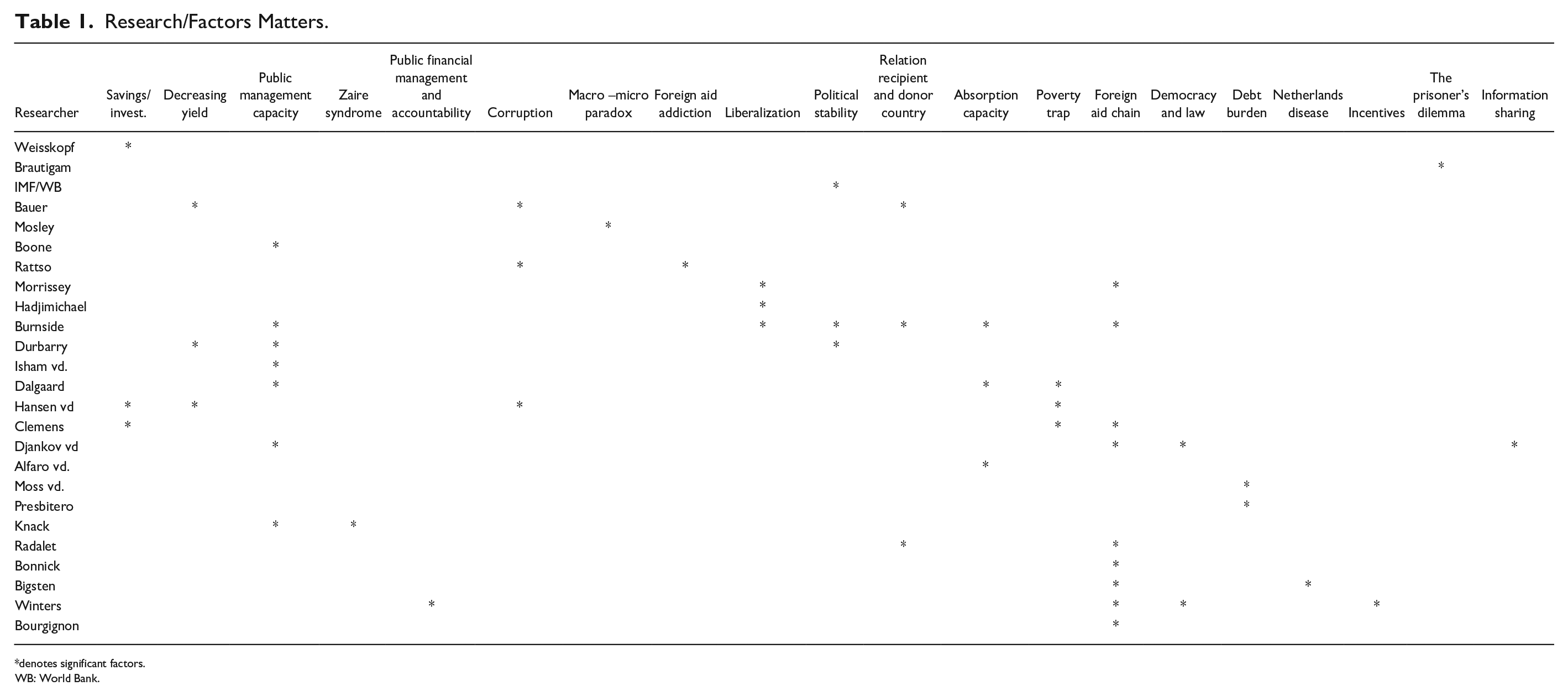
The factors which have been determined to have an impact on the effectiveness of foreign aid and are references for necessary conditions for development and correct policies are given in Table 1.
Research/Factors Matters.
denotes significant factors.
WB: World Bank.
The studies we have examined have yielded valuable results, but these investigations do not include all the problems by nature. Moreover, it also does not provide an analytical or standard definition of what can be understood from what is perceived as a problem. This prevents effective use of research results by those who have to take courses and take measures.
Therefore, the detected factors must be analytically identified and standardized; if any, the components of each factor must be determined; the issues about how and where they will be found in any country review and which methods will be used in this regard and so on need to be put forward. The factors to be included in our model are due to the transformation of the substances from the analyses above into an inclusive and comprehensible title.
In this context, each factor was examined in detail. In this detailed examination, for each factor, both the literature review and the specific empirical studies on the subject have been examined in terms of what is meant, in which direction its effect is, its importance, and what should be done with regard to this article to increase the effectiveness of the aid. The results of these examinations will be generalized by making a semi-structured questionnaire in the next section and presenting to the opinion of the top political, bureaucrats, and academicians who have taken part in the foreign aid process. The factors to be finalized by the feedback will be the final version of the items of the Model.
These studies and the issues that are found to be effective in these studies are shown in the matrix in Table 1.
Identification of Factors and the Survey
Approaches have been developed to determine the item headings related to factors by an analytical and a standardized definition through literature review. These approaches will be included in the analysis of foreign aid to TRNC to ensure the integrity of the subject. Studies that aim to test the model on the field will be included here.
As well known, substantial foreign aid by Turkey to the TRNC is done for about 45 years. Thanks to this aid, it cannot be denied that both sides have a considerable knowledge and experience. Therefore, this relationship on aid provides an ideal environment for testing whether the issues in the model are really factors that need to be considered. For this purpose, a survey was created and was applied on people who work on the aid provided by Turkey. The demographic structure of the survey participants is given in Table 2.
Demographic Distribution of Survey Participants.

Note. TR = Turkish Republic; TRNC = Turkish Republic of Northern Cyprus.
A foreign aid chain consists donor country politicians, donor country institutions, donor country’s aid offices, recipient country’s aid unit, and recipient country’s politicians. Utmost attention was paid to include the participation of all units in the aid chain in this survey. In addition, as different opinions in different conjunctures might give contradictory survey results as the time interval increases, people who worked in aid chain for last 10 years have been included in the survey. Academicians who have conducted research in this topic for the last 10 years have also participated in the survey.
On the contrary, it is aimed to ensure the participation of all persons in each cluster in the survey. In this context, following participants involved in the survey: all academicians who had researches on the use of aid and its social impact and were financed by the office for these researches between 2008 and 2017; all coordinators and assistants who had worked in the office for the last 10 years; and all undersecretaries, directors, and heads of units in the recipient country who had been in charge in the aid chain since 2010, the year in which the implementation of term program was initiated. As politicians, all finance ministers of TRNC and at least half of other ministers of recipient ministries in the last 10 years, and parliamentarians of Turkey who have responsibilities on Cyprus affairs participated in the survey. Accordingly, 32% of the survey participants are from Turkey where as 68% of them are from TRNC. On the contrary, 24% of the participants are academicians, 22% of them are politicians, 8% of them are donor’s institution staff, 8% of them are the staff of the donor country, 10% of them are the staff of the aid office, and 26% of them are the staff of the receipt country. The survey was conducted face to face in July to August 2018. Some participants were asked to answer to the questionnaire electronically, and then their opinions were received face to face or by phone for the second time.
Two issues have been identified after the field survey. First, 16 of the 20 factors in our model received strong support. The support for factors of “Poverty Trap,” “Zaire Syndrome,” “Macro–Micro Paradox,” and “Effects of Aid on Social Structure and Prisoner’s Dilemma” in our model is around 70% to 75%. The answers to the open-ended questions were analyzed in terms of these four factors. The idea of “Poverty Trap” is not fully supported because of the fact that the gross national product (GNP) per capita for US$15,000 is on the threshold of the amount in developed countries provides sufficient space for savings. “Zaire Syndrome” is not supported sufficiently because we need two conditions for the validity of this factor. First, qualified staff should work in aid offices with high salaries, and second, investments of local governments, which would already be carried out, should be made by aid offices. None of these is valid in TR-TRNC relations. For “Macro–Micro Paradox,” as it is a more technical issue, full support is not expected in the field. The factor of “Effects of Aid on Social Structure and Prisoner’s Dilemma” was clarified in the repeated interviews with the participants and it became a factor that attracted the attention of the participants. As a result, these issues/factors were preserved in the model due to both the support they received in the interview survey results and the reasons set forth in the analyses.
The second issue identified in the field survey is the shared views on the importance of the presence of a factor in the model which is “Property.” This opinion was supported in the interviews with other participants. For this reason, it was included in the model as the 21st factor, and its analytical and standardized definition were formed as a result of the literature review and its subfactors were identified and a method was developed to evaluate them.
Efficiency Climate Analysis of the Aid Provided to TRNC
Aid–Savings–Investment–Growth Relations
The main purpose of this theoretical approach, which is based on the aid–growth relationship, is to question the existence and strength of this relationship. One of the observations for delayed development has been depended on the idea that aid causes low local savings. Evidence from research shows that, although not more than the amount of aid, it leads to an increase in total savings (Hansen & Tarp, 2000). In this research, we will work on the aid–investment relationship on the basis of the aid from the Turkey to TRNC. We will look at three different relations: aid–savings, savings–investment, investment–growth.
The result of the trend analysis is that there is a weak relationship between aids and savings, but economic policies implemented after 2010 have led to an increase in savings and a reduction in consumption (Figure 2).

Aid–savings–consumption relationship (in 2018 prices, million TL).
The second analysis is the trend analysis of the relationship between savings and investments. As seen in Figure 3, while investments were higher than savings until 2010, after 2010, savings surpassed investments.

Savings–investment relationship (in 2018 prices, TL million).
Figure 3 shows us that there has been a sufficient amount of savings in the TRNC, but this amount did not turn into investment.
The annual periods are taken in Figure 4, which was drawn for the investment–growth relationship. The right axis shows the growth and the left axis shows the magnitude of the investment. There may be a rough relationship between investments and growth. When investments start to increase, growth responds to this increase with a greater increase. Likewise, when investments start to decline, growth reacts again to a greater extent. According to our trend analysis, while there is a correlation between aid and saving in TRNC, saving–investment relationship is ambiguous, and investment–growth relationship is weak. Regression analysis of these relations also seems to be useful. Table 3 shows the correlation results.
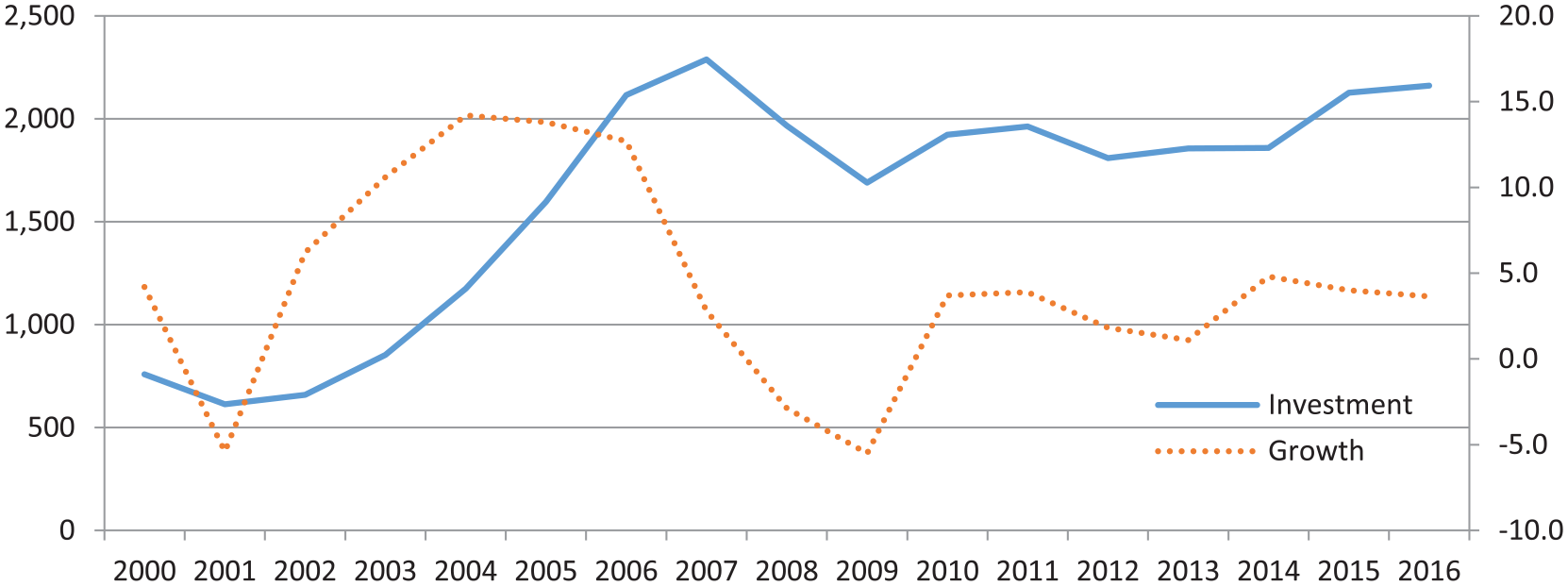
Growth–investment relationship (TL million in 2018 prices,%).
Correlation Results.

Note. N = 35 (years).
There is a significant, positive, and high-level relationship between aid and total consumption by years. The relationship between aid and saving is relatively low, but again significant, positive, and high. The fact that the relationship with consumption is higher than the relationship with saving shows that the aid goes to consumption more between the two. There is a significant, positive, and high-level relationship between savings and total investment. None of these was found to have a significant relationship with the growth rate only. To be used in Spider web analysis, assuming that the weight of the aid–savings relationship will be evaluated over 5 points, the weight of the savings–investment relationship will be evaluated over 3 points and the weight of the investment–growth relationship will be evaluated over 2 points. The situation in TRNC could be (2.5 + 1 + 0.5) 4 points.
Dependence on Foreign Aid
Bräutigam (2000) defines dependence on foreign aid as “a situation in which a country cannot perform many of the basic functions of government, such as operation, maintenance or provision of basic public services, without foreign aid funds and expertise (p. 2).” He continued with the idea that regardless of whether regulations are effective or not, the constant increase in the ratio of foreign aid payments to the national income of the recipient countries may lead to continuation in foreign aid rather than helping them to reduce imbalances in the economy. An “aid intensity” criterion is used to represent this situation. Countries receiving aid in the ratio of 10% or higher than their GNP are considered in this category (p. 2).
According to Figure 5, TRNC is not a dependent country on foreign aid as of 2016. While the TRNC, which was excluded from the definition of aid-dependent countries from 1982 to 1995, was dependent on aid between 1995 and 2010, the situation improved by decreasing to the ratio of 8% after 2010. As of 2016, this ratio has solidified itself and realized as 6.26%. The foreign aid dependency is 5.625 according to this calculation. Nondependence of aid will be found by extracting 5.625 from 10 points. This point is 4.375 for TRNC.

Aid/GNP development (%).
Political Stability
Uncertainty resulted from changes in the political system may have a negative impact on economic growth by reducing incentives for investment and consumption (Mercieca, 2010). The information we extracted from the literature tells us that there may be two reasons for instability. One of them is changes in the political system due to violence, riots, strikes, and assassinations. The other one is governmental changes that lead to unforeseen changes in laws and government policies.
Since 1983, there has been no change in the political system in the TRNC due to violence, riots, strikes, and assassinations. When we look at the governments’ term of office, we see that there is little political stability. Since 1975, 39 governments have served in the TRNC (and pre-Turkish Cypriot Federated State-KTFD) in 42 years (Yenidüzen Newspaper, 2018). This means that, according to the TRNC Constitution, the parliamentary elections are held every 5 years, but each government has served for an average of 13 months. For the Spider web analysis, it is thought that 5 points can be given because it meets the first dimension of political stability but not the second one.
Optimal Aid Allocation
Although it is theoretically accepted that there is a positive relationship between foreign aid and growth, it is a fact that as the amount of foreign aid increases, the returns for recipient countries decrease, that is, the principle of decreasing returns works (Görgülü, 2016). Some studies in the literature have identified minimum and maximum thresholds for the effectiveness of aid. According to them, the aid/GNP ratio should be (Glennie & Sumner, 2014):
between 6.6% and 14.4% (Gyimah-Brempong et al., 2012),
over 3.4% (Kalyvitis et al., 2012),
between 2% and 12% (Wagner, 2014),
over 4% (Alvi et al., 2008),
between 15% and 25% (Clemens et al., 2012),
under 5.8% (İslam, 2005).
The illustration of these can be found in Figure 6.
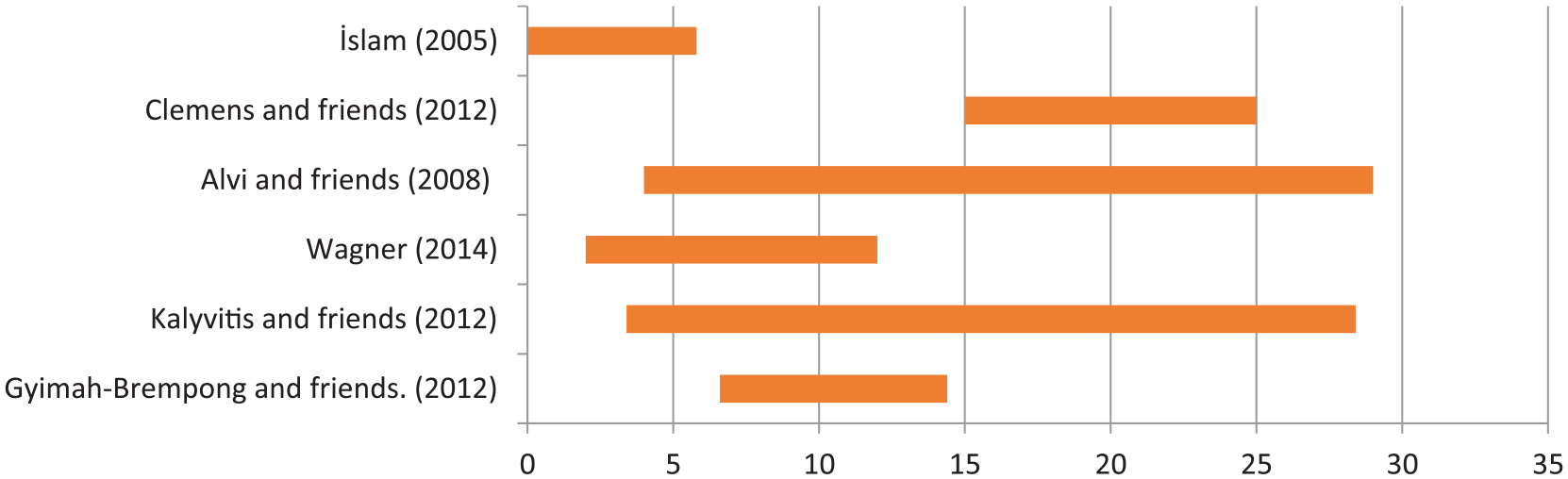
Optimal aid amount (Aid / GDP).
As seen in the figure, the ideal aid / GDP (gross domestic product) ratio of six studies in the literature review differs from each other. The range that these researches agree most will give us the magnitude that we need to take into account. Accordingly, the starting point (4%) in Alvi et al.’s (2008) research and ending point (12%) in Wagner’s (2014) research will provide us an agreed range (4–12) in five of the six studies. Therefore, after the aid reaches 4% of GDP, it starts to have a positive effect on growth; this positive effect continues up to 12% and the marginal effect of aid to be made more than 12% is negative. As a requirement of this analysis in the calculation of the score to be used in Spider web analysis, if (aid / GDP) < 4% and (aid / GDP)> 12%, it will receive 0 points. Ten points will be distributed between the ratios of 4% and 12%. It was explained in Figure 5 that the ratio of aid to TRNC to GDP was 6.26 in 2016. The aid / GDP ratio of the TRNC, which is 6.26, corresponds to 3.75 points.
Dutch Disease
This term was coined after unwanted side effects were seen in the Dutch economy when huge gas revenues in the North Sea disrupted the macroeconomic balance. High and continuous inflow of aid leads to a valued exchange rate and wage inflation, such as the jump after a natural resource is found and may be effective enough to lead to market loss and unemployment in competing sectors of foreign trade (Mercieca, 2010). Of these symptoms, the valuation of the country’s currency is not a matter for the TRNC because it does not have its own. Other issues, decrease in exports, wage inflation, and unemployment data, were analyzed in their relations to the aid.
The relationship between aid and export is examined in Figure 7. The significant increase in aid, especially from 1995 to 2000, is an increase that would lead to the emergence of Dutch disease, if any. However, exports do not seem to have been affected by any external factor other than the decisions of the Court of Justice of the European Union. The most important indicator representing wage inflation is the minimum wage. Therefore, Figure 8 examines the relationship between minimum wage and inflation. Accordingly, it is understood that both variables show a parallel development.

Foreign aid–export relationship (million dollars).
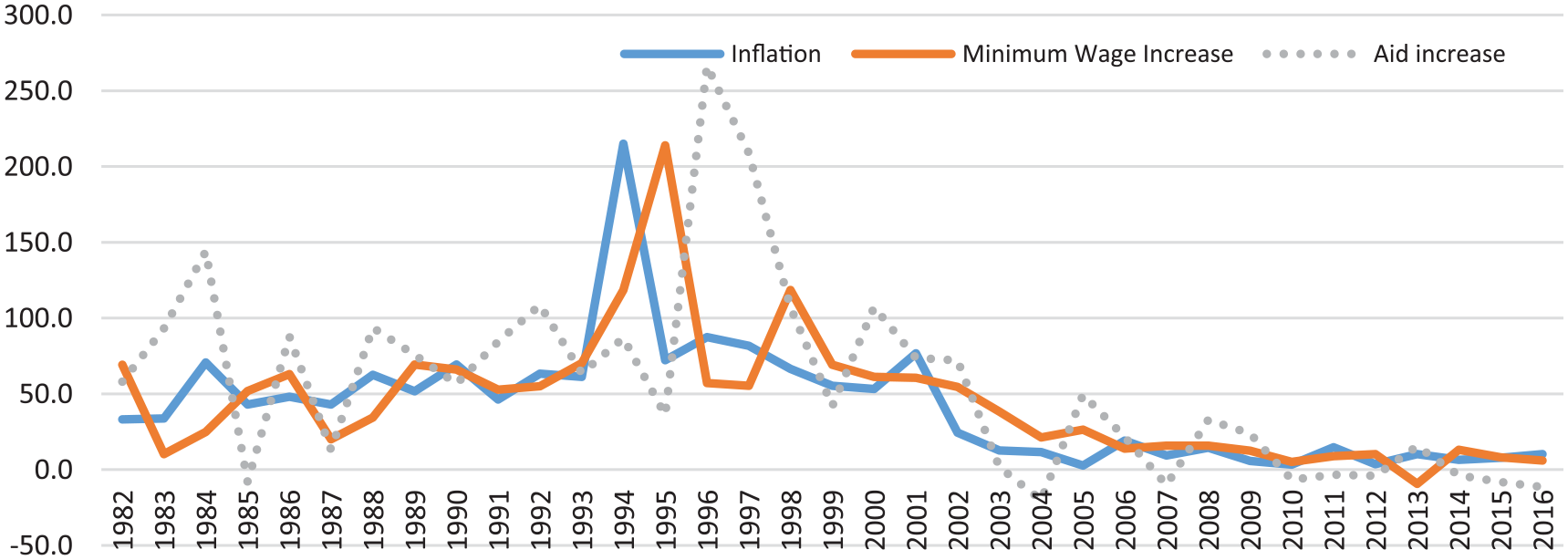
Inflation–minimum wage and its relationship.
Figure 9 shows the movement of the unemployment rate. The unemployment rate was less than 2% in 2002 and skyrocketed to 10% in 2004. This situation can be considered as a symptom of Dutch disease. In Figure 7, where we examined the minimum wage–inflation relationship, there was a sign of Dutch disease for the same period. In this period, we can say that there is a situation similar to Dutch disease. However, if we say that the symptoms of Dutch disease are not from the aid, but from the wealth created by the expectations by the Annan plan, we would make a more accurate interpretation.
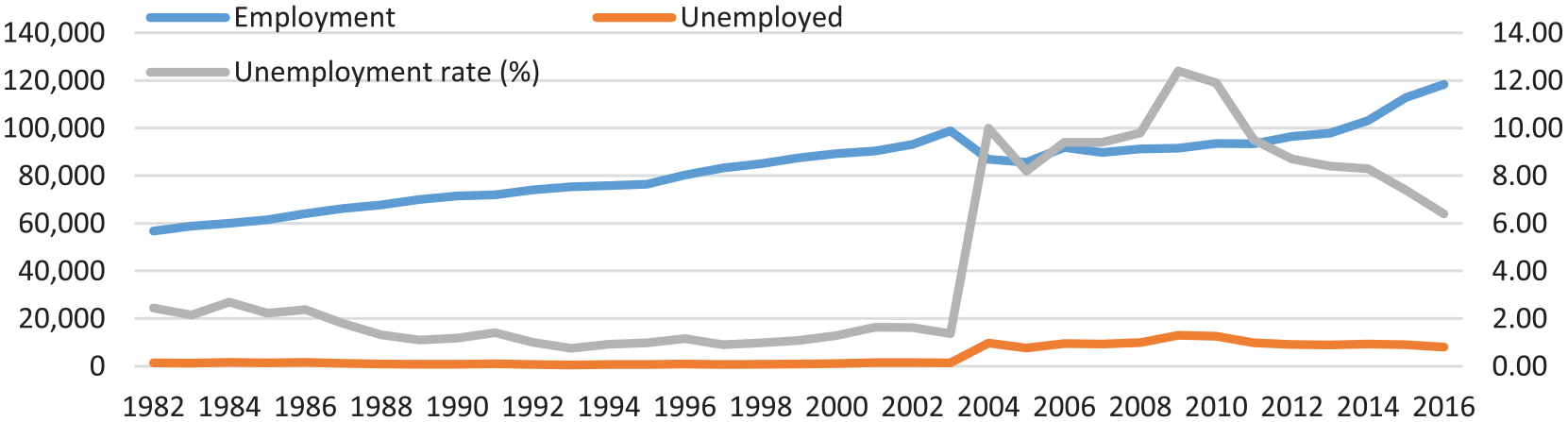
Unemployment rate.
The regression analysis of these relations once again seems to be useful.
As seen in Table 4, there is no significant relationship between aid, inflation, exports, unemployment and minimum wage in regression analysis. As a result of all these evaluations, although no obvious Dutch disease could be detected for TRNC, caution should be exercised. As a reflection of this opinion, 7.5 score is suitable for use in Spider web analysis.
Correlation Results.

Note. N = 35 (years).
Poverty Trap
Poverty trap is the situation in which an economy which has problems due to underdevelopment cannot get rid of this vicious cycle due to self-repetition of the conditions causing it (Matsuyama, 2017). Poverty trap is a mechanism in which households consume all their income to survive, and as a result, the income does not increase as no capital is invested. To see whether there is a poverty trap in the TRNC, we will first look at in what portion income is saved. According to Figure 10, there is a significant amount allocated to savings from GNP. In fact, savings have increased rapidly in recent years and reached up to 23% of GNP.

Development of total savings in GNP.
In conclusion, it is not possible to mention the existence of the poverty trap in the TRNC. As a result of these explanations and analyses, it is considered appropriate to give 10 points for Spider web analysis.
Zaire Syndrome
After decades of large-scale foreign aid in Zaire, no sign of development has brought the concept of Zaire syndrome to the literature (Knack, 2000). This situation is seen when limited skilled workforce in governments of the recipient countries has been removed from the government by providing high salaries. When donor countries undertake projects already to be carried out by recipient governments, foreign aid may prevent the development of administrative capacity in local bureaucracy (Görgülü, 2016).
The analysis of Zaire syndrome in TRNC will be examined under two headings. These are whether the skilled labor force in the public sector has transferred to the donor countries and whether the donor country has already undertaken the projects to be carried out by the recipient government.
The first issue is not observed in Turkey’s aid. There are many large projects in the TRNC funded by Turkey. However, there is no record of transfer of skilled force from the TRNC to Turkey’s aid office or its other investor organizations. On the contrary, in terms of personnel capacity development, TEPAV (2013) report stated that the most important area in the current structure is public investments which are not short-term and requires decision-making among the options. As for the public investments, since TRNC institutions did not function as a filter, the Turkish Delegation Committee undertook the project evaluation and selection function.
The first element of Zaire syndrome is not observed in the TRNC. In terms of the second element, we found that there were negative effects of aid. Accordingly, it will be fair to have a score of 6.5 to be used in Spider web analysis.
Absorptive Capacity
In general, absorptive capacity refers to the ability of an economy to utilize domestic or foreign capital efficiently (Reyes, 1990). De Renzio (2016) draws attention to the existence of a possible threshold and estimates the numerical level defined as the aid saturation point reached by the foreign aid when it is anywhere between 15% and 45% of GDP (Serie et al., 2009).
Figure 11 shows the absorptive capacity of the TRNC in three periods. Accordingly, colored areas represent between 15% and 45% of GDP. According to the graph, the absorptive capacity of a developing country with healthy absorptive capacity should be in the colored area. The line in the figure represents the realization amount of aid by Turkey. Accordingly, the absorptive capacity of the TRNC between 1982 and 1990 is below the required level. In the second half of the 1990s, TRNC absorptive capacity is in the area defined as healthy according to the literature. However, it is seen that this situation is at the lowest limit except in 1998 and 2000. After 2000, except for 2002, it is seen to be below the healthy absorptive capacity again. It should be noted that this analysis is meaningful, but only if there is more aid available. It should be noted that this analysis is meaningful, but only if there is more assistance available. We should state here that since 1982, the resources shared by Turkey for the TRNC have always been more than the level of spendings in each year.

Aid–absorption capacity relations (TL).
This analysis of the absorptive capacity points to one of the important problem areas in the TRNC. For this reason, it is considered that it would be reasonable to give around 4 points to be used in Spider web analysis.
Macro–Micro Paradox
The Macro–Micro paradox represents a situation in which the microeconomic data obtained from the evaluation of the projects financed by the aid give very good results, but this situation cannot be seen in the growth data of the country (Mosley, 1986).
Balcılar et al. (2017) analyzed the economic impacts of the grant programs implemented in the three main sectors of the TRNC since 2011, and provided them to be displayed at both micro and macro levels. The results of the research showed that, when all sectors are taken into account, 93.6% of the firms increased their production capacity with the realization of investment under the grant scheme and 92.3% of them reported that their production increased; 6.8% of the beneficiaries of the grant program reported that their investments led to a decrease in TRNC imports. If the employment impact of the grant programs is evaluated in general, the proportion of firms that create new employment through grant investment is quite high (between 72.2% and 83.5%) in all three sectors. When the sectoral growth at the macro level is considered, the annual development that has been observed, especially in the sectoral value-added growth rates, is remarkable. While the annual value-added increase in the industrial sector was 1.6% on average between 2000 and 2010, between 2011 and 2015, this rate is realized as 7.7% annually. In the same period, this ratio increased from 4.7% in tourism sector to 10.7%. In the agricultural sector, it is seen that it increased from 3.4% to 6.4%.
Accordingly, the programs implemented in the TRNC and the structure of the economy do not cause. However, the inability of these aids to prevent import dependency can be seen as a deficiency. In the light of these evaluations, it is considered that there is no Macro–Micro paradox for the TRNC and it would be appropriate to give 7 points for Spider web analysis.
Corruption
Aid and corruption are two important issues for developing economies. On one hand, aids can have beneficial effects on governance by reducing corruption, as it allows recipient countries to carry out institutional reforms. On the contrary, it can give poor incentives to recipient countries by reducing the need to collect taxes to ignore such reforms. Empirical literature tends to show that these aids contribute to corruption (Menard &Weill, 2016).
In the TRNC Corruption Perception Questionnaire, Gökçekuş and Sonan (2017) conducted a questionnaire using the methodology of the Transparency International (TI) with the participation of 366 businesspeople who are in managerial positions in firms that are members of Cyprus Chamber of Commerce. According to the survey results, TI-CPI 2017 score was calculated as 40 of 100 points. Therefore, the score we will give to the TRNC to be used in the analysis of Spider web will be the same as the score of the research which is 4.
Effects of Aid on Social Structure and Prisoner’s Dilemma
Aid can protect communities from some of the costs of poor governance, but in turn can reduce incentives to push for structural reforms and greater accountability. Observers consider the increase in the number of active NGOs and the decrease in their member bases as indicators of this situation. In addition, in general, citizens face a prisoner’s dilemma. People who are striving for sincere reform efforts tend to turn into people who forget these efforts.
Figure 12, which gives the number of associations established in TRNC over the years, shows us that there is a close relationship between the increase in the number of associations and aid. The first increase in the number of associations was between 1984 and 1985, which coincided with the founding years of the TRNC. The fluctuation observed around 1994 coincided with the fluctuation in the political structure of the TRNC. The increase in the number of associations between 1999 and 2002 coincided with the economic crisis. In particular, the increase between 2004 and 2009 coincided with the period when EU (European Union) funds flew to the TRNC. The increase between 2011 and 2014 corresponds to the period of the Turkey’s initiation of the grant schemes to NGOs.

Number of associations founded by years.
The second topic, the prisoner’s dilemma, was examined through the questionnaire. Here are some answers from the participants: There is a similar situation in the TRNC. (Interview: S. Yeldener) Only career is not enough to promote. Some relationships are also required. Someone to be straight, but it lags behind. (Interview: L. Hızal) We do not hesitate to reach the higher authorities in order to have a relative of the State as a civil servant. (Interview: H. Erçakıca) Behind these thoughts, everyone is doing why I do not have an approach. (Interview: B. Özgür) This is a vicious circle, this cycle is difficult to exit. Yes. We can call it the prisoner dilemma. (Interview: S. Özdemir)
Based on these two analyses, we can talk about a deterioration in the social structure and the prisoner’s dilemma in the TRNC. While this situation is extremely difficult to measure, half of the 10 points are extracted from the NGO analysis and the remaining half lost 1 point according to the interviews. Therefore, 4 points is given for this factor.
Democracy and Law
Theories define the rule of law as a system of rules that are transparent, open to the public, and based on rules which are regularly predictable and equally applied to both citizens and politicians (Erbeznik, 2011). Democracy is also built on the ability of government handover.
The issue to be taken into consideration in terms of law is in the TRNC Competitiveness Report (2016–2017). The Report has been prepared in accordance with the Global Competitiveness Index. There are four indices related to our subject in the Report (Table 5). If we calculate the score given out of 5, it will be seen that 1.875 is the score of the law.
Indices of the TRNC Law System.

Source. TRNC Competitiveness Report.
Note. TRNC = Turkish Republic of Northern Cyprus.
Another subject we will consider under this heading is democracy. Freedom in the World 2018 index is the study that can be taken into consideration regarding the state of democracy in the TRNC (Table 6).
TRNC Democratic System Freedom Indices.

Source. Freedom in the World 2018.
Note. LGBT = lesbian, gay, bisexual, transgender.
In the Freedom index, the TRNC received a full score in most of the categories that included subtopics of democracy, with an average score of 31 / 40, that is, 3.875 of 5. Considering that democracy has never been interrupted in the TRNC, it is a fact that there is a high level of democracy culture in the TRNC. Therefore, it is appropriate that the sum of this factor (law + democracy) should be 5.875 by giving 4 points out of 5 to the TRNC on democracy.
Public Management Capacity
Good governance is the basic condition in which each of the conditions that ensure the effectiveness of foreign aid must work together. The quality of a country’s government is manifested by its impact on growth and improving the quality of life for people. Econometric surveys show that the impact of high-quality public institutions can exceed the impact of good economic policies when explaining development performance (Knack & Keefer, 1995). Public management capacity is determined by the International Country Risk Guide (ICRG). The ICRG was not prepared for the TRNC. However, some sections of the TRNC Competitiveness Report (2016–2017) will shed light on our research. In this Report, the scores representing good governance and bureaucratic quality are as follows.
As the number calculated in Table 7 is considered to be appropriate for using in Spider web analysis, our score for the TRNC is 3.95.
Good Governance Index in Competitiveness Report (2016–2017).

Source. Competitiveness Report (2016–2017).
Foreign Aid Chain and Aid Offices
The top-down links of the aid chain begin with voters and politicians in the donor country, end with local agencies, enablers of suppliers, and local voters in a recipient country. Therefore, the efficient operation of the aid chain is in any case influencing the effectiveness of the aid. The foreign aid chain will be analyzed through Easterly and Pfutze’s (2008) analysis. According to Easterly and Pfutze’s (2008) analysis, the data on the spending of aid offices are not poor but rather is powerful considering Turkey’s aid office. This office, which provides most of the aid allowances, makes sure that the aid is subject to the budget process by adding its allowances to the TRNC budget and that it is approved and put into force by the TRNC Republic Assembly. Furthermore, the aid office fulfills the principle of transparency by publishing its annual aid budgets and annual activity reports on its website. Some may talk about fragmentation in aid for the TRNC. However, the fact that most of the aid is provided by a single office reduces the damage of fragmentation. It is not for the TRNC that the aid goes to autocratic corruption. Because the constant change of power in the TRNC prevents the aid from going to autocratic corruption. In conclusion, 6 points is given to the TRNC for this topic.
Incentives
The decision-making process surrounding aid spending is full of different stakeholders, private interests, and rent-seeking activities. Each circle in the aid chain has its own motivation and these incentives affect the outcome (Williamson, 2010). The aid process, which includes donor and recipient governments, aid offices, producers and citizen interest groups, involves several layers of actors who have their own interests. The decision-making process surrounding aid spending has to manage different stakeholders, private interests, and rent-seeking activities.
The main question whose answers we look for in this section is whether the actors involved in the process of the foreign aid to the TRNC have a positive incentive environment for the effectiveness of this aid. For this purpose, the literature on how the incentives of the actors are affected has been searched and 28 sentences have been formed. For example, “Donors, especially aid offices, prefer to focus on aid expenditures as the preferred measure of success. The expenditures are also the budget of the aid offices, and the budget of these offices is the cause of their assets” is one of them. Participants were asked to score these sentences between 1 and 10 points according to their approval status. The necessary calculations were made as a result of the survey and the score of the Incentive title was determined as 4.06.
Informing Problem
Successful aid requires accurate and timely, coordinated sharing of information. Coordination of foreign aid also requires that both donors and recipients have enough information. Therefore, the information problem is an important issue both for donors and recipient countries. It is appropriate for the TRNC to use the questionnaire we have conducted to understand the situation in this important issue. Seventeen participants answered the question about this subject in our survey. Nine of them stated that the donor side has information problem and eight of them stated that the recipient side has information problem. The fact that the numbers are close to each other shows that both sides have information problems and this problem is of the same severity. The answers given by participants to this open-ended question help us to analyze. According to the survey results, it is understood that there is an information problem. This problem leads to “the possibility of trust problem.” It is unprofessional and faces to the danger of “asymmetric information.” It also “preserves the worry of movement on the wrong ground although it has been corrected.”
From this point of view, it is appropriate to give 4 points to the TRNC for this factor to be used in Spider web analysis.
Donor–Recipient Country Relations and Coordination among Donors
One of the most influential factors on the effectiveness of foreign aid is the relationship between the donor country and the recipient country. The nature of the relationship, both political and human, is a decisive factor in the effectiveness of the aid. Easterly and Pfutze (2008) report that three ineffective aid channel, which are bound aid, food aid and technical assistance, are also to be sought in the upper policy documents or to be taken into account when outlining the aid. In addition, evaluating the field through the Samaritan dilemma model will provide an adequate analysis.
The relation between Turkey and the TRNC does not fit into any of the three ineffective aid channels within the scope of Easterly and Pfutze’s (2008) research which was briefly mentioned above. There is no bound aid in implementation and described in the texts of Agreements (2009, 2012, 2016; http://kei.gov.tr/ekonomik-program/) in aids provided by Turkey.
If we make an evaluation based on the Samaritan dilemma model, the relationship between the two countries is in cell D. Although TR Technical Delegation (2010, 2011, 2012; http://kei.gov.tr/ekonomik-program/) Monitoring Evaluation Reports stated that the TRNC remains weak in terms of structural reforms, it is seen that aid continued. However, in the subsequent Annual Protocols (2013, 2014, 2015, 2016, 2017, 2018; http://kei.gov.tr/anla%C5%9Fmalar/), it is seen that aid is being given as a part of the reform. This means that the Samaritan dilemma model shows signs of moving from cell D to cell B. According to this model, cell B does not provide a real alternative for the recipient. The orientation of the relationship to the C cell is ideal for both sides. Other situations are all bad (Table 8).
The Samaritan Dilemma.
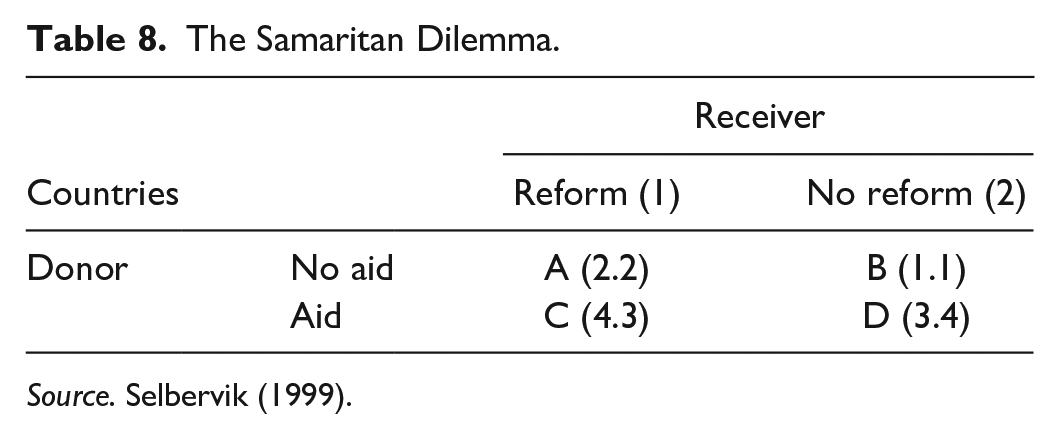
Source. Selbervik (1999).
As a result, the relationship between the donor country and the recipient country will be eligible for a total of 6 points, 5 for the Easterly and Pfutze’s (2008) survey and 1 for the Samaritan dilemma model.
Macroeconomic Politics and Liberal Policies
According to the dominant economic understanding of our time, it is possible to reach a higher welfare level with the resources of a country by the free market economy model. This approach, which has been accepted by all donor countries all over the world with and without a few exceptions, is a valid condition for both the provision and effectiveness of foreign aid. Market economy is a competitive system based on profit, an economic system model in which private property, inheritance, contracting, freedom of enterprise and choice are guaranteed and the state intervenes at the lowest level in the functioning of the price mechanism (Aktan, 1995). It is appropriate to use the government consumption index within the index developed by the Fraser Institute to get an idea of the economic understanding of the country of which the aid will be provided.
In the subindex of government consumption of Fraser Index, 6.32 points is given, thanks to the Turkey’s general government consumption/GDP ratio which is 10.4%, and 6.34 points is given due to general government consumption/GDP ratio, 9.61% of the Greek Cypriot’s side. Based on these data, it is calculated that the general government consumption/GDP ratio of the TRNC, which is 20.4%, should be 6.07 (Source: KKTC DPÖ, TC SBB, OECD, WB).
Public Financial Management and Accountability
The public financial management system is one of the most important issues in the development of a country, especially in terms of the budget process. The principle of accountability is one of the foremost principles and sensitively cared in every country that has a healthy financial system. A score of 2.5 points will be given for each aspect, including financial management, budget management principles, expenditure budget, tax collection performance, and financial control.
Budget management principles
In the TRNC, there has been no development plan, annual program, investment program, medium-term approaches for a long time. The implementation of the budget call, budget negotiations, and enactment of the budget is routinely carried out. The budget transactions are closely monitored during the year. In the light of these findings, 1.25 points is given for the field of budget management principles.
Expenditure budget
Budget deficits are not sustainable, and the Financial Space, which can be defined as the sum of resources that can be allocated for public purposes in a way that does not disrupt the balance of the economy, needs to be corrected for the TRNC (TEPAV, 2013). As the aids provided make the main infrastructure investments such as education, health and transportation, the current expenses increase, it would be appropriate to give 1 point for the expenditure budget.
Tax collection
The evaluation that exempting the import tax and income tax of employees in imports for foreign aid leads to a contraction in the tax base of the recipient country is not valid for the aid from Turkey to the TRNC. The impact of aids on the tax effort or tax collection performance in the TRNC is worth considering. In Figure 13, prepared for this purpose, the development of aid from Turkey is given in U.S. dollars to minimize the time effect of money and shown on the right axis. Public income / GNP ratio is on the left axis.

The impact of aid on the tax effort in the TRNC.
According to Figure 14, there is a decrease in tax collection performance since 2005. However, it is not possible to say that this decrease was due to the increase in aid. The decrease in income as a result of the decrease in tax collection performance in the 2006–2008 period caused an increase in budget deficits. Increasing budget deficits seem to have led to an increase in aid. As a result of these assessments, it would be appropriate to give a score of 1.25 for tax collection performance.

TRNC’s cumulative loan debt (million US$).
Financial control
According to the TEPAV (2013) study, the weakness of the audit of the Court of Accounts is a problem that is valid both for budget supports and investment expenditures. Within the framework of these findings, it is considered appropriate to give 1 point for this factor by extracting at least 1 point for the weakness of the audit of the Court of Accounts, and extracting 0.5 points as there is less risk due to the control of the aid committee. The score to be used in Spider web analysis from the Public Financial Management and Accountability dimension is 4.5.
Debt Burden
The debt stock and related ratios of the recipient country are among the elements that are most affected by the aid. Therefore, to be effective, there are issues that need to be taken into consideration in foreign aid’s use. Particularly, conditional aids and domestic resource assistance and dependency to the aid are factors that can increase the debt burden if the aid is not used carefully. In addition, debt forgiveness poses a moral hazard. Therefore, the negativities that the aid provided to the TRNC may face within the debt burden are conditional grants, domestic resource contribution, and moral hazard. These topics will be examined under debt burden.
In the texts of agreements and protocols related to Turkey’s aids, there is no requirement on using the aids for the goods imported from Turkey. There is not any issue that can lead a burden to the TRNC, except for the debt and interest liabilities both in the grant and loan part of the aid. The conditions in which the domestic resource contribution is stipulated are either the provision of land in central government investments or the partial contribution in local governments. As there is no significant negativity in terms of conditional aid and domestic resource contribution, we can move on to the effect of debt suspension on the moral dimension. Figure 14 shows the TRNC’s cumulative loan debts based on the aid in U.S. dollars. It is seen that the debts of the TRNC are constantly increasing. The interest expenses of these debts are also not paid.
As a result, we will give 7 points to the TRNC under the debt burden factor for the Spider web analysis.
Property
Property is categorized into three: physical, financial, and intellectual property. Property rights are the arrangements made for the individual to use the scarce resources effectively in the economic life. These rights reveal the opportunities of individuals, or society, to access existing resources (Ata & Şahbaz, 2013). The private property system gives individuals the right to use their resources as they find appropriate. Dominance over what they have leads property users to take full account of all the benefits and costs of using these resources in a particular way (O’Driscoll & Hoskins, 2003).
For the aid to TRNC to be effective, we will need to look at whether there has been sufficient progress in property rights. In particular, the International Property Rights Index (IPRI) is used in this topic (Table 9).
Property Rights Index.

Source. TRNC Competitiveness Report (2016–2017) and TEPAV (2013).
As a result, 4.25 points are given to the TRNC to be used in Spider web analysis.
TRNC Application Result
The 21 factors affecting the impact of external aid on development were analyzed in terms of TRNC. Spider web analysis in Figure 15 shows the scoring of the 21 factors examined. According to our analysis, the score of TRNC is 5.25. This means that the effectiveness of the aid is only half the potential. It is possible to define TRNC as successful areas for factors above 6.5 points, areas open to development for factors of 5 to 6 points, and areas that need to be definitely improved for factors below 5 points. In this case,
foreign aid dependency,
Zaire syndrome,
Dutch disease,
poverty trap,
macro–micro paradox, and
debt burden
factors are in the successful group. Improvements can also be made regarding these factors. However, the marginal benefit of the improvement in the following factors is much greater.
The second group which we call as factors with areas is open to improvement:
Political stability,
Law and democracy,
Economic policies,
Aid chain and aid office,
Donor-recipient relationship.
The third group that we call factors must be improved:
Aid–savings–investment–growth relationship,
Optimal aid request,
Absorptive capacity,
Corruption,
The prisoner’s dilemma,
Public management,
Incentives,
Information sharing,
Public financial management, and
Property.
As a result of this analysis, it will be possible that the aid to TRNC will be more effective if improvements are made in these areas. How to make improvements in these areas is the subject of another study.

Spider web analysis.
Conclusion
The capital shortage that is the most important problem of developing countries is a problem that can be overcome by external financing. Foreign aid is the most advantageous title under the title of foreign financing for every country on the path of development. Although this condition which was accepted theoretically was supported with empirical studies in the early days of modern foreign aid, it was met with suspicion in the periods when econometric models became more qualified. However, it has been seen that the situations that cause these suspicions are not from foreign aid but from the insufficiency of the climate of effectiveness in the countries that use foreign aid.
As a result of the analysis, the difficulties associated with investigating whether aid encourages growth have been better understood; it has been found that foreign aid is an important resource for addressing the problems of developing countries such as saving gap and foreign exchange scarcity; empirical studies conducted after 1990s have given clues about the right policies and factors which must be in the climate of effectiveness of foreign aid.
Based on these empirical studies, the right policies and factors were revealed in our study. These factors, each of which reaches up to 20 by collecting them under a headline, have been investigated in detail, their standard definition has been achieved, their direction of impact has been determined, and they have been divided into detailed factors.
As a result of this analysis, a questionnaire was produced once a field research was conducted on the experienced people on foreign aid to TRNC. According to the results of the field research, 16 of the 20 factors in our model received strong support. As the support for four factors was 70% to 75% and it received less support than the others, face-to-face interviews were conducted and the subject was subjected to detailed analysis. As a result, these issues/factors were preserved in the model. In the field research, it has been also determined that the ownership is an important factor affecting the development and effectiveness of foreign aid.
Our model, which is made up of 21 factors that are defined, standardized, detailed, whose impact direction has been determined and by which method will be determined and scored, has been prepared for the TRNC application. Each of the 21 factors was examined, and scoring was made for the issues in front of the effectiveness of the foreign aid given for the TRNC. Scores were prioritized by cobweb analysis. Thus, it was determined which factors would be improved before foreign aid to TRNC and an opening was made about how these factors could be improved.
This study has developed a viable model for investigating the presence of an efficacy climate prior to the use of external aid to an isolated island economy.
Footnotes
Declaration of Conflicting Interests
The author(s) declared no potential conflicts of interest with respect to the research, authorship, and/or publication of this article.
Funding
The author(s) received no financial support for the research, authorship, and/or publication of this article.
