




Abstract
This research was designed to investigate whether organizational stress had an intermediary role in the effect of Hofstede cultural dimensions on time management. Near East University from Cyprus, which represents the individual culture, and Hakkari University from Turkey representing the collectivist culture were selected for the research analyses. In all, 638 administrative and academic members from both universities were interviewed face-to-face on a voluntary basis, and data were collected by the simple random sampling method. The research findings suggest that time should be managed after identifying the type of culture—individualistic or collectivist—to decrease the level of stress experienced by university staff. In other words, Hofstede’s cultural dimension has an impact on time management, and organizational stress has a partial mediation effect on this dimension. Although the variables in the study have been studied in the literature together with many different factors, Hofstede is significant in terms of determining the role of organizational stress in the effect of cultural dimensions on time management. The effectiveness of Hofstede’s cultural dimensions through organizational stress in time management allows business and project plans to be carried out in a way that manages individual, team or departmental performances taking into account the organizational stress elements. It is considered that this study will particularly be effective in medicine, project management, and independent auditing.
Keywords
Introduction
Time management is a phenomenon that requires a certain set of skills and in parallel with today’s technological developments, especially employees in the professional business world should be taught and trained in this field. The skills required for time management must be either innately present in the individual or should be taught to serve the individual in a specific plan. From this point of view, time management has found its place in the micro-scale theories in the organizational field.
In this vein, time management well reveals the clues to coping with stress. Thus, certain studies that demonstrate the existence of the relationship between time management and stress management (Dierkes et al., 2003; Özer, 2010) explain skilled management ways to cope with stress, while tips on developing skills for time management are also revealed. In this context, adhering to the argument that the behavioral school may be productive in the case of meeting individual social needs (O’Connor, 1999), it can be uttered that micro-scale theories such as time and stress management pave the way for the development of social.
The above-mentioned small-scale theories may undoubtedly vary depending on the type and origin of the cultural environment of the organization. Therefore, organizational culture is directly influenced by both time and stress management styles, or it is influenced by both forms of management (Festjens & Janiszewski, 2015; Galetzka et al, 2018; Leslie & Gelfand, 2012). While there are resources indicating that organizational culture mediates perceived ethics and small- and medium-sized enterprise (SME) performance (Gorondutse & Hilman, 2016), it also mediates the formation of innovation and leadership values (Abdullah et al., 2013) and organizational culture has a mediating effect in transformative leadership structure and institutional resource planning. However, there is not any study in the literature that defines the types of administrative concepts where the organizational stress has a mediating effect. Moreover, there are only few studies indicating that job stress has a mediating effect in this field.
In this respect, this study strives to close the gap in the literature by revealing the following research questions: Under what circumstances does organizational stress depend on an organization’s culture and how it helps manage time? Do employees’ stress levels change the relationship between these two concepts? If so, how does this change take place? Depending on this problem, although some organizational stress-related studies are not built on intermediary effect, these studies focus on the fact that organizational efficiency mediates the mental health, professional stress and organizational climate of employees (Artnez et al., 2011); or that stress has an intermediary effect between interventional leadership and organizational citizenship behavior (Mahmood & Kareem, 2018); or work activities such as the mediation of work stress between the business demands and work performance (Alhomayan, 2013), and all these studies further focus on work stress rather than organizational stress.
Depending on this problematic of the research, the literature on time management was primarily reviewed with a focus on the gap pertaining to organizational culture and stress management. Thanks to the variables determined after methodical editing, a research model was proposed to obtain original results.
Time Management
Time management harmonizes time by means of planning, programing, and listing priorities together with establishing objectives, and determining priority jobs with a view to determining and meeting needs (Smythe & Robertson, 1999). In short, it refers to certain techniques such as making to-do things, planning activities and using various types of techniques to prepare such to-do-lists (Claessens et al., 2009). However, some researchers indicate that time not only has a physical dimension, but also a psychological dimension (Boslough, 1990). Awareness and each psychological situation or point refers to the psychological dimension; the part of time expressed in the form of hours refers to the physical dimension (Passing, 2007: 38). While many organizations employ advanced systems to account for every penny spent, they are not aware of the value of effective time management (Oshagbemi, 1995). Management of time is not related to creating more time, it is about ensuring the best use of the time we have (Hansen, 2011; Moore, 2014).
In the time management process, materials are used such as activity books, action plans, priority to-do lists, personal goal setting, effective programming, and general repetitions that prevent the postponing of tasks in the time management process and facilitate decision making in regard to business priorities (Rivera, 2007). The main factors determining or affecting effective management of organizational time can be listed as determining priorities, planning, effective communication, decision making, delegation of authority, managing time of subordinates, managing senior managers, eliminating interruptions, and so on (Toksoy & Ayyildiz, 2010: 3578). Factors that are caused by personal and cultural characteristics and lead to time losses or the ineffective use of time are called time traps (Hickox, 2006).
Time is unstoppable and cannot be stored. Therefore, the value of time varies depending on whether it is used correctly or incorrectly. People know that it is better to use time correctly rather than wasting it and to have control over time while sparing time for activities. People who learn that the value of time changes depending on its use are often more aware of how to use time effectively (Festjens & Janiszewski, 2015). In other words, people are aware of the fact that the value of time has changed. The changing value of time according to usage and knowing its importance indicate that there is a greater need for time management (Juhnke et al., 2013). The dominant attitude in Anglo-Saxon organizational cultures is that time has a cash value. American and Canadian businessmen expect to start negotiations on time. Beginning late or delaying negotiations is considered to be inappropriate and rude. This cultural attitude concerning time is also related to other aspects of the cultures in question. In the United States, wages are time-dependent and the efficiency of employees is not surprising due to the high value attributed to time. Time is perceived as an opportunity to further production and increase income. Therefore, organizational culture also refers to planned time (Sofyalıoğlu & Aktaş, 2001). Therefore, organizational culture refers to both planned time (Walsh, 2008, pp. 7–10) and possible or random developments (Adams & Blair, 2019).
Studies conducted on time management concentrate upon topics such as academic achievement (Abdulghani et al., 2014; Britton & Tesser, 1991; Varışoğlu & Yılmaz, 2012) variables based on demographic variables such as gender, age, and so on (Guoqing & Yongxin, 2000: 38-39; Hoobler et al., 2009; Küçükaltan et al., 2013); time management in sports students (Juhnke et al., 2013); work performance (Barling et al., 1996; Macan, 1994); stress and anxiety (Mirenda et al., 2015: 122, 124; Misra & Mckean, 2000; Nonis & Hudson, 2006; Trueman & Hartley, 1996); stress (Macquet & Skalej, 2015); self-regulation (Baothman et al., 2018); and unrecognized personal behavior (Scherer et al., 2017).
Organizational Culture
Understanding organizational culture as a whole will allow understanding the organizational/professional life (Alvesson, 2013). As they are open systems, cultures are interacting with the societies in which they operate. National cultures in which organizations exist have an impact on people involved in those organizations (Leslie & Gelfand, 2012). Of course, it cannot be expected that an organizational culture that consists of common meanings and symbols shared within itself (Alvesson, 2013; Hofstede, 2001) can avoid being affected by other cultures.
In a sense, organizational culture is a historical product affecting interpretations and behaviors (Yin et al., 2014). Employees within an organization transfer organizational culture during their socialization process by means of elements such as stories, traditions, symbols, and organizational jargon (Güçlü, 2003). A set of shared values within organizational culture also affect the internal dynamics and achievements of organizations (Koçel, 2005), and they determine whether organizational culture is considered weak or strong (Robbins, 2000). Considered from this perspective, organizational culture represents the organizational learning process (Argyris, 1995; Dauber, Fink, & Yolles, 2012: 13-14).
In this study, many approaches and classifications were used, particularly Hofstede’s (1984a) culture model, to identify organizational culture. According to this model, which consists of four dimensions, individuals making up organizational culture also reflect the characteristics of the national culture to which the organization belongs. In this study, individualism and collectivism as cultural variables were taken into consideration to conduct a comparative study.
Individualism—Collectivism
The values and norms of an organization refers to whether it meets individual or social demands, how these demands are reflected (Sığrı & Tığlu, 2006) and the individual’s level of integration with groups (Hofstede & Bond, 1988). Societies in which group interests are prioritized over individual interests are called collectivist/socialist (Gonzalez & Rime, 2005). It has been observed that Western countries have achieved high individualism scores, whereas Eastern and Latin countries have demonstrated collective behavioral tendencies (Kağıtçıbaşı, 2001).
Hofstede (1984) explained individualism and collectivist dimensions buy stating that Individualism is valid in societies where inter-individual bonds are not strict; each individual is obliged to look after himself and his family. Collectivism, on the other hand, is valid in societies where individuals feel belonging and loyalty to powerful and connected groups from the moment they are born.” The individualist pattern is opposite to the concept of collectivism. In some cultures, people assign too much importance to individualistic needs and desires whereas in other cultures, the needs of society are prioritized according to individual needs (Triandis, 1982). Individualism centralizes the person’s objective and freedom, whereas societal characteristics remain at the periphery. Collectivism refers to a form of existence in which a group and its members are separated from other groups and their members and connections are formed among group members establishing mutual liability (Sakal & Yıldız, 2015).
Uncertainty Avoidance
It refers to an uncorrected or irreparable situation of uncertainty in a community or organization (Rogovsky & Schuler, 1997). It is assumed that uncertainty, which is one of the fundamental sources of concern for humans, affects the social culture (Hofstede, 1984). It includes many variables such as risk appetite, future anxiety, wages, job safety, career opportunities, retirement, and work stress (Hofstede, 2011). In societies with high levels of anxiety due to uncertainty, the individuals’ level of expressing themselves is more advanced. The use of hand-arm movements while talking, excessive mimic movements and tone amplification behaviors are not tolerated (Savicki, 1999, 244).
Power Distance
Based on inequality in society, this dimension examines the process of inequality-based conflict (Hofstede et al., 2010). It tries to determine social power distances by means of examining the acceptance of differentiation and distinction between people with different levels of power or expectations of differentiation. The level of acceptance of this inequality differs based on the society. While narrow power distances are observed more in Western countries, greater distances are seen in Asian countries. Societies with wide power distances contain solid hierarchical lines based on military structures.
Masculinity—Femininity
They refer to the status of individuals and relationships between individuals. In this approach, while the negative aspects of masculine culture are generally shown, feminine culture contains positive elements. Gender roles are transferred to every stage of social life through socialization (Hofstede, 2001). In an organization where masculine culture is dominant, passion for ascension, autocratic and oppressive attitudes, importance of competition, ambition of monetization and materialistic tendencies can often be seen (Şekerli & Gerede, 2011). While individuals living in masculine cultures demonstrate a power and success-oriented structure, avoidance of conflict, harmony and synchronization are prioritized in feminine cultures.
Long–Short Term Orientation
Since people have a long- or short-term orientation, they are interested in values that societies attribute to the past and future (Hofstede, 2001). Due to the different perception of time in Western and Eastern societies, differences have also occurred in long- or short-term plans and orientations. While Western societies consider time as more linear, planned, standardized and measurable, time in Eastern societies is evaluated from a traditional perspective that is multidimensional, cyclical and covers the whole life (Hofstede, 2011). While short-term oriented firms expect to immediately from every activity, long-term oriented firms expect profit as a result of certain processes and after completion of these processes (Roath et al., 2002).
Organizational Stress
This term was developed by Selye in 1950s. Stress is defined as the situation that people experienced when they are confronted with things that they evaluate as threats (Atkinson et al., 1987) to their self-esteem or well-being (Kyriacou & Sutciffe, 1978). Stress is examined under three groups, namely stress sources, psychological and physiological effect of stress sources on the person, and the assessment of current stress sources as threatening or harmful (Hansen & Sullivan, 2003).
As a mental and physical condition that may affect individual efficiency, effectiveness, health and quality of work directly and negatively (Gill et al., 2006), stress can be triggered to activate a wide variety of hormonal secretions in the sympathetic nerve system in the form of tension when an individual is faced with a difficult situation or with tension (Cartwright & Cooper, 1997). It is associated with a variety of chronic health problems including work stress and cardiovascular diseases. It leads to hypertension, musculoskeletal system and psychological disorders, reproductive disorders, and mental and neurological problems (Swanson, 2000). When people believe that there is little they can do to change a stressful situation, they tend to use emotion-oriented coping, and when they believe that they have the power to change something, they use problem-oriented coping mechanisms (Völlink et al., 2013). The behaviors of employees and management in the workplace are not only based on their own motives and needs, but also as a result of their perceptions of everyone in that organization (Harris & Hartman, 2002).
Organizational stress is considered to be one of the major issues in managerial terms as a factor affecting the working performance of each member of staff, ranging from new workers to the highest-level officers (Ross, 1997). The sources of organizational stress were gathered under four headings by Luthans (1989). These include organizational policies, structural characteristics of an organization, physical working conditions, and organizational processes. Based on an overall assessment, it can be seen that researchers concentrate on workers’ functional environment while grouping organizational stress sources.
Tools and Methods
Sample
The research universe consisted of university employees who were working at Near East University and Hakkari University in Turkey and voluntarily participated in the research. A total of 638 university employees including 76 women (11.90%) and 562 men (88.1%) participated in the study. Participants’ ages varied between 18 and 63, and it was observed that the average age range was 31 to 40 years (42.5%). Furthermore, 303 of the academicians and administrative staff had work experience of 0 to 10 years (47.5%), 175 of them had 11 to 20 years (27.4%) of experience, 154 of them had 21 to 30 years (24.1%) of experience and 6 of them had more than 30 years (0.9%) of experience. Near East University was selected to represent individualist culture, and Hakkari University was chosen to represent collectivist culture using random or probability method.
Data Collection Tools
Demographic information form
It is a form developed by the researchers to obtain various socio-demographic information about the participants, such as age, gender, work title, and total work experience.
Time Management Scale: To measure time management, a survey was used that was originally developed by Britton and Tesser (1991), received intense interest in the field and was translated to Turkish by different researchers (Alay & Koçak, 2002). The scale consists of three sub-dimensions, including time-planning (ZP), time attitudes (ZT), and time-consuming (ZTU). By adhering to the original form of the questionnaire created by our researchers, the participants were requested to make evaluations on a 5-point Likert-type scale including Never (1), Rarely (2), Sometimes (3), Frequently (4), and Always agree (5). Cronbach’s alpha value was found to be .823 as a result of the analyses conducted, and according to the results of confirmatory factor analysis, the χ2/df value was found to be 2.624, the root mean square error approximation (RMSEA) value. 071, the Normed Fit Index (NFI) value .908, the Relative Fit Index (RFI) value .923; the Incremental Fit Index (IFI) value .951, the Tucker–Lewis Index (TLI) value .944, the Comparative Fit Index (CFI) value .964, the PCLOSE value .068, and the HOLTER value was found to be 202.
Organizational Stress Scale (OSS)
The Organizational Stress Scale developed by Theorell et al. (1988) and adapted into Turkish was used to measure organizational stress levels. This scale consists of 17 questions and contains three main sub-scales: the “Workload” sub-scale, which consists of 5 questions; the “Control” sub-scale, which consists of 6 questions; and the “Social Support” sub-scale, which consists of 6 questions (Alves et al., 2004: 2-5). Participants were requested to evaluate expressions in the sub-scales related to organizational stress levels based on a 5-item scale including “Never (1); Very Rarely (2); Sometimes (3); Most of the Time (4), and Always (5).” Expressions related to some items on the scale were scored reversely. The total score of the sub-dimensions was calculated by adding the scores of each sub-dimension. Accordingly, individuals with high scores tended to have higher organizational stress levels. High scores showed high workload, high social support, high skill utilization, and high decision-making freedom. Cronbach’s alpha value was found to be .813 as a result of the analyses conducted, and according to the results of confirmatory factor analysis, the χ2/df value was found to be 2.815; the RMSEA value .077; the NFI value .938; the RFI value .900; the IFI value .950; the TLI value .919; the CFI value .950; and the PCLOSE value .052 and the HOLTER value was found to be 204.
Organizational Culture Scale
The scale that Hofstede used to determine cultural dimensions and validity-reliability that was tested by Lei and Wu (2007) was used in the study. In the scale in question, which was in 5-point Likert-type, there were five dimensions including masculinity (ER), power distance (GM), uncertainty avoidance (BK), individualism (BI), and long-term focus (UZ). Cronbach’s alpha value was found to be .836 as a result of the analyses conducted, and according to the results of confirmatory factor analysis, the χ2/df value was found to be 1.794, the RMSEA value .035, the NFI value .997, the RFI value .961, the IFI value .999, the TLI value .982, the CFI value .999, the PCLOSE value .474, and the HOLTER value was found to be 1365.
Hypotheses
Hypotheses developed in accordance with the purpose of the research are as follows:
Data collection
Data required for the research was collected through the face-to-person survey method, since this method offered significant advantages in terms of a high answering rate and allowing many questions to be asked (Ayten, 2016). Survey applications were carried out under the guidance of researchers at the locations where their employees worked. A prepared informed consent text was given to the voluntary participants prior to the application and they were asked questions after approval had been received. Since the validity and reliability tests for all surveys were successfully completed, no questions were excluded from the forms. After determining the effects between the variables based on the research model, the role of mediation was examined in accordance with the methodology developed by Baron and Kenny (1986).
Analysis of data
For the data analysis, Statistical Package for the Social Sciences (SPSS) 25.0 and Analysis of Moment Structures (AMOS) 24.0 package programs were used. At the end of the analyses, χ2/DF, RMSEA, HOELTER, PCLOSE, NFI, NFI, RFI, IFI, TLI, and CFI goodness of fit indices related to the model were examined.
Findings
Basic information about time management, Hofstede culture and organizational stress scale in the research survey applied to the group in terms of gender, age, and work experience described in the sample section is shown in Table 1.
Base Statistics for Variables.

In the literature, studies aimed at analyzing statistical intermediary role have continuously improved from the early stages until today. Discussions primarily focusing on causality and intermediation patterns (Baron & Kenny, 1986; Maccorquodale & Meehl, 1948; MacKinnon et al., 2000) did not include bootstrap-based tests. MacKinnon et al. (2002) and Shrout and Bolger (2002) tested the significance of indirect effects in intermediary role test and conducting studies using bootstrap-based analysis, while the use of structural equation model has been popularized as an analysis method using measurement errors (Byrne, 2006). In structural equation modeling, processes are performed by assuming that there are linear relations among latent variables and between observed and latent variables (Tabachnick & Fidell, 2007).
In the first model, time management was taken as the dependent variable, and the Hofstede organizational culture scale and sub-dimensions were taken as the independent variables. Thus, the first impact identified by Baron and Kenny (1986) was examined.
In the second model, time management was taken as the dependent variable, and the Holfstede organizational culture scale and organizational stress tool were taken as intermediary variables (Figure 2).
In Table 2, root mean square error of approximation (RMESA), NFI, RFI, IFI, TLI, and CFI values are examined. NFI is associated with a positive number of samples. NFI, RFI, IFI, TLI, and CFI have values between 0.00 and 1.00. If a model as an RMSEA value between 0.05 and 0.08, it is assumed to be in an acceptable fit (Hair et al., 2010; Şimşek, 2007; see Tables 3 and 4).
Fit indices of Scales.

Note. CFI = comparative fit index; IFI = Incremental Fit Index; NFI = Normed Fit Index; RFI = Relative Fit Index; RMSEA = root mean square error approximation; TLI = Tucker–Lewis Index; PCLOSE= RMSEA associated p value; HOELTER= Hoelter’s Critical N.
Regression Coefficients of Relations between Variables.

Direct and Indirect Effect Analysis Results for Intermediary Role of Model 2.
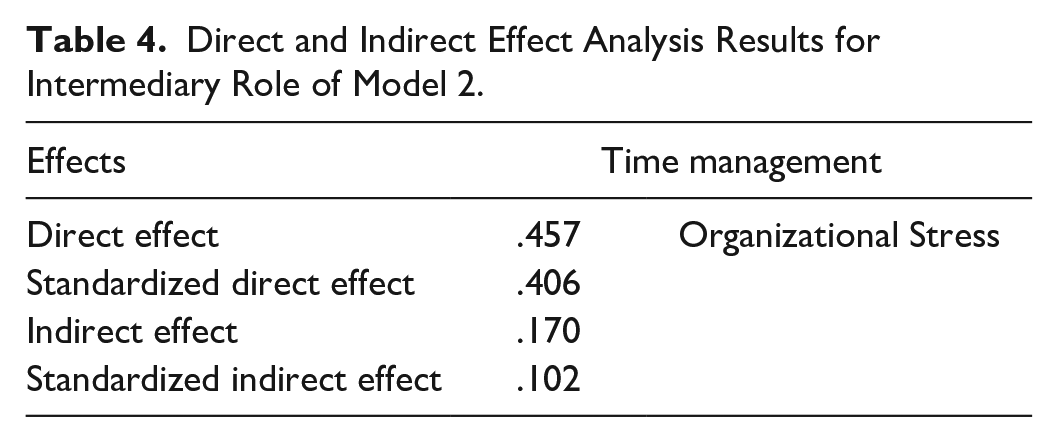
Analyzing the table above, it can be said that both models developed in the study provided fit indices; therefore, the necessary conditions were met for deciding on the mediation effect with structural equation modeling. If the effect of an independent variable on a dependent variable is decreased or destroyed, it is concluded that the variable in the developed model is an intermediary variable (Baron & Kenny, 1986). When Table 2 is examined, H1.1 “Hofstede culture has an effect on time management” H1.2 “Hofstede culture has an effect on organizational stress,” and H1.3 “Organizational stress has an effect on time management” were all accepted.
Analyzing Tables 2 and 3 above, it can be fairly stated that organizational stress has a partially intermediary role in the effect of organizational culture on time management. When Figures 1 and 2 with Tables 2 and 3 are evaluated together, it is possible to discuss the partially mediating role of organizational stress on the effect of organizational culture on time management. Therefore, H1 propounding that “organizational stress has a partial role in the effect of Hofstede culture on time management,” is accepted.

Test results of Model 1.

Test results of Model 2.
Discussion and Conclusion
Although there are many studies in the literature dwelling upon the same variables as this study, it is found that there is no any study measuring the effect of organizational stress on organizational culture as well as scrutinizing the intermediary role of organizational stress in the effect of Hofstede culture dimensions on time management. In this vein, Terzi (2004) stated in his research that that male and female students differ according to the Hofstede cultural dimensions, and that models specific to our society should be created in both organizational and managerial fields. Moreover, significant differences were found between the groups analyzed in terms of gender, income level, size of the cities they were born and raised, status in workplace, and the typologies of organizational culture in Hofstede (2016).
In the literature, Copper (2002) further examined anxiety, weak motivation, and depression attributed to factors related to experience of adverse emotional situations such as frustration, business dissatisfaction, decreased business commitment, and anxiety based on organizational stress. In addition, Nel et al. (2004) examined the amount of work performance, absence, and turnover reducing quality as a result of organizational outcomes of stress, while Bellingrath (2009) investigated the relationship between chronic work stress, depletion based on organizational stress, and allostatic load in women. Boehlko (2009) examined stress based on giving new supervisors new responsibilities, increasing economic concerns, political and managerial pressures, lack of ability to participate in decisions, reward and punishment methods, and failure in being autonomous. On the other hand, Gökgöz and Altuğ (2014) analyzed the effects of medium level of organizational stress they found among academic staff, while Balyer and Gündüz (2014) pointed out to stress levels experienced by educational inspectors due to their duties. In the same vein, Macquet and Skalej (2015) investigated how time management affects elite athletes and their decision-making processes. Yamuç and Türker (2015) reviewed sources of organizational stress, while Grissom et al. (2015) examined how managers with developed time management skills showed high performance by sparing less time in interpersonal relationships. Ayaz and Batı (2017) investigated the relationship between organizational stress and organizational trust and Monteiro et al. (2017) looked into how a family-friendly organization culture decreases work stress and ability to compromise. Uğurlu Aldoğan and Aykora (2017) focused on organizational stress and time management; Develi et al. (2017) elaborated on the sources or underlying reasons of organizational stress as well as conscious awareness; and Çolak (2017) examined organizational stress and organizational creativity. However, as specified above, no studies in the literature have been found to dwell upon Hofstede’s culture scale, time management, and organizational stress.
The findings obtained in this study suggest that organizational stress might well contribute to reducing various difficulties at workplace by the influence of Hofstede’s culture on time management. Therefore, the general proposition in the study was verified as a result of the test, and it showed that academic and administrative staff working in universities have an individualist or collectivist culture, which is effective in time management. The effectiveness of Hofstede’s cultural dimensions through organizational stress in time management allows business and project plans to be carried out in a way that manages individual, team or departmental performances by taking into account the organizational stress elements. It is considered that this finding will be particularly effective in medicine, project management, and independent auditing.
Research Limitations and Recommendations for Further Research
Apart from the aforementioned strengths of the research, there are certain limitations to point out to propose various recommendations for further research. First, this research was conducted only on a working group of university employees who worked at Near East University in Cyprus and Hakkari University in Turkey and volunteered to participate in the research. Therefore, it would be rather useful to repeat validity and reliability analyses on data obtained from different sample groups. Furthermore, it should not be overlooked that our scale is based on Hofstede’s cultural dimensions. Outside the university environment, there may well be a need to provide academic contributions to the measuring power of the model.
Recommendations for Practitioners
Strategies that play a proactive and complementary role in adapting to the changes that organizations face are a dynamic structure developed through specific analyses (Yalcın & Seker, 2016). Therefore, processes within organizations should be managed by means of effective communication channels formed by different cultures (Fang et al., 2011) on the basis of reflection of organizational culture on social culture, and the fact that these cultures emerge over time according to common meanings within an organization (Lee et al., 2015).
It is important that managers approach the organizational problems they face when performing their management functions from the “organizational behavior” perspective (Bayram, 2017; Şeker et al., 2019). This will be the cornerstone for the strategies and policies to be developed to ensure the continuity of organizations under today’s competitive conditions.
In this regard, several solid mechanisms should be developed to enable educators with high focus of internal control and personal creativity to take initiative against constraints and negativities (Çayırdağ, 2017). Therefore, leaving the authority of the manager to other employees at the university to support group processes and collaborations is also an expression of respect and trust toward those who work at the university. Thus, the university’s current leadership capacity should be improved (Chamberland, 2009).
On the other hand, there is a need to develop political and legal mechanisms in educational activities, and they should be encouraged at universities. In this sense, using the expertise and skills of academicians, organizations will be stronger with joint decisions made as a result of strategic alliances through effective and efficient communication channels with stakeholders from the business world involved in problem solving with functional teams. In this way, managers who are both authorized and responsible in corporate and official affairs will have less burdens.
Consequently, practitioners should develop practices to implement business plans and reduce organizational stress by keeping in mind how cultural values affect behaviors and why individuals in a culture behave in a certain way.
Recommendations for Future Researchers
Similar to our research, future studies using intermediate variables on outputs such as success level, which would have an intermediary effect on culture, will have great contribution to the literature in this field. Thus, there is a need for conducting in-depth studies via different research models including several variables such as employees’ psychological capital, motivation and burnout levels, job satisfaction, and variables pertaining to the “self” such proficiency, cognitive and sensory characteristics, emotional or organizational intelligence, internal control focuses, multicultural educational practices, addictions, non-functional attitudes, corporate culture, and interaction with stakeholders.
In this vein, the quantitative nature of the research is expected to pave the way for qualitative research on culture and performance as well. Considering that this research model cannot be applied as a standard in every institution and is designed only according to the institution given in the study (tailor-made), the necessity of qualitative studies in the harmonization stages is further understood.
Conclusively, future studies with comparative evaluation of management and leadership styles based on performance indicators as well as the role of culture in the management styles of organizations that have achieved success in their fields of activity will provide greater contribution to the field, while also investigating the ways how cooperation is developed between human resources and other stakeholders who achieve success in addition to determining how leadership styles emerge.
Footnotes
Declaration of Conflicting Interests
The author(s) declared no potential conflicts of interest with respect to the research, authorship, and/or publication of this article.
Funding
The author(s) received no financial support for the research, authorship, and/or publication of this article.
