




Abstract
Effective time management is associated with greater academic performance and lower levels of anxiety in students; however many students find it hard to find a balance between their studies and their day-to-day lives. This article examines the self-reported time management behaviors of undergraduate engineering students using the Time Management Behavior Scale. Correlation analysis, regression analysis, and model reduction are used to attempt to determine which aspects of time management the students practiced, which time management behaviors were more strongly associated with higher grades within the program, and whether or not those students who self-identified with specific time management behaviors achieved better grades in the program. It was found that students’ perceived control of time was the factor that correlated significantly with cumulative grade point average. On average, it was found that time management behaviors were not significantly different across gender, age, entry qualification, and time already spent in the program.
Keywords
Introduction
A number of factors affect undergraduate student performance. Many of these factors may be perceived as being academic—related to the relevant skill sets that a student may have and how they access the educational offer. One of the general missions of higher education is to develop these academic skills: enhancing critical thinking and educational frameworks through teaching, feedback, and access to high quality resources. However, nonacademic factors that impact students’ chances of attaining success in higher education are equally important and deserve investigation. One such nonacademic skill is time management. Good time management skills have been identified as having a “buffering” effect on stress (Misra & McKean, 2000) and are a key indication of higher performance and lower stress and anxiety in higher education (Kearns & Gardiner, 2007). However, many students find it hard to regulate both their studies and their external lives (Van der Meer, Jansen, & Torenbeek, 2010) leading to time mismanagement, poor sleep patterns, and increased levels of stress (Hardy, 2003).
Time management can be defined as clusters of behavioral skills that are important in the organization of study and course load (Lay & Schouwenburg, 1993). Empirical evidence suggests that effective time management is associated with greater academic achievement (McKenzie & Gow, 2004; Trueman & Hartley, 1996) as students learn coping strategies that allow them to negotiate competing demands. Students are tasked to juggle the work–life balance without much institutional support, and the way that higher education institutions are organized tends to lead to peaks and troughs in the student workload. Scherer, Talley, and Fife (2017) found that noncognitive personal behaviors such as a student’s time perspective are effective predictors of academic outcomes as poor time management approaches mean that students find it hard to plan their work and may feel agitated toward the end of a course—when they are likely to be assessed. Ling, Heffernan, and Muncer (2003) found that students perceived poor time management to also be related to particular negative examination outcomes—whether this is actually the case or whether this is a case of self-serving bias, there is a clear association between student performance and their ability to manage time effectively.
Kelly (2002) proposes that examining time use efficiency involves three primary assumptions: an awareness of time, an awareness of the elements that fill time, and positive working habits. Typically such awareness is developed through self-regulation and the development of goals and action plans, and it has been found that such time management techniques can lower student feelings of anxiety (Lang, 1992)—although they do not affect clinical conditions such depression. For Macan, Shahani, Dipboye, and Phillips (1990), the most significant aspect of time management is “Perceived Control of Time”—In their research they found that students who perceived that they were in control of their own time reported a significantly greater work–life balance; a lower sense of work overload, and less tension than their peers. This article is of value in adding to the existing knowledge base of time management issues particularly in regard to identifying the granular aspects of student time management. Here we use a modified version of the Macan et al.’s Time Management Behavior Scale as a means to the time management behaviors of undergraduate students in the Department of Electrical and Computer Engineering (DECE) at the university under study. This is done as a means to identify potential or perceived barriers to student success. This data-driven study will help guide colleagues having similar departmental discussions through illuminating significant aspects of students’ time management behaviors.
Time Management
A number of studies have identified the positive impact of time management. Time management skills have been shown to have a positive impact on student learning and student outcomes (Kearns & Gardiner, 2007; Kelly, 2002; McKenzie & Gow, 2004) and Krause and Coates (2008) report that the capacity to successfully manage their time is the foundation of students developing good study habits and strategies for success. Time management offers individuals the means to structure and control their activities (Claessens, van Eerde, Rutte, & Roe, 2004) and Wang, Kao, Huan, and Wu (2011) found that time management is important beyond the university campus, where the capacity to manage one’s free time is found to significantly increases an individual’s quality of life. O’Connell (2014) also suggests that the balance between sleep, exercise, and appropriate diet alongside an increase in “downtime” would lead to a decrease in student illness, therefore suggesting the link between time management a physical health.
For Ponton, Carr, and Confessore (2000), learning is a function of effort and resilience, where individual approaches to learning involve students actively engaging with their studies in the face of challenges such as the perceived lack of time. Such a time management strategy is referred to as “planning behaviour” (Claessens et al., 2004) where effective time management involves understanding the effort required to address the many aspects of learning and is enhanced through motivation and goal orientation (Braxton, Hirschy, & McClendon, 2004; Law, Sandnes, Jian, & Huang, 2009; Martin, 2008). Individual student characteristics such as their motivational drivers, their self-control, and their need for attention impact their capacity to persist in times of perceived difficulty (Braxton et al., 2004) and extensive course load and the various challenges in academic curricula necessitate the use of effective study strategies (Deshler et al., 2001).
While Kelly (2002) highlights the importance of individuals having an awareness of time and the activities that fill up one’s time, Kelly also notes that not only do individuals typically underestimate or overestimate how long it takes to complete a task but that they rarely give an accurate estimation. Making effective use of time involves maximizing functions such as starting a task, staying focused, and balancing one task against another. Developing work plans may be one way to address this; however, students who typically procrastinate do not feel less anxious after developing work plans (Lay & Schouwenburg, 1993), possibly because they are aware that, although they have planned to do an activity, their innate voice tells that they will still have trouble actually starting the task and will have trouble juggling their various tasks. Britton and Tesser (1991) found a positive correlation between short-range planning and grade point average (GPA) of students, which suggests that students who are actively engaged in time management processes are likely to see attainment benefits. Britton and Tesser stated that short-range planning was a more effective time management technique than long-range planning because plans could be adjusted to fast changes or unpredictable situations, which allowed for flexibility, something that is clearly relevant in the lives of fast-paced, multitasking modern students, but also something that might not lead to students developing effective study habits. Without the development of effective habits, such as such motivation, metacognition, and self-regulation, students are likely to perform poorly and find it difficult to improve future performance (Baothman, Aljefri, Agha, & Khan, 2018).
Students who are able to develop time management strategies and set appropriate work goals for themselves offer a self-regulatory framework (Miller, Greene, Montalvo, Ravindran, & Nichols, 1996) regarding their approach, effort, persistence, and time management. Strongman and Burt (2000) suggest that there is a relationship between academic attainment and the ability to stay on task for extended periods of time and found that students with higher academic standing took fewer and shorter breaks. They do not necessarily suggest that there is a causal relationship (in either direction) between academic attainment and ability to stay on task; however, many studies have found that high levels of motivation help maintain focus (Dupeyrat & Mariné, 2005) and are likely to lead to success in general (Deci & Ryan, 2000) as well as specific success in student outcomes (Harackiewicz, Barron, Tauer, & Elliot, 2002; Husman & Lens, 1999).
In their study of workload expectations among first-year engineering undergraduate students at the University of Toronto, Gerrard, Newfield, Asli, and Variawa (2017) found that there was a link between how students perceived difficulty and the time they spent on assessments, and that time was the most impactful factor. Likewise, in examining anxiety among engineering students Yanik, Yan, Kaul, and Ferguson (2016) asked students to write journal entries in which they expressed their fears and anxieties and found that in the students’ reflections time management was a prominent theme. Law et al. (2009) investigated the factors that lead to student success among engineering students and found that extrinsic factors (pulling forces, group pressure, and approaches to learning) have a general motivating effect but that intrinsic factors (individual attitudes and expectations) have a higher effect. Thus, for many engineering students, goal orientation is individualized and the ability of a teacher to motivate an individual is circumvented by the student’s personal perspective. In such a condition, successful approaches to time management are dependent on individual students (Miller et al., 1996) and teachers are limited in their capacity to address poor time management.
From key messages drawn from the literature, we find that for students to successfully plan their behaviors so as to be effective in their time management they need to have an awareness of the factors that fill their time; they need to have a good understanding of how long it takes to complete individual tasks; they need to be self-directed, and they need to be able to be involved in short-term planning.
Research Questions
In an attempt to examine the practices and insight of students in regard to time management and the links between time management and student outcomes, three areas of study were developed from the key messages in the literature. In exploring these areas, we ask the following three questions:
Method
This research contained two key phases—an initial scoping exercise, followed by detailed review. During the scoping phase of the research, members of academic staff in the Department of Electrical and Computer Engineering (DECE) were surveyed using an online tool. The participants identified 12 nonacademic factors that they felt impacted on student performance and rated these using a Likert-type rating scale. Each factor was rated for perceived prevalence and perceived severity. The results from this phase are shown in Table 1 and show that student time management was regarded as the most important nonacademic factor.
Academic Staff Perspective on Student Performance Factors.

Phase 2 of the project then involved a detailed review of the factor that was deemed to be most impactful in regard to student performance and time management. A modified version of the Time Management Behavior Scale (Macan et al., 1990) was used to examine students’ reflections on their strategies for the time management of their academic load. The Time Management Behavior Scale was selected as it is an instrument that has been found to be valid and predictive (Misra & McKean, 2000). Participants were asked to rate 34 statements using a 5-point scale, running from seldom true through to very often true. This scale attempted to find individual perspectives on the balance between time management, procrastination, and behavior. The Time Management Behavior Scale (TMB) has four major categories of questions, that is, setting goals and priorities (SGP), mechanics of time management (TMM), preference for organization (PFO), and perceived control of time (PCOT). SGP deals with such activities such as setting goals, breaking larger tasks into smaller tasks, setting deadlines, setting priorities, and following a schedule. TMM treats with making a schedule, taking notes, logging activities, keeping an appointment book, avoiding places with interruptions and distractions, and efficient use of idle time. PFO probes the respondents’ perceptions on the usefulness of scheduling and organizing time and space, whereas PCOT attempts to ascertain the degree to which the respondent thinks he or she has control of their time.
All registered DECE undergraduate students (n = 289) were invited to participate in phase two of the study. They were given a brief overview of the project and information regarding confidentiality and research ethics. A total of 75 students responded by giving informed consent and completing the survey. The participation rate was just over 25% of the total population. Because the survey was self-selected, there may be some bias in the resultant data. The nature of this bias is hard to ascertain, as the literature would suggest that both students who have good time management skills and students who have a tendency to procrastinate would be responsive to completing this survey (Lay & Schouwenburg, 1993; Ling et al., 2003).
Students’ academic performance (e.g., GPA) was obtained via the institution’s student administration system and departmental documents. Log files on students’ participation in courses on the virtual learning platform were also gathered. Each student was assigned a unique random identifier that would not reveal his or her identification to others outside of the research team. These unique codes facilitated the merger of students’ performance data, questionnaire responses, and the virtual learning platform’s log-files into a comma-separated values (csv) file which did not contain any personally identifiable information. Once collated, these unique codes became unnecessary and were therefore removed. RStudio/R was the statistical tool used to perform the analysis.
Data Analysis
For this study, student performance is defined in terms of the GPA of the semester during which the questionnaire was administered and is denoted as “Sem.GPA,” the student’s cumulative GPA (“Cum.GPA”), and the GPA the student attained in his or her first semester in the program (i.e., “First.Year.GPA”).
Comparison of Means
To determine whether or not GPA and TMB scores differed by gender, age, entry qualification, and time in system and whether or not students failed courses in the first or second levels of the program, the means across these differentiators were compared using the t-test command in R (as shown in Table 2). It was found that for gender, the mean for the GPAs and TMB scores was not significantly different between male and female students (i.e., the p values were much greater than .05). The same could be said about the performance and TMB scores for students older than the median age of 21 years when compared with those below the median age. There is also no statistically significant difference in mean for the TMB scores and GPA scores between students who entered the program based solely on Pure Mathematics and Physics entry qualifications and those who entered otherwise. In addition, there seemed to be no significant difference in the TMB scores and GPA performance between students who had been in the system for just two semesters (i.e., one academic year) and those who were there for a longer duration. There is even no statistically significant difference in the mean TMB scores between those students who failed Level 1 courses and those who did not, although there is the expected significant difference in mean GPA performance between the two sets. The only significant difference in mean TMB behavior would be for PCOT between those students who failed Level 1 Semester 2 courses and those who did not. With no apparent distinction among the students in terms of performance and TMB behavior, the analysis that follows uses the entire data set in aggregate.
Comparison of Means of GPA and TMB Scores.

Note. GPA = grade point average; TMB = Time Management Behavior Scale; Sem.GPA = semester grade point average; Cum.GPA = student’s cumulative grade point average; SGP = setting goals and priorities; TMM = mechanics of time management; PFO = preference for organization; PCOT = perceived control of time.
Correlation Analysis
A correlation analysis was performed among the individual TMB scores (i.e., SGP, TMM, PFO, PCOT), GPA (i.e., Sem.GPA, Cum.GPA, First.Sem.GPA) and other pertinent features such as number of semesters in the system (“No..of.Semesters”), age, number of Level 1 courses failed (“Level.1.Fails”), number of Level 1 courses failed in the first semester in the program (“Level.1.Sem.1”), number of Level 1 courses failed in the second semester in the program (“Level.1.Sem.2”). The undergraduate program is tightly coupled (with a number of prerequisite courses) and rigidly scheduled, so that a failure in courses in the lower levels could impact progression through the program, hence the reason for the latter three features being included in the analysis.
The correlation analysis could be found in Table 3. Correlations deemed statistically significant (i.e., p value < .05) are shaded in gray. As expected, the GPAs are significantly correlated with failures in the Level 1 courses. Cumulative GPA and Semester GPA were positively correlated with SGP and PCOT but there was no significant correlation with TMM and PFO. There seemed to be no significant correlation between the first semester’s GPA with any of the TMB scores. Among the TMM scores, SGP was significantly and positively correlated with TMM, PFO and PCOT. PFO was correlated with PCOT. At this stage, SGP and PCOT are the most significant TMB factors that impact student performance (current and cumulative) with there being very little impact of any TMB factor on their first semester’s performance.
Correlation Analysis.

Note. Correlations deemed statistically significant (i.e., p value < .05) are shaded in gray. Sem.GPA = semester grade point average; Cum.GPA = student’s cumulative grade point average; SGP = setting goals and priorities; TMM = mechanics of time management; PFO = preference for organization; PCOT = perceived control of time.
Regression Analysis
Multiple linear regression was performed between student performance and student time management behaviors (TMB) and thereby determine the predictive power of these models for student performance based on time management behaviors. The regression coefficients and coefficients of determination are shown in Table 4. Based on the p value for regression of First.Sem.GPA with the TMB factors (i.e., 0.1285) one can conclude that the overall relationship is not significant, whereas that for Sem.GPA (0.04718) and Cum.GPA (0.01059) are marginally significant when all factors are in play. Interestingly for Sem.GPA, none of the individual factors (i.e., SGP, TMM, PFO and PCOT) are statistically significant, that is, we cannot reject the null hypothesis that their coefficients are zero because their individual p values are greater than .05). For Cum.GPA, the only coefficient that may be meaningful to the model is PCOT with a p value of .0144. For the Sem.GPA model, the TMB factors could account for only 7.7% of the variability and for the Cum.GPA model, 12.16%, meaning that there are other factors (not considered in this study) that contribute to the Cum.GPA.
Multiple Linear Regression of Students’ GPA Performance With TMB Predictors.
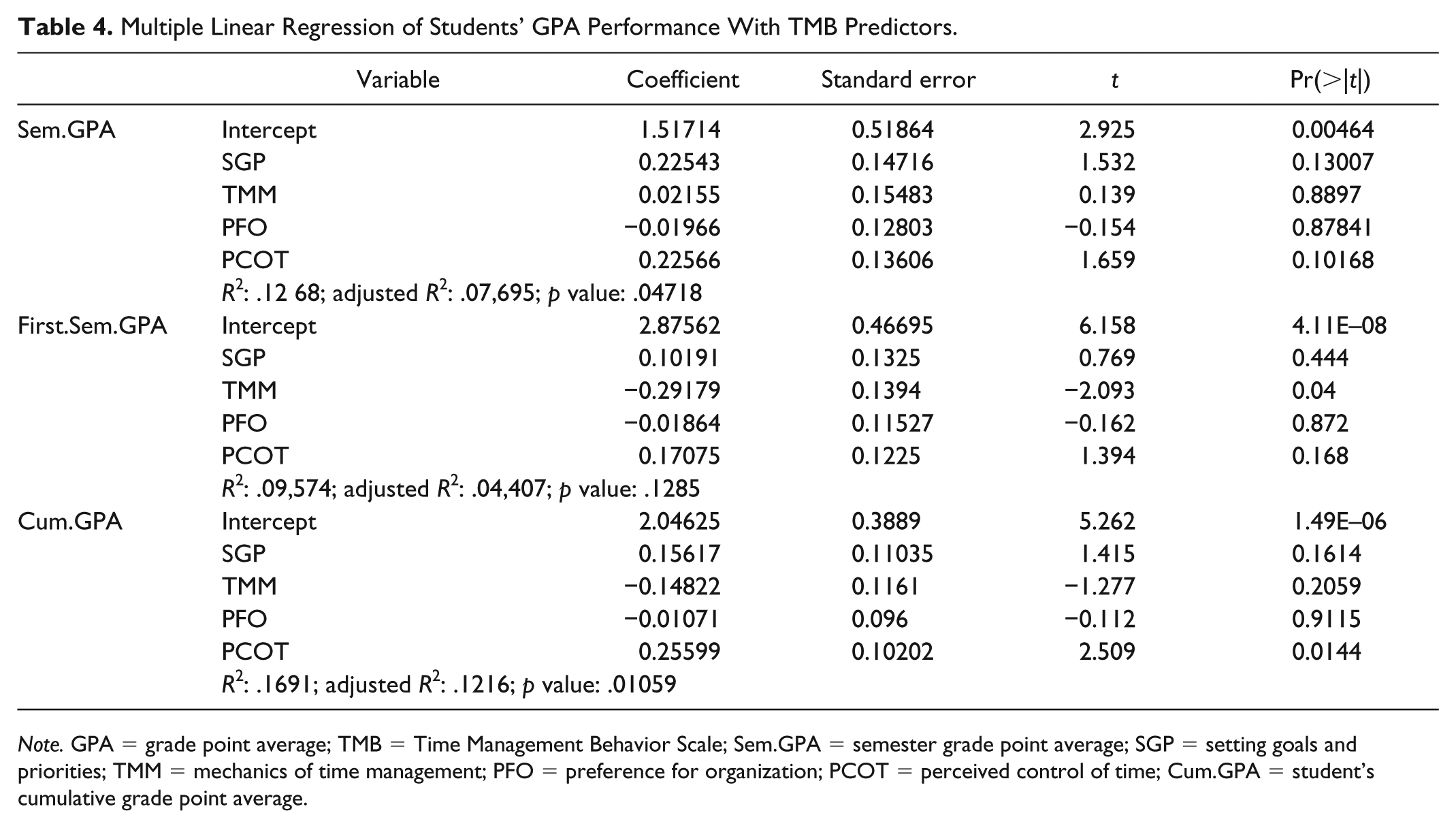
Note. GPA = grade point average; TMB = Time Management Behavior Scale; Sem.GPA = semester grade point average; SGP = setting goals and priorities; TMM = mechanics of time management; PFO = preference for organization; PCOT = perceived control of time; Cum.GPA = student’s cumulative grade point average.
Model Reduction and Performance
The lack of significance in some of the factors and the correlations among factors make model reduction a suitable option. Using regsubsets function of the “leaps” package in R, we determine the models which, having different subsets of the TMB factors, would provide the largest adjusted coefficient of determination (i.e.,
Ranking of Cum.GPA and Sem.GPA Models in Terms of Adjusted
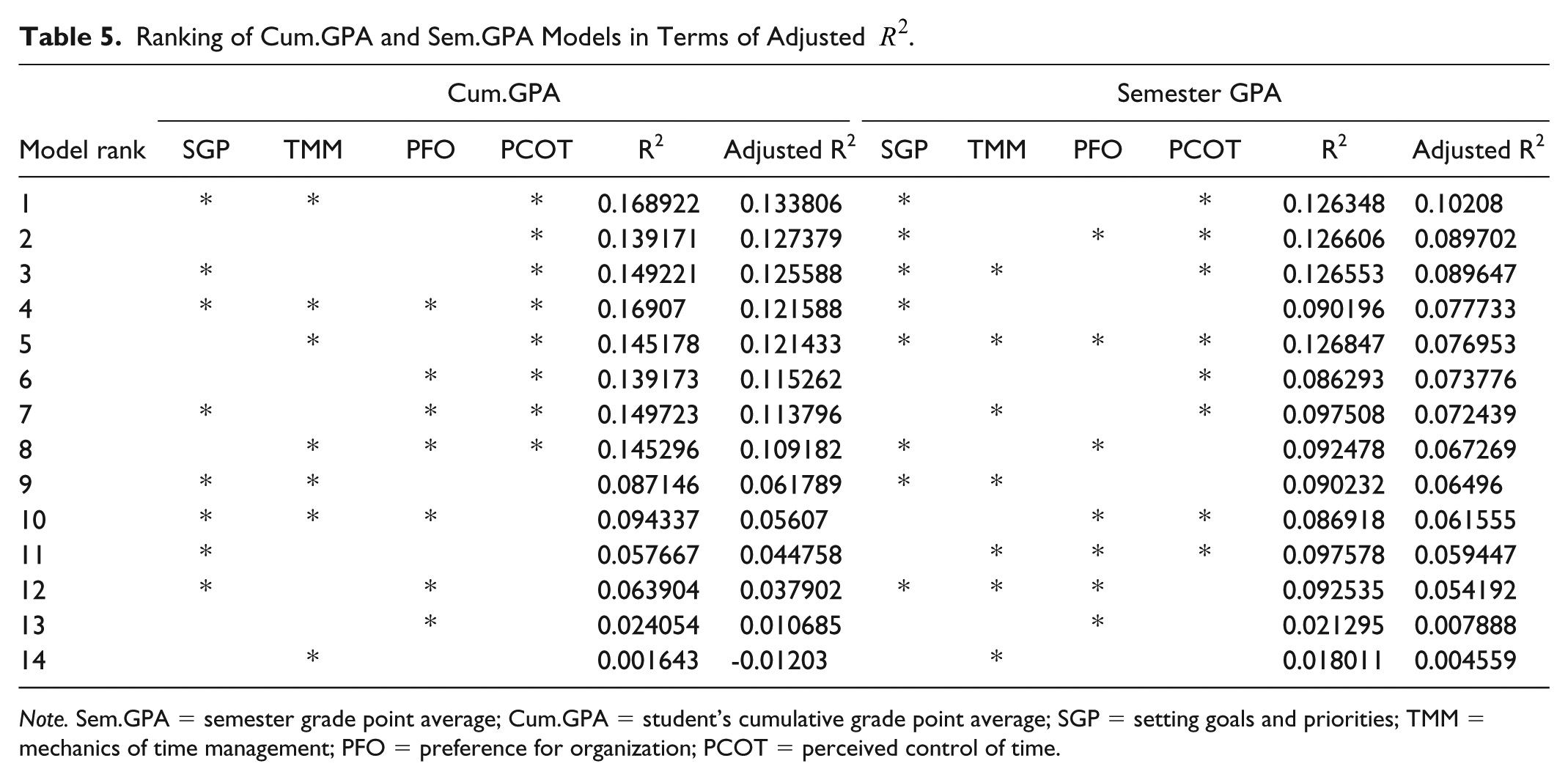
Note. Sem.GPA = semester grade point average; Cum.GPA = student’s cumulative grade point average; SGP = setting goals and priorities; TMM = mechanics of time management; PFO = preference for organization; PCOT = perceived control of time.
To test the performance of the models to predict the cumulative GPA based solely on the TMB factors, we adopt a cross-validation method whereby 10 randomly selected 80% to 20% splits of the data set are used. The 80% portion constitutes the training set for each iteration and is used to determine the model coefficients. The 20% portion of the split data set constitutes the test set and is used to predict the cumulative GPA using the model drawn from the training set. The correlation is then calculated between the model predicted GPA and the actual GPA for the test set. The results are shown in Table 6.
Correlation Accuracy of Cum.GPA and Sem.GPA Reduce Models Through Cross-Validation.

Note. SGP = setting goals and priorities; TMM = mechanics of time management; PCOT = perceived control of time.
Individual Question Analysis
The TMB scores examined were based on the categories SGP, TMM, PFO, and PCOT. These category scores were the average of the scores for the individual questions belonging to that category. For a deeper view of the data we identify those questions for which students scored poorly (i.e., below 2.5). These individual questions highlight specific challenges students faced and would have been masked by the overall category score. These questions are shown in Table 7.
Individual Question Analysis.

Note. SGP = setting goals and priorities; TMM = mechanics of time management; PCOT = perceived control of time.
Comparison of GPA Performance by TMB Behavior
We attempt to determine whether students whose TMB scores are greater than the mean TMB score have a higher cumulative GPA (on average) than their counterparts with a lower TMB score. The results are shown in Table 8. For SGP and PCOT, there is a significant difference in the mean cumulative GPA, whereas for TMM and PFO, there is no significant difference.
Average GPA Performance by TMB Score.

Note. Cum.GPA = student’s cumulative grade point average; SGP = setting goals and priorities; TMM = mechanics of time management; PFO = preference for organization; PCOT = perceived control of time.
Discussion
The first research question explored the aspects of time management that participants practice. It was found that the average overall scores for participants’ likelihood for SGP and for them having a PFO were greater than 3.0. This suggests that students are likely to set themselves goals and would like to be organized but it does not mean that they will follow through on such preferences. The score in relation to participants understanding the TMM was less than 2.4 and the score in regard to their PCOT was somewhat greater than 2.5 (see Table 2). This implies that, in general, students were more inclined to goal and priority setting and that they do have a PFO but are less inclined to use actual time management techniques. Such a position may be the result of approaches to learning that have been developed over a period of time but Kelly (2002) found that effective time usage involves positive work habits and this would suggest that without effective learning strategies students are unlikely to develop effective time management practices. This is an interesting twist—where students would like to be organized but don’t seem to have any strategies to help them do so. This observation holds true regardless of gender, age bracket, entry qualification, and time in the program.
In Table 7, we identified those individual questions for which students scored poorly (on average). The data suggest that students have trouble with both the TMM and that they do not perceive that they have much control over their time. Could it be that if students were to more explicitly and consistently engaged with activities that help them plan and keep track of their time such as keeping a log of activities, reviewing daily activities, and keeping an appointment book, then they might feel more in control of their time and more able to estimate the time needed to accomplish tasks?
With regard to the second research question on whether students who self-identify with specific time management behaviors achieve better grades in the program, Table 8 indicates that students who scored higher than the average in regard to both SGP and their PCOT score did, on average, have a significantly greater cumulative GPA (with PCOT making the more significant difference). These findings support previous work by Kearns and Gardiner (2007), McKenzie and Gow (2004), and Trueman and Hartley (1996). The question here is whether these time management behaviors lead to an improvement in cumulative GPA or whether “good” students are better at organizing their time.
For the third research question, examining which time management behaviors are more strongly associated with higher grades within the program, we consider Table 3. Based on the correlation results, it was found that students’ ability to set goals and prioritize activities alongside their PCOT were the time management behaviors that had the most significant positive correlation with Semester GPA and cumulative GPA (see also Law et al., 2009, who suggest that such results are typical of Engineering students). By regression analysis and model reduction, the optimal model for Semester GPA was the one with SGP and PCOT as predictors, and for cumulative GPA, the TMM was also included. However, these optimal models, at best, only account for less than 14% of the variability in GPA meaning that these time management factors are not strongly predictive of GPA performance (as can be seen in Table 4 and Table 5) and that there are other factors affecting student performance that are yet to be discovered. Nevertheless, time management behaviors do seem to have some influence. Given that students had reasonable scores in relation to SGP but low scores in relation to the TMM and their PCOT, focus should be given to the latter two factors so as to support students refine their approach to goal setting and help them realize these goals through the practices of useful time management techniques such as scheduling and tracking of activities. While it is clear that there is a correlation between certain time management behaviors and GPA, further long-term investigation is needed to determine the direction of the causal relationship between good grades and good time management behaviors.
Conclusion
In this article, we provided a systematic approach that isolates the time management behaviors of undergraduate engineering students that impact their academic performance. This approach also allowed us to determine the extent to which these behaviors impact such performance, thereby providing us more focused guidance as to what possible interventions may be effective in helping students achieve better academic performance together with a greater sense of well-being in the program. This study adds confirmatory evidence to the existing research literature that how students perceive their control of time correlates positively with academic performance, and finds that this transcends gender, age, entry qualifications, and even the number of semesters already in the degree program.
From this particular data set, we have inferred that students are very inclined to SGP but may not have the tactical time management skills to realize these goals and priorities efficiently. Also students find themselves procrastinating on tasks they do not like but must be done. It was found that although time management behaviors seemed to influence academic performance, they only accounted for a small percentage of the variability of the cumulative GPA, implying that there are other factors, such as study skills, problem solving, socioeconomics, and personality, that need to be explored.
Our results contribute to the understanding of students’ time management behaviors in relation to their academic performance. This research was undertaken with student within a department of Electrical and Computer Engineering and further research is needed to establish its generalizability to other disciplines and contexts. In establishing a clear link between students’ time management behaviors and GPA, this study helps to identify a potential barrier to student success and offers justification for practical interventions in this area. Furthermore, in shinning a light on the significance of one nonacademic factor, this study also suggests that other such factors may also impact students’ chances of attaining success in higher education and therefore deserve investigation.
Footnotes
Acknowledgements
We thank Dr. Cathy-Ann Radix for her assistance in writing the proposal for this project and in the initial data-collection phase.
Declaration of Conflicting Interests
The author(s) declared no potential conflicts of interest with respect to the research, authorship, and/or publication of this article.
Funding
The author(s) received no financial support for the research, authorship, and/or publication of this article.
